

EN 1434-3:2008
(Main)Heat Meters - Part 3: Data exchange and interfaces
General Information
- Abstract
This European Standard applies to heat meters, that is to instruments intended for measuring the heat which, in a heat-exchange circuit, is absorbed or given up by a liquid called the energy-conveying liquid. The meter indicates heat in legal units.
Electrical safety requirements are not covered by this standard.
Part 3 specifies the data exchange between a meter and a readout device (POINT / POINT communication). For these applications using the optical readout head, the EN 62056-21 protocol is recommended.
For direct or remote local readout of a single or a few meters via a battery driven readout device, the physical layer of EN 13757-6 (local bus) is recommended.
For bigger networks with up to 250 meters, a master unit with AC mains supply according to EN 13757-2 is necessary to control the M-Bus. For these applications the physical and link layer of EN 13757-2 and the application layer of EN 13757-3 is required.
For wireless meter communications, EN 13757-4 describes several alternatives of walk/drive-by readout via a mobile station or by using stationary receivers or a network. Both unidirectionally and bidirectionally transmitting meters are supported by this standard.
- Status
- Withdrawn
- Publication Date
- 14-Oct-2008
- Withdrawal Date
- 29-Sep-2026
- Technical Committee
- CEN/TC 294 - Communication systems for meters and remote reading of meters
- Drafting Committee
- CEN/TC 294/WG 4 - Data exchange for meters on bus-systems and interface
- Current Stage
- 9960 - Withdrawal effective - Withdrawal
- Start Date
- 02-Dec-2015
- Completion Date
- 30-Sep-2026

Relations
- Effective Date
- 22-Dec-2008
- Effective Date
- 08-Jun-2022
- Effective Date
- 09-Feb-2026
- Effective Date
- 28-Jan-2026
- Effective Date
- 28-Jan-2026
- Effective Date
- 28-Jan-2026
- Effective Date
- 28-Jan-2026
- Effective Date
- 28-Jan-2026
- Effective Date
- 28-Jan-2026
- Effective Date
- 28-Jan-2026
Get Certified
Connect with accredited certification bodies for this standard

BSMI (Bureau of Standards, Metrology and Inspection)
Taiwan's standards and inspection authority.
Sponsored listings
Frequently Asked Questions
EN 1434-3:2008 is a standard published by the European Committee for Standardization (CEN). Its full title is "Heat Meters - Part 3: Data exchange and interfaces". This standard covers: This European Standard applies to heat meters, that is to instruments intended for measuring the heat which, in a heat-exchange circuit, is absorbed or given up by a liquid called the energy-conveying liquid. The meter indicates heat in legal units. Electrical safety requirements are not covered by this standard. Part 3 specifies the data exchange between a meter and a readout device (POINT / POINT communication). For these applications using the optical readout head, the EN 62056-21 protocol is recommended. For direct or remote local readout of a single or a few meters via a battery driven readout device, the physical layer of EN 13757-6 (local bus) is recommended. For bigger networks with up to 250 meters, a master unit with AC mains supply according to EN 13757-2 is necessary to control the M-Bus. For these applications the physical and link layer of EN 13757-2 and the application layer of EN 13757-3 is required. For wireless meter communications, EN 13757-4 describes several alternatives of walk/drive-by readout via a mobile station or by using stationary receivers or a network. Both unidirectionally and bidirectionally transmitting meters are supported by this standard.
This European Standard applies to heat meters, that is to instruments intended for measuring the heat which, in a heat-exchange circuit, is absorbed or given up by a liquid called the energy-conveying liquid. The meter indicates heat in legal units. Electrical safety requirements are not covered by this standard. Part 3 specifies the data exchange between a meter and a readout device (POINT / POINT communication). For these applications using the optical readout head, the EN 62056-21 protocol is recommended. For direct or remote local readout of a single or a few meters via a battery driven readout device, the physical layer of EN 13757-6 (local bus) is recommended. For bigger networks with up to 250 meters, a master unit with AC mains supply according to EN 13757-2 is necessary to control the M-Bus. For these applications the physical and link layer of EN 13757-2 and the application layer of EN 13757-3 is required. For wireless meter communications, EN 13757-4 describes several alternatives of walk/drive-by readout via a mobile station or by using stationary receivers or a network. Both unidirectionally and bidirectionally transmitting meters are supported by this standard.
EN 1434-3:2008 is classified under the following ICS (International Classification for Standards) categories: 17.200.10 - Heat. Calorimetry. The ICS classification helps identify the subject area and facilitates finding related standards.
EN 1434-3:2008 has the following relationships with other standards: It is inter standard links to EN 1434-3:1997, EN 1434-3:2015, EN 62056-21:2002, EN 13757-6:2015, EN 13757-4:2005, EN 13757-1:2021, EN 13757-5:2015, EN 13757-3:2004, EN 13757-2:2004, CEN/TR 15760:2010. Understanding these relationships helps ensure you are using the most current and applicable version of the standard.
EN 1434-3:2008 is available in PDF format for immediate download after purchase. The document can be added to your cart and obtained through the secure checkout process. Digital delivery ensures instant access to the complete standard document.
Standards Content (Sample)
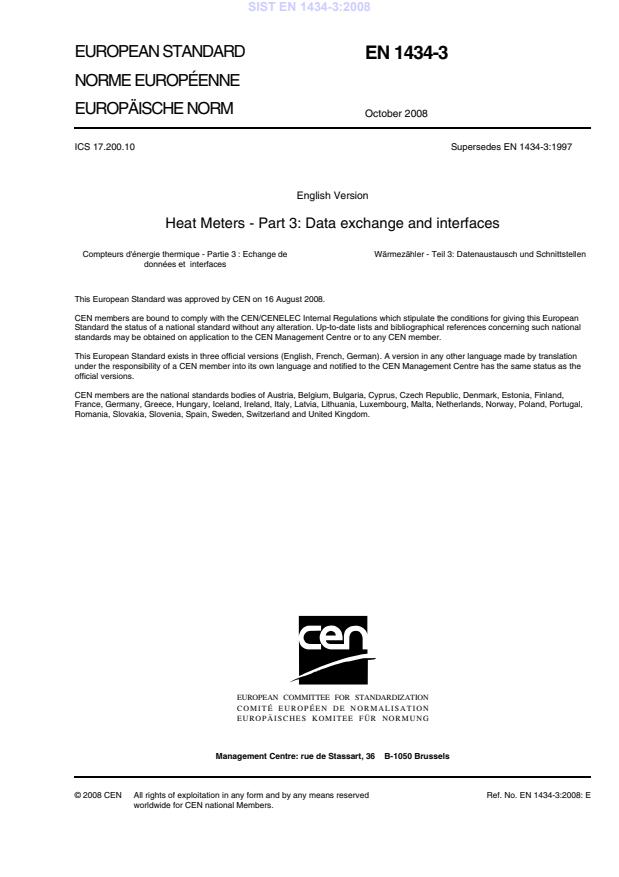
2003-01.Slovenski inštitut za standardizacijo. Razmnoževanje celote ali delov tega standarda ni dovoljeno.Toplotni števci - 3. del: Izmenjava podatkov in vmesnikiWärmezähler - Teil 3: Datenaustausch und SchnittstellenCompteurs d'énergie thermique - Partie 3 : Echange de données et interfacesHeat Meters - Part 3: Data exchange and interfaces17.200.10Toplota. KalorimetrijaHeat. CalorimetryICS:Ta slovenski standard je istoveten z:EN 1434-3:2008SIST EN 1434-3:2008en01-december-2008SIST EN 1434-3:2008SLOVENSKI
STANDARDSIST EN 1434-3:19971DGRPHãþD
EUROPEAN STANDARDNORME EUROPÉENNEEUROPÄISCHE NORMEN 1434-3October 2008ICS 17.200.10Supersedes EN 1434-3:1997
English VersionHeat Meters - Part 3: Data exchange and interfacesCompteurs d'énergie thermique - Partie 3 : Echange dedonnées et
interfacesWärmezähler - Teil 3: Datenaustausch und SchnittstellenThis European Standard was approved by CEN on 16 August 2008.CEN members are bound to comply with the CEN/CENELEC Internal Regulations which stipulate the conditions for giving this EuropeanStandard the status of a national standard without any alteration. Up-to-date lists and bibliographical references concerning such nationalstandards may be obtained on application to the CEN Management Centre or to any CEN member.This European Standard exists in three official versions (English, French, German). A version in any other language made by translationunder the responsibility of a CEN member into its own language and notified to the CEN Management Centre has the same status as theofficial versions.CEN members are the national standards bodies of Austria, Belgium, Bulgaria, Cyprus, Czech Republic, Denmark, Estonia, Finland,France, Germany, Greece, Hungary, Iceland, Ireland, Italy, Latvia, Lithuania, Luxembourg, Malta, Netherlands, Norway, Poland, Portugal,Romania, Slovakia, Slovenia, Spain, Sweden, Switzerland and United Kingdom.EUROPEAN COMMITTEE FOR STANDARDIZATIONCOMITÉ EUROPÉEN DE NORMALISATIONEUROPÄISCHES KOMITEE FÜR NORMUNGManagement Centre: rue de Stassart, 36
B-1050 Brussels© 2008 CENAll rights of exploitation in any form and by any means reservedworldwide for CEN national Members.Ref. No. EN 1434-3:2008: ESIST EN 1434-3:2008
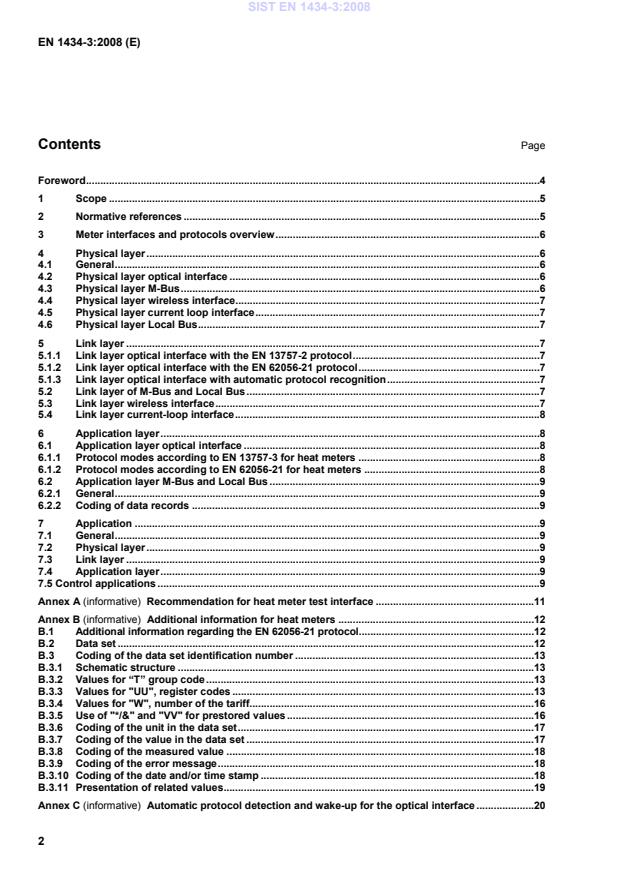
Recommendation for heat meter test interface.11 Annex B (informative)
Additional information for heat meters.12 B.1 Additional information regarding the EN 62056-21 protocol.12 B.2 Data set.12 B.3 Coding of the data set identification number.13 B.3.1 Schematic structure.13 B.3.2 Values for “T” group code.13 B.3.3 Values for "UU", register codes.13 B.3.4 Values for "W", number of the tariff.16 B.3.5 Use of "*/&" and "VV" for prestored values.16 B.3.6 Coding of the unit in the data set.17 B.3.7 Coding of the value in the data set.17 B.3.8 Coding of the measured value.18 B.3.9 Coding of the error message.18 B.3.10 Coding of the date and/or time stamp.18 B.3.11 Presentation of related values.19 Annex C (informative)
Automatic protocol detection and wake-up for the optical interface.20 SIST EN 1434-3:2008
Usage of heat meters in control applications.22 D.1 Heat meter.22 D.1.1 General.22 D.1.2 Application layer: data records.22 D.1.3 Application: actuality of the data.22 D.1.4 Application layer: acceptable data types (DIFs).23 D.1.5 Application layer: acceptable units (VIFs).23 D.2 Controller.23 D.2.1 Start until first answer.23 D.2.2 Start until first successful readout.24 Annex E (informative)
Protection techniques for M-Bus meters against surge/lightning.25 Annex F (informative)
Additional information about the master-unit for the M-Bus.30 F.1 Master side interface to the M-Bus.30 F.2 Master side interface for local data read out.30 F.3 Full size level converter.31 Bibliography.33
For wireless meter communications, EN 13757-4 describes several alternatives of walk/drive-by readout via a mobile station or by using stationary receivers or a network. Both unidirectionally and bidirectionally transmitting meters are supported by this standard.
2 Normative references The following referenced documents are indispensable for the application of this document. For dated references, only the edition cited applies. For undated references, the latest edition of the referenced document (including any amendments) applies. EN 13757-1, Communication system for meters and remote reading of meters — Part 1: Data exchange EN 13757-2:2004, Communication systems for and remote reading of meters — Part 2: Physical and link layer EN 13757-3:2004, Communication systems for and remote reading of meters — Part 3: Dedicated application layer EN 13757-4:2005, Communication systems for meters and remote reading of meters — Part 4: Wireless meter readout (Radio meter reading for operation in the 868 MHz to 870 MHz SRD band) EN 13757-5, Communication systems for meters and remote reading of meters — Part 5: Wireless relaying EN 13757-6, Communication systems for meters and remote reading of meters — Part 6: Local Bus
EN 62056-21:2002, Electricity metering — Data exchange for meter reading, tariff and load control — Part 21: Direct local data exchange (IEC 62056-21:2002) SIST EN 1434-3:2008
Hardware interface type Recommended standard Alternative standards Optical EN 62056-21:2002, 3.2 EN 13757-2
EN 62056-21:2002, Subclause 4.1 M-Bus
EN 13757-2
No alternative
Wireless Modes S or T of EN 13757-4:2005 Mode R2 of EN 13757-4:2005
Relaying EN 13757-5 Current loop EN 62056-21:2002, 3.1 No alternative Local Bus EN 13757-6
No alternative Application layer (All interfaces) EN 13757-3 EN 13757-1 4 Physical layer 4.1 General A meter can have either none or a number of interfaces to communicate with the outside world. If a meter has an interface in accordance with this standard, it shall fulfil at least one of the following requirements for the physical layer. 4.2 Physical layer optical interface The optical interface is used for local data readout. A hand held unit, equipped with an optical readout head, is temporarily connected to one heat meter and the data is read out, one heat meter at a time. The physical properties of the optical interface are defined in EN 62056-21.
4.3 Physical layer M-Bus
The physical layer of the M-Bus is described in EN 13757-2. It can be used for "point to point" or for "multi-point" communication in bus systems. If a heat meter presents more than one unit load to the bus, the number of unit loads has to be shown on the meter documentation as “xUL” where x is the number of unit loads. Only integer values are allowed. Especially in extended installation, meters with an M-Bus interface might need additional protection against surge and lightning. Annex E shows various techniques for either constructing meters with an M-bus interface and integrated enhanced protection elements. In addition it shows how to construct external protection elements for meters with a standard (unprotected) M-Bus interface. Two variants are given: one (preferred) for situation where a ground connection is available and a variant with weaker protection if no ground connection is available. An enhanced version of the protection additionally protects the meter and its interface from destruction if mains power is connected to the M-Bus terminals of the meter. If the readout frequency of the meter is limited either by software or by the battery capacity, the meter documentation shall signal the readout frequency as “x per day”, “y per h” or “z per min” where x, y or z are the number of readouts within the corresponding period allowed by the software without impairing the battery lifetime. Heat meters with unlimited readout frequency do not need such information. SIST EN 1434-3:2008
The basic rules of the protocol are defined in EN 62056-21. Annex B of that document deals with battery operated devices (i.e. some heat meters). The manufacturer ID (identification) mentioned in EN 62056-21 (three upper case letters) is used for heat meters using this protocol in the same manner. For heat meter manufacturers using the data transmission protocol of EN 13757-3, the EN 62056-21 ID is also used to calculate the ID number described in Clause 6 of this standard. The formula stated in 6.6.1 shall be used (see also Annex B). EN 62056-21 describes various modes of operation. All main modes "A", "B", "C" and "D" are allowed for heat meters. 6.1.2.2 Restrictions for heat meters The EN 62056-21 protocol shall be used with some restrictions. In some cases, EN 62056-21 offers more than one possibility to perform the communication. For communication with heat meters, only the selection described in the following subclauses shall be used. The selection is consistent with EN 62056-21.
6.1.2.3 Calculation of block check character The calculation of the block check character shall always be used for the data message sent from the heat meter to the readout device. 6.1.2.4 Syntax diagram The syntax described in EN 62056-21:2002, 5.5 shall be used for heat meters as follows: the wake-up message can be sent from the hand held unit to the heat meter to activate the com-munication facilities in the heat meter; the data message for heat meters shall start with the STX character and end with the ETX and BCC sequence; the data block consists of one or more data lines; each data line may contain up to 78 characters and ends with a CR and LF. SIST EN 1434-3:2008
7.3 Link layer A heat meter shall support both the primary and the secondary addressing via the link layer. The application shall support the assignment of primary addresses via the M-Bus. All application layer command for managing the secondary addressing mode (including the functions of extended secondary addressing) shall be supported. All application layer commands for managing the secondary address shall be supported. When the user is able to change the secondary address of the meter, the commands for the extended secondary addressing mode shall be supported as well. 7.4 Application layer All readout telegrams shall contain at least the standard header with the meter-ID. The minimum variable data element list shall contain the actual accumulated energy. The default unit shall be the unit on the meter display. The minimum resolution of the accumulated energy shall be the same as on the meter display. The minimum value actuality shall be 15 min. The minimum readout frequency is the readout of up to 250 meters in a segment once per day.
7.5 Control applications Meter suitable for control applications shall fulfil, in addition to the minimum requirements of 7.4, the requirements of Annex D. The suitability of a heat meter with M-Bus interface for such applications may only SIST EN 1434-3:2008
Recommendation for heat meter test interface Modern heat meters are mainly equipped with CMOS microprocessors with a very low power consumption, allowing battery operation. Testing and adjusting of this type of meters needs a completely different approach. Until now, almost every meter type needed its own test equipment to handle the manufacturer's
...