

EN 12932:2008
(Main)Chemicals used for treatment of water intended for human consumption - Chemicals for emergency use - Sodium dichloroisocyanurate, dihydrate
- Abstract
This European Standard is applicable to sodium dichloroisocyanurate dihydrate used for emergency treatment of water intended for human consumption. It describes the characteristics of sodium dichloroisocyanurate dihydrate and specifies the requirements and the corresponding test methods for sodium dichloroisocyanurate dihydrate. It gives information on its use in water treatment. It also determines the rules relating to safe handling and use of sodium dichloroisocyanurate dihydrate (see Annex B).
- Status
- Withdrawn
- Publication Date
- 29-Jul-2008
- Withdrawal Date
- 29-Sep-2026
- Technical Committee
- CEN/TC 164 - Water supply
- Drafting Committee
- CEN/TC 164/WG 9 - Drinking water treatment
- Current Stage
- 9960 - Withdrawal effective - Withdrawal
- Start Date
- 25-Mar-2015
- Completion Date
- 30-Sep-2026

Relations
- Effective Date
- 15-Aug-2009
- Effective Date
- 03-Jul-2013
- Effective Date
- 25-Aug-2026
- Effective Date
- 25-Aug-2026
- Effective Date
- 25-Aug-2026
- Effective Date
- 09-Feb-2026
- Refers
EN 1233:1996 - Water quality - Determination of chromium - Atomic absorption spectrometric methods - Effective Date
- 28-Jan-2026
- Effective Date
- 28-Jan-2026
- Effective Date
- 28-Jan-2026
- Effective Date
- 28-Jan-2026
- Effective Date
- 28-Jan-2026
- Effective Date
- 28-Jan-2026
- Effective Date
- 28-Jan-2026
Get Certified
Connect with accredited certification bodies for this standard

ECOCERT
Organic and sustainability certification.

Eurofins Food Testing Global
Global leader in food, environment, and pharmaceutical product testing.

Intertek Bangladesh
Intertek certification and testing services in Bangladesh.
Sponsored listings
Frequently Asked Questions
EN 12932:2008 is a standard published by the European Committee for Standardization (CEN). Its full title is "Chemicals used for treatment of water intended for human consumption - Chemicals for emergency use - Sodium dichloroisocyanurate, dihydrate". This standard covers: This European Standard is applicable to sodium dichloroisocyanurate dihydrate used for emergency treatment of water intended for human consumption. It describes the characteristics of sodium dichloroisocyanurate dihydrate and specifies the requirements and the corresponding test methods for sodium dichloroisocyanurate dihydrate. It gives information on its use in water treatment. It also determines the rules relating to safe handling and use of sodium dichloroisocyanurate dihydrate (see Annex B).
This European Standard is applicable to sodium dichloroisocyanurate dihydrate used for emergency treatment of water intended for human consumption. It describes the characteristics of sodium dichloroisocyanurate dihydrate and specifies the requirements and the corresponding test methods for sodium dichloroisocyanurate dihydrate. It gives information on its use in water treatment. It also determines the rules relating to safe handling and use of sodium dichloroisocyanurate dihydrate (see Annex B).
EN 12932:2008 is classified under the following ICS (International Classification for Standards) categories: 71.100.80 - Chemicals for purification of water. The ICS classification helps identify the subject area and facilitates finding related standards.
EN 12932:2008 has the following relationships with other standards: It is inter standard links to EN 12932:2000, EN 12932:2015, ISO 8288:1986, ISO 3165:1976, ISO 6206:1979, ISO 8213:1986, EN 1233:1996, EN ISO 12846:2012, EN ISO 3696:1995, EN 13631-14:2003, EN 1998-6:2005, EN ISO 8751:1997, EN 15073:2013. Understanding these relationships helps ensure you are using the most current and applicable version of the standard.
EN 12932:2008 is available in PDF format for immediate download after purchase. The document can be added to your cart and obtained through the secure checkout process. Digital delivery ensures instant access to the complete standard document.
Standards Content (Sample)
2003-01.Slovenski inštitut za standardizacijo. Razmnoževanje celote ali delov tega standarda ni dovoljeno.Kemikalije, ki se uporabljajo za pripravo pitne vode - Kemikalije za uporabo v sili - Natrijev dikloroizociaourat, dehidriranProdukte zur Aufbereitung von Wasser für den menschlichen Gebrauch - Produkte für den Notfall - Natriumdichlorisocyanurat-dihydratProduits chimiques pour le traitement de l'eau destinée à la consommation humaine - Produits chimiques utilisés en cas d'urgence - Dichloroisocyanurate de sodium, dihydratéChemicals used for treatment of water intended for human consumption - Chemicals for emergency use - Sodium dichloroisocyanurate, dihydrate71.100.80Chemicals for purification of water13.060.20Pitna vodaDrinking waterICS:Ta slovenski standard je istoveten z:EN 12932:2008SIST EN 12932:2008en,fr,de01-november-2008SIST EN 12932:2008SLOVENSKI
STANDARDSIST EN 12932:20001DGRPHãþD
EUROPEAN STANDARDNORME EUROPÉENNEEUROPÄISCHE NORMEN 12932July 2008ICS 71.100.80Supersedes EN 12932:2000
English VersionChemicals used for treatment of water intended for humanconsumption - Chemicals for emergency use - Sodiumdichloroisocyanurate, dihydrateProduits chimiques pour le traitement de l'eau destinée à laconsommation humaine - Produits chimiques utilisés encas d'urgence - Dichloroisocyanurate de sodium, dihydratéProdukte zur Aufbereitung von Wasser für denmenschlichen Gebrauch - Produkte für den Notfall -Natriumdichlorisocyanurat-dihydratThis European Standard was approved by CEN on 28 June 2008.CEN members are bound to comply with the CEN/CENELEC Internal Regulations which stipulate the conditions for giving this EuropeanStandard the status of a national standard without any alteration. Up-to-date lists and bibliographical references concerning such nationalstandards may be obtained on application to the CEN Management Centre or to any CEN member.This European Standard exists in three official versions (English, French, German). A version in any other language made by translationunder the responsibility of a CEN member into its own language and notified to the CEN Management Centre has the same status as theofficial versions.CEN members are the national standards bodies of Austria, Belgium, Bulgaria, Cyprus, Czech Republic, Denmark, Estonia, Finland,France, Germany, Greece, Hungary, Iceland, Ireland, Italy, Latvia, Lithuania, Luxembourg, Malta, Netherlands, Norway, Poland, Portugal,Romania, Slovakia, Slovenia, Spain, Sweden, Switzerland and United Kingdom.EUROPEAN COMMITTEE FOR STANDARDIZATIONCOMITÉ EUROPÉEN DE NORMALISATIONEUROPÄISCHES KOMITEE FÜR NORMUNGManagement Centre: rue de Stassart, 36
B-1050 Brussels© 2008 CENAll rights of exploitation in any form and by any means reservedworldwide for CEN national Members.Ref. No. EN 12932:2008: ESIST EN 12932:2008
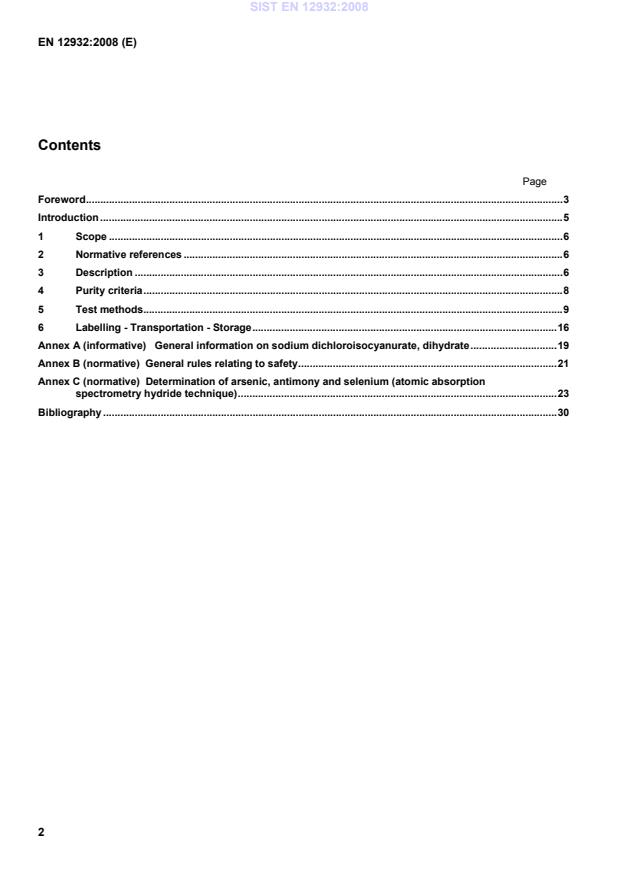
General information on sodium dichloroisocyanurate, dihydrate.19 Annex B (normative)
General rules relating to safety.21 Annex C (normative)
Determination of arsenic, antimony and selenium (atomic absorption spectrometry hydride technique).23 Bibliography.30
Deletion of reference to EU Directive 80/778/EEC of July 15, 1980 in order to take into account the latest Directive in force (see [1]). Other amendments: a) section 3.1.2 – addition of “Troclosene sodium, dihydrate” as a synonym; b) section 4.3 – inclusion of the maximum admissible water content {14%}; c) section 5.2: 1) inclusion of section 5.2.2.1 Water; 2) change numbering of following section to
5.2.2.2 Sodium chloride; d) section 6.1 – inclusion of big bags as permitted means of delivery; e) section 6.2 – updating of risk and safety labelling according to EU directives (Annex I of the Directive 67/548EEC and its latest Adaptations to Technical Progress); 1) correction of hazard symbols {“N : Dangerous for the environment” instead of “O : Oxidizing”} 2) addition of R phrase: R 50/53: Very toxic to aquatic organisms, may cause long-term adverse effects in the aquatic environment. 3) addition of S phrases: S2: Keep out of the reach of children. S 60: This material and its container must be disposed of as hazardous waste. S 61: Avoid release to the environment. Refer to special instructions/safety data sheets. f) section 6.3 : SIST EN 12932:2008
1) Chemical Abstracts Service Registry Number. 2) European Inventory of Existing Commercial Chemical Substances. 3) 100 kPa = 1 bar SIST EN 12932:2008
Users of this product should check the national regulations in order to clarify whether it is of appropriate purity for treatment of water intended for human consumption, taking into account raw water quality, required dosage, contents of other impurities and additives used in the product not stated in this product standard. Limits have been given for impurities and chemical parameters where these are likely to be present in significant quantities from the current production process and raw materials. If the production process or raw materials lead to significant quantities of impurities, by-products or additives being present, this shall be notified to the user. 4.2 Composition of commercial product The product shall contain at least a mass fraction of 55 % of available chlorine as calculated in accordance with the corresponding method given in 5.2.1. 4.3 Impurities and main by-products The water content shall be less than a mass fraction of 14 % of the product. SIST EN 12932:2008
Limit mg/kg of product Element Type 1 Type 2 Arsenic (As) max. 10 10 Cadmium (Cd) max. 1 1 Chromium (Cr) max. 6 10 Mercury (Hg) max. 0,02 0,02 Nickel (Ni) max. 3 3 Lead (Pb) max. 4 4 Antimony (Sb) max. 5 5 Selenium (Se) max. 1 1 NOTE Cyanide, which does not exist in a strong oxidizing medium such as sodium dichloroisocyanurate, dihydrate, is not a relevant chemical parameter. Pesticides and polycyclic aromatic hydrocarbons are not by-products of the manufacturing process. For parametric values of sodium dichloroisocyanurate on trace metal content in drinking water, see [1]. 5 Test methods 5.1 Sampling Observe the general recommendations of ISO 3165 and take account of ISO 6206. Prepare the laboratory sample(s) required by the relevant procedure described in ISO 8213. 5.2 Analysis 5.2.1 Determination of available chlorine (main product) 5.2.1.1 Principle The available chlorine is determined by measuring active chlorine in the sample. The oxidizing chlorine reacts with potassium iodide releasing iodine which is then titrated with sodium thiosulfate standard volumetric solution in the presence of starch indicator solution. 5.2.1.2 Reagents All reagents shall be of a recognized analytical grade and the water used shall conform to grade 3 in accordance with EN ISO 3696. 5.2.1.2.1 Potassium iodide crystals (KI). 5.2.1.2.2 Glacial acetic acid. SIST EN 12932:2008
Alternatively a standard volumetric solution can be prepared by the following procedure: Dissolve 24,8 g Na2S2O3 . 5 H2O in a 1 000 ml one-mark volumetric flask in about 0,75 l water. After the temperature has equalized make up to the mark with water and mix thoroughly.
To standardize :
Weigh, to the nearest 0,1 mg, 3,600 g (m)of dry potassium iodate. Dissolve in water in a 1 000 ml one-mark volumetric flask, make up to the mark with water and mix (standard reference solution c(1/6 KIO3) = 0,1 mol/l). Place 200 ml of water in a 500 ml stoppered conical flask, add (2 ± 0,5) g of potassium iodide and stir to dissolve. Then introduce,by means of a pipette, 10,0 ml of sodium thiosulfate solution for standardization, add (15 ± 1) ml of hydrochloric acid solution (diluted 1 + 1 by volume) and (5 ± 1) ml of starch solution (5.2.1.2.4). Titrate immediately with the potassium iodate standard reference solution until the appearance of a blue coloration persisting for at least 30 s occurs . Record the volume (V1) of iodate used.
The actual concentration, c, of the sodium thiosulfate standard volumetric solution (Na2S2O3.5H2O), expressed in moles per litre is given by the following equation:
VcV11c×=
(1) where
c1 is the concentration, expressed in moles per litre, of the potassium iodate standard reference solution [c(1/6 KIO3) = 0,1 mol/l];
V is the volume, in millilitres, of the sodium thiosulfate standard volumetric solution used for the standardization (V= 10 ml);
V1
is the volume, in millilitres, of potassium iodate standard reference solution used in the titration. 5.2.1.2.4 Starch solution, mass fraction1 % .
Make a slurry with (1 ± 0,1) g starch and (5 ± 1) ml water. Add (90 ± 5) ml boiling water to the slurry. Stir to dissolve it and cool the solution. This solution needs refrigeration to avoid the decomposition of the starch which results in a vague end point. Keep the solution cool and use it within one week. NOTE Commercial indicators for iodine titration exist and can be used in place of the specified starch solution provided that their efficiency has been previously tested. 5.2.1.3 Apparatus
5.2.1.3.1 Ordinary laboratory apparatus and glassware. 5.2.1.4 Procedure 5.2.1.4.1 Test portion Weigh, to the nearest 0,1 mg, 0,25 g of the laboratory sample (m0) into a tared stoppered weighing bottle. 5.2.1.4.2 Determination Transfer the test portion to a 200 ml volumetric flask. SIST EN 12932:2008
10021x−=1mmmw (3) where m1 is the mass, in grams, before drying; m2 is the mass, in grams, after drying. 5.2.2.2 Sodium chloride 5.2.2.2.1 General This method applies to products with sodium chloride content in the range of a mass fraction from 0 % to
0,05 %. 5.2.2.2.2 Principle The sodium dichloroisocyanurate dihydrate is acidified and then digested to remove all traces of available chlorine. Sodium is analysed in solution by atomic absorption spectrometry. 5.2.2.2.3 Reagents
All reagents shall be of a recognized analytical grade and the water used shall conform to grade 3 in accordance with EN ISO 3696. 5.2.2.2.3.1 Sulfuric acid concentrated, (H2SO4) mass fraction 95 % minimum. 5.2.2.2.3.2 Sodium standard stock solution, c (Na) = 1 000 µg/ml.
Weigh 2,542 1 g of sodium chloride that has been previously dried for 1 h at 110 °C. Dissolve with water and make up to the mark with water in a 1 000 ml one mark volumetric flask. Mix well. 5.2.2.2.4 Apparatus
Ordinary laboratory apparatus and glassware, together with the following: 5.2.2.2.4.1 Atomic absorption spectrometer equipped with sodium hollow cathode lamp; 5.2.2.2.4.2 Hot plates. 5.2.2.2.5 Procedure 5.2.2.2.5.1 Test portion Weigh, to the nearest 0,1 mg, 2,5 g of the laboratory sample (m3) into a tared stoppered weighing bottle. 5.2.2.2.5.2 Determination Transfer the test portion to a 250 ml beaker. Dilute with 25 ml of water. SIST EN 12932:2008
m3 is the mass, in grams, of the test portion; c is the concentration, in micrograms per millilitre, of sodium in the test portion as determined from the calibration graph. 5.2.2.2.7 Repeatability limit The absolute difference between two single test results, obtained under repeatability conditions, shall not be greater than the repeatability value, r, as calculated from the following equation:
r = 0,025 z (5) where z
is the mean of the two results, expressed in mass fraction in %. NOTE 1 A 98,3 % to 100,7 % recovery was obtained at Na content of mass fraction of 20 % . NOTE 2 Repeatability conditions are conditions where mutually independent test results are obtained with the same method on identical test material in the same laboratory by the same operator using the same equipment within short intervals of time. SIST EN 12932:2008
Expression of results From the interim result (y) determined (see 5.2.3.1.3.3), the content, C3, of each chemical parameter in the laboratory sample expressed in milligrams per kilogram of product is given by the following general equation: 143100CmVyC××= (6) SIST EN 12932:2008
EN 1483. 5.2.3.2.2 Reagents All reagents shall be of a recognized analytical grade and the water used shall conform to the grade 3 specified in EN ISO 3696. 5.2.3.2.2.1 Potassium permanganate solution, c(KMnO4) = 50 g/l. 5.2.3.2.2.2 Sulfuric acid, concentrated, density p = 1,84 g/ml. 5.2.3.2.2.3 Hydroxylammonium chloride, solution, c(NH2OH.HCl) = 100 g/l. 5.2.3.2.2.4 Potassium dichromate solution, c(K2Cr2O7) = 4 g/l in volume fraction 50 %
nitric acid solution. 5.2.3.2.3 Procedure 5.2.3.2.3.1 Test portion Weigh, to the nearest 0,01 g, 10 g (m5) of the
...