

EN 2856:2006
(Main)Aerospace series - Nuts, anchor, self-locking, fixed, closed corner, reduced series, with counterbore - Classification: 1 100 MPa/235 °C
General Information
- Abstract
This standard specifies requirements for closed corner, counterbored, fixed, reduced series anchor nuts, with a self-locking feature achieved by forming the upper portion out-of-round.
These nuts are intended for use in aircraft assemblies, in which the fasteners are mainly objected to shear loads. The counterbore is deep enough to accommodate a bolt shank in excess of assembly thickness, as well as the incomplete threads.
They are intended to be used with threaded parts of 1 100 MPa ) tensile strength classification.
The cadmium plating restricts the application to temperature not exceeding 235 °C.
- Status
- Published
- Publication Date
- 13-Jun-2006
- Withdrawal Date
- 30-Dec-2006
- Technical Committee
- ASD-STAN - Aerospace
- Drafting Committee
- ASD-STAN/D 3 - Mechanical
- Current Stage
- 9093 - Decision to confirm - Review Enquiry
- Start Date
- 31-May-2017
- Completion Date
- 30-Sep-2026

Overview
EN 2856:2006 is a European standard developed by CEN that specifies stringent requirements for aerospace-grade anchor nuts. These nuts are fixed, self-locking, with closed corners and a counterbore, belonging to a reduced series designed for demanding aircraft assembly applications. Classified for use with threaded parts rated at 1 100 MPa tensile strength and operating temperatures up to 235 °C, these nuts play a critical role in ensuring reliable fastening performance under shear load conditions common in aerospace structures.
The self-locking feature in this standard’s anchor nuts is achieved through an out-of-round deformation of the upper portion of the nut, enhancing vibration resistance and preventing loosening during operation. The nuts are cadmium-plated, restricting their use to temperature environments not exceeding 235 °C, balancing corrosion resistance with high mechanical performance.
Key Topics
Design and Dimensions: EN 2856:2006 references ISO 3222 for precise dimensional and form specifications of the nuts after cadmium plating and before lubrication with molybdenum disulfide (MoS2). The counterbore depth accommodates bolt shanks longer than the assembly thickness, including incomplete thread engagement.
Material and Surface Treatment: The nuts are manufactured from aerospace-grade steels complying with EN 2542 or EN 2543. Cadmium plating per EN 2133 is mandatory with a minimum thickness of 5 µm on threaded and critical contact surfaces to ensure corrosion protection. MoS2 lubrication per EN 2491 is required on threads and optional elsewhere to reduce friction during assembly.
Mechanical Properties: These nuts are suitable for threaded fasteners classified at 1 100 MPa tensile strength, optimized for shear load resistance in aircraft components.
Marking and Identification: Proper marking following EN 2424 ensures traceability. Each nut carries a unique designation code reflecting the thread size and EN standard number, essential for inventory and quality control in aerospace manufacturing.
Quality Assurance: Compliance with aerospace quality management is governed by EN 9100, enhancing confidence in product consistency and regulatory adherence.
Applications
EN 2856:2006 anchor nuts are specifically engineered for aerospace assemblies where fasteners experience predominantly shear loading rather than tension. Their key applications include:
Aircraft Structural Assemblies: Attachment of components where vibration and shear forces are significant, requiring secure, vibration-resistant fastening.
Landing Gear and Control Systems: Critical areas demanding reliable self-locking fasteners to maintain structural integrity under dynamic stresses.
Engine Mounts and Airframe Components: High-strength anchor nuts ensure durability and safety at elevated temperatures (up to 235 °C).
These nuts are selected to maintain fastener security, reduce maintenance requirements, and resist loosening from cyclic loads and vibration, vital in aerospace safety-critical applications.
Related Standards
EN 2856:2006 integrates closely with multiple international aerospace standards, enhancing interoperability and standardized production:
ISO 3222: Defines dimensional and form specifications for aerospace anchor nuts related to EN 2856.
ISO 5855-2 & ISO 5858: Cover limits for aerospace MJ threads and self-locking nuts procurement specifications.
EN 2133: Addresses cadmium plating for aerospace fasteners.
EN 2424: Specifies marking requirements of aerospace products for traceability.
EN 2491: Details molybdenum disulfide dry lubricant application methods to improve assembly performance.
EN 2542 / EN 2543: Describe material properties of steels used for prevailing torque nuts.
EN 9100: Aerospace quality management system ensures manufacturing and quality assurance processes meet stringent aerospace industry demands.
Summary
EN 2856:2006 represents a critical European aerospace standard targeting high-strength, self-locking anchor nuts designed for shear-loaded aircraft assemblies. By defining exacting requirements for nut geometry, material, plating, lubrication, and marking, the standard supports reliable and safe fastening solutions essential to aerospace manufacturing. Its integration with related ISO and EN standards provides manufacturers and engineers a comprehensive framework for producing consistent and certified nuts suitable for demanding aerospace environments. Keywords for optimized search include aerospace anchor nuts, self-locking nuts, cadmium plated fasteners, high-strength nuts 1100 MPa, aerospace standards EN 2856, and aircraft fastening components.
Relations
- Effective Date
- 25-Aug-2026
- Effective Date
- 25-Aug-2026
- Effective Date
- 25-Aug-2026
- Effective Date
- 25-Aug-2026
- Effective Date
- 28-Jan-2026
- Effective Date
- 28-Jan-2026
- Effective Date
- 28-Jan-2026
- Effective Date
- 28-Jan-2026
- Effective Date
- 28-Jan-2026
- Effective Date
- 28-Jan-2026
- Effective Date
- 28-Jan-2026
- Effective Date
- 28-Jan-2026
- Effective Date
- 28-Jan-2026
Get Certified
Connect with accredited certification bodies for this standard

BUREAU VERITAS Certification Germany
Bureau Veritas certification in Germany.

Element Materials Technology
Materials testing and product certification.

AQMS Ltd.
AQMS provides ISO certification to SMEs across the UK.
Sponsored listings
Frequently Asked Questions
EN 2856:2006 is a standard published by the European Committee for Standardization (CEN). Its full title is "Aerospace series - Nuts, anchor, self-locking, fixed, closed corner, reduced series, with counterbore - Classification: 1 100 MPa/235 °C". This standard covers: This standard specifies requirements for closed corner, counterbored, fixed, reduced series anchor nuts, with a self-locking feature achieved by forming the upper portion out-of-round. These nuts are intended for use in aircraft assemblies, in which the fasteners are mainly objected to shear loads. The counterbore is deep enough to accommodate a bolt shank in excess of assembly thickness, as well as the incomplete threads. They are intended to be used with threaded parts of 1 100 MPa ) tensile strength classification. The cadmium plating restricts the application to temperature not exceeding 235 °C.
This standard specifies requirements for closed corner, counterbored, fixed, reduced series anchor nuts, with a self-locking feature achieved by forming the upper portion out-of-round. These nuts are intended for use in aircraft assemblies, in which the fasteners are mainly objected to shear loads. The counterbore is deep enough to accommodate a bolt shank in excess of assembly thickness, as well as the incomplete threads. They are intended to be used with threaded parts of 1 100 MPa ) tensile strength classification. The cadmium plating restricts the application to temperature not exceeding 235 °C.
EN 2856:2006 is classified under the following ICS (International Classification for Standards) categories: 49.030.30 - Nuts. The ICS classification helps identify the subject area and facilitates finding related standards.
EN 2856:2006 has the following relationships with other standards: It is inter standard links to ISO 5855-2:1999, ISO 8788:2000, ISO 3222:1998, ISO 5858:1999, EN 2491:2011, EN ISO 15792-1:2008, EN 2424:2008, EN 2543:2009, EN 2133:2020, EN 2542:2008, CEN/TS 13001-3-2:2004/AC:2006, EN 9100:2018, EN 840-6:2004+A1:2008. Understanding these relationships helps ensure you are using the most current and applicable version of the standard.
EN 2856:2006 is available in PDF format for immediate download after purchase. The document can be added to your cart and obtained through the secure checkout process. Digital delivery ensures instant access to the complete standard document.
Standards Content (Sample)
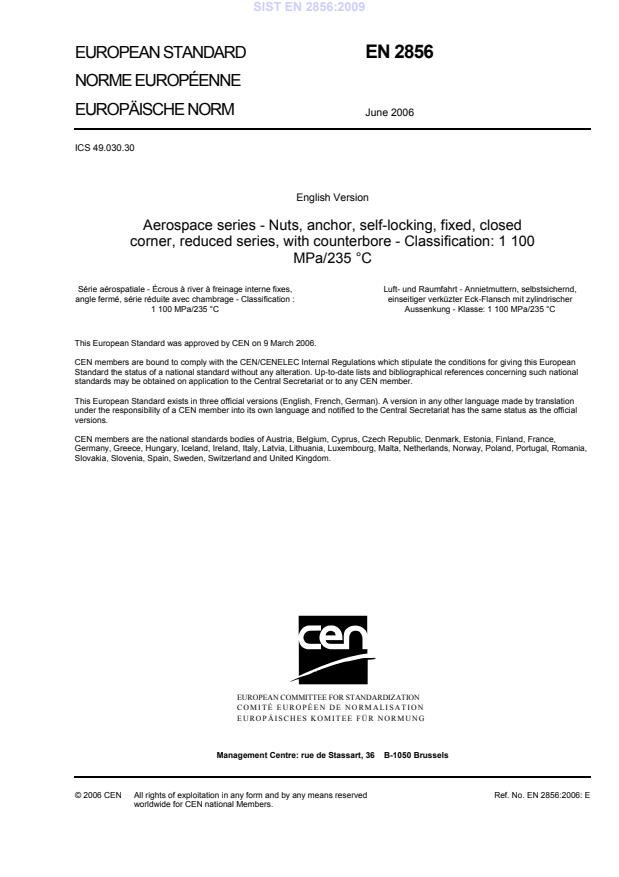
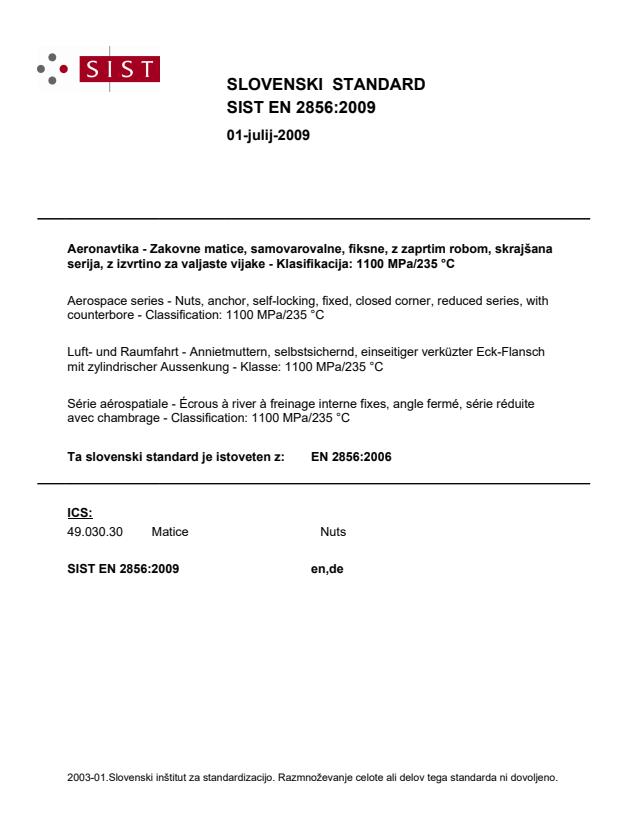
2003-01.Slovenski inštitut za standardizacijo. Razmnoževanje celote ali delov tega standarda ni dovoljeno.Aeronavtika - Zakovne matice, samovarovalne, fiksne, z zaprtim robom, skrajšana serija, z izvrtino za valjaste vijake - Klasifikacija: 1100 MPa/235 °CLuft- und Raumfahrt - Annietmuttern, selbstsichernd, einseitiger verküzter Eck-Flansch mit zylindrischer Aussenkung - Klasse: 1100 MPa/235 °CSérie aérospatiale - Écrous à river à freinage interne fixes, angle fermé, série réduite avec chambrage - Classification: 1100 MPa/235 °CAerospace series - Nuts, anchor, self-locking, fixed, closed corner, reduced series, with counterbore - Classification: 1100 MPa/235 °C49.030.30MaticeNutsICS:Ta slovenski standard je istoveten z:EN 2856:2006SIST EN 2856:2009en,de01-julij-2009SIST EN 2856:2009SLOVENSKI
STANDARD
EUROPEAN STANDARD NORME EUROPÉENNE EUROPÄISCHE NORM
EN 2856
June 2006 ICS 49.030.30 English Version
Aerospace series - Nuts, anchor, self-locking, fixed, closed corner, reduced series, with counterbore - Classification: 1 100 MPa/235 °C
Série aérospatiale - Écrous à river à freinage interne fixes, angle fermé, série réduite avec chambrage - Classification : 1 100 MPa/235 °C
Luft- und Raumfahrt - Annietmuttern, selbstsichernd, einseitiger verküzter Eck-Flansch mit zylindrischer Aussenkung - Klasse: 1 100 MPa/235 °C This European Standard was approved by CEN on 9 March 2006.
CEN members are bound to comply with the CEN/CENELEC Internal Regulations which stipulate the conditions for giving this European Standard the status of a national standard without any alteration. Up-to-date lists and bibliographical references concerning such national standards may be obtained on application to the Central Secretariat or to any CEN member.
This European Standard exists in three official versions (English, French, German). A version in any other language made by translation under the responsibility of a CEN member into its own language and notified to the Central Secretariat has the same status as the official versions.
CEN members are the national standards bodies of Austria, Belgium, Cyprus, Czech Republic, Denmark, Estonia, Finland, France, Germany, Greece, Hungary, Iceland, Ireland, Italy, Latvia, Lithuania, Luxembourg, Malta, Netherlands, Norway, Poland, Portugal, Romania, Slovakia, Slovenia, Spain, Sweden, Switzerland and United Kingdom.
EUROPEAN COMMITTEE FOR STANDARDIZATION
COMITÉ EUROPÉEN DE NORMALISATION EUROPÄISCHES KOMITEE FÜR NORMUNG
Management Centre: rue de Stassart, 36
B-1050 Brussels © 2006 CEN All rights of exploitation in any form and by any means reserved worldwide for CEN national Members. Ref. No. EN 2856:2006: ESIST EN 2856:2009
...