

EN 15302:2008
(Main)Railway applications - Method for determining the equivalent conicity
General Information
- Abstract
This European Standard establishes an evaluation procedure for determining equivalent conicity. A benchmark calculation is specified to achieve comparable results on a consistent basis for the equivalent conicity, which may be calculated by different methods not given in this European Standard. This European Standard also proposes possible calculation methods. Informative examples of the use of the Klingel formula (see Annex B) and linear regression of the r-function (see Annex C) are included in this European Standard.
This European Standard includes reference profiles, profile combinations, tolerances and reference results with tolerance limits, which allow the user to assess the acceptability of a measuring and calculation system including random- and grid- errors of the measuring system. It sets down the principles of calculation that need to be followed but does not impose any particular numerical calculation method.
This European Standard does not define limits for the equivalent conicity and gives no tolerances for the rail profile and the wheel profile to achieve acceptable results for the conicity.
For purposes outside the scope of this European Standard (e.g. simulation of vehicle behaviour) it can be useful or necessary to use more sophisticated theories. These methods are not within the scope of this European Standard.
For the application of this European Standard some general recommendations are given in Annex I.
- Status
- Withdrawn
- Publication Date
- 11-Mar-2008
- Withdrawal Date
- 02-Nov-2010
- Technical Committee
- CEN/TC 256 - Railway applications
- Drafting Committee
- CEN/TC 256/WG 10 - Vehicle/Track Interaction
- Current Stage
- 9960 - Withdrawal effective - Withdrawal
- Start Date
- 03-Nov-2010
- Completion Date
- 03-Nov-2010
96/48/EC - Interoperability of the trans-European high-speed rail systemOJ Ref: C, C 97 OJ Date: 16-Apr-2010

Relations
- Merged Into
EN 15302:2008+A1:2010 - Railway applications - Method for determining the equivalent conicity - Effective Date
- 06-Sep-2010
- Effective Date
- 28-Jan-2026
- Amended By
EN 15302:2008/FprA1 - Railway applications - Method for determining the equivalent conicity - Effective Date
- 15-Feb-2010
Get Certified
Connect with accredited certification bodies for this standard

IRIS Certification (UNIFE)
International Railway Industry Standard certification.

TÜV SÜD Rail GmbH
TÜV SÜD railway certification services.
BSMI (Bureau of Standards, Metrology and Inspection)
Taiwan's standards and inspection authority.
Sponsored listings
Frequently Asked Questions
EN 15302:2008 is a standard published by the European Committee for Standardization (CEN). Its full title is "Railway applications - Method for determining the equivalent conicity". This standard covers: This European Standard establishes an evaluation procedure for determining equivalent conicity. A benchmark calculation is specified to achieve comparable results on a consistent basis for the equivalent conicity, which may be calculated by different methods not given in this European Standard. This European Standard also proposes possible calculation methods. Informative examples of the use of the Klingel formula (see Annex B) and linear regression of the r-function (see Annex C) are included in this European Standard. This European Standard includes reference profiles, profile combinations, tolerances and reference results with tolerance limits, which allow the user to assess the acceptability of a measuring and calculation system including random- and grid- errors of the measuring system. It sets down the principles of calculation that need to be followed but does not impose any particular numerical calculation method. This European Standard does not define limits for the equivalent conicity and gives no tolerances for the rail profile and the wheel profile to achieve acceptable results for the conicity. For purposes outside the scope of this European Standard (e.g. simulation of vehicle behaviour) it can be useful or necessary to use more sophisticated theories. These methods are not within the scope of this European Standard. For the application of this European Standard some general recommendations are given in Annex I.
This European Standard establishes an evaluation procedure for determining equivalent conicity. A benchmark calculation is specified to achieve comparable results on a consistent basis for the equivalent conicity, which may be calculated by different methods not given in this European Standard. This European Standard also proposes possible calculation methods. Informative examples of the use of the Klingel formula (see Annex B) and linear regression of the r-function (see Annex C) are included in this European Standard. This European Standard includes reference profiles, profile combinations, tolerances and reference results with tolerance limits, which allow the user to assess the acceptability of a measuring and calculation system including random- and grid- errors of the measuring system. It sets down the principles of calculation that need to be followed but does not impose any particular numerical calculation method. This European Standard does not define limits for the equivalent conicity and gives no tolerances for the rail profile and the wheel profile to achieve acceptable results for the conicity. For purposes outside the scope of this European Standard (e.g. simulation of vehicle behaviour) it can be useful or necessary to use more sophisticated theories. These methods are not within the scope of this European Standard. For the application of this European Standard some general recommendations are given in Annex I.
EN 15302:2008 is classified under the following ICS (International Classification for Standards) categories: 17.040.20 - Properties of surfaces; 45.060.01 - Railway rolling stock in general. The ICS classification helps identify the subject area and facilitates finding related standards.
EN 15302:2008 has the following relationships with other standards: It is inter standard links to EN 15302:2008+A1:2010, EN 4840-101:2018, EN 15302:2008/FprA1. Understanding these relationships helps ensure you are using the most current and applicable version of the standard.
EN 15302:2008 is associated with the following European legislation: EU Directives/Regulations: 93/38/EEC, 96/48/EC; Standardization Mandates: M/024, M/275. When a standard is cited in the Official Journal of the European Union, products manufactured in conformity with it benefit from a presumption of conformity with the essential requirements of the corresponding EU directive or regulation.
EN 15302:2008 is available in PDF format for immediate download after purchase. The document can be added to your cart and obtained through the secure checkout process. Digital delivery ensures instant access to the complete standard document.
Standards Content (Sample)
2003-01.Slovenski inštitut za standardizacijo. Razmnoževanje celote ali delov tega standarda ni dovoljeno.Railway applications - Method for determining the equivalent conicityApplications ferroviaires - Méthode de détermination de la conicité équivalenteBahnanwendungen - Methode zur Bestimmung der äquivalenten Konizität45.060.01Železniška vozila na splošnoRailway rolling stock in generalICS:SIST EN 15302:2008enTa slovenski standard je istoveten z:EN 15302:200801-junij-2008SIST EN 15302:2008SLOVENSKI
STANDARD
EUROPEAN STANDARDNORME EUROPÉENNEEUROPÄISCHE NORMEN 15302March 2008ICS 17.040.20; 45.060.01 English VersionRailway applications - Method for determining the equivalentconicityApplications ferroviaires - Méthode de détermination de laconicité équivalenteBahnanwendungen - Verfahren zur Bestimmung deräquivalenten KonizitätThis European Standard was approved by CEN on 7 February 2008.CEN members are bound to comply with the CEN/CENELEC Internal Regulations which stipulate the conditions for giving this EuropeanStandard the status of a national standard without any alteration. Up-to-date lists and bibliographical references concerning such nationalstandards may be obtained on application to the CEN Management Centre or to any CEN member.This European Standard exists in three official versions (English, French, German). A version in any other language made by translationunder the responsibility of a CEN member into its own language and notified to the CEN Management Centre has the same status as theofficial versions.CEN members are the national standards bodies of Austria, Belgium, Bulgaria, Cyprus, Czech Republic, Denmark, Estonia, Finland,France, Germany, Greece, Hungary, Iceland, Ireland, Italy, Latvia, Lithuania, Luxembourg, Malta, Netherlands, Norway, Poland, Portugal,Romania, Slovakia, Slovenia, Spain, Sweden, Switzerland and United Kingdom.EUROPEAN COMMITTEE FOR STANDARDIZATIONCOMITÉ EUROPÉEN DE NORMALISATIONEUROPÄISCHES KOMITEE FÜR NORMUNGManagement Centre: rue de Stassart, 36
B-1050 Brussels© 2008 CENAll rights of exploitation in any form and by any means reservedworldwide for CEN national Members.Ref. No. EN 15302:2008: E
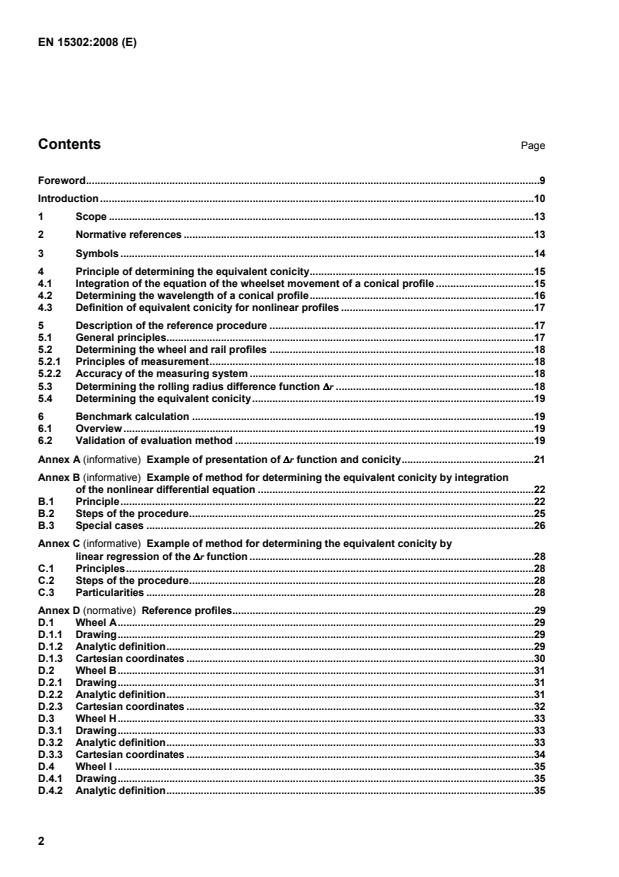
Example of presentation of ∆∆∆∆r function and conicity.21 Annex B (informative)
Example of method for determining the equivalent conicity by integration of the nonlinear differential equation.22 B.1 Principle.22 B.2 Steps of the procedure.25 B.3 Special cases.26 Annex C (informative)
Example of method for determining the equivalent conicity by linear regression of the ∆∆∆∆r function.28 C.1 Principles.28 C.2 Steps of the procedure.28 C.3 Particularities.28 Annex D (normative)
Reference profiles.29 D.1 Wheel A.29 D.1.1 Drawing.29 D.1.2 Analytic definition.29 D.1.3 Cartesian coordinates.30 D.2 Wheel B.31 D.2.1 Drawing.31 D.2.2 Analytic definition.31 D.2.3 Cartesian coordinates.32 D.3 Wheel H.33 D.3.1 Drawing.33 D.3.2 Analytic definition.33 D.3.3 Cartesian coordinates.34 D.4 Wheel I.35 D.4.1 Drawing.35 D.4.2 Analytic definition.35
Calculation results with reference profiles.39 E.1 Wheel A / Rail A.40 E.1.1 Diagram of ∆∆∆∆r, tanγγγγa, tanγγγγe functions and representation of contact points.40 E.1.2 Representation of the curves of kinematic rolling movement of the wheelset on track.41 E.1.3 Numerical values for ∆∆∆∆r function.42 E.1.4 Numerical values for tanγγγγe function.43 E.2 Wheel B / Rail A.44 E.2.1 Diagram ∆∆∆∆r, tanγγγγa, tanγγγγe functions and representation of contact points.44 E.2.2 Representation of the curves of kinematic rolling movement of the wheelset on track.45 E.2.3 Numerical values for ∆∆∆∆r function.46 E.2.4 Numerical values for tanγγγγe function.47 E.3 Wheel H / Rail A.48 E.3.1 Diagram of ∆∆∆∆r, tanγγγγa, tanγγγγe functions and representation of contact points.48 E.3.2 Representation of the curves of kinematic rolling movement of the wheelset on track.49 E.3.3 Numerical values for ∆∆∆∆r function.50 E.3.4 Numerical values for tanγγγγe function.51 E.4 Wheel I / Rail A.52 E.4.1 Diagram of ∆∆∆∆r, tanγγγγa, tanγγγγe functions and representation of contact points.52 E.4.2 Representation of the curves of kinematic rolling movement of the wheelset on track.53 E.4.3 Numerical values for ∆∆∆∆r function.54 E.4.4 Numerical values for tanγγγγe function.55 E.5 Modified Wheel A (-2 mm on left wheel diameter) / Rail A.56 E.5.1 Diagram of ∆∆∆∆r, tanγγγγa, tanγγγγe functions and representation of contact points.56 E.5.2 Representation of the curves of kinematic rolling movement of the wheelset on track.57 E.5.3 Numerical values for ∆∆∆∆r function.58 E.5.4 Numerical values for tanγγγγe function.59 E.6 Modified Wheel B (-2 mm on left wheel diameter) / Rail A.60 E.6.1 Diagram of ∆∆∆∆r, tanγγγγa, tanγγγγe functions and representation of contact points.60 E.6.2 Representation of the curves of kinematic rolling movement of the wheelset on track.61 E.6.3 Numerical values for ∆∆∆∆r function.62 E.6.4 Numerical values for tanγγγγe function.63 E.7 Modified Wheel H (-2 mm on left wheel diameter) / Rail A.64 E.7.1 Diagram of ∆∆∆∆r, tanγγγγa, tanγγγγe functions and representation of contact points.64 E.7.2 Representation of the curves of kinematic rolling movement of the wheelset on track.65 E.7.3 Numerical values for ∆∆∆∆r function.66 E.7.4 Numerical values for tanγγγγe function.67 E.8 Modified Wheel I (-2 mm on left wheel diameter) / Rail A.67 E.8.1 Diagram of ∆∆∆∆r, tanγγγγa, tanγγγγe functions and representation of contact points.67 E.8.2 Representation of the curves of kinematic rolling movement of the wheelset on track.69 E.8.3 Numerical values for ∆∆∆∆r function.70 E.8.4 Numerical values for tanγγγγe function.71 E.9 (Right Wheel A – Left Wheel B) / Rail A.72 E.9.1 Diagram of ∆∆∆∆r, tanγγγγa, tanγγγγe functions and representation of contact points.72 E.9.2 Representation of the curves of kinematic rolling movement of the wheelset on track.73 E.9.3 Numerical values for ∆∆∆∆r function.74 E.9.4 Numerical values for tanγγγγe function.75 Annex F (normative)
Tolerances on equivalent conicity.76 F.1 Wheel A / Rail A.77
Examples of calculation results with introduced errors.104 G.1 Wheel A / Rail A – Random error in mm.104 G.2 Wheel A / Rail A — Random error in mm.105 G.3 Wheel A / Rail A — Random error in mm.106 G.4 Wheel A / Rail A — Grid error in mm.107 G.5 Wheel A / Rail A — Grid error in mm.108 G.6 Wheel A / Rail A — Grid error in mm.109 G.7 Wheel H / Rail A — Random error in mm.110 Annex H (informative)
Guideline for application of errors.111 H.1 Grid error.111 H.2 Random error.113 Annex I (informative)
Guidelines for application.115 Annex ZA (informative)
Relationship between this European Standard and the Essential Requirements of EU Directive Council Directive 96/48/EC as amended by 2004/50/EC.117 Bibliography.119
Figures Figure 1 — Benchmark process, Step 1.11 Figure 2 — Benchmark process, Step 2.11 Figure 3 — Benchmark process, Step 3.12 Figure 4 — Dimensions on the wheelset.15 Figure 5 — y = f(x) function.16 Figure A.1 — ∆∆∆∆r = f(y) function and tanγγγγe = f(y).21 Figure B.1 — Representation of dx, dy.22
Wheel A / Rail A.40 Figure E.1b — Representation of the curves of kinematic rolling movement of the wheelset on track — Wheel A / Rail A.41 Figure E.2a — Diagram ∆∆∆∆r, tanγγγγa, tanγγγγe functions and representation of contact points —
Wheel B / Rail A.44 Figure E.2b — Representation of the curves of kinematic rolling movement of the wheelset on track — Wheel B / Rail A.45 Figure E.3a — Diagram of ∆∆∆∆r, tanγγγγa, tanγγγγe functions and representation of contact points —
Wheel H / Rail A.48 Figure E.3b — Representation of the curves of kinematic rolling movement of the wheelset on track — Wheel H / Rail A.49 Figure E.4a — Diagram of ∆∆∆∆r, tanγγγγa, tanγγγγe functions and representation of contact points —
Wheel I / Rail A.52 Figure E.4b — Representation of the curves of kinematic rolling movement of the wheelset on track — Wheel I / Rail A.53 Figure E.5a — Diagram of ∆∆∆∆r, tanγγγγa, tanγγγγe functions and representation of contact points —
Modified Wheel A / Rail A.56 Figure E.5b — Representation of the curves of kinematic rolling movement of the wheelset on track — Modified Wheel A / Rail A.57 Figure E.6a — Diagram of ∆∆∆∆r, tanγγγγa, tanγγγγe functions and representation of contact points —
Modified Wheel B / Rail A.60 Figure E.6b — Representation of the curves of kinematic rolling movement of the wheelset on track — Modified Wheel B / Rail A.61 Figure E.7a — Diagram of ∆∆∆∆r, tanγγγγa, tanγγγγe functions and representation of contact points —
Modified Wheel H / Rail A.64 Figure E.7b — Representation of the curves of kinematic rolling movement of the wheelset on track — Modified Wheel H / Rail A.65
Modified Wheel I / Rail A.68 Figure E.8b — Representation of the curves of kinematic rolling movement of the wheelset on track — Modified Wheel I / Rail A.69 Figure E.9a — Diagram of ∆∆∆∆r, tanγγγγa, tanγγγγe functions and representation of contact points —
(Right Wheel A – Left Wheel B) / Rail A.72 Figure E.9b — Representation of the curves of kinematic rolling movement of the wheelset on track — (Right Wheel A – Left Wheel B) / Rail A.73 Figure F.1 — Diagram Wheel A / Rail A.77 Figure F.2 — Diagram Wheel B / Rail A.80 Figure F.3 — Diagram Wheel H / Rail A.83 Figure F.4 — Diagram Wheel I / Rail A.86 Figure F.5 — Diagram modified Wheel A / Rail A.89 Figure F.6 — Diagram modified Wheel B / Rail A.92 Figure F.7 — Diagram modified Wheel H / Rail A.95 Figure F.8 — Diagram modified Wheel I / Rail A.98 Figure F.9 — Diagram (Right Wheel A — Left Wheel B) / Rail A.101 Figure G.1 — Wheel A / Rail A — Random error in mm.104 Figure G.2 — Wheel A / Rail A — Random error in mm.105 Figure G.3 — Wheel A / Rail A — Random error in mm.106 Figure G.4 — Wheel A / Rail A — Grid error in mm.107 Figure G.5 — Wheel A / Rail A — Grid error in mm.108 Figure G.6 — Wheel A / Rail A — Grid error in mm.109 Figure G.7 — Wheel H / Rail A — Random error in mm.110 Figure H.1 — Transformation of the point P (x, y) to grid with grid widths ∆∆∆∆y, ∆∆∆∆z.111 Figure H.2 — Grid transformation with grid widths of 0,5 mm.112 Figure H.3 — Variation of the grid origin.112 Figure H.4 — 50 variants of grid origins.113 Figure H.5 — Random error of measuring points.114
Tables Table D.1 — Wheel profile: R-UIC 519-A — Right wheel.30 Table D.2 — Wheel profile: R-UIC 519-B — Right wheel.32 Table D.3 — Wheel profile: R-UIC 519-H — Right wheel.34 Table D.4 — Wheel profile: R-UIC 519-I — Right wheel.36 Table D.5 — Rail profile: S-UIC 519-A — Right rail.38 Table E.1a — Contact geometry wheel / rail: ∆∆∆∆r = f(y) — Wheel profile: R-UIC 519-A — Rail Profile: S-UIC 519-A.42 Table E.1b — Contact geometry wheel / rail: Conicity — Wheel profile: R-UIC 519-A — Rail profile: S-UIC 519-A.43
Figure 1 — Benchmark process, Step 1 In Step 2, random errors given in Annex G are added to the reference profiles in Annex D and are applied to the smoothing and interpolation algorithm. A comparison of the achieved results with the reference results including the field of tolerances in Annex F allows the assessment of the evaluation procedure (see Figure 2).
Figure 2 — Benchmark process, Step 2
Figure 3 — Benchmark process, Step 3
...