

EN 326-2:2010
(Main)Wood-based panels - Sampling, cutting and inspection - Part 2: Initial type testing and factory production control
General Information
- Abstract
This European Standard specifies methods for internal initial type testing (ITT) and internal factory production control (FPC) as well as external control of wood-based panels for their compliance with EN 13986 and other relevant product specifications. However, it may also apply, at the option of the manufacturer, to wood-based panels applied for non-construction purposes.
This European Standard is not applicable for the assessment of compliance with specifications of panels comprised in consignments. In such cases, EN 326-3 applies.
For factory production control, if required, methods for the assessment of conformity of batches and of production over longer periods are given.
For external control, if required, methods for the initial inspection of a factory and initial type testing of a product, and for the surveillance of the factory production control, are given.
In the factory production control small test pieces are used. The statistics of evaluation is based on normal distribution.
- Status
- Withdrawn
- Publication Date
- 28-Sep-2010
- Withdrawal Date
- 29-Sep-2026
- Technical Committee
- CEN/TC 112 - Woodbased panels
- Drafting Committee
- CEN/TC 112/WG 4 - Test methods
- Current Stage
- 9960 - Withdrawal effective - Withdrawal
- Start Date
- 06-Aug-2014
- Completion Date
- 30-Sep-2026

Relations
- Effective Date
- 02-Oct-2010
- Effective Date
- 22-Dec-2008
- Effective Date
- 19-Jan-2023
- Effective Date
- 25-Aug-2026
- Effective Date
- 28-Jan-2026
- Effective Date
- 28-Jan-2026
- Effective Date
- 28-Jan-2026
- Effective Date
- 19-Jun-2013
Get Certified
Connect with accredited certification bodies for this standard

Gozdarski inštitut Slovenije
Slovenian Forestry Institute. Forest management certification support, timber testing.
Sponsored listings
Frequently Asked Questions
EN 326-2:2010 is a standard published by the European Committee for Standardization (CEN). Its full title is "Wood-based panels - Sampling, cutting and inspection - Part 2: Initial type testing and factory production control". This standard covers: This European Standard specifies methods for internal initial type testing (ITT) and internal factory production control (FPC) as well as external control of wood-based panels for their compliance with EN 13986 and other relevant product specifications. However, it may also apply, at the option of the manufacturer, to wood-based panels applied for non-construction purposes. This European Standard is not applicable for the assessment of compliance with specifications of panels comprised in consignments. In such cases, EN 326-3 applies. For factory production control, if required, methods for the assessment of conformity of batches and of production over longer periods are given. For external control, if required, methods for the initial inspection of a factory and initial type testing of a product, and for the surveillance of the factory production control, are given. In the factory production control small test pieces are used. The statistics of evaluation is based on normal distribution.
This European Standard specifies methods for internal initial type testing (ITT) and internal factory production control (FPC) as well as external control of wood-based panels for their compliance with EN 13986 and other relevant product specifications. However, it may also apply, at the option of the manufacturer, to wood-based panels applied for non-construction purposes. This European Standard is not applicable for the assessment of compliance with specifications of panels comprised in consignments. In such cases, EN 326-3 applies. For factory production control, if required, methods for the assessment of conformity of batches and of production over longer periods are given. For external control, if required, methods for the initial inspection of a factory and initial type testing of a product, and for the surveillance of the factory production control, are given. In the factory production control small test pieces are used. The statistics of evaluation is based on normal distribution.
EN 326-2:2010 is classified under the following ICS (International Classification for Standards) categories: 79.060.01 - Wood-based panels in general. The ICS classification helps identify the subject area and facilitates finding related standards.
EN 326-2:2010 has the following relationships with other standards: It is inter standard links to EN 326-2:2000, EN 326-2:2000/AC:2005, EN 326-2:2010+A1:2014, ISO 8258:1991, EN 13986:2004+A1:2015, EN 326-1:1994, EN 13630-3:2002, EN 326-2:2010/FprA1. Understanding these relationships helps ensure you are using the most current and applicable version of the standard.
EN 326-2:2010 is associated with the following European legislation: EU Directives/Regulations: 305/2011, 89/106/EEC; Standardization Mandates: M/113. When a standard is cited in the Official Journal of the European Union, products manufactured in conformity with it benefit from a presumption of conformity with the essential requirements of the corresponding EU directive or regulation.
EN 326-2:2010 is available in PDF format for immediate download after purchase. The document can be added to your cart and obtained through the secure checkout process. Digital delivery ensures instant access to the complete standard document.
Standards Content (Sample)
2003-01.Slovenski inštitut za standardizacijo. Razmnoževanje celote ali delov tega standarda ni dovoljeno.Holzwerkstoffe - Probenahme, Zuschnitt und Überwachung - Teil 2: Erstprüfung des Produktes und werkseigene ProduktionskontrollePanneaux à base de bois - Echantillonnage, découpe et contrôle - Partie 2: Essai de type initial et contrôle de la production en usineWood-based panels - Sampling, cutting and inspection - Part 2: Initial type testing and factory production control79.060.01Wood-based panels in generalICS:Ta slovenski standard je istoveten z:EN 326-2:2010SIST EN 326-2:2011en,fr,de01-marec-2011SIST EN 326-2:2011SLOVENSKI
STANDARDSIST EN 326-2:2004/AC:2006SIST EN 326-2:20041DGRPHãþD
EUROPEAN STANDARD NORME EUROPÉENNE EUROPÄISCHE NORM
EN 326-2
September 2010 ICS 79.060.01 Supersedes EN 326-2:2000English Version
Wood-based panels - Sampling, cutting and inspection - Part 2: Initial type testing and factory production control
Panneaux à base de bois - Echantillonnage, découpe et contrôle - Partie 2 : Essai de type initial et contrôle de la production en usine
Holzwerkstoffe -Probenahme, Zuschnitt und Überwachung - Teil 2: Erstprüfung des Produktes und werkseigene Produktionskontrolle This European Standard was approved by CEN on 7 August 2010.
CEN members are bound to comply with the CEN/CENELEC Internal Regulations which stipulate the conditions for giving this European Standard the status of a national standard without any alteration. Up-to-date lists and bibliographical references concerning such national standards may be obtained on application to the CEN Management Centre or to any CEN member.
This European Standard exists in three official versions (English, French, German). A version in any other language made by translation under the responsibility of a CEN member into its own language and notified to the CEN Management Centre has the same status as the official versions.
CEN members are the national standards bodies of Austria, Belgium, Bulgaria, Croatia, Cyprus, Czech Republic, Denmark, Estonia, Finland, France, Germany, Greece, Hungary, Iceland, Ireland, Italy, Latvia, Lithuania, Luxembourg, Malta, Netherlands, Norway, Poland, Portugal, Romania, Slovakia, Slovenia, Spain, Sweden, Switzerland and United Kingdom.
EUROPEAN COMMITTEE FOR STANDARDIZATION
COMITÉ EUROPÉEN DE NORMALISATION EUROPÄISCHES KOMITEE FÜR NORMUNG
Management Centre:
Avenue Marnix 17,
B-1000 Brussels © 2010 CEN All rights of exploitation in any form and by any means reserved worldwide for CEN national Members. Ref. No. EN 326-2:2010: ESIST EN 326-2:2011
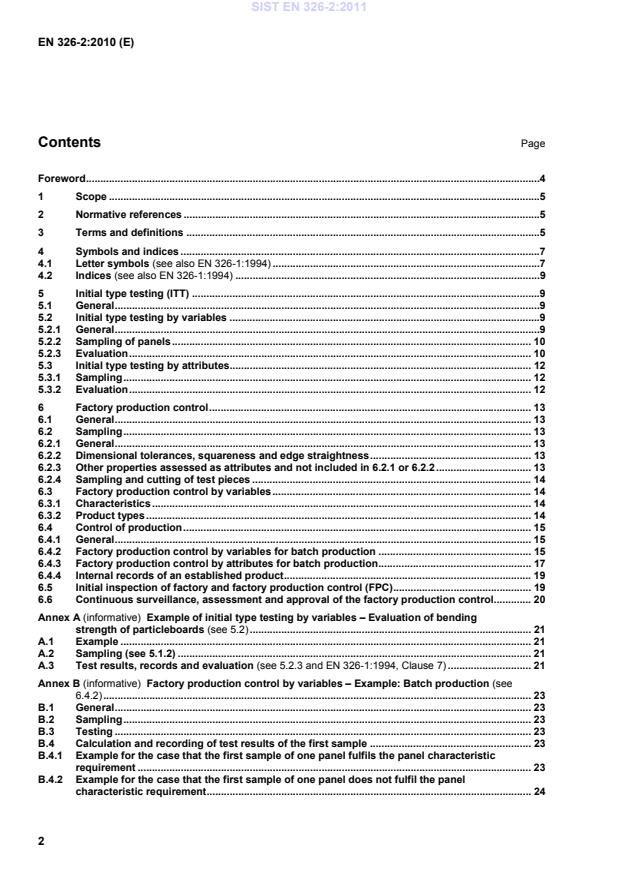
Example of initial type testing by variables – Evaluation of bending strength of particleboards (see 5.2) . 21A.1 Example . 21A.2 Sampling (see 5.1.2) . 21A.3 Test results, records and evaluation (see 5.2.3 and EN 326-1:1994, Clause 7) . 21Annex B (informative)
Factory production control by variables – Example: Batch production (see 6.4.2) . 23B.1 General . 23B.2 Sampling . 23B.3 Testing . 23B.4 Calculation and recording of test results of the first sample . 23B.4.1 Example for the case that the first sample of one panel fulfils the panel characteristic requirement . 23B.4.2 Example for the case that the first sample of one panel does not fulfil the panel characteristic requirement . 24SIST EN 326-2:2011
Example of initial type testing attributes - Evaluation of bonding quality of plywood (see 6.4.3.1) . 27C.1 Example . 27C.2 Sampling plan . 27C.3 Sampling (see 5.3.1) . 27C.4 Test data and evaluation of bond shear strength and apparent cohesive wood fibre failure percentage . 27C.4.1 General . 27C.4.2 First sample . 28C.4.3 Second sample . 29C.5 Single sampling plan . 30Annex D (informative)
Control of factory production control records - Examples of the determination of differences between factory testing and external testing (see 6.6) . 31D.1 General . 31D.1.1 Use of unconditioned test pieces . 31D.1.2 Paired testing . 31D.2 Example (1): Swelling in thickness tested according to EN 317 . 32D.2.1 Sample of example (1) . 32D.2.2 Control of variability . 32D.3 Example (2): Internal bond tested according to EN 319 . 34D.3.1 General . 34D.3.2 Sample of example (2) . 34D.3.3 Control of variability . 34D.4 Determination of a significant difference between the results from the alternative test procedure and from the standard reference test method . 35Annex E (informative)
Example of the calculation of a linear correlation (see 7.2) . 37Annex F (informative)
Example of the determination of a significant difference between the results from the alternative test procedure and from the standard reference test method (see 6.4.5) in accordance with EN 13986 . 40F.1 General . 40F.2 Control of variability (see Annex D) . 41F.3 Determination of a significant difference (see Annex D) . 41Bibliography . 42 SIST EN 326-2:2011
Coefficient of variation between the panel means jx convϕ Linear conversion function ijx Single test value or measurement jx Mean value of the m test values (or measurements) obtained from a single panel j nx Grand mean of n single panel mean values altjx, Test value of the population of the alternative test procedure refjx, Test value of the population of the reference standard test method jx∆ Test value of the difference between the alternative test procedure and the reference standard test method SIST EN 326-2:2011
5.2.1 General In general, the requirements of the panel properties are fulfilled if at least 95 % of the panel means for each characteristic are above the lower L or below the upper U specification limit respectively. NOTE For examples, see Annex A. SIST EN 326-2:2011
5.2.3 Evaluation 5.2.3.1 Evaluation by using the test results directly 5.2.3.1.1 Compliance of the ITT sample Calculate the mean value jITTx, for each panel, the grand mean value ITTx for the panels and, the standard deviation between the panels ITTxs, for each relevant characteristic in accordance with Equations (1) and (2):
ITTnjjjITTITTnxxITT∑===1, (1) and
)1()(12,,−−=∑==ITTnjjITTjITTITTxnxxsITT
(2) To fulfil the specification requirement the lower 5 % value or upper 95 % value shall be higher than or equal to the lower specification limit L or lower than or equal to the upper specification limit U respectively, when calculated according to the Equation (3) or (4), respectively:
ITTxnITTstxLITT,%5⋅−= (3) or
ITTxnITTstxUITT,%95⋅+= (4) where
ITTnt shall be taken from Table 1. SIST EN 326-2:2011
30 tm or tn, respectively 2,35 2,13 2,02 1,89 1,83 1,80 1,75 1,74 1,70 NOTE The table values correspond to a 95 % confidence limit, single-sided case, in accordance with ISO 2602:1980.
5.2.3.1.2 Variability within panels of the ITT sample
The mean standard deviation within panels of the ITT sample ITTw,s, where "w" is indicating "within" panels, shall be derived from the standard deviation within each panel jws, of the sample [equation (13)] according to Equation (5):
ITTnjjjITTwITTwnssITT∑===12,., (5) 5.2.3.2 Evaluation by using relative test results If the sample consists of panels which are covered by different lower L and/or upper U specification limits (for example by combining different thickness ranges of the same standard type of panel product), the evaluation shall be carried out on test results related to each specification limit as follows: Calculate for each individual panel the relative mean jxδ relevant to either the lower L or upper U specification limit according to Equation (6) or (7), respectively:
LLxxjLj)(,−=δ (6) or
UUxxjUj)(,−=δ (7) Calculate the grand mean of the relative differences of all panels of the inspection sample according to:
nxxnj∑=1δδ (8) and the standard deviation xsδ of the relative differences between the panel means according to: SIST EN 326-2:2011
1)(21−−=∑nxxsjnxδδδ (9) To fulfil the specification requirement the lower 5 % value or the upper 95 % value, respectively, shall be equal to or greater than zero for characteristics with a lower specification limit L or equal to or less than zero for characteristics with an upper specification limit U when calculated according to Equation (10) or (11), respectively:
xnstxLδδδ⋅−=%5, (10) or
xnstxUδδδ⋅+=%95, (11) 5.3 Initial type testing by attributes 5.3.1 Sampling The initial type testing shall comprise panels from not less than three production shifts. The minimum number of panels in the initial type testing sample shall be 20 (or 26 = 2 × 13 if a double sampling plan is used). NOTE 1 The sample sizes for the inspection by attributes correspond to a normal inspection of level I according to ISO 2859-1:1989 for a lot size (Nattr) of maximum 500 panels. NOTE 2 For examples see Annex C. 5.3.2 Evaluation 5.3.2.1 General Before sampling the manufacturer shall chose between a single (option 1) or a double sampling plan (option 2). 5.3.2.2 Single sampling plan (Option 1) If the number of defectives in the sample is greater than 2, the inspection lot shall be rejected. 5.3.2.3 Double sampling plan (Option 2) (see Table 4) A more reliable initial type testing can be carried out with a double sampling plan, where the second sample size shall be equal to the first sample size, resulting in a cumulative sample of 26 panels. Both the first 13 panels and second 13 panels of the sample shall be selected over the entire inspection lot at random. If the number of defectives found in the first sample is 0, the inspection lot shall be considered acceptable. If the number of defectives found in the first sample is greater than 0, but less than 3, the second sample of 13 panels shall be inspected. If the number of defectives found in the first sample is equal to or greater than 3, the inspection lot shall be rejected. SIST EN 326-2:2011
to
1 200 1 201
to
3 200 20 32 50 13 20 32 13 20 32 SIST EN 326-2:2011
to
10 000 80 50 50 NOTE These sample sizes for the inspection by attributes correspond to a normal inspection of level I according to ISO 2859-1:1989.
6.2.4 Sampling and cutting of test pieces The minimum number of test pieces m shall be cut from each panel as given either in EN 326-1 or in the EN for the relevant test method, or otherwise shall be agreed (see note). NOTE This should be done with an inspection body. The principles of sampling and cutting of test pieces are described in EN 326-1. 6.3 Factory production control by variables
6.3.1 Characteristics The following shall be calculated and recorded for each characteristic: the panel mean jx of the m test values ijx obtained from each single panel according to Equation (12):
mxxmiiijj∑===1 (12) and the standard deviation within a panel jws, according to Equation (13):
1)(12,−−=∑==mxxsmiijijjw (13) 6.3.2 Product types For each product type under factory production control, the following shall also be calculated and recorded: the rolling grand mean 30x of the last 30 panel means according to Equation (14):
3030130∑===jjjxx (14) the rolling standard deviation 30,xs between the last 30 panel means according to Equation (15):
29)(30123030,∑==−=jjjxxxs (15) SIST EN 326-2:2011
303012.30,∑===jjjwwss (16) 6.4 Control of production 6.4.1 General For assessing compliance of a product by variables the following methods shall be used: Factory production control by variables for batch production according to 6.4.2, or Internal records of an established product according to 6.4.4. For assessing compliance of a product by attributes the following method shall be used:
Control by attributes for batch production according to 6.4.3. 6.4.2 Factory production control by variables for batch production
In order to evaluate the compliance of the last batch production with the requirements of EN 13986, with further reference to other relevant specific product standards, the manufacturer shall use the following procedure unless alternative procedures are adopted giving at least the same level of confidence. NOTE For examples, see Annex B. To establish the conformity of the panels with the requirements estimates shall be calculated of the lower xL1 or upper xU1 confidence limit, respectively, for the last production period for which the last panel sampled is considered to be representative, according to Equations (17) and (18), respectively:
mstxLwmx⋅−=11 (17) or
mstxUwmx⋅+=11 (18) where: the standard deviation within panels wsshall be taken from: either the rolling mean standard deviation within panels 30,ws[see Equation (16)]; or the mean standard deviation within panels of the initial type testing ITTws,[see Equation (5)]; or the mean standard deviation within the last n representative panels tested according to Equation (19): SIST EN 326-2:2011
nssnjjjwnw∑===12,, (19) Only if none of these mean standard deviation within panels wsis available, the standard deviation within the last panel sampled (panel 1) 1,wsshall be used in Equations (17) and (18), respectively, by calculating according to Equation (20):
mxxsmiiiw∑==−=12111,)( (20) The t-values in relation to the number of test pieces m are given in Table 1. If xL1 is equal to or greater than the lower specification limit L, or if xU1 is equal to or less than the upper specification limit U, respectively, the panel characteristics shall be considered to be in conformity with the requirements. If the single panel sampled does not meet the requirements, one or two more panels shall be tested. In this case the grand mean values 2,1x or 3,2,1x, respectively, shall be calculated according to Equations (21) and (22):
2212,1xxx+= (21) and
33213,2,1xxxx++= (22) Estimates of the lower (xL2,1 and xL3,2,1) and upper (xU2,1 and xU3,2,1) confidence limit, respectively, shall be calculated according to Equations (23) to (26), respectively:
mstxLwmx⋅−=2,12,1 (23) and
mstxUwmx⋅+=2,12,1 (24) or
mstxLwmx⋅−=3,2,13,2,1 (25) and
mstxUwmx⋅+=3,2,13,2,1 (26) SIST EN 326-2:2011
222,21,2,1,wwwsss+= (27) and
323,22,21,3,2,1,wwwwssss++= (28) If the requirements are not met, the panels of the respective production period shall be down-graded. 6.4.3 Factory production control by attributes for batch production 6.4.3.1 Bonding strength of plywood
For verification of the fulfilment of the requirements of the bonding strength of plywood, the following rules apply: if the number of defective test pieces is equal to or less than 10 %, the requirement for the panel characteristic is fulfilled; NOTE 1 In the case of testing the bond quality of plywood, a test piece corresponds to one pair of glue lines. if the number of defective test pieces is greater than 10 %, two other panels shall be taken and tested; if the number of defective test pieces from these two panels is equal to or less than 10 %, the requirement for the panel characteristic is fulfilled; if the requirements are not met, the panels of the respective production period shall be down-graded. NOTE 2 For examples see Annex C. 6.4.3.2 General characteristics 6.4.3.2.1 General requirements in specific product standards To determine the acceptability of the characteristics given in the specific product standards, no single measured value shall exceed the requirement range given. 6.4.3.2.2 Other characteristics To determine the acceptability of an inspection unit a single sampling plan or a double sampling plan shall be used. The choice of the sampling plan shall be made prior to sampling between: a) Single sampling plan If the number of defectives in the sample is greater than the acceptance number Ac of Table 3, the inspection lot shall be rejected. SIST EN 326-2:2011
of a single sampling plan for inspection by attributes Sample size nattr,si Ac 20 32 50 80 2 3 5 7 NOTE The table values correspond to an AQL-value of 4 % for normal inspection, according to ISO 2859-1:1989.
b) Double sampling plan A more reliable inspection can be carried out with a double sampling plan where the sample sizes dattrn, given in Table 4 (the second sample size being equal to the first sample size) result in a cumulative sample size cuattrn,. If the number of defectives found in the first sample is equal to or less than the first acceptance number 1Ac in Table 4, the inspection lot shall be considered acceptable. Table 4 — The acceptance number Ac and the rejection number Re in relation to the
sample size dattrn, of a double sampling plan for inspection by attributes
Sample Sample size dattrn, Cumulative sample size cuattrn, 1Ac 2Ac 1Re 2Re first 13
26 0 – 3 – second 13 – 3 – 4 first 20
40 1 – 4 – second 20 – 4 – 5 first 32
64 2 – 5 – second 32 – 6 – 7 first 50
100 3 – 7 – second 50 – 8 – 9 NOTE The table values correspond to an AQL-value of 4 % for normal inspection, according to
ISO 2859-1:1989.
If the number of defectives found in the first sample is greater than the first acceptance number 1Ac in Table 4, but less than the first rejection number 1Re in Table 4, a second sample shall be inspected. If the number of defectives found in the first sample is equal to or greater than the first rejection number 1Re in Table 4, the inspection lot shall be rejected. SIST EN 326-2:2011
30,30%570,1jxsxL⋅−= (29) or the higher 95 percentile limit %95U of the control chart is equal to or smaller than the upper specification limit according to Equation (30):
30,30%9570,1jxsxU⋅+= (30) The specification requirement of the lower 5 % value or the upper 95 % value, respectively, shall be considered also fulfilled, if all single 30 mean values jx are greater than the lower specification limit L or less than the upper specification limit U, respectively. 6.5 Initial inspection of factory and factory production control (FPC) Initial inspection of factory and FPC shall generally be carried out when the production of the concerned technical class of the panels is already running and the FPC is already in practice. The following shall be assessed:
− the FPC-documentation; and − the factory.
In the assessment of the factory and FPC it shall be verified: a) that all resources necessary for the achievement of the declared panels' characteristics, required by this standard, are or will be available; and
b) that the FPC-procedures in accordance with the FPC-documentation are or will be implemented and followed in practice; and
All factories of the manufacturer shall be visited to verify that the above requirements a) to c) are in place. One visit may cover one or more types of panels, production lines and/or production processes. If the FPC system covers more than one type of panels, production line or production process, and if it is verified that the general requirements are fulfilled, the assessment of these general requirements does not need to be repeated when assessing the product-specific requirements for another type of panels.
Assessments previously performed in accordance with the provisions of this standard may be taken into account providing that they were made to the same system of attestation of conformity on the same type of panels, such that the results may be considered applicable to the type in question.
Any assessment and its results shall be documented in a report. 6.6 Continuous surveillance, assessment and approval of the factory production control If relevant, the continuous surveillance, assessment and approval of FPC shall take place during which it shall be satisfied that the performances of the characteristics of the product type under supervision, as declared at ITT, are maintained during production. The continuous surveillance, assessment and approval of FPC shall be based on the manufacturer's factory production control records and shall be re-assessed at least twice a year. The following shall be done under the continuous surveillance, assessment and approval of FPC:
to control the test procedures used by the manufacturer’s laboratory; to control alternative test procedures used instead of the relevant standard method; to compare two standardized test methods (e.g. the determination of a strength characteristic by using small- and medium-sized test pieces or the determination of formaldehyde emission by using different standardized test methods); or to establish a correlation between two sets of data. NOTE Suitable statistical procedures are given in Annexes D to F. Any assessment and its results shall be documented in a report.
Example of initial type testing by variables – Evaluation of bending strength of particleboards (see 5.2) A.1 Example This example deals with the initial type testing of bending strength for a 18 mm particleboard of type P4 according to EN 312:2003 with a lower specification limit of L = 15 N/mm2. A.2 Sampling (see 5.1.2) 12 panels (nitt = 12) are sampled, see Table A.1. Table A.1 — Sampling for initial inspection by variables Panel no. Product line Date of production Number of panels 1 2 1 week 1 2 3 4 1 week 2 2 5 6 1 week 3 2 7 8 2 week 1 2 9 10
2 week 2 2 11
2 week 3 2
A.3 Test results, records and evaluation (see 5.2.3 and EN 326-1:1994, Clause 7) Testing of bending strength is carried out in accordance with EN 310 on conditioned test pieces. The records are given in Table A.2, where the mean values per panel are for m = 6 test pieces. SIST EN 326-2:2011
18,5 18,8 17,5 17,0 16,0 20,0
The mean value ITTx and the standard deviation between panel means ITTxs, are calculated in accordance with Equations (1) and (2); the results are: ITTx= 17,24 N/mm2; ITT,xs = 1,27 N/mm2. The lower 5 % %5L value is calculated in accordance with Equation (3): ITT,xITT,nITT%5stxL⋅−== 17,24 – 1,80 × 1,27 = 15,0 N/mm2. The specification requirement limit (L = 15,0 N/mm2) in EN 312:2003 is (just) fulfilled. The initial type testing has given a satisfactory re
...