


EN 1570-1:2024
(Main)Safety requirements for lifting tables - Part 1: Lifting tables serving up to two fixed landing
Safety requirements for lifting tables - Part 1: Lifting tables serving up to two fixed landing
1.1 This document specifies the safety requirements for lifting tables with the following characteristics:
- serving no more than 2 fixed landings but able to pass a fixed landing and,
- having a vertical travel speed of no more than 0,15 m/s, unless safe by position and,
- for raising or lowering goods (with or without operator(s) and/or authorized person(s)), or;
- for raising or lowering operator(s) and/or authorized person(s) with or without goods, to positions where they can carry out work from a fixed or movable lifting table that is guided throughout its vertical travel only (see Annex H).
1.2 This document specifies the appropriate technical measures for eliminating and reducing the risks arising from the significant hazards listed in Annex B.
1.3 This document does not apply to the following equipment:
- lifting tables with a vertical travel speed exceeding 0,15 m/s, unless safe by position;
- lifting tables, serving more than 2 fixed landings of a construction, for lifting goods, with a vertical travel speed not exceeding 0,15 m/s (EN 1570-2:2016);
- lifting tables, serving more than 2 fixed landings of a construction, for lifting operators, with a vertical travel speed not exceeding 0,15 m/s;
- lifting tables carrying operators and installed in full enclosures with a vertical travel speed not exceeding 0,15 m/s;
- lifting tables used on ships;
- lifting tables designed for artists and stage set features during artistic performances (EN 17206:2020);
- power operated lifting platforms for persons with impaired mobility (EN 81-41:2010);
- mobile lifting tables for airport ground support equipment (EN 1915-2:2001+A1:2009 and EN 12312-1:2013);
- mobile elevating work platforms (EN 280-1:2022);
- static Group B elevating work platforms (EN 280-1:2022);
- vehicle servicing lifts (EN 1493:2022);
- mobile lifting tables used for firefighting (EN 1777:2010);
- mobile lifting tables with a horizontal travelling speed of more than 1,6 m/s;
- rail dependent storage and retrieval equipment (EN 528:2021+A1:2022);
- scissor lift pallet trucks (EN ISO 3691-5:2015, including EN ISO 3691-5:2015/AC:2016 and EN ISO 3691-5:2015/A1:2020);
- lifting tables suspended from a ceiling.
1.4 This document does not consider the additional requirements for:
- electromagnetic compatibility;
- operation in severe conditions (e.g. extreme climates, freezer applications, strong magnetic fields);
- operation subject to special rules (e.g. potentially explosive atmospheres, mines);
- handling of loads, the nature of which could lead to dangerous situations (e.g. molten metal, acids, radiating materials, particularly brittle loads, loose loads (gravel, tubes));
- hazards occurring during construction, transportation, and disposal;
- equipment installed on the load platform or the replacing or maintaining of it;
- integration into broader systems or other machines, etc.;
- cable-less controls, i.e. wireless;
- lifting tables where the hydraulic pressure is derived directly from gas pressure;
- lifting tables powered by internal combustion engines.
Sicherheitsanforderungen an Hubtische - Teil 1: Hubtische, die bis zu zwei feste Haltestellen anfahren
1.1 Dieses Dokument legt Sicherheitsanforderungen für Hubtische mit den folgenden Eigenschaften fest:
- Sie fahren nicht mehr als 2 feste Haltestellen an, sind aber in der Lage, eine feste Haltestelle zu passieren;
- Sie haben eine vertikale Fahrgeschwindigkeit von nicht mehr als 0,15 m/s, es sei denn, der Hubtisch ist sicher durch die Einbauposition und
- zum Heben oder Senken von Gütern (mit oder ohne Bedienperson(n) und/oder befugte(n) Person(en)), oder
- zum Heben oder Senken von Bedienpersonen und/oder befugten Personen mit oder ohne Güter in Positionen, in denen sie Arbeiten von einem festen oder ortsveränderlichen Hubtisch aus durchführen können, der dabei nur über seinen senkrechten Hubweg geführt wird (siehe Anhang H).
1.2 Dieses Dokument legt die geeigneten technischen Maßnahmen zur Vermeidung oder Verminderung der Risiken fest, die sich aus den in Anhang B aufgeführten wesentlichen Gefährdungen ergeben.
1.3 Dieses Dokument findet keine Anwendung auf folgende Geräte:
- Hubtische mit einer vertikalen Fahrgeschwindigkeit von mehr als 0,15 m/s, es sei denn, sie sind sicher durch die Einbauposition;
- Hubtische zum Heben von Gütern, die mehr als 2 Haltestellen eines Gebäudes anfahren und deren Hubgeschwindigkeit 0,15 m/s (EN 1570 2:2016) nicht überschreitet;
- Hubtische zum Heben von Bedienpersonen, die mehr als 2 Haltestellen eines Gebäudes anfahren und deren Hubgeschwindigkeit 0,15 m/s nicht überschreitet;
- Hubtische zum Befördern von Bedienpersonen, eingebaut mit einer vollständigen Einhausung, bei denen die Hubgeschwindigkeit 0,15 m/s nicht überschreitet;
- Hubtische für die Verwendung auf Schiffen;
- Hubtische für Künstler und Bühnenausstattung während künstlerischer Darbietungen (EN 17206:2020);
- kraftbetriebene Hubplattformen für Personen mit eingeschränkter Mobilität (EN 81 41:2010);
- fahrbare Hubtische als Flughafenbodengeräte (EN 1915-2:2001+A1:2009 und EN 12312 1:2013);
- fahrbare Hubarbeitsbühnen (EN 280 1:2022);
- ortsfeste Hubarbeitsbühnen der Gruppe B (EN 280 1:2022);
- Fahrzeughebebühnen für die Instandhaltung (EN 1493:2022);
- fahrbare Hubtische zur Feuerbekämpfung (EN 1777:2010);
- fahrbare Hubtische mit einer horizontalen Fahrgeschwindigkeit von mehr als 1,6 m/s;
- Regalbediengeräte (EN 528:2021+A1:2022);
- Flurförderzeuge mit Scherenhubvorrichtung für Paletten (EN ISO 3691 5:2015, inklusive EN ISO 3691 5:2015/AC:2016 und EN ISO 3691 5:2015/A1:2020);
Exigences de sécurité des tables élévatrices - Partie 1 : Tables élévatrices desservant jusqu'à deux paliers définis
1.1 Le présent document spécifie les exigences de sécurité relatives aux tables élévatrices présentant les caractéristiques suivantes :
- ne desservent pas plus de deux paliers fixes mais sont capables de franchir un palier fixe et,
- ont une vitesse de translation verticale ne dépassant pas 0,15 m/s, sauf si elles sont sûres de par leur position et,
- pour monter ou descendre des marchandises (avec ou sans opérateur(s) et/ou une ou plusieurs personnes autorisées), ou ;
- pour monter ou descendre un ou plusieurs opérateurs et/ou une ou plusieurs personnes autorisées, avec ou sans marchandises, à des positions où ils peuvent effectuer des travaux depuis une table élévatrice fixe ou mobile, guidée uniquement tout au long de sa course verticale (voir Annexe H).
1.2 Le présent document spécifie les mesures techniques appropriées pour réduire et éliminer les risques émanant des phénomènes dangereux significatifs, listés à l’Annexe B.
1.3 Le présent document ne s'applique pas aux équipements suivants :
- les tables élévatrices dont la vitesse de translation verticale est supérieure à 0,15 m/s, sauf si elles sont sûres de par leur position ;
- les tables élévatrices desservant plus de deux paliers fixes d’un bâtiment, utilisées pour transporter des marchandises, et dont la vitesse de translation verticale ne dépasse pas 0,15 m/s (EN 1570-2:2016) ;
- les tables élévatrices desservant plus de 2 paliers fixes d'un bâtiment, utilisées pour transporter des opérateurs, avec une vitesse de translation verticale ne dépassant pas 0,15 m/s ;
- les tables élévatrices transportant des opérateurs et installées dans des enceintes entièrement fermées, avec une vitesse de translation verticale ne dépassant pas 0,15 m/s ;
- les tables élévatrices utilisées à bord de navires ;
- les tables élévatrices prévues pour élever des artistes et des décors pendant les représentations artistiques (EN 17206:2020);
- les plates-formes élévatrices motorisées à l’usage des personnes à mobilité réduite (EN 81-41:2010);
- les tables élévatrices mobiles destinées au matériel au sol pour aéronefs (EN 1915-2:2001+A1:2009 et EN 12312-1:2013);
- les plates-formes de travail élévatrices mobiles (EN 280-1:2022) ;
- les plates-formes de travail élévatrices fixes de Groupe B (EN 280-1:2022) ;
- les élévateurs de véhicules (EN 1493:2022) ;
- les tables élévatrices mobiles utilisées pour lutter contre les incendies (EN 1777:2010) ;
- les tables élévatrices mobiles dont la vitesse de translation horizontale est supérieure à 1,6 m/s ;
- les transtockeurs (EN 528:2021+A1:2022) ;
- les transpalettes à ciseaux (EN ISO 3691-5:2015, y compris EN ISO 3691-5:2015/AC:2016 et EN ISO 3691-5:2015/A1:2020) ;
- les tables élévatrices suspendues au plafond.
1.4 Le présent document ne tient pas compte des exigences supplémentaires concernant :
- la compatibilité électromagnétique ;
- l’utilisation dans des conditions sévères (par exemple, climats extrêmes, applications dans les chambres froides, champs magnétiques élevés) ;
- l'utilisation soumise à des règles particulières (par exemple, atmosphères explosibles, mines) ;
- la manutention de charges dont la nature pourrait engendrer des situations dangereuses (par exemple, métal fondu, acides, matériaux rayonnants, charges particulièrement fragiles, charges en vrac (gravier, tubes)) ;
- les phénomènes dangereux engendrés lors d'opérations de construction, de transport, et de mise au rebut ;
- les équipements montés sur la plate-forme de chargement, la remplaçant, ou la maintenant ;
- l'intégration dans des systèmes plus grands ou d'autres machines, etc. ;
- les radiocommandes, c’est-à-dire sans fil ;
- les tables élévatrices dont la pression hydraulique est directement dérivée de la pression d'un gaz ;
- les tables élévatrices alimentées par des moteurs à combustion interne.
Varnostne zahteve za dvižne mize - 1. del: Dvižne mize za dvigovanje do dveh nivojev
1.1 Ta dokument določa varnostne zahteve za dvižne mize:
– za dvigovanje do največ dveh stalnih nivojev, z zmožnostjo prečkanja stalnega nivoja;
– z navpično potovalno hitrostjo največ 0,15 m/s, razen če je varno zaradi položaja; in
– za dvigovanje in spuščanje blaga (z upravljavci in/ali pooblaščenimi osebami ali brez njih); ali
– za dvigovanje in spuščanje upravljavcev in/ali pooblaščenih oseb, z blagom ali brez njega, na položaje, kjer lahko izvajajo delo s fiksne ali premične dvižne mize, ki je v celoti vodena samo v navpičnem gibanju.
1.2 Ta dokument obravnava vsa večja tveganja, z izjemo hrupa, ki so povezana z dvižnimi mizami, kadar se uporabljajo v skladu s predvidenim namenom in pod pogoji, ki jih je predvidel proizvajalec (glej seznam tveganj, dodatek B). Ta dokument določa ustrezne tehnične ukrepe za odpravljanje in zmanjševanje tveganj, ki izhajajo iz večjih nevarnosti.
1.3 Ta dokument se ne uporablja za naslednjo opremo:
– dvižne mize z navpično potovalno hitrostjo, ki presega 0,15 m/s, razen če je varno zaradi položaja;
– dvižne mize za dvigovanje do več kot dveh stalnih nivojev konstrukcije, za dvigovanje blaga z navpično potovalno hitrostjo, ki ne presega 0,15 m/s (EN 1570-2);
– dvižne mize za dvigovanje do več kot dveh stalnih nivojev konstrukcije, za dvigovanje upravljavcev z navpično potovalno hitrostjo, ki ne presega 0,15 m/s;
– dvižne mize, ki prenašajo upravljavce in so vgrajene v popolnih ohišjih z navpično potovalno hitrostjo, ki ne presega 0,15 m/s;
– dvižne mize, ki se uporabljajo na ladjah;
– dvižne mize, zasnovane za dvigovanje izvajalcev in scenskih rekvizitov med umetniškimi predstavami;
– napajane dvižne ploščadi za osebe z omejenimi gibalnimi sposobnostmi (EN 81-41);
– premične dvižne mize za podporno opremo na tleh za letalski promet (EN 1915-2 in EN 12312-1);
– dvižne mize, ki so zasnovane kot del dvigala v skladu z Direktivo 95/16/ES;
– premične dvižne delovne ploščadi (EN 280);
– statične dvižne delovne ploščadi skupine B (EN 280);
– dvigala za servisiranje vozil (EN 1493);
– premične dvižne mize za gasilske enote (EN 1777);
– premične dvižne mize z vodoravno potovalno hitrostjo nad 1,6 m/s;
– regalna dvigala in opremo (EN 528);
– vozila z dvižno ploščadjo (EN ISO 3691-5);
– dvižne mize, obešene na stropu.
1.4 Ta dokument ne obravnava dodatnih zahtev za:
– elektromagnetno združljivost;
– obratovanje v težkih pogojih (npr. skrajne podnebne razmere, zmrzal, močna magnetna polja);
– obratovanje, pri katerem veljajo posebna pravila (npr. potencialno eksplozivne atmosfere, rudniki);
– rokovanje z nevarnim tovorom, ki lahko povzroči nevarne razmere (npr. taljena kovina, kisline, sevajoči materiali, še posebej krhek tovor, tovor v razsutem stanju (gramoz, cevi));
– nevarnosti, ki se pojavijo med gradnjo, prevozom in odstranitvijo;
– opremo, ki je nameščena na ploščad z bremenom, oziroma njeno nadomestitev ali vzdrževanje;
– vključitev v širše sisteme ali druge stroje itd.;
– krmiljenje brez kablov;
– dvižne mize, pri katerih hidravlični tlak izhaja neposredno iz plinskega tlaka;
– dvižne mize, ki jih poganja motor z notranjim zgorevanjem.
General Information
Relations
Standards Content (Sample)
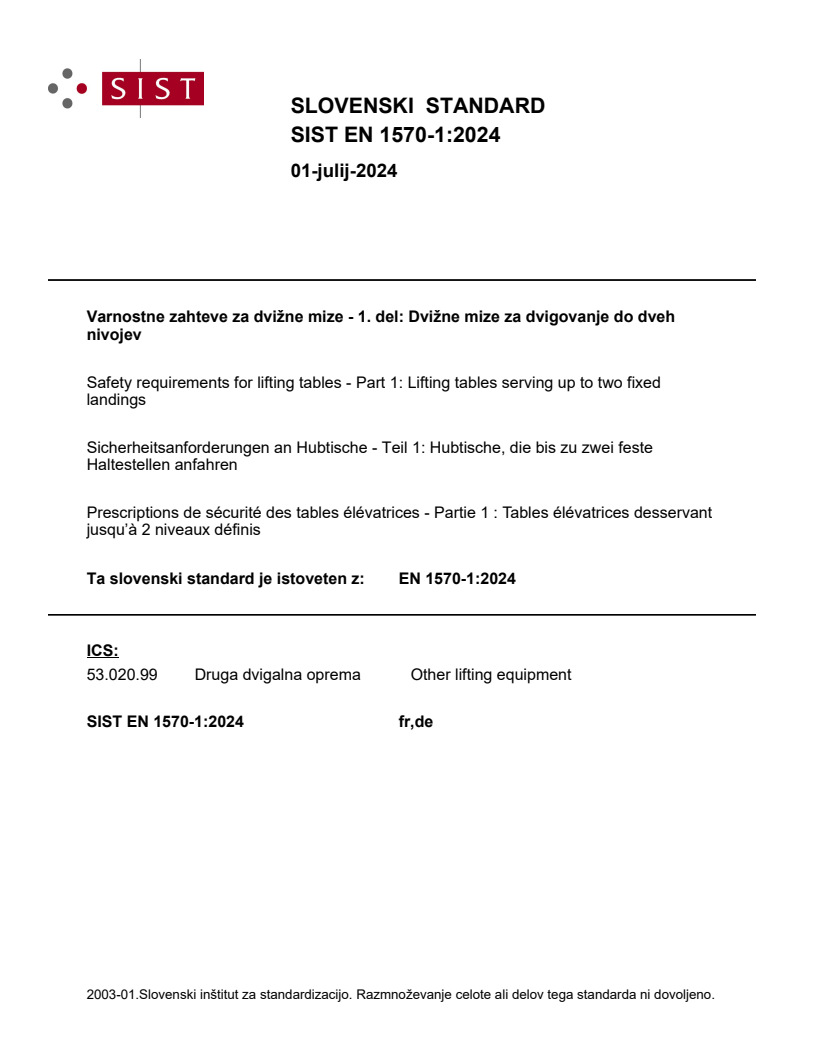
SLOVENSKI STANDARD
01-julij-2024
Varnostne zahteve za dvižne mize - 1. del: Dvižne mize za dvigovanje do dveh
nivojev
Safety requirements for lifting tables - Part 1: Lifting tables serving up to two fixed
landings
Sicherheitsanforderungen an Hubtische - Teil 1: Hubtische, die bis zu zwei feste
Haltestellen anfahren
Prescriptions de sécurité des tables élévatrices - Partie 1 : Tables élévatrices desservant
jusqu’à 2 niveaux définis
Ta slovenski standard je istoveten z: EN 1570-1:2024
ICS:
53.020.99 Druga dvigalna oprema Other lifting equipment
2003-01.Slovenski inštitut za standardizacijo. Razmnoževanje celote ali delov tega standarda ni dovoljeno.
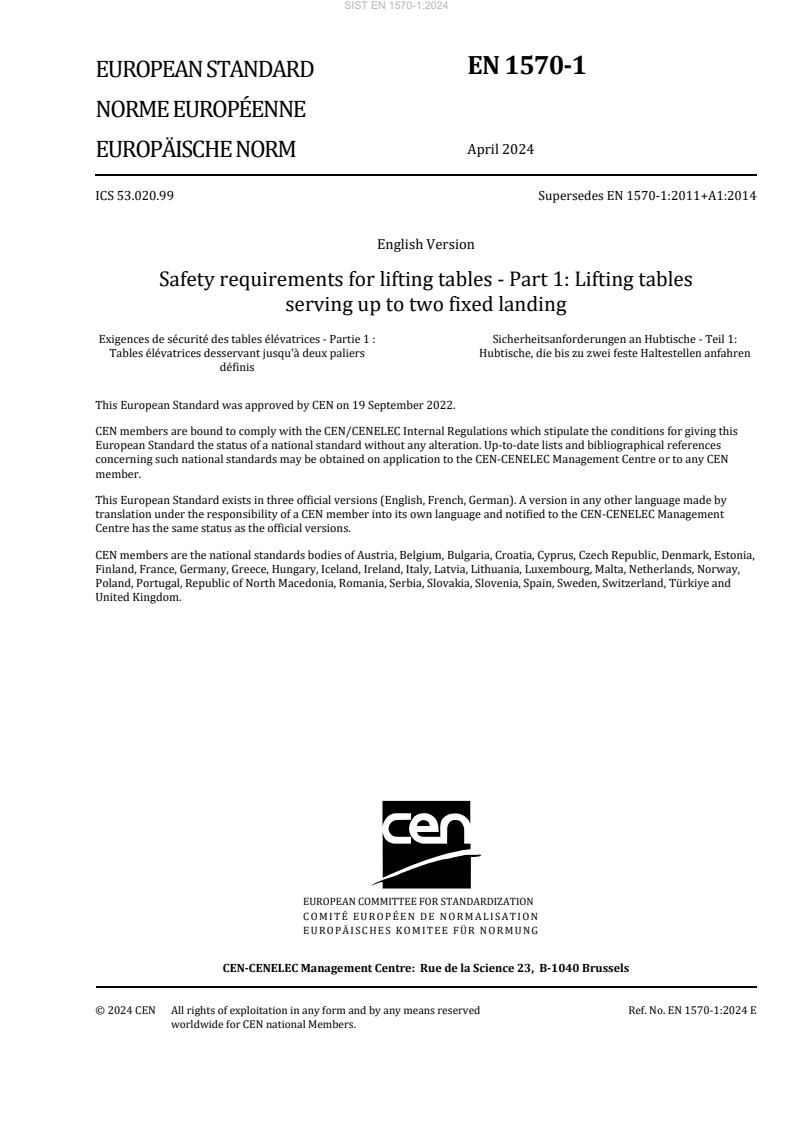
EN 1570-1
EUROPEAN STANDARD
NORME EUROPÉENNE
April 2024
EUROPÄISCHE NORM
ICS 53.020.99 Supersedes EN 1570-1:2011+A1:2014
English Version
Safety requirements for lifting tables - Part 1: Lifting tables
serving up to two fixed landing
Exigences de sécurité des tables élévatrices - Partie 1 : Sicherheitsanforderungen an Hubtische - Teil 1:
Tables élévatrices desservant jusqu'à deux paliers Hubtische, die bis zu zwei feste Haltestellen anfahren
définis
This European Standard was approved by CEN on 19 September 2022.
CEN members are bound to comply with the CEN/CENELEC Internal Regulations which stipulate the conditions for giving this
European Standard the status of a national standard without any alteration. Up-to-date lists and bibliographical references
concerning such national standards may be obtained on application to the CEN-CENELEC Management Centre or to any CEN
member.
This European Standard exists in three official versions (English, French, German). A version in any other language made by
translation under the responsibility of a CEN member into its own language and notified to the CEN-CENELEC Management
Centre has the same status as the official versions.
CEN members are the national standards bodies of Austria, Belgium, Bulgaria, Croatia, Cyprus, Czech Republic, Denmark, Estonia,
Finland, France, Germany, Greece, Hungary, Iceland, Ireland, Italy, Latvia, Lithuania, Luxembourg, Malta, Netherlands, Norway,
Poland, Portugal, Republic of North Macedonia, Romania, Serbia, Slovakia, Slovenia, Spain, Sweden, Switzerland, Türkiye and
United Kingdom.
EUROPEAN COMMITTEE FOR STANDARDIZATION
COMITÉ EUROPÉEN DE NORMALISATION
EUROPÄISCHES KOMITEE FÜR NORMUNG
CEN-CENELEC Management Centre: Rue de la Science 23, B-1040 Brussels
© 2024 CEN All rights of exploitation in any form and by any means reserved Ref. No. EN 1570-1:2024 E
worldwide for CEN national Members.
Contents Page
European foreword . 4
Introduction. 6
1 Scope . 7
2 Normative references . 8
3 Terms and definitions. 10
4 Safety requirements and/or protective/risk reduction measures . 14
4.1 General . 14
4.2 Calculations . 14
4.2.1 Stresses . 14
4.2.2 Platform deflection . 16
4.2.3 Strength of the building/structure supporting the lifting table . 17
4.2.4 Stability . 17
4.3 General requirements for all lifting tables . 18
4.3.1 Protection against crushing and shearing. 18
4.3.2 High temperatures . 20
4.3.3 Speed . 20
4.4 Protection for the travel zone and for the platform . 20
4.4.1 General . 20
4.4.2 Protection from the travel zone at an upper landing . 21
4.4.3 Protection for the area underneath the platform. 22
4.4.4 Platform protection . 22
4.4.5 Guard-rails . 23
4.4.6 Screens . 24
4.4.7 Opening protections within guard-rails or screens . 25
4.4.8 Flexible guards . 31
4.4.9 Deflectors . 31
4.5 Design of the platform . 32
4.5.1 General . 32
4.5.2 Anchorages . 32
4.6 Levels and clearances of fixed landings . 33
4.7 Driving system . 33
4.7.1 General . 33
4.7.2 Hydraulic drive system . 35
4.7.3 Mechanical drive systems . 36
4.7.4 Rope drives . 37
4.7.5 Tension chain drives . 38
4.7.6 Rigid chain drives . 38
4.7.7 Screw drives . 39
4.7.8 Rack and pinion drives . 39
4.7.9 Belt drives . 39
4.7.10 Manual drives . 40
4.8 Controls . 40
4.9 Electrical system . 42
4.9.1 General . 42
4.9.2 Protection rating . 42
4.9.3 Batteries . 43
4.10 Safety devices . 43
4.10.1 General . 43
4.10.2 Safety edges . 43
4.10.3 Maintenance support . 44
4.11 Additional requirements for mobile lifting tables . 44
4.12 Additional requirements for lifting tables in AGVs and in skillet-lines . 48
5 Verification of the safety requirements and/or measures. 50
5.1 General . 50
5.2 Design check . 51
5.3 Manufacturing check . 51
5.4 Visual inspection . 51
5.5 Practical test . 52
5.6 Electrical tests . 52
6 Instructions for the user . 52
6.1 General . 52
6.2 Marking . 52
6.3 Instructions for use . 54
6.4 Instructions for installation . 55
6.5 Instructions for maintenance and inspection . 56
Annex A (normative) Test procedures . 58
Annex B (informative) List of significant hazards . 60
Annex C (normative) Manual force measurements methods . 64
C.1 Driving lifting tables . 64
C.2 Maximum allowable forces for raising and lowering manual lifting tables. 64
Annex D (normative) Dimensions of steps and ladders . 65
Annex E (informative) Sign pictograms . 67
Annex F (informative) Controls and corresponding pictograms . 69
F.1 General . 69
F.2 Requirements according to 4.8.3 . 69
Annex G (informative) Risk when passing an upper landing . 72
Annex H (informative) Machines covered by this standard versus EN 280 machines . 73
Annex I (informative) Guide to travel zone risks . 76
I.1 General . 76
I.2 Landing, risk question 1. 77
I.3 Landing, risk question 2 and 3 . 78
I.4 Platform, risk question 4 . 79
I.5 Platform, risk question 5 and 6 . 80
Annex ZA (informative) Relationship between this European Standard and the essential
requirements of EU Directive 2006/42/EC aimed to be covered . 81
Bibliography . 85
European foreword
This document (EN 1570-1:2024) has been prepared by Technical Committee CEN/TC 98 “Lifting
platforms”, the secretariat of which is held by DIN.
This European Standard shall be given the status of a national standard, either by publication of an
identical text or by endorsement, at the latest by October 2024, and conflicting national standards shall
be withdrawn at the latest by October 2024.
Attention is drawn to the possibility that some of the elements of this document may be the subject of
patent rights. CEN shall not be held responsible for identifying any or all such patent rights.
This document supersedes EN 1570-1:2011+A1:2014.
The revisions to the standard are based mainly on the following points, which are embedded throughout
the document:
— a wholesale restructure of the document;
— the inclusion for lifting tables in non-industrial applications; Static Elevating Work Platforms and
lifting tables used in Skillet lines or Autonomous Ground Vehicles;
— the ability to pass a fixed landing and to carry authorized persons when under operator control;
— the introduction of rated and structural loads;
— the replacement of EN 1570-1:2011+A1:2014, Table 3 – Lift installation safeguard requirements
with new flow charts within Annex I – Guide to travel zone risks;
— where appropriate, risk of falling is now associated with the height of fall rather than the travel height
of the machine;
— greater emphasis on protection of the public when the lifting tables are used in public accessible
areas;
— the reintroduction of boom barriers and clarity on interlocking and locking requirements for
removable guard-rails;
— locking of the lift table when at an upper fixed landing;
— the relaxation of overload monitoring limits due to the lack of appropriate state of the art equipment;
— restrictions on the use of pipe rupture protection devices in hydraulic systems;
— the introduction of rigid / pusher chains and the removal of pneumatic drives.
This document has been prepared under a standardization request addressed to CEN by the European
Commission. The Standing Committee of the EFTA States subsequently approves these requests for its
Member States.
For the relationship with EU Legislation, see informative Annex ZA, which is an integral part of this
document.
Any feedback and questions on this document should be directed to the users’ national standards body.
A complete listing of these bodies can be found on the CEN website.
According to the CEN-CENELEC Internal Regulations, the national standards organisations of the
following countries are bound to implement this European Standard: Austria, Belgium, Bulgaria, Croatia,
Cyprus, Czech Republic, Denmark, Estonia, Finland, France, Germany, Greece, Hungary, Iceland, Ireland,
Italy, Latvia, Lithuania, Luxembourg, Malta, Netherlands, Norway, Poland, Portugal, Republic of North
Macedonia, Romania, Serbia, Slovakia, Slovenia, Spain, Sweden, Switzerland, Türkiye and the United
Kingdom.
Introduction
This document was drafted as a design guidance manual to provide a means of achieving conformance to
the essential safety requirements stipulated under Machinery Directive 2006/42/EC.
As lifting tables are used in a wide range of applications, it is equally necessary to perform individual risk
assessments in accordance with EN ISO 12100:2010 for the actual operating conditions.
Products sold indirectly to end-users should be built to cover all the risks related to the use and all
conditions foreseeable by the manufacturer, as described and detailed in the instruction manual.
Where the text gives an example of a safety measure for the purposes of greater clarity, this should not
be considered as the only possible solution. Any other solution leading to the same risk reduction is
permissible if an equivalent or increased level of safety is achieved.
While drafting this document, it was assumed that:
— the lifting tables are only operated by persons trained in the use of the equipment in accordance with
the manufacturer’s instructions, and that the working area is adequately lit;
— the lifting tables are installed or used on hard standing, even, appropriately prepared surfaces;
— where there are special requirements on low noise levels, such as for hospital applications and
theatres, etc., the customer should specify these requirements and the manufacturer should then take
all appropriate measures.
When provisions of this type C standard are different from those which are stated in type A or B
standards, the provisions of this type C standard take precedence over the provisions of the other
standards, when machines have been designed and built according to the provisions of this type C
standard.
1 Scope
1.1 This document specifies the safety requirements for lifting tables with the following characteristics:
— serving no more than 2 fixed landings but able to pass a fixed landing and,
— having a vertical travel speed of no more than 0,15 m/s, unless safe by position and,
— for raising or lowering goods (with or without operator(s) and/or authorized person(s)), or;
— for raising or lowering operator(s) and/or authorized person(s) with or without goods, to
positions where they can carry out work from a fixed or movable lifting table that is guided
throughout its vertical travel only (see Annex H).
1.2 This document specifies the appropriate technical measures for eliminating and reducing the risks
arising from the significant hazards listed in Annex B.
1.3 This document does not apply to the following equipment:
— lifting tables with a vertical travel speed exceeding 0,15 m/s, unless safe by position;
— lifting tables, serving more than 2 fixed landings of a construction, for lifting goods, with a vertical
travel speed not exceeding 0,15 m/s (EN 1570-2:2016);
— lifting tables, serving more than 2 fixed landings of a construction, for lifting operators, with a vertical
travel speed not exceeding 0,15 m/s;
— lifting tables carrying operators and installed in full enclosures with a vertical travel speed not
exceeding 0,15 m/s;
— lifting tables used on ships;
— lifting tables designed for artists and stage set features during artistic performances
(EN 17206:2020);
— power operated lifting platforms for persons with impaired mobility (EN 81-41:2010);
— mobile lifting tables for airport ground support equipment (EN 1915-2:2001+A1:2009 and
EN 12312-1:2013);
— mobile elevating work platforms (EN 280-1:2022);
— static Group B elevating work platforms (EN 280-1:2022);
— vehicle servicing lifts (EN 1493:2022);
— mobile lifting tables used for firefighting (EN 1777:2010);
— mobile lifting tables with a horizontal travelling speed of more than 1,6 m/s;
— rail dependent storage and retrieval equipment (EN 528:2021+A1:2022);
— scissor lift pallet trucks (EN ISO 3691-5:2015, including EN ISO 3691-5:2015/AC:2016 and
EN ISO 3691-5:2015/A1:2020);
— lifting tables suspended from a ceiling.
1.4 This document does not consider the additional requirements for:
— electromagnetic compatibility;
— operation in severe conditions (e.g. extreme climates, freezer applications, strong magnetic fields);
— operation subject to special rules (e.g. potentially explosive atmospheres, mines);
— handling of loads, the nature of which could lead to dangerous situations (e.g. molten metal, acids,
radiating materials, particularly brittle loads, loose loads (gravel, tubes));
— hazards occurring during construction, transportation, and disposal;
— equipment installed on the load platform or the replacing or maintaining of it;
— integration into broader systems or other machines, etc.;
— cable-less controls, i.e. wireless;
— lifting tables where the hydraulic pressure is derived directly from gas pressure;
— lifting tables powered by internal combustion engines.
2 Normative references
The following documents are referred to in the text in such a way that some or all of their content
constitutes requirements of this document. For dated references, only the edition cited applies. For
undated references, the latest edition of the referenced document (including any amendments) applies.
EN 280-1:2022, Mobile elevating work platforms — Part 1: Design calculations — Stability criteria —
Construction — Safety — Examinations and tests
EN 1493:2022, Vehicle lifts
EN 12453:2017+A1:2021, Industrial, commercial and garage doors and gates — Safety in use of power
operated doors — Requirements and test methods
EN 60204-1:2018, Safety of machinery — Electrical equipment of machines — Part 1: General requirements
(IEC 60204-1:2016, modified)
EN 60204-32:2008, Safety of machinery — Electrical equipment of machines — Part 32: Requirements for
hoisting machines (IEC 60204-32:2008)
EN 60529:1991, Degrees of protection provided by enclosures (IP Code) (IEC 60529:1989)
EN 60947-5-1:2017, Low-voltage switchgear and controlgear — Part 5-1: Control circuit devices and
switching elements — Electromechanical control circuit devices (IEC 60947-5-1:2016)
As impacted by EN 60529:1991/AC:2006-12, EN 60529:1991/A1:2000, EN 60529:1991/A2:2013 and
EN 60529:1991/A2:2013/AC:2019-02.
As impacted by EN 60947-5-1:2017/AC:2020-05.
EN 60947-5-3:2013, Low-voltage switchgear and controlgear — Part 5-3: Control circuit devices and
switching elements — Requirements for proximity devices with defined behaviour under fault conditions
(PDDB) (IEC 60947-5-3:2013)
EN 61310-2:2008, Safety of machinery — Indication, marking and actuation — Part 2: Requirements for
marking (IEC 61310-2:2007)
EN IEC 61496-1:2020, Safety of machinery — Electro-sensitive protective equipment — Part 1: General
requirements and tests (IEC 61496-1:2020)
EN IEC 61496-2:2020, Safety of machinery — Electro-sensitive protective equipment — Part 2: Particular
requirements for equipment using active opto-electronic protective devices (AOPDs) (IEC 61496-2:2020)
EN IEC 60947-5-2:2020, Low-voltage switchgear and controlgear — Part 5-2: Control circuit devices and
switching elements — Proximity switches
EN ISO 4413:2010, Hydraulic fluid power — General rules and safety requirements for systems and their
components (ISO 4413:2010)
EN ISO 11161:2007, Safety of machinery — Integrated manufacturing systems — Basic requirements
(ISO 11161:2007)
EN ISO 12100:2010, Safety of machinery — General principles for design — Risk assessment and risk
reduction (ISO 12100:2010)
EN ISO 13849-1:2023, Safety of machinery — Safety-related parts of control systems — Part 1: General
principles for design (ISO 13849-1:2023)
EN ISO 13850:2015, Safety of machinery — Emergency stop function — Principles for design (ISO
13850:2015)
EN ISO 13856-2:2013, Safety of machinery — Pressure-sensitive protective devices — Part 2: General
principles for design and testing of pressure-sensitive edges and pressure-sensitive bars (ISO 13856-2:2013)
EN ISO 13857:2019, Safety of machinery — Safety distances to prevent hazard zones being reached by
upper and lower limbs (ISO 13857:2019)
EN ISO 14119:2013, Safety of machinery — Interlocking devices associated with guards — Principles for
design and selection (ISO 14119:2013)
EN ISO 14120:2015, Safety of machinery — Guards — General requirements for the design and construction
of fixed and movable guards (ISO 14120:2015)
EN ISO 14122-3:2016, Safety of machinery — Permanent means of access to machinery — Part 3: Stairs,
stepladders and guard-rails (ISO 14122-3:2016)
ISO 606:2015, Short-pitch transmission precision roller and bush chains, attachments and associated chain
sprockets
ISO 2408:2017, Steel wire ropes — Requirements
As impacted by EN IEC 60947-5-2:2020/A11:2022.
As impacted by EN ISO 11161:2007/A1:2010.
ISO 4301-1:2016, Cranes — Classification — Part 1: General
ISO 4347:2015, Leaf chains, clevises and sheaves — Dimensions, measuring forces, tensile strengths and
dynamic strengths
ISO 11228-1:2021, Ergonomics — Manual handling — Part 1: Lifting, lowering and carrying
ISO 11228-2:2007, Ergonomics — Manual handling — Part 2: Pushing and pulling
ISO 16625:2013, Cranes and hoists — Selection of wire ropes, drums and sheaves
3 Terms and definitions
For the purposes of this document, the terms and definitions given in EN ISO 12100:2010 and the
following apply.
ISO and IEC maintain terminology databases for use in standardization at the following addresses:
— ISO Online browsing platform: available at https://www.iso.org/obp
— IEC Electropedia: available at https://www.electropedia.org/
3.1
lifting table
lifting device with a load supporting platform rigidly guided throughout its travel
Note 1 to entry: A scissor lift or mast lift for example.
3.2
fixed lifting table
lifting table where the place of installation is not intended to be changed, according to the manufacturer’s
instructions
3.3
movable lifting table
lifting table installed so that the place of installation may be readily changed without integrated devices
Note 1 to entry: By use of a crane, forklift or similar for example.
3.4
mobile lifting table
lifting table which is mobile by one or more integrated devices
Note 1 to entry: By use of wheels or air cushions for example.
3.5
guided mobile lifting table
lifting table which runs on a pre-set route
Note 1 to entry: Running on tracks or in rails for example.
3.6
work platform
platform which can be moved under load to the required working position and from which erection,
repair, inspection, or similar work can be carried out
3.7
maintenance support
device that can be set up in such a way that maintenance and repair work below the platform can be
carried out safely
3.8
self-propelled lifting table
lifting table, other than vehicle mounted, which is capable of horizontal movement under its own power
3.9
operator
person who is trained and authorised/permitted by the duty holder, to operate the lifting table, according
to the manufacturer’s instructions
Note 1 to entry: The machine owner is considered as the duty holder.
3.10
authorised person
person whose presence in the area is authorised/permitted by the operator and whose safety is the
responsibility of the operator
3.11
fixed landing
permanent level of the construction for loading and unloading the lifting table
3.12
variable landing
non-permanent level for loading and unloading of the lifting table
Note 1 to entry: Vehicle serving for example.
3.13
platform
part of the lifting table (including extensions) designed to accommodate the working load and/or
persons; fork arms are considered as a load platform for goods only
3.14
rated load
load that consists of goods, persons, tools, and material acting vertically on the work platform and that
the manufacturer has stated the machine is capable of lifting/lowering when used in accordance with the
instruction manual
3.15
structural load
load, excluding rated load, comprising of any equipment that is fixed on the platform
Note 1 to entry: Structural load may include guard-rails, gates, roller conveyors etc.
Note 2 to entry: Structural load shall be considered as part of the lifting table self-weight.
3.16
guard
part of the machine or the surrounding structure specifically used to provide protection by means of a
physical barrier
3.17
maximum working pressure
highest pressure in the hydraulic system at which it is intended to operate under normal working
conditions with rated load and, if any, structural load
3.18
travel zone
space through which the lifting mechanism and load, platform, and any attachment to it moves
3.19
non-public area
area to which access is restricted only to persons who are authorised to be in that area, and not accessible
to the public
3.20
public area
space open to persons without specific training, instruction or awareness including children
3.21
vertical travel speed
average lifting and lowering speed of the platform when measured throughout its normal travel range
3.22
screen
permanent protection from access to the hazard for the whole body, also called distance guards in
EN ISO 14120:2015
3.23
guard-rail
device for protection against accidental fall or accidental access to a hazardous area, with which stairs,
step ladders, landings or platforms and walkways (level surface used for moving from one point to
another) may be equipped
3.24
removable guard-rail
guard-rail designed to be removable without the use of a tool
Note 1 to entry: Bolted guard-rails are not considered removable.
3.25
enclosure
permanent protection where the whole of the travel zone is protected with rigid guards to make the lifting
table inaccessible whilst in operation, i.e. safe by position
3.26
automatically controlled lifting table
lifting table whose operating sequence is determined by a control program, which can be semi-automatic
when operations are initiated by an operator, or fully automatic when no operator intervention is
required
3.27
gate
opening part within a guard-rail, enclosure, or screen, to give access from a landing or a platform
3.28
inward opening gate
platform mounted inward opening gate is always opened towards the centre of the platform; and a
landing mounted inward opening gate is opened away from the centre of the platform
3.29
outward opening gate
platform mounted outward opening gate is always opened away from the centre of the platform; and a
landing mounted outward opening gate is opened towards the centre of the platform
3.30
safe by position
condition when a lifting table or any part of a lifting table or load is sufficiently shielded from being
reached or accessed during operation, to avoid any hazard to persons or goods according to
EN ISO 13857:2019
3.31
remote control
cable connected control device, static or pendant, that is not situated on the platform
3.32
hinged connecting plate
plate mounted to the edge of the platform by a hinge to connect the platform to a landing (fixed or
variable)
3.33
unassisted hinged connecting plate
hinged connecting plate that is entirely manually operated
3.34
assisted hinged connecting plate
hinged connecting plate that is counterbalanced to reduce the manual effort of operating the plate
Note 1 to entry: Counterbalanced may be by spring or weights for example.
3.35
power actuated hinged connecting plate
hinged connecting plate that requires no manual effort to operate
3.36
interlocking device
mechanical, electrical, or other type of device, the purpose of which is to prevent the operation of
hazardous machine functions under specified conditions (generally as long as a guard is not closed)
[SOURCE: EN ISO 12100:2010, 3.28.1]
3.37
skillet-line
system utilising platforms (skillets) to transport materials or products through various assembly
operations providing access around the perimeter of the product, enabling the worker to travel with the
product as it is conveyed through the various stages of assembly
3.38
AGV
driverless industrial truck that follows marked lines or wires on the floor, or uses radio or satellite signals,
vision cameras, magnets, or lasers for navigation to transport loads
3.39
externally operated non-return valve
non-return check valve that can be overridden by external means, e.g. actuated electrically or manually
3.40
rigid guarding
physical, non-flexible, barrier
Note 1 to entry: A physical barrier may be a guard-rail or wall for example.
4 Safety requirements and/or protective/risk reduction measures
4.1 General
Machinery shall comply with the safety requirements and/or protective/risk reduction measures of this
clause. In addition, the machine shall be designed according to the principles of EN ISO 12100:2010 for
relevant, but not significant hazards, not dealt with by this document.
4.2 Calculations
4.2.1 Stresses
4.2.1.1 The lifting table shall be designed in accordance with usual calculation codes and good
engineering practice and all failure modes of the material shall be considered, including fatigue failure.
4.2.1.2 The stresses in any part of the lifting table assessed using the permissible stress method shall
not, under normal working conditions, exceed the lowest of the following values:
1) 0,66 times the yield stress of the material used; or
2) 0,50 times the ultimate tensile stress of the material used.
4.2.1.3 The stresses shall be calculated for a lifting table carrying its rated load and, if any, structural
load whilst being used in compliance with the manufacturer’s instructions.
The loads shall include all real static and dynamic forces, both vertical and horizontal, any wind forces,
and all forces applied to the platform during loading and unloading. In case of extending part(s) of the
platform, the calculations shall consider the extension in the worst condition.
If wind forces are to be considered in the calculations, EN 280-1:2022, 4.2.3.3 shall be applied.
4.2.1.4 The minimum dynamic forces to be used for the calculations set out under 4.2.1.3 shall result
from:
1) the total vertical load (this includes the rated load and, if any, structural load, and the self-weight of
the moving parts of the structure) increased by the dynamic factor for the category of lift shown in
Table 1;
2) the horizontal load coefficient for the category of lift shown in Table 1, taken as acting horizontally
at the platform level in the direction causing the maximum stress in the part being considered.
Table 1 — Load factors for lifting tables
b
Lift Dynamic Horizontal load Application
Lifetime
category factor coefficient [in % of
minimum load
the rated load]
cycles under full
load [ × 10 ]
a
1 1,4 10
Lifting tables for general purpose.
2 1,1 2,5 8 Lifting tables with a clearly defined
lifting load and where other forces can
be excluded; height adjustment
without systematic lateral forces.
3 1,2 5,0 32 Lifting tables suited for the use of
manual work; e.g. adjustable height
workstation.
4 1,3 10 128 Lifting tables suited for crossing with,
e.g. manually operated industrial
trucks, electric pallet-stacking trucks
with a maximum braking of 10 %.
Lifting tables with mounted gravity
conveyors.
5 1,4 10 512 Lifting tables suited for a high number
of cycles, e.g. for fully automatic
production lines.
c d a
6 Lifting tables used in skillet lines.
1,6 20 128
c d a
7 Lifting tables used as part of AGVs.
1,8 20 128
When a lifting table is crossed by vehicles, or is integrated in a handling device, the lateral forces have to be
verified in individual cases. Higher horizontal load coefficients have to be established if required.
a
This minimum number of cycles shall be increased by the manufacturer according to the use of the lifting table.
b
When load cycle is used, in relation to lifting categories, the lifetime of lifting tables is generally 10 years when maintained
in accordance with the manufacturer’s instructions.
c
Where skillet-lines or AGVs are used on uneven floors/driveways, the dynamic factor shall be increased to ensure that
the load bearing structure of the lifting table withstands the increased forces.
d
Horizontally moving lifting tables with high apex speeds, whilst turning, may require a higher value for the horizontal
load coefficient.
When determining the minimum dynamic forces used in the calculations, the following must be taken
into consideration:
1) where rigid guarding prevents loading or unloading across a side, or other means prevent force
transmission to the platform in a particular direction, the horizontal load coefficient in this direction
need not be considered;
2) that lifting tables are classified in 7 categories (called lift category) depending on the use for which
they are designed. The dynamic factor, horizontal load coefficient and number of cycles used in the
design calculations shall be as defined in Table 1;
3) any likely wind forces, shall be in addition to the horizontal load coefficient calculations.
4.2.1.5 If operators and/or authorized persons are to be carried on the platform, their load shall be
taken as 80 kg, concentrated in an area of 0,2 m by 0,2 m for each person, spaced apart at 0,5 m centres
and placed in the most unfavourable position on the platform for stress and tilt calculations.
4.2.1.6 The use of the maintenance support(s) when applied according to the manufacturer's
instructions, must not cause permanent deformation of the normal load bearing parts.
4.2.2 Platform deflection
When the lifting table is not designed for a specific loading, it shall be designed to meet all the following
load requirements (see Figure 1):
— firstly, the rated load evenly distributed over the usable platform area;
— secondly, half the rated load distributed over half the usable platform length or longest side of the
platform;
— finally, one third of the rated load distributed over half the usable platform width or shortest side of
the platform.
The load requirements shall be fulfilled when the platform is in the worst stressed position.
If the lifting table is driven by a scissor mechanism, the longest side is considered as the side parallel to
the scissor arms and the shortest side is considered as the side perpendicular to the scissor arms.
If the lifting table is driven by a non-scissor mechanism, the manufacturer shall describe the permissible
loading configuration that the machine is designed for in the instructions for use (see 6.3.1).
Key
l length
w width
Figure 1 — Load distribution requirements
In neither case shall hazardous, tilting or deflection take place when used as intended by the
manufacturer. The maximum tilting or deflection shall not exceed that shown in Figure 2 where:
a) is the maximum tilting or deflection (y) of any side up to 2,0 m (l) long and is y = (1+ (2 − l)) %;
b) is the maximum tilting or deflection (y) of any side above 2,0 m (l) long and is y = 1,0 %.
Key
y percentage tilting or deflection of a side l
l length of the side of a lifting table platform (in metres)
a maximum tilting or deflection of any side up to 2,0 m
b maximum tilting or deflection of any side above 2,0 m
Figure 2 — Deflection of platform
4.2.3 Strength of the building/structure supporting the lifting table
The support (and, if appropriate, the load-bearing structure of the construction) to which the lifting table
is attached shall be built to withstand all the reasonably foreseeable static and dynamic vertical and
horizontal forces generated by both the load and the lifting table itself during normal operation and
exceptional operating conditions, e.g. anti-fall device operation.
The design shall address all dynamic forces and all externally imposed forces,
...
Questions, Comments and Discussion
Ask us and Technical Secretary will try to provide an answer. You can facilitate discussion about the standard in here.