

EN 13523-12:2024
(Main)Coil coated metals - Test methods - Part 12: Resistance to scratching
General Information
- Abstract
This document specifies the procedure for determining the resistance of an organic coating on a metallic substrate to penetration by scratching with a needle.
It is possible that with some aluminium alloys and thin gauge steel substrate below 0,4 mm, that rather than scratching, the needle will deform the substrate. Under these conditions, this test method is not applicable.
Soft coatings such as poly vinyl chloride (PVC) and structured coatings will not give a precise result due to the soft nature of the coating and/or the potential for the needle to snag.
The method is not applicable to conductive coatings.
- Status
- Published
- Publication Date
- 23-Apr-2024
- Technical Committee
- CEN/TC 139 - Paints and varnishes
- Drafting Committee
- CEN/TC 139/WG 9 - Testing of coil coated metals
- Current Stage
- 6060 - Definitive text made available (DAV) - Publishing
- Start Date
- 24-Apr-2024
- Due Date
- 06-Aug-2025
- Completion Date
- 24-Apr-2024

Overview
EN 13523-12:2024 – Coil Coated Metals – Test Methods – Part 12: Resistance to Scratching is a European Standard developed by CEN for assessing the scratch resistance of organic coatings applied on metallic substrates. This standard outlines a precise method for measuring how well an organic coating, such as those used on steel or aluminium sheets in coil coating applications, withstands penetration when scratched with a needle under controlled laboratory conditions.
This procedure is essential for quality control and product development in industries where coated metals must endure mechanical stress without losing their protective or decorative attributes.
Key Topics
Scope and Applicability
- The method determines the resistance of organic coatings on metals to penetration by scratching using a specified needle.
- Not suitable for thin gauge steel below 0.4 mm or certain aluminium alloys, as the substrate may deform instead of only scratching.
- Not applicable to soft coatings (e.g., polyvinyl chloride), structured coatings, or conductive coatings, as results cannot be reliably measured.
Test Principle
- A coated metal test panel is placed under a scratch apparatus equipped with a spherical-tip needle.
- A defined load is applied to the needle, and the panel is drawn underneath it at constant speed. Any penetration of the coating to the underlying metal is detected electrically.
- Tests are repeated to ensure repeatability, and results are reported as either “pass/fail” at a given load or as the mean load at which penetration occurs.
Test Conditions
- Standard ambient conditions are used, with more stringent temperature and humidity control if needed for disputes.
- Coating and panel preparation, as well as direction of scratch (relative to the rolling direction), are defined according to EN 13523-0.
Applications
EN 13523-12:2024 is used in various industrial contexts, especially in:
Manufacturing and Quality Control
- Ensures that coil-coated steel and aluminium products meet resistance requirements before shipment.
- Useful for validating durability in architectural panels, household appliance parts, automotive components, and construction profiles.
Product Development
- Allows for comparison and optimization of different organic coatings, providing essential data for selecting coating systems with improved scratch resistance.
Specification and Compliance
- Referenced in technical datasheets and procurement specifications for customers requiring validated scratch resistance in coated metal products.
By adopting EN 13523-12:2024, manufacturers can demonstrate compliance with recognized European best practices, enhancing product reliability and competitive advantage.
Related Standards
EN 13523-0:2021
Coil coated metals - Test methods - Part 0: General introductionEN ISO 1518-1
Paints and varnishes - Determination of scratch resistance - Part 1: Constant-loading methodEN 10169
Continuously organic coated (coil coated) steel flat products - Technical delivery conditionsEN 1396
Aluminium and aluminium alloys - Coil coated sheet and strip for general applications - Specifications
These standards are foundational for professionals conducting testing, certification, and development of coil coated metal products. Using the latest edition, such as EN 13523-12:2024, ensures up-to-date procedures and compatibility with current industry and market requirements. For broader coating performance assessment, consult the entire EN 13523 series, which addresses a comprehensive range of physical and chemical properties for coil coated metals.
Relations
- Effective Date
- 03-May-2023
- Effective Date
- 28-Jan-2026
- Effective Date
- 28-Jan-2026
- Effective Date
- 28-Jan-2026
- Effective Date
- 28-Jan-2026
- Effective Date
- 28-Jan-2026
Get Certified
Connect with accredited certification bodies for this standard

DVS-ZERT GmbH
German welding certification society.
CARES (UK Certification Authority for Reinforcing Steels)
UK certification for reinforcing steels and construction.
EWF/IIW (European/International Welding Federation)
International welding personnel certification.
Sponsored listings
Frequently Asked Questions
EN 13523-12:2024 is a standard published by the European Committee for Standardization (CEN). Its full title is "Coil coated metals - Test methods - Part 12: Resistance to scratching". This standard covers: This document specifies the procedure for determining the resistance of an organic coating on a metallic substrate to penetration by scratching with a needle. It is possible that with some aluminium alloys and thin gauge steel substrate below 0,4 mm, that rather than scratching, the needle will deform the substrate. Under these conditions, this test method is not applicable. Soft coatings such as poly vinyl chloride (PVC) and structured coatings will not give a precise result due to the soft nature of the coating and/or the potential for the needle to snag. The method is not applicable to conductive coatings.
This document specifies the procedure for determining the resistance of an organic coating on a metallic substrate to penetration by scratching with a needle. It is possible that with some aluminium alloys and thin gauge steel substrate below 0,4 mm, that rather than scratching, the needle will deform the substrate. Under these conditions, this test method is not applicable. Soft coatings such as poly vinyl chloride (PVC) and structured coatings will not give a precise result due to the soft nature of the coating and/or the potential for the needle to snag. The method is not applicable to conductive coatings.
EN 13523-12:2024 is classified under the following ICS (International Classification for Standards) categories: 25.220.60 - Organic coatings. The ICS classification helps identify the subject area and facilitates finding related standards.
EN 13523-12:2024 has the following relationships with other standards: It is inter standard links to EN 13523-12:2017, EN 23270:1991, EN 13523-0:2021, EN 10169:2010+A1:2012, EN 13523-0:2014, EN 10169:2022. Understanding these relationships helps ensure you are using the most current and applicable version of the standard.
EN 13523-12:2024 is available in PDF format for immediate download after purchase. The document can be added to your cart and obtained through the secure checkout process. Digital delivery ensures instant access to the complete standard document.
Standards Content (Sample)
SLOVENSKI STANDARD
01-september-2024
Nadomešča:
SIST EN 13523-12:2017
Prevlečene kovine, ki se navijajo - Preskusne metode - 12. del: Odpornost proti
razenju
Coil coated metals - Test methods - Part 12: Resistance to scratching
Bandbeschichtete Metalle - Prüfverfahren - Teil 12: Widerstand gegen Ritzen
Tôles prélaquées - Méthodes d'essai - Partie 12 : Résistance à la rayure
Ta slovenski standard je istoveten z: EN 13523-12:2024
ICS:
17.040.20 Lastnosti površin Properties of surfaces
25.220.60 Organske prevleke Organic coatings
2003-01.Slovenski inštitut za standardizacijo. Razmnoževanje celote ali delov tega standarda ni dovoljeno.
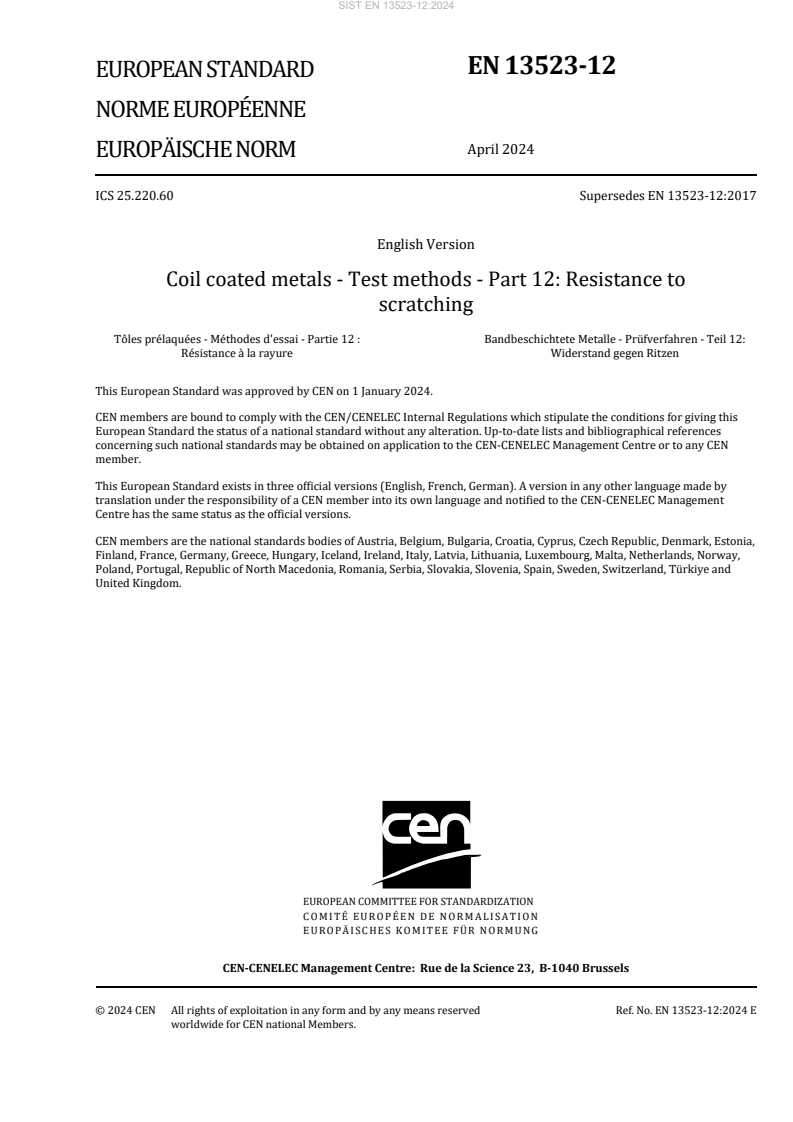
EN 13523-12
EUROPEAN STANDARD
NORME EUROPÉENNE
April 2024
EUROPÄISCHE NORM
ICS 25.220.60 Supersedes EN 13523-12:2017
English Version
Coil coated metals - Test methods - Part 12: Resistance to
scratching
Tôles prélaquées - Méthodes d'essai - Partie 12 : Bandbeschichtete Metalle - Prüfverfahren - Teil 12:
Résistance à la rayure Widerstand gegen Ritzen
This European Standard was approved by CEN on 1 January 2024.
CEN members are bound to comply with the CEN/CENELEC Internal Regulations which stipulate the conditions for giving this
European Standard the status of a national standard without any alteration. Up-to-date lists and bibliographical references
concerning such national standards may be obtained on application to the CEN-CENELEC Management Centre or to any CEN
member.
This European Standard exists in three official versions (English, French, German). A version in any other language made by
translation under the responsibility of a CEN member into its own language and notified to the CEN-CENELEC Management
Centre has the same status as the official versions.
CEN members are the national standards bodies of Austria, Belgium, Bulgaria, Croatia, Cyprus, Czech Republic, Denmark, Estonia,
Finland, France, Germany, Greece, Hungary, Iceland, Ireland, Italy, Latvia, Lithuania, Luxembourg, Malta, Netherlands, Norway,
Poland, Portugal, Republic of North Macedonia, Romania, Serbia, Slovakia, Slovenia, Spain, Sweden, Switzerland, Türkiye and
United Kingdom.
EUROPEAN COMMITTEE FOR STANDARDIZATION
COMITÉ EUROPÉEN DE NORMALISATION
EUROPÄISCHES KOMITEE FÜR NORMUNG
CEN-CENELEC Management Centre: Rue de la Science 23, B-1040 Brussels
© 2024 CEN All rights of exploitation in any form and by any means reserved Ref. No. EN 13523-12:2024 E
worldwide for CEN national Members.
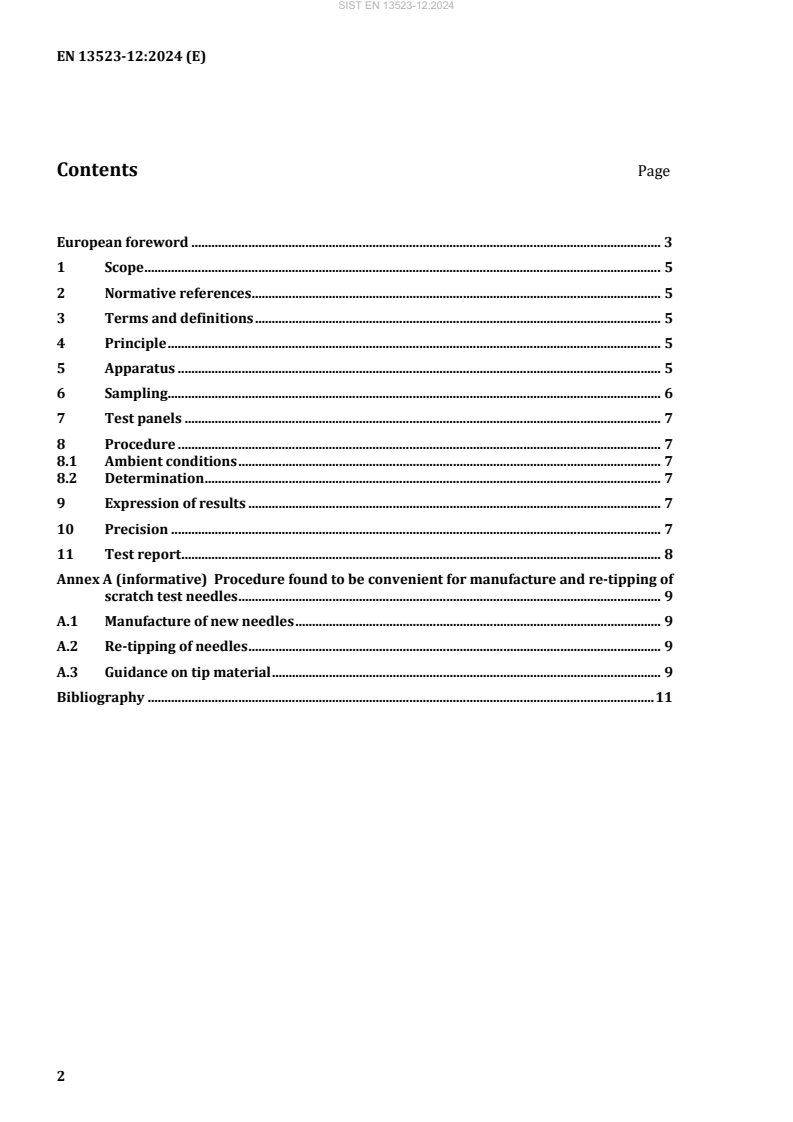
Contents Page
European foreword . 3
1 Scope . 5
2 Normative references . 5
3 Terms and definitions . 5
4 Principle . 5
5 Apparatus . 5
6 Sampling . 6
7 Test panels . 7
8 Procedure . 7
8.1 Ambient conditions . 7
8.2 Determination . 7
9 Expression of results . 7
10 Precision . 7
11 Test report . 8
Annex A (informative) Procedure found to be convenient for manufacture and re-tipping of
scratch test needles . 9
A.1 Manufacture of new needles . 9
A.2 Re-tipping of needles . 9
A.3 Guidance on tip material . 9
Bibliography . 11
European foreword
This document (EN 13523-12:2024) has been prepared by Technical Committee CEN/TC 139 “Paints and
varnishes”, the secretariat of which is held by DIN.
This European Standard shall be given the status of a national standard, either by publication of an
identical text or by endorsement, at the latest by October 2024, and conflicting national standards shall
be withdrawn at the latest by October 2024.
Attention is drawn to the possibility that some of the elements of this document may be the subject of
patent rights. CEN shall not be held responsible for identifying any or all such patent rights.
This document supersedes EN 13523-12:2017.
12:2017:
a) in 8.2 information on direction of scratching has been added;
b) Annex A concerning details about the tip and the needle has been added;
c) the text has been editorially revised and the normative references have been updated.
The EN 13523 series, Coil coated metals — Test methods, consists of the following parts:
— Part 0: General introduction
— Part 1: Film thickness
— Part 2: Gloss
— Part 3: Colour difference and metamerism — Instrumental comparison
— Part 4: Pencil hardness
— Part 5: Resistance to rapid deformation (impact test)
— Part 6: Adhesion after indentation (cupping test)
— Part 7: Resistance to cracking on bending (T-bend test)
— Part 8: Resistance to salt spray (fog)
— Part 9: Resistance to water immersion
— Part 10: Resistance to fluorescent UV radiation and water condensation
— Part 11: Resistance to solvents (rubbing test)
— Part 12: Resistance to scratching
— Part 13: Resistance to accelerated ageing by the use of heat
— Part 14: Chalking (Helmen method)
— Part 16: Resistance to abrasion
— Part 17: Adhesion of strippable films
— Part 18: Resistance to staining
— Part 19: Panel design and method of atmospheric exposure testing
— Part 20: Foam adhesion
— Part 21: Evaluation of outdoor exposed panels
— Part 22: Colour difference — Visual comparison
— Part 23: Resistance to humid atmospheres containing sulfur dioxide
— Part 24: Resistance to blocking and pressure marking
— Part 25: Resistance to humidity
— Part 26: Resistance to condensation of water
— Part 27: Resistance to humid poultice (Cataplasm test)
— Part 29: Resistance to environmental soiling (Dirt pick-up and striping)
Any feedback and questions on this document should be directed to the users’ national standards body.
A complete listing of these bodies can be found on the CEN website.
According to the CEN-CENELEC Internal Regulations, the national standards organisations of the
following countries are bound to implement this European Standard: Austria, Belgium, Bulgaria, Croatia,
Cyprus, Czech Republic, Denmark, Estonia, Finland, France, Germany, Greece, Hungary, Iceland, Ireland,
Italy, Latvia, Lithuania, Luxembourg, Malta, Netherlands, Norway, Poland, Portugal, Republic of North
Macedonia, Romania, Serbia, Slovakia, Slovenia, Spain, Sweden, Switzerland, Türkiye and the United
Kingdom.
...