

EN ISO 1833-28:2020
(Main)Textiles - Quantitative chemical analysis - Part 28: Mixtures of chitosan with certain other fibres (method using diluted acetic acid) (ISO 1833-28:2019)
General Information
- Abstract
This document specifies a method, using diluted acetic acid, to determine the mass percentage of chitosan fibres, after elimination of non-fibrous matter, in textiles made of mixtures of:
— chitosan fibre
with
— certain other fibres.
This method is applicable to fibre mixtures of chitosan fibre with cellulose fibres (cotton, linen, ramie, viscose, modal, lyocell), protein fibres (wool, cashmere, silk), or synthetic fibres (polyester, polyamide, acrylic).
- Status
- Published
- Publication Date
- 28-Apr-2020
- Withdrawal Date
- 30-Oct-2020
- Technical Committee
- CEN/TC 248 - Textiles and textile products
- Drafting Committee
- CEN/TC 248 - Textiles and textile products
- Current Stage
- 6060 - Definitive text made available (DAV) - Publishing
- Start Date
- 29-Apr-2020
- Due Date
- 25-Feb-2022
- Completion Date
- 29-Apr-2020


Overview
EN ISO 1833-28:2020 specifies standardized procedures for the quantitative chemical analysis of textiles containing chitosan fibres in combination with other common fibres. Developed by the European Committee for Standardization (CEN) and aligned with ISO 1833-28:2019, this standard establishes a method utilizing diluted acetic acid to accurately determine the mass percentage of chitosan after removal of non-fibrous matter. This ensures reliable identification and quantification in a wide range of textile fibre blends, supporting quality control and regulatory compliance across the textile industry.
Key Topics
Scope of Application:
The standard is applicable to fibre blends containing chitosan fibres with:- Cellulose fibres (cotton, linen, ramie, viscose, modal, lyocell)
- Protein fibres (wool, cashmere, silk)
- Synthetic fibres (polyester, polyamide, acrylic)
Principle of the Method:
- Chitosan fibres are selectively dissolved from a dry textile mass using a solution of diluted acetic acid.
- The remaining residue (other fibres) is collected, washed, dried, and weighed.
- The percentage of chitosan is determined by calculating the difference in mass before and after extraction.
Reagents and Equipment:
- Use of diluted acetic acid and ammonia solution as key reagents.
- Standard laboratory apparatus, including conical flasks and mechanical shakers, maintained at specified temperatures.
Result Calculation:
- Mass percentage of chitosan is calculated according to general principles outlined in ISO 1833-1.
- Correction factors are applied based on fibre types, ensuring accuracy.
Precision Assurance:
- Confidence limits for results are ±1 percentage point at a 95% confidence level, based on interlaboratory validation.
Applications
Textile Product Quality Assurance:
Ensures accurate identification of chitosan content in textile blends for manufacturers, suppliers, and quality control laboratories.Product Labelling & Regulatory Compliance:
Supports proper product labelling in compliance with international and national textile regulations regarding fibre composition.Textile R&D:
Facilitates the evaluation of new textile materials and blends incorporating chitosan - a biopolymer valued for its antimicrobial and sustainable properties.Material Certification & Traceability:
Provides a reliable protocol for certifying fibre content claims in technical textiles, medical textiles, and eco-friendly fabric products.
Related Standards
ISO 1833-1:
Textiles - Quantitative chemical analysis - Part 1: General principles of testing
Lays down the essential principles for quantitative analysis across all textile fibre types.ISO 2076:
Textiles - Man-made fibres - Generic names
Provides standard definitions and nomenclature for man-made textile fibres, including chitosan.ISO 13528:
Statistical methods for use in proficiency testing by interlaboratory comparison
Used in the standard’s validation to establish statistical precision and repeatability.ISO 5725-5:
Accuracy (trueness and precision) of measurement methods and results - Part 5
Details alternative methods to determine precision in standard measurement methods.
EN ISO 1833-28:2020 plays a vital role in advancing reliable chemical analysis for textiles containing chitosan. The method’s clear procedural guidance and demonstrated accuracy enable consistent fibre content determination, supporting industry-wide best practices in textile manufacturing, research, and compliance. Integrating this standard strengthens confidence in textile material claims, aiding both innovation and consumer assurance.
Relations
- Refers
ISO 1833-1:2006 - Textiles — Quantitative chemical analysis — Part 1: General principles of testing - Effective Date
- 25-Aug-2026
- Effective Date
- 28-Jan-2026
Get Certified
Connect with accredited certification bodies for this standard

Control Union Certifications
Global certification for agriculture and sustainability.

Hohenstein Institut
Textile testing and certification.

Bureau Veritas Bangladesh
Bureau Veritas certification services in Bangladesh.
Sponsored listings
Frequently Asked Questions
EN ISO 1833-28:2020 is a standard published by the European Committee for Standardization (CEN). Its full title is "Textiles - Quantitative chemical analysis - Part 28: Mixtures of chitosan with certain other fibres (method using diluted acetic acid) (ISO 1833-28:2019)". This standard covers: This document specifies a method, using diluted acetic acid, to determine the mass percentage of chitosan fibres, after elimination of non-fibrous matter, in textiles made of mixtures of: — chitosan fibre with — certain other fibres. This method is applicable to fibre mixtures of chitosan fibre with cellulose fibres (cotton, linen, ramie, viscose, modal, lyocell), protein fibres (wool, cashmere, silk), or synthetic fibres (polyester, polyamide, acrylic).
This document specifies a method, using diluted acetic acid, to determine the mass percentage of chitosan fibres, after elimination of non-fibrous matter, in textiles made of mixtures of: — chitosan fibre with — certain other fibres. This method is applicable to fibre mixtures of chitosan fibre with cellulose fibres (cotton, linen, ramie, viscose, modal, lyocell), protein fibres (wool, cashmere, silk), or synthetic fibres (polyester, polyamide, acrylic).
EN ISO 1833-28:2020 is classified under the following ICS (International Classification for Standards) categories: 59.060.01 - Textile fibres in general. The ICS classification helps identify the subject area and facilitates finding related standards.
EN ISO 1833-28:2020 has the following relationships with other standards: It is inter standard links to ISO 1833-1:2006, EN ISO 24024-2:2021. Understanding these relationships helps ensure you are using the most current and applicable version of the standard.
EN ISO 1833-28:2020 is available in PDF format for immediate download after purchase. The document can be added to your cart and obtained through the secure checkout process. Digital delivery ensures instant access to the complete standard document.
Standards Content (Sample)
SLOVENSKI STANDARD
01-julij-2020
Tekstilije - Kvantitativna kemična analiza - 28. del: Mešanice hitozana z nekaterimi
drugimi vlakni (metoda z uporabo razredčene ocetne kisline) (ISO 1833-28:2019)
Textiles - Quantitative chemical analysis - Part 28: Mixtures of chitosan with certain other
fibres (method using diluted acetic acid) (ISO 1833-28:2019)
Textilien - Quantitative chemische Analysen - Teil 28: Mischungen aus Chitosan mit
bestimmten anderen Fasern (Essigsäure-Verfahren) (ISO 1833-28:2019)
Textiles - Analyse chimique quantitative - Partie 28: Mélanges de chitosane avec
certaines autres fibres (méthode à l'acide acétique dilué) (ISO 1833-28:2019)
Ta slovenski standard je istoveten z: EN ISO 1833-28:2020
ICS:
59.060.01 Tekstilna vlakna na splošno Textile fibres in general
71.040.40 Kemijska analiza Chemical analysis
2003-01.Slovenski inštitut za standardizacijo. Razmnoževanje celote ali delov tega standarda ni dovoljeno.
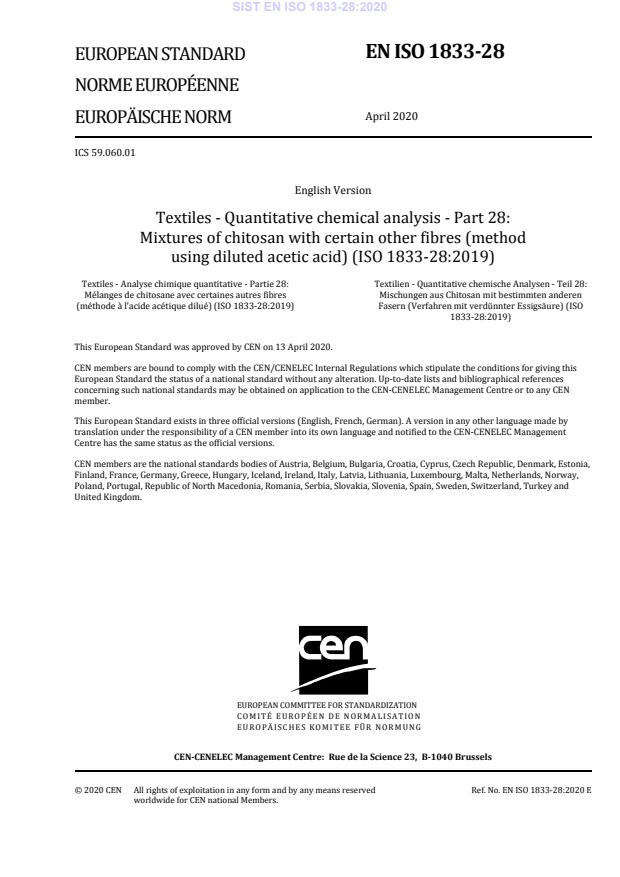
EN ISO 1833-28
EUROPEAN STANDARD
NORME EUROPÉENNE
April 2020
EUROPÄISCHE NORM
ICS 59.060.01
English Version
Textiles - Quantitative chemical analysis - Part 28:
Mixtures of chitosan with certain other fibres (method
using diluted acetic acid) (ISO 1833-28:2019)
Textiles - Analyse chimique quantitative - Partie 28: Textilien - Quantitative chemische Analysen - Teil 28:
Mélanges de chitosane avec certaines autres fibres Mischungen aus Chitosan mit bestimmten anderen
(méthode à l'acide acétique dilué) (ISO 1833-28:2019) Fasern (Verfahren mit verdünnter Essigsäure) (ISO
1833-28:2019)
This European Standard was approved by CEN on 13 April 2020.
CEN members are bound to comply with the CEN/CENELEC Internal Regulations which stipulate the conditions for giving this
European Standard the status of a national standard without any alteration. Up-to-date lists and bibliographical references
concerning such national standards may be obtained on application to the CEN-CENELEC Management Centre or to any CEN
member.
This European Standard exists in three official versions (English, French, German). A version in any other language made by
translation under the responsibility of a CEN member into its own language and notified to the CEN-CENELEC Management
Centre has the same status as the official versions.
CEN members are the national standards bodies of Austria, Belgium, Bulgaria, Croatia, Cyprus, Czech Republic, Denmark, Estonia,
Finland, France, Germany, Greece, Hungary, Iceland, Ireland, Italy, Latvia, Lithuania, Luxembourg, Malta, Netherlands, Norway,
Poland, Portugal, Republic of North Macedonia, Romania, Serbia, Slovakia, Slovenia, Spain, Sweden, Switzerland, Turkey and
United Kingdom.
EUROPEAN COMMITTEE FOR STANDARDIZATION
COMITÉ EUROPÉEN DE NORMALISATION
EUROPÄISCHES KOMITEE FÜR NORMUNG
CEN-CENELEC Management Centre: Rue de la Science 23, B-1040 Brussels
© 2020 CEN All rights of exploitation in any form and by any means reserved Ref. No. EN ISO 1833-28:2020 E
worldwide for CEN national Members.
Contents Page
European foreword . 3
European foreword
The text of ISO 1833-28:2019 has been prepared by Technical Committee ISO/TC 38 "Textiles” of the
International Organization for Standardization (ISO) and has been taken over as EN ISO 1833-28:2020
by Technical Committee CEN/TC 248 “Textiles and textile products” the secretariat of which is held by
BSI.
This European Standard shall be given the status of a national standard, either by publication of an
identical text or by endorsement, at the latest by October 2020, and conflicting national standards shall
be withdrawn at the latest by October 2020.
Attention is drawn to the possibility that some of the elements of this document may be the subject of
patent rights. CEN shall not be held responsible for identifying any or all such patent rights.
According to the CEN-CENELEC Internal Regulations, the national standards organizations of the
following countries are bound to implement this European Standard: Austria, Belgium, Bulgaria,
Croatia, Cyprus, Czech Republic, Denmark, Estonia, Finland, France, Germany, Greece, Hungary, Iceland,
Ireland, Italy, Latvia, Lithuania, Luxembourg, Malta, Netherlands, Norway, Poland, Portugal, Republic of
North Macedonia, Romania, Serbia, Slovakia, Slovenia, Spain, Sweden, Switzerland, Turkey and the
United Kingdom.
Endorsement notice
The text of ISO 1833-28:2019 has been approved by CEN as EN ISO 1833-28:2020 without any
modification.
INTERNATIONAL ISO
STANDARD 1833-28
First edition
2019-06
Textiles — Quantitative chemical
analysis —
Part 28:
Mixtures of chitosan with certain
other fibres (method using diluted
acetic acid)
Textiles — Analyse chimique quantitative —
Partie 28: Mélanges de chitosane avec certaines autres fibres
(méthode à l'acide acétique dilué)
Reference number
ISO 1833-28:2019(E)
©
ISO 2019
ISO 1833-28:2019(E)
© ISO 2019
All rights reserved. Unless otherwise specified, or required in the context of its implementation, no part of this publication may
be reproduced or utilized otherwise in any form or by any means, electronic or mechanical, including photocopying, or posting
on the internet or an intranet, without prior written permission. Permission can be requested from either ISO at the address
below or ISO’s member body in the country of the requester.
ISO copyright office
CP 401 • Ch. de Blandonnet 8
CH-1214 Vernier, Geneva
Phone: +41 22 749 01 11
Fax: +41 22 749 09 47
Email: copyright@iso.org
Website: www.iso.org
Published in Switzerland
ii © ISO 2019 – All rights reserved
ISO 1833-28:2019(E)
Contents Page
Foreword .iv
1 Scope . 1
2 Normative references . 1
3 Terms and definitions . 1
4 Principle . 2
5 Reagents . 2
6 Apparatus . 2
7 Test procedure . 2
8 Calculation and expression of results . 3
9 Precision . 3
Annex A (informative) Statistic data of interlaboratory trial . 4
Bibliography . 5
...