


EN 15839:2024/prA1
(Amendment)Railway applications - Testing and simulation for the acceptance of running characteristics of railway vehicles - Running safety under longitudinal compressive force
Railway applications - Testing and simulation for the acceptance of running characteristics of railway vehicles - Running safety under longitudinal compressive force
This document defines the assessment of endurable longitudinal compressive force (LCF) of a vehicle. The endurable longitudinal compressive force is a parameter depending on the vehicle design. It is used to estimate the risk of derailment of a vehicle as a result of being subjected to longitudinal compressive force, under operating conditions.
NOTE 1 As operating conditions can vary in several aspects (infrastructure, train configurations etc.), this document defines uniform assessments of endurable longitudinal compressive force per vehicle in specific operating conditions. The main assessment of endurable longitudinal compressive force for conventional trains is derived from UIC 530-2:2011, which is based on practical tests performed in ERRI-B12. Assessments of endurable longitudinal compressive force for high-capacity trains in this document are required by the methodology of IRS 40421. IRS 40421 assesses operational train parameters.
This document applies to the following types of vehicles:
- single wagons;
- permanently coupled units with standard ends between the vehicles;
- permanently coupled units with diagonal buffers and screw couplers between the vehicles;
- permanently coupled units with a bar coupler between the vehicles;
- articulated units with 2-axle bogies;
- wagons with 3-axle bogies;
- low-floor wagons with eight or more axles (e.g. rolling road wagon);
- vehicles with centre couplers;
- railbound construction and maintenance machines as defined in EN 14033-1:2017.
NOTE 2 This document defines the acceptance process to be followed by vehicles that are operated in a way that high longitudinal compressive force occur in the trains due to their operational environment (e.g. train composition, brake mode, track layout).
The following vehicles are not in the scope of this document:
- locomotives and passenger rolling stocks;
- vehicles that are only operated in passenger trains.
NOTE 3 Locomotives, passenger rolling stocks and vehicles operated in passenger trains only are not in the scope of this document as they either are subject to low longitudinal compressive force in operation or have sufficient endurable longitudinal compressive force due to their axle load.
Acceptance criteria and test conditions as well as conditions for simulation are defined in this document. Conditions for dispensation of the assessment of the endurable longitudinal compressive force are also defined in this document.
This document applies principally to vehicles which operate without restrictions on tracks with a gauge of 1 435 mm in Europe.
NOTE 4 The influence on railway systems using other gauges is not sufficiently understood to extend the scope of this document to gauges other than 1 435 mm.
NOTE 5 For wagons with centre couplers, a need for assessment of derailment risk due to Longitudinal Forces on other gauges (1 524 mm, 1 600 mm, 1 668 mm) has been expressed. The influence on railway systems using other gauges is not sufficiently understood. This document only introduces some notions to assess it independently from the gauge.
Bahnanwendungen - Versuche und Simulationen für die Zulassung der fahrtechnischen Eigenschaften von Eisenbahnfahrzeugen - Fahrsicherheit unter Längsdruckkräft
Applications ferroviaires - Essais et simulations en vue de la validation du comportement dynamique des véhicules ferroviaires - Sécurité de circulation sous force longitudinale de compression
Železniške naprave - Preskušanje in simuliranje voznih karakteristik pri prevzemu železniških vozil - Vozna varnost pri vzdolžni tlačni sili - Dopolnilo A1
General Information
- Status
- Not Published
- Publication Date
- 26-Aug-2027
- Technical Committee
- CEN/TC 256 - Railway applications
- Drafting Committee
- CEN/TC 256/WG 10 - Vehicle/Track Interaction
- Current Stage
- 4060 - Closure of enquiry - Enquiry
- Start Date
- 09-Apr-2026
- Due Date
- 03-Jul-2026
- Completion Date
- 09-Apr-2026

Relations
- Effective Date
- 21-May-2025
Overview
EN 15839:2024/prA1 is a European draft standard developed by CEN for the railway sector, focusing on the testing and simulation methods used to assess the running safety of railway vehicles under longitudinal compressive force (LCF). The document defines how the endurable longitudinal compressive force is determined for different types of rail vehicles, aiming to ensure safety and prevent derailment risks during operational scenarios where significant LCF may occur. The standard covers a wide range of freight rolling stock but specifically excludes locomotives and vehicles in passenger service only.
Key Topics
Assessment of Endurable Longitudinal Compressive Force (LCF):
EN 15839 establishes uniform methods to determine the maximum LCF that a vehicle can sustain without increasing derailment risk. This value depends on vehicle design, operational environment, and train configuration.Testing and Simulation Procedures:
The standard outlines both physical testing and advanced simulation approaches for measuring running characteristics, helping manufacturers and operators ensure compliance before vehicles enter service.Scope of Application:
The document applies to:- Single wagons
- Permanently coupled freight units (with various coupler and buffer types)
- Articulated and multi-axle freight wagons
- Vehicles equipped with centre couplers
- Railbound construction and maintenance machines (as referenced in EN 14033-1:2017)
It excludes locomotives, passenger rolling stock, and vehicles only operating in passenger trains.
Operating Conditions and Acceptance:
Prescribes acceptance criteria, test conditions, and simulation details relevant for railway vehicles expected to experience high longitudinal compressive forces due to operational factors like braking, train composition, or specific track layouts.European Track Gauge:
The standard primarily addresses vehicles running on 1,435 mm gauge tracks, reflecting the most prevalent gauge in Europe. It provides only limited guidance for broader or narrower gauges due to insufficient system knowledge.
Applications
EN 15839:2024/prA1 is essential for various stakeholders in the railway industry, including:
Rolling Stock Manufacturers:
Assists manufacturers in designing and validating new freight wagons and railbound vehicles to meet the longitudinal compressive force requirements, ensuring market acceptance and safety compliance.Rail Operators and Fleet Managers:
Enables operators to verify that their wagons or coupled units can operate safely within their specific network’s operational demands, reducing derailment risk owing to longitudinal forces.Certification Bodies and Safety Assessors:
Provides a clear, standardized process for the acceptance of running safety performance, facilitating consistent certification across the European railway sector.Infrastructure Owners:
Ensures that only wagons designed to withstand the appropriate LCF are permitted, reducing risk of vehicle instability and derailment on their networks.Maintenance and Construction Sectors:
Applies to specific maintenance machines, guiding their acceptance for safe integration into regular railway operations.
Related Standards
For organizations and professionals utilizing EN 15839:2024/prA1, the following related standards and references are particularly relevant:
UIC 530-2:2011:
Provides the foundation for assessment methodology, based on practical tests related to vehicle running safety under LCF.IRS 40421:
Specifies methodologies for assessing operational train parameters affecting longitudinal compressive forces in high-capacity trains.EN 14033-1:2017:
Defines railbound construction and maintenance machines, referenced for the scope of applicable vehicles.Other Track Gauge Standards:
While EN 15839 focuses on the 1,435 mm gauge, there is recognition of limited guidance for wider gauges (e.g., 1,524 mm, 1,600 mm, 1,668 mm) and a noted need for independent assessment protocols.
Implementation of EN 15839:2024/prA1 enhances railway safety by ensuring freight vehicles and specialized machinery are rigorously evaluated for stability under longitudinal compressive forces, supporting operational reliability across European rail networks.
Get Certified
Connect with accredited certification bodies for this standard

IRIS Certification (UNIFE)
International Railway Industry Standard certification.

TÜV SÜD Rail GmbH
TÜV SÜD railway certification services.

Bureau Veritas Railway Certification
Railway and transportation certification.
Sponsored listings
Frequently Asked Questions
EN 15839:2024/prA1 is a draft published by the European Committee for Standardization (CEN). Its full title is "Railway applications - Testing and simulation for the acceptance of running characteristics of railway vehicles - Running safety under longitudinal compressive force". This standard covers: This document defines the assessment of endurable longitudinal compressive force (LCF) of a vehicle. The endurable longitudinal compressive force is a parameter depending on the vehicle design. It is used to estimate the risk of derailment of a vehicle as a result of being subjected to longitudinal compressive force, under operating conditions. NOTE 1 As operating conditions can vary in several aspects (infrastructure, train configurations etc.), this document defines uniform assessments of endurable longitudinal compressive force per vehicle in specific operating conditions. The main assessment of endurable longitudinal compressive force for conventional trains is derived from UIC 530-2:2011, which is based on practical tests performed in ERRI-B12. Assessments of endurable longitudinal compressive force for high-capacity trains in this document are required by the methodology of IRS 40421. IRS 40421 assesses operational train parameters. This document applies to the following types of vehicles: - single wagons; - permanently coupled units with standard ends between the vehicles; - permanently coupled units with diagonal buffers and screw couplers between the vehicles; - permanently coupled units with a bar coupler between the vehicles; - articulated units with 2-axle bogies; - wagons with 3-axle bogies; - low-floor wagons with eight or more axles (e.g. rolling road wagon); - vehicles with centre couplers; - railbound construction and maintenance machines as defined in EN 14033-1:2017. NOTE 2 This document defines the acceptance process to be followed by vehicles that are operated in a way that high longitudinal compressive force occur in the trains due to their operational environment (e.g. train composition, brake mode, track layout). The following vehicles are not in the scope of this document: - locomotives and passenger rolling stocks; - vehicles that are only operated in passenger trains. NOTE 3 Locomotives, passenger rolling stocks and vehicles operated in passenger trains only are not in the scope of this document as they either are subject to low longitudinal compressive force in operation or have sufficient endurable longitudinal compressive force due to their axle load. Acceptance criteria and test conditions as well as conditions for simulation are defined in this document. Conditions for dispensation of the assessment of the endurable longitudinal compressive force are also defined in this document. This document applies principally to vehicles which operate without restrictions on tracks with a gauge of 1 435 mm in Europe. NOTE 4 The influence on railway systems using other gauges is not sufficiently understood to extend the scope of this document to gauges other than 1 435 mm. NOTE 5 For wagons with centre couplers, a need for assessment of derailment risk due to Longitudinal Forces on other gauges (1 524 mm, 1 600 mm, 1 668 mm) has been expressed. The influence on railway systems using other gauges is not sufficiently understood. This document only introduces some notions to assess it independently from the gauge.
This document defines the assessment of endurable longitudinal compressive force (LCF) of a vehicle. The endurable longitudinal compressive force is a parameter depending on the vehicle design. It is used to estimate the risk of derailment of a vehicle as a result of being subjected to longitudinal compressive force, under operating conditions. NOTE 1 As operating conditions can vary in several aspects (infrastructure, train configurations etc.), this document defines uniform assessments of endurable longitudinal compressive force per vehicle in specific operating conditions. The main assessment of endurable longitudinal compressive force for conventional trains is derived from UIC 530-2:2011, which is based on practical tests performed in ERRI-B12. Assessments of endurable longitudinal compressive force for high-capacity trains in this document are required by the methodology of IRS 40421. IRS 40421 assesses operational train parameters. This document applies to the following types of vehicles: - single wagons; - permanently coupled units with standard ends between the vehicles; - permanently coupled units with diagonal buffers and screw couplers between the vehicles; - permanently coupled units with a bar coupler between the vehicles; - articulated units with 2-axle bogies; - wagons with 3-axle bogies; - low-floor wagons with eight or more axles (e.g. rolling road wagon); - vehicles with centre couplers; - railbound construction and maintenance machines as defined in EN 14033-1:2017. NOTE 2 This document defines the acceptance process to be followed by vehicles that are operated in a way that high longitudinal compressive force occur in the trains due to their operational environment (e.g. train composition, brake mode, track layout). The following vehicles are not in the scope of this document: - locomotives and passenger rolling stocks; - vehicles that are only operated in passenger trains. NOTE 3 Locomotives, passenger rolling stocks and vehicles operated in passenger trains only are not in the scope of this document as they either are subject to low longitudinal compressive force in operation or have sufficient endurable longitudinal compressive force due to their axle load. Acceptance criteria and test conditions as well as conditions for simulation are defined in this document. Conditions for dispensation of the assessment of the endurable longitudinal compressive force are also defined in this document. This document applies principally to vehicles which operate without restrictions on tracks with a gauge of 1 435 mm in Europe. NOTE 4 The influence on railway systems using other gauges is not sufficiently understood to extend the scope of this document to gauges other than 1 435 mm. NOTE 5 For wagons with centre couplers, a need for assessment of derailment risk due to Longitudinal Forces on other gauges (1 524 mm, 1 600 mm, 1 668 mm) has been expressed. The influence on railway systems using other gauges is not sufficiently understood. This document only introduces some notions to assess it independently from the gauge.
EN 15839:2024/prA1 is classified under the following ICS (International Classification for Standards) categories: 45.060.20 - Trailing stock. The ICS classification helps identify the subject area and facilitates finding related standards.
EN 15839:2024/prA1 has the following relationships with other standards: It is inter standard links to EN 15839:2024. Understanding these relationships helps ensure you are using the most current and applicable version of the standard.
EN 15839:2024/prA1 is associated with the following European legislation: EU Directives/Regulations: 2016/797/EU; Standardization Mandates: M/483, M/591. When a standard is cited in the Official Journal of the European Union, products manufactured in conformity with it benefit from a presumption of conformity with the essential requirements of the corresponding EU directive or regulation.
EN 15839:2024/prA1 is available in PDF format for immediate download after purchase. The document can be added to your cart and obtained through the secure checkout process. Digital delivery ensures instant access to the complete standard document.
Standards Content (Sample)
SLOVENSKI STANDARD
01-marec-2026
Železniške naprave - Preskušanje in simuliranje voznih karakteristik pri prevzemu
železniških vozil - Vozna varnost pri vzdolžni tlačni sili - Dopolnilo A1
Railway applications - Testing and simulation for the acceptance of running
characteristics of railway vehicles - Running safety under longitudinal compressive force
Bahnanwendungen - Versuche und Simulationen für die Zulassung der fahrtechnischen
Eigenschaften von Eisenbahnfahrzeugen - Fahrsicherheit unter Längsdruckkräft
Applications ferroviaires - Essais et simulations en vue de la validation du comportement
dynamique des véhicules ferroviaires - Sécurité de circulation sous force longitudinale de
compression
Ta slovenski standard je istoveten z: EN 15839:2024/prA1
ICS:
45.060.20 Železniški vagoni Trailing stock
2003-01.Slovenski inštitut za standardizacijo. Razmnoževanje celote ali delov tega standarda ni dovoljeno.
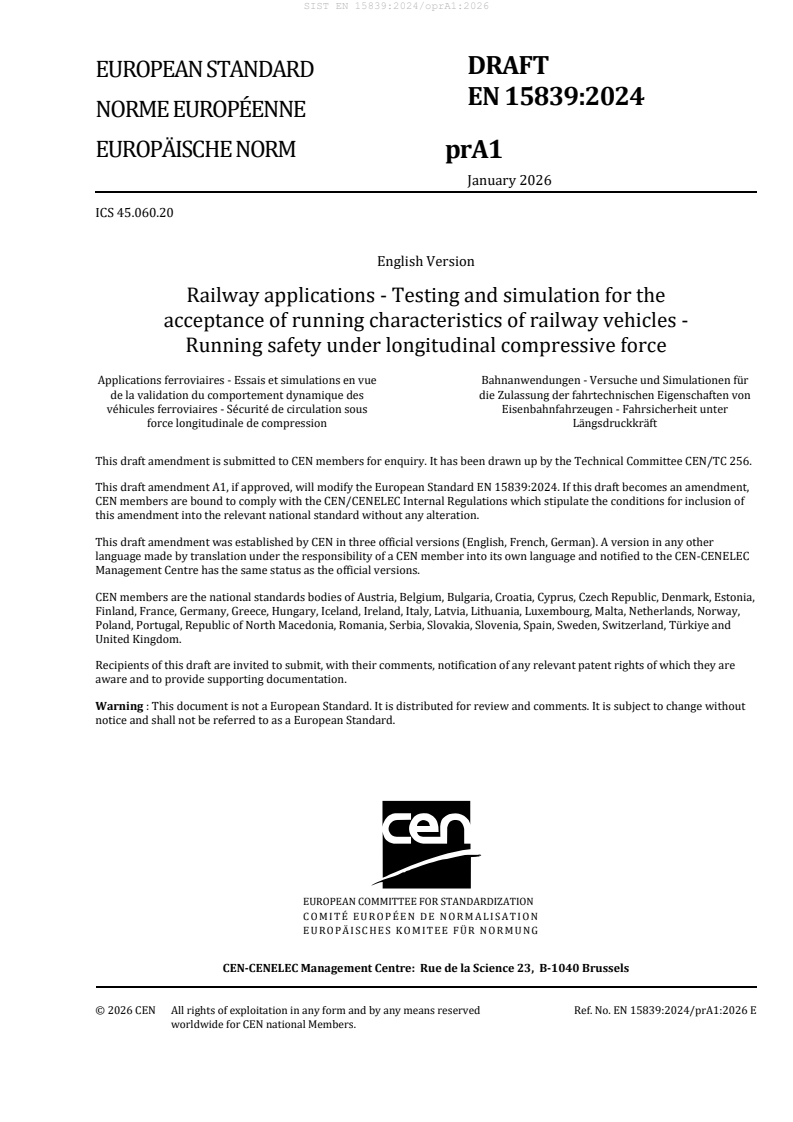
DRAFT
EUROPEAN STANDARD
EN 15839:2024
NORME EUROPÉENNE
EUROPÄISCHE NORM
prA1
January 2026
ICS 45.060.20
English Version
Railway applications - Testing and simulation for the
acceptance of running characteristics of railway vehicles -
Running safety under longitudinal compressive force
Applications ferroviaires - Essais et simulations en vue Bahnanwendungen - Versuche und Simulationen für
de la validation du comportement dynamique des die Zulassung der fahrtechnischen Eigenschaften von
véhicules ferroviaires - Sécurité de circulation sous Eisenbahnfahrzeugen - Fahrsicherheit unter
force longitudinale de compression Längsdruckkräft
This draft amendment is submitted to CEN members for enquiry. It has been drawn up by the Technical Committee CEN/TC 256.
This draft amendment A1, if approved, will modify the European Standard EN 15839:2024. If this draft becomes an amendment,
CEN members are bound to comply with the CEN/CENELEC Internal Regulations which stipulate the conditions for inclusion of
this amendment into the relevant national standard without any alteration.
This draft amendment was established by CEN in three official versions (English, French, German). A version in any other
language made by translation under the responsibility of a CEN member into its own language and notified to the CEN-CENELEC
Ma
...