

CEN/TS 16614-3:2016
(Main)Public transport - Network and Timetable Exchange (NeTEx) - Part 3: Public transport fares exchange format
General Information
- Abstract
1.1 General
NeTEx is dedicated to the exchange of scheduled data (network, timetable and fare information). It is based on Transmodel V5.1 (EN 12986), IFOPT (EN 28701) and SIRI (CEN/TS 15531-4, CEN/TS 15531-5 and EN 15531-1, EN 15531-2, EN 15531-3 ) and supports the exchange of information of relevance for passenger information about public transport services and also for running Automated Vehicle Monitoring Systems (AVMS).
NOTE NeTEx is a refinement and an implementation of Transmodel and IFOPT; the definitions and explanations of these concepts are extracted directly from the respective standard and reused in NeTEx, sometimes with adaptations in order to fit the NeTEx context. Although the data exchanges targeted by NeTEx are predominantly oriented towards provisioning passenger information systems and AVMS with data from transit scheduling systems, it is not restricted to this purpose and NeTEx can also provide an effective solution to many other use cases for transport data exchange.
1.2 Fares scope
This Part 3 of NeTEx, is specifically concerned with the exchange of fare structures and fare data, using data models that relate to the underlying network and timetable models defined in Part 1 and Part 2 and the Fare Collection data model defined in Transmodel V51. See the use cases below for the overall scope of Part 3. In summary, it is concerned with data for the following purposes:
(i) To describe the many various possible fare structures that arise in public transport (for example, flat fares, zonal fares, time dependent fares, distance based fares, stage fares, pay as you go fares, season passes, etc., etc.).
(ii) To describe the fare products that may be purchased having these fare structures and to describe the conditions that may attach to particular fares, for example if restricted to specific groups of users, or subject to temporal restrictions. These conditions may be complex.
(i) To allow actual price data to be exchanged. Note however that NeTEx does not itself specify pricing algorithms or how fares should be calculated. This is the concern of Fare Management Systems. It may be used may be used to exchange various parameters required for pricing calculations that are needed to explain or justify a fare.
(iii) To include the attributes and the text descriptions necessary to present fares and their conditions of sale and use to the public.
NeTEx should be regarded as being ‘upstream’ of retail systems and allows fare data to be managed and integrated with journey planning and network data in public facing information systems. It is complementary to and distinct from the ‘downstream’ ticketing and retail systems that sell fares and of the control systems that validate their use. See ‘Excluded Use Cases’ below for further information on the boundaries of NeTEx with Fare Management Systems.
1.3 Transport modes
All mass public transport modes are taken into account by NeTEx, including train, bus, coach, metro, tramway, ferry, and their submodes. It is possible to describe airports, air journeys, and air fares, but there has not been any specific consideration of any additional requirements that apply specifically to air transport.
1.4 Compatibility with existing standards and recommendations
The overall approach for the definition of fares within NeTEx Part 3 follows the approach used by Transmodel V5.1, namely the definition of access rights rather than of just products.
This approach, used in Transmodel V5.1 (Fare Collection data model) to specify the access rights related to the urban public transport (for all urban modes) has been extended to cover access rights for long-distance rail.
NOTE The concepts from Transmodel V5.1 and IFOPT used and/or modified by NeTEx are incorporated into Transmodel V6 to guarantee compatibility and coherence of standards.
- Status
- Withdrawn
- Publication Date
- 22-Mar-2016
- Withdrawal Date
- 29-Sep-2026
- Technical Committee
- CEN/TC 278 - Road transport and traffic telematics
- Drafting Committee
- CEN/TC 278/WG 3 - Public transport (PT)
- Current Stage
- 9960 - Withdrawal effective - Withdrawal
- Start Date
- 15-Apr-2020
- Completion Date
- 30-Sep-2026


Relations
- Effective Date
- 22-Apr-2020
- Effective Date
- 28-Jan-2026
Get Certified
Connect with accredited certification bodies for this standard

BSI Group
BSI (British Standards Institution) is the business standards company that helps organizations make excellence a habit.

NYCE
Mexican standards and certification body.
Sponsored listings
Frequently Asked Questions
CEN/TS 16614-3:2016 is a technical specification published by the European Committee for Standardization (CEN). Its full title is "Public transport - Network and Timetable Exchange (NeTEx) - Part 3: Public transport fares exchange format". This standard covers: 1.1 General NeTEx is dedicated to the exchange of scheduled data (network, timetable and fare information). It is based on Transmodel V5.1 (EN 12986), IFOPT (EN 28701) and SIRI (CEN/TS 15531-4, CEN/TS 15531-5 and EN 15531-1, EN 15531-2, EN 15531-3 ) and supports the exchange of information of relevance for passenger information about public transport services and also for running Automated Vehicle Monitoring Systems (AVMS). NOTE NeTEx is a refinement and an implementation of Transmodel and IFOPT; the definitions and explanations of these concepts are extracted directly from the respective standard and reused in NeTEx, sometimes with adaptations in order to fit the NeTEx context. Although the data exchanges targeted by NeTEx are predominantly oriented towards provisioning passenger information systems and AVMS with data from transit scheduling systems, it is not restricted to this purpose and NeTEx can also provide an effective solution to many other use cases for transport data exchange. 1.2 Fares scope This Part 3 of NeTEx, is specifically concerned with the exchange of fare structures and fare data, using data models that relate to the underlying network and timetable models defined in Part 1 and Part 2 and the Fare Collection data model defined in Transmodel V51. See the use cases below for the overall scope of Part 3. In summary, it is concerned with data for the following purposes: (i) To describe the many various possible fare structures that arise in public transport (for example, flat fares, zonal fares, time dependent fares, distance based fares, stage fares, pay as you go fares, season passes, etc., etc.). (ii) To describe the fare products that may be purchased having these fare structures and to describe the conditions that may attach to particular fares, for example if restricted to specific groups of users, or subject to temporal restrictions. These conditions may be complex. (i) To allow actual price data to be exchanged. Note however that NeTEx does not itself specify pricing algorithms or how fares should be calculated. This is the concern of Fare Management Systems. It may be used may be used to exchange various parameters required for pricing calculations that are needed to explain or justify a fare. (iii) To include the attributes and the text descriptions necessary to present fares and their conditions of sale and use to the public. NeTEx should be regarded as being ‘upstream’ of retail systems and allows fare data to be managed and integrated with journey planning and network data in public facing information systems. It is complementary to and distinct from the ‘downstream’ ticketing and retail systems that sell fares and of the control systems that validate their use. See ‘Excluded Use Cases’ below for further information on the boundaries of NeTEx with Fare Management Systems. 1.3 Transport modes All mass public transport modes are taken into account by NeTEx, including train, bus, coach, metro, tramway, ferry, and their submodes. It is possible to describe airports, air journeys, and air fares, but there has not been any specific consideration of any additional requirements that apply specifically to air transport. 1.4 Compatibility with existing standards and recommendations The overall approach for the definition of fares within NeTEx Part 3 follows the approach used by Transmodel V5.1, namely the definition of access rights rather than of just products. This approach, used in Transmodel V5.1 (Fare Collection data model) to specify the access rights related to the urban public transport (for all urban modes) has been extended to cover access rights for long-distance rail. NOTE The concepts from Transmodel V5.1 and IFOPT used and/or modified by NeTEx are incorporated into Transmodel V6 to guarantee compatibility and coherence of standards.
1.1 General NeTEx is dedicated to the exchange of scheduled data (network, timetable and fare information). It is based on Transmodel V5.1 (EN 12986), IFOPT (EN 28701) and SIRI (CEN/TS 15531-4, CEN/TS 15531-5 and EN 15531-1, EN 15531-2, EN 15531-3 ) and supports the exchange of information of relevance for passenger information about public transport services and also for running Automated Vehicle Monitoring Systems (AVMS). NOTE NeTEx is a refinement and an implementation of Transmodel and IFOPT; the definitions and explanations of these concepts are extracted directly from the respective standard and reused in NeTEx, sometimes with adaptations in order to fit the NeTEx context. Although the data exchanges targeted by NeTEx are predominantly oriented towards provisioning passenger information systems and AVMS with data from transit scheduling systems, it is not restricted to this purpose and NeTEx can also provide an effective solution to many other use cases for transport data exchange. 1.2 Fares scope This Part 3 of NeTEx, is specifically concerned with the exchange of fare structures and fare data, using data models that relate to the underlying network and timetable models defined in Part 1 and Part 2 and the Fare Collection data model defined in Transmodel V51. See the use cases below for the overall scope of Part 3. In summary, it is concerned with data for the following purposes: (i) To describe the many various possible fare structures that arise in public transport (for example, flat fares, zonal fares, time dependent fares, distance based fares, stage fares, pay as you go fares, season passes, etc., etc.). (ii) To describe the fare products that may be purchased having these fare structures and to describe the conditions that may attach to particular fares, for example if restricted to specific groups of users, or subject to temporal restrictions. These conditions may be complex. (i) To allow actual price data to be exchanged. Note however that NeTEx does not itself specify pricing algorithms or how fares should be calculated. This is the concern of Fare Management Systems. It may be used may be used to exchange various parameters required for pricing calculations that are needed to explain or justify a fare. (iii) To include the attributes and the text descriptions necessary to present fares and their conditions of sale and use to the public. NeTEx should be regarded as being ‘upstream’ of retail systems and allows fare data to be managed and integrated with journey planning and network data in public facing information systems. It is complementary to and distinct from the ‘downstream’ ticketing and retail systems that sell fares and of the control systems that validate their use. See ‘Excluded Use Cases’ below for further information on the boundaries of NeTEx with Fare Management Systems. 1.3 Transport modes All mass public transport modes are taken into account by NeTEx, including train, bus, coach, metro, tramway, ferry, and their submodes. It is possible to describe airports, air journeys, and air fares, but there has not been any specific consideration of any additional requirements that apply specifically to air transport. 1.4 Compatibility with existing standards and recommendations The overall approach for the definition of fares within NeTEx Part 3 follows the approach used by Transmodel V5.1, namely the definition of access rights rather than of just products. This approach, used in Transmodel V5.1 (Fare Collection data model) to specify the access rights related to the urban public transport (for all urban modes) has been extended to cover access rights for long-distance rail. NOTE The concepts from Transmodel V5.1 and IFOPT used and/or modified by NeTEx are incorporated into Transmodel V6 to guarantee compatibility and coherence of standards.
CEN/TS 16614-3:2016 is classified under the following ICS (International Classification for Standards) categories: 35.240.60 - IT applications in transport. The ICS classification helps identify the subject area and facilitates finding related standards.
CEN/TS 16614-3:2016 has the following relationships with other standards: It is inter standard links to CEN/TS 16614-3:2020, CEN/TS 16614-1:2014. Understanding these relationships helps ensure you are using the most current and applicable version of the standard.
CEN/TS 16614-3:2016 is associated with the following European legislation: EU Directives/Regulations: 2010/40/EU. When a standard is cited in the Official Journal of the European Union, products manufactured in conformity with it benefit from a presumption of conformity with the essential requirements of the corresponding EU directive or regulation.
CEN/TS 16614-3:2016 is available in PDF format for immediate download after purchase. The document can be added to your cart and obtained through the secure checkout process. Digital delivery ensures instant access to the complete standard document.
Standards Content (Sample)
SLOVENSKI STANDARD
01-julij-2016
Javni prevoz - Izmenjava omrežnih in voznorednih podatkov (NeTEx) - 3. del:
Format za izmenjavo informacij o vozovnicah
Public transport - Network and Timetable Exchange (NeTEx) - Part 3: Public transport
fares exchange format
Öffentlicher Verkehr - Netzwerk- und Fahrplan Austausch (NeTEx) - Teil 3:
Austauschformat für die Fahrkartenauskunft des öffentlichen Verkehrs
Transport public - Echange des données de réseau et d'horaires (NeTEx) - Partie 3 :
Format d'échange d'informations voyageurs concernant le réseau de transport public
Ta slovenski standard je istoveten z: CEN/TS 16614-3:2016
ICS:
03.220.01 Transport na splošno Transport in general
35.240.60 Uporabniške rešitve IT v IT applications in transport
prometu
2003-01.Slovenski inštitut za standardizacijo. Razmnoževanje celote ali delov tega standarda ni dovoljeno.
CEN/TS 16614-3
TECHNICAL SPECIFICATION
SPÉCIFICATION TECHNIQUE
March 2016
TECHNISCHE SPEZIFIKATION
ICS 35.240.60
English Version
Public transport - Network and Timetable Exchange
(NeTEx) - Part 3: Public transport fares exchange format
Transport public - Echange des données de réseau et Öffentlicher Verkehr - Netzwerk- und Fahrplan
d'horaires (NeTEx) - Partie 3 : Format d'échange Austausch (NeTEx) - Teil 3: Austauschformat für die
d'informations voyageurs concernant le réseau de Fahrkartenauskunft des öffentlichen Verkehrs
transport public
This Technical Specification (CEN/TS) was approved by CEN on 17 August 2015 for provisional application.
The period of validity of this CEN/TS is limited initially to three years. After two years the members of CEN will be requested to
submit their comments, particularly on the question whether the CEN/TS can be converted into a European Standard.
CEN members are required to announce the existence of this CEN/TS in the same way as for an EN and to make the CEN/TS
available promptly at national level in an appropriate form. It is permissible to keep conflicting national standards in force (in
parallel to the CEN/TS) until the final decision about the possible conversion of the CEN/TS into an EN is reached.
CEN members are the national standards bodies of Austria, Belgium, Bulgaria, Croatia, Cyprus, Czech Republic, Denmark, Estonia,
Finland, Former Yugoslav Republic of Macedonia, France, Germany, Greece, Hungary, Iceland, Ireland, Italy, Latvia, Lithuania,
Luxembourg, Malta, Netherlands, Norway, Poland, Portugal, Romania, Slovakia, Slovenia, Spain, Sweden, Switzerland, Turkey and
United Kingdom.
EUROPEAN COMMITTEE FOR STANDARDIZATION
COMITÉ EUROPÉEN DE NORMALISATION
EUROPÄISCHES KOMITEE FÜR NORMUNG
CEN-CENELEC Management Centre: Avenue Marnix 17, B-1000 Brussels
© 2016 CEN All rights of exploitation in any form and by any means reserved Ref. No. CEN/TS 16614-3:2016 E
worldwide for CEN national Members.
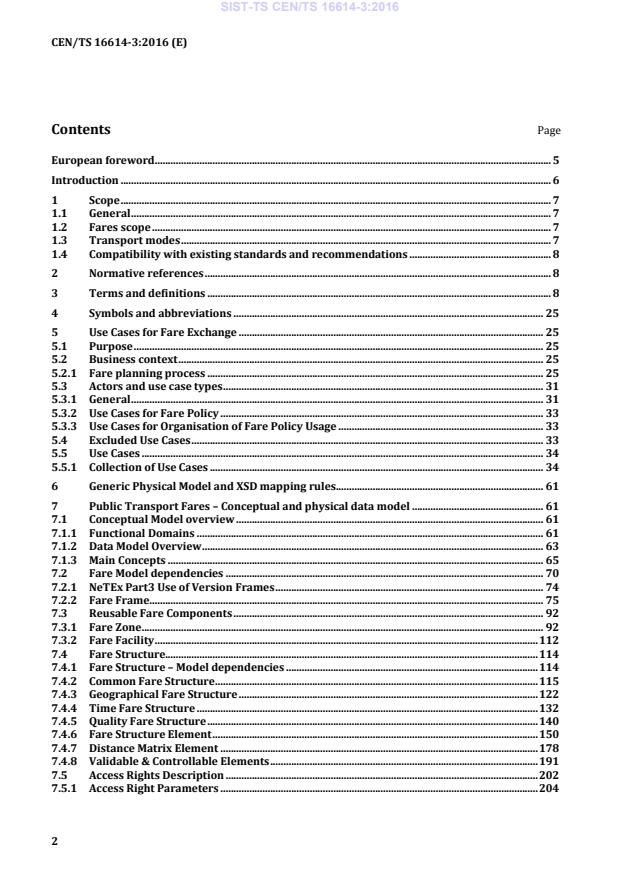
Contents Page
European foreword. 5
Introduction . 6
1 Scope . 7
1.1 General . 7
1.2 Fares scope . 7
1.3 Transport modes . 7
1.4 Compatibility with existing standards and recommendations . 8
2 Normative references . 8
3 Terms and definitions . 8
4 Symbols and abbreviations . 25
5 Use Cases for Fare Exchange . 25
5.1 Purpose . 25
5.2 Business context . 25
5.2.1 Fare planning process . 25
5.3 Actors and use case types . 31
5.3.1 General . 31
5.3.2 Use Cases for Fare Policy . 33
5.3.3 Use Cases for Organisation of Fare Policy Usage . 33
5.4 Excluded Use Cases . 33
5.5 Use Cases . 34
5.5.1 Collection of Use Cases . 34
6 Generic Physical Model and XSD mapping rules. 61
7 Public Transport Fares – Conceptual and physical data model . 61
7.1 Conceptual Model overview . 61
7.1.1 Functional Domains . 61
7.1.2 Data Model Overview . 63
7.1.3 Main Concepts . 65
7.2 Fare Model dependencies . 70
7.2.1 NeTEx Part3 Use of Version Frames . 74
7.2.2 Fare Frame . 75
7.3 Reusable Fare Components . 92
7.3.1 Fare Zone . 92
7.3.2 Fare Facility . 112
7.4 Fare Structure. 114
7.4.1 Fare Structure – Model dependencies . 114
7.4.2 Common Fare Structure . 115
7.4.3 Geographical Fare Structure . 122
7.4.4 Time Fare Structure . 132
7.4.5 Quality Fare Structure . 140
7.4.6 Fare Structure Element . 150
7.4.7 Distance Matrix Element . 178
7.4.8 Validable & Controllable Elements . 191
7.5 Access Rights Description . 202
7.5.1 Access Right Parameters . 204
7.5.2 Fare Product . 314
7.6 Pricing . 356
7.6.1 Fare Calculation Parameters . 356
7.6.2 Fare Price . 371
7.6.3 Fare Table . 382
7.7 Sales Description . 400
7.7.1 Fare Sales Distribution . 400
7.7.2 Fare Travel Document . 411
7.7.3 Fare Sales Package . 418
8 Sales Transactions . 440
8.1 General . 440
8.2 Sales Transaction – Model dependencies . 440
8.3 Sales Transaction Frame – Conceptual MODEL . 443
8.3.1 Sales Transaction Frame – Physical Model. 444
8.3.2 Sales Transaction Frame – Attributes and XSD . 444
8.3.3 Fare Contract . 445
8.3.4 Retail . 456
8.3.5 Sales Transaction . 461
Annex A (normative) Extensions to NeTEx Part1 & 2 . 475
A.1 Introduction . 475
A.2 Enhancement to Part 1 Model . 475
A.2.1 Organisation delegation relationship . 475
A.2.2 Alternative Name Package . 476
A.2.3 Booking Arrangements . 478
A.2.4 Booking Arrangements . 479
A.2.5 Generic Assignment Package. 479
A.2.6 Generic Layer Model . 481
A.2.7 Generic Validity Condition Model . 485
A.3 Enhancement to Part 2 Model . 486
A.3.1 Vehicle Journey Assignment . 486
A.4 Alignment of Part 1 and Part 2 Attributes . 489
A.4.1 Part 1 - Framework –Versions & Validity MODEL . 489
A.4.2 Part 1 – Framework – Responsibility MODEL . 492
A.4.3 Part 1 – Framework – Location MODEL . 494
A.4.4 Part 1 – Framework – Reusable Components MODEL . 500
A.4.5 Part 1 – Network Description MODEL . 513
A.4.6 Part 1 – Tactical Planning Components MODEL . 519
A.4.7 Part 1 – Fixed Objects MODEL . 530
A.4.8 Part 2 – Journey, Times & Service MODEL . 547
Annex B (informative) ERA – TAP TSI annexes B1, B2 and B3 mapping . 562
B.1 Summary of mapping of B1 (NRT) fares . 562
B.2 Summary of mapping of B2 (IRT) fares . 562
B.3 Summary of mapping of B3 (Special) fares . 563
Annex C (informative) NeTEx Passenger Information Query model . 564
C.1 PiQuery . 564
C.1.1 PI Query dependencies . 564
C.1.2 PiQuery . 568
Annex D (informative) How to go from a trip (from NeTEx Part1&2) to a fare ?. 610
D.1 Passenger Trip . 610
D.1.1 Passenger Trip Model . 610
D.1.2 Passenger Fare Model . 618
Annex E (informative) Proposed model for Parking Tariff . 622
E.1 Parking Tariff . 622
E.1.1 Parking Tariff – Conceptual MODEL . 622
Bibliography . 627
European foreword
This document (CEN/TS 16614-3:2016) has been prepared by Technical Committee CEN/TC 278
“Intelligent transport systems”, the secretariat of which is held by NEN.
Attention is drawn to the possibility that some of the elements of this document may be the subject of
patent rights. CEN [and/or CENELEC] shall not be held responsible for identifying any or all such
patent rights.
This document presents Part 3 of the European Technical Specification known as “NeTEx”. NeTEx
provides a framework for specifying communications and data exchange protocols for organizations
wishing to exchange scheduled Information relating to public transport operations.
This Technical Specification is made up of three parts defining a single European Standard series,
which provides a complete exchange format for public transport networks, timetable description and
fare information.
— Part 1 is the description of the public transport network topology exchange format. It also
contains use cases shared with part 2, and modelling rules and the description of a framework
shared by all parts.
— Part 2 is the description of the scheduled timetables exchange format.
— Part 3 is the description of the fare information exchange format.
Part 1 is fully standalone, and Part 2 and Part 3 rely on Part 1.
The XML schema can be downloaded from www.netex.org.uk, along with available guidance on its
use, example XML files, and case studies of national and local deployments.
NOTE This document is higly technical, and a special care has been taken to keep the text readable.
In particular a set of formatting conventions is followed that enhance the usual CEN writing rules in
order to distinguish references to elements of the formal models within text:
— Transmodel terms and NeTEx conceptual model elements are in capital letters (JOURNEY
PATTERN for example).
— NeTEx physical model names are in bold italic font and use camelcase style with no spaces
(JourneyPattern for example).
— NeTEx physical model attribute types are in italic style and use camelcase style with no spaces
(TypeOfEntity for example).
According to the CEN-CENELEC Internal Regulations, the national standards organizations of the
following countries are bound to announce this Technical Specification: Austria, Belgium, Bulgaria,
Croatia, Cyprus, Czech Republic, Denmark, Estonia, Finland, Former Yugoslav Republic of Macedonia,
France, Germany, Greece, Hungary, Iceland, Ireland, Italy, Latvia, Lithuania, Luxembourg, Malta,
Netherlands, Norway, Poland, Portugal, Romania, Slovakia, Slovenia, Spain, Sweden, Switzerland,
Turkey and the United Kingdom.
Introduction
Public transport services rely increasingly on information systems to ensure reliable, efficient
operation and widely accessible, accurate passenger information. These systems are used for a range
of specific purposes: setting schedules and timetables; managing vehicle fleets; publicising fares,
issuing tickets and receipts; providing real-time information on service running, and so on.
The first two parts of the European Technical Specification NeTEx specifies a Network and Timetable
Exchange for Public Transport. It is intended to be used to exchange data relating to scheduled public
transport between the systems of PT organiZations. It can also be seen as complementary to the SIRI
(Service Interface for Real-time Information) standard, as SIRI needs a prior exchange of reference
data from NeTEx’s scope to provide the necessary context for the subsequent exchange of a real-time
data.
This European Technical Specification (NeTex – Part 3) specifies exchanges of Public Transport fares
between systems and organisations. It is a complement to the Parts 1 and 2 in the sense that it uses a
subset of concepts defined there.
Well-defined, open interfaces have a crucial role in improving the economic and technical viability of
Public Transport Information Systems of all kinds. Using standardized interfaces, systems can be
implemented as discrete pluggable modules that can be chosen from a wide variety of suppliers in a
competitive market, rather than as monolithic proprietary systems from a single supplier. Interfaces
also allow the systematic automated testing of each functional module, vital for managing the
complexity of increasing large and dynamic systems. Furthermore, individual functional modules can
be replaced or evolved, without unexpected breakages of obscurely dependent function.
This standard will improve a number of features of public transport information and service
management: Interoperability – the standard will facilitate interoperability between information
processing systems of the transport operators by: (i) introducing common architectures for message
exchange; (ii) introducing a modular set of compatible information services, (iii) using common data
models and schemas for the messages exchanged for each service; and (iv) introducing a consistent
approach to data management.
Technical advantages include the following: a modular reusing of a common communication layer
shared with SIRI for all the various technical services enables cost-effective implementations, and
makes the standard readily extensible in future.
1 Scope
1.1 General
NeTEx is dedicated to the exchange of scheduled data (network, timetable and fare information). It is
based on Transmodel V5.1 (EN 12986), IFOPT (EN 28701) and SIRI (CEN/TS 15531-4, CEN/TS
15531-5 and EN 15531-1, EN 15531-2, EN 15531-3 ) and supports the exchange of information of
relevance for passenger information about public transport services and also for running Automated
Vehicle Monitoring Systems (AVMS).
NOTE NeTEx is a refinement and an implementation of Transmodel and IFOPT; the definitions and
explanations of these concepts are extracted directly from the respective standard and reused in NeTEx,
sometimes with adaptations in order to fit the NeTEx context. Although the data exchanges targeted by NeTEx
are predominantly oriented towards provisioning passenger information systems and AVMS with data from
transit scheduling systems, it is not restricted to this purpose and NeTEx can also provide an effective solution
to many other use cases for transport data exchange.
1.2 Fares scope
This Part 3 of NeTEx, is specifically concerned with the exchange of fare structures and fare data,
using data models that relate to the underlying network and timetable models defined in Part 1 and
Part 2 and the Fare Collection data model defined in Transmodel V51. See the use cases below for the
overall scope of Part 3. In summary, it is concerned with data for the following purposes:
(i) To describe the many various possible fare structures that arise in public transport (for
example, flat fares, zonal fares, time dependent fares, distance based fares, stage fares, pay as
you go fares, season passes, etc., etc.).
(ii) To describe the fare products that may be purchased having these fare structures and to
describe the conditions that may attach to particular fares, for example if restricted to specific
groups of users, or subject to temporal restrictions. These conditions may be complex.
(i) To allow actual price data to be exchanged. Note however that NeTEx does not itself specify
pricing algorithms or how fares should be calculated. This is the concern of Fare Management
Systems. It may be used may be used to exchange various parameters required for pricing
calculations that are needed to explain or justify a fare.
(iii) To include the attributes and the text descriptions necessary to present fares and their
conditions of sale and use to the public.
NeTEx should be regarded as being ‘upstream’ of retail systems and allows fare data to be managed
and integrated with journey planning and network data in public facing information systems. It is
complementary to and distinct from the ‘downstream’ ticketing and retail systems that sell fares and
of the control systems that validate their use. See ‘Excluded Use Cases’ below for further information
on the boundaries of NeTEx with Fare Management Systems.
1.3 Transport modes
All mass public transport modes are taken into account by NeTEx, including train, bus, coach, metro,
tramway, ferry, and their submodes. It is possible to describe airports, air journeys, and air fares, but
there has not been any specific consideration of any additional requirements that apply specifically
to air transport.
Under development
1.4 Compatibility with existing standards and recommendations
The overall approach for the definition of fares within NeTEx Part 3 follows the approach used by
Transmodel V5.1, namely the definition of access rights rather than of just products.
This approach, used in Transmodel V5.1 (Fare Collection data model) to specify the access rights
related to the urban public transport (for all urban modes) has been extended to cover access rights
for long-distance rail.
NOTE The concepts from Transmodel V5.1 and IFOPT used and/or modified by NeTEx are incorporated
into Transmodel V6 to guarantee compatibility and coherence of standards.
Concepts covered in NeTEx Part 1 and 2 that relate in particular to long-distance train travel include;
rail operators and related organizations; stations and related equipment; journey coupling and
journey parts; train composition and facilities; planned passing times; timetable versions and validity
conditions and train routing restrictions.
In the case of long distance train access rights, NeTEx takes into account the requirements
formulated by the ERA (European Rail Agency) – TAP/TSI (Telematics Applications for Passenger/
Technical Specification for Interoperability, entered into force on 13 May 2011 as the Commission
Regulation (EU) No 454/2011), based on UIC directives. The relate in partoiucalr to the B1 (Non
Reservation Tickets), B2 (Integrated Reservation Tickets) and B3 (Special Fares) along with various
UIC Leaflets.
As regards the other exchange protocols for network and timetable exchanges, a formal compatibility
is ensured with TransXChange (UK), VDV 452 (Germany), NEPTUNE (France, BISON (Netherland)
and NOPTIS (Nordic Public Transport Interface Standard).
The exchange of data in NeTEx format can be undertaken using a variety of protocols. For example:
through dedicated web services, through data file exchanges, or by using the SIRI exchange protocol
as described in part 2 of the SIRI documentation. NeTEx adds additional services using the common
SIRI transport mechanism.
2 Normative references
The following documents, in whole or in part, are normatively referenced in this document and are
indispensable for its application. For dated references, only the edition cited applies. For undated
references, the latest edition of the referenced document (including any amendments) applies.
CEN/TS 16614-1:2014, Public transport ― Network and Timetable Exchange (NeTEx) ― Part 1: Public
transport network topology exchange format
3 Terms and definitions
For the purposes of this document, the terms and definitions given in CEN/TS 16614-1:2014 and the
following apply.
3.1
access right in product
(Fare Product MODEL)
a VALIDABLE ELEMENT as a part of a PRE-ASSIGNED FARE PRODUCT, including its possible order in
the set of all VALIDABLE ELEMENTs grouped together to define the access right assigned to that
PRE-ASSIGNED FARE PRODUCT
3.2
access right parameter assignment
(Validity Parameters MODEL)
the assignment of a fare collection parameter (referring to geography, time, quality or usage) to an
element of a fare system (access right, validated access, control mean, etc.)
3.3
amount of price unit
(Fare Product MODEL)
a FARE PRODUCT consisting in a stored value of PRICE UNITs: an amount of money on an electronic
purse, amount of units on a value card etc.
3.4
blacklist
(Fare Contract MODEL)
a list of identified TRAVEL DOCUMENTs or CONTRACTs the validity of which has been cancelled
temporarily or permanently, for a specific reason like loss of the document, technical malfunction, no
credit on bank account, offences committed by the customer, etc.
3.5
border point
(Fare Zone MODEL)
a POINT on the Network marking a boundary for the fare calculation. May or may not be a
SCHEDULED STOP POINT
3.6
cancelling
(Cancelling Usage Parameters MODEL)
parameter giving conditions for cancelling of a purchased access right
3.7
capped discount right
(Fare Product MODEL)
a specialisation of SALE DISCOUNT RIGHT where the discount is expressed as a rule specifying a
ceiling for a given time interval. For example, the London Oyster card fare, which charges for each
journey until travel equivalent to a day pass has been consumed after which further travel is free at
that day
3.8
capping rule
(Fare Product MODEL)
a capping limit for a given time interval, where the capping is expressed by another product. For
example, the London Oyster card fare, which charges for each journey until travel equivalent to a
day pass for the mode of travel has been consumed
3.9
capping rule price
(Fare Product MODEL)
a set of all possible price features of a CAPPING RULE: default total price, discount in value or
percentage etc.
3.10
cell
(Fare Table MODEL)
an unique individual combination of features within a FARE TABLE, used to associate a FARE PRICE
with a fare element
3.11
charging moment
(Fare Product MODEL)
a classification of FARE PRODUCTs according to the payment method and the account location: pre-
payment with cancellation (throw-away), pre-payment with debit on a value card, pre-payment
without consumption registration (pass), post-payment etc.
3.12
charging policy
(Charging Usage Parameters MODEL)
parameter governing minimum amount and credit allowed when consuming a FARE PRODUCT
3.13
commercial profile
(Eligibility Usage Parameters MODEL)
a category of users depending on their commercial relations with the operator (frequency of use,
amount of purchase etc.), often used for allowing discounts
3.14
companion profile
(Eligibility Usage Parameters MODEL)
the number and characteristics of the persons entitled to travel in a group or as companions to
another USER PROFILE
3.15
controllable element
(Validable Element MODEL)
the smallest controllable element of public transport consumption, all along which any VALIDITY
PARAMETER ASSIGNMENT remains valid
3.16
controllable element in sequence
(Validable Element MODEL)
a CONTROLLABLE ELEMENT as a part of a FARE STRUCTURE ELEMENT, including its possible order
in the sequence of CONTROLLABLE ELEMENTs grouped together to form that FARE STRUCTURE
ELEMENT, and its possible quantitative limitation
3.17
controllable element price
(Validable Element MODEL)
a set of all possible price features of a CONTROLLABLE ELEMENT: default total price, discount in
value or percentage etc.
3.18
customer
(Fare Contract MODEL)
an identified person or organisation involved in a fare process. There may be a CONTRACT between
the CUSTOMER and the OPERATOR or the AUTHORITY ruling the consumption of services
3.19
discounting rule
(Fare Calculation Parameters MODEL)
a price calculation rule determined by a set of discounts, depending upon a USAGE PARAMETER, to
be applied to a FARE PRICE
3.20
distance matrix element
(Distance Matrix Element MODEL)
a cell of an origin-destination matrix for TARIFF ZONEs or STOP POINTs, expressing a fare distance
for the corresponding trip: value in km, number of fare units etc.
3.21
distance matrix element price
(Distance Matrix Element MODEL)
a set of all possible price features of a DISTANCE MATRIX ELEMENT: default total price etc.
3.22
distribution assignment
(Sales Package MODEL)
an assignment of the COUNTRY and/or DISTRIBUTION CHANNEL through which a product may or
may not be distributed
3.23
distribution channel
(Sales Distribution MODEL)
a type of outlet for selling of a product
3.24
entitlement given
(Entitlement Parameters MODEL)
parameter indicating whether a particular FARE PRODUCT provides an entitlement to buy or use an
access right
3.25
entitlement product
(Fare Product MODEL)
a precondition to access a service or to purchase a FARE PRODUCT issued by an organisation that
may not be a PT operator (e.g. military card)
3.26
entitlement required
(Entitlement Parameters MODEL)
parameter indicating whether a particular FARE PRODUCT requires an entitlement to by or use an
access right
3.27
exchanging
(Booking Usage Parameters MODEL)
whether and how the access right may be exchanged for another access right
3.28
fare
(Use Case)
from the customer perspective: the amount that a customer has to pay for a journey or for acquiring
a product
3.29
fare day type
(Fare Calculation Parameters MODEL)
a type of day used in the fare collection domain, characterised by one or more properties which affect
the definition of access rights and prices in the fare system
3.30
fare demand factor
(Quality Fare Structure MODEL)
a named set of parameters defining a period of travel with a given price, for example off peak, peak,
super off peak, etc.
3.31
fare element in sequence
(Common Fare Structure MODEL)
a FARE ELEMENT as a part of an ELEMENT, including its possible order in the sequence of FARE
ELEMENTs
3.32
fare frame
(Fare Frame MODEL)
the set of all fare data defined for a specific VEHICLE MODE to which the same VALIDITY
CONDITIONs have been assigned
3.33
fare frame defaults
(Fare Frame MODEL)
set of pricing parameters and values to apply to an individual element in the frame if no explicit value
is specified on the element
3.34
fare interval
(Common Fare Structure MODEL)
an interval based aspect of the fare structure
3.35
fare point in pattern
(Fare Zone MODEL)
a POINT IN PATTERN which represents the start or end of a FARE SECTION, or a point used to define
a SERIES CONSTRAINT
3.36
fare price
(Fare Price MODEL)
price features DEFINED BY DEFAULT characterizing different PRICE GROUPs
3.37
fare product
(Fare Product MODEL)
an immaterial marketable element (access rights, discount rights, etc.), specific to a CHARGING
MOMENT
3.38
fare product price
(Fare Product MODEL)
a set of all possible price features of a FARE PRODUCT: default total price, discount in value or
percentage etc.
3.39
fare quota factor
(Quality Fare Structure MODEL)
a named set of parameters defining a number of quota fares available of a given denomination
3.40
fare scheduled stop point
(Fare Zone MODEL)
a specialisation of SCHEDULED STOP POINT describing a stop with fare accounting and routing
characteristics
3.41
fare section
(Fare Zone MODEL)
a subdivision of a JOURNEY PATTERN consisting of consecutive POINTs IN JOURNEY PATTERN, used
to define an element of the fare structure
3.42
fare structure
(Use Case)
set of parameters that determine the basic tariffs
3.43
fare structure element
(Fare Structure Element MODEL)
a sequence or set of CONTROLLABLE ELEMENTs to which rules for limitation of access rights and
calculation of prices (fare structure) are applied
3.44
fare structure element in sequence
(Fare Structure Element MODEL)
a FARE STRUCTURE ELEMENT as a part of a VALIDABLE ELEMENT, including its possible order in
the sequence of FARE STRUCTURE ELEMENTs forming that VALIDABLE ELEMENT, and its possible
quantitative limitation
3.45
fare structure element price
(Fare Structure Element MODEL)
a set of all possible price features of a FARE STRUCTURE ELEMENT: default total price, discount in
value or percentage etc.
3.46
fare structure factor
(Common Fare Structure MODEL)
a factor influencing access rights definition or calculation of prices
3.47
fare table
(Fare Table MODEL)
a grouping of prices (specialization of PRICE GROUP) that may be associated with all or any of
DISTANCE MATRIX ELEMENT, FARE STRUCTURE ELEMENT GEOGRAPHICAL INTERVAL, GROUP OF
ACCESS RIGHT PARAMETER, CLASS OF USE, OPERATOR, VEHICLE MODE, FARE PRODUCT
3.48
fare unit
(Common Fare Structure MODEL)
a unit associated with a FARE STRUCTURE FACTOR
3.49
fare zone
(Fare Zone MODEL)
a specialisation of TARIFF ZONE to include FARE SECTIONs
3.50
frequency of use
(Travel Usage Parameters MODEL)
the limits of usage frequency for a FARE PRODUCT (or one of its components) or a SALES PACKAGE
during a specific VALIDITY PERIOD. There may be different tariffs depending on how often the right
is consumed during the period
3.51
fulfilment method
(Sales Distribution MODEL)
the means by which the ticket is delivered to the CUSTOMER, e.g. online, collection, etc.
3.52
fulfilment method price
(Sales Distribution MODEL)
a set of all possible price features of a FULFILMENT METHOD default total price etc.
3.53
generic parameter assignment
(Validity Parameters MODEL)
a VALIDITY PARAMETER ASSIGNMENT specifying generic access rights for a class of products (e.g. a
time band limit - 7 a.m. to 10 a.m. - for trips made with a student pass)
3.54
geographical interval
(Geographical Fare Structure MODEL)
a geographical interval specifying access rights for the FARE STRUCTURE ELEMENTs within the
range of this interval: 0 km - 5 km, 4-6 zones etc.
3.55
geographical interval price
(Geographical Fare Structure MODEL)
a set of all possible price features of a GEOGRAPHICAL INTERVAL: default total price etc.
3.56
geographical structure factor
(Geographical Fare Structure MODEL)
the value of a GEOGRAPHICAL INTERVAL or a DISTANCE MATRIX ELEMENT expressed by a
GEOGRAPHICAL UNIT
3.57
geographical unit
(Geographical Fare Structure MODEL)
a unit for calculating geographical graduated fares
3.58
geographical unit price
(Geographical Fare Structure MODEL)
a set of all possible price features of a GEOGRAPHICAL UNIT: default total price etc.
3.59
group of distance matrix elements
(Distance Matrix Element MODEL)
a grouping of DISTANCE MATRIX ELEMENTS. May be used to provide reusable Origin / Destination
pairs (and associate them a PRICE)
3.60
group of distribution channels
(Sales Distribution MODEL)
a grouping of DISTRIBUTION CHANNELs
3.61
group of sales packages
(Sales Package MODEL)
a grouping of SALES PACKAGEs
3.62
group ticket
(Eligibility Usage Parameters MODEL)
the number and characteristics of persons entitled to travel in addition to the holder of an access
right
3.63
interchanging
(Travel Usage Parameters MODEL)
limitations on making changes within a trip
3.64
limiting rule
(Fare Calculation Parameters MODEL)
rule for limiting the results of a price calculation
3.65
luggage allowance
(Luggage Usage Parameters MODEL)
the number and characteristics (weight, volume) of luggage that a holder of an access right is entitled
to carry
3.66
minimum stay
(Travel Usage Parameters MODEL)
details of any minimum stay at the destination required to use the product
3.67
month validity offset
(Fare Calculation Parameters MODEL)
days before (negative) or after (positive) the start of the month that a product with a calendar
period driven activation becomes valid
3.68
network validity parameter
(Validity Parameters MODEL)
a type of VALIDITY PARAMETER related to the network structure
3.69
organisational validity parameter
(Validity Parameters MODEL)
a type of VALIDITY PARAMETER related to organisational issues
3.70
parking charge band
(Parking Tariff MODEL)
parking charges that describe the cost of using a PARKING or PARKING AREA for a given period
3.71
parking price
(Parking Tariff MODEL)
a specialisation of FARE PRICE that defines the price of a PARKING CHARGE BAND
3.72
parking tariff
(Parking Tariff MODEL)
a set of parking CHARGE BANDs that describe the cost of using a PARKING or PARKING AREA
3.73
parking tax rate
(Parking Tariff MODEL)
a DISCOUNTABLE FARE PRICE that may be associated with all or any of a USAGE PARAMETER,
DISTANCE MATRIX ELEMENT, FARE STRUCTURE ELEMENT or GROUP OF ACCESS PARAMETERs
3.74
passenger contract
(Fare Contract MODEL)
a contract with a particular (but possibly anonymous) customer, ruling the consumption of transport
services (and joint services). A PASSENGER CONTRACT may be designed for a fixed SALES PACKAGE
(e.g. ticket) or to allow successive purchases of SALES PACKAGEs
...