

EN 2226:2014
(Main)Aerospace series - Steel X105CrMo17 (1.4125) - Hardened and tempered - Hand and die forgings - De ≤ 150 mm
General Information
- Abstract
This standard specifies the requirements relating to:
Steel X105CrMo17 (1.4125)
Hardened and tempered
Hand and die forgings
De ≤ 150 mm
for aerospace applications.
NOTE Other common designation:
UNS: S44004,
AISI: 440C, XDBD.
- Status
- Published
- Publication Date
- 15-Jul-2014
- Withdrawal Date
- 30-Jan-2015
- Technical Committee
- ASD-STAN - Aerospace
- Drafting Committee
- ASD-STAN/D 4 - Metallic
- Current Stage
- 9093 - Decision to confirm - Review Enquiry
- Start Date
- 21-Jan-2025
- Completion Date
- 30-Sep-2026

Overview
EN 2226:2014 defines the material and production requirements for steel X105CrMo17 (1.4125) used in aerospace hand and die forgings with an external diameter (De) up to 150 mm. This aerospace series standard, published by CEN/ASD-STAN, aligns with the EN metallic materials series and references EN 4700-006, EN 4258 and EN 4500-003 for format and testing rules. The material is also commonly designated as UNS S44004, AISI 440C (XDBD).
Key attributes described in the standard include: air-melted production, forged forms (hand and die), heat treatment conditions (hardened and tempered), microstructure controls and inspection requirements. Typical applications noted include bearing components where hardness and wear resistance are critical.
Key Topics
- Material designation: Steel X105CrMo17 (1.4125). Other designations: UNS S44004, AISI 440C.
- Forms & dimensions: Hand and die forgings, De ≤ 150 mm.
- Melting method: Air melted.
- Heat treatment / Use condition: Hardened and tempered; quenching and tempering ranges are specified (quench from the austenitizing range, followed by tempering with a minimum temper temperature). Sub-zero treatment to approximately −80 °C ±10 °C may be applied where agreed.
- Microstructure: Carbides shall be fine and non-aligned; grain size requirements are included (reference to EN 4700-006, e.g. G ≥ 5 where applicable).
- Inspection & testing: Visual, dimensional and marking inspections are required; sample and test-piece provisions follow EN 4700-006 procedures. Internal and surface defect criteria reference EN 4700-006 and EN 4050-4.
Applications
EN 2226:2014 is targeted at aerospace manufacturers and supply-chain partners specifying high-carbon martensitic stainless steel forgings for components that demand:
- High hardness and wear resistance (typical of bearing parts)
- Consistent microstructure and controlled carbide distribution
- Tight dimensional tolerances and documented inspection/test records
Typical uses include bearing elements and other precision forged parts in aerospace systems where corrosion resistance combined with high hardness is required.
Related Standards
- EN 4700-006 - Technical specification for pre-production and production forgings (referenced for testing, sampling and forging requirements).
- EN 4258 - General organization of aerospace material standardization (series structure and links).
- EN 4500-003 - Rules for drafting and presentation of material standards (specific rules for heat resisting alloys referenced).
For procurement and qualification, EN 2226:2014 requires agreement between manufacturer and purchaser on any qualification programme, production routes and any deviations from default conditions. Always cross-reference the normative EN documents cited in EN 2226 for full test and inspection protocols.
Relations
- Effective Date
- 28-Jan-2026
- Effective Date
- 28-Jan-2026
- Effective Date
- 28-Jan-2026
- Effective Date
- 28-Jan-2026
- Effective Date
- 28-Jan-2026
- Effective Date
- 28-Jan-2026
Get Certified
Connect with accredited certification bodies for this standard

BUREAU VERITAS Certification Germany
Bureau Veritas certification in Germany.

Element Materials Technology
Materials testing and product certification.

AQMS Ltd.
AQMS provides ISO certification to SMEs across the UK.
Sponsored listings
Frequently Asked Questions
EN 2226:2014 is a standard published by the European Committee for Standardization (CEN). Its full title is "Aerospace series - Steel X105CrMo17 (1.4125) - Hardened and tempered - Hand and die forgings - De ≤ 150 mm". This standard covers: This standard specifies the requirements relating to: Steel X105CrMo17 (1.4125) Hardened and tempered Hand and die forgings De ≤ 150 mm for aerospace applications. NOTE Other common designation: UNS: S44004, AISI: 440C, XDBD.
This standard specifies the requirements relating to: Steel X105CrMo17 (1.4125) Hardened and tempered Hand and die forgings De ≤ 150 mm for aerospace applications. NOTE Other common designation: UNS: S44004, AISI: 440C, XDBD.
EN 2226:2014 is classified under the following ICS (International Classification for Standards) categories: 49.025.10 - Steels. The ICS classification helps identify the subject area and facilitates finding related standards.
EN 2226:2014 has the following relationships with other standards: It is inter standard links to EN 4700-006:2025, EN 4500-003:2024, EN 4258:2024, EN 3058:1994, EN 3055:1994, EN 4036:2021. Understanding these relationships helps ensure you are using the most current and applicable version of the standard.
EN 2226:2014 is available in PDF format for immediate download after purchase. The document can be added to your cart and obtained through the secure checkout process. Digital delivery ensures instant access to the complete standard document.
Standards Content (Sample)
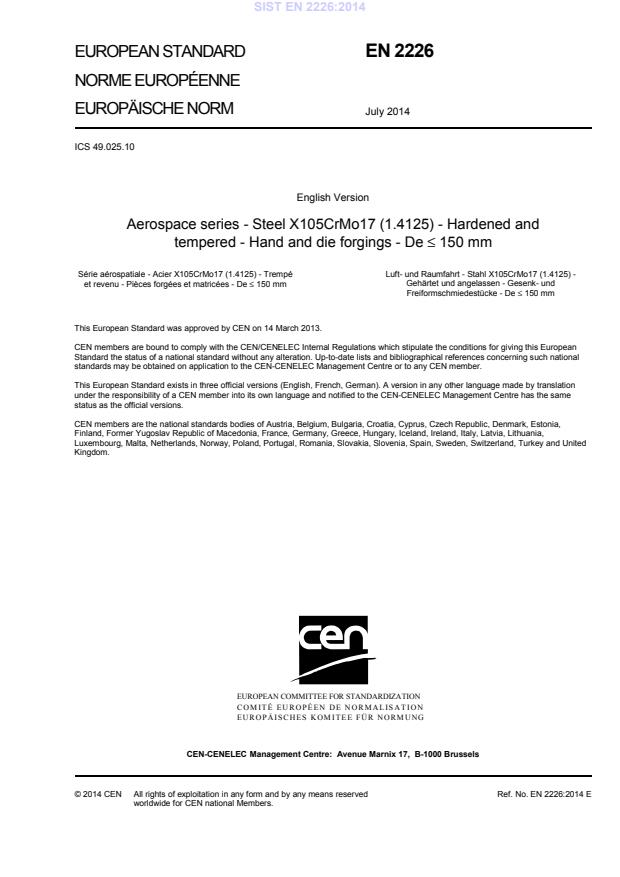
2003-01.Slovenski inštitut za standardizacijo. Razmnoževanje celote ali delov tega standarda ni dovoljeno.49.025.10JeklaSteelsICS:Ta slovenski standard je istoveten z:EN 2226:2014SIST EN 2226:2014en,fr,de01-oktober-2014SIST EN 2226:2014SLOVENSKI
STANDARD
EUROPEAN STANDARD NORME EUROPÉENNE EUROPÄISCHE NORM
EN 2226
July 2014 ICS 49.025.10 English Version
Aerospace series - Steel X105CrMo17 (1.4125) - Hardened and tempered - Hand and die forgings - De ≤ 150 mm
Série aérospatiale - Acier X105CrMo17 (1.4125) - Trempé et revenu - Pièces forgées et matricées - De ≤ 150 mm
Luft- und Raumfahrt - Stahl X105CrMo17 (1.4125) - Gehärtet und angelassen - Gesenk- und Freiformschmiedestücke - De ≤ 150 mm This European Standard was approved by CEN on 14 March 2013.
CEN members are bound to comply with the CEN/CENELEC Internal Regulations which stipulate the conditions for giving this European Standard the status of a national standard without any alteration. Up-to-date lists and bibliographical references concerning such national standards may be obtained on application to the CEN-CENELEC Management Centre or to any CEN member.
This European Standard exists in three official versions (English, French, German). A version in any other language made by translation under the responsibility of a CEN member into its own language and notified to the CEN-CENELEC Management Centre has the same status as the official versions.
CEN members are the national standards bodies of Austria, Belgium, Bulgaria, Croatia, Cyprus, Czech Republic, Denmark, Estonia, Finland, Former Yugoslav Republic of Macedonia, France, Germany, Greece, Hungary, Iceland, Ireland, Italy, Latvia, Lithuania, Luxembourg, Malta, Netherlands, Norway, Poland, Portugal, Romania, Slovakia, Slovenia, Spain, Sweden, Switzerland, Turkey and United Kingdom.
EUROPEAN COMMITTEE FOR STANDARDIZATION
COMITÉ EUROPÉEN DE NORMALISATION EUROPÄISCHES KOMITEE FÜR NORMUNG
CEN-CENELEC Management Centre:
Avenue Marnix 17,
B-1000 Brussels © 2014 CEN All rights of exploitation in any form and by any means reserved worldwide for CEN national Members. Ref. No. EN 2226:2014 ESIST EN 2226:2014
...