

EN 16186-8:2022
(Main)Railway applications - Driver's cab - Part 8: Tram vehicle layout and access
General Information
- Abstract
This document gives design rules and requirements in order to ensure proper access, lighting, seating and exit of driver's cabs. The different dimensions are based on the anthropometric data defined in EN 16186-5. The corresponding assessment methods are also included in this document. It covers the following aspects:
— dimension and interior layout;
— door access, steps, floor characteristics;
— seats dimension and clearance;
— interior cab lighting;
— emergency exit;
— marking and labelling.
This document is applicable to vehicles operating on tram networks.
- Status
- Withdrawn
- Publication Date
- 12-Apr-2022
- Withdrawal Date
- 29-Sep-2026
- Technical Committee
- CEN/TC 256 - Railway applications
- Drafting Committee
- CEN/TC 256/WG 37 - Driver's cabs and windscreens
- Current Stage
- 9960 - Withdrawal effective - Withdrawal
- Start Date
- 24-Jul-2024
- Completion Date
- 30-Sep-2026

Relations
- Effective Date
- 05-Jun-2024
- Effective Date
- 25-Aug-2026
- Effective Date
- 09-Feb-2026
- Effective Date
- 28-Jan-2026
- Effective Date
- 28-Jan-2026
- Effective Date
- 28-Jan-2026
- Effective Date
- 28-Jan-2026
- Effective Date
- 28-Jan-2026
- Effective Date
- 28-Jan-2026
- Effective Date
- 28-Jan-2026
- Effective Date
- 28-Jan-2026
- Effective Date
- 28-Jan-2026
- Effective Date
- 28-Jan-2026
- Effective Date
- 28-Jan-2026
- Effective Date
- 28-Jan-2026
Get Certified
Connect with accredited certification bodies for this standard

IRIS Certification (UNIFE)
International Railway Industry Standard certification.

TÜV SÜD Rail GmbH
TÜV SÜD railway certification services.

Bureau Veritas Railway Certification
Railway and transportation certification.
Sponsored listings
Frequently Asked Questions
EN 16186-8:2022 is a standard published by the European Committee for Standardization (CEN). Its full title is "Railway applications - Driver's cab - Part 8: Tram vehicle layout and access". This standard covers: This document gives design rules and requirements in order to ensure proper access, lighting, seating and exit of driver's cabs. The different dimensions are based on the anthropometric data defined in EN 16186-5. The corresponding assessment methods are also included in this document. It covers the following aspects: — dimension and interior layout; — door access, steps, floor characteristics; — seats dimension and clearance; — interior cab lighting; — emergency exit; — marking and labelling. This document is applicable to vehicles operating on tram networks.
This document gives design rules and requirements in order to ensure proper access, lighting, seating and exit of driver's cabs. The different dimensions are based on the anthropometric data defined in EN 16186-5. The corresponding assessment methods are also included in this document. It covers the following aspects: — dimension and interior layout; — door access, steps, floor characteristics; — seats dimension and clearance; — interior cab lighting; — emergency exit; — marking and labelling. This document is applicable to vehicles operating on tram networks.
EN 16186-8:2022 is classified under the following ICS (International Classification for Standards) categories: 45.060.10 - Tractive stock; 45.140 - Metro, tram and light rail equipment. The ICS classification helps identify the subject area and facilitates finding related standards.
EN 16186-8:2022 has the following relationships with other standards: It is inter standard links to EN 16186-8:2022+A1:2024, ISO 2631-1:1997, ISO 3864-1:2011, EN 45545-4:2013, EN 17530:2022+A1:2024, EN 15227:2020+A1:2024, EN 16186-5:2021, EN 13272-2:2019, EN 12663-1:2010+A2:2023, EN 15152:2019+A1:2023, EN 643:1994, EN ISO 3385:2014, EN 894-3:2000+A1:2008, EN 1005-3:2002+A1:2008, EN ISO 7010:2020. Understanding these relationships helps ensure you are using the most current and applicable version of the standard.
EN 16186-8:2022 is associated with the following European legislation: Standardization Mandates: M/483. When a standard is cited in the Official Journal of the European Union, products manufactured in conformity with it benefit from a presumption of conformity with the essential requirements of the corresponding EU directive or regulation.
EN 16186-8:2022 is available in PDF format for immediate download after purchase. The document can be added to your cart and obtained through the secure checkout process. Digital delivery ensures instant access to the complete standard document.
Standards Content (Sample)
SLOVENSKI STANDARD
01-junij-2022
Železniške naprave - Voznikova kabina - 8. del: Razpored v tramvaju in dostop
Railway applications - Driver's cab - Part 8: Tram vehicle layout and access
Bahnanwendungen - Führerraum - Teil 8: Gestaltung und Zugang bei
Straßenbahnfahrzeugen
Applications ferroviaires - Cabines de conduite - Partie 8 : Amènagement et accès pour
les tramways
Ta slovenski standard je istoveten z: EN 16186-8:2022
ICS:
45.060.10 Vlečna vozila Tractive stock
45.140 Oprema za podzemne vlake, Metro, tram and light rail
tramvaje in lahka tirna vozila equipment
2003-01.Slovenski inštitut za standardizacijo. Razmnoževanje celote ali delov tega standarda ni dovoljeno.
EN 16186-8
EUROPEAN STANDARD
NORME EUROPÉENNE
April 2022
EUROPÄISCHE NORM
ICS 45.060.10; 45.140
English Version
Railway applications - Driver's cab - Part 8: Tram vehicle
layout and access
Applications ferroviaires - Cabines de conduite - Partie Bahnanwendungen - Führerraum - Teil 8: Gestaltung
8 : Aménagement et accès pour les tramways und Zugang bei Straßenbahnfahrzeugen
This European Standard was approved by CEN on 13 March 2022.
CEN members are bound to comply with the CEN/CENELEC Internal Regulations which stipulate the conditions for giving this
European Standard the status of a national standard without any alteration. Up-to-date lists and bibliographical references
concerning such national standards may be obtained on application to the CEN-CENELEC Management Centre or to any CEN
member.
This European Standard exists in three official versions (English, French, German). A version in any other language made by
translation under the responsibility of a CEN member into its own language and notified to the CEN-CENELEC Management
Centre has the same status as the official versions.
CEN members are the national standards bodies of Austria, Belgium, Bulgaria, Croatia, Cyprus, Czech Republic, Denmark, Estonia,
Finland, France, Germany, Greece, Hungary, Iceland, Ireland, Italy, Latvia, Lithuania, Luxembourg, Malta, Netherlands, Norway,
Poland, Portugal, Republic of North Macedonia, Romania, Serbia, Slovakia, Slovenia, Spain, Sweden, Switzerland, Turkey and
United Kingdom.
EUROPEAN COMMITTEE FOR STANDARDIZATION
COMITÉ EUROPÉEN DE NORMALISATION
EUROPÄISCHES KOMITEE FÜR NORMUNG
CEN-CENELEC Management Centre: Rue de la Science 23, B-1040 Brussels
© 2022 CEN All rights of exploitation in any form and by any means reserved Ref. No. EN 16186-8:2022 E
worldwide for CEN national Members.
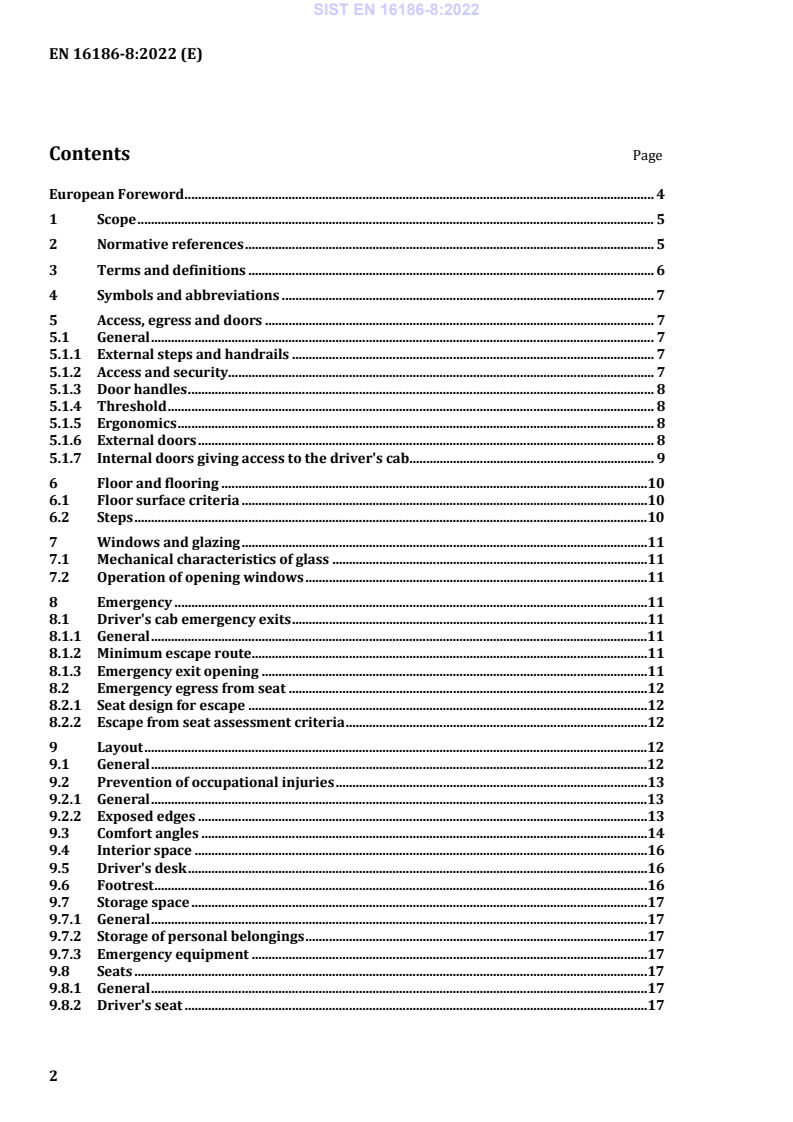
Contents Page
European Foreword . 4
1 Scope . 5
2 Normative references . 5
3 Terms and definitions . 6
4 Symbols and abbreviations . 7
5 Access, egress and doors . 7
5.1 General . 7
5.1.1 External steps and handrails . 7
5.1.2 Access and security . 7
5.1.3 Door handles . 8
5.1.4 Threshold . 8
5.1.5 Ergonomics . 8
5.1.6 External doors . 8
5.1.7 Internal doors giving access to the driver's cab . 9
6 Floor and flooring .10
6.1 Floor surface criteria .10
6.2 Steps .10
7 Windows and glazing .11
7.1 Mechanical characteristics of glass .11
7.2 Operation of opening windows .11
8 Emergency .11
8.1 Driver's cab emergency exits .11
8.1.1 General .11
8.1.2 Minimum escape route .11
8.1.3 Emergency exit opening .11
8.2 Emergency egress from seat .12
8.2.1 Seat design for escape .12
8.2.2 Escape from seat assessment criteria .12
9 Layout .12
9.1 General .12
9.2 Prevention of occupational injuries .13
9.2.1 General .13
9.2.2 Exposed edges .13
9.3 Comfort angles .14
9.4 Interior space .16
9.5 Driver's desk .16
9.6 Footrest .16
9.7 Storage space .17
9.7.1 General .17
9.7.2 Storage of personal belongings .17
9.7.3 Emergency equipment .17
9.8 Seats .17
9.8.1 General .17
9.8.2 Driver's seat .17
9.8.3 Additional seats . 19
9.9 Surface finish . 19
9.10 Privacy shield . 19
10 Lighting . 20
11 Marking and labelling in driver's cab. 20
Annex A (normative) Driver's seat dimensions and driver's seat integration . 21
Annex B (Normative) Minimum leg clearance . 25
Annex C (normative) Mandatory labels . 26
Bibliography . 27
European foreword
This document (EN 16186-8:2022) has been prepared by Technical Committee CEN/TC 256 “Railway
applications”, the secretariat of which is held by DIN.
This European Standard shall be given the status of a national standard, either by publication of an
identical text or by endorsement, at the latest by October 2022, and conflicting national standards shall
be withdrawn at the latest by October 2022.
Attention is drawn to the possibility that some of the elements of this document may be the subject of
patent rights. CEN shall not be held responsible for identifying any or all such patent rights.
EN 16186 Railway applications — Driver’s cab consists of the following parts:
— Part 1: Anthropometric data and visibility
— Part 2: Integration of displays, controls and indicators
— Part 3: Design of displays for heavy rail vehichles
— Part 4: Layout and access
— Part 5: External visibility for tram vehicles
— Part 6: Integration of displays, controls and indicators for tram vehicles
— Part 7: Design of displays for tram vehicles
— Part 8: Tram vehicle layout and access
Any feedback and questions on this document should be directed to the users’ national standards body.
A complete listing of these bodies can be found on the CEN website.
According to the CEN-CENELEC Internal Regulations, the national standards organisations of the
following countries are bound to implement this European Standard: Austria, Belgium, Bulgaria, Croatia,
Cyprus, Czech Republic, Denmark, Estonia, Finland, France, Germany, Greece, Hungary, Iceland, Ireland,
Italy, Latvia, Lithuania, Luxembourg, Malta, Netherlands, Norway, Poland, Portugal, Republic of North
Macedonia, Romania, Serbia, Slovakia, Slovenia, Spain, Sweden, Switzerland, Turkey and the United
Kingdom.
To be published.
1 Scope
This document gives design rules and requirements in order to ensure proper access, lighting, seating
and exit of driver's cabs. The different dimensions are based on the anthropometric data defined in
EN 16186-5. The corresponding assessment methods are also included in this document. It covers the
following aspects:
— dimension and interior layout;
— door access, steps, floor characteristics;
— seats dimension and clearance;
— interior cab lighting;
— emergency exit;
— marking and labelling.
This document is applicable to vehicles operating on tram networks.
2 Normative references
The following documents are referred to in the text in such a way that some or all of their content
constitutes requirements of this document. For dated references, only the edition cited applies. For
undated references, the latest edition of the referenced document (including any amendments) applies.
EN 894-3, Safety of machinery - Ergonomics requirements for the design of displays and control actuators -
Part 3: Control actuators
EN 1005-3, Safety of machinery - Human physical performance - Part 3: Recommended force limits for
machinery operation
EN 12663-1, Railway applications - Structural requirements of railway vehicle bodies - Part 1: Locomotives
and passenger rolling stock (and alternative method for freight wagons)
EN 13272-2, Railway applications - Electrical lighting for rolling stock in public transport systems - Part 2:
Urban rail
EN 15152, Railway applications - Windscreens for trains
EN 15227, Railway applications - Crashworthiness requirements for rail vehicles
EN 16186-5:2021, Railway applications - Driver’s cabs - Part 5: External visibility for tram vehicles
EN 16186-6:— , Railway applications - Driver’s cabs - Part 6: Integration of displays, controls and
indicators for tram vehicles
EN 17530, Railway applications - Interior glazing for rail vehicles
Under preparation: Stage at the time of publication: prEN 16186-6:2022.
EN 45545-4:2013, Railway applications - Fire protection on railway vehicles - Part 4: Fire safety
requirements for rolling stock design
EN ISO 2813:2014, Paints and varnishes - Determination of gloss value at 20°, 60° and 85° (ISO 2813:2014)
EN ISO 3385, Flexible cellular polymeric materials - Determination of fatigue by constant-load pounding
(ISO 3385)
EN ISO 7010:2020, Graphical symbols - Safety colours and safety signs - Registered safety signs (ISO
7010:2019, Corrected version 2020-06)
ISO 2631-1, Mechanical vibration and shock — Evaluation of human exposure to whole-body vibration —
Part 1: General requirements
ISO 3864-1:2011, Graphical symbols — Safety colours and safety signs — Part 1: Design principles for safety
signs and safety markings
3 Terms and definitions
For the purposes of this document, the following terms and definitions apply.
ISO and IEC maintain terminological databases for use in standardization at the following addresses:
— ISO Online browsing platform: available at https://www.iso.org/obp
— IEC Electropedia: available at https://www.electropedia.org/
3.1
gloss
optical property of a surface, characterised by its ability to reflect light specularly
[SOURCE: EN ISO 2813:2014, definition 3.1 modified, the Note 1 to entry has been deleted]
3.2
primary controls
controls having high importance and/or high frequency and/or prolonged periods of use
NOTE 1 to entry: Safety related controls are high importance controls.
3.3
primary information
information having high importance and/or high frequency of checking
NOTE 1 to entry: Safety related information is high importance information.
4 Symbols and abbreviations
For the purposes of this document, the following abbreviations are used.
g Standard acceleration due to gravity (9,81 m/s )
FLP Footrest Lowest Position
GU Gloss Unit as defined in EN ISO 2813
HP Heel point
RAL Colour codification from Deutsches Institut für Gütesicherung und Kennzeichnung,
former Reichs-Ausschuss für Lieferbedingungen
SRP Seat Reference Point
5 Access, egress and doors
5.1 General
5.1.1 External steps and handrails
The access steps shall be in the same vertical plane or in a plane with an angle of pitch less than 90°
(except where not possible due to different mounting conditions, for example, where some steps are
bogie mounted and some are body mounted). The access steps shall be located one above the other and
are equidistant from one another. The vertical distance between the steps is recommended to be in
between 250 mm and 350 mm, but shall not exceed 450 mm. The bottom step shall be as low as permitted
by the gauge and should not be higher than 600 mm above top of rail.
The steps shall be of the same width which shall be 300 mm as a minimum. The depth of the step shall be
at least 80 mm. There shall be a free space above the step, with a minimum depth of 150 mm. This space
over the step should be 150 mm high but shall not be less than 120 mm high. The height may decrease to
80 mm at a depth of 150 mm.
The level of the access door does not have to comply with the requirements above.
The floor or any sealing frame at the access door needs not be considered as a step but the height of the
floor level above the adjacent step shall not be more than 450 mm and it is recommended that this height
is equidistant to the other steps.
A handrail shall be provided in all cases on each side of external doors and steps directly leading to a
driver’s cab. The handrails shall be mounted solely at each end. The distance from the lower extremity of
the handrail to top of rail should not be higher than 1 100 mm, but shall not exceed 1 250 mm. The
distance from the top end of the handrail to the driver’s cab floor level should be 1 200 mm but shall not
be less than 1 000 mm.
The handrail shall be made of round bar with a diameter of min. 20 mm to max. 35 mm and shall
withstand a force applied by staff of 1,5 kN at any point in any direction without causing permanent
deformation to it or its fixings.
5.1.2 Access and security
Access to the driver’s cab shall be from the exterior via a direct external door, and/or through a door from
an adjacent compartment or area behind the cab.
These doors shall be designed to have an operational envelope that does not conflict with the envelope
of another door.
The driver’s cab and its access shall be designed so that the staff are able to prevent the cab being accessed
by non-authorized persons, whether the cab is occupied or not. This requirement is deemed to be fulfilled
by a locking system.
An emergency escape device shall permit to open any cab door from inside the cab without using any tool
or key.
Egress and access to the driver’s cab shall be possible without any energy supply.
5.1.3 Door handles
Door handles on the inside of the cab which are intended to be operated from a standing position shall
be located at a height between 820 mm and 1 200 mm (distance between the rotation axis of the handle
and the cab floor). The recommended value for the height of the door handles is 850 mm.
The handles shall have rounded edges and the force required to operate it should be adapted to the
driver's population. In all cases, the force shall not exceed 50 N.
5.1.4 Threshold
The height of door threshold shall not be more than:
— 20 mm from the floor adjacent to the door, for interior doors, from the highest adjacent floor level;
— 60 mm from the floor adjacent to the door, for exterior doors.
5.1.5 Ergonomics
For handles inside the cab in regular use at least 40 mm clearance to surrounding surfaces shall be
provided.
5.1.6 External doors
External cab doors when opened shall not infringe the intended maximal construction gauge defined from
gauge rules of the vehicle.
Driver’s cab external doors shall have a rectangular-like shape with a minimum unobstructed passage of
1 850 mm (height) × 550 mm (width) in accordance with Figure 1 (recommended 1 900 mm × 600 mm).
NOTE The width value is based on anthropometric data (shoulder breadth).
Key
w width
h height
r radius
Figure 1 — Minimum unobstructed passage dimensions
Dimension r shall not exceed 10 % of the width.
Cab external doors shall not open unintentionally. External cab doors shall have at least two stable
positions (fully opened and closed) for which unwanted movement shall be prevented reliably.
5.1.7 Internal doors giving access to the driver's cab
If internal doors lead directly to the passenger area, a device to observe this area from inside the cab shall
be provided, (e.g. by a spy hole or a transparent partition wall).
Internal doors shall have a rectangular-like minimum unobstructed passage height and width of
1 850 mm × 550 mm (recommended 1900 mm × 600 mm). Internal doors which are positioned left or
right of the vehicle's longitudinal axis may have a trapezium shaped upper area with an angle of the top
outer side (see Figure 2).
Internal cab doors shall have at least two stable positions (fully opened and closed) for which unwanted
movement shall be prevented reliably.
Dimensions in millimetres
Figure 2 — Minimum door clearance for lateral internal doors
6 Floor and flooring
6.1 Floor surface criteria
Walkable area and steps shall be slip resistant.
This is deemed to be fulfilled by applying the requirement of EN 16165:2021, α ≥ 9°.
shod
For minimizing the tripping hazard, the walkable floor of the cab shall be level (with a tolerance of ± 2°).
Exceptions are allowed in the following areas:
— area up to a maximum of 25 mm from the walls;
— the area below the desk;
— the area adjacent to doors (if there is a step) up to a distance of 25 mm.
No irregularity on the walkable floor shall protrude by more than 2 mm.
Sealing plates of door frames or sealing plates of door thresholds and maintenance openings are not
considered as being a floor irregularity, but shall not exceed 5 mm in height.
Due to the application of a vertical load of 1300 N on a surface of 300 mm × 200 mm, no eslastic deflection
of more than 10 mm in direction of the load shall be observed in the walkable floor, over the whole area.
This can be demonstrated by calculation or by test.
NOTE No reference to EN 15663 is given, because the load is associated to the stiffness of the floor and not to
the load calculation for the vehicle.
6.2 Steps
The walkable floor of the driver's cab (access to the cab and foot rest excluded) shall be without any steps.
Steps are permitted between the cab and adjacent passenger area, as well as for accessing the cab from
the exterior.
Steps shall not exceed a maximum height of 230 mm and should not exceed a height of 200 mm and shall
have a depth of ≥ 210 mm. If more than one step is used, the height of each step shall be identical. If there
are two or more steps, a handhold (e.g. a handrail or a single handle) shall be provided.
If there is a difference between the floor surface level of the cab and the passenger area level, it should
not exceed 30 mm. This is not considered as a step.
If steps are provided, the first and the last step inside the cab shall be indicated by a yellow or yellow-
black band with a minimum width of 25 mm along the useable width of the steps on the top surfaces of
the nosing line. The yellow colour is defined in ISO 3864-4.
NOTE First step means the first usable step when ascending and the edge of the walking floor when descending.
7 Windows and glazing
7.1 Mechanical characteristics of glass
External glazing of cab windows shall be in accordance with EN 15152 and internal glazing of the cab
shall be in accordance with EN 17530.
The design of the windscreen may be affected by CEN/TR 17420.
7.2
...