

EN 13697:2001
(Main)Chemical disinfectants and antiseptics - Quantitative non-porous surface test for the evaluation of bactericidal and/or fungicidal activity of chemical disinfectants used in food, industrial, domestic and institutional areas - Test method and requirements without mechanical action (phase 2/step2)
General Information
- Abstract
This European Standard specifies a test method (phase 2/step 2) and the minimum requirements for bactericidal and/or fungicidal activity of chemical disinfectants that form a homogeneous physically stable preparation in hard water and that are used in food, industrial, domestic and institutional areas, excluding areas and situations where disinfection is medically indicated and excluding products used on living tissues.
The scope of this European Standard applies at least to the following :
a) Processing, distribution and retailing of :
1) Food of animal origin :
- milk and milk products ;
- meat and meat products ;
- fish, seafood and products ;
- eggs and egg products ;
- animal feeds ;
- etc.
2) Food of vegetable origin :
- beverages ;
- fruits, vegetables and derivatives (including sugar distillery) ;
- flour, milling and backing ;
- animal feeds ;
- etc.
b) Institutional and domestic areas :
- catering establishments ;
- public areas ;
- public transports ;
- schools ;
- nurseries ;
- shops ;
- sports rooms ;
- waste container (bins) ;
- hotels ;
- dwellings ;
- clinically non sensitive areas of hospitals ;
- offices ;
- etc.
c) Other industrial areas :
- packaging material ;
- biotechnology (yeast, proteins, enzymes...) ;
- pharmaceutical ;
- cosmetics and toiletries ;
- textiles ;
- space industry, computer industry ;
- etc.
Using this European Standard, it is possible to determine the bactericidal or fungicidal activity of the undiluted product. As three concentrations have to be tested, in the active to non active range, dilution of the product is required and, therefore, the product shall form a homogeneous stable preparation in hard water.
NOTE 1 The method described is intended to determine the activity of commercial formulations or active substances on bacteria and/or fungi in the conditions in which they are used.
- Status
- Withdrawn
- Publication Date
- 28-Aug-2001
- Withdrawal Date
- 29-Sep-2026
- Technical Committee
- CEN/TC 216 - Chemical disinfectants and antiseptics
- Drafting Committee
- CEN/TC 216/WG 3 - Food hygiene and domestic and institutional use
- Current Stage
- 9960 - Withdrawal effective - Withdrawal
- Start Date
- 01-Apr-2015
- Completion Date
- 30-Sep-2026

Relations
- Effective Date
- 08-Apr-2015
- Effective Date
- 28-Jan-2026
- Effective Date
- 28-Jan-2026
- Effective Date
- 28-Jan-2026
- Effective Date
- 28-Jan-2026
- Effective Date
- 28-Jan-2026
Get Certified
Connect with accredited certification bodies for this standard

BSI Group
BSI (British Standards Institution) is the business standards company that helps organizations make excellence a habit.

TÜV Rheinland
TÜV Rheinland is a leading international provider of technical services.

TÜV SÜD
TÜV SÜD is a trusted partner of choice for safety, security and sustainability solutions.
Sponsored listings
Frequently Asked Questions
EN 13697:2001 is a standard published by the European Committee for Standardization (CEN). Its full title is "Chemical disinfectants and antiseptics - Quantitative non-porous surface test for the evaluation of bactericidal and/or fungicidal activity of chemical disinfectants used in food, industrial, domestic and institutional areas - Test method and requirements without mechanical action (phase 2/step2)". This standard covers: This European Standard specifies a test method (phase 2/step 2) and the minimum requirements for bactericidal and/or fungicidal activity of chemical disinfectants that form a homogeneous physically stable preparation in hard water and that are used in food, industrial, domestic and institutional areas, excluding areas and situations where disinfection is medically indicated and excluding products used on living tissues. The scope of this European Standard applies at least to the following : a) Processing, distribution and retailing of : 1) Food of animal origin : - milk and milk products ; - meat and meat products ; - fish, seafood and products ; - eggs and egg products ; - animal feeds ; - etc. 2) Food of vegetable origin : - beverages ; - fruits, vegetables and derivatives (including sugar distillery) ; - flour, milling and backing ; - animal feeds ; - etc. b) Institutional and domestic areas : - catering establishments ; - public areas ; - public transports ; - schools ; - nurseries ; - shops ; - sports rooms ; - waste container (bins) ; - hotels ; - dwellings ; - clinically non sensitive areas of hospitals ; - offices ; - etc. c) Other industrial areas : - packaging material ; - biotechnology (yeast, proteins, enzymes...) ; - pharmaceutical ; - cosmetics and toiletries ; - textiles ; - space industry, computer industry ; - etc. Using this European Standard, it is possible to determine the bactericidal or fungicidal activity of the undiluted product. As three concentrations have to be tested, in the active to non active range, dilution of the product is required and, therefore, the product shall form a homogeneous stable preparation in hard water. NOTE 1 The method described is intended to determine the activity of commercial formulations or active substances on bacteria and/or fungi in the conditions in which they are used.
This European Standard specifies a test method (phase 2/step 2) and the minimum requirements for bactericidal and/or fungicidal activity of chemical disinfectants that form a homogeneous physically stable preparation in hard water and that are used in food, industrial, domestic and institutional areas, excluding areas and situations where disinfection is medically indicated and excluding products used on living tissues. The scope of this European Standard applies at least to the following : a) Processing, distribution and retailing of : 1) Food of animal origin : - milk and milk products ; - meat and meat products ; - fish, seafood and products ; - eggs and egg products ; - animal feeds ; - etc. 2) Food of vegetable origin : - beverages ; - fruits, vegetables and derivatives (including sugar distillery) ; - flour, milling and backing ; - animal feeds ; - etc. b) Institutional and domestic areas : - catering establishments ; - public areas ; - public transports ; - schools ; - nurseries ; - shops ; - sports rooms ; - waste container (bins) ; - hotels ; - dwellings ; - clinically non sensitive areas of hospitals ; - offices ; - etc. c) Other industrial areas : - packaging material ; - biotechnology (yeast, proteins, enzymes...) ; - pharmaceutical ; - cosmetics and toiletries ; - textiles ; - space industry, computer industry ; - etc. Using this European Standard, it is possible to determine the bactericidal or fungicidal activity of the undiluted product. As three concentrations have to be tested, in the active to non active range, dilution of the product is required and, therefore, the product shall form a homogeneous stable preparation in hard water. NOTE 1 The method described is intended to determine the activity of commercial formulations or active substances on bacteria and/or fungi in the conditions in which they are used.
EN 13697:2001 is classified under the following ICS (International Classification for Standards) categories: 11.080.20 - Disinfectants and antiseptics; 71.100.35 - Chemicals for industrial and domestic disinfection purposes. The ICS classification helps identify the subject area and facilitates finding related standards.
EN 13697:2001 has the following relationships with other standards: It is inter standard links to EN 13697:2015, EN 1275:2005, EN 12353:2021, EN 10088-1:2023, EN 10088-2:2024, EN 1040:2005. Understanding these relationships helps ensure you are using the most current and applicable version of the standard.
EN 13697:2001 is available in PDF format for immediate download after purchase. The document can be added to your cart and obtained through the secure checkout process. Digital delivery ensures instant access to the complete standard document.
Standards Content (Sample)
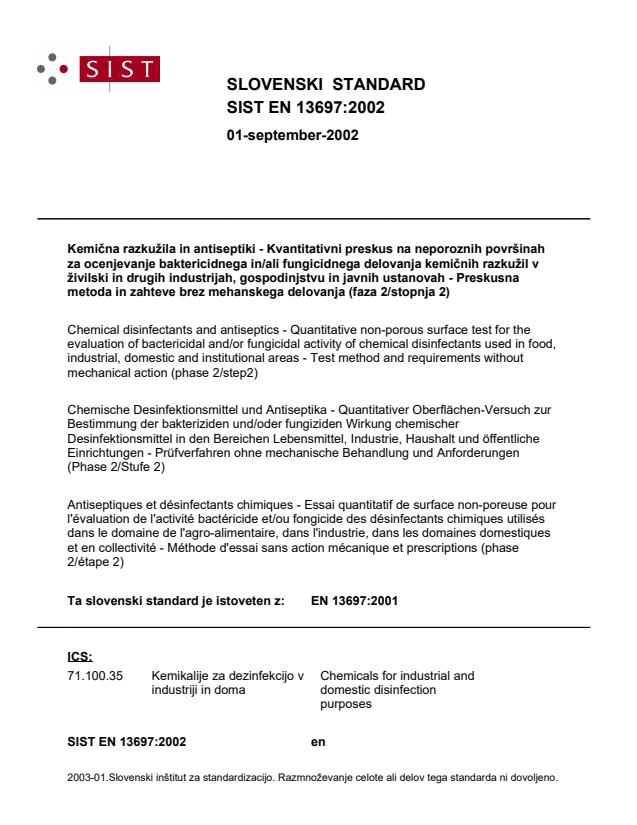
2003-01.Slovenski inštitut za standardizacijo. Razmnoževanje celote ali delov tega standarda ni dovoljeno.Chemische Desinfektionsmittel und Antiseptika - Quantitativer Oberflächen-Versuch zur Bestimmung der bakteriziden und/oder fungiziden Wirkung chemischer Desinfektionsmittel in den Bereichen Lebensmittel, Industrie, Haushalt und öffentliche Einrichtungen - Prüfverfahren ohne mechanische Behandlung und Anforderungen (Phase 2/Stufe 2)Antiseptiques et désinfectants chimiques - Essai quantitatif de surface non-poreuse pour l'évaluation de l'activité bactéricide et/ou fongicide des désinfectants chimiques utilisés dans le domaine de l'agro-alimentaire, dans l'industrie, dans les domaines domestiques et en collectivité - Méthode d'essai sans action mécanique et prescriptions (phase 2/étape 2)Chemical disinfectants and antiseptics - Quantitative non-porous surface test for the evaluation of bactericidal and/or fungicidal activity of chemical disinfectants used in food, industrial, domestic and institutional areas - Test method and requirements without mechanical action (phase 2/step2)71.100.35Kemikalije za dezinfekcijo v industriji in domaChemicals for industrial and domestic disinfection purposesICS:Ta slovenski standard je istoveten z:EN 13697:2001SIST EN 13697:2002en01-september-2002SIST EN 13697:2002SLOVENSKI
STANDARD
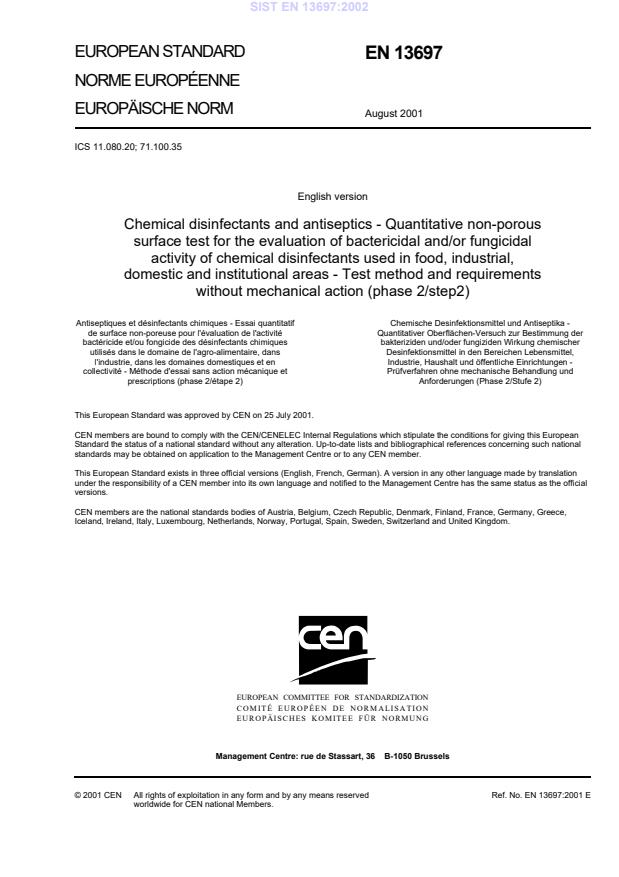
EUROPEAN STANDARDNORME EUROPÉENNEEUROPÄISCHE NORMEN 13697August 2001ICS 11.080.20; 71.100.35English versionChemical disinfectants and antiseptics - Quantitative non-poroussurface test for the evaluation of bactericidal and/or fungicidalactivity of chemical disinfectants used in food, industrial,domestic and institutional areas - Test method and requirementswithout mechanical action (phase 2/step2)Antiseptiques et désinfectants chimiques - Essai quantitatifde surface non-poreuse pour l'évaluation de l'activitébactéricide et/ou fongicide des désinfectants chimiquesutilisés dans le domaine de l'agro-alimentaire, dansl'industrie, dans les domaines domestiques et encollectivité - Méthode d'essai sans action mécanique etprescriptions (phase 2/étape 2)Chemische Desinfektionsmittel und Antiseptika -Quantitativer Oberflächen-Versuch zur Bestimmung derbakteriziden und/oder fungiziden Wirkung chemischerDesinfektionsmittel in den Bereichen Lebensmittel,Industrie, Haushalt und öffentliche Einrichtungen -Prüfverfahren ohne mechanische Behandlung undAnforderungen (Phase 2/Stufe 2)This European Standard was approved by CEN on 25 July 2001.CEN members are bound to comply with the CEN/CENELEC Internal Regulations which stipulate the conditions for giving this EuropeanStandard the status of a national standard without any alteration. Up-to-date lists and bibliographical references concerning such nationalstandards may be obtained on application to the Management Centre or to any CEN member.This European Standard exists in three official versions (English, French, German). A version in any other language made by translationunder the responsibility of a CEN member into its own language and notified to the Management Centre has the same status as the officialversions.CEN members are the national standards bodies of Austria, Belgium, Czech Republic, Denmark, Finland, France, Germany, Greece,Iceland, Ireland, Italy, Luxembourg, Netherlands, Norway, Portugal, Spain, Sweden, Switzerland and United Kingdom.EUROPEAN COMMITTEE FOR STANDARDIZATIONCOMITÉ EUROPÉEN DE NORMALISATIONEUROPÄISCHES KOMITEE FÜR NORMUNGManagement Centre: rue de Stassart, 36
B-1050 Brussels© 2001 CENAll rights of exploitation in any form and by any means reservedworldwide for CEN national Members.Ref. No. EN 13697:2001 ESIST EN 13697:2002
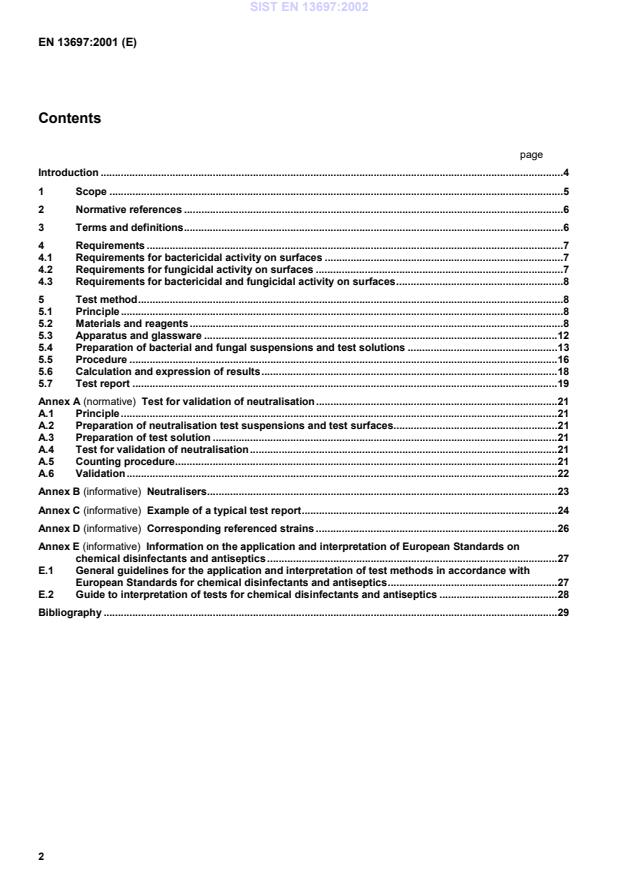
Test for validation of neutralisation.21A.1Principle.21A.2Preparation of neutralisation test suspensions and test surfaces.21A.3Preparation of test solution.21A.4Test for validation of neutralisation.21A.5Counting procedure.21A.6Validation.22Annex B (informative)
Neutralisers.23Annex C (informative)
Example of a typical test report.24Annex D (informative)
Corresponding referenced strains.26Annex E (informative)
Information on the application and interpretation of European Standards onchemical disinfectants and antiseptics.27E.1General guidelines for the application and interpretation of test methods in accordance withEuropean Standards for chemical disinfectants and antiseptics.27E.2Guide to interpretation of tests for chemical disinfectants and antiseptics.28Bibliography.29SIST EN 13697:2002
1)ATCC 15 442, ATCC 6 538, ATCC 10 541, ATCC 10 536, ATCC 10 231, ATCC 16 404 and ATCC 13311 are the collectionnumbers of strains supplied by the American Type Culture Collections. DSM 6 235, DSM 6 234, DSM 1333 and DSM 70487 arethe collection numbers of strains supplied by the DSMZ (Deutsche Sammlung von Mikroorganismen und Zellkulturen). Thisinformation is given for the convenience of users of this standard and does not constitute an endorsement by CEN of theproduct named. Equivalent products can be used if they can be shown to lead to the same results.SIST EN 13697:2002
C.5.2.2.4 Malt extract agar (MEA)For maintenance of fungal strains, sporulation and performance of viable counts.Malt extract (technical grade)30,0 gSoya peptone3,0 gAgar15,0 gWater (see 5.2.2.2)1 000,0 mlSterilise in the autoclave (see 5.3.2.1). After sterilisation the pH of the medium shall be equivalent to 5,6 ± 0,2 whenmeasured at 20 °C.5.2.2.5 DiluentTryptone sodium chloride solution :Tryptone, pancreatic digest of casein1,0 gNaCl8,5 gWater (see 5.2.2.2)1 000,0 mlSterilise in the autoclave (see 5.3.2.1). After sterilisation the pH shall be equivalent to 7,0 ± 0,2 when measured at20 °C.5.2.2.6 NeutraliserThe neutraliser shall be validated for the product under test in accordance with annex A. The neutraliser shall besterile.NOTEInformation on neutralisers that have been found to be suitable for some categories of products is given in annex B.5.2.2.7 Hard water for dilution of the productsHard water for dilution of products shall be prepared as follows : solution A : Dissolve 19,84 g anhydrous MgCl2 and 46,24 g anhydrous CaCl2 in water (see 5.2.2.2) and diluteto 1 000 ml ;SIST EN 13697:2002
Decon 3) for 60 min. Immediately rinse the discs with running freshly distilled water for 10 s.The surface shall not be allowed to dry to any extent. The discs shall only be handled with forceps. Rinse the discswith water (see 5.2.2.2) for a further 10 s to ensure complete removal of the surfactant. To supply a satisfactoryflow of water, a sterilized fluid dispensing pressure vessel with suitable hose and connectors or other suitablemethod can be used and regulated to supply approximately 2 000 ml per min. To sterilise place the clean disc in abath containing 70 % (V/V) iso-propanol for 15 min. Remove the disc and dry by evaporation under laminar air flow.5.3 Apparatus and glassware5.3.1 GeneralSterilize all glassware and parts of apparatus that will come into contact with the culture media and reagents or thesample, except those which are supplied sterile, by one of the following methods :a) in the autoclave (see 5.3.2.1) by maintaining it at 121
C0 3 for a minimum holding time of 15 min ;b) in the dry heat sterilizer (see 5.3.2.1) by maintaining it at 180 °C for a minimum holding time of 30 min, at170 °C for a minimum holding time of 1 h or at 160 °C for a minimum holding time of 2 h.
2)Suitable stainless steel discs can usually be purchased from local engineering companies.3)Decon is an example of a suitable product available commercially. This information is given for the convenience of usersof this standard and does not constitute an endorsement by CEN of this product.SIST EN 13697:2002
C0 3 for 15 min ;b) for dry heat sterilisation, a hot air oven capable of being maintained at 180 °C for a minimum holding time of30 min, at 170 °C for a minimum holding time of 1 h or at 160 °C for a minimum holding time of 2 h.5.3.2.2Water baths capable of being controlled at 20 °C
± 1 °C, at 45 °C ± 1 °C and at additional testtemperatures ± 1 °C (see 5.5.1).5.3.2.3Incubator (for bactericidal activity), capable of being controlled at either 36 °C ± 1 °C or 37 °C ± 1 °C.An incubator at 37 °C ± 1 °C may be used if an incubator at 36 °C ± 1 C is not available.5.3.2.4Incubator (for fungicidal activity), capable of being controlled at 30 °C ± 1 °C.5.3.2.5pH meter, having an accuracy of calibration of 0,1 pH units at 25 °C.5.3.2.6Stopwatch5.3.2.7Vortex mixer (electromechanical agitator, i.e. Vortex® mixer 5))5.3.2.8Containers : Test tubes, culture bottles or flasks of suitable capacity.5.3.2.9Graduated pipettes of nominal capacities 10 ml, 1 ml and 0,1 ml. Calibrated automatic pipettes maybe used.5.3.2.10Petri dishes of size 90 mm to 100 mm.5.3.2.11Glass beads (Diameter : 3 mm to 4 mm).5.3.2.12Volumetric flasks of suitable capacity, calibrated at 20 °C.5.3.2.13Mechanical shaker5.3.2.14Forceps5.3.2.15Microbiological filtered laminar air flow5.3.2.16Fritted filter : Porosity of 40 µm to 100 µm (see ISO 4793).5.4 Preparation of bacterial and fungal suspensions and test solutions5.4.1 Bacterial and fungal suspensions5.4.1.1 Stock cultures of test organismsStocks cultures shall be kept in accordance with the requirements of EN 12353.5.4.1.2 Working culture of test organismsa) bacteria :In order to prepare the working culture of the test organism, subculture from the stock culture (see 5.4.1.1) bystreaking on TSA slopes (see 5.2.2.3) and incubate (see 5.3.2.3). After 18 h to 24 h prepare a second
4)Disposable equipment is an acceptable alternative to reusable glassware.5)Vortex® in an example of a suitable product available commercially. This information is given for the convenience of usersof this standard and does not constitute an endorsement by CEN of this product.SIST EN 13697:2002
6)Analytical quality, non hydrolysed in accordance with European Pharmacopoeia volume 1. TWEEN 80 is an example of asuitable product available commercially. This information is given for the convenience of users of this standard and does notconstitute an endorsement by CEN of this product.SIST EN 13697:2002
(°C) : the test temperature shall be at room temperature between the range 18 °C ± 1 °C and 25 °C ± 1 °C ; additional temperatures may be chosen from 4 °C ± 1 °C or 10 °C ± 1 °C or 40 °C ± 1 °C. A temperaturecontrolled chamber should be used for temperatures other than ambient.b) contact time ; t (min) : the contact time to be tested is 5 min ± 10 s for bacteria and 15 min ± 10 s for fungi ; additional times may be chosen from 1 min ± 10 s, 5 min ± 10 s, 15 min ± 10 s, 30 min ± 10 s and60 min ± 10 s.c) strains : strains shall be as given in 5.2.1.d) interfering substances : the interfering substance to be tested is the bovine albumin solution (see 5.2.2.8.1) under obligatory oroptional dirty conditions according to practical applications ; in the case of additional requirements other interfering substances (see 5.2.2.8.2 to 5.2.2.8.7) may bechosen according to the application field of the product.The product shall not cause the formation of any precipitate in the experimental conditions used.Each selected experimental condition (, t, strains and interfering substance) shall be validated in accordance withannex A.SIST EN 13697:2002
...