

CEN/TS 13001-3-1:2004
(Main)Cranes - General design - Part 3-1: Limit states and proof of competence of steel structures
General Information
- Abstract
This European Standard is to be used together with Part 1 and Part 2 and as such they specify general conditions, requirements and methods to prevent mechanical hazards of cranes by design and theoretical verification.
NOTE Specific requirements for particular types of crane are given in the appropriate European Standard for the particular crane type.
The following is a list of significant hazardous situations and hazardous events that could result in risks to persons during normal use and foreseeable misuse. Clauses 4 to 8 of this standard are necessary to reduce or eliminate the risks associated with the following hazards:
a) Exceeding the limits of strength (yield, ultimate, fatigue);
b) Exceeding temperature limits of material or components;
c) Elastic instability of the crane or its parts (buckling, bulging).
This European Standard is applicable to cranes which are manufactured after the date of approval by CEN of this standard and serves as reference base for the European Standards for particular crane types.
NOTE prCEN/TS 13001-3-1 deals only with limit state method according to prEN 13001-1.
As an alternative to the herein presented limit state method using partial safety factors, the allowable stress method using a global safety factor according to prEN 13001-1 and prEN 13001-2 may also be applied for special crane systems with linear behaviour.
As crane structures are basically dynamically loaded only the linear theory of elasticity is applicable and only limited local plasticity is allowed. The use of the theory of plasticity for calculation of ultimate load bearing capacity is not allowed.
- Status
- Withdrawn
- Publication Date
- 14-Dec-2004
- Withdrawal Date
- 27-Mar-2012
- Technical Committee
- CEN/TC 147 - Cranes - Safety
- Drafting Committee
- CEN/TC 147/WG 2 - Design - General
- Current Stage
- 9960 - Withdrawal effective - Withdrawal
- Start Date
- 28-Mar-2012
- Completion Date
- 28-Mar-2012
- Directive
- 98/37/EC - Machinery

Relations
- Effective Date
- 27-Jun-2012
- Effective Date
- 28-Jan-2026
- Effective Date
- 28-Jan-2026
- Effective Date
- 28-Jan-2026
- Effective Date
- 22-Dec-2008
Frequently Asked Questions
CEN/TS 13001-3-1:2004 is a technical specification published by the European Committee for Standardization (CEN). Its full title is "Cranes - General design - Part 3-1: Limit states and proof of competence of steel structures". This standard covers: This European Standard is to be used together with Part 1 and Part 2 and as such they specify general conditions, requirements and methods to prevent mechanical hazards of cranes by design and theoretical verification. NOTE Specific requirements for particular types of crane are given in the appropriate European Standard for the particular crane type. The following is a list of significant hazardous situations and hazardous events that could result in risks to persons during normal use and foreseeable misuse. Clauses 4 to 8 of this standard are necessary to reduce or eliminate the risks associated with the following hazards: a) Exceeding the limits of strength (yield, ultimate, fatigue); b) Exceeding temperature limits of material or components; c) Elastic instability of the crane or its parts (buckling, bulging). This European Standard is applicable to cranes which are manufactured after the date of approval by CEN of this standard and serves as reference base for the European Standards for particular crane types. NOTE prCEN/TS 13001-3-1 deals only with limit state method according to prEN 13001-1. As an alternative to the herein presented limit state method using partial safety factors, the allowable stress method using a global safety factor according to prEN 13001-1 and prEN 13001-2 may also be applied for special crane systems with linear behaviour. As crane structures are basically dynamically loaded only the linear theory of elasticity is applicable and only limited local plasticity is allowed. The use of the theory of plasticity for calculation of ultimate load bearing capacity is not allowed.
This European Standard is to be used together with Part 1 and Part 2 and as such they specify general conditions, requirements and methods to prevent mechanical hazards of cranes by design and theoretical verification. NOTE Specific requirements for particular types of crane are given in the appropriate European Standard for the particular crane type. The following is a list of significant hazardous situations and hazardous events that could result in risks to persons during normal use and foreseeable misuse. Clauses 4 to 8 of this standard are necessary to reduce or eliminate the risks associated with the following hazards: a) Exceeding the limits of strength (yield, ultimate, fatigue); b) Exceeding temperature limits of material or components; c) Elastic instability of the crane or its parts (buckling, bulging). This European Standard is applicable to cranes which are manufactured after the date of approval by CEN of this standard and serves as reference base for the European Standards for particular crane types. NOTE prCEN/TS 13001-3-1 deals only with limit state method according to prEN 13001-1. As an alternative to the herein presented limit state method using partial safety factors, the allowable stress method using a global safety factor according to prEN 13001-1 and prEN 13001-2 may also be applied for special crane systems with linear behaviour. As crane structures are basically dynamically loaded only the linear theory of elasticity is applicable and only limited local plasticity is allowed. The use of the theory of plasticity for calculation of ultimate load bearing capacity is not allowed.
CEN/TS 13001-3-1:2004 is classified under the following ICS (International Classification for Standards) categories: 53.020.20 - Cranes. The ICS classification helps identify the subject area and facilitates finding related standards.
CEN/TS 13001-3-1:2004 has the following relationships with other standards: It is inter standard links to EN 13001-3-1:2012, EN 81-43:2009, EN 13135-2:2004+A1:2010, EN 13852-1:2013, CEN/TS 13001-3-1:2004/AC:2006. Understanding these relationships helps ensure you are using the most current and applicable version of the standard.
CEN/TS 13001-3-1:2004 is associated with the following European legislation: EU Directives/Regulations: 98/37/EC; Standardization Mandates: M/BC/CEN/91/1. When a standard is cited in the Official Journal of the European Union, products manufactured in conformity with it benefit from a presumption of conformity with the essential requirements of the corresponding EU directive or regulation.
CEN/TS 13001-3-1:2004 is available in PDF format for immediate download after purchase. The document can be added to your cart and obtained through the secure checkout process. Digital delivery ensures instant access to the complete standard document.
Standards Content (Sample)
SLOVENSKI STANDARD
01-marec-2005
Dvigala (žerjavi) - Konstrukcija, splošno – 3-1. del: Mejna stanja in dokaz varnosti
jeklene nosilne konstrukcije
Cranes - General design - Part 3-1: Limit states and proof of competence of steel
structures
Krane - Konstruktion allgemein - Teil 3-1: Grenzzustände und Sicherheitsnachweis von
Stahltragwerken
Appareils de levage a charge suspendue - Conception générale - Partie 3-1: Etats limites
et vérification d'aptitude des structures en acier
Ta slovenski standard je istoveten z: CEN/TS 13001-3-1:2004
ICS:
53.020.20 Dvigala Cranes
2003-01.Slovenski inštitut za standardizacijo. Razmnoževanje celote ali delov tega standarda ni dovoljeno.
TECHNICAL SPECIFICATION
CEN/TS 13001-3-1
SPÉCIFICATION TECHNIQUE
TECHNISCHE SPEZIFIKATION
December 2004
ICS 53.020.20
English version
Cranes - General design - Part 3-1: Limit states and proof of
competence of steel structures
Appareils de levage à charge suspendue - Conception Krane - Konstruktion allgemein - Teil 3-1: Grenzzustände
générale - Partie 3-1: Etats limites et vérification d'aptitude und Sicherheitsnachweis von Stahltragwerken
des structures métalliques
This Technical Specification (CEN/TS) was approved by CEN on 25 November 2003 for provisional application.
The period of validity of this CEN/TS is limited initially to three years. After two years the members of CEN will be requested to submit their
comments, particularly on the question whether the CEN/TS can be converted into a European Standard.
CEN members are required to announce the existence of this CEN/TS in the same way as for an EN and to make the CEN/TS available
promptly at national level in an appropriate form. It is permissible to keep conflicting national standards in force (in parallel to the CEN/TS)
until the final decision about the possible conversion of the CEN/TS into an EN is reached.
CEN members are the national standards bodies of Austria, Belgium, Cyprus, Czech Republic, Denmark, Estonia, Finland, France,
Germany, Greece, Hungary, Iceland, Ireland, Italy, Latvia, Lithuania, Luxembourg, Malta, Netherlands, Norway, Poland, Portugal, Slovakia,
Slovenia, Spain, Sweden, Switzerland and United Kingdom.
EUROPEAN COMMITTEE FOR STANDARDIZATION
COMITÉ EUROPÉEN DE NORMALISATION
EUROPÄISCHES KOMITEE FÜR NORMUNG
Management Centre: rue de Stassart, 36 B-1050 Brussels
© 2004 CEN All rights of exploitation in any form and by any means reserved Ref. No. CEN/TS 13001-3-1:2004: E
worldwide for CEN national Members.
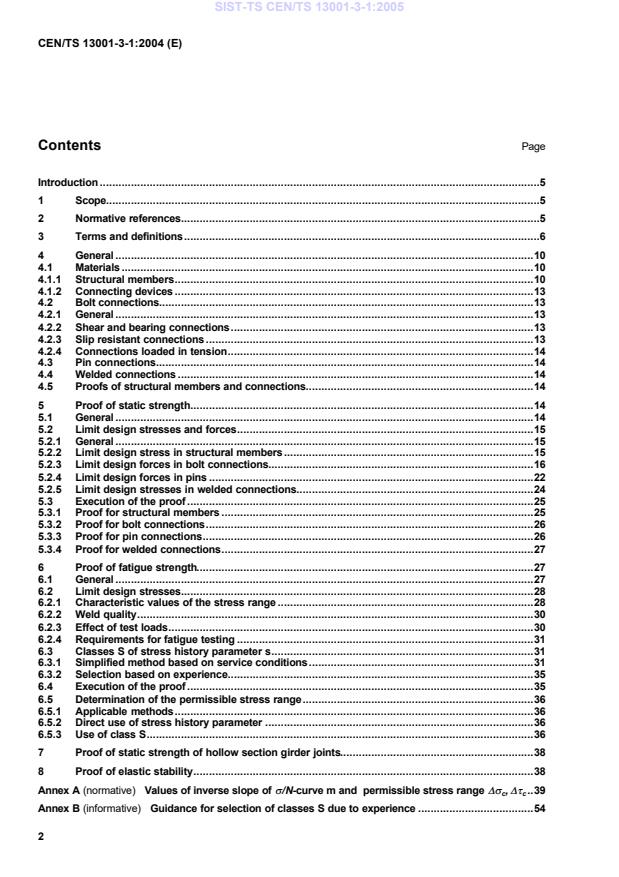
Contents Page
Introduction .5
1 Scope.5
2 Normative references.5
3 Terms and definitions.6
4 General .10
4.1 Materials .10
4.1.1 Structural members.10
4.1.2 Connecting devices .13
4.2 Bolt connections.13
4.2.1 General .13
4.2.2 Shear and bearing connections.13
4.2.3 Slip resistant connections .13
4.2.4 Connections loaded in tension.14
4.3 Pin connections.14
4.4 Welded connections .14
4.5 Proofs of structural members and connections.14
5 Proof of static strength.14
5.1 General .14
5.2 Limit design stresses and forces.15
5.2.1 General .15
5.2.2 Limit design stress in structural members.15
5.2.3 Limit design forces in bolt connections.16
5.2.4 Limit design forces in pins .22
5.2.5 Limit design stresses in welded connections.24
5.3 Execution of the proof .25
5.3.1 Proof for structural members .25
5.3.2 Proof for bolt connections.26
5.3.3 Proof for pin connections.26
5.3.4 Proof for welded connections.27
6 Proof of fatigue strength.27
6.1 General .27
6.2 Limit design stresses.28
6.2.1 Characteristic values of the stress range .28
6.2.2 Weld quality.30
6.2.3 Effect of test loads.30
6.2.4 Requirements for fatigue testing .31
6.3 Classes S of stress history parameter s.31
6.3.1 Simplified method based on service conditions.31
6.3.2 Selection based on experience.35
6.4 Execution of the proof .35
6.5 Determination of the permissible stress range.36
6.5.1 Applicable methods.36
6.5.2 Direct use of stress history parameter .36
6.5.3 Use of class S.36
7 Proof of static strength of hollow section girder joints.38
8 Proof of elastic stability.38
Annex A (normative) Values of inverse slope of s/N-curve m and permissible stress range Ds , Dt .39
c c
Annex B (informative) Guidance for selection of classes S due to experience .54
Annex C (normative) Calculated values of permissible stress range Ds .55
Rd
Annex D (normative) Design weld stress s and t .57
W,Sd W,Sd
D.1 Butt joint .57
D.2 Fillet weld and groove weld with uniform distributed load.58
D.3 Relevant distribution length under punctiform load .59
Annex E (informative) Hollow Sections .60
Annex F (informative) Selection of a suitable set of crane standards for a given application .71
Annex ZA (informative) Relationship between this European Standard and the Essential Requirements
of EU Directive 98/37/EC .72
Bibliography .73
Foreword
This document (CEN/TS 13000-3.1:2004) has been prepared by Technical Committee CEN/TC 147 “Cranes —
Safety”, the secretariat of which is held by BSI.
This document has been prepared under a mandate given to CEN by the European Commission and the European
Free Trade Association, and supports essential requirements of EU Directive 98/37/EC, amended by 98/79/EC.
According to the CEN/CENELEC Internal Regulations, the national standards organisations of the following
countries are bound to announce this Technical Specification: Austria, Belgium, Cyprus, Czech Republic, Denmark,
Estonia, Finland, France, Germany, Greece, Hungary Iceland, Ireland, Italy, Latavia, Lithuania, Luxembourg, Malta,
Netherlands, Norway, Poland, Portugal, Slovakia, Slovenia, Spain, Sweden, Switzerland and the United Kingdom.
This European Standard is one Part of EN 13001. The other parts are as follows:
Part 1: General principles and requirements
Part 2: Load actions
The annexes A, C and D are normative. The annexes B, E and F are informative.
Introduction
This European Standard has been prepared to be a harmonised standard to provide one means for the mechanical
design and theoretical verification of cranes to conform with the essential health and safety requirements of the
Machinery Directive, as amended. This standard also establishes interfaces between the user (purchaser) and the
designer, as well as between the designer and the component manufacturer, in order to form a basis for selecting
cranes and components.
This European Standard is a type C standard as stated in EN 1070.
The machinery concerned and the extent to which hazards, hazardous situations and events are covered are
indicated in the scope of this document.
When provisions of this type C standard are different from those which are stated in type A or B standards, the
provisions of this type C standard take precedence over the provisions of the other standards, for machines that
have been designed and built according to the provisions of this type C standard.
The machinery concerned and the extent to which hazards are covered are indicated in the scope of this standard.
1 Scope
This European Standard is to be used together with Part 1 and Part 2 and as such they specify general conditions,
requirements and methods to prevent mechanical hazards of cranes by design and theoretical verification.
NOTE Specific requirements for particular types of crane are given in the appropriate European Standard for the particular
crane type.
The following is a list of significant hazardous situations and hazardous events that could result in risks to persons
during normal use and foreseeable misuse. Clauses 4 to 8 of this standard are necessary to reduce or eliminate
the risks associated with the following hazards:
a) Exceeding the limits of strength (yield, ultimate, fatigue);
b) Exceeding temperature limits of material or components;
c) Elastic instability of the crane or its parts (buckling, bulging).
This European Standard is applicable to cranes which are manufactured after the date of approval by CEN of this
standard and serves as reference base for the European Standards for particular crane types.
NOTE prCEN/TS 13001-3-1 deals only with limit state method according to EN 13001-1.
As an alternative to the herein presented limit state method using partial safety factors, the allowable stress method
using a global safety factor according to Part 1 and Part 2 may also be applied for special crane systems with linear
behaviour.
As crane structures are basically dynamically loaded only the linear theory of elasticity is applicable and only limited
local plasticity is allowed. The use of the theory of plasticity for calculation of ultimate load bearing capacity is not
allowed.
2 Normative references
This European Standard incorporates by dated or undated reference, provisions from other publications. These
normative references are cited at the appropriate places in the text, and the publications are listed hereafter. For
dated references, subsequent amendments to or revisions of, any of these publications apply to this European
Standard only when incorporated in it by amendment or revision. For undated references the latest edition of the
publication referred to applies (including amendments).
EN 1070:1998, Safety of machinery — Terminology.
EN 1990-1:2002, Eurocode – Basic of structural design
EN 1993-1-1:1992: Eurocode 3: Design of steel structures — Part 1-1: General rules and rules for buildings.
EN 10025:1990/A1:1993, Hot rolled products of non-alloy structural steels — Technical delivery conditions
(includes amendment A1:1993).
EN 10045-1:1989, Charpy impact test on metallic material — Part 1: Test method.
EN 10113-1:1993, Hot-rolled products in weldable fine grain structural steels — Part 1: General delivery conditions.
EN 10113-2:1993, Hot-rolled products in weldable fine grain structural steels — Part 2: Delivery conditions for
normalized/normalized rolled steels.
EN 10113-3:1993, Hot-rolled products in weldable fine grain structural steels — Part 3: Delivery conditions for
thermomechanical rolled steels.
EN 10137-2:1995, Plates and wide flats made of high yield strength structural steels in the quenched and tempered
or precipitation hardened conditions — Part 2: Delivery conditions for quenched and tempered steels.
EN 10149-1:1995, Hot-rolled flat products made of high yield strength steels for cold forming — Part 1: General
delivery conditions.
EN 10149-2:1995, Hot-rolled flat products made of high yield strength steels for cold forming — Part 2: Delivery
conditions for thermomechanically rolled steels.
EN 10149-3:1995, Hot-rolled flat products made of high yield strength steels for cold forming — Part 3: Delivery
conditions for normalized or normalized rolled steels.
EN 10164:1993, Steel products with improved deformation properties perpendicular to the surface of the product —
Technical delivery conditions.
EN 12345:1996, Welding — Multilingual terms for welding joints with illustrations (trilingual version).
EN 13001-1:2004, Cranes — General Design — Part 1:General principles and requirements.
EN 13001-2:2004, Cranes — General Design — Part 2: Load actions.
EN 22553:1994, Welded, brazed and soldered joints — Symbolic representation on drawings (ISO 2553:1992).
EN 25817:1992, Arc-welded joints in steel — Guidance on quality levels for imperfections (ISO 5817:1992).
EN ISO 898-1:1999, Mechanical properties of fasteners — Part 1: Bolts, screws and studs (ISO 898-1:1999).
EN ISO 9013:2002, Thermal cutting — Classification of thermal cuts — Geometrical specification and quality
tolerances (ISO 9013:2002).
EN ISO 12100-1:2003, Safety of machinery — Basic concepts, general principles for design — Part 1: Basic
terminology, methodology (ISO 12100-1:2003).
EN ISO 12100-2:2003, Safety of machinery — Basic concepts, general principles for design — Part 2: Technical
principles and specifications (ISO 12100-2:2003).
ISO 286-2:1990, ISO system of limits and fits — Part 2: Tables of standard tolerance grades and limit deviations for
holes and shafts.
ISO 4306-1:1990, Cranes — Vocabulary — Part 1: General.
3 Terms and definitions
3.1
Terms and definitions
For the purposes of this European Standard, the terms and definitions given in EN 292-1, EN 292-2 and EN 1070
and the basic list of definitions as provided in EN 1990-1 apply. For the definitions of loads, clause 6 of
ISO 4306-1:1990 applies.
3.2
Symbols and abbreviations
The symbols and abbreviations used in this Part of the EN 13001 are given in Table 1.
Table 1 — Symbols and abbrevations
Symbols,
Description
abbreviations
A cross section
A stress area of a bolt
S
a relevant weld thickness
r
D , D outer, inner diameter of hollow pin
o i
d diameter (shank of bolt, pin)
d diameter of hole
o
e , e distances
1 2
F tensile force in bolt
b
F limit force
d
F characteristic value (force)
K
F preloading force in bolt
p
F limit design force
Rd
F external force (on bolted connection)
t
F limit design bearing force
b, Rd
F ; F design bearing force
b, Sd bi, Sd
F design preloading force
p, d
F limit design slip force per bolt and friction interface
s, Rd
F limit design tensile force in bolt
t, Rd
F limit design shear force per bolt/pin and shear plane
v, Rd
F design shear force per bolt/pin and shear plane
v, Sd
F acting normal/shear force
s,t
f limit stress
d
f characteristic value (stress)
K
f limit design stress
Rd
Table 1 (continued)
Symbols,
Description
abbreviations
f ultimate strength of material
u
f ultimate strength of bolts
ub
f limit design weld stress
w, Rd
f yield point of material
y
f yield point of bolts
yb
f yield point (nominal value) of material or member
yk
f yield point of pins
yp
G mass of the moving crane parts during a representative working cycle
t
h distance between weld and contact area of acting load
K stiffness (slope) of bolt
b
K stiffness (slope) of flanges
c
k* specific spectrum ratio factor
k stress spectrum factor based on m of the detail under consideration
(m)
k stress spectrum factor based on m = 3
(m=3)
l relevant weld length
r
l weld length
W
M limit design bending moment
Rd
M design bending moment
Sd
m
inverse slope of s/N-curve
NC notch class
extreme values of stresses
min s, max s
P probability of survival
S
p , p distances
1 2
Q mass of the maximum hoist load
q impact toughness parameter
R design resistance
d
r radius of wheel
S design strain
d
s(m) stress history parameter
T temperature
t thickness
W elastic section modulus
el
characteristic factor for bearing connection
a
characteristic factor for limit weld stress
a
w
general resistance coefficient
g
m
fatigue strength specific resistance factor
g
Mf
Table 1 (concluded)
Symbols,
Description
abbreviations
partial safety factor
g
p
resulting resistance coefficient
g
R
specific resistance factor
g
S
resulting resistance coefficient of bolt
g
Rb
g
specific resistance factor of bolt
sb
g resulting resistance coefficient of members
Rm
g specific resistance factor of members
sm
g resulting resistance coefficient of pins
Rp
g specific resistance factor of pins
sp
g resulting resistance coefficient of slip-resistance connection
Rs
g specific resistance factor of slip-resistance connection
ss
g resulting resistance coefficient of welding connection
Rw
g specfic resistance factor of welding connection
sw
f dynamic factor
k spread angle
l width of contact area in weld direction
d elongation from preloading
p
DF additional force
b
Dd additional elongation
µ slip factor
Ds characteristic value of stress range (normal stress)
c
Dt characteristic value of stress range (shear stress)
c
s design stress (normal)
Sd
t design stress (shear)
Sd
s design weld stress (normal)
w, Sd
t
design weld stress (shear)
w, Sd
Ds permissible (limit) stress range (normal)
Rd
Ds permissible stress range for k* = 1
Rd,1
Dt permissible (limit) stress range (shear)
Rd
Ds design stress range (normal)
Sd
Dt design stress range (shear)
Sd
4 General
4.1 Materials
4.1.1 Structural members
European Standards specify materials and specific values. This standard gives a preferred selection.
For structural members, steel according to following European Standards should be used:
¾ Non-alloy structural steels EN 10025.
¾ Weldable fine grain structural steels in conditions:
¾ normalised (N) EN 10113-2;
¾ thermomechanical (M) EN 10113-3.
¾ High yield strength structural steels in the quenched and tempered condition EN 10137-2.
¾ High yield strength steels for cold forming in conditions:
¾ thermomechanical (M) EN 10149-2;
¾ normalised (N) EN 10149-3.
Table 2 shows specific values for the nominal value of strength f , f and limit design stress f (see 5.2). For more
u y Rd
information see the specific European Standard.
Grades and qualities other than those mentioned in the above standards and in Table 2 can be used if the
mechanical properties and the chemical composition are guaranteed by the manufacturer and conform to the
relevant European Standard. If necessary, the weldability shall be demonstrated by the steel manufacturer.
When selecting grade and quality of the steel for tensile members, the sum of impact toughness parameters q shall
i
be taken into account. Table 3 gives the impact toughness parameters q for various influences. Table 4 gives the
i
required steel quality and impact energy/test temperature in dependence of Sq. Grades and qualities of steel other
i
than mentioned in Table 4 may be used, if the steel manufacturer guarantees and certifies an impact energy/test
temperature, tested according to EN 10045-1.
Table 2 — Specific values of steels for structural members
Limit design stress
Nominal strength
for g =1,1
Rm
Thickness t
Steel Standard
f f
y u
(mm)
f , normal f , shear
Rd Rd
yield ultimate 2 2
2 2 (N/mm ) (N/mm )
(N/mm ) (N/mm )
t£16 235 214 123
225 205 118
16
S235 340
215 195 113
40
195 177 102
100
275 250 144
t£16
265 241 139
16
255 232 134
40
S275 430
245 223 129
63
EN 10025
235 214 123
80
225 205 118
100
t£16 355 323 186
345 314 181
16
335 305 176
40
S355 490
325 296 171
63
315 287 166
80
295 268 155
100
t<16 355 323 186
345 314 181
16
335 305 176
40
S355 450
325 295 171
63
315 286 165
80
295 268 155
100
t<16 420 382 220
EN 10113-2
16
(N)
390 355 205
40
S420
370 336 194
63
EN 10113-3
360 327 189
80
(M)
340 309 178
100
t<16
460 418 241
440 400 231
16
430 391 226
S460 40
410 373 215
63
400 364 210
80
3
S460 550
440 400 231
50
500 455 262
3
S500 590
480 436 252
50
3
S550 640
530 482 278
50
EN 10137-2 3
S620
580 527 304
50
690 627 362
3
S690
650 591 341
50
3
S890
830 880 755 436
50
960 873 504
S960 3
Table 2 (concluded)
Limit design stress
Nominal strength
for g =1,1
Rm
Thickness
Steel Standard
f f
y u
t (mm)
f , normal f , shear
Rd Rd
yield ultimate
2 2
(N/mm ) (N/mm )
2 2
(N/mm ) (N/mm )
S315 315 390 286 165
S355 355 430 323 186
S420 420 480 382 220
S460 (M) 460 520 418 241
all t
500 455 262
EN 10149–2
S500 (M) 550
(M)
550 500 289
S550 (M) 600
EN 10149-3
(N)
S600 (M) 600 650 545 315
t£8 650 591 341
S650 (M) 700
t>8 630 573 331
t£8 700 636 367
S700 (M) 750
t>8 680 618 357
Table 3 — Impact toughness parameters q
i
i Influence q
i
0 £ T
-20 £ T < 0 1
1 Temperature T (°C)
-40 £ T < -20 2
-50 £ T < -40 4
f £ 300 0
y
300 < f £ 460 1
y
2 Yield point f (N/mm ) 460 < f £ 700 2
y y
700
y
1 000
y
Material thickness t (mm) t £ 10 0
Equivalent thickness t for solid bars: 10 < t £ 20 1
20 < t £ 50 2
50 < t £ 100 3
d b b
t = for <1,8 : t =
t > 100 4
1,8 1,8
h
Ds > 125 0
c
80 < Ds £ 125 1
c
Stress concentration and notch class Ds
c
(N/mm ) (see annex A and annex E)
56< Ds £ 80 2
c
Ds £ 56 3
c
Table 4 — Impact toughness requirement and corresponding steel quality for åq
i
åq £ 3 4 £ åq £ 6 7 £ åq £ 9 åq ³ 10
i i i i
Impact energy/ test
temperature 27 J / +20°C 27 J / 0°C 27 J / -20°C 27 J / -40°C
requirement
EN 10025 JR J0 J2 a)
EN 10113 N, M N, M N, M NL, ML
EN 10137-2 Q Q Q QL
EN 10149 NC, MC NC, MC NC, MC a)
a)
May be used if the steel manufacturer guarantees and certifies an impact energy/test temperature of at least 27 J at
–40 °C, tested according to EN 10045-1.
4.1.2 Connecting devices
For bolt connections bolts of the property classes 4.6, 5.6, 8.8, 10.9 or 12.9 according to EN ISO 898-1 shall be
used. Nominal values of the strengths:
Table 5 — Property classes
Property class 4.6 5.6 8.8 10.9 12.9
f (N/mm ) 240 300 640 900 1 080
yb
f (N/mm ) 400 500 800 1 000 1 200
ub
4.2 Bolt connections
4.2.1 General
For the purpose of this standard bolt connections are specified as connections, where
¾ bolts are tightened and thus compress the joint surfaces together;
¾ the joint surfaces are secured against rotation (e. g. by using multiple bolts).
4.2.2 Shear and bearing connections
Connections with fitted bolts, where
¾ the loads act perpendicular to the bolt axis and cause shear and bearing stresses in the bolts;
¾ clearance between bolt and hole shall be according to ISO 286-2 tolerances h13 and H11;
¾ at maximum 10 % of the clamping length may be covered by the threaded part of the bolt;
¾ special surface treatment of the contact surfaces is not required.
4.2.3 Slip resistant connections
Connections with high strength bolts of property classes 8.8, 10.9 or 12.9, where
¾ the loads are transmitted by friction between the joint surfaces;
¾ bolts are tightened by a controlled method to the full preloading state;
¾ the surface condition of the contact surfaces shall be specified and taken into account accordingly.
4.2.4 Connections loaded in tension
Connections with high strength bolts of property classes 8.8, 10.9 or 12.9, where
¾ the loads act in the direction of the bolt axis and cause axial stresses in the bolts;
¾ bolts are tightened by a controlled method to the full preloading state;
¾ fatigue assessment of the bolts shall be done considering the structural features of the joint, e. g. stiffness of
the connected parts and the leverage action caused by the joint geometry;
¾ an even contact over the whole intended contact area of the joint shall be ensured.
4.3 Pin connections
Pin connections are regarded as connections that allow turning of the connected parts.
4.4 Welded connections
Terms for welded joints shall be as given in EN 12345. Symbolic representation on drawings shall be according to
EN 22553.
4.5 Proofs of structural members and connections
It has to be proven that the strains S do not exceed the resistances R :
d d
S £ R (1)
d d
The strains S shall be determined by applying the loads, load combinations and partial safety factors according
d
Table 10 of EN 13001-2.
In the following clauses, the resistances R are presented as limit stresses f or limit forces F .
d d d
For the ultimate limit state, the following proofs shall be delivered:
¾ proof of strength of structural members and connections under quasi-static stress according to 5;
¾ proof of fatigue strength according to 6;
¾ proof of strength of hollow section girder joints under quasi-static stress according to 7;
¾ proof of elastic stability of structural members and special elements according to 8.
5 Proof of static strength
5.1 General
The proof of strength under quasi-static stress protects against excessive deformations due to yielding of the
material or sliding of friction-grip connections as well as against static rupture of structural members or connections.
The proof shall be delivered for structural members and connections taking into account the most unfavourable
load effects from the load combinations A, B or C according to Table 10 of EN 13001-2: and applying the
resistances according to 5.2.
5.2 Limit design stresses and forces
5.2.1 General
The limit design stresses and forces shall be calculated by:
Limit design stresses f = function ( f ,g ) or
Rd k R
(2)
Limit design forces F = function ( F ,g )
Rd k R
where
f or F are characteristic values (or nominal values)
k k
g is the resulting resistance coefficient g =g ×g
R R m s
g is the resistance coefficient g =1,1 (see Table 10 of EN 13001-2)
m m
g is the general specific resistance coefficient for special parts of this standard
s
NOTE f and F are equivalent to R / g in Figure 2 of EN 13001-1.
Rd Rd m
5.2.2 Limit design stress in structural members
The limit design stress f , used for the design of structural members, shall be calculated by:
Rd
f
yk
f = for normal stresses (3)
Rd
g
Rm
f
yk
f = for shear stresses (4)
Rd
g
Rm
with g = g ×g
Rm m sm
where
f is the nominal value of the yield point of the material (see Table 2)
yk
g is the specific resistance coefficient for material as follows:
sm
For non-rolled material
g =1,0
sm
For rolled materials (e. g. plates and profiles):
g = 1,0 for stresses in the plane of rolling
sm
g = 1,0 for compressive and shear stresses
sm
For tensile stresses perpendicular to the plane of rolling (see Figure 1):
g = 1,0 for material in quality classes Z25 or Z35 according to EN 10164
sm
g = 1,16 for material in quality class Z15 according to EN 10164
sm
g = 1,34 without quality classification
sm
Figure 1 — Tensile load perpendicular to plane of rolling
Hence follow the limit design stresses, which are dependent on the material and the kind of stressing which are
given in Table 2.
5.2.3 Limit design forces in bolt connections
5.2.3.1 Shear and bearing connections
The resistance of a connection shall be determined by applying the limit forces of the individual connecting devices.
The limit design shear force F per bolt and per shear plane shall be calculated by:
v,Rd
f × A
yb
=
F (5)
,
v Rd
g × 3
Rb
with g =g ×g
R m sb
b
where
f is the yield point (nominal value) of the bolt material
yb
A is the cross-section of the bolt shank at the shear plane
g is the specific resistance factor for bolt connections
sb
g = 1,0 for multiple shear plane connections
sb
g = 1,3 for single shear plane connections
sb
See Table 6 for limit design shear forces as an example.
Table 6 — Limit design shear force F per fitted bolt and per shear plane for multiple shear plane
v,Rd
connections
F (kN)
v,Rd
Shank resp.
Fitted bolt Hole diameter Fitted bolt material
hole section
for g = 1,1
Rb
(mm) (mm ) 4.6 5.6 8.8 10.9 12.9
M12 13 133 16,7 20,9 44,6 62,8 75,4
M16 17 227 28,6 35,7 76,2 107,2 128,6
M20 21 346 43,5 54,4 116,2 163,2 196,1
M22 23 415 52,2 65,3 139,4 196,0 235,2
M24 25 491 61,8 77,3 164,9 231,9 278,3
M27 28 616 77,6 97,0 206,9 291,0 349,2
M30 31 755 95,1 111,8 253,6 356,6 428,0
The limit design bearing force F per bolt may be calculated by:
b,Rd
a × f × d ×t
y
F = (6)
b,Rd
g
Rb
with g =g ×g
R m sb
b
where
e
3×d
e ³ 2,0 d
1 o
p 1
- e ³ 1,5 d (7)
2 o
a = Min
3×d 4
p ³ 3,0 d
1 o
p ³ 3,0 d
f 2 o
ub
f
u
1.0
Figure 2 — Illustration for formula (7)
f is the ultimate strength (nominal value) of the bolt (Table 5)
ub
f is the ultimate strength (nominal value) of the basic material (Table 2)
u
f is the yield point (nominal value) of the basic material (Table 2)
y
d is the shank diameter of the bolt
t is the minimum of thicknesses of the basic material
g is the specific resistance factor for bolt connections
sb
g = 0,7 for multiple shear plane connections
sb
g = 0,9 for single shear plane connections
sb
5.2.3.2 Slip-resistant connections
The resistance of a connection shall be determined by applying the limit forces of the individual connecting devices.
For slip-resistant connections the limit design slip force F per bolt and per friction interface shall be calculated
s,Rd
by:
m × (F - F )
p,d t
F = (8)
s,Rd
g
Rs
with g =g ×g
Rs m ss
where:
m is the slip factor
m = 0,50 for surfaces
¾ blasted metallic bright with steel grit or sand, no unevennesses;
¾ blasted with steel grit or sand and aluminised;
¾ blasted with steel grit or sand and metallised with a product basing on zinc that
causes a friction coefficient of min. 0,5
m = 0,40 for surfaces
¾ blasted with steel grit or sand and alkali-zinc-silicate coating of 50 mm to 80 mm
thickness
m = 0,30 for surfaces
¾ cleaned metallic bright with wire brush or scarfing
m = 0,20 for surfaces
¾ cleaned of loose rust, oil and dirt
F is the design preloading force.
p,d
F is an external tensile force in direction of the axis of the bolt (see Figure 3)
t
It shall be ensured that the used preloading force is greater than or equal to the design
preloading force.
g is the specific resistance factor for slip-resistant connections;
ss
g =1,14
ss
See Table 7 for limit design slip forces using for example a design preloading force of
F = 0,7× f × A ,
p,d yb s
where
f is the yield point (nominal value) of the bolt material (Table 5)
yb
A is the stress area of the bolt.
s
prCEN/TS 13001-3-1:2003 (E)
Table 7 — Limit design slip force F per bolt and per friction interface using a design preloading force F =0.7× f × A
S,Rd
p,d yb s
Bolt stress Design preloading
Limit design slip force F (kN)
s,Rd
area force F (kN)
p,d
Bolt material
A Bolt material
S
(mm ) 8.8 10.9 12.9
Slip factor : Slip factor : Slip factor :
8.8 10.9 12.9 0.50 0.40 0.30 0.20 0.50 0.40 0.30 0.20 0.50 0.40 0.30 0.20
M12 84,3 37,8 53,1 63,7 15,1 12,1 9,1 6,0 21,2 17,0 12,7 8,5 25,5 20,4 15,3 10,2
M16 157,0 70,3 98,9 119,0 28,1 22,5 16,9 11,2 39,6 31,6 23,7 15,8 47,6 38,1 28,6 19,0
M20 245,0 110,0 154,0 185,0 44,0 35,2 26,4 17,6 61,6 49,3 37,0 24,6 74,0 59,2 44,4 29,6
M22 303,0 136,0 191,0 229,0 54,4 43,5 32,6 21,8 76,4 61,1 45,8 30,6 91,6 73,3 55,0 36,6
M24 353,0 158,0 222,0 267,0 63,2 50,6 37,9 25,3 88,8 71,0 53,3 35,5 107,0 85,4 64,1 42,7
M27 459,0 206,0 289,0 347,0 82,4 65,9 49,4 33,0 116,0 92,5 69,4 46,2 139,0 111,0 83,3 55,5
M30 561,0 251,0 353,0 424,0 100,0 80,3 60,2 40,2 141,0 113,0 84,7 56,5 170,0 136,0 102,0 67,8
M36 817,0 366,0 515,0 618,0 146,0 117,0 87,8 58,6 206,0 165,0 124,0 82,4 247,0 198,0 148,0 98,9
CEN/TS 13001-3.1:2004 (E)
5.2.3.3 Connections loaded in tension
The resistance of a connection shall be determined by applying the limit forces of the individual connecting
devices.
In principle the proof of competence has to take into account the stiffnesses of the bolt and the flanges to be
connected (see Figure 3).
F Preloading force in bolt
p
d Bolt elongation from preloading
p
F External force
t
Dd: Additional elongation
F Tensile force in bolt
b
DF additional force in bolt
b
Slope K Stiffness of bolt
b
Slope K Stiffness of flanges
c
Figure 3 — Force-elongation-diagram
For simplification the limit design tensile force per bolt F may be calculated by:
t,Rd
F
p,d
F = (9)
t,Rd
g
Rb
with g = g × g
Rb m sb
where
F is the design preloading force. It shall be ensured that the used preloading force is
p,d
greater than or equal to the design preloading force
g is the specific resistance factor for connections loaded in tension
sb
g = 1,0
sb
See Table 8 for limit design tensile forces according to formula (9) using for example a design preloading
force of
F =0,7× f × A
p,d yb s
where
CEN/TS 13001-3.1:2004 (E)
f is the yield point (nominal value) of the bolt material (Table 5)
yb
A is the stress area of the bolt.
s
Table 8 — Limit design tensile force F per bolt in direction of the bolt axis, using a design
t,Rd
preloading force F =0,7× f × A
p,d yb s
Limit design tensile force
per bolt
Design preloading
stress
area
F (kN)
force F (kN) t,Rd
p,d
Bolt
A
for g = 1.1
S
Bolt material Rb
(mm )
Bolt material
8.8 10.9 12.9 8.8 10.9 12.9
M12 84,3 37,8 53,1 63,7 34,3 48,2 57,9
M16 157,0 70,3 98,9 119,0 63,9 88,9 108,1
M20 245,0 110,0 154,0 185,0 100,0 140,0 168,1
M22 303,0 136,0 191,0 229,0 123,6 173,6 208,1
M24 353,0 158,0 222,0 267,0 143,9 201,8 242,7
M27 459,0 206,0 289,0 347,0 187,2 262,7 315,4
M30 561,0 251,0 353,0 424,0 228,1 320,9 385,4
M36 817,0 366,0 515,0 618,0 332,7 468,1 561,8
5.2.4 Limit design forces in pins
The pin of a pin connection shall be designed taking into account bending, shearing and bearing. Therefore
the following simplified system may be assumed:
For pins the following limit design loads shall be taken into account:
W × f
el yp
¾ Limit design bending moment M = (10)
Rd
g
Rp
with g =g ×g
Rp m sp
where
W is the elastic section modulus of the pin
el
f is the yield point (nominal value) of the pin material
yp
g is the specific resistance factor for pin connections bending moment g = 1,0
sp
sp
A× f
yp
¾ Limit design shear force per shear plane for pins F = × (11)
v,Rd
u
3 ×g
Rp
CEN/TS 13001-3.1:2004 (E)
with g =g ×g
Rp m sp
where
u u = for solid pins
4 1+ v + v
u = × for hollow pins
3 1+ v
where
D
i
n = ,
D
O
D is the inner diameter of pin
i
D is the outer diameter of pin
O
A is the cross-section of the pin
g is the specific resistance factor for pin connections shear force
sp
g = 1,0 for multiple shear plane connections
sp
g = 1,3 for single shear plane connections
sp
a × d × t × f
y
¾ Limit design bearing force F = (12)
b,Rd
g
Rp
with g =g ×g
Rp m sp
where
f
ì
yp
ï
f
y
ï
ï
a=Min
í
ï
1,0
ï
ï
î
CEN/TS 13001-3.1:2004 (E)
Figure 4 — Pin connections
f is the yield point (nominal value) of basic material
y
d is the diameter of the pin
t is the minimum of thickness of the basic material
g is the specific resistance factor for pin connections bearing force
sp
g = 0,7 for multiple shear plane connections
sp
g = 0,9 for single shear plane connections
sp
In case of significant movement between pin and bearing the limit bearing force shall be reduced in order to
reduce wear.
5.2.5 Limit design stresses in welded connections
The limit design weld stress f used for the design of a welded connection depends on:
w,Rd
¾ the parent metal to be welded;
¾ the type of the weld;
¾ the type of stress;
¾ the weld quality;
¾ the kind of welding process.
CEN/TS 13001-3.1:2004 (E)
The limit design weld stress f shall be calculated by:
w,Rd
× f
a
w
yk
f = (13)
w,Rd
g
Rw
with g =g ×g
Rw m sw
where
a is a factor given in Table 9 in dependence on the type of weld, the type of stress and the material
w
f is the minimal nominal value of the yield points of the parent and weld consumable materials in the
yk
weld joint
g is the specific resistance factor for welded connections
sw
g = 1,0
sw
Table 9 — Factor a for limit weld stress
w
a
w
Direction of
Penetration Type of stress
f < 690 690 £ f < 960 f ³ 960
yk
yk yk
stress
(N/mm²)
(N/mm²) (N/mm²)
Weld with full Tension 1,0 1,0 0,93
penetration or
Compression 1,0 1,0 0,93
backwelded
Tension 0,7 0,7 0,65
Stress across the Weld without
weld direction full penetration
Compression 0,8 0,8 0,74
Weld
with/without full Shear 1/Ö2 1/Ö3 0,54
penetration
Tension/
Weld
1,0 1,0 0,93
Stress in weld
Compression
with/without full
direction
penetration
Shear 1/Ö3 1/Ö3 0,54
5.3 Execution of the proof
5.3.1 Proof for structural members
For the structural member to be designed it shall be proven that:
s £ f and t £ f (14)
Sd Rd Sd Rd
where
t , s are the design stresses
Sd Sd
f is the corresponding limit design stress according to 5.2.2.
Rd
CEN/TS 13001-3.1:2004 (E)
In case of plane states of stresses it shall additionally be proven that:
æ s ö æs ö s ×s
æ ö
t
Sd ,x Sd, y Sd,x Sd, y
Sd
ç ÷ ç ÷
ç ÷
+ - + £ 1 (15)
ç ÷
ç ÷ ç ÷
f f f × f f
Rd ,x Rd ,y Rd,x Rd ,y Rd
è ø è ø
è ø
where
x, y indicate the orthogonal directions of stresses
Spatial states of stresses may be reduced to the most unfavourable plane state of stress.
5.3.2 Proof for bolt connections
For the most unfavourably loaded element of a connection it shall be proven that:
F £ F (16)
Sd Rd
where
F is the design force of the element
Sd
F is the limit design force according to 5.2.3, in dependence on the type of the connection
Rd
and its type of stress, i. e.
limit design shear force F
v,Rd
limit design bearing force F
b,Rd
limit design slip force F
s,Rd
limit design tensile force F
t,Rd
In particular for connections loaded in tension (see 5.2.3.3) the tensile force in the bolt F shall always satisfy:
b
f × A
yb S
F £ (17)
b
g
m
5.3.3 Proof for pin connections
For pins, it shall be proven that:
M £ M
Sd Rd
F £ F (18)
v,Sd v,Rd
F £ F
bi,Sd b,Rd
where
M is the design value of the bending moment in the pin
Sd
M is the limit design bending moment according to 5.2.4
Rd
F is the design value of the shear force in the pin
v,Sd
CEN/TS 13001-3.1:2004 (E)
F is the limit design shear f
...