

EN 16207:2014
(Main)Railway applications - Braking - Functional and performance criteria of Magnetic Track Brake systems for use in railway rolling stock
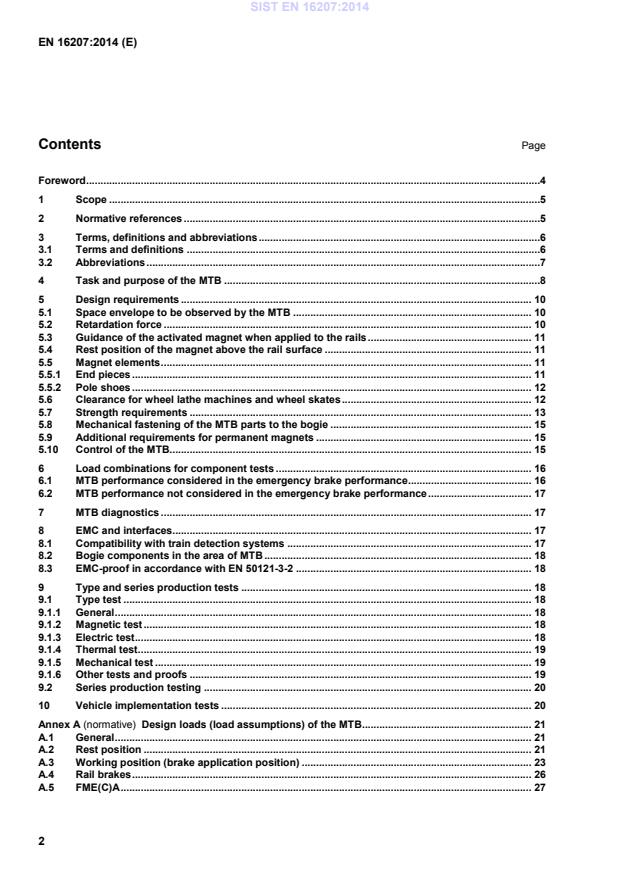
General Information
- Abstract
This European Standard specifies the functionality, position, constraints and control of a magnetic track brake system (MTB system) installed in bogies for use in emergency braking and in low adhesion conditions on Mainline Trains up to speeds of 280 km/h. It covers high suspension types of MTB only and not high/low and low suspension type of MTB.
This document also contains test methods and acceptance criteria for an MTB system. It identifies interfaces with electrical equipment, bogie, track and other brake systems.
On the basis of the existing international and national standards, additional requirements are defined for:
- conditions of application for the MTB system;
- retardation and brake forces;
- functional and design features;
- strength requirements;
- type, series and vehicle implementation tests.
For design and calculation a "reference surface" is established.
- Status
- Withdrawn
- Publication Date
- 19-Aug-2014
- Withdrawal Date
- 29-Sep-2026
- Technical Committee
- CEN/TC 256 - Railway applications
- Drafting Committee
- CEN/TC 256/SC 3/WG 47 - Braking
- Current Stage
- 9060 - Closure of 2 Year Review Enquiry - Review Enquiry
- Start Date
- 03-Mar-2020
- Completion Date
- 03-Mar-2020
- Directive
- 2008/57/EC - DIRECTIVE 2008/57/EC OF THE EUROPEAN PARLIAMENT AND OF THE COUNCIL of 17 June 2008 on the interoperability of the rail system within the Community (Recast)OJ Ref: C 249/04 OJ Date: 08-Jul-2016

Relations
- Effective Date
- 19-Jan-2023
- Effective Date
- 25-Aug-2026
- Effective Date
- 19-May-2026
- Effective Date
- 25-Mar-2026
- Effective Date
- 09-Feb-2026
- Effective Date
- 09-Feb-2026
- Effective Date
- 09-Feb-2026
- Effective Date
- 09-Feb-2026
- Effective Date
- 09-Feb-2026
- Effective Date
- 09-Feb-2026
- Effective Date
- 09-Feb-2026
- Effective Date
- 09-Feb-2026
- Effective Date
- 09-Feb-2026
- Effective Date
- 09-Feb-2026
- Effective Date
- 28-Jan-2026
Get Certified
Connect with accredited certification bodies for this standard

IRIS Certification (UNIFE)
International Railway Industry Standard certification.

TÜV SÜD Rail GmbH
TÜV SÜD railway certification services.

Bureau Veritas Railway Certification
Railway and transportation certification.
Sponsored listings
Frequently Asked Questions
EN 16207:2014 is a standard published by the European Committee for Standardization (CEN). Its full title is "Railway applications - Braking - Functional and performance criteria of Magnetic Track Brake systems for use in railway rolling stock". This standard covers: This European Standard specifies the functionality, position, constraints and control of a magnetic track brake system (MTB system) installed in bogies for use in emergency braking and in low adhesion conditions on Mainline Trains up to speeds of 280 km/h. It covers high suspension types of MTB only and not high/low and low suspension type of MTB. This document also contains test methods and acceptance criteria for an MTB system. It identifies interfaces with electrical equipment, bogie, track and other brake systems. On the basis of the existing international and national standards, additional requirements are defined for: - conditions of application for the MTB system; - retardation and brake forces; - functional and design features; - strength requirements; - type, series and vehicle implementation tests. For design and calculation a "reference surface" is established.
This European Standard specifies the functionality, position, constraints and control of a magnetic track brake system (MTB system) installed in bogies for use in emergency braking and in low adhesion conditions on Mainline Trains up to speeds of 280 km/h. It covers high suspension types of MTB only and not high/low and low suspension type of MTB. This document also contains test methods and acceptance criteria for an MTB system. It identifies interfaces with electrical equipment, bogie, track and other brake systems. On the basis of the existing international and national standards, additional requirements are defined for: - conditions of application for the MTB system; - retardation and brake forces; - functional and design features; - strength requirements; - type, series and vehicle implementation tests. For design and calculation a "reference surface" is established.
EN 16207:2014 is classified under the following ICS (International Classification for Standards) categories: 45.060.01 - Railway rolling stock in general. The ICS classification helps identify the subject area and facilitates finding related standards.
EN 16207:2014 has the following relationships with other standards: It is inter standard links to EN 16207:2014+A1:2019, ISO 8028:1999, EN 50129:2026, EN 14198:2026, EN 50121-3-2:2016, EN 50716:2023, EN 50126-1:2017, EN 60529:1991, EN 50126-2:2017/A1:2024, EN 50129:2018, EN 50124-1:2017, EN 50126-2:2017, EN 50126-1:2017/A1:2024, EN 60077-1:2002, EN ISO 4628-3:2024. Understanding these relationships helps ensure you are using the most current and applicable version of the standard.
EN 16207:2014 is associated with the following European legislation: EU Directives/Regulations: 2008/57/EC; Standardization Mandates: M/334, M/483. When a standard is cited in the Official Journal of the European Union, products manufactured in conformity with it benefit from a presumption of conformity with the essential requirements of the corresponding EU directive or regulation.
EN 16207:2014 is available in PDF format for immediate download after purchase. The document can be added to your cart and obtained through the secure checkout process. Digital delivery ensures instant access to the complete standard document.
Standards Content (Sample)
2003-01.Slovenski inštitut za standardizacijo. Razmnoževanje celote ali delov tega standarda ni dovoljeno.Železniške naprave - Zavore - Funkcionalna merila in merila za zmogljivost elektromagnetnih zavornih sistemov za železniška vozilaBahnanwendungen - Bremse - Anforderungen an die Funktion und die Leistungsfähigkeit von elektromagnetischen Schienenbremssystemen für SchienenfahrzeugeApplications ferroviaires - Freinage - Critères pour la fonction et la performance des systèmes de freinage électromagnétiques pour véhicules ferroviairesRailway applications - Braking - Functional and performance criteria of Electromagnetic Track Brake systems for use in railway rolling stock45.040Materiali in deli za železniško tehnikoMaterials and components for railway engineeringICS:Ta slovenski standard je istoveten z:EN 16207:2014SIST EN 16207:2014en,fr,de01-november-2014SIST EN 16207:2014SLOVENSKI
STANDARD
EUROPEAN STANDARD NORME EUROPÉENNE EUROPÄISCHE NORM
EN 16207
August 2014 ICS 45.060.01 English Version
Railway applications - Braking - Functional and performance criteria of Magnetic Track Brake systems for use in railway rolling stock
Applications ferroviaires - Freinage - Critères pour la fonction et la performance des systèmes de freinage magnétiques pour véhicules ferroviaires
Bahnanwendungen - Bremse - Anforderungen an Funktion und Leistungsfähigkeit von Magnetschienenbremssystemen für Schienenfahrzeuge This European Standard was approved by CEN on 28 June 2014.
CEN members are bound to comply with the CEN/CENELEC Internal Regulations which stipulate the conditions for giving this European Standard the status of a national standard without any alteration. Up-to-date lists and bibliographical references concerning such national standards may be obtained on application to the CEN-CENELEC Management Centre or to any CEN member.
This European Standard exists in three official versions (English, French, German). A version in any other language made by translation under the responsibility of a CEN member into its own language and notified to the CEN-CENELEC Management Centre has the same status as the official versions.
CEN members are the national standards bodies of Austria, Belgium, Bulgaria, Croatia, Cyprus, Czech Republic, Denmark, Estonia, Finland, Former Yugoslav Republic of Macedonia, France, Germany, Greece, Hungary, Iceland, Ireland, Italy, Latvia, Lithuania, Luxembourg, Malta, Netherlands, Norway, Poland, Portugal, Romania, Slovakia, Slovenia, Spain, Sweden, Switzerland, Turkey and United Kingdom.
EUROPEAN COMMITTEE FOR STANDARDIZATION
COMITÉ EUROPÉEN DE NORMALISATION EUROPÄISCHES KOMITEE FÜR NORMUNG
CEN-CENELEC Management Centre:
Avenue Marnix 17,
B-1000 Brussels © 2014 CEN All rights of exploitation in any form and by any means reserved worldwide for CEN national Members. Ref. No. EN 16207:2014 ESIST EN 16207:2014
Design loads (load assumptions) of the MTB . 21 A.1 General . 21 A.2 Rest position . 21 A.3 Working position (brake application position) . 23 A.4 Rail brakes . 26 A.5 FME(C)A . 27 SIST EN 16207:2014
Measurement of the magnetic attractive force — Functional test of brake magnets . 30 B.1 Measurement of the magnetic attractive force of MTB magnets . 30 B.2 Formation of the mean magnetic attractive force for rigid magnets . 31 B.3 Formation of the mean magnetic attractive force for articulated magnets . 31 Annex C (normative)
End pieces of MTB . 33 Annex ZA (informative)
Relationship between this European Standard and the Essential Requirements of EU Directive 2008/57/EC . 37 Bibliography . 40
Key 1 magnet with segmented or rigid pole shoes 2 actuator 3 tie bar 4 brake reaction bracket, non-magnetic 5 centring device to restrict lateral movement in the rest position 6 special end pieces for negotiating point work 7 electrical interface 8 pneumatical interface Figure 1 — Installation of an MTB into a bogie (example) The MTB is generally used in the following cases: a) Emergency brake applications: The MTB is activated automatically in case of an emergency brake application. If the MTB is part of the emergency braking performance then it is subject to specific safety and reliability requirements with respect to its availability to be applied. In this situation the retardation rate can be included in the braked weight value/overall retardation of the vehicle. b) Brake application under low adhesion conditions or steep slopes: The MTB may be actuated at the driver’s discretion independently of the wheel/rail adhesion dependent brake. SIST EN 16207:2014
qx = lateral clearance + The distance between the centre lines of the magnets shall be 1 510 mm for standard gauge (1 435 mm), see Annex C. When intended for use on different gauges the distance between the centre lines shall be adjusted accordingly. A bogie shall always comprise two magnets with pole shoes of identical construction. Appropriate devices (e. g. tie bars) shall be provided to maintain the pole shoes in a parallel position to each other. When the rail head is interrupted (switches, crossings), guidance of the magnet along the longitudinal axis of the rail head and its geometrical position, in relation to the vertical axis, shall be ensured in an optimum way to achieve a retardation rate that is as uniform as possible and to make sure that the MTB guiding elements in the running gear be subjected to the least possible mechanical load. The working MTB shall be capable of passing over switches and crossings (incorporating fixed crossings). A reference switch where the tangent of the crossing angle is tg . ≥ 0,034 is able to verify the capable function. 5.4 Rest position of the magnet above the rail surface The MTB when in its rest position with the vehicle in working order, with fully worn wheels and taking into account static deflection of the running gear shall: — remain within the space "b", as defined in EN 15273-1:2013, Figure C.4; — be 40 mm to 100 mm above the rail surface. It may be assumed that the stationary parts in the switch and crossing environment do not exceed a height of 80 mm above the rail surface. 5.5 Magnet elements 5.5.1 End pieces The end pieces of a magnet have several tasks: — they protect the magnet pole shoes transmitting the braking force from mechanical damage; — they assist the passage of the magnet over switches and crossings when the magnets are in working position, to reduce the risk of derailment; — they contribute to the overall retardation generated by the magnet. SIST EN 16207:2014
Key D wheel diameter d diameter of driving roller S distance between axis of driving rollers 1 driving roller of the wheel lathe 2 lathe tool Figure 2 — Typical underfloor wheel lathe configuration NOTE Typical dimensions for wheel lathe machines are: — diameter of driving roller d = 220 mm; — distance between axis of driving rollers S = 440 mm. To permit the use of wheel skates, it shall be possible to remove the magnets or their end pieces without damage. 5.7 Strength requirements The MTB (magnets, actuators, tie bar, brake reaction bracket – see Figure 1) should be designed so that: — no resonant vibrations are exerted on the bogie frame and the parts of the MTB; SIST EN 16207:2014
Key 1 magnet with segmented or rigid pole shoes 2 actuator 3 centring device to restrict lateral movement in the rest position 4 tie bar Figure 3 — Designations In its high suspension type the MTB is held in its rest position by spring force and is fastened to the running gear by means of centring devices. In this rest position the MTB is engaged with the bogie frame and is subject to a series of forces exerted on the latter, originating from elastic variations of the bogie frame. To permit a comparable assessment to be made, independently of the real design, a square horizontal level with a lateral length of about 1 000 mm is defined as a „reference surface“. Any displacements, distortions and SIST EN 16207:2014
...