

EN 12312-5:2005
(Main)Aircraft ground support equipment - Specific requirements - Part 5: Aircraft fuelling equipment
General Information
- Abstract
This part of EN 12312 specifies the minimum essential safety requirements for the design and construction of "Aircraft refuellers, hydrant dispensers and fuelling equipment" used for the delivery of aviation fuels to aircraft. It applies to both rigid vehicles (with or without drawbar trailers) and to articulated tractor and trailer combinations, vehicles classed as hydrant dispensers, hydrant pit servicing vehicles and any other type of equipment which is used directly for servicing aircraft with aviation fuels.
- Status
- Withdrawn
- Publication Date
- 08-Feb-2005
- Withdrawal Date
- 28-Apr-2009
- Technical Committee
- CEN/TC 274 - Aircraft ground support equipment
- Current Stage
- 9960 - Withdrawal effective - Withdrawal
- Start Date
- 29-Apr-2009
- Completion Date
- 29-Apr-2009
- Directive
- 98/37/EC - MachineryOJ Ref: C, C 336 OJ Date: 31-Dec-2005

Relations
- Effective Date
- 11-Feb-2009
- Effective Date
- 22-Dec-2008
Get Certified
Connect with accredited certification bodies for this standard

BUREAU VERITAS Certification Germany
Bureau Veritas certification in Germany.

Element Materials Technology
Materials testing and product certification.

AQMS Ltd.
AQMS provides ISO certification to SMEs across the UK.
Sponsored listings
Frequently Asked Questions
EN 12312-5:2005 is a standard published by the European Committee for Standardization (CEN). Its full title is "Aircraft ground support equipment - Specific requirements - Part 5: Aircraft fuelling equipment". This standard covers: This part of EN 12312 specifies the minimum essential safety requirements for the design and construction of "Aircraft refuellers, hydrant dispensers and fuelling equipment" used for the delivery of aviation fuels to aircraft. It applies to both rigid vehicles (with or without drawbar trailers) and to articulated tractor and trailer combinations, vehicles classed as hydrant dispensers, hydrant pit servicing vehicles and any other type of equipment which is used directly for servicing aircraft with aviation fuels.
This part of EN 12312 specifies the minimum essential safety requirements for the design and construction of "Aircraft refuellers, hydrant dispensers and fuelling equipment" used for the delivery of aviation fuels to aircraft. It applies to both rigid vehicles (with or without drawbar trailers) and to articulated tractor and trailer combinations, vehicles classed as hydrant dispensers, hydrant pit servicing vehicles and any other type of equipment which is used directly for servicing aircraft with aviation fuels.
EN 12312-5:2005 is classified under the following ICS (International Classification for Standards) categories: 49.100 - Ground service and maintenance equipment. The ICS classification helps identify the subject area and facilitates finding related standards.
EN 12312-5:2005 has the following relationships with other standards: It is inter standard links to EN 12312-5:2005+A1:2009, EN 12312-5:2005/prA1. Understanding these relationships helps ensure you are using the most current and applicable version of the standard.
EN 12312-5:2005 is associated with the following European legislation: EU Directives/Regulations: 98/37/EC; Standardization Mandates: M/079. When a standard is cited in the Official Journal of the European Union, products manufactured in conformity with it benefit from a presumption of conformity with the essential requirements of the corresponding EU directive or regulation.
EN 12312-5:2005 is available in PDF format for immediate download after purchase. The document can be added to your cart and obtained through the secure checkout process. Digital delivery ensures instant access to the complete standard document.
Standards Content (Sample)
SLOVENSKI STANDARD
01-maj-2005
Podporna oprema na tleh za letalski promet - Posebne zahteve - 5. del: Oprema za
oskrbo letal z gorivom
Aircraft ground support equipment - Specific requirements - Part 5: Aircraft fuelling
equipment
Luftfahrt-Bodengeräte - Besondere Anforderungen - Teil 5: Betankungseinrichtungen für
Luftfahrzeuge
Matériel au sol pour aéronefs - Exigences particulieres - Partie 5: Matériels
d'avitaillement en carburant
Ta slovenski standard je istoveten z: EN 12312-5:2005
ICS:
49.100 Oprema za servis in Ground service and
vzdrževanje na tleh maintenance equipment
2003-01.Slovenski inštitut za standardizacijo. Razmnoževanje celote ali delov tega standarda ni dovoljeno.
EUROPEAN STANDARD
EN 12312-5
NORME EUROPÉENNE
EUROPÄISCHE NORM
February 2005
ICS 49.100
English version
Aircraft ground support equipment - Specific requirements - Part
5: Aircraft fuelling equipment
Matériel au sol pour aéronefs - Exigences particulières - Luftfahrt-Bodengeräte - Besondere Anforderungen - Teil 5:
Partie 5: Matériels d'avitaillement en carburant Betankungseinrichtungen für Luftfahrzeuge
This European Standard was approved by CEN on 3 January 2005.
CEN members are bound to comply with the CEN/CENELEC Internal Regulations which stipulate the conditions for giving this European
Standard the status of a national standard without any alteration. Up-to-date lists and bibliographical references concerning such national
standards may be obtained on application to the Central Secretariat or to any CEN member.
This European Standard exists in three official versions (English, French, German). A version in any other language made by translation
under the responsibility of a CEN member into its own language and notified to the Central Secretariat has the same status as the official
versions.
CEN members are the national standards bodies of Austria, Belgium, Cyprus, Czech Republic, Denmark, Estonia, Finland, France,
Germany, Greece, Hungary, Iceland, Ireland, Italy, Latvia, Lithuania, Luxembourg, Malta, Netherlands, Norway, Poland, Portugal, Slovakia,
Slovenia, Spain, Sweden, Switzerland and United Kingdom.
EUROPEAN COMMITTEE FOR STANDARDIZATION
COMITÉ EUROPÉEN DE NORMALISATION
EUROPÄISCHES KOMITEE FÜR NORMUNG
Management Centre: rue de Stassart, 36 B-1050 Brussels
© 2005 CEN All rights of exploitation in any form and by any means reserved Ref. No. EN 12312-5:2005: E
worldwide for CEN national Members.
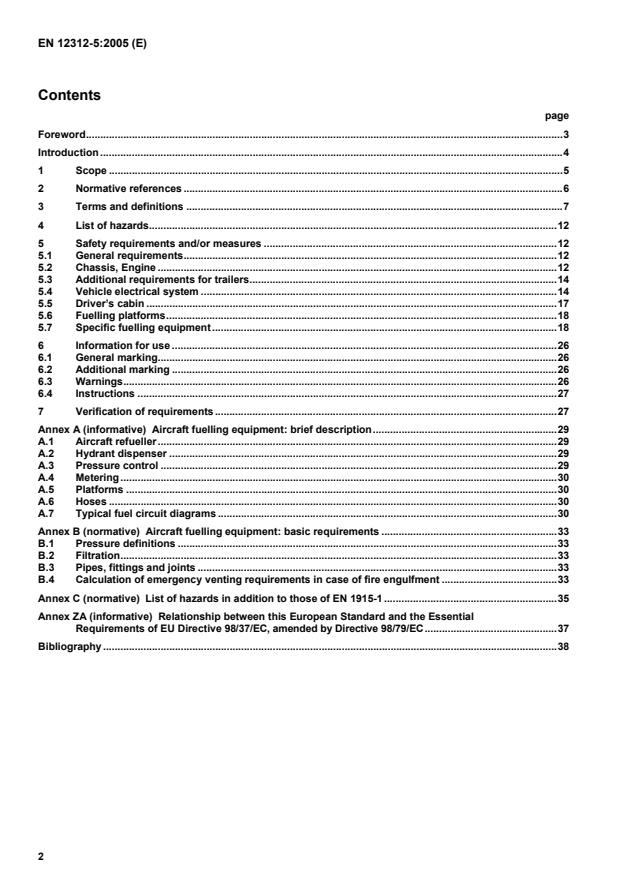
Contents
page
Foreword.3
Introduction .4
1 Scope .5
2 Normative references .6
3 Terms and definitions .7
4 List of hazards.12
5 Safety requirements and/or measures .12
5.1 General requirements.12
5.2 Chassis, Engine .12
5.3 Additional requirements for trailers.14
5.4 Vehicle electrical system .14
5.5 Driver’s cabin .17
5.6 Fuelling platforms.18
5.7 Specific fuelling equipment.18
6 Information for use .26
6.1 General marking.26
6.2 Additional marking .26
6.3 Warnings.26
6.4 Instructions .27
7 Verification of requirements.27
Annex A (informative) Aircraft fuelling equipment: brief description.29
A.1 Aircraft refueller.29
A.2 Hydrant dispenser .29
A.3 Pressure control .29
A.4 Metering.30
A.5 Platforms .30
A.6 Hoses .30
A.7 Typical fuel circuit diagrams .30
Annex B (normative) Aircraft fuelling equipment: basic requirements .33
B.1 Pressure definitions .33
B.2 Filtration.33
B.3 Pipes, fittings and joints .33
B.4 Calculation of emergency venting requirements in case of fire engulfment .33
Annex C (normative) List of hazards in addition to those of EN 1915-1 .35
Annex ZA (informative) Relationship between this European Standard and the Essential
Requirements of EU Directive 98/37/EC, amended by Directive 98/79/EC.37
Bibliography .38
Foreword
This document (EN 12312-5:2005) has been prepared by Technical Committee CEN/TC 274 "Aircraft ground support
equipment" the secretariat of which is held by DIN.
This European Standard shall be given the status of a national standard, either by publication of an identical text or
by endorsement, at the latest by August 2005, and conflicting national standards shall be withdrawn at the latest by
August 2005.
This document has been prepared under a mandate given to CEN by the European Commission and the European
Free Trade Association and supports essential requirements of EU Directive(s).
For relationship with EU Directives, see informative Annex ZA, which is an integral part of this document.
The Parts of EN 12312 — Aircraft ground support equipment — Specific requirements — are:
Part 1: Passenger stairs
Part 2: Catering vehicles
Part 3: Conveyor belt vehicles
Part 4: Passenger boarding bridges
Part 5: Aircraft fuelling equipment
Part 6: Deicers and deicing/antiicing equipment
Part 7: Aircraft movement equipment
Part 8: Maintenance stairs and platforms
Part 9: Container/Pallet loaders
Part 10: Container/Pallet transfer transporters
Part 11: Container/Pallet dollies and loose load trailers
Part 12: Potable water service equipment
Part 13: Lavatory service equipment
Part 14: Disabled/Incapacitated passenger boarding equipment
Part 15: Baggage and equipment tractors
Part 16: Air start equipment
Part 17: Air conditioning equipment
Part 18: Nitrogen or Oxygen units
Part 19: Aircraft jacks, axle jacks and hydraulic tail stanchions
Part 20: Ground power equipment
According to the CEN/CENELEC Internal Regulations, the national standards organizations of the following coun-
tries are bound to implement this European Standard: Austria, Belgium, Cyprus, Czech Republic, Denmark, Esto-
nia, Finland, France, Germany, Greece, Hungary, Iceland, Ireland, Italy, Latvia, Lithuania, Luxembourg, Malta,
Netherlands, Norway, Poland, Portugal, Slovakia, Slovenia, Spain, Sweden, Switzerland and United Kingdom.
Introduction
This document specifies health and safety requirements, as well as some functional and performance requirements
for aircraft fuelling equipment (AFE) intended for use on all aircraft types commonly in service in civil air transport.
The minimum essential criteria are considered to be of primary importance in providing safe, serviceable, economical
and practical AFE. Deviations from the recommended criteria should occur only after careful consideration, extensive
testing, risk assessment and thorough service evaluation have shown alternative methods or conditions to be satisfac-
tory.
This document is a Type C standard as stated in EN ISO12100-1 and EN ISO 12100-2.
The machinery concerned and the extent to which hazards, hazardous situations and events are covered are indi-
cated in the scope of this document.
When provisions of this type C standard are different from those which are stated in type A or B standards, the pro-
visions of this type C standard take precedence over the provisions of the other standards, for machines that have
been designed and built according to the provisions of this type C standard.
1 Scope
This document specifies the technical requirements to minimise the hazards listed in Clause 4 which can arise dur-
ing the commissioning, operation and maintenance of AFE when carried out in accordance with the specifications
given by the manufacturer or his authorised representative. It also takes into account some performance require-
ments recognised as essential by authorities, aircraft and ground support equipment (GSE) manufacturers as well
as airlines, airports and fuelling companies.
This document applies to all types of aircraft fuelling equipment:
aircraft refuellers;
hydrant dispensers;
defuellers;
hydrant pit servicing vehicles;
stationary dispensing units,
intended to service aircraft with aviation fuels and to be operated on airfields, heliports and other aircraft refuelling
related areas such as maintenance bases.
NOTE 1 In general, the European Agreement concerning the International Carriage of Dangerous Goods by Road (ADR) is
not applicable to AFE as they are not deemed to be used on public roads. However, certain requirements have been considered
when developing this standard.
The use of AFE on public roads is not intended with the following exceptions:
transportation of fuel from tank farms to refuelling areas;
maintenance purposes with empty cargo tanks.
NOTE 2 This may include the need of local traffic derogation (see Clause 0 of EN 1915-1:2001 — negotiation).
The intended functions of AFE are:
loading fuel from the tank farm and/or a hydrant system to the AFE;
storage and transportation of fuel;
fuelling from the AFE to the aircraft;
filtration of the fuel;
metering the fuel for a transfer of custody;
defuelling the aircraft to the AFE;
flushing fuel from hydrant systems;
unloading AFE to the tank farm after defuelling of an aircraft;
transferring fuel from one AFE to another.
This document does not apply to:
AFE whose only power source for aircraft refuelling is directly applied manual effort;
hydrant systems, tank farms, pipework and underground tanks;
specific hazards due to the operation of the AFE in a potentially explosive atmosphere;
built-in fire extinguisher systems.
This document does not establish requirements for noise and vibration.
Noise and vibration are dealt with respectively in EN 1915-4 and EN 1915-3.
This document does not deal with hazards in respect to a standard automotive chassis and from other vehicles on
the apron.
This document is not applicable to AFE which are manufactured before the date of publication of this document by
CEN.
2 Normative references
The following referenced documents are indispensable for the application of this document. For dated references,
only the edition cited applies. For undated references, the latest edition of the referenced document (including any
amendments) applies.
EN 418:1992, Safety of machinery — Emergency stop equipment, functional aspects — Principles for design.
EN 764, Pressure equipment — Terminology and symbols — Pressure, temperature, volume.
EN 954-1, Safety of machinery — Safety-related parts of control systems — Part 1: General principles for design.
EN 1050:1996, Safety of machinery — Principles for risk assessment.
EN 1361, Rubber hoses and hose assemblies for aviation fuel handling - Specification.
EN 1915-1:2001, Aircraft ground support equipment - General requirements — Part 1: Basic safety requirements.
EN 1915-2, Aircraft ground support equipment - General requirements — Part 2: Stability and strength
requirements, calculations and test methods.
EN 50020, Electrical apparatus for potentially explosive atmospheres — Intrinsic safety "i".
EN 60079-0:2004, Electrical apparatus for explosive gas atmospheres – Part 0: General requirements (IEC 60079-
0:2004).
EN 60079-1:2004, Electrical apparatus for potentially explosive atmospheres – Part 1: Flameproof enclosure “d”
(IEC 60079-1:2003).
EN 60079-2:2004, Electrical apparatus for explosive gas atmospheres – Part 2: Pressurized enclosure “p” (IEC
160079-2:2001).
EN 60079-7, 2003, Electrical apparatus for explosive gas atmospheres – Part 7: Increased safety “e” (IEC 60079-
7:2001).
EN 60079-14:2003, Electrical apparatus for explosive gas atmospheres – Part 14: Electrical installations in hazard-
ous areas (other than mines) (IEC 60079-14:2002).
EN 60079-15:2003, Electrical apparatus for explosive gas atmospheres – Part 15: Type of protection “n” (IEC
60079-15:2001, modified).
EN 60079-18:2004, Electrical apparatus for explosive gas atmospheres – Part 18: Construction, test, and marking
of type of protection encapsulation “m” electrical apparatus (IEC 60079-18:2004).
EN 60529, Degrees of protection provided by enclosures (IP code) (IEC 60529:1989).
EN ISO 12100-1:2003, Safety of machinery - Basic concepts, general principles for design - Part 1: Basic terminol-
ogy, methodology (ISO 12100-1:2003).
EN ISO 12100-2:2003, Safety of machinery - Basic concepts, general principles for design - Part 2: Technical prin-
ciples (ISO 12100-2:2003).
ISO 45, Aircraft - Pressure refuelling connections.
ISO 46:1973, Aircraft - Fuel nozzle grounding plugs and sockets.
1)
ISO 102:1990, Aircraft - Gravity filling orifices.
ISO 1102, Commercial road vehicles —50 mm drawbar eye — Interchangeability.
ISO 1728, Road vehicles — Pneumatic braking connections between motor vehicles and towed vehicles — Inter-
1)
changeability.
ISO 2883, Rubber, vulcanized — Antistatic and conductive products for industrial use — Electrical resistance limits.
ISO 3584, Road vehicles — Drawbar couplings — Interchangeability.
ISO 3795, Road vehicles, and tractors and machinery for agriculture and forestry — Determination of burning be-
haviour of interior materials.
ISO 4009, Commercial vehicles — Location of electrical and pneumatic connections between towing vehicles and
trailers.
ISO 8755, Commercial road vehicles — 40 mm drawbar eye — Interchangeability.
IEC 60079-5:1997, Electrical apparatus for explosive gas atmospheres — Part 5: Powder filling "q".
IEC 60079-6:1995, Electrical apparatus for explosive gas atmospheres — Part 6: Oil-immersion "o".
IEC 60079-11:1999, Electrical apparatus for explosive gas atmospheres — Part 11: Intrinsic safety "i".
3 Terms and definitions
For the purposes of this document, the terms and definitions given in EN ISO 12100-1:2003, EN ISO 12100-2:2003
and EN 1915-1:2001 and the following apply.
3.1
aircraft fuelling equipment (AFE)
equipment used to handle aviation fuels on an airfield, including
— aircraft refuellers,
— hydrant dispensers,
— defuellers,
— hydrant pit servicing vehicles,
— stationary dispensing units
3.2
aircraft fuel control panel
aircraft mounted panel, used to control fuel distribution and quantities in aircraft tanks
3.3
aircraft refueller
self-propelled or towable vehicle designed to carry aviation fuel and capable of refuelling aircraft by means of an
on-board pump. Most vehicles of this type are also capable of defuelling aircraft
3.4
aircraft refuelling adapter
aircraft mounted adapter to which the pressure refuelling coupling is connected
NOTE A similar adapter may be used to connect loading hoses to an aircraft refueller.
1) Revision in preparation at the time of publication of this document.
3.5
aircraft refuelling pressure
fuel pressure allowed by the aircraft manufacturer or airline operator at the aircraft manifold during fuel flow
3.6
aviation fuels
hydrocarbon type liquids used as fuel in an aircraft engine including
— Jet fuel
Kerosene type distillate fuel used in turbine engines
— Aviation gasoline — Avgas
Gasoline for use in piston type aircraft engines
3.7
baffle
non liquid tight, transverse partition in a cargo tank
NOTE If the baffle is fitted longitudinally it is called "a longitudinal baffle".
3.8
baffled area
part of the cargo tank between two baffles or between baffle and tank end
3.9
battery master switch
switch fitted close to the vehicle battery for isolating circuits of the AFE’s electrical system
3.10
bonding cable
electrically conducting cable/wire to equalise electrical potential, e.g. between AFE and aircraft, aircraft refueller
and loading facility
3.11
bonding point
designated attachment point for the bonding cable to ensure good electrical continuity
3.12
bottom loading
loading an aircraft refueller or cargo tank into the bottom of the tank through a closed system
3.13
bottom loading adapter
self-sealing device to which the loading hose or arm is connected
3.14
brake interlock
system fitted to ensure that the vehicle cannot be moved, if hoses and/or other equipment have not been
disconnected from aircraft or loading point and properly stowed, lowered or secured
3.15
bulkhead
liquid tight, transverse closure between compartments of a cargo tank
3.16
bulk meter
means of measuring the quantity of fuel passed through it
3.17
cargo tank
tank for the carrying of aviation fuels, having a liquid capacity of more than 1 000 litres, mounted permanently or
otherwise secured on an AFE
3.18
chassis
— self-propelled chassis: part of the vehicle which comprises the driver’s or operator’s cabin, the engine and
transmission including the fuel, intake and exhaust systems, the wheels, axles, suspension system, braking
system and other parts of the running gear, the fifth wheel assembly (for towing a semi-trailer) or the drawbar
coupling (for towing drawbar trailers), the lights and electrical system that are usually fitted by the manufac-
turer of the chassis and the frame on which it is built
— trailer chassis: part of the trailer which comprises the running gear (wheels, axles, suspension system and
braking system), the drawbar or A frame, that part of the assembly fitted to the trailer to connect to the tractor
fifth wheel (the rubbing plate), the lights and electrical system and the frame on which the tank and/or equip-
ment is fitted
3.19
closed circuit overwing/trigger nozzle
nozzle connected mechanically to the fuel filling orifice which is vented to the atmosphere
3.20
compartment
liquid tight division in a cargo tank
3.21
hold to run control ("deadman control")
device that requires permanent or pulsing operator input throughout an operation in order for the operation to
continue and which stops the operation if not properly activated
3.22
hold to run valve ("deadman valve")
on-off valve to start and stop the flow of fuel, controlled by the hold to run control
3.23
defueller
vehicle designed to defuel but not to refuel aircraft
3.24
defuelling
function of removing fuel from an aircraft into a vehicle, usually through the aircraft refuelling adapters. This is
subdivided into:
— pressure defuelling: when aircraft pumps are used to pump the fuel from the tanks of the aircraft to the AFE;
— suction defuelling: when AFE’s pump is used to draw the fuel from the aircraft.
A combination of both may be used
3.25
filtration equipment
device installed on the AFE through which the aviation fuel passes for removal of particulate matter and water
3.26
fuel sense pressure
pressure measured in a refuelling system downstream of the pressure control device used as a reference for the
pressure control device (see also Pressure Control System)
3.27
hose end pressure control valve (HEPCV)
pressure regulator mounted on the refuelling coupling to limit pressure at its outlet and to control surge pressure
limits at the aircraft fuelling adapter
3.28
hydrant dispenser
self-propelled or towable vehicle used to refuel aircraft requiring an external fuel supply. The pressure source is the
hydrant system
NOTE Hydrant dispensers may be fitted with a boost pump where hydrant pressure is insufficient to provide adequate flow
rates into the aircraft.
3.29
hydrant pit box
box set in the operational area which contains the hydrant pit valve or the low point or vent valve
3.30
hydrant pit coupler
device fitted to the intake hose to connect the hose to the hydrant pit valve
NOTE The coupler may be fitted with additional devices such as deadman control, pressure control and an excess flow
limiter.
3.31
hydrant pit servicing vehicle
AFE designed to flush and test hydrant pit valves in situ as well as to flush and vent low and high points on the
hydrant system
3.32
hydrant pit valve
valve set in a hydrant pit box, equipped with an emergency shut-off device, to which the hydrant pit coupler can be
attached
NOTE The hydrant pit valve may be fitted with additional devices such as deadman control, pressure control valve or
excess flow limiter.
3.33
hydrant system
system of tanks, stationary pumps, valves, filters and pipework to supply fuel to the operational area where aircraft
are refuelled
3.34
in-line pressure control valve
valve installed in the AFE pipework or at the hydrant pit coupler to control fuel pressure
NOTE It may also incorporate the deadman function.
3.35
intake hose
hose for fuel flow from the hydrant pit valve to the AFE
3.36
interlock override switch
device to render the brake interlock inoperative in emergency situations
3.37
brake interlock
device which prevents a vehicle being moved when components are not in their secured positions
3.38
internal stop valve
valve designed for loading or discharging of fuel fitted in the bottom of a cargo tank
3.39
operational area
part of an airfield used for servicing aircraft
3.40
overwing/trigger nozzle
nozzle used for non-pressure fuelling and hand held in an open fuel filling orifice giving access to the aircraft fuel
tank
3.41
power take-off
device fitted to the vehicle to provide power to auxiliary services such as a hydraulic pump or fuel pump
3.42
pressure control system
system fitted to AFE or hydrant pit valves to limit the pressure of fuel delivered to aircraft
3.43
pressure refuelling coupling
quick disconnect device, used in pressure refuelling, fitted to the hose end, connecting hose and aircraft fuelling
adapter
3.44
refuelling
— underwing or pressure refuelling: refuelling under positive pressure through a coupling directly connected to
the aircraft fuelling adapter;
— overwing or non-pressure refuelling: refuelling at atmospheric pressure through an overwing/trigger nozzle and
entered into a fuel filling orifice
3.45
refuelling platform
fixed or moveable platform to enable the operator to gain access to the aircraft fuel control panel and aircraft
refuelling adapters
NOTE This may be an elevating platform, an extending structure or both, and may be part of or remote from an AFE.
3.46
rigid vehicle
self-propelled road chassis to which an aviation fuel tank is permanently attached
3.47
self-loading/dual purpose refueller
vehicle equipped to be self-loaded from the hydrant system or fitted out as a dual purpose vehicle that can also be
used as a hydrant dispenser, i.e. hydrant sourced fuel is delivered directly to the aircraft and not via the cargo tank.
In both cases, the refuellers are fitted with an intake hose and coupler to connect to the hydrant pit valve
3.48
specific fuelling equipment
part of the AFE comprising the fuel handling components, including, but not limited to
— cargo tank,
— deadman systems,
— filtration,
— hoses,
— metering equipment,
— pipework,
— pressure control,
— pumps,
— sampling devices,
— valves
3.49
static dissipator additive (SDA)
additive added to the fuel to increase its electrical conductivity
NOTE Also known as conductivity improver or anti static additive.
3.50
stationary dispensing unit
underground rising platform and/or fixed unit designed to refuel aircraft
3.51
surge pressure
pressure generated by the sudden deceleration of a liquid within a hydraulic or fuel system
3.52
vacuum breaker
valve mounted in a system to allow automatic or manual relief of negative pressures
4 List of hazards
The list of risks and hazards (see Annex C) is based on EN 1050 and contains the hazards and hazardous situa-
tions, as far as they are dealt with in this document, identified by risk assessment as significant for aircraft fuelling
equipment and which require action to eliminate or reduce risks.
5 Safety requirements and/or measures
5.1 General requirements
5.1.1 Aircraft fuelling equipment shall conform to the requirements of EN 1915-1, unless otherwise specified in
this standard. It shall also conform to the specific requirements of this document.
5.1.2 Vehicles shall not exceed an overall height of 3,6 m and an overall width of 3,6 m in driving configuration.
Devices which protrude outside of the contour of the vehicle, e.g. intake hose holders, support brackets etc., shall
be of removable construction.
5.1.3 Stability and strength calculations shall be carried out in accordance with EN 1915-2.
5.1.4 AFE shall be designed for the intended fuel grade(s). They shall carry only one grade of aviation fuel.
5.1.5 For aircraft refuellers, the height of the centre of gravity of the rated load shall not be greater than 95 % of
the distance between the outer wall of the supporting tyres measured at the outside of their contact with the
ground.
5.1.6 Where built-in fire extinguisher systems are not provided, provision shall be made on all moveable AFE for
the fitting of at least two dry chemical type fire extinguishers of a minimum capacity of 6 kg, accessible from the
ground.
5.1.7 Mechanical protection shall be provided for the rear light assemblies of towing vehicles and trailers to
reduce the risk of damage to the lens unit.
5.1.8 All metallic components mounted on the chassis — with the exception of the lanyard connection which,
where fitted, shall be insulated — shall be bonded together and to the chassis.
A bonding cable shall be provided on the AFE to connect between the aircraft and the AFE. The termination fitted to
the end of the cable for connection to the aircraft shall be designed to make a proper and firm contact, without
damaging the aircraft attachment point. The resistance, when measured between the termination and the AFE
chassis, shall not exceed 10 Ohm.
The cable shall be made readily visible to personnel working in the vicinity, e.g. by a distinctive colour (other than red),
flags, reflectors.
Bonding points shall be provided on AFE to permit connection of a bonding cable from its loading facility.
5.2 Chassis, Engine
5.2.1 Where commercially available chassis are used, due account of the imposed loads and speeds shall be
taken and the chassis modified or reinforced where necessary to suit the conditions of use of the completed
vehicle. Any alteration or modification of the chassis shall be carried out in accordance with the chassis
manufacturer's instructions/data.
5.2.2 Where a sub-frame is used either to reinforce the main chassis members or to mount the operational
equipment, especially as used in hydrant dispensers, it shall be rigidly assembled to the chassis frame, e.g. by
rivets, bolts.
5.2.3 The vehicle tyres shall conform to the requirements of ISO 2883 or an equivalent standard.
5.2.4 Towing couplings for drawbar trailers shall meet the requirements of ISO 1102 or ISO 8755 as appropriate
and rated to pull the heaviest trailer intended to be used.
5.2.5 Only compression ignition engines shall be used.
5.2.6 The engine shall be protected so that any spillage or leakage of flammable liquid from the specific fuelling
equipment cannot impinge on the heated surfaces of the engine, in accordance with 5.5.3.
5.2.7 The air induction system of the engine shall be located and/or protected so as to minimise the possibility of
induction of flammable vapour from spillage due to release from a safety relief device or breather valve on the
cargo tank, e.g. forward of the fire screen or in an elevated position.
5.2.8 The exhaust system, including any turbocharger, shall be located, routed and protected so that any spillage
or leakage of flammable liquid cannot impinge on heated surfaces of the system. It shall discharge on the side
opposite to the control station.
The fitting of a spark arrestor or similar device as required in 5.26 (b), EN 1915-1:2001, does not apply.
5.2.9 The engine fuel system shall be installed such that leaking or spilled fuel can drain directly to the ground
without impinging on the engine or its exhaust system. Fuel supply and return lines shall be so installed as to be
protected from damage by impact and/or abrasion and vibration. Engine fuel tanks shall be fitted with a securely
fastened filler cap.
5.2.10 Where there is a danger of spilled aviation fuel or vapour being inducted into the engine which may render
the engine stop device ineffective, either the exhaust or intake system shall be fitted with a means to prevent
engine run on.
5.2.11 At least one external engine stop device shall be provided in addition to the stop device fitted in the driver’s
cabin which, when activated, shall stop the engine as quickly as the system allows for. One of these shall be on or
near the control position.
5.2.12 Where, by closing the operating station door/cover the engine stop is not accessible, an additional external
stop device shall be fitted outside of, and on the same side as, the control position.
5.2.13 On each side of the vehicle, at least one external engine stop device shall be provided, accessible from the
ground at all times.
5.2.14 On AFE equipped with an elevating fuelling platform, an additional engine stop shall be fitted on the plat-
form.
5.2.15 All AFE shall be fitted with a means to prevent movement when any of the following conditions apply (brake
interlock):
hoses are not stowed on the AFE;
a loading hose is connected to the AFE;
the bonding wire is not stowed on the AFE;
refuelling platforms and access devices are not in the fully lowered and/or stowed position;
folding railings are not fully lowered;
power take-off is engaged;
fuelling cabinet hinged doors are open;
any parts temporarily protruding (see 5.1.2) are not stowed.
NOTE Where the interlock system operates on the vehicle brakes during travel, the application of the brakes should be
smooth so that it does not constitute a hazard to the driver or other persons on the equipment. The vehicle brake lights should
operate in this event.
The corresponding safety circuit shall be in accordance with EN 954-1, at least category 1.
A yellow flashing warning light, visible both from inside and outside the driver's cabin, shall be provided in the
driver’s cabin which remains illuminated as long as all of the interlock protected components are not properly
stowed or lowered.
Where an interlock override device is installed, it shall be sealed in the interlock activated mode, and be of such a
type that it cannot be permanently in the override mode without indication. An additional red warning light shall be
installed to indicate that the system is in emergency override mode.
A low air pressure warning device shall be activated if low air pressure may render the interlock system inoperative.
5.3 Additional requirements for trailers
5.3.1 Drawbar trailers shall not have less than two axles. The axles shall be so spaced as to support the trailer
when it is disconnected from the towing vehicle and keep it stable.
5.3.2 Drawbar trailers shall be braked at all axles, activated from the prime mover braking system (service
brake). A parking brake shall be provided.
5.3.3 On drawbar trailers it shall be possible to set the height of the drawbar eye to the required position of the
drawbar coupling and for it to remain in that position without human assistance.
5.3.4 Drawbar and coupling combinations shall be designed to allow free movement for, and protection to, any
connection cables and hoses between the trailer and the towing vehicle and be mounted in accordance with
ISO 3584.
NOTE Where towing vehicle and trailer are designed by different manufacturers, an agreement between both is necessary
(see Clause 0 of EN 1915-1:2001 — negotiation).
5.3.5 Means to support the front end of semi-trailers, when disconnected from the towing vehicle, shall be pro-
vided.
NOTE The support means may be suitable for laden or unladen conditions as intended by the manufacturer (see Clause 0
of EN 1915-1:2001 — negotiation).
5.3.6 The electrical system of the trailer shall be compatible with that of the towing vehicle.
5.3.7 Trailer brake connections shall conform to ISO 1728.
5.3.8 Electrical trailer connections shall conform to ISO 4009.
5.4 Vehicle electrical system
5.4.1 The nominal system voltage shall not exceed 24 V DC.
5.4.2 The battery terminals shall be electrically insulated or covered by an electrically insulated battery box
cover. If the batteries are not located under the engine bonnet, they shall be fitted and secured in a suitably vented
box which should be located as close as reasonably practicable to the rear of the cab. The box should also prevent
any spillage of flammable liquid from coming into contact with the battery connections.
5.4.3 A battery master switch that should include double pole switching to isolate outgoing circuits from both
poles of the battery shall be placed as close to the battery as possible.
Where controlled isolation of electronic control modules (ECMs) is required, a delay (for all circuits if necessary) of
up to ten seconds may be provided.
It shall be possible to open the switch while the engine is running, without causing any dangerous excess voltage.
Operation of the switch shall not constitute a fire hazard in an explosive atmosphere. The casing of the switch shall
meet the requirements of protection degree IP65 in accordance with EN 60529.
5.4.4 The cable connections on the battery master switch shall have a protection degree meeting the require-
ments of at least IP54 in accordance with EN 60529. However, this does not apply if these connections are con-
tained in a housing which may be the battery box. In this case it is sufficient to insulate the connections against
short circuits, for example with an effective rubber cap which should also prevent any spillage of flammable liquid
from coming into contact with the connections.
5.4.5 To maintain the integrity of any intrinsically safe circuits remaining powered when the master switch is in
the 'OFF' position, the switch should have contacts capable of achieving physical separation for isolation purposes
to the latest requirements specified in EN 60079-0 and EN 50020.
5.4.6 A control device to facilitate the disconnecting and reconnecting functions of the switch shall be installed in
the driver's cab. It shall be readily accessible to the driver (i.e. when seated and wearing a seat belt) and be
distinctively marked. It shall be protected against inadvertent operation by either adding a protective cover, by
using a dual movement control device or by other suitable means.
5.4.7 An additional external control device should be installed on the side of the AFE opposite to the battery
master switch to the rear of the driver’s cabin.
The location of external control devices should be identified by legible and durable notices, clearly visible from both
sides of the vehicle, with characters at least 10 mm high or, if a symbol, at least 100 mm high.
5.4.8 Wiring systems for hydrant dispensers, tractors of semi-trailer and rigid chassis refuellers shall be installed
in accordance with one of the following:
an insulated return where the vehicle chassis is ‘floating’ electrically and is not connected to either the negative
or positive pole of the battery, with all electrically powered equipment having supply and return cables, or
a chassis return standard where the negative pole of the battery is connected from the negative terminal on
the battery master switch (switched side) to the vehicle chassis, with electrically powered equipment having a
supply cable and the return via connections to the chassis, or
an insulated return standard but where a connection is made from the negative terminal on the battery master
switch (switched side) to the manufacturer's dedicated earth point.
A plate or notice shall be fitted inside the cab indicating which of the above systems is fitted.
5.4.9 For trailers and semi-trailers the electrical system should be installed to an insulated return standard where
the trailer-tank structure is 'floating' electrically and is not connected to either the negative or positive pole of the
battery (via the trailer connection). All electrically powered equipment should have supply and return cables
connected to the trailer electrical connection with no connection made to the tank structure.
5.4.10 The size of conductors used in the wiring system shall be large enough to avoid overheating. Conductors
shall be adequately insulated.
5.4.11 All circuits shall be protected by fuses or automatic circuit breakers, except:
from the battery to cold start and stopping systems of the engine;
from the battery to the alternator;
from the alternator to the fuse or circuit-breaker box;
from the battery to the starter motor, but this should not include the relay operated by the ignition switch.
The above unprotected circuits shall be as short as possible.
Fuses and circuit breakers should be:
fitted in the positive feed to the equipment that it protects and installed in an enclosure forward of the fire
screen and rated for the smallest conductor being protected;
marked with the maximum fuse/circuit breaker rating and the service that it protects, inside or on the cover of
the enclosure; and
open-circuit within 10 seconds (fuses) and within 30 seconds (thermal circuit breakers) when passing a current
of twice their rating.
5.4.12 Cables shall be securely fastened and positioned in such a way that the conductors are adequately
protected against mechanical and thermal stresses.
5.4.13 On vehicles with the electrical system installed to the chassis return standard:
a) The negative pole of the battery shall be connected to the chassis, via the master switch, in the vicinity of the
battery box at the manufacturer’s designated connection. No other electrical equipment shall be connected to
the chassis at this point;
b) All other electrical connections to the chassis shall only be forward of the fire screen at points designated by
the vehicle manufacturer and in the manner used by the manufacturer in order to provide a reliable and
durable earth point.
The designated points shall be clearly labelled with non-corroding tags. The location of the chassis earth
point(s) shall be clearly shown on a durable plate which is readily visible on the vehicle. A combined plate
showing the location of the chassis earth points and whether 'double pole' or 'chassis return' may be used;
c) The wiring to the rear of, and external to the driver’s cabin shall use an insulated return to one of the electrical
connections to the chassis in b) above; this includes headlamps, sidelamps, fog-lamps, end outline marker
lamps and indicators, but excludes any wiring to the engine, clutch, and gearbox.
5.4.14 All supply and return circuits shall be connected to the master switch. Permanently energised installations
certified for use in a hazardous area shall be connected to the battery side of the switch. All other installations shall
be connected to the switched side of the switch.
NOTE Connection of permanently energised circuits to the master switch, rather than the battery, minimises the risk of
damage to their cables and connections.
5.4.15 The nominal circuit voltage of any circuit on the vehicle should not exceed the nominal voltage of the
battery installed on the vehicle.
5.4.16 Control switches should, wherever practicable, be on the live side of the circuit. The cab interior light circuit
and sensors on the engine, gearbox and axles are recognised exceptions. Wherever practicable circuits should be
provid
...