


EN ISO/IEC 19896-3:2025
(Main)Information security, cybersecurity and privacy protection - Requirements for the competence of IT security conformance assessment body personnel - Part 3: Knowledge and skills requirements for evaluators and reviewers according to the ISO/IEC 15408 series and ISO/IEC 18045 (ISO/IEC 19896-3:2025)
Information security, cybersecurity and privacy protection - Requirements for the competence of IT security conformance assessment body personnel - Part 3: Knowledge and skills requirements for evaluators and reviewers according to the ISO/IEC 15408 series and ISO/IEC 18045 (ISO/IEC 19896-3:2025)
This document provides the specialized requirements for individuals to demonstrate competence in performing IT product security evaluations and reviews according to the ISO/IEC 15408 series and ISO/IEC 18045.
NOTE It is possible that evaluators and testers belong to bodies operating under ISO/IEC 17025 and reviewers belong to bodies operating under ISO/IEC 17065.
Informationssicherheit, Cybersicherheit und Schutz der Privatsphäre - Anforderungen an die Kompetenz des Personals von Konformitätsbewertungsstellen für IT-Sicherheit - Teil 3: Anforderungen an die Kenntnisse und Fähigkeiten von Evaluatoren und Zertifizierern nach ISO/IEC 15408 und ISO/IEC 18045 (ISO/IEC 19896-3:2025)
Sécurité de l'information, cybersécurité et protection de la vie privée - Exigences relatives aux compétences du personnel des organismes d'évaluation de la conformité de la sécurité TI - Partie 3: Exigences en matière de connaissances et de compétences pour les évaluateurs et les examinateurs conformément à la série ISO/IEC 15408 et à l'ISO/IEC 18045 (ISO/IEC 19896-3:2025)
Le présent document fournit les exigences spécialisées permettant aux personnes de démontrer leur compétence dans la réalisation d'évaluations et d'examens de la sécurité des produits TI conformément à la série ISO/IEC 15408 et à l'ISO/IEC 18045.
NOTE Il est possible que les évaluateurs et les testeurs appartiennent à des organismes opérant sous l'ISO/IEC 17025 et que les examinateurs appartiennent à des organismes opérant sous l'ISO/IEC 17065.
Informacijska varnost, kibernetska varnost in varovanje zasebnosti - Zahteve za usposobljenost osebja za ugotavljanje skladnosti z varnostjo IT - 3. del: Zahteve glede znanja in spretnosti ocenjevalcev in certifikacijskih organov v skladu s standardom ISO/IEC 15408 (ISO/IEC FDIS 19896-3:2025)
General Information
Relations
Standards Content (Sample)
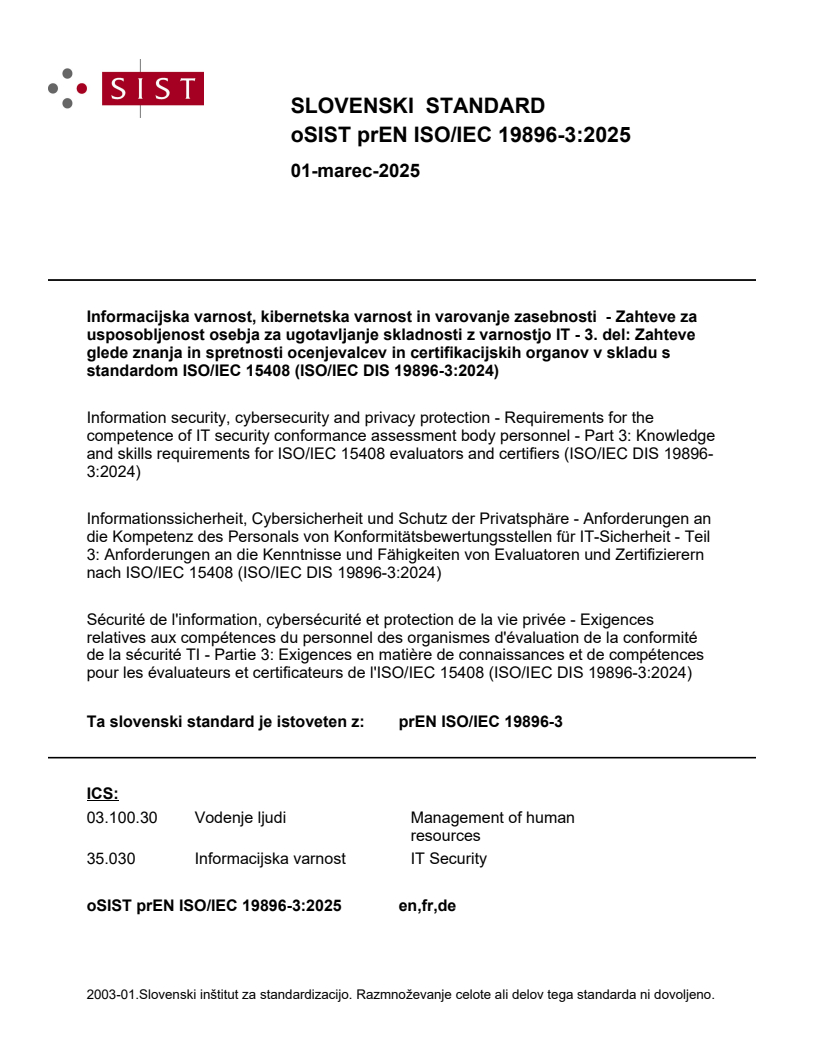
SLOVENSKI STANDARD
oSIST prEN ISO/IEC 19896-3:2025
01-marec-2025
Informacijska varnost, kibernetska varnost in varovanje zasebnosti - Zahteve za
usposobljenost osebja za ugotavljanje skladnosti z varnostjo IT - 3. del: Zahteve
glede znanja in spretnosti ocenjevalcev in certifikacijskih organov v skladu s
standardom ISO/IEC 15408 (ISO/IEC DIS 19896-3:2024)
Information security, cybersecurity and privacy protection - Requirements for the
competence of IT security conformance assessment body personnel - Part 3: Knowledge
and skills requirements for ISO/IEC 15408 evaluators and certifiers (ISO/IEC DIS 19896-
3:2024)
Informationssicherheit, Cybersicherheit und Schutz der Privatsphäre - Anforderungen an
die Kompetenz des Personals von Konformitätsbewertungsstellen für IT-Sicherheit - Teil
3: Anforderungen an die Kenntnisse und Fähigkeiten von Evaluatoren und Zertifizierern
nach ISO/IEC 15408 (ISO/IEC DIS 19896-3:2024)
Sécurité de l'information, cybersécurité et protection de la vie privée - Exigences
relatives aux compétences du personnel des organismes d'évaluation de la conformité
de la sécurité TI - Partie 3: Exigences en matière de connaissances et de compétences
pour les évaluateurs et certificateurs de l'ISO/IEC 15408 (ISO/IEC DIS 19896-3:2024)
Ta slovenski standard je istoveten z: prEN ISO/IEC 19896-3
ICS:
03.100.30 Vodenje ljudi Management of human
resources
35.030 Informacijska varnost IT Security
oSIST prEN ISO/IEC 19896-3:2025 en,fr,de
2003-01.Slovenski inštitut za standardizacijo. Razmnoževanje celote ali delov tega standarda ni dovoljeno.
oSIST prEN ISO/IEC 19896-3:2025
oSIST prEN ISO/IEC 19896-3:2025
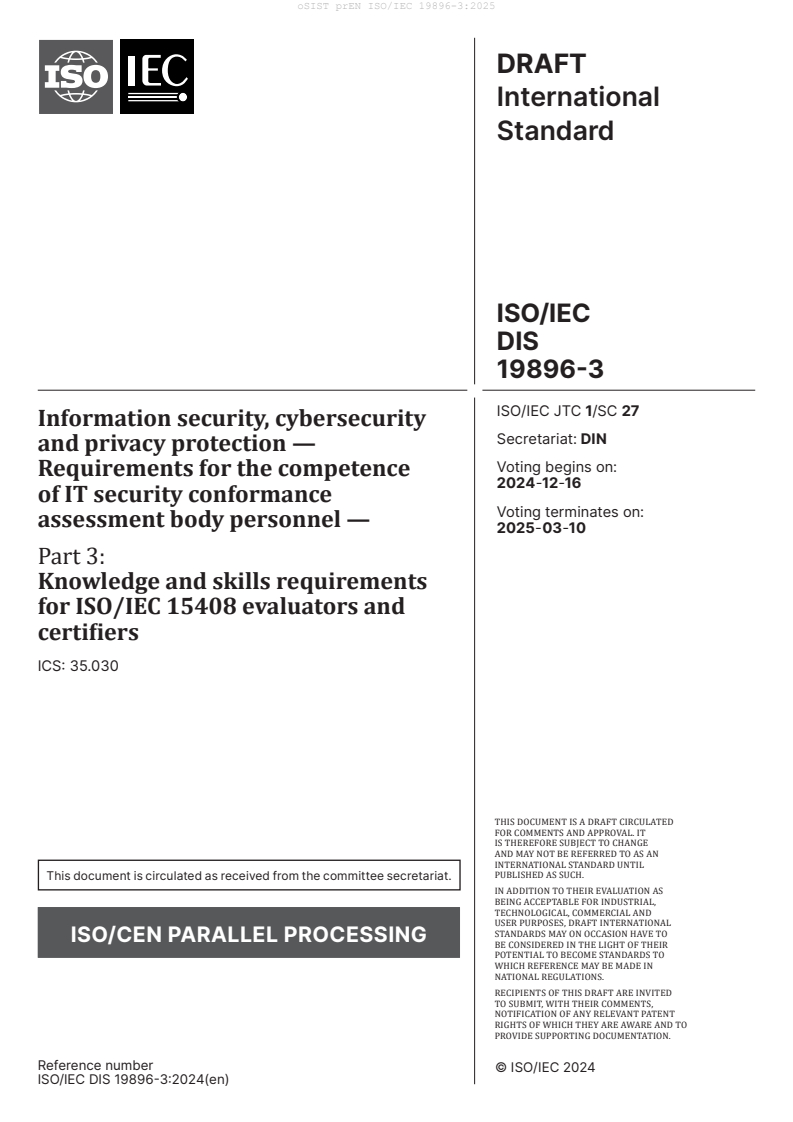
DRAFT
International
Standard
ISO/IEC
DIS
19896-3
ISO/IEC JTC 1/SC 27
Information security, cybersecurity
Secretariat: DIN
and privacy protection —
Voting begins on:
Requirements for the competence
2024-12-16
of IT security conformance
Voting terminates on:
assessment body personnel —
2025-03-10
Part 3:
Knowledge and skills requirements
for ISO/IEC 15408 evaluators and
certifiers
ICS: 35.030
THIS DOCUMENT IS A DRAFT CIRCULATED
FOR COMMENTS AND APPROVAL. IT
IS THEREFORE SUBJECT TO CHANGE
AND MAY NOT BE REFERRED TO AS AN
INTERNATIONAL STANDARD UNTIL
PUBLISHED AS SUCH.
This document is circulated as received from the committee secretariat.
IN ADDITION TO THEIR EVALUATION AS
BEING ACCEPTABLE FOR INDUSTRIAL,
TECHNOLOGICAL, COMMERCIAL AND
USER PURPOSES, DRAFT INTERNATIONAL
STANDARDS MAY ON OCCASION HAVE TO
ISO/CEN PARALLEL PROCESSING
BE CONSIDERED IN THE LIGHT OF THEIR
POTENTIAL TO BECOME STANDARDS TO
WHICH REFERENCE MAY BE MADE IN
NATIONAL REGULATIONS.
RECIPIENTS OF THIS DRAFT ARE INVITED
TO SUBMIT, WITH THEIR COMMENTS,
NOTIFICATION OF ANY RELEVANT PATENT
RIGHTS OF WHICH THEY ARE AWARE AND TO
PROVIDE SUPPORTING DOCUMENTATION.
Reference number
© ISO/IEC 2024
ISO/IEC DIS 19896-3:2024(en)
oSIST prEN ISO/IEC 19896-3:2025
DRAFT
ISO/IEC DIS 19896-3:2024(en)
International
Standard
ISO/IEC
DIS
19896-3
ISO/IEC JTC 1/SC 27
Information security, cybersecurity
Secretariat: DIN
and privacy protection —
Voting begins on:
Requirements for the competence
of IT security conformance
Voting terminates on:
assessment body personnel —
Part 3:
Knowledge and skills requirements
for ISO/IEC 15408 evaluators and
certifiers
ICS: 35.030
THIS DOCUMENT IS A DRAFT CIRCULATED
FOR COMMENTS AND APPROVAL. IT
IS THEREFORE SUBJECT TO CHANGE
AND MAY NOT BE REFERRED TO AS AN
INTERNATIONAL STANDARD UNTIL
PUBLISHED AS SUCH.
This document is circulated as received from the committee secretariat.
IN ADDITION TO THEIR EVALUATION AS
BEING ACCEPTABLE FOR INDUSTRIAL,
© ISO/IEC 2024
TECHNOLOGICAL, COMMERCIAL AND
USER PURPOSES, DRAFT INTERNATIONAL
All rights reserved. Unless otherwise specified, or required in the context of its implementation, no part of this publication may
STANDARDS MAY ON OCCASION HAVE TO
ISO/CEN PARALLEL PROCESSING
be reproduced or utilized otherwise in any form or by any means, electronic or mechanical, including photocopying, or posting on
BE CONSIDERED IN THE LIGHT OF THEIR
the internet or an intranet, without prior written permission. Permission can be requested from either ISO at the address below
POTENTIAL TO BECOME STANDARDS TO
WHICH REFERENCE MAY BE MADE IN
or ISO’s member body in the country of the requester.
NATIONAL REGULATIONS.
ISO copyright office
RECIPIENTS OF THIS DRAFT ARE INVITED
CP 401 • Ch. de Blandonnet 8
TO SUBMIT, WITH THEIR COMMENTS,
CH-1214 Vernier, Geneva
NOTIFICATION OF ANY RELEVANT PATENT
Phone: +41 22 749 01 11
RIGHTS OF WHICH THEY ARE AWARE AND TO
PROVIDE SUPPORTING DOCUMENTATION.
Email: copyright@iso.org
Website: www.iso.org
Published in Switzerland Reference number
© ISO/IEC 2024
ISO/IEC DIS 19896-3:2024(en)
© ISO/IEC 2024 – All rights reserved
ii
oSIST prEN ISO/IEC 19896-3:2025
ISO/IEC DIS 19896-3:2024(en)
Contents Page
Foreword .iv
Introduction .v
1 Scope . 1
2 Normative references . 1
3 Terms and definitions . 1
4 Knowledge . 2
4.1 Knowledge required for evaluators .2
4.1.1 General .2
4.1.2 Knowledge of ISO/IEC 15408 and ISO/IEC 18045 .2
4.1.3 Knowledge of the assurance paradigm .4
4.1.4 Knowledge of information security.5
4.1.5 Knowledge of the technology .6
4.2 Knowledge required for certifiers .7
4.2.1 General .7
4.2.2 Knowledge of ISO/IEC 15408 and ISO/IEC 18045 .7
4.2.3 Knowledge of the assurance paradigm .9
4.2.4 Knowledge of information security.11
4.2.5 Knowledge of technology. 12
5 Skills .13
5.1 Skills required for evaluators . 13
5.1.1 General . 13
5.1.2 Basic evaluation skills . 13
5.1.3 Core evaluation skills given in ISO/IEC 15408-3 and ISO/IEC 18045 .14
5.1.4 Skills required for specific security assurance classes . 15
5.1.5 Skills required for specific security functional requirement classes .16
5.1.6 Skills required for specific technology .16
5.2 Skill required for certifiers .16
5.2.1 Basic certification skills .16
5.2.2 Core certification skills regarding ISO/IEC 15408-3 and ISO/IEC 18045 .17
5.2.3 Skills required for specific security assurance classes .17
5.2.4 Skills required for specific security functional requirement classes .17
5.2.5 Skills required for specific technology .18
Annex A (informative) Technology types: Knowledge and skills . 19
Annex B (informative) Examples of knowledge and skills required for evaluating security
assurance requirement classes .25
Annex C (informative) Examples of knowledge required for evaluating security functional
requirement classes .38
Bibliography . 41
© ISO/IEC 2024 – All rights reserved
iii
oSIST prEN ISO/IEC 19896-3:2025
ISO/IEC DIS 19896-3:2024(en)
Foreword
ISO (the International Organization for Standardization) and IEC (the International Electrotechnical
Commission) form the specialized system for worldwide standardization. National bodies that are
members of ISO or IEC participate in the development of International Standards through technical
committees established by the respective organization to deal with particular fields of technical activity.
ISO and IEC technical committees collaborate in fields of mutual interest. Other international organizations,
governmental and non-governmental, in liaison with ISO and IEC, also take part in the work. In the field of
information technology, ISO and IEC have established a joint technical committee, ISO/IEC JTC 1.
The procedures used to develop this document and those intended for its further maintenance are described
in the ISO/IEC Directives, Part 1. In particular, the different approval criteria needed for the different types
of document should be noted. This document was drafted in accordance with the editorial rules of the ISO/
IEC Directives, Part 2 (see www.iso.org/directives).
Attention is drawn to the possibility that some of the elements of this document may be the subject of patent
rights. ISO and IEC shall not be held responsible for identifying any or all such patent rights. Details of any
patent rights identified during the development of the document will be in the Introduction and/or on the
ISO list of patent declarations received (see www.iso.org/patents).
Any trade name used in this document is information given for the convenience of users and does not
constitute an endorsement.
For an explanation of the voluntary nature of standards, the meaning of ISO specific terms and expressions
related to conformity assessment, as well as information about ISO's adherence to the World Trade
Organization (WTO) principles in the Technical Barriers to Trade (TBT) see www.iso.org/iso/foreword.html.
This document was prepared by Technical Committee ISO/IEC JTC 1, Information technology, Subcommittee
SC 27, Information security, cybersecurity and privacy protection.
A list of all parts in the ISO/IEC 19896 series can be found on the ISO website.
Any feedback or questions on this document should be directed to the user’s national standards body. A
complete listing of these bodies can be found at www.iso.org/members.html.
© ISO/IEC 2024 – All rights reserved
iv
oSIST prEN ISO/IEC 19896-3:2025
ISO/IEC DIS 19896-3:2024(en)
Introduction
The ISO/IEC 15408 series permits comparability between the results of independent security evaluations.
It does so by providing a common set of requirements for the security functionality of IT products and
for assurance measures applied to these IT products during a security evaluation. Many certification and
evaluation schemes as well as certification bodies have been developed using the ISO/IEC 15408 series and
ISO/IEC 18045 as a basis, which permits comparability between the results of evaluation projects.
The evaluation process usually relies on both pre-defined tests/methods for a type of TOE, and TOE-
specific tests/methods that are defined for a given implementation of the TOE. Hence, the competence of the
individual evaluators, which are expected not only to apply pre-defined tests/methods but to define and run
TOE-specific tests/methods, is key to ensure the comparability and repeatability of evaluation results which
is the foundation for mutual recognition.
[Editor’s Note: This standard uses the phrase “organizations implementing an evaluation scheme”. Experts
and national bodies are kindly requested to review if this wording can be improved, i.e. if this concept can be
expressed more clearly. ]
This document establishes a baseline for the minimum competence of ISO/IEC 15408 evaluators and
certifiers with the goal of establishing conformity in the requirements for the training of ISO/IEC 15408
evaluators and certifiers associated with IT organizations implementing evaluation schemes and
certification bodies. It provides the specialized requirements to demonstrate the competence of individuals
in performing IT product security evaluations and certifications in accordance with the ISO/IEC 15408
series and ISO/IEC 18045. ISO/IEC 15408-1 describes the general framework for competences including
the various elements of competence: knowledge, skills, experience and education. This document includes
knowledge and skills especially in the following areas.
— Information security
Knowledge: Information security principles, information security properties, information security
threats and vulnerabilities
Skills: Understand information security requirements, understand the context
— Information security evaluation
Knowledge: Knowledge of the ISO/IEC 15408 series and ISO/IEC 18045, laboratory management system
Skills: Basic evaluation skills, core evaluation skills, skills required when evaluating specific security
assurance classes, skills required when evaluating specific security functional requirements classes
— Information systems architecture
Knowledge: Technology being evaluated
Skills: Understand the interaction of security components and information
— Information security testing
Knowledge: Information security testing techniques, information security testing tools, product
development lifecycle, test types
Skills: Create and manage an information security test plan, design information security tests, prepare
and conduct information security tests
The audience for this document includes certification authorities, testing laboratory accreditation bodies,
organizations implementing evaluation schemes, laboratories, evaluators and organizations offering
professional credentialing
© ISO/IEC 2024 – All rights reserved
v
oSIST prEN ISO/IEC 19896-3:2025
oSIST prEN ISO/IEC 19896-3:2025
DRAFT International Standard ISO/IEC DIS 19896-3:2024(en)
Information security, cybersecurity and privacy protection —
Requirements for the competence of IT security conformance
assessment body personnel —
Part 3:
Knowledge and skills requirements for ISO/IEC 15408
evaluators and certifiers
1 Scope
This document provides the specialized requirements to demonstrate competence of individuals in
performing IT product security evaluations and certifications in accordance with the ISO/IEC 15408 series
and ISO/IEC 18045.
2 Normative references
The following documents are referred to in the text in such a way that some or all of their content constitutes
requirements of this document. For dated references, only the edition cited applies. For undated references,
the latest edition of the referenced document (including any amendments) applies.
ISO/IEC 19896-1, Information security, cybersecurity and privacy protection — Requirements for the
competence of IT security conformance assessment body personnel — Part 1: Introduction and concepts
ISO/IEC 15408 (all parts), Information security, cybersecurity and privacy protection — Evaluation criteria for
IT security
ISO/IEC 18045:2022, Information security, cybersecurity and privacy protection — Evaluation criteria for IT
security — Methodology for IT security evaluation
3 Terms and definitions
For the purposes of this document, the terms and definitions given in ISO/IEC 19896-1, ISO/IEC 15408-1,
ISO/IEC 15408-2, ISO/IEC 15408-3, ISO/IEC 18045 and the following apply.
ISO and IEC maintain terminological databases for use in standardization at the following addresses:
— ISO Online browsing platform: available at https:// www .iso .org/ obp
— IEC Electropedia: available at https:// www .electropedia .org/
3.1
supporting document
document that specifies the use of the Common Criteria (CC) or Common Methodology for Information
Technology Security Evaluation (CEM) in a particular field or domain of technology
Note 1 to entry: Such document may be either mandatory or guidance and generally specifies harmonised
interpretations of the CC and CEM where deemed necessary and/or useful.
© ISO/IEC 2024 – All rights reserved
oSIST prEN ISO/IEC 19896-3:2025
ISO/IEC DIS 19896-3:2024(en)
3.2
technical domain
family of IT products that require specific technical competencies, especially with regard to the vulnerability
analysis, requiring a common understanding of the attack potential for performing the evaluation
4 Knowledge
4.1 Knowledge required for evaluators
4.1.1 General
Subclauses 4.1.2 to 4.1.6 address the knowledge that is needed for evaluation to the ISO/IEC 15408 series
and ISO/IEC 18045.
Some knowledge is required for every evaluator independent of their specific task, while other knowledge is
required only depending on the specific evaluation task and TOE the evaluator is assigned to.
NOTE Previous experience in tasks related to the use of ISO/IEC 15408 and its related documents including,
but not limited to, performing related work such as consultancy, product development, research and specification of
requirements can contribute to the elements of knowledge that are required for competence.
4.1.2 Knowledge of ISO/IEC 15408 and ISO/IEC 18045
4.1.2.1 ISO/IEC 15408-1
Every evaluator shall be able to demonstrate knowledge about the topics required to fulfil their role
according to their competence level and on which they are authorized to work.
Every evaluator’s knowledge shall include:
a) the terms and definitions defined in ISO/IEC 15408 (all parts);
b) the terms and definitions defined in ISO/IEC 18045;
c) the context for ISO/IEC 15408 evaluations; and
d) the general model for the ISO/IEC 15408 series given in ISO/IEC 15408-1.
When the evaluator’s role and competency level demand it, their knowledge shall include the relevant items
of the following list:
e) tailoring security requirements: operations, dependencies between components and extended
components;
f) specification of protection profiles, modules, configurations and packages;
g) handling of evaluation results;
h) specification of security targets;
i) composition models;
j) multi-assurance approach; and
k) modularization concepts.
4.1.2.2 ISO/IEC 15408-2
Every evaluator shall be able to demonstrate knowledge about the security functional requirements (SFRs)
of ISO/IEC 15408-2 required to fulfil their role according to their competence level and the technology types
© ISO/IEC 2024 – All rights reserved
oSIST prEN ISO/IEC 19896-3:2025
ISO/IEC DIS 19896-3:2024(en)
on which the evaluator is authorized to work, as well as any dependent SFRs. Examples for the knowledge
required by ISO/IEC 15408-2 are given in Annex C.
If the evaluator needs to demonstrate competence in ISO/IEC 15408-2, then the knowledge in the respective
security functional requirements shall be demonstrated.
4.1.2.3 ISO/IEC 15408-3
Every evaluator shall be able to demonstrate knowledge about the security assurance requirements
(SARs) given in ISO/IEC 15408-3 required to fulfil their role according to their competence level and that
are specified by Security Targets (ST) on which the evaluator is authorized to work on. The knowledge of
particular SAR components shall include those on which the evaluator is authorized to work. Examples for
the knowledge required by ISO/IEC 15408-3 are given in Annex B.
If the evaluator needs to demonstrate competence in ISO/IEC 15408-3, then the knowledge in the respective
security assurance requirements shall be demonstrated.
4.1.2.4 ISO/IEC 15408-4
If the evaluator needs to demonstrate competence in ISO/IEC 15408-4, then the following shall be
demonstrated:
a) the framework used for deriving evaluation activities from work units in ISO/IEC 18045;
b) the general model of evaluation methods and evaluation activities; and
c) defining evaluation activities for extended SARs.
4.1.2.5 ISO/IEC 15408-5
If the evaluator needs to demonstrate competence in ISO/IEC 15408-5, then those specified in
ISO/IEC 15408-5 shall be demonstrated.
4.1.2.6 ISO/IEC 18045
Every evaluator shall demonstrate:
a) the evaluation process: this process is described in ISO/IEC 18045:2022, Clause 9; and
b) security evaluation method and activities: this information is given in ISO/IEC 18045.
Additionally, every evaluator shall have the necessary knowledge required by the evaluation methods
and activities specified for the assurance classes on which they are authorized to work. Examples for the
knowledge required by ISO/IEC 18045 are given in Annex B.
Every evaluator working in the ALC class shall additionally have the following knowledge:
c) site security (including physical, technical, organisational and personnel security requirements and
measures, IT logical security / network security);
d) site audits;
e) secure development processes;
f) Software/Hardware Bill of Materials;
g) configuration management and development practices;
h) information security standards; and
i) methods for product development and its life cycle.
© ISO/IEC 2024 – All rights reserved
oSIST prEN ISO/IEC 19896-3:2025
ISO/IEC DIS 19896-3:2024(en)
4.1.3 Knowledge of the assurance paradigm
4.1.3.1 Knowledge of the evaluation scheme and overall evaluation framework
Evaluation schemes usually specify an overall evaluation framework with scheme-specific scope, regulations
and application rules. Organizations implementing such an evaluation scheme as well as certification bodies
working within such an evaluation scheme typically define specifications based on the scheme. Within the
predefined limits they also define their operational framework such as policies and procedures that are
specific to the evaluation scheme.
Every evaluator shall be able to demonstrate knowledge of the evaluation schemes as required to fulfil their
role according to their competence level and that is applicable to the evaluation schemes in which they are
authorized to work.
Every evaluator shall have the necessary knowledge of the following items that are of relevance to the
evaluation-related work on which the evaluator is authorized to work:
a) scope of the evaluation scheme;
b) any (sector-specific) regulations, legislation, policies, and further specifics;
c) different types of evaluation / certification procedures (e.g. initial certification, assurance continuity as
re-certification, re-assessment, maintenance);
d) guidance to organizations implementing evaluation schemes and to their evaluators;
e) recognition arrangements; and
f) vulnerability disclosure and handling.
g) scope of the implementing organization;
h) policies regarding evaluation projects including entry criteria, time limits, site visit requirements;
i) specific supporting documents;
j) specific interpretations;
k) specific guidance for evaluators;
l) approved protection profiles and their supporting documents;
m) specific assurance methods;
n) reporting requirements;
o) vulnerability disclosure and handling;
p) quality; and
q) laboratory approval requirements.
NOTE See ISO/IEC 18045:2022, A.5 for guidance to evaluation schemes on this topic.
4.1.3.2 Knowledge of the certification body
Every evaluator shall be able to demonstrate knowledge of the certification bodies as required to fulfil their
role according to their competence level and that is applicable to the certification bodies for which they are
authorized to work.
NOTE Certification bodies are called “evaluation authority” in ISO/IEC 15408-1.
© ISO/IEC 2024 – All rights reserved
oSIST prEN ISO/IEC 19896-3:2025
ISO/IEC DIS 19896-3:2024(en)
EXAMPLE The "Common Criteria Recognition Arrangement (CCRA)" and the "Senior Officials Group Information
Systems Security (SOG-IS)" are mutual recognition arrangements under which several evaluation schemes with
their certification bodies for Common Criteria certification work. The “EU Common Criteria Scheme (EUCC)” is an
evaluation scheme itself with several assigned certification bodies.
Every evaluator shall have the necessary knowledge of the following items that are of relevance to the
evaluation-related work on which the evaluator is authorized to work:
a) scope of the certification body;
b) different types of evaluation/certification procedures (e.g. initial certification, assurance continuity as
re-certification, re-assessment, maintenance);
c) certification body policies;
d) policies regarding to evaluation projects including entry criteria, time limits, site visit requirements;
e) specific interpretations;
f) specific supporting documents;
g) specific guidance;
h) specific assurance methods;
i) reporting requirements;
j) vulnerability disclosure and handling; and
k) quality.
4.1.3.3 Knowledge of the laboratory and its management system
Every evaluator shall have knowledge of:
a) the laboratory’s management system, including policies, processes and procedures that are applicable
to evaluators;
b) laboratory approved methods; and
c) laboratory competence requirements.
NOTE Management systems vary greatly in their implementations. However, items such as document control,
record control, control of nonconforming testing and/or calibration work, handling of technical records, and conflict
of interest are often the direct responsibility of every evaluator. Most laboratory management systems are based on
ISO/IEC 17025.
4.1.4 Knowledge of information security
Every evaluator shall have the necessary knowledge of the following concepts in order to fulfil their role and
in accordance with the requirements of the evaluation scheme:
a) security principles;
b) security properties;
c) mechanisms of attack;
d) attack potential;
e) cryptography;
f) secure development life cycles;
g) security testing; and
© ISO/IEC 2024 – All rights reserved
oSIST prEN ISO/IEC 19896-3:2025
ISO/IEC DIS 19896-3:2024(en)
h) vulnerabilities and weaknesses.
Specific additional deeper / broader knowledge on information security topics outlined in the preceding
bullet list that is expected from evaluators is addressed in Clause 4.1.5.
4.1.5 Knowledge of the technology
4.1.5.1 Knowledge of technology types
The ISO/IEC 15408 series and ISO/IEC 18045 can be used in the evaluation of a wide variety of information
technologies. These technologies are often classified into various technology types by organizations
implementing evaluation schemes, certification bodies or others.
Every evaluator shall have the necessary knowledge of the information technology types on which
the evaluators are authorized to work, including the common security architectures deployed for that
technology type.
NOTE Annex A provides an informative list of knowledge topics presented by commonly identified technology types.
EXAMPLE Commonly identified technology types include:
— access control devices and systems;
— encryption, key management and PKI systems, products for digital signatures;
— databases;
— operating systems;
— network and network-related devices and systems;
— mobile devices and systems;
— multi-function devices;
— ICs, smart cards and smart-card related devices and systems;
— hardware devices;
— detection devices and systems; and
— data protection, biometric systems and devices, trusted computing.
4.1.5.2 Knowledge of Protection Profiles, packages and supporting documents
Every evaluator shall have the necessary knowledge of the following, where they are applicable for the
information technology the evaluators on which they are authorized to work :
a) protection profiles, functional packages, assurance packages, PP-Modules, PP-Configurations and any
related supporting documents specified in connection with the evaluator's work;
b) any additional evaluation methods and assurance activities specified as applicable to an evaluation; and
c) how to determine if any interpretations or guidance in regard to protection profiles, packages and
related supporting documents have been issued and whether they are applicable to a particular
evaluation project.
Additionally, they may have knowledge of
d) specific supporting documents, e.g. from JIL or CCRA cPP; and
EXAMPLE
— technical domain Smart Cards
© ISO/IEC 2024 – All rights reserved
oSIST prEN ISO/IEC 19896-3:2025
ISO/IEC DIS 19896-3:2024(en)
— technical domain Security Boxes
— on network security, operating system security, …
e) the cPP concept.
4.1.5.3 Knowledge of specific technology
Since technology can vary and are continually evolving it is not possible to identify all the knowledge
required. Annex A provides an informative list of both knowledge and skills for many technologies. In
addition, the Bibliography gives many technology-related references.
Guidance on how to gain, maintain and update technology-related knowledge is provided in Annex A.3.
4.1.5.4 Knowledge for the evaluation of Protection Profiles, PP-Modules and PP-Configurations
(classes APE and ACE)
Every evaluator evaluating protection profiles shall have additional knowledge. This shall include:
a) knowledge of the TOE’s intended usage, surrounding system and processes, threat model, security
objectives and provided security functionality;
b) extensive knowledge of the relevant product type;
c) specific knowledge of the technology used in the product type used in the PP, including the possibilities
(and limitations) of this technology;
d) knowledge on the operating environment of the product type;
e) knowledge of the life cycle of the product type;
f) knowledge about modularization concepts like packages, modular PPs, conformance claims on other
PPs, multi-assurance;
g) knowledge of other PPs from the same domain;
h) in depth knowledge of ISO/IEC 15408-2;
i) knowledge of relevant cryptographic catalogues and standards; and
j) modelling of algorithms, protocols and management functionality .
4.2 Knowledge required for certifiers
4.2.1 General
Subclauses 4.2.2 to 4.2.6 address the knowledge that is needed for certification to the ISO/IEC 15408 series
and ISO/IEC 18045.
Some knowledge is required for every certifier independent of their specific task, while other knowledge is
required only depending on the specific certification task and TOE the certifier is assigned to.
NOTE Previous experience in tasks related to the use of ISO/IEC 15408 and its related documents including,
but not limited to, performing related work such as consultancy, product development, research and specification of
requirements can contribute to the elements of knowledge that are required for competence.
4.2.2 Knowledge of ISO/IEC 15408 and ISO/IEC 18045
4.2.2.1 ISO/IEC 15408-1
Every certifier shall be able to demonstrate knowledge about the topics required to fulfil their role according
to their competence level.
© ISO/IEC 2024 – All rights reserved
oSIST prEN ISO/IEC 19896-3:2025
ISO/IEC DIS 19896-3:2024(en)
Every certifier’s knowledge shall include:
a) the terms and definitions defined in ISO/IEC 15408 (all parts);
b) the terms and definitions defined in ISO/IEC 18045;
c) the context for ISO/IEC 15408 evaluations;
d) the general model for the ISO/IEC 15408 series given in ISO/IEC 15408-1;
e) tailoring security requirements: operations, dependencies between components and extended
components;
g) handling of certification results;
h) the specification of security targets;
When the certifier’s role and competency level demand it, their knowledge shall include some of the
following:
i) specification of protection profiles, modules, configurations and packages;
j) composition models;
k) multi-assurance-approach; and
l) modularization concepts.
4.2.2.2 ISO/IEC 15408-2
Every certifier shall be able to demonstrate knowledge about the security functional requirements (SFRs) of
ISO/IEC 15408-2 required to fulfil their role according to their competence level and the technology types
on which the certifier is authorized to work, as well as any dependent SFRs. Examples for the knowledge
required by ISO/IEC 15408-2 are given in Annex C.
If the certifier needs to demonstrate competence in ISO/IEC 15408-2, then the knowledge in the respective
security functional requirements shall be demonstrated.
4.2.2.3 ISO/IEC 15408-3
Every certifier shall be able to demonstrate knowledge about the security assurance requirements (SARs)
given in ISO/IEC 15408-3 required to fulfil their role according to their competence level and that are
specified by Security Targets (ST) that the certifier is authorized to work on. The knowledge of particular
SAR components shall include those on which the certifier is authorized to work. Examples for the knowledge
required by ISO/IEC 15408-3 are given in Annex B.
If the certifier needs to demonstrate competence in ISO/IEC 15408-3, then the knowledge in the respective
security assurance requirements shall be demonstrated.
4.2.2.4 ISO/IEC 15408-4
If the certifier needs to demonstrate competence in ISO/IEC 15408-4, then the following shall be
demonstrated:
a) the framework used for deriving evaluation activities from work units in ISO/IEC 18045;
b) the general model of evaluation methods and evaluation activities; and
c) defining evaluation activities for extended SARs.
© ISO/IEC 2024 – All rights reserved
oSIST prEN ISO/IEC 19896-3:2025
ISO/IEC DIS 19896-3:2024(en)
4.2.2.5 ISO/IEC 15408-5
If the certifier needs to demonstrate competence in ISO/IEC 15408-5, then those specified in ISO/IEC 15408-4
shall be demonstrated.
4.2.2.6 ISO/IEC 18045
Every certifier shall demonstrate knowledge about the evaluation process: this process is described in
ISO/IEC 18045:2022, Clause 9.
Additionally, every certifier shall have the necessary knowledge required by the evaluation methods
and activities specified for the assurance classes on which they are authorized to work. Examples for the
knowledge required by ISO/IEC 18045 are given in Annex B.
Every certifier authorized to work in the ALC class shall additionally have the following knowledge:
a) site security (including physical, technical, organisational and personnel security requirements and
measures, IT logical security / network security);
b) site audits;
c) secure development processes;
d) Software/Hardware Bill of Materials;
e) configuration management and development practices;
f) information security standards; and
g) methods for product development and its life cycle.
4.2.3 Knowledge of the assurance paradigm
4.2.3.1 Knowledge of the evaluation scheme and overall evaluation framework
Evaluation schemes usually specify an overall evaluation framework with scheme-specific scope, regulations
and application rules. Organizations implementing such an evaluation scheme as well as certification bodies
working within such evaluation scheme typically define specifications based on that scheme. Within the
predefined limits they also define their operational framework such as policies and procedures that are
specific to the evaluation scheme and the certification body.
Every certifier shall be able to demonstrate knowledge about the evaluation schemes required to fulfil their
role according to their competence level and that is applicable to the evaluation schemes to which their
certification body is assigned to.
Every certifier shall have the necessary knowledge of the following items that are of relevance to the
certification-related work on which the certifiers are authorized to work:
a) scope of the evaluation scheme;
b) any (sector-specific) regulations, legislation, policies, and further specifics;
c) different types of evaluation / certification procedures (e.g. initial certification, assurance continuity as
re-certification, re-assessment, maintenance);
d) guidance to certification bodies working within the evaluation schemes and to their certifiers;
e) recognition arrangements; and
f) vulnerability disclosure and handling.
g) scope of the implementing organization;
© ISO/IEC 2024 – All rights reserved
oSIST prEN ISO/IEC 19896-3:2025
ISO/IEC DIS 19896-3:2024(en)
h) policies regarding to evaluation projects including entry criteria, time limits, site visit requirements;
i) specific supporting documents;
j) specific interpretations;
k) specific guidance for certifiers;
l) approved protection profiles and their supporting documents;
m) specific assurance methods;
n) reporting requirements;
o) vulnerability disclosure and handling; and
p) quality.
NOTE See ISO/IEC 18045:2022, A.5 for guidance to evaluation schemes on this topic.
4.2.3.2 Knowledge of the certification body
Every certifier shall be able to demonstrate knowledge about the certification bodies required to fulfil their
role according to their competence level and that is applicable to the certification bodies for which they are
authorized to work.
NOTE Certification bodies are called “evaluation authority” in ISO/IEC 15408-1.
EXAMPLE The "Common Criteria Recognition Arrangement (CCRA)" and the "Senior Officials Group Information
Systems Security (SOG-IS)" are mutual recognition arrangements under which several evaluation schemes with
their certification bodies for Common Criteria certification work. The “EU Common Criteria Scheme (EUCC)” is an
evaluation scheme itself with several assigned certification bodies.
Every certifier shall have the necessary knowledge of the following items that are of relevance to the
certification-related work on which the certifier is authorized to work:
a) scope of the certification body;
b) different types of evaluation/certification procedures (e.g. initial certification, assurance continuity as
re-certification, re-assessment, maintenance);
c) certification body policies;
d) policies regarding evaluation projects including entry criteria, time limits, site visit requirements;
e) specific interpretations;
f) specific supporting documents;
g) specific guidance;
h) specific assurance methods;
i) reporting requirements;
j) vulnerability disclosure and handling; and
k) quality.
4.2.3.3 Knowledge of the certification body and its management system
Every certifier of the certification body shall have knowledge of:
a) the certification body’s management system, including policies, processes and procedures that are
applicable to certifiers and their certification activities;
© ISO/IEC 2024 – All rights reserved
oSIST prEN ISO/IEC 19896-3:2025
ISO/IEC DIS 19896-3:2024(en)
b) the certification body competence requirements;
c) structure and relevance of certification criteria and evaluation methodology applied;
d) structure and relevance of technical and organisational aspects of the evaluation and certification
process; and
e) role and placement of the certification body within the evaluation scheme and overall evaluation
framework.
EXAMPLE
— any sector-specific policies, regulations and legislation;
— laboratory approval requirements for the organization implementing the evaluation scheme;
— policies of organizations implementing the evaluation scheme in regard to evaluation projects including entry
criteria, time limits, report requirements, site visit requirements;
— guidance to evaluators;
— specific interpretations of the organizations implementing the evaluation scheme;
— specific guidance of the organizations implementing the evaluation scheme;
— approved protection profiles and their supporting documents;
— assurance methods and activities specific to the organizations implementing the evaluation scheme; and
— reporting requirements.
NOTE 1 See ISO/IEC 18045:2022, A.5 for guidance to evaluation schemes on this topic.
NOTE 2 Management systems vary greatly in their implementations. However, items such as document control,
record control, handling of technical records, and conflict of interest are often the direct responsibility of every
certifier. Most certification body management systems are based on ISO/IEC 17065.
4.2.4 Knowledge of information security
Every certifier shall have general knowledge of:
a) security principles;
EXAMPLE confidentiality, integrity, availability
b) security properties;
EXAMPLE security by design, security by default, data minimization
c) mechanisms of attack;
d) attack potential;
e) cryptography;
f) secure development life cycle
...
Questions, Comments and Discussion
Ask us and Technical Secretary will try to provide an answer. You can facilitate discussion about the standard in here.