


EN ISO 16321-3:2022/FprA1
(Amendment)Eye and face protection for occupational use - Part 3: Additional requirements for mesh protectors - Amendment 1 (ISO 16321-3:2021/FDAM 1:2025)
Eye and face protection for occupational use - Part 3: Additional requirements for mesh protectors - Amendment 1 (ISO 16321-3:2021/FDAM 1:2025)
Protection des yeux et du visage à usage professionnel - Partie 3: Exigences complémentaires relatives aux protecteurs grillagés - Amendement 1 (ISO 16321-3:2021/FDAM 1:2025)
Zaščita za oči in obraz za poklicno uporabo - 3. del: Dodatne zahteve za mrežne ščitnike za oči in obraz - Dopolnilo A1 (ISO 16321-3:2021/FDAM 1:2025)
General Information
- Status
- Not Published
- Publication Date
- 19-Feb-2026
- Technical Committee
- CEN/TC 85 - Eye-protective equipment
- Drafting Committee
- CEN/TC 85 - Eye-protective equipment
- Current Stage
- 6055 - CEN Ratification completed (DOR) - Publishing
- Start Date
- 20-Dec-2025
- Completion Date
- 20-Dec-2025
Relations
- Effective Date
- 12-Feb-2026
- Effective Date
- 30-Oct-2024
Overview
EN ISO 16321-3:2022/FprA1 is an international standard developed by CEN (European Committee for Standardization) that establishes additional requirements for mesh protectors used in occupational eye and face protection. This amendment (Amendment 1) specifically updates the minimum number of apertures in mesh protectors, aiming to improve the protective performance and safety of personal protective equipment (PPE) for professionals exposed to workplace hazards.
Occupational eye and face protection is crucial in many industries, helping to protect workers from flying debris, particles, sparks, or other physical hazards. Mesh protectors, such as mesh face shields, goggles, and spectacles, are widely used when protection from large particles is required while maintaining ventilation and visibility.
Key Topics
- Mesh Protectors: The standard applies to mesh-type face shields, goggles, and spectacles designed for occupational use.
- Aperture Requirements: This amendment updates the testing and specification for the minimum number of mesh apertures per square centimeter:
- Mesh face shields and goggles must have at least 15 apertures per cm².
- Mesh spectacles must have at least 50 apertures per cm².
- Testing Method: The requirements reference testing in accordance with ISO 18526-3:2020, section 11.1, ensuring that product evaluation follows internationally recognized protocols.
- Improved Safety: By specifying more precise mesh aperture counts, the amendment aims to enhance user safety while maintaining comfort and usability.
Applications
Industries and Use Cases
EN ISO 16321-3:2022/FprA1 is relevant to a broad range of sectors where occupational eye and face protection is necessary:
- Forestry and Agriculture: Mesh face shields are commonly used to protect against large wood chips, branches, and flying debris.
- Metalworking and Construction: Workers are protected from sparks, shavings, and debris generated during cutting, grinding, or drilling.
- Landscaping: Mesh spectacles and goggles are used to safeguard the eyes from dust, sand, and plant fragments.
- Maintenance and Industrial Cleaning: Mesh protection is used where fine particulate defense is not required, but airflow and visibility are crucial.
Benefits
- Enhanced Protection: Clear minimum aperture densities help ensure adequate protection against workplace hazards.
- Consistency in Manufacturing: Manufacturers must adhere to specified criteria, helping harmonize product quality and safety across markets.
- Regulatory Compliance: Adopting this standard assists organizations in meeting local and international PPE requirements.
Related Standards
- EN ISO 16321 Series: This amendment is part of a broader series covering performance and testing requirements for occupational eye and face protection.
- ISO 18526-3:2020: Specifies test methods for PPE related to mesh aperture evaluation.
- ISO/TC 94/SC 6: The technical committee focused on personal protective equipment, particularly eye and face protection.
- EN 166: General standard for personal eye protection, often referenced in conjunction with specialized standards like EN ISO 16321-3.
Organizations manufacturing, supplying, or using mesh protectors in the workplace should be familiar with EN ISO 16321-3:2022/FprA1 to ensure their equipment complies with the latest occupational safety requirements. Staying updated with amendments supports risk reduction, legal compliance, and user confidence in workplace safety equipment.

Get Certified
Connect with accredited certification bodies for this standard

CIS Institut d.o.o.
Personal Protective Equipment (PPE) certification body. Notified Body NB-2890 for EU Regulation 2016/425 PPE.

Kiwa BDA Testing
Building and construction product certification.
Kmetijski inštitut Slovenije
Agricultural Institute of Slovenia. Soil testing, plant health, agricultural product analysis.
Sponsored listings
Frequently Asked Questions
EN ISO 16321-3:2022/FprA1 is a draft published by the European Committee for Standardization (CEN). Its full title is "Eye and face protection for occupational use - Part 3: Additional requirements for mesh protectors - Amendment 1 (ISO 16321-3:2021/FDAM 1:2025)". This standard covers: Eye and face protection for occupational use - Part 3: Additional requirements for mesh protectors - Amendment 1 (ISO 16321-3:2021/FDAM 1:2025)
Eye and face protection for occupational use - Part 3: Additional requirements for mesh protectors - Amendment 1 (ISO 16321-3:2021/FDAM 1:2025)
EN ISO 16321-3:2022/FprA1 is classified under the following ICS (International Classification for Standards) categories: 13.340.20 - Head protective equipment. The ICS classification helps identify the subject area and facilitates finding related standards.
EN ISO 16321-3:2022/FprA1 has the following relationships with other standards: It is inter standard links to ISO 16321-3:2021/Amd 1:2025, EN ISO 16321-3:2022. Understanding these relationships helps ensure you are using the most current and applicable version of the standard.
EN ISO 16321-3:2022/FprA1 is associated with the following European legislation: EU Directives/Regulations: 2016/425; Standardization Mandates: M/571, M/571 AMD 1. When a standard is cited in the Official Journal of the European Union, products manufactured in conformity with it benefit from a presumption of conformity with the essential requirements of the corresponding EU directive or regulation.
EN ISO 16321-3:2022/FprA1 is available in PDF format for immediate download after purchase. The document can be added to your cart and obtained through the secure checkout process. Digital delivery ensures instant access to the complete standard document.
Standards Content (Sample)
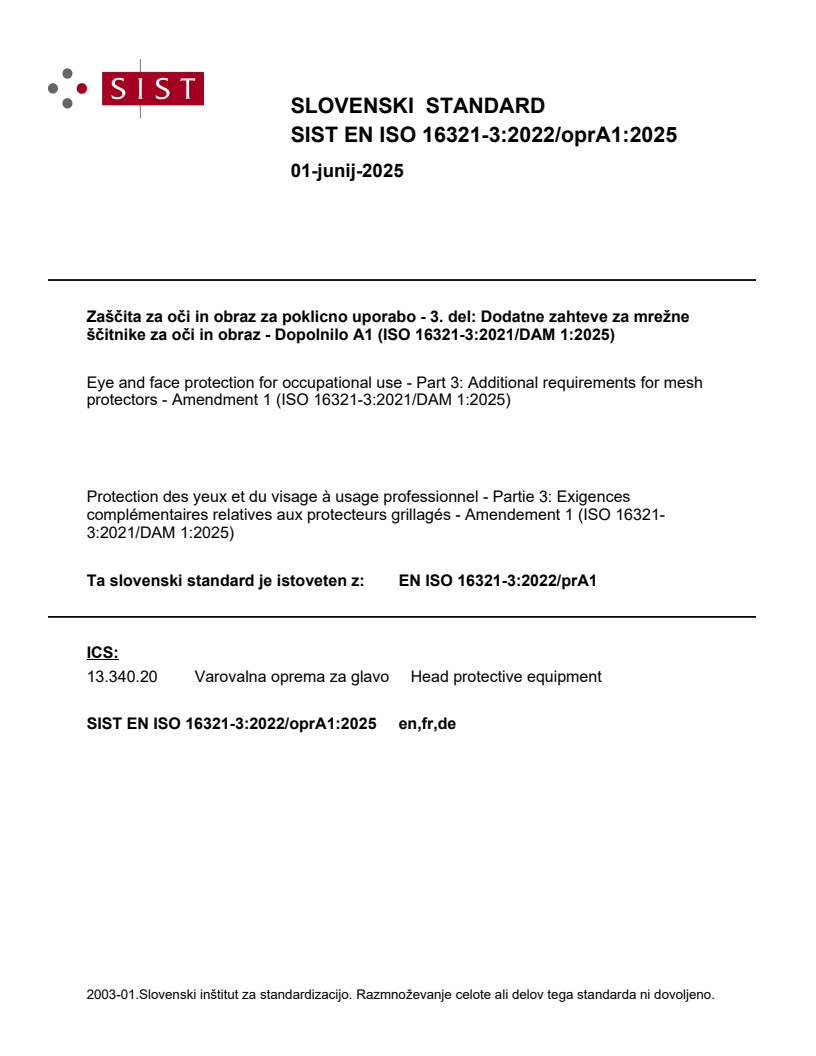
SLOVENSKI STANDARD
SIST EN ISO 16321-3:2022/oprA1:2025
01-junij-2025
Zaščita za oči in obraz za poklicno uporabo - 3. del: Dodatne zahteve za mrežne
ščitnike za oči in obraz - Dopolnilo A1 (ISO 16321-3:2021/DAM 1:2025)
Eye and face protection for occupational use - Part 3: Additional requirements for mesh
protectors - Amendment 1 (ISO 16321-3:2021/DAM 1:2025)
Protection des yeux et du visage à usage professionnel - Partie 3: Exigences
complémentaires relatives aux protecteurs grillagés - Amendement 1 (ISO 16321-
3:2021/DAM 1:2025)
Ta slovenski standard je istoveten z: EN ISO 16321-3:2022/prA1
ICS:
13.340.20 Varovalna oprema za glavo Head protective equipment
SIST EN ISO 16321-3:2022/oprA1:2025 en,fr,de
2003-01.Slovenski inštitut za standardizacijo. Razmnoževanje celote ali delov tega standarda ni dovoljeno.
SIST EN ISO 16321-3:2022/oprA1:2025
SIST EN ISO 16321-3:2022/oprA1:2025
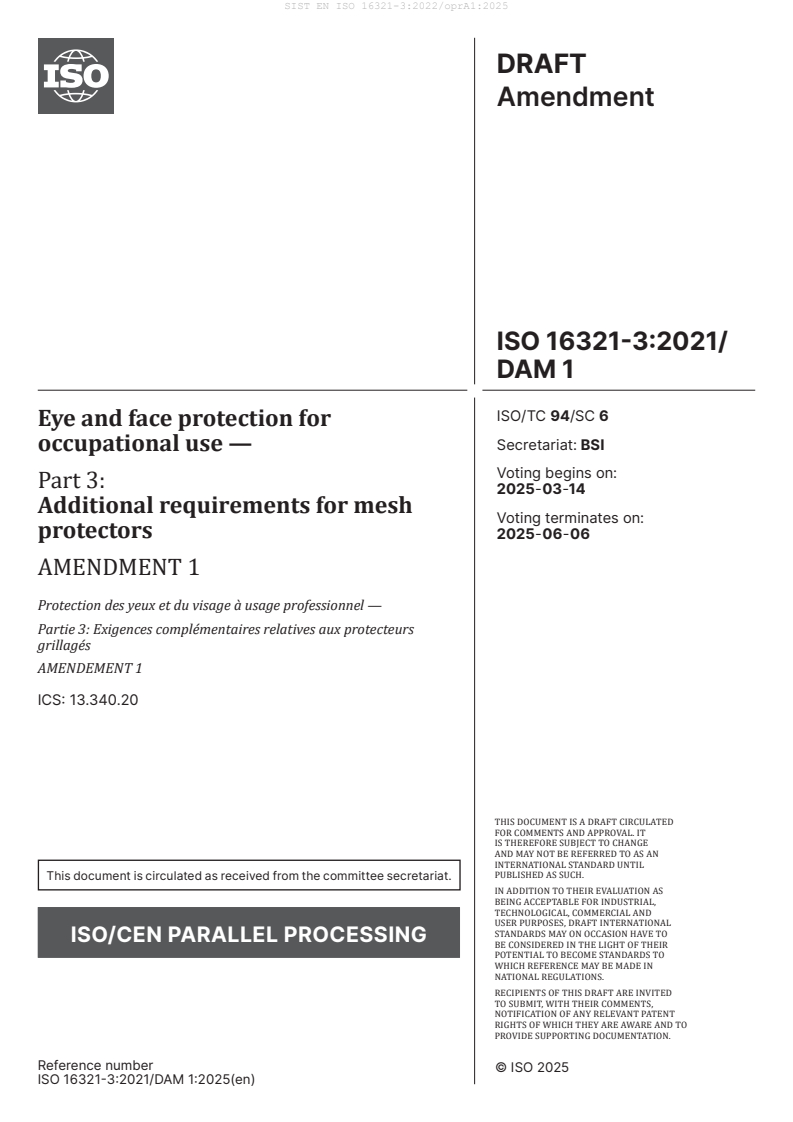
DRAFT
Amendment
ISO 16321-3:2021/
DAM 1
ISO/TC 94/SC 6
Eye and face protection for
Secretariat: BSI
occupational use —
Voting begins on:
Part 3:
2025-03-14
Additional requirements for mesh
Voting terminates on:
protectors 2025-06-06
AMENDMENT 1
Protection des yeux et du visage à usage professionnel —
Partie 3: Exigences complémentaires relatives aux protecteurs
grillagés
AMENDEMENT 1
ICS: 13.340.20
THIS DOCUMENT IS A DRAFT CIRCULATED
FOR COMMENTS AND APPROVAL. IT
IS THEREFORE SUBJECT TO CHANGE
AND MAY NOT BE REFERRED TO AS AN
INTERNATIONAL STANDARD UNTIL
PUBLISHED AS SUCH.
This document is circulated as received from the committee secretariat.
IN ADDITION TO THEIR EVALUATION AS
BEING ACCEPTABLE FOR INDUSTRIAL,
TECHNOLOGICAL, COMMERCIAL AND
USER PURPOSES, DRAFT INTERNATIONAL
STANDARDS MAY ON OCCASION HAVE TO
ISO/CEN PARALLEL PROCESSING
BE CONSIDERED IN THE LIGHT OF THEIR
POTENTIAL TO BECOME STANDARDS TO
WHICH REFERENCE MAY BE MADE IN
NATIONAL REGULATIONS.
RECIPIENTS OF THIS DRAFT ARE INVITED
TO SUBMIT, WITH THEIR COMMENTS,
NOTIFICATION OF ANY RELEVANT PATENT
RIGHTS OF WHICH THEY ARE AWARE AND TO
PROVIDE SUPPORTING DOCUMENTATION.
Reference number
ISO 16321-3:2021/DAM 1:2025(en)
SIST EN ISO 16321-3:2022/oprA1:2025
DRAFT
ISO 16321-3:2021/DAM 1:2025(en)
Amendment
ISO 16321-3:2021/
DAM 1
ISO/TC 94/SC 6
Eye and face protection for
Secretariat: BSI
occupational use —
Voting begins on:
Part 3:
Additional requirements for mesh
Voting terminates on:
protectors
AMENDMENT 1
Protection des yeux et du visage à usage professionnel —
Partie 3: Exigences complémentaires relatives aux protecteurs
grillagés
AMENDEMENT 1
ICS: 13.340.20
THIS DOCUMENT IS A DRAFT CIRCULATED
FOR COMMENTS AND APPROVAL. IT
IS THEREFORE SUBJECT TO CHANGE
AND MAY NOT BE REFERRED TO AS AN
INTERNATIONAL STANDARD UNTIL
PUBLISHED AS SUCH.
This document is circulated as received from the committee secretariat.
IN ADDITION TO THEIR EVALUATION AS
BEING ACCEPTABLE FOR INDUSTRIAL,
© ISO 2025
TECHNOLOGICAL, COMMERCIAL AND
USER PURPOSES, DRAFT INTERNATIONAL
All rights reserved. Unless otherwise specified, or required in the context of its implementation, no part of this publication may
STANDARDS MAY ON OCCASION HAVE TO
ISO/CEN PARALLEL PROCESSING
be reproduced or utilized otherwise in any form or by any means, electronic or mechanical, including photocopying, or posting on
BE CONSIDERED IN THE LIGHT OF THEIR
the internet or an intranet, without prior written permission. Permission can be requested from either ISO at the address below
POTENTIAL TO BECOME STANDARDS TO
WHICH REFERENCE MAY BE MADE IN
or ISO’s member body in the country of the requester.
NATIONAL REGULATIONS.
ISO copyright office
RECIPIENTS
...
Questions, Comments and Discussion
Ask us and Technical Secretary will try to provide an answer. You can facilitate discussion about the standard in here.
Loading comments...