

EN 14620-3:2006
(Main)Design and manufacture of site built, vertical, cylindrical, flat-bottomed steel tanks for the storage of refrigerated, liquefied gases with operating temperatures between 0 °C and -165 °C - Part 3: Concrete components
General Information
- Abstract
This European Standard specifies general requirements for materials, design and construction of the concrete components of the refrigerated liquefied gas storage tanks.
This European Standard deals with the design and manufacture of site built, vertical, cylindrical, flat-bottomed steel tanks for the storage of refrigerated, liquefied gases with operating temperatures between 0 °C and –165 °C.
- Status
- Published
- Publication Date
- 12-Sep-2006
- Technical Committee
- CEN/TC 265 - Site built metallic tanks for the storage of liquids
- Drafting Committee
- CEN/TC 265/WG 10 - Revision of EN 14620
- Current Stage
- 9093 - Decision to confirm - Review Enquiry
- Start Date
- 29-Jan-2014
- Completion Date
- 29-Jan-2014

Overview
EN 14620-3:2006 is a European Standard developed by CEN that specifies the general requirements for the design, materials, and manufacture of concrete components used in site-built, vertical, cylindrical, flat-bottomed steel tanks. These tanks are intended for the storage of refrigerated, liquefied gases at operating temperatures between 0 °C and -165 °C. As Part 3 of the EN 14620 series, this standard focuses on the critical role of concrete structures, ensuring safety, durability, and integrity for tanks that store cryogenic products such as LNG and LPG across a range of industrial applications.
Key Topics
- Materials Requirements: Outlines the use of appropriate concretes, reinforcing steel, and pre-stressing steel, ensuring all components maintain structural integrity at low temperatures, as prescribed in EN 1992-1-1 and EN 206-1.
- Design Principles: Provides guidance on using partial factor methods and limit state theory to achieve required reliability for concrete elements, aligning with the principles in Eurocode 2.
- Vapour and Liquid Tightness: Emphasizes the importance of vapour-tight liners and coatings, including required testing for permeability and durability, to prevent leakage and contamination.
- Construction Detailing: Addresses detailing requirements for wall and base connections, concrete cover, minimum reinforcement, bund walls, and practical recommendations for joints, pre-stressing systems, and the implementation of liners and coatings.
- Workmanship and Quality Control: Covers best practices for crack control, curing, tolerance management, and the need for robust quality control in placement, compaction, and concrete production.
Applications
The EN 14620-3:2006 standard is essential for the safe and effective design and construction of tanks used in:
- Liquefied Natural Gas (LNG) Storage: Large-scale on-site tanks storing LNG at cryogenic temperatures.
- Liquefied Petroleum Gas (LPG) Storage: Stationary tanks for commercial and industrial LPG storage.
- Chemical and Petrochemical Facilities: Storage of other refrigerated, liquefied industrial gases.
- Energy and Utilities Infrastructure: Ensuring the reliability and safety of content containment, preventing leaks, and enabling compliance with international safety regulations.
- Environmental Protection: Bund walls and containment design to mitigate accidental releases and minimize environmental impact.
Proper application of EN 14620-3:2006 ensures that concrete components deliver high performance under extreme temperature conditions and rigorous operational demands.
Related Standards
For a holistic approach to the design and operation of cryogenic storage tanks, the following related standards should also be referenced:
- EN 14620-1:2006 - General requirements for refrigerated, liquefied gas storage tanks.
- EN 14620-2 - Metallic components for tanks within the same temperature and use range.
- EN 14620-4 - Insulation components to control thermal loss and protect structural integrity.
- EN 14620-5 - Procedures for testing, drying, purging, and cool-down of storage tanks.
- EN 1992-1-1 (Eurocode 2) - General rules for the design of concrete structures.
- EN 206-1 - Specification, performance, production, and conformity of concrete.
By integrating the requirements of EN 14620-3:2006 with these related standards, stakeholders ensure comprehensive compliance with European and international best practices for storage tank design, safety, and performance.
Keywords: EN 14620-3:2006, concrete components, refrigerated liquefied gas storage, cryogenic storage tanks, vapour tightness, tank design, industrial standards, site-built tanks, tank containment, CEN standards, LNG/LPG storage.
Relations
- Effective Date
- 11-Mar-2026
- Effective Date
- 28-Jan-2026
- Effective Date
- 28-Jan-2026
- Effective Date
- 28-Jan-2026
- Effective Date
- 28-Jan-2026
- Effective Date
- 28-Jan-2026
- Effective Date
- 28-Jan-2026
- Effective Date
- 28-Jan-2026
- Effective Date
- 28-Jan-2026
- Effective Date
- 28-Jan-2026
- Effective Date
- 28-Jan-2026
- Effective Date
- 28-Jan-2026
- Effective Date
- 28-Jan-2026
Get Certified
Connect with accredited certification bodies for this standard

Institut za varilstvo d.o.o. (Welding Institute)
Slovenia's leading welding institute since 1952. ISO 3834, EN 1090, pressure equipment certification, NDT personnel, welder qualification. Only IIW Au
Sponsored listings
Frequently Asked Questions
EN 14620-3:2006 is a standard published by the European Committee for Standardization (CEN). Its full title is "Design and manufacture of site built, vertical, cylindrical, flat-bottomed steel tanks for the storage of refrigerated, liquefied gases with operating temperatures between 0 °C and -165 °C - Part 3: Concrete components". This standard covers: This European Standard specifies general requirements for materials, design and construction of the concrete components of the refrigerated liquefied gas storage tanks. This European Standard deals with the design and manufacture of site built, vertical, cylindrical, flat-bottomed steel tanks for the storage of refrigerated, liquefied gases with operating temperatures between 0 °C and –165 °C.
This European Standard specifies general requirements for materials, design and construction of the concrete components of the refrigerated liquefied gas storage tanks. This European Standard deals with the design and manufacture of site built, vertical, cylindrical, flat-bottomed steel tanks for the storage of refrigerated, liquefied gases with operating temperatures between 0 °C and –165 °C.
EN 14620-3:2006 is classified under the following ICS (International Classification for Standards) categories: 23.020.10 - Stationary containers and tanks. The ICS classification helps identify the subject area and facilitates finding related standards.
EN 14620-3:2006 has the following relationships with other standards: It is inter standard links to EN 206-2:2026, EN 1992-1-1:2004, EN 1992-1-2:2004, EN 206:2013+A2:2021, EN 14620-2:2006, EN 14620-1:2006, EN 848-1:2007+A2:2012, EN 1473:2007, EN 1473:2016, EN 14620-4:2025, EN 1993-4-2:2007, EN 1473:2021, EN 14620-1:2024. Understanding these relationships helps ensure you are using the most current and applicable version of the standard.
EN 14620-3:2006 is available in PDF format for immediate download after purchase. The document can be added to your cart and obtained through the secure checkout process. Digital delivery ensures instant access to the complete standard document.
Standards Content (Sample)
2003-01.Slovenski inštitut za standardizacijo. Razmnoževanje celote ali delov tega standarda ni dovoljeno.Design and manufacture of site built, vertical, cylindrical, flat-bottomed steel tanks for the storage of refrigerated, liquefied gases with operating temperatures between 0 °C and -165 °C
- Part 3: Concrete componentsOLConception et fabrication de réservoirs en acier a fond plat, verticaux, cylindriques, construits sur site, destinés au stockage des gaz réfrigérés, liquéfiés, dont les températures de service sont comprises entre 0 °C et -165 °C - Partie 3: Constituants bétonAuslegung und Herstellung standortgefertigter, stehender, zylindrischer Flachboden-Stahltanks für die Lagerung von tiefkalt verflüssigten Gasen bei Betriebstemperaturen zwischen 0 °C und -165 °C - Teil 3: Bauteile aus BetonTa slovenski standard je istoveten z:EN 14620-3:2006SIST EN 14620-3:2007en23.020.10UH]HUYRDUMLStationary containers and tanksICS:SLOVENSKI
STANDARDSIST EN 14620-3:200701-januar-2007
EUROPEAN STANDARD NORME EUROPÉENNE EUROPÄISCHE NORM
EN 14620-3
September 2006 ICS 23.020.10 English Version
Design and manufacture of site built, vertical, cylindrical, flat-bottomed steel tanks for the storage of refrigerated, liquefied gases with operating temperatures between 0 °C and -165 °C - Part 3: Concrete components
Conception et fabrication de réservoirs en acier à fond plat, verticaux, cylindriques, construits sur site, destinés au stockage des gaz réfrigérés, liquéfiés, dont les températures de service sont comprises entre 0 °C et -165 °C - Partie 3: Constituants béton
Auslegung und Herstellung standortgefertigter, stehender, zylindrischer Flachboden-Stahltanks für die Lagerung von tiefkalt verflüssigten Gasen bei Betriebstemperaturen zwischen 0 °C und -165 °C - Teil 3: Bauteile aus Beton This European Standard was approved by CEN on 20 February 2006.
CEN members are bound to comply with the CEN/CENELEC Internal Regulations which stipulate the conditions for giving this European Standard the status of a national standard without any alteration. Up-to-date lists and bibliographical references concerning such national standards may be obtained on application to the Central Secretariat or to any CEN member.
This European Standard exists in three official versions (English, French, German). A version in any other language made by translation under the responsibility of a CEN member into its own language and notified to the Central Secretariat has the same status as the official versions.
CEN members are the national standards bodies of Austria, Belgium, Cyprus, Czech Republic, Denmark, Estonia, Finland, France, Germany, Greece, Hungary, Iceland, Ireland, Italy, Latvia, Lithuania, Luxembourg, Malta, Netherlands, Norway, Poland, Portugal, Romania, Slovakia, Slovenia, Spain, Sweden, Switzerland and United Kingdom.
EUROPEAN COMMITTEE FOR STANDARDIZATION
COMITÉ EUROPÉEN DE NORMALISATION EUROPÄISCHES KOMITEE FÜR NORMUNG
Management Centre: rue de Stassart, 36
B-1050 Brussels © 2006 CEN All rights of exploitation in any form and by any means reserved worldwide for CEN national Members. Ref. No. EN 14620-3:2006: E
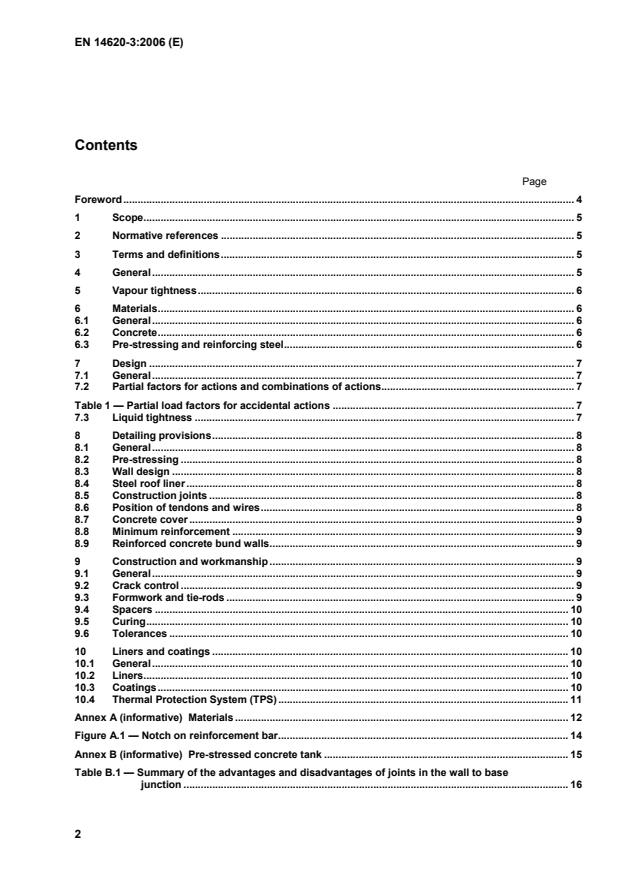
Materials.12 Figure A.1 — Notch on reinforcement bar.14 Annex B (informative)
Pre-stressed concrete tank.15 Table B.1 — Summary of the advantages and disadvantages of joints in the wall to base junction.16
This European Standard shall be given the status of a national standard, either by publication of an identical text or by endorsement, at the latest by March 2007, and conflicting national standards shall be withdrawn at the latest by March 2007. EN 14620 Design and manufacture of site built, vertical, cylindrical, flat-bottomed steel tanks for the storage of refrigerated, liquefied gases with operating temperatures between 0 °C and -165 °C consists of the following parts: Part 1: General; Part 2: Metallic components; Part 3: Concrete components; Part 4: Insulation components; Part 5: Testing, drying, purging and cool down. According to the CEN/CENELEC Internal Regulations, the national standards organizations of the following countries are bound to implement this European Standard: Austria, Belgium, Cyprus, Czech Republic, Denmark, Estonia, Finland, France, Germany, Greece, Hungary, Iceland, Ireland, Italy, Latvia, Lithuania, Luxembourg, Malta, Netherlands, Norway, Poland, Portugal, Romania, Slovakia, Slovenia, Spain, Sweden, Switzerland and United Kingdom.
1 Scope This European Standard specifies general requirements for materials, design and construction of the concrete components of the refrigerated liquefied gas storage tanks. This European Standard deals with the design and manufacture of site built, vertical, cylindrical, flat-bottomed steel tanks for the storage of refrigerated, liquefied gases with operating temperatures between 0 °C and –165 °C. 2 Normative references The following referenced documents are indispensable for the application of this European Standard. For dated references, only the edition cited applies. For undated references, the latest edition of the referenced document (including any amendments) applies. EN 206-1, Concrete — Part 1: Specification, performance, production and conformity EN 1992-1-1:2004, Eurocode 2: Design of concrete structures — Part 1-1: General rules and rules for buildings EN 1992-1-2:2004, Eurocode 2: Design of concrete structures — Part 1-2: General rules — Structural fire design EN 14620-1:2006, Design and manufacture of site built, vertical, cylindrical, flat-bottomed steel tanks for the storage of refrigerated, liquefied gases with operating temperatures between 0 °C and −165°C — Part 1: General EN 14620-2, Design and manufacture of site built, vertical, cylindrical, flat-bottomed steel tanks for the storage of refrigerated, liquefied gases with operating temperatures between 0 °C and –165 °C — Part 2: Metallic components 3 Terms and definitions For the purposes of this European Standard, the terms and definitions given in EN 14620-1:2006 and the following apply. 3.1 low temperature temperature lower than –20 °C 4 General For material selection and design of normal reinforced concrete and/or pre-stressed concrete structures, reference is made to EN 1992-1-1.
Dead Imposed Abnormal load Wind
Adverse Beneficial AdverseBeneficial
Normal action plus one accidental action 1,05 1,0 1,05 0 1,0 0,3 Accidental actions being, earthquake (SSE), blast overpressure, external impact, fire or leakage from inner tank.
7.3 Liquid tightness For liquid tightness, the following shall be considered: a) In case of a non-liquid tight liner/coating For concrete outer containers without a liquid tight liner or coating, the liquid tightness of the concrete shall be ensured by means of the minimum compression zone of 100 mm. b) In case of a liquid tight liner/coating Where a liquid tight liner/coating is applied (to ensure full tightness of the secondary container) then cracking of the concrete section shall be permitted within the limits specified by EN 1992-1-1. In such cases the crack width shall be calculated and the liner/coating shall be proven to be capable of ‘bridging’ a gap equal to 120 % of the crack width.
Vertical pre-stressing is not required. It can be combined with horizontal pre-stressing. The need for vertical pre-stressing depends on the tank design pressure, tank diameter, and associated permanent and transitional stresses within the concrete section. 8.3 Wall design The minimum wall thickness shall be determined so that: adequate cover to all reinforcement and pre-stressing tendons shall be available; space between the reinforcement and pre-stressing tendons shall be sufficient to ensure that a homogeneous, liquid tight concrete structure is obtained. 8.4 Steel roof liner The steel roof liner shall be anchored adequately to the concrete roof. NOTE The liner may act as formwork for the concrete and may also act compositely with the use of shear studs. The concrete may be built up in layers to prevent overstress of the liner (see also B.6) 8.5 Construction joints Attention shall be paid to the design and execution of the construction joints. The location and necessity shall be carefully planned to minimize the risk of poor jointing. For the areas where liquid tightness is to be assured, the contractor shall provide method statements based on proven working practices and where necessary, due to lack of evidence, the contractor shall carry out tests to demonstrate that the construction joint is liquid tight. 8.6 Position of tendons and wires For internal pre-stressing systems using buttresses and grouted tendons, due account of the emergency conditions, e.g. fire scenarios, shall be taken to determine the position of the pre-stressing system. NOTE 1 Tendons should be preferably placed, in the centre of the concrete wall for protection against external fires. The tendons shall be well protected from corrosion during the life of the tank. Grouting procedures shall be provided and agreed between the designer and contractor to provide adequate protection to the tendons. NOTE 2 In very aggressive environments, where additional protection is required, for the tendons, non-ferrous pre-stressing ducts may be considered. Reference is made to ‘Durable bonded post-tensioned bridges’ Concrete Society Report TR47 [12]. For non-bonded tendons, reference should be made to FIP recommendation 91 [13].
...