

EN 15806:2010
(Main)Railway applications - Braking - Static brake testing
General Information
- Abstract
This European Standard specifies generic static tests requirements for the braking systems for all types of railways vehicles. Hereinafter all references to tests are to be read as “static” tests.
The methods of test and acceptance criteria are described in the appropriate standards (as example, for High speed trains, FprEN 15734-1 and FprEN 15734-2 apply).
Static tests conducted in normal service before the departure of the train are not considered in this standard.
This European Standard is applicable to brake systems on:
- all new vehicle designs of vehicles;
- all new constructions of existing vehicle types;
- all major overhauls of the above-mentioned vehicles if they involve redesigning or extensive alteration to the brake system of the vehicle concerned.
This European Standard does not apply to special transport systems (suspended monorail, rack and pinion lines, etc.), nor to investigative and supplementary tests.
Annex A presents the components and sub-systems to be incorporated in the brake system considered.
- Status
- Withdrawn
- Publication Date
- 05-Oct-2010
- Withdrawal Date
- 29-Sep-2026
- Technical Committee
- CEN/TC 256 - Railway applications
- Current Stage
- 9960 - Withdrawal effective - Withdrawal
- Start Date
- 04-Apr-2018
- Completion Date
- 30-Sep-2026

Relations
- Effective Date
- 09-Feb-2026
- Effective Date
- 09-Feb-2026
- Effective Date
- 28-Jan-2026
- Effective Date
- 28-Jan-2026
- Effective Date
- 28-Jan-2026
- Effective Date
- 28-Jan-2026
- Effective Date
- 16-Nov-2014
Get Certified
Connect with accredited certification bodies for this standard

IRIS Certification (UNIFE)
International Railway Industry Standard certification.

TÜV SÜD Rail GmbH
TÜV SÜD railway certification services.

Bureau Veritas Railway Certification
Railway and transportation certification.
Sponsored listings
Frequently Asked Questions
EN 15806:2010 is a standard published by the European Committee for Standardization (CEN). Its full title is "Railway applications - Braking - Static brake testing". This standard covers: This European Standard specifies generic static tests requirements for the braking systems for all types of railways vehicles. Hereinafter all references to tests are to be read as “static” tests. The methods of test and acceptance criteria are described in the appropriate standards (as example, for High speed trains, FprEN 15734-1 and FprEN 15734-2 apply). Static tests conducted in normal service before the departure of the train are not considered in this standard. This European Standard is applicable to brake systems on: - all new vehicle designs of vehicles; - all new constructions of existing vehicle types; - all major overhauls of the above-mentioned vehicles if they involve redesigning or extensive alteration to the brake system of the vehicle concerned. This European Standard does not apply to special transport systems (suspended monorail, rack and pinion lines, etc.), nor to investigative and supplementary tests. Annex A presents the components and sub-systems to be incorporated in the brake system considered.
This European Standard specifies generic static tests requirements for the braking systems for all types of railways vehicles. Hereinafter all references to tests are to be read as “static” tests. The methods of test and acceptance criteria are described in the appropriate standards (as example, for High speed trains, FprEN 15734-1 and FprEN 15734-2 apply). Static tests conducted in normal service before the departure of the train are not considered in this standard. This European Standard is applicable to brake systems on: - all new vehicle designs of vehicles; - all new constructions of existing vehicle types; - all major overhauls of the above-mentioned vehicles if they involve redesigning or extensive alteration to the brake system of the vehicle concerned. This European Standard does not apply to special transport systems (suspended monorail, rack and pinion lines, etc.), nor to investigative and supplementary tests. Annex A presents the components and sub-systems to be incorporated in the brake system considered.
EN 15806:2010 is classified under the following ICS (International Classification for Standards) categories: 45.040 - Materials and components for railway engineering; 45.060.01 - Railway rolling stock in general. The ICS classification helps identify the subject area and facilitates finding related standards.
EN 15806:2010 has the following relationships with other standards: It is inter standard links to ISO 8573-1:2010, EN 50125-1:2014, EN 15595:2018+A1:2023, EN 15663:2017+A2:2024, EN 14478:2005, EN 14033-1:2017, prEN 15746-1. Understanding these relationships helps ensure you are using the most current and applicable version of the standard.
EN 15806:2010 is associated with the following European legislation: EU Directives/Regulations: 2001/16/EC, 2006/42/EC, 2008/57/EC, 96/48/EC; Standardization Mandates: M/275, M/334. When a standard is cited in the Official Journal of the European Union, products manufactured in conformity with it benefit from a presumption of conformity with the essential requirements of the corresponding EU directive or regulation.
EN 15806:2010 is available in PDF format for immediate download after purchase. The document can be added to your cart and obtained through the secure checkout process. Digital delivery ensures instant access to the complete standard document.
Standards Content (Sample)
2003-01.Slovenski inštitut za standardizacijo. Razmnoževanje celote ali delov tega standarda ni dovoljeno.Bahnanwendungen - Bremse - Statische BremsprüfungApplications ferroviaires - Freinage - Essai statique de freinageRailway applications - Braking - Static brake testing45.040Materiali in deli za železniško tehnikoMaterials and components for railway engineeringICS:Ta slovenski standard je istoveten z:EN 15806:2010SIST EN 15806:2010en,fr01-december-2010SIST EN 15806:2010SLOVENSKI
STANDARD
EUROPEAN STANDARD NORME EUROPÉENNE EUROPÄISCHE NORM
EN 15806
October 2010 ICS 45.040; 45.060.01 English Version
Railway applications - Braking - Static brake testing
Applications ferroviaires - Freinage - Essai statique de freinage
Bahnanwendungen - Bremse - Statische Bremsprüfung This European Standard was approved by CEN on 21 August 2010.
CEN members are bound to comply with the CEN/CENELEC Internal Regulations which stipulate the conditions for giving this European Standard the status of a national standard without any alteration. Up-to-date lists and bibliographical references concerning such national standards may be obtained on application to the CEN Management Centre or to any CEN member.
This European Standard exists in three official versions (English, French, German). A version in any other language made by translation under the responsibility of a CEN member into its own language and notified to the CEN Management Centre has the same status as the official versions.
CEN members are the national standards bodies of Austria, Belgium, Bulgaria, Croatia, Cyprus, Czech Republic, Denmark, Estonia, Finland, France, Germany, Greece, Hungary, Iceland, Ireland, Italy, Latvia, Lithuania, Luxembourg, Malta, Netherlands, Norway, Poland, Portugal, Romania, Slovakia, Slovenia, Spain, Sweden, Switzerland and United Kingdom.
EUROPEAN COMMITTEE FOR STANDARDIZATION
COMITÉ EUROPÉEN DE NORMALISATION EUROPÄISCHES KOMITEE FÜR NORMUNG
Management Centre:
Avenue Marnix 17,
B-1000 Brussels © 2010 CEN All rights of exploitation in any form and by any means reserved worldwide for CEN national Members. Ref. No. EN 15806:2010: ESIST EN 15806:2010
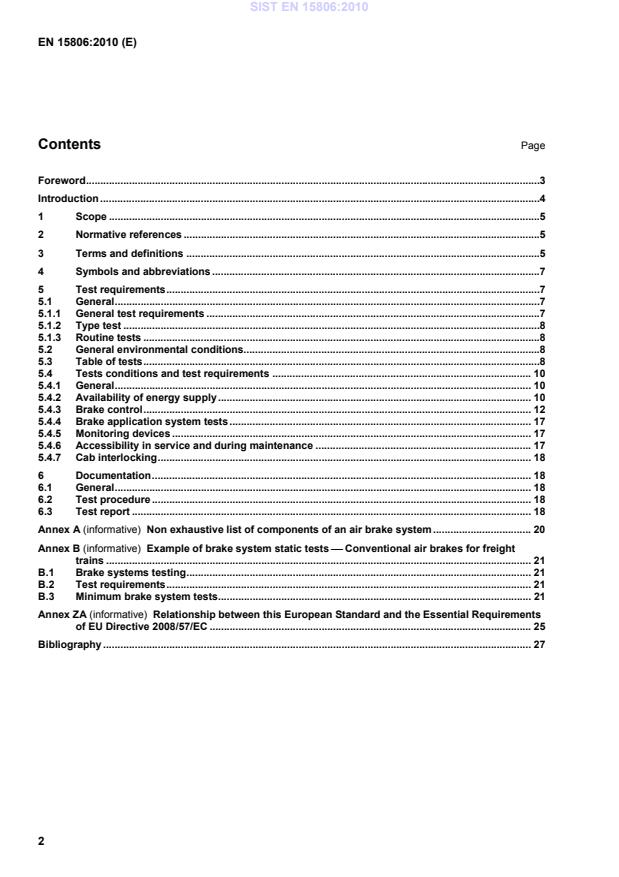
Non exhaustive list of components of an air brake system . 20Annex B (informative)
Example of brake system static tests Conventional air brakes for freight trains . 21B.1 Brake systems testing . 21B.2 Test requirements . 21B.3 Minimum brake system tests . 21Annex ZA (informative)
Relationship between this European Standard and the Essential Requirements of EU Directive 2008/57/EC . 25Bibliography . 27
This European Standard covers the static brake type and routine testing of brake systems used in railway vehicles. Only routine tested components may be used.
2 Normative references The following referenced documents are indispensable for the application of this document. For dated references, only the edition cited applies. For undated references, the latest edition of the referenced document (including any amendments) applies. EN 14478:2005, Railway applications — Braking — Generic vocabulary EN 15595, Railway applications — Braking — Wheel slide protection EN 15663, Railway applications — Definition of vehicle reference masses
EN 50125-1 Railway applications — Environmental conditions for equipment — Part 1: Equipment on board rolling stock ISO 8573-1, Compressed air — Part 1: Contaminants and purity classes 3 Terms and definitions For the purposes of this document, the terms and definitions given in EN 14478:2005 and the following apply. 3.1 brake test test which aims to prove that a brake system complies with the requirements in terms of function and performance NOTE The brake tests may comprise: - type test; - routine tests. SIST EN 15806:2010
3.5 routine test test of the brake system to which each and every vehicle or train is subjected, after manufacture, in order to verify that it complies with the relevant criteria for the type of vehicle or train concerned 3.6 interface specification specification describing the functional and component requirements to assure that the different brake sub-systems are able to operate together in the whole brake system (e.g. signal structure, pressure values, timing values) 3.7 stakeholders bodies involved with the train design, train procurement, train maintenance, trains testing, etc. (e.g. notified body, train manufacturer, brake supplier, train operator, etc) 3.8 brake system specification
all points which shall be described in a brake system specification and containing at least the following requirements: a) List of relevant documents: 1) European directives 2) European standards b) Brake system requirements: 1) Application and release timings 2) Brake performance 3) Load criteria
4) Operational requirements 5) Brake system failure consequences 6) Brake control properties 7) Train signalling / communication SIST EN 15806:2010
G
Good P
Passenger R
Rapid (High performance) R+Mg Rapid + magnetic track brake 5 Test requirements 5.1 General 5.1.1 General test requirements Prior to carrying out the requirements of the following brake system tests the vehicle/train shall have successfully completed the testing of all vehicle systems which interface with the brake system e.g. vehicle control systems, WSP systems, etc. and all wiring tests. With a pre-serial unit or first vehicle/train of a serial production, type tests shall demonstrate that the brake system complies with the requirements. After successful passing of the type tests, routine tests shall confirm the technical stability of the production process of the system and its subsystems on subsequent trains following manufacture or modification as applicable. For this purpose, the final design of the system and its subsystems defined during the type test shall be considered. Brake testing shall also be undertaken if the brake system, and/or any other part of the train (e.g. train mass and/or load carried) has been changed from the final approved design referring to type test. (e.g. change of pad quality, shape). For example, this may be achieved by adjusting the settings of the existing brake equipment or installing new equipment, etc.
The content of this type testing, due to a brake design change, shall be agreed according to the modifications implemented. Before carrying out these tests, the following conditions shall be assured: The train brake system has been assembled according to the manufacturer’s design specifications; All system integration tests that could be carried out in advance of physical fitment of the brake system components to the vehicle/train to confirm their satisfactory interaction have been successfully carried out; All necessary component type / routine tests shall have been successfully completed. A non exhaustive list of brake components is given in Annex A. Tests associated with energy production (see ISO 8573-1) are supposed to be performed before beginning the static test on the train. SIST EN 15806:2010
Where interactions between components and or subsystems has not been reliably verified by carrying out bench testing, these interactions shall be verified by testing after they have been integrated on the vehicle concerned. 5.1.2 Type test Where type tests are deemed necessary they shall be performed on a vehicle or train considered representative of the remainder of the fleet or build of vehicles or trains that use the same type designation. These tests shall take place prior to any of that fleet or build of vehicles entering service and they form the basis of an acceptance of the brake system design. The principal objectives of these type tests are to verify that the train’s braking system and equipment complies with the requirements of brake system specifications and to establish the values of all the relevant parameters as a reference for assessing the dynamic performance. If a multiple unit operation is required in the brake system specification, a static test shall be performed with a single unit and the longest multiple unit composition. Where interactions between components and or subsystems has not been reliably verified by carrying out bench testing, these interactions shall be verified by testing after they have been integrated on the vehicle concerned. 5.1.3 Routine tests Routine tests are to be carried out on every vehicle to verify conformance with the type-tested vehicle/train. The principal objective of the routine tests is to verify that each train’s braking equipment is consistent with that of the type tested train. All routine tests shall be completed successfully prior to the introduction of that unit or train into service. 5.2 General environmental conditions The brake system and braking equipment shall be tested within the ranges of conditions as specified in EN 50125-1.
5.3 Table of tests Table 1 lists the static tests that shall be carried out for all brake systems unless the nature of the brake system concerned is such that certain tests are not applicable (e.g. electrical tests for systems that do not use electricity as a control or power medium).
The Table 1 identifies the individual tests as stated in 5.4 and whether these tests should be conducted as part of type or routine tests conducted on an individual vehicle or train as applicable. The actual test sequence is at the discretion of the relevant test engineer. NOTE The applicability of the tests should be agreed between the stakeholders involved. These tests describe the minimum requirements for a static test. Braking energy supply sub-systems are those systems used to store and distribute the energy subsequently converted into a force for retarding the train. These sub-systems include main compressors, auxiliary compressors, hydraulic pumps, accumulators, reservoirs, battery charging, auxiliary generators, etc. They are only considered insofar as the interaction they have with the brake system (e.g. the quantity of energy required from these sub-systems as a function of time). Braking energy supply may also be used for communicating the braking application and release commands.
Refer to Annex B for a typical static test as applicable to a vehicle fitted with a conventional UIC type air brake for freight trains. Table 1 — List of static tests Clause number Designation of the tests Type test Routine test T (Train / multiple unit) I (Individual vehicle / single unit) 5.4.2
Availability of energy supply
5.4.2.2
Energy delivery and storage
5.4.2.2.2 Charging test X X T / I 5.4.2.2.3 Safety test X X T / I 5.4.2.2.4 Energy supply control
X X T / I 5.4.2.2.5 Successive applications of the brake (inexhaustibility) X
T / I 5.4.2.2.6 Electrical supply test X X T / I 5.4.2.3
Energy loss
5.4.2.3.2 Main reservoirs and all systems supplied by those reservoirs
X X T / I 5.4.2.3.3 Auxiliary/brake supply reservoirs/accumulators, brake cylinders and associated devices X X T / I 5.4.2.3.4 Brake pipe X X T / I 5.4.3 Brake control
5.4.3.2
Interfaces of the brake system with safety related systems X X T / I 5.4.3.3 Check of brake control signals and resultant reactions X X T 5.4.3.4 Check that the brake application command is not adversely affected by the energy supply during braking X X T 5.4.3.5 Emergency brake: levels, timings and time interlocking X X T 5.4.3.6 Service brake application and release: levels and timings X X T 5.4.3.7 Service brake: graduability, stability and repeatability X X T 5.4.3.8 Loss of control of distributor control reservoir pressure X X T / I 5.4.3.9 Pressure switches or equivalent devices X X T
5.4.3.10 Isolation of sub-systems from the brake system at vehicle level X X T 5.4.3.11 Verifying the effects of variation to system setting (e.g. G/P timings) X X T / I 5.4.3.12 Automatic function – Loss of brake system continuity X X T 5.4.3.13 Automatic function – Critical reduction in stored braking energy X X T 5.4.3.14 Load dependent function
X X T / I 5.4.3.15 Effectiveness of brake system protection devices X X T SIST EN 15806:2010
5.4 Tests conditions and test requirements 5.4.1 General The following subclauses describe in more detail the tests listed in the Table 1. As a minimum, the following tests shall be conducted at various load conditions of the vehicle/train. The definition of the load conditions to be used is as contained in EN 15663. Vehicles without load dependant brake control shall be tested in state "operational mass, in working order". Herein after referred to as “empty” for the purpose of this standard. Vehicles equipped with a load dependant brake control shall be tested in the states "operational mass in working order" and "design mass under exceptional payload". Herein after referred to as “loaded” for the purpose of this standard. Load conditions may be simulated using mass dummies or equivalent means for obtaining the required load per unit area. Alternatively, and in the case of intermediate load conditions, loading can be simulated by using other methods, for example, by reproducing the load/weigh signal input to the brake control system, using an independent pressure regulator, or mechanically pressing on the primary suspension. NOTE The number of intermediate conditions of loads should be defined by the brake system specification. 5.4.2 Availability of energy supply 5.4.2.1 General The energy supply systems for pneumatic, hydraulic and electrical equipment shall be tested separately as applicable. The following tests, mentioned in 5.4.2.2 and 5.4.2.3, cover the different functional interfaces between the braking system and the energy supply systems. SIST EN 15806:2010
The time achieved to put the vehicle in a pressure or energy state, such that from a brake system status point of view the vehicle/train is “ready to be driven”, shall be recorded. Ready to be driven is typically identified for example by the achievement of a minimum pressure in the brake supply reservoir, or other brake energy level, to ensure that full brake applications can be achieved prior to the vehicle being driven. The charging of the systems shall be continued noting the time at which the full system pressure is achieved, as signalled by the stopping of the relevant compressor/pumps. 5.4.2.2.3 Safety test Protection against overload of energy storage shall be checked by means described in the test procedure. 5.4.2.2.4 Energy supply control Energy consumption shall be simulated to check that the compressor/pumps management automatically maintains the specified service pressure.
An energy user shall be introduced in the system such that the air/hydraulic system is observed to replenish the energy system pressure to maintain the required energy status. 5.4.2.2.5 Successive applications of the brake (inexhaustibility) Commencing with the specified working pressures for the pneumatic energy supply the specified number of successive application (of the emergency or full service brake dependant on the brake system specification) shall be carried out, and it shall be confirmed that the pressures in the brake cylinder and other braking equipment including magnetic track brake lowering cylinders if applicable, are within the range defined in the brake system specification. 5.4.2.2.6 Electrical supply test The electrical energy supply for electro-pneumatic, electric braking (e.g. utilising the traction motors), magnetic track brakes and eddy current brakes shall be checked according to the tests procedure. SIST EN 15806:2010
The energy loss (leakage) from the brake system and all other systems that derive their energy from the same energy source shall be tested. The energy loss shall be monitored during a specified time according as identified in the brake specification.
As applicable, the energy loss tests are performed when brakes are applied and released. As necessary, the energy supply to the subsystem to be tested shall be isolated to facilitate the testing. 5.4.2.3.2 Main reservoirs and all systems supplied by those reservoirs With the various items of pneumatic equipment under pressure (except those intentionally designed to have certain inherent leaks but not in operation), the main reservoir pressure shall be checked in order that the stored energy is kept without feeding within the tolerances defined in the brake specification. 5.4.2.3.3 Auxiliary/brake supply reservoirs/accumulators, brake cylinders and associated devices
With the brake and energy supply system pressurised to the level(s) defined in the brake system specifications and the brake released, apply the emergency brake and then isolate the reservoir(s/accumulators) from the energy supply in such a way that: no further energy can be admitted into the reservoir/accumulators; the means normally used for admitting energy into the reservoir/accumulators are depressurised on the energy supply side; the remaining subsystem under test is the reservoir/accumulator, brake actuation equipment, pressure control devices (e.g. brake distributor) and any non return devices between this subsystem and the energy supply.
The pressure drop in the reservoir or accumulator and the brake actuation equipment shall remain equal or lower than the leakage limits (pressure drop versus time) defined in the brake system specifications. 5.4.2.3.4 Brake pipe
Where applicable the brake pipe leakage shall be tested. All devices supplied by the brake pipe shall be connected. The driver's brake valve shall be isolated. The pressure drop in the brake pipe shall remain equal or lower than the leakage limits (pressure drop versus time) defined in the brake system specifications. 5.4.3 Brake control
5.4.3.1 General The tests are applicable for all types of brake systems (pneumatic, hydraulic, electric). The objective is to establish that the system as a whole and all control components function correctly as described in the brake system specification in association with the energy supply system.
5.4.3.2 Interfaces of the brake system with safety related systems All safety related systems that have an interface with the brake system, not covered by the specific requirements elsewhere in 5.4.3 shall be tested in accordance with the brake system specification. As a minimum, the systems listed below shall be checked in order to ensure that these systems initiate automatic brake application: SIST EN 15806:2010
...