


FprEN ISO 8528-13
(Main)Reciprocating internal combustion engine driven alternating current generating sets - Part 13: Safety (ISO/FDIS 8528-13:2025)
Reciprocating internal combustion engine driven alternating current generating sets - Part 13: Safety (ISO/FDIS 8528-13:2025)
ISO 8528-13:2016 specifies the safety requirements for reciprocating internal combustion (RIC) engine driven generating sets up to 1 000 V consisting of an RIC engine, an alternating current (AC) generator including the additional equipment required for operating, e.g. controlgear, switchgear, auxiliary equipment.
It is applicable to generating sets for land and marine use (domestic, recreational and industrial application). It is not applicable to generating sets used on board of seagoing vessels and mobile offshore units as well as on aircraft or to propel road vehicles and locomotives.
NOTE This part of ISO 8528 does not apply to arc welding equipment (IEC 60974 series).
The special requirements needed to cover operation in potentially explosive atmospheres are not covered in this part of ISO 8528.
The hazards relevant to RIC engine driven generating sets are identified in Annex A.
ISO 8528-13:2016 deals with the special requirements of test and safety design which should be observed in addition to the definitions and requirements in ISO 8528-1, ISO 8528-2, ISO 8528-3, ISO 8528-4, ISO 8528-5 and ISO 8528-6, where applicable. It specifies safety requirements in order to protect the user from danger.
Stromerzeugungsaggregate mit Hubkolben-Verbrennungsmotor - Teil 13: Sicherheit (ISO/FDIS 8528-13:2025)
Groupes électrogènes à courant alternatif entraînés par moteurs alternatifs à combustion interne - Partie 13: Sécurité (ISO/FDIS 8528-13:2025)
ISO 8528-13:2016 précise les prescriptions de sécurité applicables aux groupes électrogènes jusqu'à 1 000 V entraînés par moteurs alternatifs à combustion interne, constitués d'un moteur alternatif à combustion interne, d'un générateur de courant alternatif, y compris les équipements supplémentaires requis pour leur fonctionnement, par exemple appareillage de commande et de coupure et équipement auxiliaire.
Elle est applicable aux groupes électrogènes utilisés pour des applications terrestres et marines (applications domestiques, de loisirs et industrielles). Elle n'est pas applicable aux groupes électrogènes utilisés sur les navires de haute mer et les unités mobiles «off shore» ainsi qu'à bord des aéronefs ou pour la propulsion de véhicules terrestres et de locomotives.
NOTE La présente partie de l'ISO 8528 ne s'applique pas au matériel de soudage à l'arc (série IEC 60974).
Les prescriptions particulières nécessaires pour un fonctionnement en atmosphères potentiellement explosibles ne sont pas couvertes par la présente partie de l'ISO 8528.
Les phénomènes dangereux relatifs aux groupes électrogènes entraînés par moteurs alternatifs à combustion interne sont identifiés dans l'Annexe A.
ISO 8538-13:2016 traite des prescriptions particulières d'essai et de conception relative à la sécurité qu'il convient de respecter en complément des définitions et des prescriptions spécifiées dans les normes ISO 8528‑1, ISO 8528‑2, ISO 8528‑3, ISO 8528‑4, ISO 8528‑5 et ISO 8528‑6, le cas échéant. Elle spécifie les prescriptions de sécurité visant à protéger l'utilisateur de tout danger.
Agregati za proizvodnjo izmeničnega toka, gnani z batnim motorjem z notranjim zgorevanjem - 13. del: Varnost (ISO/DIS 8528-13:2024)
General Information
Relations
Standards Content (Sample)
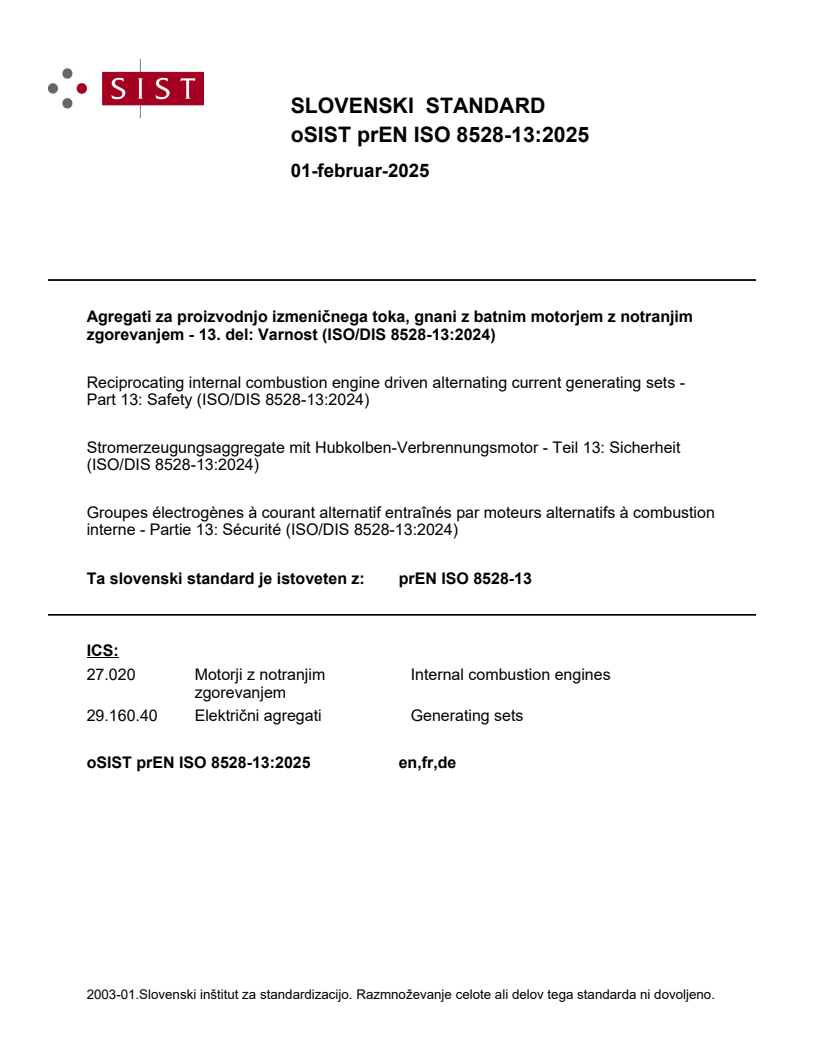
SLOVENSKI STANDARD
01-februar-2025
Agregati za proizvodnjo izmeničnega toka, gnani z batnim motorjem z notranjim
zgorevanjem - 13. del: Varnost (ISO/DIS 8528-13:2024)
Reciprocating internal combustion engine driven alternating current generating sets -
Part 13: Safety (ISO/DIS 8528-13:2024)
Stromerzeugungsaggregate mit Hubkolben-Verbrennungsmotor - Teil 13: Sicherheit
(ISO/DIS 8528-13:2024)
Groupes électrogènes à courant alternatif entraînés par moteurs alternatifs à combustion
interne - Partie 13: Sécurité (ISO/DIS 8528-13:2024)
Ta slovenski standard je istoveten z: prEN ISO 8528-13
ICS:
27.020 Motorji z notranjim Internal combustion engines
zgorevanjem
29.160.40 Električni agregati Generating sets
2003-01.Slovenski inštitut za standardizacijo. Razmnoževanje celote ali delov tega standarda ni dovoljeno.
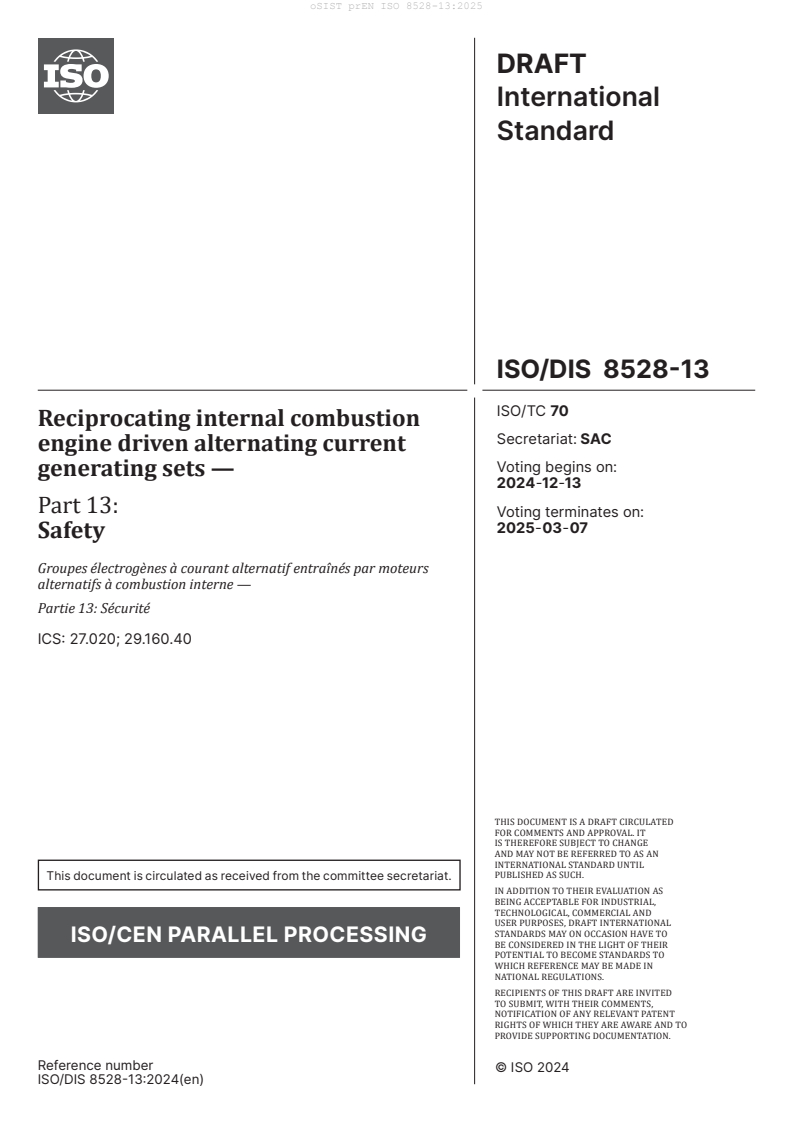
DRAFT
International
Standard
ISO/DIS 8528-13
ISO/TC 70
Reciprocating internal combustion
Secretariat: SAC
engine driven alternating current
Voting begins on:
generating sets —
2024-12-13
Part 13:
Voting terminates on:
2025-03-07
Safety
Groupes électrogènes à courant alternatif entraînés par moteurs
alternatifs à combustion interne —
Partie 13: Sécurité
ICS: 27.020; 29.160.40
THIS DOCUMENT IS A DRAFT CIRCULATED
FOR COMMENTS AND APPROVAL. IT
IS THEREFORE SUBJECT TO CHANGE
AND MAY NOT BE REFERRED TO AS AN
INTERNATIONAL STANDARD UNTIL
PUBLISHED AS SUCH.
This document is circulated as received from the committee secretariat.
IN ADDITION TO THEIR EVALUATION AS
BEING ACCEPTABLE FOR INDUSTRIAL,
TECHNOLOGICAL, COMMERCIAL AND
USER PURPOSES, DRAFT INTERNATIONAL
STANDARDS MAY ON OCCASION HAVE TO
ISO/CEN PARALLEL PROCESSING
BE CONSIDERED IN THE LIGHT OF THEIR
POTENTIAL TO BECOME STANDARDS TO
WHICH REFERENCE MAY BE MADE IN
NATIONAL REGULATIONS.
RECIPIENTS OF THIS DRAFT ARE INVITED
TO SUBMIT, WITH THEIR COMMENTS,
NOTIFICATION OF ANY RELEVANT PATENT
RIGHTS OF WHICH THEY ARE AWARE AND TO
PROVIDE SUPPORTING DOCUMENTATION.
Reference number
ISO/DIS 8528-13:2024(en)
DRAFT
ISO/DIS 8528-13:2024(en)
International
Standard
ISO/DIS 8528-13
ISO/TC 70
Reciprocating internal combustion
Secretariat: SAC
engine driven alternating current
Voting begins on:
generating sets —
Part 13:
Voting terminates on:
Safety
Groupes électrogènes à courant alternatif entraînés par moteurs
alternatifs à combustion interne —
Partie 13: Sécurité
ICS: 27.020; 29.160.40
THIS DOCUMENT IS A DRAFT CIRCULATED
FOR COMMENTS AND APPROVAL. IT
IS THEREFORE SUBJECT TO CHANGE
AND MAY NOT BE REFERRED TO AS AN
INTERNATIONAL STANDARD UNTIL
PUBLISHED AS SUCH.
This document is circulated as received from the committee secretariat.
IN ADDITION TO THEIR EVALUATION AS
BEING ACCEPTABLE FOR INDUSTRIAL,
© ISO 2024
TECHNOLOGICAL, COMMERCIAL AND
USER PURPOSES, DRAFT INTERNATIONAL
All rights reserved. Unless otherwise specified, or required in the context of its implementation, no part of this publication may
STANDARDS MAY ON OCCASION HAVE TO
ISO/CEN PARALLEL PROCESSING
be reproduced or utilized otherwise in any form or by any means, electronic or mechanical, including photocopying, or posting on
BE CONSIDERED IN THE LIGHT OF THEIR
the internet or an intranet, without prior written permission. Permission can be requested from either ISO at the address below
POTENTIAL TO BECOME STANDARDS TO
WHICH REFERENCE MAY BE MADE IN
or ISO’s member body in the country of the requester.
NATIONAL REGULATIONS.
ISO copyright office
RECIPIENTS OF THIS DRAFT ARE INVITED
CP 401 • Ch. de Blandonnet 8
TO SUBMIT, WITH THEIR COMMENTS,
CH-1214 Vernier, Geneva
NOTIFICATION OF ANY RELEVANT PATENT
Phone: +41 22 749 01 11
RIGHTS OF WHICH THEY ARE AWARE AND TO
PROVIDE SUPPORTING DOCUMENTATION.
Email: copyright@iso.org
Website: www.iso.org
Published in Switzerland Reference number
ISO/DIS 8528-13:2024(en)
ii
ISO/DIS 8528-13:2024(en)
Contents Page
Foreword .v
Introduction .vi
1 Scope . 1
2 Normative references . 1
3 Terms and definitions . 3
4 Safety requirements and/or protective/risk reduction measures and verification . 5
4.1 General .5
4.2 Starting system .5
4.2.1 Requirements .5
4.2.2 Verification .5
4.3 Stopping .6
4.3.1 Requirements .6
4.3.2 Verification .6
4.4 Emergency stopping .6
4.4.1 Requirements .6
4.4.2 Verification .7
4.5 Control devices .7
4.5.1 Design, safety and mechanical strength .7
4.5.2 Identification .8
4.5.3 Accessibility .8
4.6 Monitoring devices .9
4.6.1 Requirements .9
4.6.2 Verification .9
4.7 Warning devices .9
4.7.1 Requirements .9
4.7.2 Verification .9
4.8 Guarding .9
4.8.1 General .9
4.8.2 Guarding against mechanical hazards .10
4.8.3 Guarding against hot surfaces .10
4.9 Stability for low power generating sets .14
4.9.1 Not in operation .14
4.9.2 In operation . 15
4.10 Lighting . 15
4.10.1 Requirements . 15
4.10.2 Verification . 15
4.11 Handling . 15
4.11.1 Requirements . 15
4.11.2 Verification .16
4.12 Mechanical strength .16
4.12.1 Requirements .16
4.12.2 Verification .16
4.13 Fire protection .16
4.13.1 General .16
4.13.2 Requirements .17
4.13.3 Verification .17
4.14 Hoses, pipes and electrical harnesses of the RIC engine .17
4.14.1 Requirements .17
4.14.2 Verification .17
4.15 Electrical equipment .18
4.15.1 Generating sets .18
4.15.2 Other electrical equipment . 20
4.16 Noise . 20
4.16.1 Requirements . 20
iii
ISO/DIS 8528-13:2024(en)
4.16.2 Verification . 20
4.17 Access systems . 20
4.17.1 Requirements . 20
4.17.2 Verification . 20
4.18 Access to service points. 20
4.18.1 Requirements . 20
4.18.2 Verification . 20
4.19 Gaseous and particulate exhaust emissions .21
4.19.1 Requirements .21
4.19.2 Verification .21
4.20 Drainage .21
4.20.1 Requirements .21
4.20.2 Verification .21
5 Information for use .21
5.1 Operating and maintenance instruction .21
5.1.1 Requirements .21
5.1.2 Verification . 22
5.2 Safety labels . 22
5.2.1 Requirements . 22
5.2.2 Verification . 23
5.3 Marking . 23
5.3.1 Requirements . 23
5.3.2 Verification .24
Annex A (normative) List of significant hazards .25
Annex B (normative) Application of IEC 60204-1:2021 for generating sets .27
Annex C (normative) Instruction manual — Safety guide additional requirements for low-
power generating sets for use by layperson .37
Annex ZA (informative) Relationship between this document and the essential requirements
of Directive 2006/42/EC aimed to be covered .40
Bibliography . 41
iv
ISO/DIS 8528-13:2024(en)
Foreword
ISO (the International Organization for Standardization) is a worldwide federation of national standards
bodies (ISO member bodies). The work of preparing International Standards is normally carried out through
ISO technical committees. Each member body interested in a subject for which a technical committee
has been established has the right to be represented on that committee. International organizations,
governmental and non-governmental, in liaison with ISO, also take part in the work. ISO collaborates closely
with the International Electrotechnical Commission (IEC) on all matters of electrotechnical standardization.
The procedures used to develop this document and those intended for its further maintenance are described
in the ISO/IEC Directives, Part 1. In particular, the different approval criteria needed for the different types
of ISO documents should be noted. This document was drafted in accordance with the editorial rules of the
ISO/IEC Directives, Part 2 (see www.iso.org/directives).
Attention is drawn to the possibility that some of the elements of this document may be the subject of patent
rights. ISO shall not be held responsible for identifying any or all such patent rights. Details of any patent
rights identified during the development of the document will be in the Introduction and/or on the ISO list of
patent declarations received (see www.iso.org/patents).
Any trade name used in this document is information given for the convenience of users and does not
constitute an endorsement.
For an explanation of the voluntary nature of standards, the meaning of ISO specific terms and expressions
related to conformity assessment, as well as information about ISO's adherence to the World Trade
Organization (WTO) principles in the Technical Barriers to Trade (TBT), see www.iso.org/iso/foreword.html.
This document was prepared by Technical Committee ISO/TC 70, Internal combustion engines.
This second edition cancels and replaces the first edition (ISO 8528-13:2016), which has been technically
revised.
The main changes are as follows:
— the normative references have been updated;
— the definition of «high voltage electrical equipment» has been added;
— the Clause 6 has been modified;
— the Annex C has been updated;
A list of all parts in the ISO 8528 series can be found on the ISO website.
Any feedback or questions on this document should be directed to the user’s national standards body. A
complete listing of these bodies can be found at www.iso.org/members.html.
v
ISO/DIS 8528-13:2024(en)
Introduction
This document is a type-C standard as stated in ISO 12100.
This document is of relevance, in particular, for the following stakeholder groups representing the market
players with regard to machinery safety:
— machine manufacturers (small, medium and large enterprises);
— health and safety bodies (regulators, accident prevention organisations, market surveillance, etc.).
Others can be affected by the level of machinery safety achieved with the means of the document by the
above-mentioned stakeholder groups:
— machine users/employers (small, medium and large enterprises);
— machine users/employees (e.g. trade unions, organizations for people with special needs);
— service providers, e.g. for maintenance (small, medium and large enterprises);
— consumers (in the case of machinery intended for use by consumers).
The above-mentioned stakeholder groups have been given the possibility to participate at the drafting
process of this document.
The machinery concerned and the extent to which hazards, hazardous situations or hazardous events are
covered are indicated in the Scope of this document.
When requirements of this type-C standard are different from those which are stated in type-A or -B
standards, the requirements of this type-C standard take precedence over the requirements of the other
standards for machines that have been designed and built according to the requirements of this type-C
standard.
vi
DRAFT International Standard ISO/DIS 8528-13:2024(en)
Reciprocating internal combustion engine driven alternating
current generating sets —
Part 13:
Safety
1 Scope
This document specifies the safety requirements for reciprocating internal combustion (RIC) engine driven
generating sets consisting of an RIC engine, an alternating current (AC) generator including the additional
equipment required for operating, e.g. controlgear, switchgear, auxiliary equipment.
It is applicable to generating sets for land and marine use (domestic, recreational and industrial application).
It is not applicable to generating sets used on board of seagoing vessels and mobile offshore units as well as
on aircraft or to propel road vehicles and locomotives.
NOTE This document does not apply to arc welding equipment (IEC 60974 series).
The special requirements needed to cover operation in potentially explosive atmospheres are not covered in
this document.
The hazards relevant to RIC engine driven generating sets are identified in Annex A.
This document deals with the special requirements of test and safety design which is observed in addition to
the definitions and requirements in ISO 8528-1, ISO 8528-2, ISO 8528-3, ISO 8528-4, ISO 8528-5, ISO 8528-6
and ISO 8528-10, where applicable. It specifies safety requirements in order to protect the user from danger.
2 Normative references
The following documents are referred to in the text in such a way that some or all of their content constitutes
requirements of this document. For dated references, only the edition cited applies. For undated references,
the latest edition of the referenced document (including any amendments) applies.
ISO 2261, Reciprocating internal combustion engines — Hand-operated control devices — Standard direction
of motion
ISO 2710-1, Reciprocating internal combustion engines — Vocabulary — Part 1: Terms for engine design and
operation
ISO 2710-2, Reciprocating internal combustion engines — Vocabulary — Part 2: Terms for engine maintenance
ISO 3046-1, Reciprocating internal combustion engines — Performance — Part 1: Declarations of power, fuel
and lubricating oil consumptions, and test methods — Additional requirements for engines for general use
ISO 3046-6, Reciprocating internal combustion engines — Performance — Part 6: Overspeed protection
ISO 4871, Acoustics — Declaration and verification of noise emission values of machinery and equipment
ISO 6826:2022, Reciprocating internal combustion engines — Fire protection
ISO 7967-1, Reciprocating internal combustion engines — Vocabulary of components and systems — Part 1:
Structure and external covers
ISO/DIS 8528-13:2024(en)
ISO 7967-2, Reciprocating internal combustion engines — Vocabulary of components and systems — Part 2:
Main running gear
ISO 7967-3, Reciprocating internal combustion engines — Vocabulary of components and systems — Part 3:
Valves, camshaft drives and actuating mechanisms
ISO 7967-4, Reciprocating internal combustion engines — Vocabulary of components and systems — Part 4:
Pressure charging and air/exhaust gas ducting systems
ISO 7967-8, Reciprocating internal combustion engines — Vocabulary of components and systems — Part 8:
Starting systems
ISO 7967-9, Reciprocating internal combustion engines — Vocabulary of components and systems — Part 9:
Control and monitoring systems
ISO 8528-1:2018, Reciprocating internal combustion engine driven alternating current generating sets — Part
1: Application, ratings and performance
ISO 8528-2, Reciprocating internal combustion engine driven alternating current generating sets — Part 2: Engines
ISO 8528-3, Reciprocating internal combustion engine driven alternating current generating sets — Part 3:
Alternating current generators for generating sets
ISO 8528-4:2005, Reciprocating internal combustion engine driven alternating current generating sets — Part
4: Controlgear and switchgear
ISO 8528-5:2022, Reciprocating internal combustion engine driven alternating current generating sets — Part
5: Generating sets
ISO 8528-6, Reciprocating internal combustion engine driven alternating current generating sets — Part 6:
Test methods
ISO 8528-7, Reciprocating internal combustion engine driven alternating current generating sets — Part 7:
Technical declarations for specification and design
ISO 8528-8:2016, Reciprocating internal combustion engine driven alternating current generating sets — Part
8: Requirements and tests for low-power generating sets
ISO 8528-9, Reciprocating internal combustion engine driven alternating current generating sets — Part 9:
Measurement and evaluation of mechanical vibrations
ISO 8528-10:2022, Reciprocating internal combustion engine driven alternating current generating sets — Part
10: Measurement of airborne noise
ISO 8999, Reciprocating internal combustion engines — Graphical symbols
ISO 11429, Ergonomics — System of auditory and visual danger and information signals
ISO 12100:2010, Safety of machinery — General principles for design — Risk assessment and risk reduction
ISO 13732-1, Ergonomics of the thermal environment — Methods for the assessment of human responses to
contact with surfaces — Part 1: Hot surfaces
ISO 13850, Safety of machinery — Emergency stop function — Principles for design
ISO 13857:2019, Safety of machinery — Safety distances to prevent hazard zones being reached by upper and
lower limbs
ISO 14122-2, Safety of machinery — Permanent means of access to machinery — Part 2: Working platforms and
walkways
ISO 14314:2009, Reciprocal internal combustion engines — Recoil starting equipment — General safety
requirements
ISO/DIS 8528-13:2024(en)
ISO 15534-2, Ergonomic design for the safety of machinery — Part 2: Principles for determining the dimensions
required for access openings
IEC 60034-1:2022, Rotating electrical machines — Part 1: Rating and performance
IEC 60034-5:2020, Rotating electrical machines — Part 5: Degrees of protection provided by the integral design
of rotating electrical machines (IP code) — Classification
IEC 60245-4, Rubber insulated cables — Rated voltages up to and including 450/750 V — Part 4: Cords and
flexible cables
IEC 60204-1:2021, Safety of machinery — Electrical equipment of machines — Part 1: General requirements
IEC 60204-11, Safety of machinery — Electrical equipment of machines — Part 11: Requirements for equipment
for voltages above 1 000 V AC or 1 500 V DC and not exceeding 36 kV
IEC 60335-1:2021, Household and similar electrical appliances — Safety — Part 1: General requirements
IEC 60364-1, Low-voltage electrical installations — Part 1: Fundamental principles, assessment of general
characteristics, definitions
IEC 60364-4-41, Low-voltage electrical installations — Part 4-41: Protection for safety — Protection against
electric shock
IEC 60068-2-75, Environmental testing — Part 2-75: Tests — Test Eh: Hammer tests
IEC 60073, Basic and safety principles for man-machine interface, marking and identification — Coding
principles for indicators and actuators
IEC 61310-1, Safety of machinery — Indication, marking and actuation — Part 1: Requirements for visual,
acoustic and tactile signals
IEC 61310-2, Safety of machinery — Indication, marking and actuation — Part 2: Requirements for marking
3 Terms and definitions
For the purposes of this document, the terms and definitions given in ISO 2710-1, ISO 2710-2, ISO 3046-1,
ISO 3046-6, ISO 7967-1, ISO 7967-2, ISO 7967-3, ISO 7967-4, ISO 7967-8, ISO 7967-9, ISO 8528-1, ISO 8528-2,
ISO 8528-3, ISO 8528-4, ISO 8528-5, ISO 8528-6, ISO 8528-7, ISO 8528-8, ISO 8528-9, ISO 8528-10, ISO 12100,
IEC 60364-1, IEC 60204-11 and the following apply.
ISO and IEC maintain terminology databases for use in standardization at the following addresses:
— ISO Online browsing platform: available at https:// www .iso .org/ obp
— IEC Electropedia: available at https:// www .electropedia .org/
3.1
layperson
person who does not necessarily recognize potential danger resulting from electricity, moving parts or hot parts
Note 1 to entry: The layperson has normally a lack of training, knowledge and experience.
3.2
close proximity
30 mm space immediately around the operating and adjusting controls and carrying handles, including their
whole movement range
3.3
low power power
electric power assigned by the manufacturer according to ISO 8528-1:2018, Clause 13 (COP, PRP, LTP, ESP),
except for low power generating sets to ISO 8528-8:2016, 3.3 (COP)
ISO/DIS 8528-13:2024(en)
3.4
low power generating sets
power generating sets for the purpose of this part of ISO 8528 which are determined by the following special
features:
— low power is taken to mean rated power of a magnitude up to 10 kW/50 Hz, 12 kW/60 Hz;
— users normally are layperson;
— complete generating set is usually transportable, or mobile;
— electrical output is connected by means of plugs, sockets and screwed terminal except for extra low
voltages;
— generating set is ready for use without any additional installation work by the user.
[SOURCE: ISO 8528-8:2016, Clause 1]
3.5
frame contour
outmost of low power generating sets, consisting of robust parts such as, the frame made of pipe, the fuel
tank, the handle, the control box, etc
3.6
operator interface
means by which information is communicated between a human operator(s) and the SIS (e.g. LCD, indicating
lights, push-buttons, horns, alarms)
Note 1 to entry: The operator interface is sometimes referred to as the human-machine interface (HMI).
3.7
control device
device connected into the control circuit (circuit used for the control, including monitoring) and used for
controlling the operation of the machine ( e.g. relay, contactor, position sensor PLC module, actuator,…)
3.8
controlgear
switching device and its combination with associated control, measuring, protective and regulating
equipment, intended in principle for the control of electrical energy consuming equipment
3.9
enclosure
part providing protection of equipment against external influences and, in any direction, protection against
direct contact
3.10
electrical equipment
material, fitting, device, component, appliance, fixture, apparatus, and the like using electric currents or
electromagnetic fields, except for the safety extra low voltage circuits
3.11
control
operation consisting of interacting by touching the machine in the places defined for this purpose during the
starting, functioning and stopping phases
3.12
monitoring
operation consisting of observing the operating parameters of the machine during its operation while
maintaining appropriate safety distances depending on the risks identified
ISO/DIS 8528-13:2024(en)
3.13
maintenance
all operations intended to prevent or repair breakdowns that occur on the machine. The recommendations
and schedule of the machine manufacturer must be followed. Maintenance must be carried out with the
machine stopped and in electrical safety
3.14
canopy
element ensuring the protection of equipment against external influences caused by bad weather and solid
foreign objects
4 Safety requirements and/or protective/risk reduction measures and verification
4.1 General
Machinery shall comply with the safety requirements and/or protective measures/risk reduction measures
of this Clause.
In addition, the machine shall be designed according to the principles of ISO 12100 for relevant but not
significant hazards which are not dealt with by this document.
If the installation of a generating set can create hazards in addition to those covered by this document, the
safety requirements and/or protective measures related to these additional hazards are the responsibilities
of the installer, if necessary with the agreement of the manufacturer of the generating set. The installer is
responsible for ensuring compliance for the additional hazards arising because of the installation.
The hazards relevant to RlC engine driven generating sets that shall be considered in order to prevent
personal injury are listed in Annex A.
4.2 Starting system
4.2.1 Requirements
Starting systems can be triggered manually or automatically.
Electrical starting systems normally operate at voltages of 24 V or below. Electrical starting systems above
24 V are not dealt with in this document and the installer of the engine shall ensure safe operation after
connecting the engine to the driven machinery.
For engines with compressed air starting, the starting pneumatic system shall comply with the installation
requirements and with the operation and safety information specified in the manuals provided by the
starting system components suppliers.
— starting handles shall have sufficient clearance from the mounting surface to ensure safe turning;
— diesel engines with a manual starter shall have a decompression facility which shall not be required to
be hand-held during cranking.
The only permissible hand starting systems are crank handle (as defined above) and recoil starting devices
as described in ISO 14314. The marking required in ISO 14314:2009, 7.3 shall not apply.
4.2.2 Verification
Compliance with the requirements shall be verified by inspection and testing of the starting systems.
ISO/DIS 8528-13:2024(en)
4.3 Stopping
4.3.1 Requirements
4.3.1.1 Normal stopping
All generating sets shall have a normal switch or other normal stopping device which can be manually
or automatically actuated. Stopping controls shall remain in the stop position when operated. This shall
operate by a device ensuring the cutting off of the fuel or the ignition (for spark ignition engines) supply.
4.3.1.2 Stopping in case of failure
Generating sets except low power generating sets shall be provided with an automatically actuated stopping
device in case of failure.
This device shall monitor one or more signals of the generating set and if these signals are out of the
allowable range it shall trigger the automatic stop.
The main signals used to actuate automatic stopping may include, but not be limited to, the following:
a) for the RIC engine
1) overspeed;
2) low lubricating oil pressure;
3) high coolant temperature, and
4) low coolant level;
b) for the generator
1) excessive overvoltage, and
2) overload.
These signals or other measures used to actuate automatic stopping shall be specified depending on the
application.
4.3.2 Verification
Normal stopping shall be verified by inspection and testing of the stopping device in manual and in automatic
modes (if provided in the application).
Automatic stopping in case of failure shall be verified by testing the action of typical failure modes in
operating conditions (an appropriate method shall be used to create typical failure conditions, e.g. manual
triggering, short-circuiting of contacts).
4.4 Emergency stopping
4.4.1 Requirements
Emergency stopping devices are required for remote controlled generating sets and generating sets with
an enclosure or container accessible by persons. In accordance with the risk assessment in ISO 12100:2010,
6.3.5.2, an emergency stopping device is not required for low power generating sets, as it shall not lessen the
risk by reducing the stopping time.
Emergency stopping devices shall be actuated manually. As for normal stopping, emergency stopping shall
operate by a device ensuring the cutting off of the fuel supply or ignition (for spark ignition engines). This
device should include an air supply cut-off.
ISO/DIS 8528-13:2024(en)
Emergency stopping devices shall also meet the requirements of ISO 13850, category 0, and the reset shall
not initiate a restart or any hazardous conditions.
Manually actuated emergency stopping devices shall be located inside and outside the enclosure or container
in which a generating set is located and which is accessible for personnel to carry out maintenance or control
operations when generating sets are in operation.
For enclosures, containers or canopy where it is impossible for personnel to get inside, at least one emergency
stopping devices must be located outside.
4.4.2 Verification
Emergency stopping devices shall be verified by inspection and testing in operating conditions.
4.5 Control devices
4.5.1 Design, safety and mechanical strength
4.5.1.1 Requirements
Control devices for the RIC engine of the generating set shall meet the following requirements:
— hand controls shall be designed to withstand 1,2× the maximum actuating forces given in Table 1;
Table 1 — Clearance between controls
Operation by Spacing Maximum actuating
(mm) (N)
Finger tip 10 10
Finger grasp
— toggles 20 50
— knobs 20 50
Hand
— upward 50 400
— fore-aft 50 300
— for handles, knobs, grips, levers and similar devices, requirements and tests shall be in accordance with
IEC 60335-1:2021;
— controls shall act positively and smoothly and without delay or unexpected action and be in accordance
with ISO 2261;
— the surface temperature of the controls that shall be manually actuated while the engine is running shall
be within the following limits in accordance with ISO 13732-1 for a contact time of 10 s;
— 55 °C for metallic surfaces, and
— 70 °C for non metallic surfaces;
— sharp edges or corners on, or close proximity to manual controls shall be removed. Edges shall have a
chamfer of at least 0,5 mm.
4.5.1.2 Verification
Control devices of the RIC engine shall be verified by inspection and testing.
Control devices of the generating sets shall be verified in accordance with IEC 60204-1:2021, 10.1 and 10.2.
ISO/DIS 8528-13:2024(en)
For surface temperature measurement of the control devices (RIC engines and generating sets), the following
method shall be conducted:
a) the generating set shall be operated at its rated power until the surface temperatures stabilize;
b) the test shall be conducted in a well-ventilated location not directly exposed to sunshine;
c) if the test is conducted at an ambient temperature outside of the nominal (20 ± 3) °C the reported
temperatures shall be corrected by the Formula (1):
Corrected temperatureC()° =°reported temperatureC() −ambiennt temperatureC()° +°20 C (1)
4.5.2 Identification
4.5.2.1 Requirements
The controls devices of the RIC engines shall be identified according to the function th
...
Questions, Comments and Discussion
Ask us and Technical Secretary will try to provide an answer. You can facilitate discussion about the standard in here.