

EN 15663:2017
(Main)Railway applications - Vehicle reference masses
General Information
- Abstract
This European Standard defines a set of reference masses for specifying the requirements for the design, testing, acceptance, marking, delivery and operation of rail vehicles.
The reference masses defined in this document are as follows:
- dead mass;
- design mass in working order;
- design mass under normal payload;
- design mass under exceptional payload;
- operational mass in working order;
- operational mass under normal payload.
These reference masses are defined with respect to the whole vehicle, but they can also apply to a specific system or component.
The specification of values for tolerances applicable to reference masses is not in the scope of this standard. Tolerances can be required by an application standard.
Additional loadings due to environmental factors, for example snow and retained or absorbed rainwater, are not in the scope of this European Standard.
- Status
- Withdrawn
- Publication Date
- 04-Jul-2017
- Withdrawal Date
- 29-Sep-2026
- Technical Committee
- CEN/TC 256 - Railway applications
- Drafting Committee
- CEN/TC 256/WG 2 - Structural requirements
- Current Stage
- 9960 - Withdrawal effective - Withdrawal
- Start Date
- 19-Dec-2018
- Completion Date
- 30-Sep-2026


Relations
- Effective Date
- 12-Jul-2017
- Effective Date
- 12-Jul-2017
- Effective Date
- 19-Jan-2023
- Effective Date
- 28-Jan-2026
- Effective Date
- 28-Jan-2026
- Effective Date
- 28-Jan-2026
- Effective Date
- 27-Dec-2017
Get Certified
Connect with accredited certification bodies for this standard

IRIS Certification (UNIFE)
International Railway Industry Standard certification.

TÜV SÜD Rail GmbH
TÜV SÜD railway certification services.

Bureau Veritas Railway Certification
Railway and transportation certification.
Sponsored listings
Frequently Asked Questions
EN 15663:2017 is a standard published by the European Committee for Standardization (CEN). Its full title is "Railway applications - Vehicle reference masses". This standard covers: This European Standard defines a set of reference masses for specifying the requirements for the design, testing, acceptance, marking, delivery and operation of rail vehicles. The reference masses defined in this document are as follows: - dead mass; - design mass in working order; - design mass under normal payload; - design mass under exceptional payload; - operational mass in working order; - operational mass under normal payload. These reference masses are defined with respect to the whole vehicle, but they can also apply to a specific system or component. The specification of values for tolerances applicable to reference masses is not in the scope of this standard. Tolerances can be required by an application standard. Additional loadings due to environmental factors, for example snow and retained or absorbed rainwater, are not in the scope of this European Standard.
This European Standard defines a set of reference masses for specifying the requirements for the design, testing, acceptance, marking, delivery and operation of rail vehicles. The reference masses defined in this document are as follows: - dead mass; - design mass in working order; - design mass under normal payload; - design mass under exceptional payload; - operational mass in working order; - operational mass under normal payload. These reference masses are defined with respect to the whole vehicle, but they can also apply to a specific system or component. The specification of values for tolerances applicable to reference masses is not in the scope of this standard. Tolerances can be required by an application standard. Additional loadings due to environmental factors, for example snow and retained or absorbed rainwater, are not in the scope of this European Standard.
EN 15663:2017 is classified under the following ICS (International Classification for Standards) categories: 45.060.01 - Railway rolling stock in general. The ICS classification helps identify the subject area and facilitates finding related standards.
EN 15663:2017 has the following relationships with other standards: It is inter standard links to EN 15663:2009, EN 15663:2009/AC:2010, EN 15663:2017+A1:2018, EN 12080:2017+A1:2022, EN 12082:2017, EN 12080:2017, EN 15663:2017/prA1. Understanding these relationships helps ensure you are using the most current and applicable version of the standard.
EN 15663:2017 is associated with the following European legislation: EU Directives/Regulations: 2008/57/EC; Standardization Mandates: M/483. When a standard is cited in the Official Journal of the European Union, products manufactured in conformity with it benefit from a presumption of conformity with the essential requirements of the corresponding EU directive or regulation.
EN 15663:2017 is available in PDF format for immediate download after purchase. The document can be added to your cart and obtained through the secure checkout process. Digital delivery ensures instant access to the complete standard document.
Standards Content (Sample)
2003-01.Slovenski inštitut za standardizacijo. Razmnoževanje celote ali delov tega standarda ni dovoljeno.Bahnanwendungen - Definition der FahrzeugreferenzmassenApplications ferroviaires - Définition des masses de référence des véhiculesRailway applications - Vehicle reference masses45.060.01Železniška vozila na splošnoRailway rolling stock in generalICS:Ta slovenski standard je istoveten z:EN 15663:2017SIST EN 15663:2017en,fr,de01-september-2017SIST EN 15663:2017SLOVENSKI
STANDARDSIST EN 15663:2009/AC:2010SIST EN 15663:20091DGRPHãþD
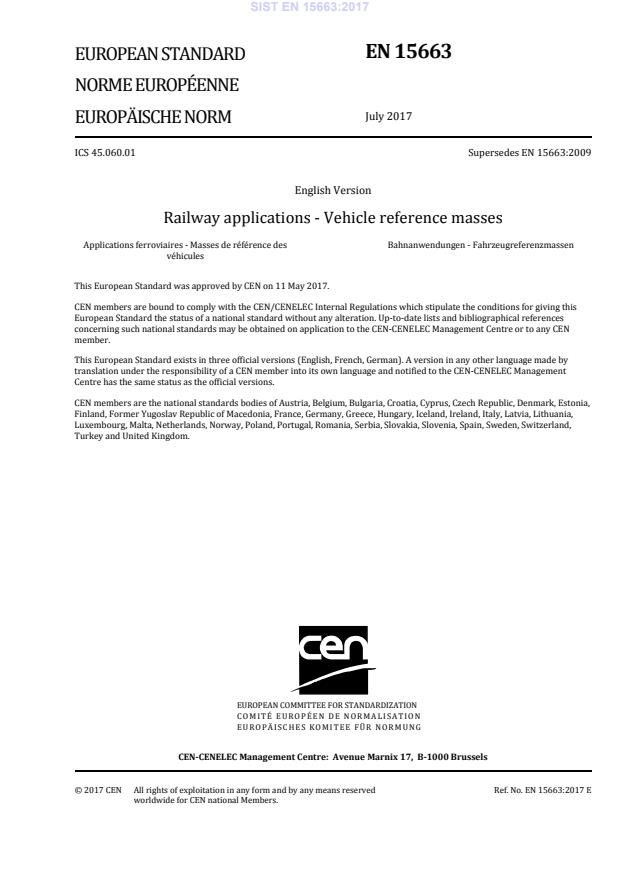
EUROPEAN STANDARD NORME EUROPÉENNE EUROPÄISCHE NORM
EN 15663
July
t r s y ICS
v wä r x rä r s Supersedes EN
s w x x uã t r r {English Version
Railway applications æ Vehicle reference masses Applications ferroviaires æ Masses de référence des véhicules
Bahnanwendungen æ Fahrzeugreferenzmassen This European Standard was approved by CEN on
s s May
t r s yä
egulations which stipulate the conditions for giving this European Standard the status of a national standard without any alterationä Upætoædate lists and bibliographical references concerning such national standards may be obtained on application to the CENæCENELEC Management Centre or to any CEN memberä
translation under the responsibility of a CEN member into its own language and notified to the CENæCENELEC Management Centre has the same status as the official versionsä
CEN members are the national standards bodies of Austriaá Belgiumá Bulgariaá Croatiaá Cyprusá Czech Republicá Denmarká Estoniaá Finlandá Former Yugoslav Republic of Macedoniaá Franceá Germanyá Greeceá Hungaryá Icelandá Irelandá Italyá Latviaá Lithuaniaá Luxembourgá Maltaá Netherlandsá Norwayá Polandá Portugalá Romaniaá Serbiaá Slovakiaá Sloveniaá Spainá Swedená Switzerlandá Turkey and United Kingdomä
EUROPEAN COMMITTEE FOR STANDARDIZATION COMITÉ EUROPÉEN DE NORMALISATION EUROPÄISCHES KOMITEE FÜR NORMUNG
CEN-CENELEC Management Centre:
Avenue Marnix 17,
B-1000 Brussels
t r s y CEN All rights of exploitation in any form and by any means reserved worldwide for CEN national Membersä Refä Noä EN
s w x x uã t r s y ESIST EN 15663:2017
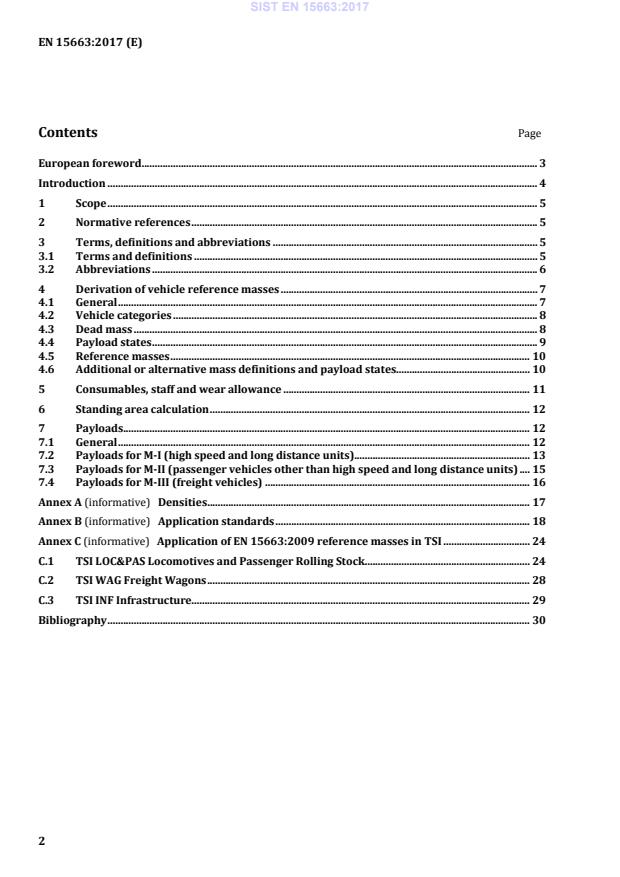
Page European foreword . 3 Introduction . 4 1 Scope . 5 2 Normative references . 5 3 Terms, definitions and abbreviations . 5 3.1 Terms and definitions . 5 3.2 Abbreviations . 6 4 Derivation of vehicle reference masses . 7 4.1 General . 7 4.2 Vehicle categories . 8 4.3 Dead mass . 8 4.4 Payload states . 9 4.5 Reference masses . 10 4.6 Additional or alternative mass definitions and payload states. 10 5 Consumables, staff and wear allowance . 11 6 Standing area calculation . 12 7 Payloads. 12 7.1 General . 12 7.2 Payloads for M-I (high speed and long distance units). 13 7.3 Payloads for M-II (passenger vehicles other than high speed and long distance units) . 15 7.4 Payloads for M-III (freight vehicles) . 16 Annex A (informative)
Densities . 17 Annex B (informative)
Application standards . 18 Annex C (informative)
Application of EN 15663:2009 reference masses in TSI . 24 C.1 TSI LOC&PAS Locomotives and Passenger Rolling Stock. 24 C.2 TSI WAG Freight Wagons . 28 C.3 TSI INF Infrastructure. 29 Bibliography . 30 SIST EN 15663:2017
Overhead luggage racks are not regarded as luggage areas. 3.1.5 passenger area area inside the vehicle dedicated for transporting passengers Note 1 to entry: Catering areas are not regarded as passenger areas. 3.1.6 catering area area set aside for passengers for the purchase or consumption of catering services (e.g. buffet, bar or bistro) 3.1.7 standing area unobstructed part of either a passenger area or a catering area which can be used by standing passengers (e.g. vestibules, aisles, stairways) 3.1.8 normal seat permanent seat in a passenger or catering area 3.1.9 tip up seat folding seat fixed to a wall or partition for temporary use 3.1.10 wear allowance quantity of mass that is assumed to be lost in service due to abrasion and mechanical wear Note 1 to entry: The main sources of wear to be accounted for are from wheels and brake friction materials.
3.2 Abbreviations For the purposes of this document, the following two and three letter abbreviations are derived as follows: The first letter denotes either an increment or a total vehicle mass: M the total vehicle Mass P mass increment (Payload, consumables, staff, wear allowance) The second letter denotes the type of payload or reference mass: U dead mass i.e. Underlying mass C Consumables, staff and wear allowance V in working order (Vide) N Normal SIST EN 15663:2017
Table 1 — Reference mass abbreviations Abbreviation Term MU Dead mass MVD Design mass in working order MND Design mass under normal payload MXD Design mass under exceptional payload MVO Operational mass in working order MNO Operational mass under normal payload Table 2 — Payload and mass increment abbreviations Abbreviation Term PCD Design consumables PND Normal design payload PXD Exceptional payload PCO Operational consumables PNO Normal operational payload If the default values for standing areas in passenger and catering areas set out in 7.2 and 7.3 are not used, the abbreviations shall be extended to indicate the values used in kg/m2 (e.g. MXD160). Where a separate catering area load is used this shall also be included, preceded by a “/” (e.g. MXD240/160). 4 Derivation of vehicle reference masses 4.1 General Methods for calculating reference masses including standard values for payloads are given in this document. To determine a reference mass the following parameters are required: — applicable vehicle category (see 4.2); — applicable payload state (see 4.4); and — condition that is required:
design condition; or
operational condition. SIST EN 15663:2017
M-II passenger vehicles other than high speed and long distance units high Commuter and suburban services (for the French network: RER or some TER, for the German Network: S-Bahn or some RB- and RE-Trains), metros, tramways
M-III freight vehicles - wagons and freight motored units 4.3 Dead mass Dead mass is the mass of the vehicle in the “as built” condition without consumables and without staff (see Clause 5). The dead mass is the underlying mass of a vehicle, a common fixed element that is used to define the other reference masses in this document. It includes interior fittings and furniture, fixed quantities of lubricants and fluids (e.g. oils, greases, insulating fluids, cooling fluids, heating fluids, transmission fluids, battery electrolyte, etc.), catering equipment (e.g. utensils, cutlery and table linen), tools and emergency equipment. All parts subject to wear shall be in a new, unworn condition. NOTE 1 At the start of a project the dead mass is an estimated value together with an estimated manufacturing tolerance based on the best information available (calculations and weighed components, etc.). The dead mass and the tolerances are refined as the project progresses and more accurate information becomes available. SIST EN 15663:2017
Reference mass Design condition Operational condition Dead mass Dead mass (MU) Vehicle in the “as built” condition without consumable and without staff (see 4.3) Mass in working order Design mass in working order (MVD) Operational mass in working order (MVO) Dead mass (MU) Dead mass (MU) plus design consumables (PCD) (see Table 6) plus operational consumables (PCO) (see Table 6) MVD = MU + PCD MVO = MU + PCO Mass under normal payload Design mass under normal payload (MND) Operational mass under normal payload (MNO) Design mass in working order (MVD) Operational mass in working order (MVO) plus normal design payload (PND) (see Tables 7, 8 and 9) plus normal operational payload (PNO) (see Tables 7, 8 and 9) MND = MVD + PND MNO = MVO + PNO Mass under exceptional payload Design mass under exceptional payload (MXD) Not applicable Design mass in working order (MVD)
plus exceptional payload (PXD) (see Tables 7, 8 and 9)
MXD = MVD + PXD
4.6 Additional or alternative mass definitions and payload states Non-standard reference masses, specified as additional or alternative mass definitions or payload states, if technically necessary, shall be defined and justified in the technical specification or in the application standard. In such cases the mass and payload definitions set out in 4.4 and 4.5 should be used as a basis wherever possible. This can be achieved for example by applying factors or by including a specific mass or payload increment.
In such cases, a suitable notation should be defined following the principles of the system set out in 3.2.
For this notation, the unused letters of the alphabet are available. EXAMPLE “Maximum braking load” as defined and used in braking standards is an example of an additional reference mass specified by an application standard. In specifying non-standard values or assumptions for determining reference masses, consideration should be given to: SIST EN 15663:2017
(Driver(s), train crew, catering personnel) 80 kg per person (an allowance for personal equipment and belongings is included in this value) Fuel Maximum design quantity 2/3 maximum design quantity Sand Maximum design quantity 2/3 maximum design quantity Food and beverages including water for drinking and cooking Maximum design quantity 1/2 maximum design quantity Clean water for washbasins, toilets or dishwashing (shared or independent supply tanks) Maximum value of the: Design quantity of all clean water tanks
or Design quantity of all waste water tanks Maximum value of the: Design quantity of all clean water tanks
or 1/2 design quantity of all waste water tanks Content of the controlled emission toilet (CET) storage tanks with or without recirculation Windscreen washer fluid Maximum design quantity 2/3 maximum design quantity Unlisted consumables Maximum design quantity 2/3 maximum design quantity Wear allowance No reduction Reduction by 1/2 of the maximum wear
Annex A provides additional information on consumable densities. SIST EN 15663:2017
...