

EN 12312-6:2004+A1:2009
(Main + Amendment)Aircraft ground support equipment - Specific requirements - Part 6: Deicers and deicing/antiicing equipment
General Information
- Abstract
This European Standard specifies the technical requirements to minimise the hazards listed in clause 4 which can arise during the commissioning, operation and maintenance of deicers and equipment designed exclusively for deicing and washing of aircraft with deicing/antiicing/washing liquids when carried out in accordance with the specifications given by the manufacturer or his authorised representative. It also takes into account some performance require¬ments recognised as essential by authorities, aircraft and GSE manufacturers as well as airlines and handling agencies.
NOTE Safety of aircraft in connection with deicing/antiicing operations is not dealt with in this European Standard. Any, even minor, aircraft deicing or antiicing operation directly affects flight safety on take-off. Prevention of aeronautical accidents resulting from in-flight icing principally concerns the fluids and methods used, but it may in certain cases also concern deicing or antiicing equipment design or operation. These aeronautical aspects are not covered in this European Standard (see also Joint Aviation authorities (JAA), Joint Aviation Regulations (JAR) JAR-OPS subpart D 1.345 and any associated material).
This standard applies to:
- self-propelled deicers with fixed platform or hinged boom;
- towable deicers with fixed platform or hinged boom;
- stationary deicing/antiicing equipment (e.g. fixed boom, gantry or tower cranes equipped with aircraft deicing/antiicing fluid systems).
This standard does not apply to:
- fixed installations, such as separate storage tanks or heating and filling stations, which are not an integrated part of the stationary deicing equipment;
- hydraulic control systems;
- pneumatic systems;
- flow generating systems as such.
This standard does not establish requirements for noise and vibration.
Noise and vibration are dealt with respectively in EN 1915-4 and EN 1915-3.
- Status
- Withdrawn
- Publication Date
- 28-Apr-2009
- Withdrawal Date
- 29-Sep-2026
- Technical Committee
- CEN/TC 274 - Aircraft ground support equipment
- Drafting Committee
- CEN/TC 274/SC 3/WG 3 - Deicing equipment, deicers
- Current Stage
- 9960 - Withdrawal effective - Withdrawal
- Start Date
- 22-Mar-2017
- Completion Date
- 30-Sep-2026
- Directive
- 2006/42/EC - Directive 2006/42/EC of the European Parliament and of the Council of 17 May 2006 on machinery, and amending Directive 95/16/EC (recast)OJ Ref: C, C 214 OJ Date: 08-Sep-2009

Relations
- Effective Date
- 19-Jan-2023
- Effective Date
- 11-Feb-2009
- Effective Date
- 04-Sep-2013
- Effective Date
- 17-Sep-2026
- Effective Date
- 25-Aug-2026
- Effective Date
- 09-Feb-2026
- Effective Date
- 28-Jan-2026
- Effective Date
- 28-Jan-2026
- Effective Date
- 28-Jan-2026
- Effective Date
- 28-Jan-2026
- Effective Date
- 28-Jan-2026
- Effective Date
- 28-Jan-2026
- Refers
EN 795:1996 - Protection against falls from a height - Anchor devices - Requirements and testing - Effective Date
- 28-Jan-2026
- Effective Date
- 28-Jan-2026
- Effective Date
- 28-Jan-2026
Get Certified
Connect with accredited certification bodies for this standard

BUREAU VERITAS Certification Germany
Bureau Veritas certification in Germany.

Element Materials Technology
Materials testing and product certification.

AQMS Ltd.
AQMS provides ISO certification to SMEs across the UK.
Sponsored listings
Frequently Asked Questions
EN 12312-6:2004+A1:2009 is a standard published by the European Committee for Standardization (CEN). Its full title is "Aircraft ground support equipment - Specific requirements - Part 6: Deicers and deicing/antiicing equipment". This standard covers: This European Standard specifies the technical requirements to minimise the hazards listed in clause 4 which can arise during the commissioning, operation and maintenance of deicers and equipment designed exclusively for deicing and washing of aircraft with deicing/antiicing/washing liquids when carried out in accordance with the specifications given by the manufacturer or his authorised representative. It also takes into account some performance require¬ments recognised as essential by authorities, aircraft and GSE manufacturers as well as airlines and handling agencies. NOTE Safety of aircraft in connection with deicing/antiicing operations is not dealt with in this European Standard. Any, even minor, aircraft deicing or antiicing operation directly affects flight safety on take-off. Prevention of aeronautical accidents resulting from in-flight icing principally concerns the fluids and methods used, but it may in certain cases also concern deicing or antiicing equipment design or operation. These aeronautical aspects are not covered in this European Standard (see also Joint Aviation authorities (JAA), Joint Aviation Regulations (JAR) JAR-OPS subpart D 1.345 and any associated material). This standard applies to: - self-propelled deicers with fixed platform or hinged boom; - towable deicers with fixed platform or hinged boom; - stationary deicing/antiicing equipment (e.g. fixed boom, gantry or tower cranes equipped with aircraft deicing/antiicing fluid systems). This standard does not apply to: - fixed installations, such as separate storage tanks or heating and filling stations, which are not an integrated part of the stationary deicing equipment; - hydraulic control systems; - pneumatic systems; - flow generating systems as such. This standard does not establish requirements for noise and vibration. Noise and vibration are dealt with respectively in EN 1915-4 and EN 1915-3.
This European Standard specifies the technical requirements to minimise the hazards listed in clause 4 which can arise during the commissioning, operation and maintenance of deicers and equipment designed exclusively for deicing and washing of aircraft with deicing/antiicing/washing liquids when carried out in accordance with the specifications given by the manufacturer or his authorised representative. It also takes into account some performance require¬ments recognised as essential by authorities, aircraft and GSE manufacturers as well as airlines and handling agencies. NOTE Safety of aircraft in connection with deicing/antiicing operations is not dealt with in this European Standard. Any, even minor, aircraft deicing or antiicing operation directly affects flight safety on take-off. Prevention of aeronautical accidents resulting from in-flight icing principally concerns the fluids and methods used, but it may in certain cases also concern deicing or antiicing equipment design or operation. These aeronautical aspects are not covered in this European Standard (see also Joint Aviation authorities (JAA), Joint Aviation Regulations (JAR) JAR-OPS subpart D 1.345 and any associated material). This standard applies to: - self-propelled deicers with fixed platform or hinged boom; - towable deicers with fixed platform or hinged boom; - stationary deicing/antiicing equipment (e.g. fixed boom, gantry or tower cranes equipped with aircraft deicing/antiicing fluid systems). This standard does not apply to: - fixed installations, such as separate storage tanks or heating and filling stations, which are not an integrated part of the stationary deicing equipment; - hydraulic control systems; - pneumatic systems; - flow generating systems as such. This standard does not establish requirements for noise and vibration. Noise and vibration are dealt with respectively in EN 1915-4 and EN 1915-3.
EN 12312-6:2004+A1:2009 is classified under the following ICS (International Classification for Standards) categories: 49.100 - Ground service and maintenance equipment. The ICS classification helps identify the subject area and facilitates finding related standards.
EN 12312-6:2004+A1:2009 has the following relationships with other standards: It is inter standard links to EN 12312-6:2004, EN 12312-6:2004/prA1, EN 12312-6:2017, EN ISO 31915-3:2026, ISO 4305:1991, ISO 11076:2006, EN 1050:1996, EN 1915-2:2001, EN 1915-3:2004+A1:2009, EN ISO 12100-2:2003, EN 1915-4:2004+A1:2009, EN ISO 6808:2000, EN 795:1996, EN 1915-1:2001, EN ISO 12100-1:2003. Understanding these relationships helps ensure you are using the most current and applicable version of the standard.
EN 12312-6:2004+A1:2009 is associated with the following European legislation: EU Directives/Regulations: 2006/42/EC, 98/37/EC; Standardization Mandates: M/079, M/396. When a standard is cited in the Official Journal of the European Union, products manufactured in conformity with it benefit from a presumption of conformity with the essential requirements of the corresponding EU directive or regulation.
EN 12312-6:2004+A1:2009 is available in PDF format for immediate download after purchase. The document can be added to your cart and obtained through the secure checkout process. Digital delivery ensures instant access to the complete standard document.
Standards Content (Sample)
2003-01.Slovenski inštitut za standardizacijo. Razmnoževanje celote ali delov tega standarda ni dovoljeno.Luftfahrt-Bodengeräte - Besondere Anforderungen - Teil 6: Enteiser und Enteisungs-/VereisungsschutzgeräteMatériel au sol pour aéronefs - Exigences particulières - Partie 6: Dégivreuses, matériels de dégivrage et d'antigivrageAircraft ground support equipment - Specific requirements - Part 6: Deicers and deicing/antiicing equipment49.100Oprema za servis in vzdrževanje na tlehGround service and maintenance equipmentICS:Ta slovenski standard je istoveten z:EN 12312-6:2004+A1:2009SIST EN 12312-6:2004+A1:2009en,de01-julij-2009SIST EN 12312-6:2004+A1:2009SLOVENSKI
STANDARD
EUROPEAN STANDARD NORME EUROPÉENNE EUROPÄISCHE NORM
EN 12312-6:2004+A1
April 2009 ICS 49.100 Supersedes EN 12312-6:2004English Version
Aircraft ground support equipment - Specific requirements - Part 6: Deicers and deicing/antiicing equipment
Matériel au sol pour aéronefs - Exigences particulières - Partie 6: Dégivreuses, matériels de dégivrage et d'antigivrage
Luftfahrt-Bodengeräte - Besondere Anforderungen - Teil 6: Enteiser und Enteisungs-/Vereisungsschutzgeräte This European Standard was approved by CEN on 24 March 2004 and includes Amendment 1 approved by CEN on 1 March 2009.
CEN members are bound to comply with the CEN/CENELEC Internal Regulations which stipulate the conditions for giving this European Standard the status of a national standard without any alteration. Up-to-date lists and bibliographical references concerning such national standards may be obtained on application to the CEN Management Centre or to any CEN member.
This European Standard exists in three official versions (English, French, German). A version in any other language made by translation under the responsibility of a CEN member into its own language and notified to the CEN Management Centre has the same status as the official versions.
CEN members are the national standards bodies of Austria, Belgium, Bulgaria, Cyprus, Czech Republic, Denmark, Estonia, Finland, France, Germany, Greece, Hungary, Iceland, Ireland, Italy, Latvia, Lithuania, Luxembourg, Malta, Netherlands, Norway, Poland, Portugal, Romania, Slovakia, Slovenia, Spain, Sweden, Switzerland and United Kingdom.
EUROPEAN COMMITTEE FOR STANDARDIZATION
COMITÉ EUROPÉEN DE NORMALISATION EUROPÄISCHES KOMITEE FÜR NORMUNG
Management Centre:
Avenue Marnix 17,
B-1000 Brussels © 2009 CEN All rights of exploitation in any form and by any means reserved worldwide for CEN national Members. Ref. No. EN 12312-6:2004+A1:2009: ESIST EN 12312-6:2004+A1:2009
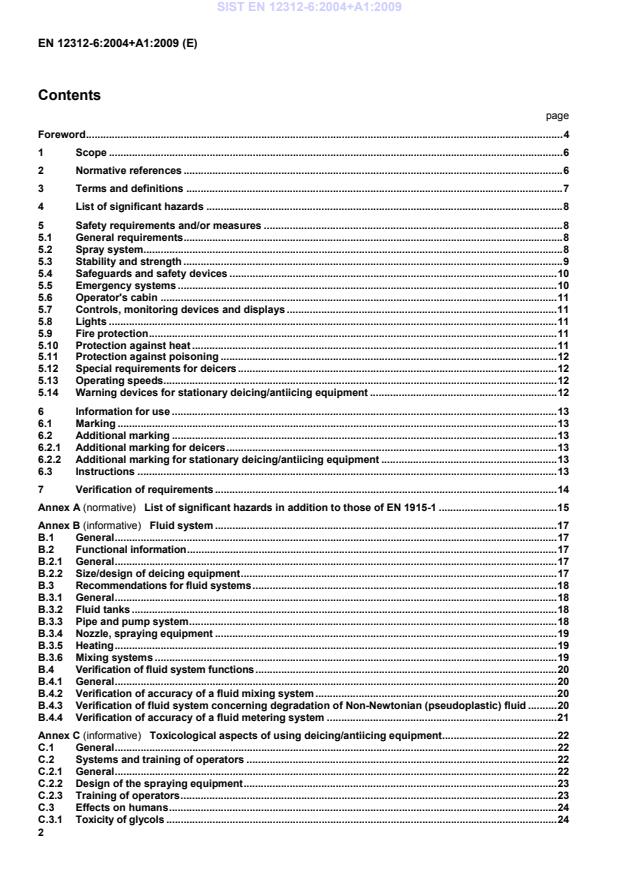
List of significant hazards in addition to those of EN 1915-1 . 15Annex B (informative)
Fluid system . 17B.1General . 17B.2Functional information . 17B.2.1General . 17B.2.2Size/design of deicing equipment . 17B.3Recommendations for fluid systems . 18B.3.1General . 18B.3.2Fluid tanks . 18B.3.3Pipe and pump system . 18B.3.4Nozzle, spraying equipment . 19B.3.5Heating . 19B.3.6Mixing systems . 19B.4Verification of fluid system functions . 20B.4.1General . 20B.4.2Verification of accuracy of a fluid mixing system . 20B.4.3Verification of fluid system concerning degradation of Non-Newtonian (pseudoplastic) fluid . 20B.4.4Verification of accuracy of a fluid metering system . 21Annex C (informative)
Toxicological aspects of using deicing/antiicing equipment . 22C.1General . 22C.2Systems and training of operators . 22C.2.1General . 22C.2.2Design of the spraying equipment . 23C.2.3Training of operators . 23C.3Effects on humans . 24C.3.1Toxicity of glycols . 24SIST EN 12312-6:2004+A1:2009
Environmental aspects of deicing/antiicing at airports . 26D.1General. 26D.2Environmental protection . 26D.2.1General. 26D.2.2Collection of glycol . 27D.2.3Treatment of glycol . 27D.3Environmental effects of deicing/antiicing fluids . 29D.3.1General. 29D.3.2Effects on aquatic environment . 29D.3.3Effects on soil environment . 29D.4Recommendations . 30Annex E (informative)
Loading control . 31Annex ZA (informative)
Relationship between
this European Standard and the Essential Requirements of EU Directive 98/37/EC, amended by Directive 98/79/EC . 32Annex ZB (informative)
!!!!Relationship between this European Standard and the Essential Requirements of EU Directive 2006/42/EC"""" . 33Bibliography . 34 SIST EN 12312-6:2004+A1:2009
Container/Pallet transfer transporters Part 11:
Container/Pallet dollies and loose load trailers Part 12:
Potable water service equipment Part 13:
Lavatory service equipment Part 14:
Disabled/incapacitated passenger boarding equipment Part 15:
Baggage and equipment tractors Part 16:
Air start equipment Part 17:
Air conditioning equipment Part 18:
Nitrogen or Oxygen units Part 19:
Aircraft jacks, axle jacks and hydraulic tail stanchions Part 20:
Ground power equipment Annex A is normative. Annexes B, C, D and E are informative. According to the CEN/CENELEC Internal Regulations, the national standards organizations of the following coun-tries are bound to implement this European Standard: Austria, Belgium, Bulgaria, Cyprus, Czech Republic, Den-mark, Estonia, Finland, France, Germany, Greece, Hungary, Iceland, Ireland, Italy, Latvia, Lithuania, Luxembourg, Malta, Netherlands, Norway, Poland, Portugal, Romania, Slovakia, Slovenia, Spain, Sweden, Switzerland and United Kingdom.
1 Scope This European Standard specifies the technical requirements to minimise the hazards listed in clause 4 which can arise during the commissioning, operation and maintenance of deicers and equipment designed exclusively for deicing and washing of aircraft with deicing/antiicing/washing liquids when carried out in accordance with the specifications given by the manufacturer or his authorised representative. It also takes into account some performance requirements recognised as essential by authorities, aircraft and GSE manufacturers as well as airlines and handling agencies. NOTE Safety of aircraft in connection with deicing/antiicing operations is not dealt with in this European Standard. Any, even minor, aircraft deicing or antiicing operation directly affects flight safety on take-off. Prevention of aeronautical accidents resulting from in-flight icing principally concerns the fluids and methods used, but it may in certain cases also concern deicing or antiicing equipment design or operation. These aeronautical aspects are not covered in this European Standard (see also Joint Aviation authorities (JAA), Joint Aviation Regulations (JAR) JAR-OPS subpart D 1.345 and any associated material). This standard applies to: self-propelled deicers with fixed platform or hinged boom; towable deicers with fixed platform or hinged boom; stationary deicing/antiicing equipment (e.g. fixed boom, gantry or tower cranes equipped with aircraft deicing/antiicing fluid systems). This standard does not apply to: fixed installations, such as separate storage tanks or heating and filling stations, which are not an integrated part of the stationary deicing equipment; hydraulic control systems; pneumatic systems; flow generating systems as such. This standard does not establish requirements for noise and vibration. Noise and vibration are dealt with respectively in !EN 1915-4" and !EN 1915-3". This standard is not dealing with hazards in respect to a standard automotive chassis and the traffic on the apron. This part of EN 12312 is not applicable to deicers and deicing/antiicing equipment which are manufactured before the date of publication by CEN of this standard. !This part of EN 12312 is intended to be used in conjunction with EN 1915-1, EN 1915-2, EN 1915-3 (for vehicles) and EN 1915-4."
2 Normative references !The following referenced documents are indispensable for the application of this document. For dated refer-ences, only the edition cited applies. For undated references, the latest edition of the referenced document (includ-ing any amendments) applies. " !deleted text" EN 795:1996, Protection against falls from a height — Anchor devices — Requirements and testing SIST EN 12312-6:2004+A1:2009
EN ISO 12100-2:2003", EN 1915-1:2001 and !ISO 11076:2006" and the following apply. 3.1 deicing/antiicing equipment piece of equipment, mobile or stationary, used for performing deicing/antiicing/washing operations on aircraft on the ground 3.2 deicer entire mobile unit, including the chassis and any structures mounted thereon 3.3 self-propelled deicer deicer able to move by an own power source and to operate without a constant connection to external energy or fluid supply 3.4 towable deicer
deicer not able to move by an own power source 3.5 stationary deicing/antiicing equipment
permanently installed equipment, e.g. gantry, fixed boom or other crane types 3.6 boom moveable hinged beam attached to the integral frame carrier to support the lifting/work platform SIST EN 12312-6:2004+A1:2009
boom mounted, enclosed lifting/work platform 3.9 basket boom mounted, open lifting/work platform 3.10 harness anchorage point
point for attaching the operator's safety harness 3.11
deicing pad
dedicated area on an airport specially designed for deicing 4 List of significant hazards The list of hazards (see annex A) is based on EN 1050:1996 and contains the hazards and hazardous situations, as far as they are dealt with in this European Standard, identified by risk assessment as significant for deicers and deicing equipment and which require action to eliminate or reduce risks. 5 Safety requirements and/or measures 5.1 General requirements 5.1.1 !Deicers and deicing/antiicing equipment shall conform to the relevant requirements of EN 1915-1, EN 1915-2, EN 1915-3 and EN 1915-4 unless otherwise specified in this standard." They shall also conform to the specific requirements of this standard. 5.1.2 The operating conditions shall be given by the manufacturer. Deicers shall be designed to operate safely in a continuous relative humidity of 94 %. Materials and devices used shall take into account the environmental conditions intended to be encountered by deicing equipment, e.g. with respect to temperature, sun, precipitation and freezing effects. NOTE The operating conditions and the materials chosen are depending on the airport of use (see clause 0 of EN 1915-1:2001 — negotiation). 5.1.3 The design of deicers and deicing/antiicing equipment shall take into account the operational conditions for deicing/antiicing as given in !ISO 11076". 5.2 Spray system 5.2.1 The control of hand held spray guns shall be of the hold-to-run type. 5.2.2 Fixed spray guns of deicers shall be prevented from spraying directly towards the operator's position, e.g. by means of a positive fit. 5.2.3 In case of spray gun failure it shall be possible to stop the fluid flow by means of an additional shut-off valve. SIST EN 12312-6:2004+A1:2009
EN ISO 13850:2008)." At least one shall be provided in the cabin/basket on deicers. Additional emergency stops shall be installed on the outer contour reachable from ground level, e.g. on each longitudinal side. 5.5.3 Emergency stops on deicers shall: stop and hold all boom and cabin/basket movements; shut down the fluid pump and heater; apply parking brakes. Emergency stops on deicers shall not: impede the emergency lowering function; stop the function of communication systems; switch off working lights; shut down fire extinguisher systems, where applicable. 5.5.4 Emergency stops on stationary systems shall be installed at operator's position(s) as well as on the structure and reachable from ground level, e.g. on each travelling gear or fundament. 5.5.5 On stationary deicing/antiicing equipment emergency stops shall stop all motions, the fluid supply and the spraying system. 5.5.6 To prevent overheating and overpressure, the fluid heater shall be equipped with safety devices. As a minimum, two independent overheat thermo-switches and two relief valves able to conduct the amount of fluid or steam generated by the heater shall be installed. 5.5.7 The deicing/antiicing equipment shall be furthermore provided with devices to shut down automatically fluid pumping and heating systems when a hazardous condition, e.g. overheating, overpressure, arises while these sys-tems are operating. These devices, when actuated, shall allow a deicer to be driven away from the aircraft. SIST EN 12312-6:2004+A1:2009
minimum training programme for the operators;
(see 5.8 and !EN 1915-1"); stability and strength (see 5.3.10); speeds (see 5.13); warning devices (see 5.14 and !EN 1915-1"); brakes and steering (see !EN 1915-1"). In addition, each harness anchorage point shall be tested according to EN 795 Class A1. If the boom construction cannot withstand the stresses occurring when carrying out the static test, the basket may be supported while the an-chorage point is tested.
(normative)
List of significant hazards in addition to those of EN 1915-1 Table
A.1 — List of hazards Number
corresponding to EN 1050:1996 Hazard Risk area Hazardous situation Reference in this standard 1.1 1.2 Crushing Shearing Equipment body
Chassis Boom
Chassis Boom
Operator's workplace Crushing between
stationary equipment and aircraft due to missing or inadequate warning device Crushing or shearing between moveable parts during operation Crushing or shearing due to missing or
inadequate emergency stops 5.3
5.5, 5.12.1
5.5, 5.6 1.1 1.3 Crushing Cutting Chassis
Crushing or cutting due to inadequate position of tow hooks Crushing or cutting due to inadequate wheel clearance 5.12.2
5.12.4 1.1 1.5 1.6 Crushing Trapping Impact Equipment body Hitting, crushing or trapping by tilting deicer due to lack of stability or strength 5.3 27.1.1 Lack of stability
Hitting, crushing or trapping due to inade-quate materials, de-vices or neglected op-erating conditions Hitting, crushing or trapping due to inade-quate operating speeds Hitting, crushing or trapping caused by jerks and jolts due to inadequate controls Trapping due to inade-quate location of man-ual controls 5.1.2, 5.1.3
5.13
5.7
5.5.1 SIST EN 12312-6:2004+A1:2009
A.1 (continued) Number
corresponding to EN 1050:1996 Hazard Risk area Hazardous
situation Reference in
this standard 1.6 Impact Spray gun Basket
Operator's workplace Hitting due to
inadequate spray
system Hitting due to missing or inadequate safety devices 5.2
5.4 1.9 High pressure fluid injec-tion
Spray system Hitting by high pressure fluid jet caused by
inadequate spray
system 5.2 3.1 Thermal hazard Operator's workplace Filling and dumping sys-tem Burns and scalds due to inadequate protection against heat or missing safety device 5.5.6, 5.10 7.1 Contact with or in-halation of substances Operator's workplace Poisoning due to
inadequate protection
5.11 7.2 Fire
Chassis Fuel system Missing or inadequate fire protection 5.9 8.4 Insufficient visibility
Operating range Controls Missing or inadequate illumination 5.8 19 Falling Operator's workplace Falling due to missing or inadequate safety devices 5.4, 5.6.3 21.5 Insufficient
visibility
Controls Poor visibility on travel and working area from the location of the
controls 5.6.1, 5.6.2 22.1 22.2 Inadequate location and
design of manual controls Controls Various risks for
persons during
operation 5.5, 5.7 26 Insufficient instructions Operating range Absence of marking and data Absence of safety
related information Missing of operating and maintenance
instructions 6.1, 6.2.1
6.2.2
6.3 SIST EN 12312-6:2004+A1:2009
(informative)
Fluid system B.1 General This annex describes recommendations for performance and capacity of fluid systems for deicing equipment as well as methods for verification of fluid systems, important for the reliability of the deicing operation. It is not the intention of this annex to specify a comprehensive set of technical design criteria for deicing equipment for aircraft, but only those relating to function, safety and performance. The annex is divided into the following three subdivisions: B.2 Functional information; B.3 Recommendations for fluid system performance and capacity; B.4 Verification of fluid system functions. The general functional requirements of a deicer can be found in ISO 11077:1993. The content of B.2, B.3 and B.4 is agreed as internationally mandatory by industry, civil aviation authorities and airlines. These requirements have been developed over a number of years and they play an important role in designing deicing/antiicing equipment. B.2 Functional information B.2.1 General To optimize the snow and ice removal effect, the fluid system of the deicing equipment should be designed for spray-ing fluid up to a temperature of 85 °C (the maximum allowed temperature of the surface of the aircraft is 80 °C). B.2.2 Size/design of deicing equipment The size and design of the deicing equipment should be agreed upon between manufacturer and user, as the opera-tional conditions can vary considerably from one airport to another. The requirements can be very different concerning reach of aerial device, tank capacity, means of heating, etc. Where a deicer is to be used for other purposes than deicing (e.g. maintenance work, aircraft washing, etc.), open basket deicers are often preferred; but in airports where the operators are deicing for longer periods or are deicing aircraft with running engines, a deicer with enclosed cabin offers a much better working environment concerning exposure to noise, weather, glycol, aerosols, etc. As training of the operator is of major importance in order to perform a fast, technically and environmentally safe deicing operation, it is important that the basket/operator's cabin has the capability to carry a second person. Certain conditions in the different airports (e.g. narrow gates, low tunnels, passenger boarding bridges, etc.) can give rise to special requirements for the maximum width and height of the deicer with the aerial device in base position. This has to be stipulated between the manufacturer and the user. SIST EN 12312-6:2004+A1:2009
...