

EN 46-2:2009
(Main)Wood preservatives - Determination of the preventive action against recently hatched larvae of Hylotrupes bajulus (Linnaeus) - Part 2: Ovicidal effect (laboratory method)
General Information
- Abstract
This European Standard specifies a method for the determination of the preventive action of a wood preservative against eggs of Hylotrupes bajulus (Linnaeus) when the preservative is applied as a surface treatment to wood.
This method is applicable to:
- water-insoluble chemicals which are being studied as active insecticides;
- organic formulations, as supplied or as prepared in the laboratory by dilution of concentrates;
- organic water-dispersible formulations as supplied or as prepared in the laboratory by dilution of concentrates; or
- water-soluble materials, for example salts.
The method is applicable whether or not the test specimens have been subjected to appropriate ageing procedures.
- Status
- Withdrawn
- Publication Date
- 10-Nov-2009
- Withdrawal Date
- 29-Sep-2026
- Technical Committee
- CEN/TC 38 - Durability of wood and derived materials
- Drafting Committee
- CEN/TC 38/WG 24 - Insect testing - (beetles - termites)
- Current Stage
- 9960 - Withdrawal effective - Withdrawal
- Start Date
- 22-Jun-2016
- Completion Date
- 30-Sep-2026



Relations
- Effective Date
- 08-Jun-2022
- Effective Date
- 29-Jun-2016
- Effective Date
- 28-Jan-2026
- Effective Date
- 28-Jan-2026
- Effective Date
- 28-Jan-2026
- Effective Date
- 28-Jan-2026
Get Certified
Connect with accredited certification bodies for this standard

ECOCERT
Organic and sustainability certification.

Eurofins Food Testing Global
Global leader in food, environment, and pharmaceutical product testing.

Intertek Bangladesh
Intertek certification and testing services in Bangladesh.
Sponsored listings
Frequently Asked Questions
EN 46-2:2009 is a standard published by the European Committee for Standardization (CEN). Its full title is "Wood preservatives - Determination of the preventive action against recently hatched larvae of Hylotrupes bajulus (Linnaeus) - Part 2: Ovicidal effect (laboratory method)". This standard covers: This European Standard specifies a method for the determination of the preventive action of a wood preservative against eggs of Hylotrupes bajulus (Linnaeus) when the preservative is applied as a surface treatment to wood. This method is applicable to: - water-insoluble chemicals which are being studied as active insecticides; - organic formulations, as supplied or as prepared in the laboratory by dilution of concentrates; - organic water-dispersible formulations as supplied or as prepared in the laboratory by dilution of concentrates; or - water-soluble materials, for example salts. The method is applicable whether or not the test specimens have been subjected to appropriate ageing procedures.
This European Standard specifies a method for the determination of the preventive action of a wood preservative against eggs of Hylotrupes bajulus (Linnaeus) when the preservative is applied as a surface treatment to wood. This method is applicable to: - water-insoluble chemicals which are being studied as active insecticides; - organic formulations, as supplied or as prepared in the laboratory by dilution of concentrates; - organic water-dispersible formulations as supplied or as prepared in the laboratory by dilution of concentrates; or - water-soluble materials, for example salts. The method is applicable whether or not the test specimens have been subjected to appropriate ageing procedures.
EN 46-2:2009 is classified under the following ICS (International Classification for Standards) categories: 71.100.50 - Wood-protecting chemicals. The ICS classification helps identify the subject area and facilitates finding related standards.
EN 46-2:2009 has the following relationships with other standards: It is inter standard links to EN 46-2:2006, EN 46-2:2016, EN ISO 3696:1995, EN 84:2020, EN 73:2020+A1:2024, EN 46-1:2016. Understanding these relationships helps ensure you are using the most current and applicable version of the standard.
EN 46-2:2009 is associated with the following European legislation: EU Directives/Regulations: 305/2011, 89/106/EEC. When a standard is cited in the Official Journal of the European Union, products manufactured in conformity with it benefit from a presumption of conformity with the essential requirements of the corresponding EU directive or regulation.
EN 46-2:2009 is available in PDF format for immediate download after purchase. The document can be added to your cart and obtained through the secure checkout process. Digital delivery ensures instant access to the complete standard document.
Standards Content (Sample)
2003-01.Slovenski inštitut za standardizacijo. Razmnoževanje celote ali delov tega standarda ni dovoljeno.Holzschutzmittel - Bestimmung der vorbeugenden Wirkung gegenüber Hylotrupes bajulus (Linnaeus) -Teil 2: Ovidize Wirkung (Laboratoriumverfahren)Produits de préservation du bois - Détermination de l'action préventive contre Hylotrupes bajulus (linnaeus)Ä - Partie 2 : Effet novicide (méthode de laboratoire)Wood preservatives - Determination of the preventive action against recently hatched larvae of Hylotrupes bajulus (Linnaeus) . Part 2: Ovicidal effect (laboratory method)71.100.50Wood-protecting chemicalsICS:Ta slovenski standard je istoveten z:EN 46-2:2009SIST EN 46-2:2010en,fr,de01-marec-2010SIST EN 46-2:2010SLOVENSKI
STANDARDSIST EN 46-2:20061DGRPHãþD
EUROPEAN STANDARD NORME EUROPÉENNE EUROPÄISCHE NORM
EN 46-2
November 2009 ICS 71.100.50 Supersedes EN 46-2:2006English Version
Wood preservatives - Determination of the preventive action against recently hatched larvae of Hylotrupes bajulus (Linnaeus) - Part 2: Ovicidal effect (laboratory method)
Produits de préservation du bois - Détermination de l'action préventive contre les larves récemment écloses d'Hylotrupes bajulus (Linnaeus) - Partie 2: Effet ovicide (Méthode de laboratoire)
Holzschutzmittel -Bestimmung der vorbeugenden Wirkung gegenüber frisch geschlüpften Larven von Hylotrupes bajulus (Linnaeus) - Teil 2: Ovidize Wirkung (Laboratoriumverfahren) This European Standard was approved by CEN on 10 October 2009.
CEN members are bound to comply with the CEN/CENELEC Internal Regulations which stipulate the conditions for giving this European Standard the status of a national standard without any alteration. Up-to-date lists and bibliographical references concerning such national standards may be obtained on application to the CEN Management Centre or to any CEN member.
This European Standard exists in three official versions (English, French, German). A version in any other language made by translation under the responsibility of a CEN member into its own language and notified to the CEN Management Centre has the same status as the official versions.
CEN members are the national standards bodies of Austria, Belgium, Bulgaria, Cyprus, Czech Republic, Denmark, Estonia, Finland, France, Germany, Greece, Hungary, Iceland, Ireland, Italy, Latvia, Lithuania, Luxembourg, Malta, Netherlands, Norway, Poland, Portugal, Romania, Slovakia, Slovenia, Spain, Sweden, Switzerland and United Kingdom.
EUROPEAN COMMITTEE FOR STANDARDIZATION
COMITÉ EUROPÉEN DE NORMALISATION EUROPÄISCHES KOMITEE FÜR NORMUNG
Management Centre:
Avenue Marnix 17,
B-1000 Brussels © 2009 CEN All rights of exploitation in any form and by any means reserved worldwide for CEN national Members. Ref. No. EN 46-2:2009: ESIST EN 46-2:2010
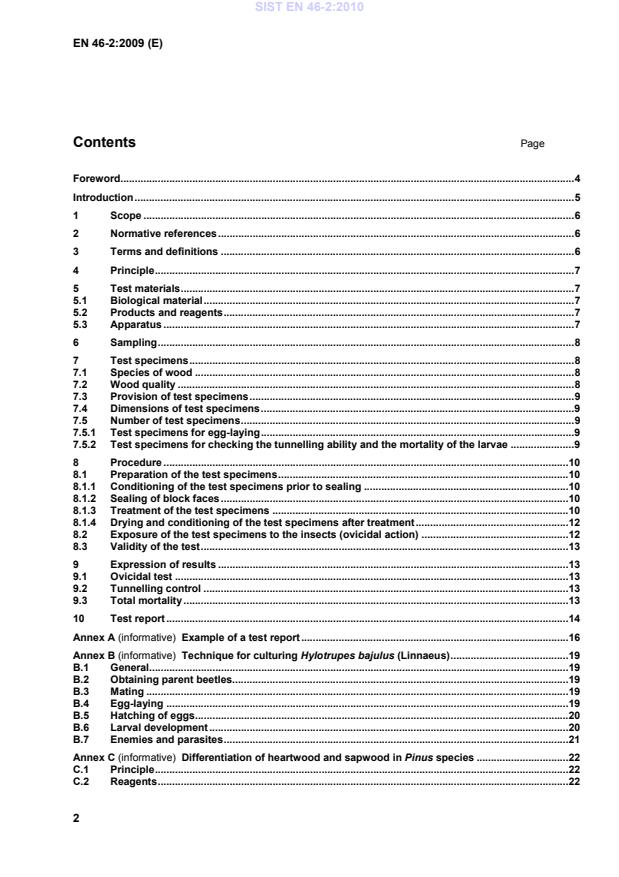
Example of a test report . 16Annex B (informative)
Technique for culturing Hylotrupes bajulus (Linnaeus) . 19B.1General. 19B.2Obtaining parent beetles. 19B.3Mating . 19B.4Egg-Iaying . 19B.5Hatching of eggs . 20B.6Larval development . 20B.7Enemies and parasites . 21Annex C (informative)
Differentiation of heartwood and sapwood in Pinus species . 22C.1Principle . 22C.2Reagents . 22SIST EN 46-2:2010
Environmental, health and safety precautions within chemical/biological laboratory . 23Bibliography . 24SIST EN 46-2:2010
Determination of the preventive action against recently hatched larvae of Hylotrupes bajulus (Linnaeus)
Part 1: Application by surface treatment (laboratory method) EN 46-2, Wood preservatives
Determination of the preventive action against recently hatched larvae of Hylotrupes bajulus (Linnaeus)
Part 2: Ovicidal effect (laboratory method) EN 46 consists of two parts to enable preventive action of wood preservatives, against recently hatched larvae of Hylotrupes bajulus, which are intended to be applied by surface treatment; Part 1 is required to determine the larvicidal effect of preservatives and Part 2 is required to determine the ovicidal action of the preservatives after egg-laying of young females. Significant technical differences between this document and EN 46-2:2006 are as follows: a) For treatment by dipping sealing of all faces except the one which is exposed to the insects added; b) Requirements for the selection of test specimens specified in more detail in 7.5.1.
According to the CEN/CENELEC Internal Regulations, the national standards organizations of the following countries are bound to implement this European Standard: Austria, Belgium, Bulgaria, Cyprus, Czech Republic, Denmark, Estonia, Finland, France, Germany, Greece, Hungary, Iceland, Ireland, Italy, Latvia, Lithuania, Luxembourg, Malta, Netherlands, Norway, Poland, Portugal, Romania, Slovakia, Slovenia, Spain, Sweden, Switzerland and the United Kingdom.
This method is applicable to:
water-insoluble chemicals which are being studied as active insecticides; organic formulations, as supplied or as prepared in the laboratory by dilution of concentrates; organic water-dispersible formulations as supplied or as prepared in the laboratory by dilution of concentrates; or water-soluble materials, for example salts. The method is applicable whether or not the test specimens have been subjected to appropriate ageing procedures. 2 Normative references The following referenced documents are indispensable for the application of this document. For dated references, only the edition cited applies. For undated references the latest edition of the referenced document (including any amendments) applies. EN 46-1, Wood preservatives
Determination of the preventive action against Hylotrupes bajulus (Linnaeus)
Part 1: Larvicidal effect (laboratory method) EN 73, Wood preservatives
Accelerated ageing tests of treated wood prior to biological testing
Evaporative ageing procedure
EN 84, Wood preservatives
Accelerated ageing of treated wood prior to biological testing
Leaching procedure EN ISO 3696:1995, Water for analytical laboratory use – Specification and test methods (ISO 3696:1987) 3 Terms and definitions For the purposes of this document, the following terms and definitions apply. 3.1 representative sample sample having its physical and/or chemical characteristics identical to the volumetric average characteristics of the total volume being sampled [EN 1001-2:2005, 4.71] 3.2 supplier sponsor of the test (person or company providing the sample of wood preservative to be tested) NOTE
Adapted from EN 1001-2:2005, 4.83. SIST EN 46-2:2010
5.1.1 Hylotrupes bajulus (Linnaeus) females. 5.1.2 Source of females The insects shall preferably be obtained from cultures reared as e.g. described in Annex B. Use only sound and lively insects.
5.2 Products and reagents
5.2.1 Paraffin wax, for fixing the glass plate in all cases and for sealing the end faces of test specimens to be treated with solutions in all cases in which water is the continuous phase. NOTE Paraffin wax with a setting point of 52 °C to 54 °C has been found to be suitable. 5.2.2 Gelatine, for sealing the end faces of test specimens to be treated with solutions in which an organic solvent is the continuous phase. 5.2.3 Water, complying with grade 3 of EN ISO 3696:1995. 5.2.4 Solvent or diluent, a volatile liquid that will dissolve or dilute the preservative but does not leave a residue in the wood at the end of the post-treatment conditioning period that has a toxic effect on the insects. CAUTION — Do not use benzene or other solvents which pose a health risk. 5.3 Apparatus 5.3.1 Culturing chamber, with air circulation, and controlled at (28 ± 2) °C and at relative humidity (70 ± 5) %. 5.3.2 Conditioning chamber, well ventilated and controlled at (20 ± 2) °C and at relative humidity (65 ± 5) %. NOTE The conditioning of test specimens may be carried out in the laboratory work area (see 5.3.3) provided that this has the conditions specified for the conditioning chamber (see 5.3.2). 5.3.3 Laboratory work area, well ventilated, where treatment of the test specimens is carried out. CAUTION — It is essential to follow safety procedures for handling flammable and toxic materials. Avoid excessive exposure of operators to solvents or their vapours. 5.3.4 Testing chamber, ventilated and air-conditioned, controlled at (22 ± 2) °C and at relative humidity between (70 ± 5) %. SIST EN 46-2:2010
The weights shall not react with any materials with which they come into contact during the test. 5.3.7 Safety equipment, protective clothing, appropriate for the test product and the test solvent, to ensure the safety of the operator. 5.3.8 Glass plates, 48 mm long and 25 mm wide, intended to provide a lateral slit on the test specimens. 5.3.9 Ordinary laboratory equipment, including a balance capable of weighing to an accuracy of 0,01 g and equipment for applying a liquid product by brushing or by pipette. 5.3.10 Protective gloves 6 Sampling The sample of preservative shall be representative of the product to be tested. Samples shall be stored and handled in accordance with any written recommendations from the supplier. NOTE For the sampling of preservatives from bulk supplies, the procedure given in EN 212 should be used. 7 Test specimens 7.1 Species of wood The reference species is Scots pine (Pinus sylvestris Linnaeus)1). NOTE Additional tests may be carried out using other species but, if so, this shall be stated in the test report. 7.2 Wood quality
The wood shall be free from visible cracks, stain, decay, insect damage and other defects. The wood shall not have been water-stored, floated, chemically treated or steamed. The wood shall originate from trees preferably felled in winter. The wood shall not have been stored for more than five years. NOTE 1 Wood that has been kiln dried at temperatures below 60 °C may be used. The wood shall be exclusively sapwood containing little resin and having between 2,5 annual rings per 10 mm and eight annual rings per 10 mm. The proportion of latewood in the annual rings shall not exceed 30 % of the whole. NOTE 2 It is recommended to use test specimens of similar growth rate within a single test.
1) In southern European countries the pine species most frequently infested by Hylotrupes bajulus may be used as an alternative, provided that the suitability of the species for use in the tests specified in this standard has been demonstrated in all aspects (development of larvae, resistance of impregnation, etc.). SIST EN 46-2:2010
b) three untreated control test specimens (each originating from a different tree unless taken at random from a stock of more than 500) for a complete test of any given preservative; c) three control test specimens treated with the solvent or diluent (5.2.3 or 5.2.4) (each originating from a different tree unless taken at random from a stock of more than 500) if a solvent or diluent (including water) is used. When dipping is to be used (8.1.3.3) it is advisable to treat more than the specified number of test specimens so that, after weighing, any test specimens with abnormally high or low retentions can be rejected from the batch. NOTE
To gain further information on a formulation, the manufacturer may find it useful to test a version of the preservative where the active ingredient(s) has been removed. 7.5.2 Test specimens for checking the tunnelling ability and the mortality of the larvae In addition to the test specimens for egg-laying at least six test specimens shall be prepared for each preservative concentration and retention for checking the tunnelling ability and the mortality of the newly hatched larvae.
2) For special tests, test specimens may be obtained according to a given series. As a result, it may be preferable to take test specimens from pretreated strips. Where pretreated strips are used details should be included in the test report. SIST EN 46-2:2010
...