


FprEN ISO 18203
(Main)Steel - Determination of the thickness of surface-hardened layers (ISO/FDIS 18203:2025)
Steel - Determination of the thickness of surface-hardened layers (ISO/FDIS 18203:2025)
ISO 18203:2016 specifies a method of measuring the case hardening depth, surface hardening depth, nitriding hardness depth and total thickness of surface hardening depth obtained, e.g. thermal (flame and induction hardening, electron beam hardening, laser beam hardening, etc.) or thermochemical (carbonitriding, carburizing and hardening, hardening and nitriding, etc.) treatment.
Stahl - Bestimmung der Dicke gehärteter Randschichten (ISO/FDIS 18203:2025)
Dieses Dokument legt ein Verfahren zur Messung der Einsatzhärtungstiefe, Randschichthärtungstiefe, Nitrierhärtetiefe und Gesamtdicke der bei Verwendung erzielten Randschichthärtungstiefe fest, z. B. thermische Behandlung (Flamm- und Induktionshärten, Elektronenstrahlhärten, Laserstrahlhärten) oder thermochemische Behandlung (Carbonitrieren, Aufkohlen und Härten, Härten und Nitrieren usw.).
Acier - Détermination de l'épaisseur des couches durcies superficielles (ISO/FDIS 18203:2025)
ISO 18203:2016 spécifie une méthode de mesure de la profondeur de cémentation, la profondeur de durcissement de la surface, la profondeur de la dureté de nitruration et l'épaisseur totale de la profondeur de durcissement de la surface obtenue par exemple, par des traitements thermiques (durcissement par flamme et par induction, durcissement par faisceau d'électrons et par faisceau laser etc.) ou thermochimiques (carbonitruration, cémentation et durcissement, durcissement et nitruration, etc.).
Jekla - Določanje debeline površinsko utrjenih plasti (ISO/FDIS 18203:2025)
General Information
- Status
- Not Published
- Publication Date
- 11-Mar-2026
- Technical Committee
- ECISS/TC 101 - Test methods for steel (other than chemical analysis)
- Current Stage
- 6055 - CEN Ratification completed (DOR) - Publishing
- Start Date
- 12-Jan-2026
- Completion Date
- 12-Jan-2026
Relations
- Effective Date
- 14-Feb-2024
Overview
FprEN ISO 18203 (ISO/DIS 18203:2025) specifies standardized methods for measuring the thickness of surface‑hardened layers in steel. It covers the determination of case hardening depth (CHD), surface hardening depth (SHD), nitriding hardness depth (NHD) and the total thickness of surface hardening depth (THD) for thermal (flame, induction, laser, electron‑beam, etc.) and thermochemical (carburizing, carbonitriding, nitriding, etc.) treatments. This draft international standard updates ISO 18203:2016 and provides harmonized rules for hardness‑based and microscopic measurement techniques used in quality control and inspection.
Key topics and requirements
- Definitions and symbols for CHD, SHD, NHD and THD, including practical measurement rules.
- Hardness test methods: Vickers (ISO 6507 series) and Knoop (ISO 4545 series) are normative references for hardness measurement.
- CHD definition: distance from surface to the layer having a hardness of 550 HV (or equivalent HK), with provisions to select higher limits by agreement when applicable.
- SHD definition: depth to a specified hardness limit calculated from minimum surface hardness (formula provided); recommended hardness limit table included.
- Measurement procedures:
- Hardness‑profile testing with specified test loads and an interpolation method (Annex A) to determine depths.
- Microscopic methods for measuring THD and metallographic preparation requirements.
- Test specimen requirements, surface preparation and measurement capability considerations.
- Core hardness verification: average of five measurements and guidance on their placement relative to hardness-depth tolerances.
- Reporting requirements and a procedural path for arbitration measurements.
Applications and who uses it
- Quality control and acceptance testing for heat‑treated steel parts (gears, shafts, bearings, fasteners).
- Metallurgical laboratories performing hardness profiling and metallography.
- Heat‑treatment shops, automotive, aerospace and heavy‑machinery manufacturers that require verified case or surface hardening depths.
- Certification bodies and procurement engineers who specify material performance and inspection criteria. Using ISO 18203 helps ensure consistent, reproducible measurement of hardened layer thicknesses and supports conformance to contractual or regulatory requirements.
Related standards
- ISO 4545‑1/2 - Knoop hardness test (method and machine verification)
- ISO 6507‑1/2 - Vickers hardness test (method and machine verification)
- ISO 15787 - Technical product documentation for heat‑treated ferrous parts
- ISO 80000‑1 - Quantities and units
Keywords: ISO 18203, FprEN ISO 18203, surface-hardened layer thickness, case hardening depth CHD, surface hardening depth SHD, nitriding hardness depth NHD, THD, Vickers, Knoop, hardness testing, steel heat treatment inspection.


Get Certified
Connect with accredited certification bodies for this standard

Element Materials Technology
Materials testing and product certification.

Inštitut za kovinske materiale in tehnologije
Institute of Metals and Technology. Materials testing, metallurgical analysis, NDT.
Sponsored listings
Frequently Asked Questions
FprEN ISO 18203 is a draft published by the European Committee for Standardization (CEN). Its full title is "Steel - Determination of the thickness of surface-hardened layers (ISO/FDIS 18203:2025)". This standard covers: ISO 18203:2016 specifies a method of measuring the case hardening depth, surface hardening depth, nitriding hardness depth and total thickness of surface hardening depth obtained, e.g. thermal (flame and induction hardening, electron beam hardening, laser beam hardening, etc.) or thermochemical (carbonitriding, carburizing and hardening, hardening and nitriding, etc.) treatment.
ISO 18203:2016 specifies a method of measuring the case hardening depth, surface hardening depth, nitriding hardness depth and total thickness of surface hardening depth obtained, e.g. thermal (flame and induction hardening, electron beam hardening, laser beam hardening, etc.) or thermochemical (carbonitriding, carburizing and hardening, hardening and nitriding, etc.) treatment.
FprEN ISO 18203 is classified under the following ICS (International Classification for Standards) categories: 77.040.99 - Other methods of testing of metals. The ICS classification helps identify the subject area and facilitates finding related standards.
FprEN ISO 18203 has the following relationships with other standards: It is inter standard links to EN ISO 18203:2022. Understanding these relationships helps ensure you are using the most current and applicable version of the standard.
FprEN ISO 18203 is available in PDF format for immediate download after purchase. The document can be added to your cart and obtained through the secure checkout process. Digital delivery ensures instant access to the complete standard document.
Standards Content (Sample)
SLOVENSKI STANDARD
oSIST prEN ISO 18203:2025
01-julij-2025
Jekla - Določanje debeline površinsko utrjenih plasti (ISO/DIS 18203:2025)
Steel - Determination of the thickness of surface-hardened layers (ISO/DIS 18203:2025)
Stahl - Bestimmung der Dicke gehärteter Randschichten (ISO/DIS 18203:2025)
Acier - Détermination de l'épaisseur des couches durcies superficielles (ISO/DIS
18203:2025)
Ta slovenski standard je istoveten z: prEN ISO 18203
ICS:
77.040.99 Druge metode za Other methods of testing of
preskušanje kovin metals
77.080.20 Jekla Steels
oSIST prEN ISO 18203:2025 en,fr,de
2003-01.Slovenski inštitut za standardizacijo. Razmnoževanje celote ali delov tega standarda ni dovoljeno.
oSIST prEN ISO 18203:2025
oSIST prEN ISO 18203:2025
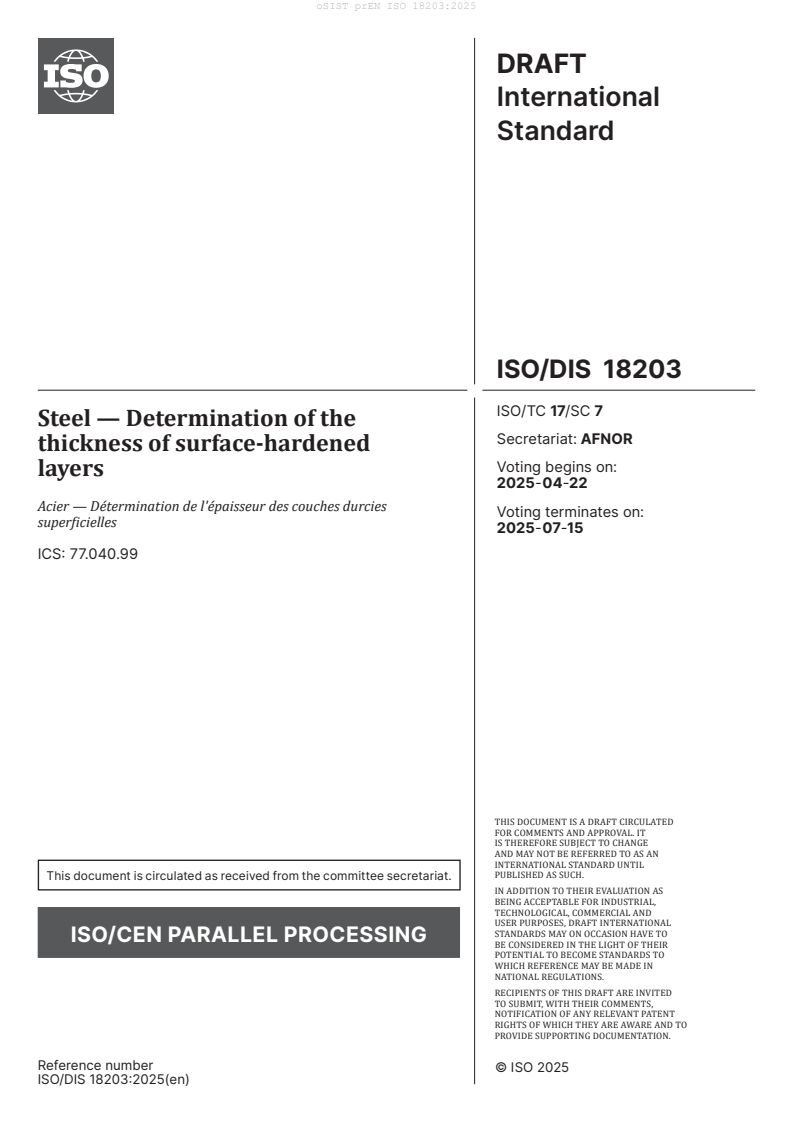
DRAFT
International
Standard
ISO/DIS 18203
ISO/TC 17/SC 7
Steel — Determination of the
Secretariat: AFNOR
thickness of surface-hardened
Voting begins on:
layers
2025-04-22
Acier — Détermination de l'épaisseur des couches durcies
Voting terminates on:
superficielles
2025-07-15
ICS: 77.040.99
THIS DOCUMENT IS A DRAFT CIRCULATED
FOR COMMENTS AND APPROVAL. IT
IS THEREFORE SUBJECT TO CHANGE
AND MAY NOT BE REFERRED TO AS AN
INTERNATIONAL STANDARD UNTIL
PUBLISHED AS SUCH.
This document is circulated as received from the committee secretariat.
IN ADDITION TO THEIR EVALUATION AS
BEING ACCEPTABLE FOR INDUSTRIAL,
TECHNOLOGICAL, COMMERCIAL AND
USER PURPOSES, DRAFT INTERNATIONAL
STANDARDS MAY ON OCCASION HAVE TO
ISO/CEN PARALLEL PROCESSING
BE CONSIDERED IN THE LIGHT OF THEIR
POTENTIAL TO BECOME STANDARDS TO
WHICH REFERENCE MAY BE MADE IN
NATIONAL REGULATIONS.
RECIPIENTS OF THIS DRAFT ARE INVITED
TO SUBMIT, WITH THEIR COMMENTS,
NOTIFICATION OF ANY RELEVANT PATENT
RIGHTS OF WHICH THEY ARE AWARE AND TO
PROVIDE SUPPORTING DOCUMENTATION.
Reference number
ISO/DIS 18203:2025(en)
oSIST prEN ISO 18203:2025
DRAFT
ISO/DIS 18203:2025(en)
International
Standard
ISO/DIS 18203
ISO/TC 17/SC 7
Steel — Determination of the
Secretariat: AFNOR
thickness of surface-hardened layers
Voting begins on:
Acier — Détermination de l'épaisseur des couches durcies
superficielles
Voting terminates on:
ICS: 77.040.99
THIS DOCUMENT IS A DRAFT CIRCULATED
FOR COMMENTS AND APPROVAL. IT
IS THEREFORE SUBJECT TO CHANGE
AND MAY NOT BE REFERRED TO AS AN
INTERNATIONAL STANDARD UNTIL
PUBLISHED AS SUCH.
This document is circulated as received from the committee secretariat.
IN ADDITION TO THEIR EVALUATION AS
BEING ACCEPTABLE FOR INDUSTRIAL,
© ISO 2025
TECHNOLOGICAL, COMMERCIAL AND
USER PURPOSES, DRAFT INTERNATIONAL
All rights reserved. Unless otherwise specified, or required in the context of its implementation, no part of this publication may
STANDARDS MAY ON OCCASION HAVE TO
ISO/CEN PARALLEL PROCESSING
be reproduced or utilized otherwise in any form or by any means, electronic or mechanical, including photocopying, or posting on
BE CONSIDERED IN THE LIGHT OF THEIR
the internet or an intranet, without prior written permission. Permission can be requested from either ISO at the address below
POTENTIAL TO BECOME STANDARDS TO
WHICH REFERENCE MAY BE MADE IN
or ISO’s member body in the country of the requester.
NATIONAL REGULATIONS.
ISO copyright office
RECIPIENTS OF THIS DRAFT ARE INVITED
CP 401 • Ch. de Blandonnet 8
TO SUBMIT, WITH THEIR COMMENTS,
CH-1214 Vernier, Geneva
NOTIFICATION OF ANY RELEVANT PATENT
Phone: +41 22 749 01 11
RIGHTS OF WHICH THEY ARE AWARE AND TO
PROVIDE SUPPORTING DOCUMENTATION.
Email: copyright@iso.org
Website: www.iso.org
Published in Switzerland Reference number
ISO/DIS 18203:2025(en)
ii
oSIST prEN ISO 18203:2025
ISO/DIS 18203:2025(en)
Contents Page
Foreword .iv
Introduction .v
1 Scope . 1
2 Normative references . 1
3 Terms and definitions . 1
4 Symbols, abbreviations and designations . 3
5 Principle . 4
6 Apparatus . 4
7 Test specimen . 4
7.1 General .4
7.2 Measurement capability . .4
7.3 Preparation of the surface to be examined .5
8 Method of measurement . 6
8.1 Hardness testing method .6
8.1.1 CHD, SHD and NHD measurement .6
8.1.2 THD Measurement .6
8.2 Microscopic methods .7
8.2.1 Total thickness of surface hardening layers (THD) .7
9 Evaluation of the results . 8
9.1 Case hardening depth (CHD), surface hardening depth (SHD) and nitriding hardness
depth (NHD) .8
9.2 Total thickness of surface hardening depth (THD) .9
10 Test report . 9
Annex A (normative) Interpolation method for determining the CHD – SHD – NHD .11
Bibliography .13
iii
oSIST prEN ISO 18203:2025
ISO/DIS 18203:2025(en)
Foreword
ISO (the International Organization for Standardization) is a worldwide federation of national standards
bodies (ISO member bodies). The work of preparing International Standards is normally carried out through
ISO technical committees. Each member body interested in a subject for which a technical committee
has been established has the right to be represented on that committee. International organizations,
governmental and non-governmental, in liaison with ISO, also take part in the work. ISO collaborates closely
with the International Electrotechnical Commission (IEC) on all matters of electrotechnical standardization.
The procedures used to develop this document and those intended for its further maintenance are described
in the ISO/IEC Directives, Part 1. In particular, the different approval criteria needed for the different types
of ISO documents should be noted. This document was drafted in accordance with the editorial rules of the
ISO/IEC Directives, Part 2 (see www.iso.org/directives).
ISO draws attention to the possibility that the implementation of this document may involve the use of (a)
patent(s). ISO takes no position concerning the evidence, validity or applicability of any claimed patent
rights in respect thereof. As of the date of publication of this document, ISO had not received notice of (a)
patent(s) which may be required to implement this document. However, implementers are cautioned that
this may not represent the latest information, which may be obtained from the patent database available at
www.iso.org/patents. ISO shall not be held responsible for identifying any or all such patent rights.
Any trade name used in this document is information given for the convenience of users and does not
constitute an endorsement.
For an explanation of the voluntary nature of standards, the meaning of ISO specific terms and expressions
related to conformity assessment, as well as information about ISO's adherence to the World Trade
Organization (WTO) principles in the Technical Barriers to Trade (TBT), see www.iso.org/iso/foreword.html.
This document was prepared by Technical Committee ISO/TC 17, Steel, Subcommittee SC 7, Methods of testing
(other than mechanical tests and chemical analysis).
This second edition cancels and replaces the first edition (ISO 18203:2016), which has been technically
revised.
The main changes are as follows:
— Removal of the reference to shot peening;
— Removal of the Compound layer Thickness CLT;
— Introduction of standard test loads for the determination of hardness depths, and the procedure for
measurements in the event of arbitration;
— Extension of Table 1 by Rockwell test methods;
— Extension of Table 2 by further short characters;
— Precise definition of how the core hardness shall be tested;
— Determination of the edge distance of the first hardness impression from the edge;
— Explanation of how to determine the total thickness of surface hardening depth THD.
Any feedback or questions on this document should be directed to the user’s national standards body. A
complete listing of these bodies can be found at www.iso.org/members.html.
iv
oSIST prEN ISO 18203:2025
ISO/DIS 18203:2025(en)
Introduction
There are several ways of creating a surface-hardened layer in steel, but the measurement of its thickness
follows the same principle, regardless of the chemical composition or heat treatment of the sample. This
document presents the basic principle of determining the thickness of surface-hardened layers as well as the
differences particular to the different methods of creating the surface-hardened layer.
No method of estimating uncertainty is presented in this document. As real applications of this procedure
accrue, the need may arise to address this topic in future revisions.
v
oSIST prEN ISO 18203:2025
oSIST prEN ISO 18203:2025
DRAFT International Standard ISO/DIS 18203:2025(en)
Steel — Determination of the thickness of surface-
hardened layers
1 Scope
This document specifies a method of measuring the case hardening depth, surface hardening depth, nitriding
hardness depth and total thickness of surface hardening depth obtained, e.g. thermal (flame and induction
hardening, electron beam hardening, laser beam hardening, etc.) or thermochemical (carbonitriding,
carburizing and hardening, hardening and nitriding, etc.) treatment.
2 Normative references
The following documents are referred to in the text in such a way that some or all of their content constitutes
requirements of this document. For dated references, only the edition cited applies. For undated references,
the latest edition of the referenced document (including any amendments) applies.
ISO 4545-1, Metallic materials — Knoop hardness test — Part 1: Test method
ISO 4545-2, Metallic materials — Knoop hardness test — Part 2: Verification and calibration of testing machines
ISO 6507-1, Metallic materials — Vickers hardness test — Part 1: Test method
ISO 6507-2, Metallic materials — Vickers hardness test — Part 2: Verification and calibration of testing machines
ISO 15787:2001, Technical product documentation — Heat-treated ferrous parts — Presentation and indications
ISO 80000-1, Quantities and units — Part 1: General
3 Terms and definitions
For the purposes of this document, the following terms and definitions apply.
ISO and IEC maintain terminology databases for use in standardization at the following addresses:
— ISO Online browsing platform: available at https:// www .iso .org/ obp
— IEC Electropedia: available at https:// www .electropedia .org/
3.1
case hardening depth
CHD
perpendicular distance between the surface and the layer having a hardness of 550 HV in accordance with
ISO 6507-1 or equivalent Knoop hardness of 550 HK in accordance with ISO 4545-1.
Note 1 to entry: For steels which present a hardness higher than 450 HV at a distance three times of the case hardening
depth (determined with a limiting hardness value of 550 HV) from the surface, a limiting hardness value higher than
550 HV, in steps of 25 units, can be selected for the determination of the case hardening depth by agreement between
interested parties.
Note 2 to entry: To measure the core hardness, five individual hardness measurements should be made, and the
average value of these measurements should be taken. To determine the depth for the core hardness measurement,
use the triple value of the upper hardness case depth tolerance.
oSIST prEN ISO 18203:2025
ISO/DIS 18203:2025(en)
+04,
EXAMPLE CHD 10, = depth for core hardness 4,2 mm. If this is not geometrically possible (e.g. in case the
−0
workpiece is too thin), separate agreements can be made to define the core hardness check position. The core hardness
is only determined once for several hardness curves and is taken for all hardness curves measured on the sample.
Note 3 to entry: In general, case hardening consists of carburizing or carbonitriding followed by quench hardening
(see ISO 4885).
Note 4 to entry: A distinction shall be made between the case hardening hardness depth CHD in the case-hardened
condition only and the CHD in the case-hardened and tempered condition. This shall be noted in the report. If the
surface hardness after tempering is so tolerated that the rule of the distance of 100 HV between core hardness and
limit hardness cannot be complied, separate agreements shall be made for this.
3.2
surface hardening depth
SHD
distance between the surface and the layer where HV is equal to the value specified by the term “hardness limit”
Recommended hardness limit values are listed in Table 1.
Table 1 — Recommended hardness limit values of SHD
Minimum surface hardness in HV, HRC, HRA or HRN
Hardness limit
HV
HV HRC HRA HR15N HR301N HR45N
250 300 to 330 30 to 33 65 to 67 75, 76 51 to 53 32 to 35
275 335 to 355 34 to 36 68 77, 78 54, 55 36 to 38
300 360 to 385 37 to 39 69, 70 79 56 to 58 39 to 41
325 390 to 420 40 to 42 71 80, 81 58 to 62 42 to 46
350 425 to 455 43 to 45 72, 73 82, 83 63, 64 47 to 49
375 460 to 480 46, 47 74 84 65, 66 50 to 52
400 485 to 515 48 to 50 75 85 67, 68 53, 54
425 520 to 545 51, 52 76 86 69, 70 55 to 57
450 550 to 575 53 77 87 71 59, 59
475 580 to 605 54, 55 78 89 72, 73 60, 61
500 610 to 635 56, 57 79 - 74 62, 63
525 640 to 665 58 80 90 75, 76 64, 65
550 670 to 705 59, 60 81 - 77 66, 67
575 710 to 730 61 82 91 78 68
600 735 to 765 62 - - 79 69
625 770 to 795 63 83 92 80 70
650 800 to 835 64, 65 - - 81 71, 72
675 840 to 865 66 84 - 82 73
This table shall not be used as a table of comparison of hardness values.
In ISO 15787 it is noted that Vickers hardness values are ending with 5 or 0, and Rockwell values with a full number. See Figures 2
to 39 in ISO 15787-2001.
Note 1 to entry: Hardness limit is a function of the minimum surface hardness required for the part, given by the
following Formula 1:
hardness limit (HL) = A × minimum surface hardness tolerance (1)
If the required minimum surface hardness is not specified, the parties involved shall agree on the limit hardness to be used.
Note 2 to entry: 0,80 is usually used for A. Other values can be applied.
oSIST prEN ISO 18203:2025
ISO/DIS 18203:2025(en)
Note 3 to entry: SHD measurement should be applied for parts which, in the surface hardened condition, have a
hardness less than (hardness limit – 100 HV) at a distance 3 × minimum SHD tolerance from the surface. Where these
conditions are not satisfied, the definition of SHD should be agreed between interested parties.
Note 4 to entry: To measure the core hardness, five individual hardness measurements should be made, and the
average value of these measurements should be taken. To determine the depth for the core hardness measuremen
...
Questions, Comments and Discussion
Ask us and Technical Secretary will try to provide an answer. You can facilitate discussion about the standard in here.
Loading comments...