


EN 13262:2025
(Main)Railway applications - Wheelsets and bogies - Wheels - Product requirements
Railway applications - Wheelsets and bogies - Wheels - Product requirements
This document specifies the characteristics of wheels for all heavy rail track gauges.
This document applies to heavy rail vehicles and applies, in principle, to other vehicles such as urban rail vehicles. Five steel grades, ER6, ER7, ER8, ERS8 and ER9, are defined in this document.
NOTE 1 Steel grade ERS8 has been introduced in this document as an optimization of steel grades ER8 and ER9 due to contact fatigue (RCF), taking into account service feedback from Europe, for example, BS 5892-3 in force in the United Kingdom.
Some features are provided as a Category 1 or Category 2 function.
The requirements defined in this document apply to cylindrical bores. Most requirements also apply to wheels with tapered bores. Specific requirements for tapered bores (e.g. geometrical dimensions, etc.) are defined in the technical specification.
This document applies to monobloc wheels in vacuum degassed steel, forged and rolled, with surface treated rims, which have already been the subject of extensive commercial applications on a European network or have complied with a technical approval procedure according to EN 13979-1:2020 to validate their design.
Annex A describes the evaluation process for accepting new materials that are not included in this document.
This document defines the requirements to be met for wheels; the technical approval procedure is not part of the scope of this document.
NOTE 2 A "surface-treated rim" is achieved by heat treatment which aims to harden the rim and create compressive residual stress.
Bahnanwendungen - Radsätze und Drehgestelle - Räder - Produktanforderungen
Das vorliegende Dokument legt die Eigenschaften von Eisenbahnrädern für alle Spurweiten fest.
Dieses Dokument ist für Vollbahnfahrzeuge und grundsätzlich für andere Fahrzeuge wie Nahverkehrsfahrzeuge anwendbar. Im vorliegenden Dokument werden fünf Stahlgüten, ER6, ER7, ER8, ERS8 und ER9, definiert.
ANMERKUNG 1 Die Stahlgüte ERS8 wurde im vorliegenden Dokument als eine optimierte Variante der Stahlgüten ER8 und ER9 in Hinsicht der Kontaktermüdung (RCF) und unter Berücksichtigung von Erfahrungswerten aus dem europäischen Bahnbetrieb, z. B. aus der in Großbritannien geltenden Norm BS 5892 3, eingeführt.
Bestimmte Eigenschaften werden nach Kategorie 1 oder Kategorie 2 angegeben.
Die in dem vorliegenden Dokument festgelegten Anforderungen sind für zylindrische Bohrungen anzuwenden. Die meisten Vorschriften sind auch für Räder mit kegelförmigen Bohrungen anzuwenden. Spezielle Anforderungen an kegelförmige Bohrungen (z. B. geometrische Abmessungen usw.) sind in der technischen Spezifikation festgelegt.
Dieses Dokument gilt für geschmiedete und gewalzte Vollräder, die aus vakuumentgastem Stahl hergestellt werden und eine Radkranzvergütung erhalten haben. Sie müssen bereits in einer bedeutenden Anzahl und unter kommerziellen Bedingungen in einem europäischen Eisenbahnnetz eingesetzt sein oder die Konstruktion muss eine Zulassungsprüfung nach EN 13979 1:2020 bestanden haben.
Anhang A beschreibt das Bewertungsverfahren für die Zulassung neuer Werkstoffe, die im vorliegenden Dokument nicht behandelt werden.
Das vorliegende Dokument legt die Produkt-Anforderungen fest, die für Räder erfüllt werden müssen; das technische Zulassungsverfahren ist nicht Bestandteil des Anwendungsbereichs des vorliegenden Dokuments.
ANMERKUNG 2 Eine Radkranzvergütung wird durch Wärmebehandlung erreicht, deren Ziel die Härtung des Radkranzes und die Schaffung von Druckeigenspannungen ist.
Applications ferroviaires - Essieux montés et bogies - Roues - Prescriptions pour le produit
Železniške naprave - Kolesne dvojice in podstavni vozički - Kolesa - Zahtevane lastnosti proizvoda
General Information
- Status
- Not Published
- Publication Date
- 23-Jun-2026
- Technical Committee
- CEN/TC 256 - Railway applications
- Drafting Committee
- CEN/TC 256/SC 2/WG 11 - Wheels - Wheelsets
- Current Stage
- 6055 - CEN Ratification completed (DOR) - Publishing
- Start Date
- 01-Dec-2025
- Due Date
- 14-Aug-2024
- Completion Date
- 01-Dec-2025

Relations
- Referred By
EN 13260:2025 - Railway applications - Wheelsets and bogies - Wheelsets - Product requirements - Effective Date
- 28-Jan-2026
- Effective Date
- 18-Jan-2023
Overview
EN 13262:2025 - Railway applications - Wheelsets and bogies - Wheels - Product requirements specifies product-level requirements for railway wheels used on all heavy rail track gauges. It covers monobloc wheels manufactured from vacuum-degassed, forged or rolled steel with surface-treated rims and defines five steel grades (ER6, ER7, ER8, ERS8 and ER9). The standard applies to heavy rail vehicles and, in principle, to other types such as urban rail vehicles. It addresses cylindrical bores (most provisions also apply to tapered bores; specific tapered-bore dimensions are set out in the technical specification).
Key Topics
- Steel grades and material acceptance: Defines ER6, ER7, ER8, ERS8 (optimized for rolling contact fatigue, RCF) and ER9; includes an Annex A process for evaluating new materials.
- Mechanical properties: Requirements for tensile, hardness (rim), impact, fatigue and rim toughness testing.
- Heat treatment and residual stresses: Specifies rim hardening to create compressive residual stress (surface-treated rim) and homogeneity checks.
- Material cleanliness and internal integrity: Micrographic cleanliness and non‑destructive integrity checks to control inclusions and defects.
- Surface and geometrical requirements: Surface finish, integrity around oil-injection holes, wear groove geometry, geometrical tolerances and static imbalance limits.
- Protective coatings and marking: Corrosion protection, paint (including mandatory thermo-sensitive paint for tread‑braked freight applications), and marking rules.
- Product qualification and supply conditions: Defines qualification groups, sampling, batch checks, permissible repairs and documentation (product qualification is distinct from technical approval).
- Test methods and annexes: Informative and normative annexes provide fatigue test examples, strain‑gauge methods for residual stress, and qualification procedures.
Applications and Users
EN 13262:2025 is primarily used by:
- Wheel manufacturers and OEMs for design, production control and material selection.
- Railway operators and maintenance organisations to specify procurement and maintenance limits for wheelsets and bogies.
- Testing laboratories and certification bodies for product qualification and acceptance testing.
- Procurement and regulatory teams when drafting contracts and ensuring compliance with EU railway directives.
Practical uses include selecting appropriate steel grades for service (considering RCF), validating heat treatment and rim hardness, setting acceptance criteria for new wheel materials, and ensuring wheels meet dimensional and surface integrity requirements for safe in-service performance.
Related Standards
- EN 13979-1:2020 (Monobloc wheels - Technical approval procedure)
- EN ISO 6892-1, EN ISO 6506-1, EN ISO 148-1, EN ISO 1101, EN ISO 14284 (test and measurement standards referenced by EN 13262)
Keywords: EN 13262:2025, railway wheels, wheelsets, bogies, steel grades ERS8, ER8, ER9, surface-treated rim, rolling contact fatigue, RCF, wheel product requirements.
Get Certified
Connect with accredited certification bodies for this standard

IRIS Certification (UNIFE)
International Railway Industry Standard certification.

TÜV SÜD Rail GmbH
TÜV SÜD railway certification services.

Bureau Veritas Railway Certification
Railway and transportation certification.
Sponsored listings
Frequently Asked Questions
EN 13262:2025 is a draft published by the European Committee for Standardization (CEN). Its full title is "Railway applications - Wheelsets and bogies - Wheels - Product requirements". This standard covers: This document specifies the characteristics of wheels for all heavy rail track gauges. This document applies to heavy rail vehicles and applies, in principle, to other vehicles such as urban rail vehicles. Five steel grades, ER6, ER7, ER8, ERS8 and ER9, are defined in this document. NOTE 1 Steel grade ERS8 has been introduced in this document as an optimization of steel grades ER8 and ER9 due to contact fatigue (RCF), taking into account service feedback from Europe, for example, BS 5892-3 in force in the United Kingdom. Some features are provided as a Category 1 or Category 2 function. The requirements defined in this document apply to cylindrical bores. Most requirements also apply to wheels with tapered bores. Specific requirements for tapered bores (e.g. geometrical dimensions, etc.) are defined in the technical specification. This document applies to monobloc wheels in vacuum degassed steel, forged and rolled, with surface treated rims, which have already been the subject of extensive commercial applications on a European network or have complied with a technical approval procedure according to EN 13979-1:2020 to validate their design. Annex A describes the evaluation process for accepting new materials that are not included in this document. This document defines the requirements to be met for wheels; the technical approval procedure is not part of the scope of this document. NOTE 2 A "surface-treated rim" is achieved by heat treatment which aims to harden the rim and create compressive residual stress.
This document specifies the characteristics of wheels for all heavy rail track gauges. This document applies to heavy rail vehicles and applies, in principle, to other vehicles such as urban rail vehicles. Five steel grades, ER6, ER7, ER8, ERS8 and ER9, are defined in this document. NOTE 1 Steel grade ERS8 has been introduced in this document as an optimization of steel grades ER8 and ER9 due to contact fatigue (RCF), taking into account service feedback from Europe, for example, BS 5892-3 in force in the United Kingdom. Some features are provided as a Category 1 or Category 2 function. The requirements defined in this document apply to cylindrical bores. Most requirements also apply to wheels with tapered bores. Specific requirements for tapered bores (e.g. geometrical dimensions, etc.) are defined in the technical specification. This document applies to monobloc wheels in vacuum degassed steel, forged and rolled, with surface treated rims, which have already been the subject of extensive commercial applications on a European network or have complied with a technical approval procedure according to EN 13979-1:2020 to validate their design. Annex A describes the evaluation process for accepting new materials that are not included in this document. This document defines the requirements to be met for wheels; the technical approval procedure is not part of the scope of this document. NOTE 2 A "surface-treated rim" is achieved by heat treatment which aims to harden the rim and create compressive residual stress.
EN 13262:2025 is classified under the following ICS (International Classification for Standards) categories: 45.040 - Materials and components for railway engineering. The ICS classification helps identify the subject area and facilitates finding related standards.
EN 13262:2025 has the following relationships with other standards: It is inter standard links to EN 13260:2025, EN 13262:2020. Understanding these relationships helps ensure you are using the most current and applicable version of the standard.
EN 13262:2025 is associated with the following European legislation: EU Directives/Regulations: 2016/797/EU, 2016/797/EU, 2016/797/EU, 2016/797/EU, 2016/797/EU, 2016/797/EU, 2016/797/EU, 2016/797/EU, 2016/797/EU, 2016/797/EU, 2016/797/EU, 2016/797/EU, 2016/797/EU; Standardization Mandates: M/483, M/591. When a standard is cited in the Official Journal of the European Union, products manufactured in conformity with it benefit from a presumption of conformity with the essential requirements of the corresponding EU directive or regulation.
EN 13262:2025 is available in PDF format for immediate download after purchase. The document can be added to your cart and obtained through the secure checkout process. Digital delivery ensures instant access to the complete standard document.
Standards Content (Sample)
SLOVENSKI STANDARD
oSIST prEN 13262:2023
01-april-2023
Nadomešča:
SIST EN 13262:2020
Železniške naprave - Kolesne dvojice in podstavni vozički - Kolesa - Zahtevane
lastnosti proizvoda
Railway applications - Wheelsets and bogies - Wheels - Product requirements
Bahnanwendungen - Radsätze und Drehgestelle - Räder - Produktanforderungen
Applications ferroviaires - Essieux montés et bogies - Roues - Prescriptions pour le
produit
Ta slovenski standard je istoveten z: prEN 13262
ICS:
45.040 Materiali in deli za železniško Materials and components
tehniko for railway engineering
oSIST prEN 13262:2023 en,fr,de
2003-01.Slovenski inštitut za standardizacijo. Razmnoževanje celote ali delov tega standarda ni dovoljeno.
oSIST prEN 13262:2023
oSIST prEN 13262:2023
DRAFT
EUROPEAN STANDARD
prEN 13262
NORME EUROPÉENNE
EUROPÄISCHE NORM
February 2023
ICS 45.040 Will supersede EN 13262:2020
English Version
Railway applications - Wheelsets and bogies - Wheels -
Product requirements
Applications ferroviaires - Essieux montés et bogies - Bahnanwendungen - Radsätze und Drehgestelle -
Roues - Prescriptions pour le produit Räder - Produktanforderungen
This draft European Standard is submitted to CEN members for enquiry. It has been drawn up by the Technical Committee
CEN/TC 256.
If this draft becomes a European Standard, CEN members are bound to comply with the CEN/CENELEC Internal Regulations
which stipulate the conditions for giving this European Standard the status of a national standard without any alteration.
This draft European Standard was established by CEN in three official versions (English, French, German). A version in any other
language made by translation under the responsibility of a CEN member into its own language and notified to the CEN-CENELEC
Management Centre has the same status as the official versions.
CEN members are the national standards bodies of Austria, Belgium, Bulgaria, Croatia, Cyprus, Czech Republic, Denmark, Estonia,
Finland, France, Germany, Greece, Hungary, Iceland, Ireland, Italy, Latvia, Lithuania, Luxembourg, Malta, Netherlands, Norway,
Poland, Portugal, Republic of North Macedonia, Romania, Serbia, Slovakia, Slovenia, Spain, Sweden, Switzerland, Türkiye and
United Kingdom.
Recipients of this draft are invited to submit, with their comments, notification of any relevant patent rights of which they are
aware and to provide supporting documentation.
Warning : This document is not a European Standard. It is distributed for review and comments. It is subject to change without
notice and shall not be referred to as a European Standard.
EUROPEAN COMMITTEE FOR STANDARDIZATION
COMITÉ EUROPÉEN DE NORMALISATION
EUROPÄISCHES KOMITEE FÜR NORMUNG
CEN-CENELEC Management Centre: Rue de la Science 23, B-1040 Brussels
© 2023 CEN All rights of exploitation in any form and by any means reserved Ref. No. prEN 13262:2023 E
worldwide for CEN national Members.
oSIST prEN 13262:2023
prEN 13262:2023 (E)
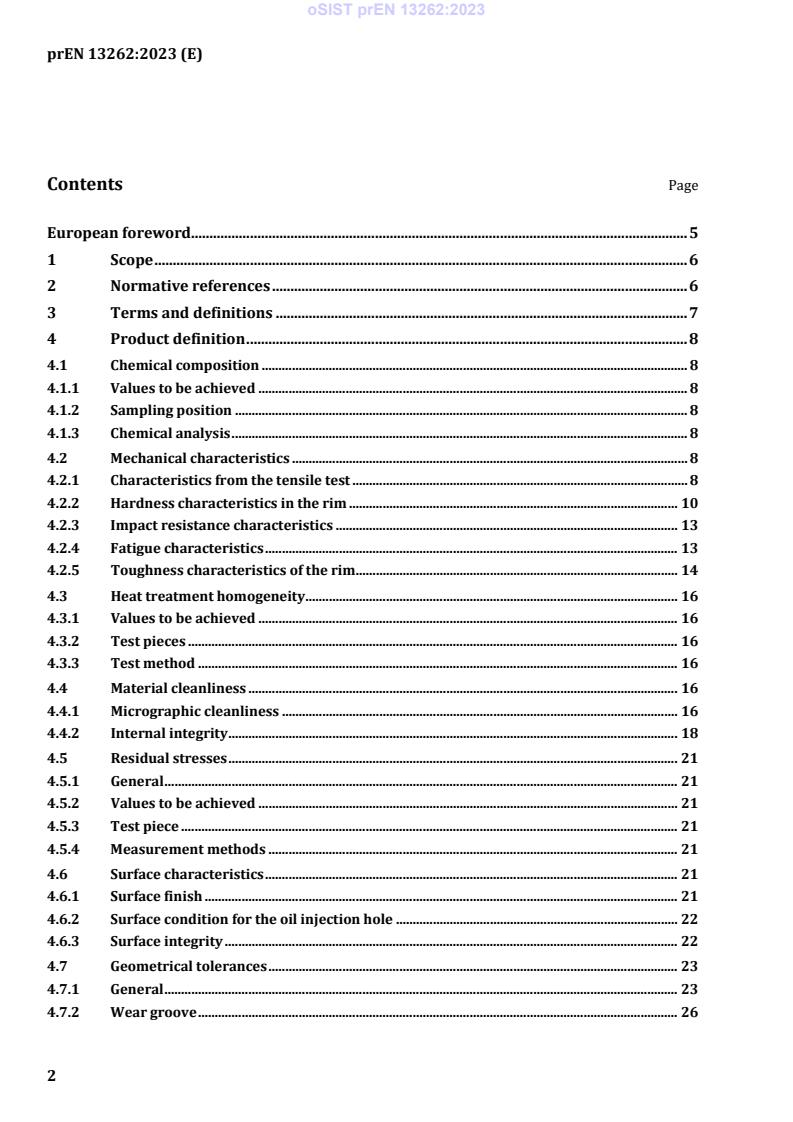
Contents Page
European foreword . 5
1 Scope . 6
2 Normative references . 6
3 Terms and definitions . 7
4 Product definition . 8
4.1 Chemical composition . 8
4.1.1 Values to be achieved . 8
4.1.2 Sampling position . 8
4.1.3 Chemical analysis . 8
4.2 Mechanical characteristics . 8
4.2.1 Characteristics from the tensile test . 8
4.2.2 Hardness characteristics in the rim . 10
4.2.3 Impact resistance characteristics . 13
4.2.4 Fatigue characteristics . 13
4.2.5 Toughness characteristics of the rim . 14
4.3 Heat treatment homogeneity . 16
4.3.1 Values to be achieved . 16
4.3.2 Test pieces . 16
4.3.3 Test method . 16
4.4 Material cleanliness . 16
4.4.1 Micrographic cleanliness . 16
4.4.2 Internal integrity . 18
4.5 Residual stresses . 21
4.5.1 General . 21
4.5.2 Values to be achieved . 21
4.5.3 Test piece . 21
4.5.4 Measurement methods . 21
4.6 Surface characteristics . 21
4.6.1 Surface finish . 21
4.6.2 Surface condition for the oil injection hole . 22
4.6.3 Surface integrity . 22
4.7 Geometrical tolerances . 23
4.7.1 General . 23
4.7.2 Wear groove . 26
oSIST prEN 13262:2023
prEN 13262:2023 (E)
4.8 Static imbalance .26
4.9 Coating and protection against corrosion .27
4.9.1 General requirements .27
4.9.2 Thermo-sensitive paint on tread braked wheels .27
4.10 Marking .28
5 Product qualification . 29
6 Conditions of supply of the product . 29
7 Tips for choosing the steel grade . 29
Annexe A (normative) Evaluation process for the acceptance of new materials . 30
A.1 General . 30
A.2 First step: Characterisation of a new steel grade . 30
A.3 Step two: Testing in service . 30
A.4 Step three: Report . 31
Annexe B (informative) Examples of test benches for fatigue testing . 32
B.1 Test piece . 32
B.2 First test method . 32
B.3 Second test method . 33
B.4 Third test method . 34
Annexe C (informative) Strain gauge method of determining the variation in
circumferential residual stresses deep under the running surface (destructive
method) . 36
C.1 Method principle . 36
C.2 Procedure . 36
C.3 Calculation of the variation of the circumferential residual stress deep under
the running surface . 37
Annexe D (normative) Product qualification . 41
D.1 Introduction . 41
D.2 General . 41
D.3 Requirements . 43
D.4 Qualification procedure . 43
D.5 Validity of the qualification . 46
D.6 Qualification record . 46
Annexe E (normative) Conditions of supply of the product . 48
E.1 Introduction . 48
E.2 General . 48
E.3 Delivery states . 49
E.4 Unit checks. 49
E.5 Batch sampling check . 49
oSIST prEN 13262:2023
prEN 13262:2023 (E)
E.6 Quality plan . 51
E.7 Permissible repairs . 52
E.8 Retest . 52
Annexe F (normative) Measurement of the hydrogen content at the time of development
of steel for monobloc wheels . 53
F.1 General . 53
F.2 Sampling . 53
F.3 Analysis method . 53
F.4 Precautions . 53
Annexe G (informative) Common applications of steel grades . 54
Annex ZA (informative) Relationship between this European Standard and the essential
requirements of EU Directive (EU) 2016/797/EC aimed to be covered . 55
Bibliography . 59
oSIST prEN 13262:2023
prEN 13262:2023 (E)
European foreword
This document (prEN 13262:2023) has been prepared by the CEN/TC 256 “Railway applications”
Technical Committee, the secretariat of which is held by DIN.
This document is currently submitted to the CEN Enquiry.
This document will supersede EN 13262:2020.
This document has been prepared under a Standardization Request given to CEN by the European
Commission and the European Free Trade Association, and supports essential requirements of EU
Directive(s) / Regulation(s).
For relationship with Directive(s) / Regulation(s), see informative Annex ZA, which forms an integral
part of this document.
In comparison with EN 13262:2020, the following technical changes are included in this revision:
— mandatory application of thermo-sensitive paint in tread braked freight application;
— definition of assessment/ product requirements for thermo-sensitive paint;
— an improved definition of the product groups submitted to qualification;
— improved requirements to assess product qualification after changes made in the manufacturing
process.
The informative annexes to this document provide additional guidance that is not mandatory but that
helps to understand or use the document.
NOTE The informative annexes can contain optional requirements. For example, a test method that is
optional, or presented as an example, can contain requirements, but it is not necessary to meet these requirements
to be in compliance with the document.
oSIST prEN 13262:2023
prEN 13262:2023 (E)
1 Scope
This document specifies the characteristics of wheels for all heavy rail track gauges.
This document applies to heavy rail vehicles and applies, in principle, to other vehicles such as urban
rail vehicles. Five steel grades, ER6, ER7, ER8, ERS8 and ER9, are defined in this document.
NOTE 1 Steel grade ERS8 has been introduced in this document as an optimization of steel grades ER8 and ER9
due to contact fatigue (RCF), taking into account service feedback from Europe, for example, BS 5892-3 in force in
the United Kingdom.
Some features are provided as a Category 1 or Category 2 function.
The requirements defined in this document apply to cylindrical bores. Most requirements also apply to
wheels with tapered bores. Specific requirements for tapered bores (e.g. geometrical dimensions, etc.)
are defined in the technical specification.
This document applies to monobloc wheels in vacuum degassed steel, forged and rolled, with surface
treated rims, which have already been the subject of extensive commercial applications on a European
network or have complied with a technical approval procedure according to EN 13979-1:2020 to
validate their design.
Annex A describes the evaluation process for accepting new materials that are not included in this
document.
This document defines the requirements to be met for wheels; the technical approval procedure is not
part of the scope of this document.
NOTE 2 A "surface-treated rim" is achieved by heat treatment which aims to harden the rim and create
compressive residual stress.
2 Normative references
The following documents are referred to in the text in such a way that some or all of their content
constitutes requirements of this document. For dated references, only the edition cited applies. For
undated references, the latest edition of the referenced document (including any amendments) applies.
EN 10020:2000, Definition and classification of grades of steel
EN 13979-1:2020, Railway Applications - Wheelsets and bogies - Monobloc wheels - Technical approval
procedure – Part 1: Forged and rolled wheels
EN ISO 148-1:2016, Metallic materials - Charpy pendulum impact test - Part 1: Test method (ISO
148-1:2016)
EN ISO 1101:2017, Geometrical product specifications (GPS) - Geometrical tolerancing - Tolerances of
form, orientation, location and run-out (ISO 1101:2017)
EN ISO 6506-1:2014, Metallic materials - Brinell hardness test - Part 1: Test method (ISO 6506-1:2005)
EN ISO 6892-1:2019, Metallic materials - Tensile testing - Part 1: Method of test at room temperature (ISO
6892-1:2019)
EN ISO 14284:2022, Steel and iron - Sampling and preparation of samples for the determination of
chemical composition (ISO 14284:2022)
oSIST prEN 13262:2023
prEN 13262:2023 (E)
ISO 4967:2013, Steel - Determination of content of non-metallic inclusions - Micrographic method using
standard diagrams
ISO 5948:2018, Railway rolling stock material - Ultrasonic acceptance testing
ISO 6933:1986, Railway rolling stock material - Magnetic particle acceptance testing
ISO/TR 9769:2018 , Steel and iron - Review of available methods of analysis
ASTM E399-19, Standard test method for linear-elastic plane-strain fracture toughness KIc of metallic
materials
3 Terms and definitions
For the purposes of this document, the following terms and definitions apply.
ISO and IEC maintain terminology databases for use in standardization at the following addresses:
— IEC Electropedia: available at https://www.electropedia.org/
— ISO Online browsing platform: available at https://www.iso.org/obp
3.1
Technical Specification
document describing specific parameters and/or product requirements in addition to the requirements
of this document
3.2
batch
batch consisting of wheels assumed to have the same characteristics
Note 1 to entry: A batch consists of wheels of the same design, forged with the raw material from a single cast
with the same warm forging process and a single heat treatment process. If the raw material is obtained from
several casts with the expected chemical composition, the resulting wheels can be combined in a batch. In this
case, it is necessary to demonstrate in the product qualification that the wheels manufactured from these different
casts meet the requirements for product qualification.
3.3
nominal diameter
diameter of the running tread of a new wheel as indicated on the wheel drawing
3.4
wheel categories
classification of the component, based on operational aspects, which determines the list of requirements
to be applied
Note 1 to entry: Category 1 is generally selected when the operating train speed is greater than 200 km/h.
Note 2 to entry: Category 2 is generally selected when the operating speed is 200 km/h or less
Note 3 to entry: These categories can also be defined in accordance with the technical specification.
1 See also CEN/TR 10261:2018.
oSIST prEN 13262:2023
prEN 13262:2023 (E)
4 Product definition
4.1 Chemical composition
4.1.1 Values to be achieved
The maximum percentages of the different elements specified are given in Table 1.
Table 1 — Maximum percentages of the different elements specified
a
Maximum content in %
Cr +
Steel
b b c
C Si Mn P S Cr Cu Mo Ni V Mo +
grade
Ni
ER6 0,48 0,40 0,75 0,020 0,015 0,30 0,30 0,08 0,30 0,06 0,50
ER7 0,52 0,40 0,80 0,020 0,015 0,30 0,30 0,08 0,30 0,06 0,50
ER8 0,56 0,40 0,80 0,020 0,015 0,30 0,30 0,08 0,30 0,06 0,50
ERS8 0,57 1,10 1,10 0,020 0,015 0,30 0,30 0,08 0,30 0,06 0,60
ER9 0,60 0,40 0,80 0,020 0,015 0,30 0,30 0,08 0,30 0,06 0,50
a
For specific applications, variations of requirements within the limits of the maximum levels can be agreed in
the technical specification.
b
A maximum content of 0,025 % may be agreed in the technical specification for specific applications.
c
A minimum sulphur content may be agreed in the technical specification based on the steel development
process to protect against hydrogen embrittlement.
4.1.2 Sampling position
The sample for determining the chemical composition shall be taken 15 mm under the running tread at
nominal diameter.
NOTE The running tread is the nominal position on the running surface where the wheel and rail are in contact.
The chemical composition can also be determined by casting analysis. In this case, the chemical
composition shall be adapted in the technical specification.
4.1.3 Chemical analysis
The chemical composition analysis shall be performed in accordance with ISO/TR 9769:2018 unless
another standard is defined in the technical specification.
For example, ASTM E415-14 and ASTM E1019-11 can be applied.
4.2 Mechanical characteristics
4.2.1 Characteristics from the tensile test
4.2.1.1 Values to be achieved
Characteristics in the wheel rim and web are given in Table 2.
oSIST prEN 13262:2023
prEN 13262:2023 (E)
Table 2 — Characteristics in the wheel rim and web
Rim Web
a b
Steel grade ReH Rm A5 Reduction of Rm A5
(MPa) (MPa) % (MPa) %
ER6 ≥ 500 780/900 ≥ 15 ≥ 100 ≥ 16
ER7 ≥ 520 820/940 ≥ 14 ≥ 110 ≥ 16
ER8 ≥ 540 860/980 ≥ 13 ≥ 120 ≥ 16
ERS8 ≥ 580 900/1020 ≥ 13 ≥ 110 ≥ 14
ER9 ≥ 580 900/1050 ≥ 12 ≥ 130 ≥ 14
a
If there is no apparent yield strength, the conventional Rp0,2 limit shall be determined.
b
Decrease in tensile strength of the web relative to the rim for the same wheel.
If there are no other requirements in the technical specification, for steel grades ER7, ER8, ERS8 and
ER9, a minimum value of 355 MPa for the yield strength in the web is required. For steel grade ER6, a
minimum value of 310 MPa for the yield strength in the web is required.
4.2.1.2 Position of the test pieces
The test pieces shall be taken from the wheel rim and web. Their positions are shown in Figure 1.
oSIST prEN 13262:2023
prEN 13262:2023 (E)
Dimensions in millimetres
Key
1 tensile test piece in the rim (15 mm axis under the running surface considering its nominal diameter)
2 tensile test piece in the web
3 impact bending test piece
4 nominal diameter
5 notch
Figure 1 — Position of test pieces
4.2.1.3 Test method
The test shall be carried out in accordance with the requirements of EN ISO 6892-1:2019. The nominal
diameter of the test piece shall be at least 10 mm and the length of the deformation gauge shall be five
times the diameter. If the test pieces cannot be taken from the web, a smaller diameter shall be agreed
in the technical specification.
4.2.2 Hardness characteristics in the rim
4.2.2.1 Values to be achieved
The minimum Brinell hardness values given in Table 3 apply up to a maximum of 35 mm of wear range
under the running surface. If the thickness of the wear range is greater than 35 mm, the values shall be
defined in the technical specification.
oSIST prEN 13262:2023
prEN 13262:2023 (E)
The hardness value at the connection between the web and the rim (point A in Figure 2) shall be at least
10 points lower than that measured at the wear range limit.
Table 3 — Values to be achieved for hardness characteristics in the rim
Minimum Brinell hardness value
Steel grade Category 1 Category 2
ER6 — 225
ER7 245 235
ER8 245 245
ERS8 250 250
ER9 255 255
4.2.2.2 Position of measuring points
Four measurements are made on a radial section of the rim, as shown in Figure 2.
oSIST prEN 13262:2023
prEN 13262:2023 (E)
Dimensions in millimetres
Key
1 limit of wear range or diameter of last achievable re-profiling (according to technical specification).
2 nominal diameter
3 internal diameter (on external face)
Figure 2 — Measurements made on a radial section of the rim
The values in Figure 2 are valid for standard gauge axles and for a rim profile width of 135 mm and
above. Other gauges and profiles may be defined in the technical specification.
4.2.2.3 Test method
It shall be carried out according to EN ISO 6506-1:2014. The diameter of the ball is 5 mm.
oSIST prEN 13262:2023
prEN 13262:2023 (E)
4.2.3 Impact resistance characteristics
4.2.3.1 Values to be achieved
The values to be achieved for the impact test are given in Table 4. For each temperature, they represent
the average value and the minimum value for the three test pieces defined in 4.2.3.2, and on the other
hand the minimum unit values. At + 20 °C, U-notch test pieces shall be used. At – 20 °C, V-notch test
pieces shall be used.
Table 4 — Values to be achieved for impact resistance characteristics
KU (Joules) at + 20 °C KV (Joules) at – 20 °C
Steel grade
Average values Minimum values Average values Minimum values
ER6 ≥ 17 ≥ 12 ≥ 12 ≥ 8
ER7 ≥ 17 ≥ 12 ≥ 10 ≥ 7
ER8 ≥ 17 ≥ 12 ≥ 10 ≥ 5
ERS8 ≥15 ≥11 ≥ 9 ≥ 5
ER9 ≥ 13 ≥ 9 ≥ 8 ≥ 5
4.2.3.2 Position of the test pieces
The position of the three test pieces is given in Figure 1. The axis of the bottom of the notches shall be
parallel to the A-A axis in Figure 1.
4.2.3.3 Test method
The test shall be carried out in accordance with EN ISO 148-1:2016.
4.2.4 Fatigue characteristics
4.2.4.1 Values to be achieved
The stress magnitude Δσ that a wheel web shall withstand, regardless of the steel grade, for 10 million
cycles without showing crack initiation with a probability of 99,7 % is given in Table 5.
This requirement is met by testing two wheels, in accordance with Annex D, D.4.4.
oSIST prEN 13262:2023
prEN 13262:2023 (E)
Table 5 — Values to be achieved for fatigue characteristics of the web
Maximum roughness Fatigue stress limits according to Values to be achieved
the wheel design evaluation for fatigue
Ra
procedure (EN 13979-1:2020) characteristics
µm
Δσ Δσ (99,7%)
(MPa) (MPa)
6,3 360 450
12,5 290 315
NOTE The purpose of obtaining these values is to ensure that the product has characteristics superior to those
used to define the allowable stresses required to size the wheel web under fatigue.
Given the approximations inherent in a fatigue calculation, the differentiation of five steel grades is
unrealistic for this characteristic. For steel grade ER6, if a lower value is expected, it shall be specified
and justified in the technical specification.
4.2.4.2 Fatigue test pieces
The test pieces shall be made up from wheels as delivered. In particular, the surface finishes of the web
are those defined in 4.6.
4.2.4.3 Test method
The test method shall enable bending stresses to be created in a section of the wheel web.
The tests shall be conducted in order to be able to use a fatigue test statistical counting method.
The tests are controlled from the radial stresses existing in the cracking area of the wheel web.
Examples of test methods are given in Annex B.
4.2.5 Toughness characteristics of the rim
4.2.5.1 General
This characteristic need only to be verified on tread braked wheels (service brake or parking brake) or
equipped with a running surface cleaning system (e.g. scrubbers), whether they are Category 1 or
Category 2.
4.2.5.2 Values to be achieved
For steel wheels of grade ER6, the average value obtained on six test pieces shall be greater than or
equal to 100 MPa m and each individual value shall be greater than or equal to 80 MPa m .
For steel wheels of grade ER7, the average value obtained on six test pieces shall be greater than or
and each individual value shall be greater than or equal to 70 MPa .
equal to 80 MPa m m
For wheels of other steel grades, the values to be achieved shall be contained in the technical
specification.
oSIST prEN 13262:2023
prEN 13262:2023 (E)
4.2.5.3 Position of the test pieces
Six test pieces shall be taken from the rim as shown in Figure 3.
The test pieces shall be evenly distributed across the entire rim.
Dimensions in millimetres
Key
1 nominal diameter
Figure 3 — Test pieces collected from the rim
4.2.5.4 Test method
The test shall be performed according to ASTM E399-19.
The special conditions that shall be used are:
— compact 30 mm thick tensile test pieces (CT30), with chevron notch with aperture angle of 90°;
— test temperature between + 15 °C and + 25 °C;
— measurement of the notch opening at the end of the test piece;
— rate of increase of stress intensity ΔK/s, for the tensile test, between 0,55 MPa ms/ and 1 MPa
ms/ .
The toughness value considered shall be the value K , calculated from the force P , determined on the
Q Q
tensile test curve.
For steel grade ER6, when P /P ≥ 1,4, the value P can be used to determine the value of K .
max q max Q
NOTE This option is explained in document ERRI B169 DT 251.
oSIST prEN 13262:2023
prEN 13262:2023 (E)
4.3 Heat treatment homogeneity
4.3.1 Values to be achieved
For Category 1 wheels, the variation in the Brinell hardness value measured on the outer face of the rim
of the tested wheel shall be 30 HB or less.
NOTE The values are not correlated with the hardness values measured in the rim according to 4.2.2 or with
the results of the wheel rim tensile test according to 4.2.1.
4.3.2 Test pieces
The hardness values shall be measured at three points located at 120° on the outer face of the rim. The
impressions shall be made on the same diameter in an area whose position is defined in Figure 4.
Dimensions in millimetres
Key
1 nominal diameter on the running tread
2 area for Brinell hardness measurement
Figure 4 — Hardness impression area
4.3.3 Test method
The measurements shall be carried out in accordance with EN ISO 6506-1:2014. The diameter of the
ball is 10 mm.
4.4 Material cleanliness
4.4.1 Micrographic cleanliness
4.4.1.1 Level to be achieved
The assessment shall be determined from the micrographic examination according to 4.4.1.3. The values
to be achieved are given in Table 6.
oSIST prEN 13262:2023
prEN 13262:2023 (E)
Table 6 — Level to be achieved for the micrographic examination
Category 1 Category 2
Type of
Thick Thick
Thin series Thin series
inclusions
series series
(max) (max)
(max) (max)
A (Sulphide) 1,5 1,5 1,5 2
B (Aluminium) 1 1,5 1,5 2
C (Silicates) 1 1,5 1,5 2
D (Globular 1 1,5 1,5 2
oxides)
B + C + D 2 3 3 4
DS 1,5 2
4.4.1.2 Position of the micrographic sample
The field to be examined corresponds to the hatched area in Figure 5.
Its centre "F" is located 15 mm below the running surface.
Dimensions in millimetres
Key
1 nominal running tread
Figure 5 — Position of the micrographic sample
4.4.1.3 Test method
The level of cleanliness shall be determined in accordance with ISO 4967:2013, Method "A".
oSIST prEN 13262:2023
prEN 13262:2023 (E)
4.4.2 Internal integrity
4.4.2.1 General
The internal integrity of the wheels shall be determined from an ultrasound examination. Standard
defects are flat bottomed holes of different diameters.
4.4.2.2 Level to be achieved
4.4.2.2.1 Wheel rim
The wheel rims shall not have internal defects giving indications of anomalies equal to or greater than
those obtained for standard defects, located at the same depth. The diameter of this standard defect is
given in Table 7.
Table 7 — Diameter of the standard defect
Category 1 Category 2
a
Standard defect diameter (mm) 1 2
a
A value of 3 mm can only be adopted for wheels up to 120 km/h, and shall be indicated in the technical
specification.
No attenuation of the bottom echo greater than or equal to 4 dB shall be tolerated when examining the
rims in the axial direction.
4.4.2.2.2 Wheel web
The wheel web shall not have:
— More than 10 indications of anomalies equal to or greater than those observed for standard defects
of ∅ 3 mm;
— Indications of anomalies equal to or greater than those observed for standard defects of ∅ 5 mm.
The permissible anomalies shall be at least 50 mm apart.
4.4.2.2.3 Wheel hub
The wheel hub shall not have:
— More than 3 indications of anomalies equal to or greater than those observed for standard defects of
∅ 3 mm;
— Indications of anomalies equal to or greater than those observed for standard defects of ∅ 5 mm.
The permissible anomalies shall be at least 50 mm apart.
For the same circumferential examination, no attenuation of the bottom echo equal to or greater than
6 dB is tolerated.
4.4.2.3 Test piece
The test piece shall consist of the complete wheel, after heat treatment, either in its as-cast state or
delivery state, and before corrosion protection.
oSIST prEN 13262:2023
prEN 13262:2023 (E)
4.4.2.4 Examination methods
4.4.2.4.1 General
The test shall be conducted by qualified personnel.
EN ISO 9712 shall be used to meet this requirement.
The general conditions of ultrasound examinations are given by ISO 5948 and shall be supplemented by
the following special terms and conditions.
4.4.2.4.2 Wheel rim
The rim shall be examined using methods D1 and D2 in ISO 5948:2018, Table 1.
Defect estimation shall be made by comparison with the artificial defects of the standard rim described
in ISO 5948:2018, Annex A.
4.4.2.4.3 Wheel web
The type of curvature (convex/concave) of the wheel web shall be taken into account in determining the
sensitivity of the test procedure.
The artificial reference defect shall be positioned both on the inner face and on the outer face of the
wheel web.
The web shall be examined on both sides. The examination is carried out in a direction perpendicular to
the surface.
Defect estimation shall be made by comparison with the artificial defects of the standard web.
The web is defined as the portion of the wheel between the two diameters where m and n are defined
in Figure 7.
The thickness e of the web is defined by:
mn+
e =
The position of the artificial defects is given according to the value of e. Two artificial defects shall be
circumferentially spaced at least 100 mm apart.
— e ≤ 10 mm:
— A 3 mm diameter flat-bottomed hole located 5 mm below the surface of the inner face of the
web;
— A 5 mm diameter flat-bottomed hole located 5 mm below the surface of the inner face of the web;
— 10 mm < e ≤ 20 mm:
— Two 3 mm diameter flat-bottomed holes located 5 mm and (e – 5) mm below the surface of the
inner face of the web;
— Two 5 mm diameter flat-bottomed holes located 5 mm and (e – 5) mm below the surface of the
inner face of the web;
oSIST prEN 13262:2023
prEN 13262:2023 (E)
— e > 20 mm:
e
— Three 3 mm diameter flat-bottomed holes located 5 mm, mm and (e – 5) mm below the
surface of the inner face of the web;
e
— Three 5 mm diameter flat-bottomed holes located 5 mm, mm and (e – 5) mm below the
surface of the inner face of the web.
4.4.2.4.4 Wheel hub
The hub shall be examined on both sides. The direction of the examination is perpendicular to the
surface.
Defect estimation is made by comparison with the artificial defects of the standard hub described in
Figure 6.
Dimensions in millimetres
NOTE Calibration references are:
— 3 holes of ∅ 3 mm located at different depths,
— 3 holes of ∅ 5 mm located at different depths
spaced as shown above.
Figure 6 — Standard hub for ultrasound examination
oSIST prEN 13262:2023
prEN 13262:2023 (E)
4.5 Residual stresses
4.5.1 General
The heat treatment performed on the wheel shall create a compressive circumferential residual stress
field in the rim.
4.5.2 Values to be achieved
The circumferential residual stresses σcrs on the surface of the finished wheel running surface shall be in
compression where σ ≤ − 80 MPa. If the value of the circumferential residual stress on the surface of
crs
the finished wheel running surface is less than -200 MPa, it shall be demonstrated that the level of radial
residual stresses in the wheel web as a result is acceptable.
The residual tensile stresses in the wheel web can influence the fatigue resistance of the wheel web. An
assessment of this effect can be demonstrated, for example, by means of feedback, a fatigue test on the
wheel web, a calculation taking into account the effect of the mean stress in relation to residual stress,
etc.
Circumferential residual stresses shall be compressed over the entire wear range.
NOTE The compression stress value is assumed to reach zero in the rim. A typical depth of this transition is in
the area between the wear limit and 15 mm below.
4.5.3 Test piece
The test piece shall consist of the complete wheel, after heat treatment and final machining.
4.5.4 Measurement methods
Measurement methods (for example, ultrasound or destructive) shall determine the variation in
circumferential stresses deep under the running surface. This method shall be defined in the technical
specification.
Annex C sets out a method for this destructive testing measurement.
4.6 Surface characteristics
4.6.1 Surface finish
4.6.1.1 General
Machined wheel webs are recommended for all wheel applications. When non-machined wheel webs
are used (for example for double ripple wheels), magnetic particle examination shall be performed in
accordance with subclause 4.6.3.
Parts that remain "as-forged" and/or "as-rolled" shall be cleaned by mechanical means (e.g.
shot-blasting) to remove any irregularities from the forging and heat treatment process and shall be
smoothly blended into the machined areas.
4.6.1.2 Characteristics to be achieved
Depending on their use, the wheels can be fully machined or not. They shall have no surface marks (for
example, tightening marks) other than those specified at the positions provided in this document (for
example, marking, indentation hardness).
The roughness (Ra) of surfaces in the "finished" and "ready to assemble" states of the wheels is given in
Table 8.
oSIST prEN 13262:2023
prEN 13262:2023 (E)
Table 8 — Roughness of wheel surfaces (Ra) in delivery state
Roughness Ra
a (µm)
Part of the wheel Delivery state
Category 1 Category 2
Finished ≤ 12,5
Bore
b
Ready to assemble 0,8 to 3,2
≤ 6,3
(the value 12,5 can be
used if evidence is
c
Web and hub Finished ≤ 3,2
provided of the fatigue
limit being reached in
accordance with
EN 13979-1:2020)
d
Running surface Finished ≤ 6,3 ≤ 12,5
d
Rim faces Finished ≤ 6,3 ≤ 12,5
a
See E.3.
b
If the wheel is to be fitted to a hollow axle, other values may be stipulated in the technical specification to
allow ultrasound examinations in service.
c
If the technical specification so defines, these parts may be non-machined to the extent that the roughness
tolerances meet the requirements of this table.
d
≤ 6,3 if a standard defect of 2 mm is prescribed (see 4.4.2).
4.6.1.3 Measurement and inspection method
The general condition of the wheel surface shall be visually inspected.
The roughness of the wheel surfaces (Ra) in the delivery state, as shown in Table 8, shall be checked by
comparison with the surface finish reference standards or measured with a roughness meter on the flat
surfaces.
4.6.2 Surface condition for the oil injection hole
The oil injection hole for the wheel and the groove shall be free of dirt and other obstructions. They shall
be protected from dirt during transport and storage after final machining of the wheel is carried out.
4.6.3 Surface integrity
4.6.3.1 General
The surface integrity shall be determined by magnetic particle examination, or other methods can be
used for delivery if the technical specification so provides (see Table E.1).
Examinations shall be carried out by qualified personnel.
EN ISO 9712 shall be used to meet this requirement.
oSIST prEN 13262:2023
prEN 13262:2023 (E)
4.6.3.2 Level to be achieved
Unless otherwise specified in the technical specification, the maximum lengths of permissible
surface-breaking defects shall be:
— 2 mm on machined surfaces,
— 6 mm on as-forged or as-rolled surfaces.
4.6.3.3 Test piece
The test piece shall consist of the wheel, after heat treatment, in delivery state and before corrosion
protection.
4.6.3.4 Examination methods
Magnetic particle examination shall be carried out under the general conditions required by
ISO 6933:1986, with the exception of:
— The value of the magnetic surface induction which shall be 4 mT or greater;
— The irradiance of the ultraviolet light which shall be 15 W/m or greater.
The method of magnetisation to be used is that indicated in ISO 6933:1986, Figure C.
The equipment used shall highlight defects at any point in the wheel, regardless of their orientation.
After performing a magnetic particle examination, the wheels shall be de-magnetised. Residual
magnetism shall be less than 4 A/cm.
4.7 Geometrical tolerances
4.7.1 General
The geometry and dimensions of the wheels shall be defined by the drawings attached to the technical
specification.
The geometrical tolerances sh
...