

EN ISO 16805:2005
(Main)Binders for paints and varnishes - Determination of glass transition temperature (ISO 16805:2003)
General Information
- Abstract
ISO 16805:2003 specifies the procedure to be used for sample preparation for the determination of the glass transition temperature of binders for paints and varnishes, including coating powders, by differential scanning calorimetry (DSC). The method to be used for determining the glass transition temperature is specified in ISO 11357-2.
- Status
- Published
- Publication Date
- 03-May-2005
- Withdrawal Date
- 29-Nov-2005
- Technical Committee
- CEN/TC 139 - Paints and varnishes
- Drafting Committee
- CEN/TC 139 - Paints and varnishes
- Current Stage
- 6060 - Definitive text made available (DAV) - Publishing
- Start Date
- 04-May-2005
- Completion Date
- 04-May-2005

Overview
EN ISO 16805:2005 (identical to ISO 16805:2003) specifies the procedure for sample preparation when determining the glass transition temperature (Tg) of binders for paints and varnishes, including coating powders, using differential scanning calorimetry (DSC). The standard focuses on preparing representative, reproducible specimens; the actual DSC measurement method is given in ISO 11357-2.
Key topics and requirements
- Scope: Sample preparation for Tg determination of binders for paints and varnishes; measurement follows ISO 11357-2.
- Sampling: Take a representative sample in accordance with ISO 15528.
- Film application:
- Use a film applicator with a gap of 40 µm to 50 µm.
- Apply a wet-film thickness approximately 20 µm to 25 µm (0.8–1.0 mills/thous) or as agreed by the user.
- Substrates: Use a flat, inert, non‑porous substrate that allows easy film removal (examples: glass, PTFE, EPDM) that is inert to the binder.
- Drying: Store films under controlled atmospheric conditions until fully dry. When comparing systems, use identical drying times and conditions.
- Elevated temperature caution: Higher drying temperatures may shorten drying time but can cause thermal decomposition or crosslinking, altering Tg; select temperatures carefully.
- DSC sample preparation: After drying, place a specimen of known mass in a DSC pan ensuring good contact as specified in ISO 11357-2 (see Subclause 9.2).
- Reporting requirements: Test reports must include reference to ISO 16805, product identification (manufacturer, trade name, batch), sample preparation details (substrate, application, drying conditions, test temperature/pressure), measurement parameters and results per ISO 11357-1/2, whether onset or midpoint Tg was reported and whether first or second measurement was used, any deviations, and test date.
Applications and users
This standard is essential for:
- Paint and varnish formulators verifying polymer binder properties.
- Quality control and analytical laboratories performing routine Tg testing.
- R&D teams comparing binder formulations or processing conditions.
- Coatings manufacturers assessing the effect of solvents, drying, or curing on polymer mobility.
- Regulatory and standards bodies needing consistent, reproducible sample-preparation protocols.
Practical benefits include improved reproducibility of Tg results, consistent sample handling across labs, and reliable data to guide formulation, processing, and performance predictions.
Related standards
- ISO 11357-1: Plastics - DSC - Part 1: General principles
- ISO 11357-2: Plastics - DSC - Part 2: Determination of glass transition temperature (method for Tg measurement)
- ISO 15528: Paints, varnishes and raw materials - Sampling
Keywords: EN ISO 16805:2005, glass transition temperature, Tg, binders for paints and varnishes, DSC, differential scanning calorimetry, sample preparation, ISO 11357-2, coating powders.
Relations
- Effective Date
- 25-Aug-2026
- Effective Date
- 25-Aug-2026
- Refers
ISO 11357-1:2009 - Plastics — Differential scanning calorimetry (DSC) — Part 1: General principles - Effective Date
- 25-Aug-2026
- Effective Date
- 28-Jan-2026
- Effective Date
- 28-Jan-2026
Frequently Asked Questions
EN ISO 16805:2005 is a standard published by the European Committee for Standardization (CEN). Its full title is "Binders for paints and varnishes - Determination of glass transition temperature (ISO 16805:2003)". This standard covers: ISO 16805:2003 specifies the procedure to be used for sample preparation for the determination of the glass transition temperature of binders for paints and varnishes, including coating powders, by differential scanning calorimetry (DSC). The method to be used for determining the glass transition temperature is specified in ISO 11357-2.
ISO 16805:2003 specifies the procedure to be used for sample preparation for the determination of the glass transition temperature of binders for paints and varnishes, including coating powders, by differential scanning calorimetry (DSC). The method to be used for determining the glass transition temperature is specified in ISO 11357-2.
EN ISO 16805:2005 is classified under the following ICS (International Classification for Standards) categories: 87.060.20 - Binders. The ICS classification helps identify the subject area and facilitates finding related standards.
EN ISO 16805:2005 has the following relationships with other standards: It is inter standard links to ISO 11357-2:1999, ISO 15528:2000, ISO 11357-1:2009, EN 1395-7:2007, EN 3375-009:2016. Understanding these relationships helps ensure you are using the most current and applicable version of the standard.
EN ISO 16805:2005 is available in PDF format for immediate download after purchase. The document can be added to your cart and obtained through the secure checkout process. Digital delivery ensures instant access to the complete standard document.
Standards Content (Sample)
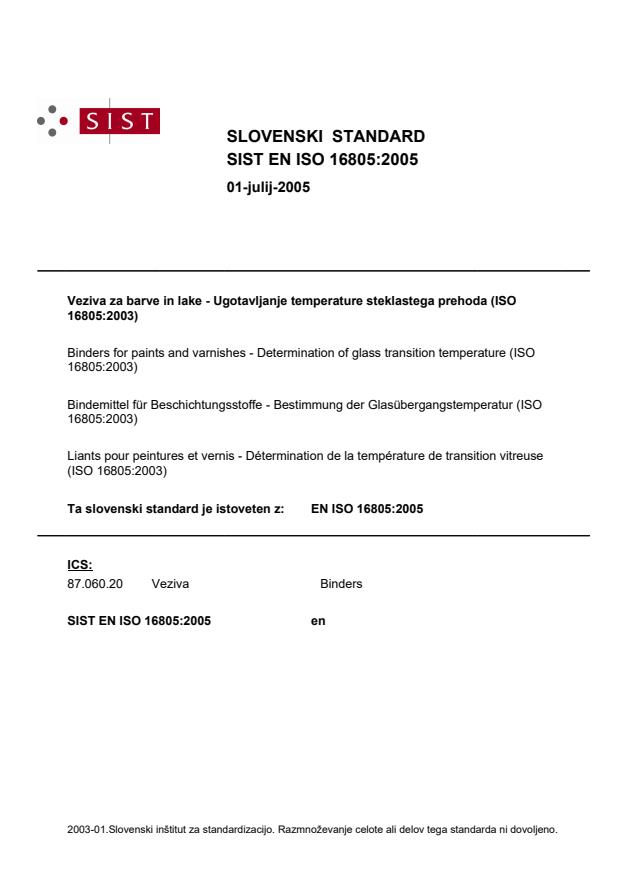
SLOVENSKI STANDARD
01-julij-2005
Veziva za barve in lake - Ugotavljanje temperature steklastega prehoda (ISO
16805:2003)
Binders for paints and varnishes - Determination of glass transition temperature (ISO
16805:2003)
Bindemittel für Beschichtungsstoffe - Bestimmung der Glasübergangstemperatur (ISO
16805:2003)
Liants pour peintures et vernis - Détermination de la température de transition vitreuse
(ISO 16805:2003)
Ta slovenski standard je istoveten z: EN ISO 16805:2005
ICS:
87.060.20 Veziva Binders
2003-01.Slovenski inštitut za standardizacijo. Razmnoževanje celote ali delov tega standarda ni dovoljeno.
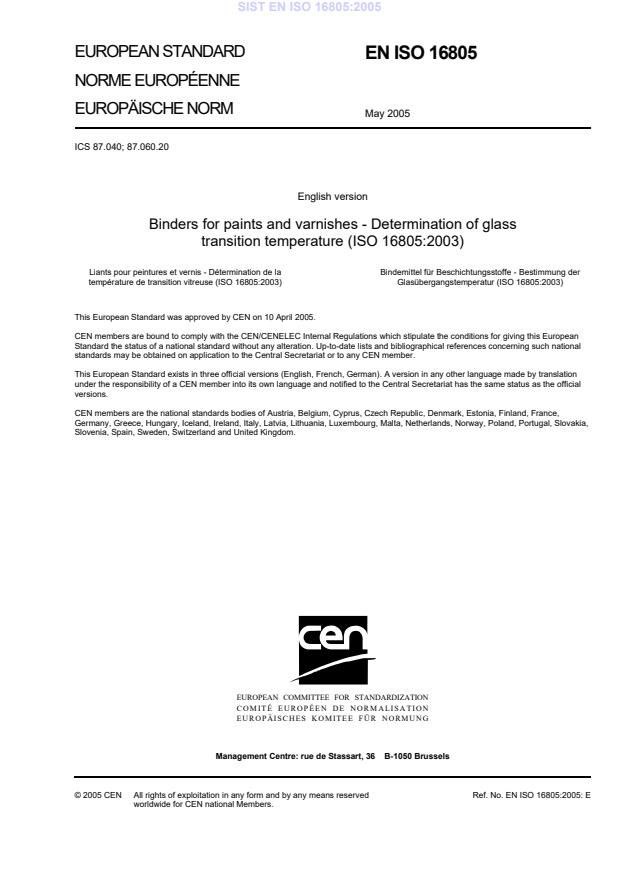
EUROPEAN STANDARD
EN ISO 16805
NORME EUROPÉENNE
EUROPÄISCHE NORM
May 2005
ICS 87.040; 87.060.20
English version
Binders for paints and varnishes - Determination of glass
transition temperature (ISO 16805:2003)
Liants pour peintures et vernis - Détermination de la Bindemittel für Beschichtungsstoffe - Bestimmung der
température de transition vitreuse (ISO 16805:2003) Glasübergangstemperatur (ISO 16805:2003)
This European Standard was approved by CEN on 10 April 2005.
CEN members are bound to comply with the CEN/CENELEC Internal Regulations which stipulate the conditions for giving this European
Standard the status of a national standard without any alteration. Up-to-date lists and bibliographical references concerning such national
standards may be obtained on application to the Central Secretariat or to any CEN member.
This European Standard exists in three official versions (English, French, German). A version in any other language made by translation
under the responsibility of a CEN member into its own language and notified to the Central Secretariat has the same status as the official
versions.
CEN members are the national standards bodies of Austria, Belgium, Cyprus, Czech Republic, Denmark, Estonia, Finland, France,
Germany, Greece, Hungary, Iceland, Ireland, Italy, Latvia, Lithuania, Luxembourg, Malta, Netherlands, Norway, Poland, Portugal, Slovakia,
Slovenia, Spain, Sweden, Switzerland and United Kingdom.
EUROPEAN COMMITTEE FOR STANDARDIZATION
COMITÉ EUROPÉEN DE NORMALISATION
EUROPÄISCHES KOMITEE FÜR NORMUNG
Management Centre: rue de Stassart, 36 B-1050 Brussels
© 2005 CEN All rights of exploitation in any form and by any means reserved Ref. No. EN ISO 16805:2005: E
worldwide for CEN national Members.
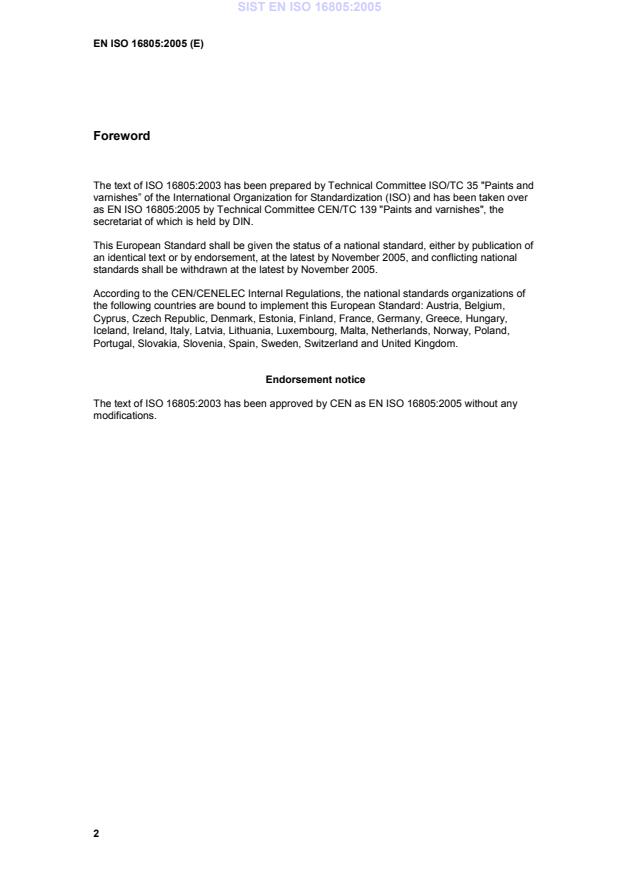
Foreword
The text of ISO 16805:2003 has been prepared by Technical Committee ISO/TC 35 "Paints and
varnishes” of the International Organization for Standardization (ISO) and has been taken over
as EN ISO 16805:2005 by Technical Committee CEN/TC 139 "Paints and varnishes", the
secretariat of which is held by DIN.
This European Standard shall be given the status of a national standard, either by publication of
an identical text or by endorsement, at the latest by November 2005, and conflicting national
standards shall be withdrawn at the latest by November 2005.
According to the CEN/CENELEC Internal Regulations, the national standards organizations of
the following countries are bound to implement this European Standard: Austria, Belgium,
Cyprus, Czech Republic, Denmark, Estonia, Finland, France, Germany, Greece, Hungary,
Iceland, Ireland, Italy, Latvia, Lithuania, Luxembourg, Malta, Netherlands, Norway, Poland,
Portugal, Slovakia, Slovenia, Spain, Sweden, Switzerland and United Kingdom.
Endorsement notice
The text of ISO 16805:2003 has been approved by CEN as EN ISO 16805:2005 without any
modifications.
INTERNATIONAL ISO
STANDARD 16805
First edition
2003-10-15
Binders for paints and varnishes —
Determination of glass transition
temperature
Liants pour peintures et vernis — Détermination de la température de
transition vitreuse
Reference number
ISO 16805:2003(E)
©
ISO 2003
ISO 16805:2003(E)
PDF disclaimer
This PDF file may contain embedded typefaces. In accordance with Adobe's licensing policy, this file may be printed or viewed but
shall not be edited unless the typefaces which are embedded are licensed to and installed on the computer performing the editing. In
downloading this file, parties accept therein the responsibility of not infringing Adobe's licensing policy. The ISO Central Secretariat
accepts no liability in this area.
Adobe is a trademark of Adobe Systems Incorporated.
Details of the software products used to create this PDF file can be found in the General Info relative to the file; the PDF-creation
parameters were optimized for printing. Every care has been taken to ensure that the file is suitable for use by ISO member bodies. In
the unlikely event that a problem relating to it is found, please inform the Central Secretariat at the address given below.
© ISO 2003
All rights reserved. Unless otherwise specified, no part of this publication may be reproduced or utilized in any form or by any means,
electronic or mechanical, including photocopying and microfilm, without permission in writing from either ISO at the address below or
ISO's member body in the country of the requester.
ISO copyright office
Case postale 56 • CH-1211 Geneva 20
Tel. + 41 22 749 01 11
Fax + 41 22 749 09 47
E-mail copyright@iso.org
Web www.iso.org
Published in Switzerland
ii © ISO 2003 — All rights reserved
ISO 16805:2003(E)
Foreword
ISO (the International Organization for Standardization) is a worldwide federation of national standards bodies
(ISO member bodies). The work of preparing International Standards is normally carried out through ISO
technical committees. Each member body interested in a subject for which a technical committee has been
established has the right to be represented on that committee. International organizations, governmental and
non-governmental, in liaison with ISO, also take part in the work. ISO collaborates closely with the
International Electrotechnical Commission (IEC) on all matters of electrotechnical standardization
...