

EN 16922:2026
(Main)Railway applications - Ground based service - Vehicle waste water discharge equipment
General Information
- Abstract
This document specifies the interface requirements for controlled emission toilet equipment on railway vehicles and the infrastructure, including catering area sink waste retention tanks. Vehicle and infrastructure specific requirements are also given.
The document includes fixed and portable infrastructure equipment used to empty retention tanks, but excludes equipment fitted to railway vehicles where no fixed connections are used between vehicle and infrastructure.
- Status
- Published
- Publication Date
- 24-Feb-2026
- Technical Committee
- CEN/TC 256 - Railway applications
- Drafting Committee
- CEN/TC 256/WG 43 - Ground based services
- Current Stage
- 6060 - Definitive text made available (DAV) - Publishing
- Start Date
- 25-Feb-2026
- Due Date
- 26-Feb-2026
- Completion Date
- 25-Feb-2026

Overview
EN 16922:2026 is a European standard developed by CEN that defines the interface requirements for controlled emission toilet (CET) equipment on railway vehicles and related infrastructure. This standard ensures safe, hygienic, and efficient waste water management for rolling stock by standardizing connections, system design, and operation for both vehicle and ground-based (fixed and portable) service installations. It covers requirements for toilet and catering sink waste retention tanks, specifies labelling and connection identification, and addresses both vehicle and supporting infrastructure interfaces.
EN 16922:2026 supersedes EN 16922:2017+A1:2019 and introduces key updates for system pressure guidance and alignment with current standard references, supporting safety, interoperability, and maintenance efficiency throughout the European rail network.
Key Topics
- Controlled Emission Toilets (CET): Standardizes the interface, marking, and operational expectations for emission control and waste retention systems in railway vehicles.
- Interface Connections: Defines and modularizes the design for 3” and 1” discharge/flushing connections, ensuring compatibility between trains and servicing infrastructure.
- Retention Tank Requirements: Outlines construction, location, and labelling of waste and grey water tanks for passenger toilets and catering facilities, emphasizing leak-proof and corrosion-resistant design.
- System Labelling and Marking: Specifies identification protocols for all connections and tanks, including color codes, labelling in the native language and English, and prominent display of tank volumes.
- Flushing and Ventilation: Sets minimum and aspirational flushing volumes, mandates venting systems to avoid pressure imbalances, and details cleaning and maintenance access requirements.
- Infrastructure Equipment: Specifies fixed and mobile equipment for safe and efficient emptying and flushing of retention tanks, including breakaway couplings, vacuum or air pressure systems, and backflow prevention devices.
- Temperature and Environmental Resistance: Defines minimum operational temperature thresholds and durability against cold climates and vibration, enhancing reliability and safety.
Applications
EN 16922:2026 is essential for:
- Railway Operators: Establishes consistent processes for waste water discharge, supports hygienic conditions for passengers and staff, and aligns waste management practices with regulatory requirements.
- Rolling Stock Manufacturers: Ensures new and refurbished vehicles meet harmonized European waste water discharge interfaces, thus simplifying development, procurement, and cross-border operation.
- Infrastructure Managers: Provides standardized requirements for design and operation of ground-based service points, minimizing operational risks, preventing contamination, and facilitating efficient maintenance.
- Maintenance Providers: Guides safe and efficient cleaning, emptying, and servicing procedures, with a focus on clear identification and compatibility.
- Environmental Compliance: Supports the safe containment, collection, and disposal of black water (toilet) and grey water (sink) effluents, in line with environmental protection and public health regulations.
Related Standards
EN 16922:2026 references and works in conjunction with several related railway and water management standards, including:
- EN 1717: Protection of potable water installations and devices against pollution.
- EN 12663-1: Structural requirements for railway vehicle bodies.
- EN 15877-2: Markings for railway vehicles.
- EN 16362: Ground-based services for water restocking on rolling stock.
- EN 45545-2: Fire protection requirements for railway materials and components.
Additionally, referencing standards such as EN 50125-1 (environmental conditions for rolling stock equipment) and UIC 563 (rail coach hygiene fittings) provides comprehensive coverage and helps ensure system reliability and interoperability across the European rail sector.
Keywords: EN 16922:2026, controlled emission toilets, railway waste water discharge, rail vehicle retention tanks, ground-based service equipment, European railway standards, CET interface requirements, railway hygiene, rolling stock maintenance, waste disposal infrastructure.
Relations
- Effective Date
- 22-Nov-2023
- Effective Date
- 01-Apr-2026
- Effective Date
- 01-Apr-2026
- Effective Date
- 18-Mar-2026
Get Certified
Connect with accredited certification bodies for this standard

IRIS Certification (UNIFE)
International Railway Industry Standard certification.

TÜV SÜD Rail GmbH
TÜV SÜD railway certification services.

Bureau Veritas Railway Certification
Railway and transportation certification.
Sponsored listings
Frequently Asked Questions
EN 16922:2026 is a standard published by the European Committee for Standardization (CEN). Its full title is "Railway applications - Ground based service - Vehicle waste water discharge equipment". This standard covers: This document specifies the interface requirements for controlled emission toilet equipment on railway vehicles and the infrastructure, including catering area sink waste retention tanks. Vehicle and infrastructure specific requirements are also given. The document includes fixed and portable infrastructure equipment used to empty retention tanks, but excludes equipment fitted to railway vehicles where no fixed connections are used between vehicle and infrastructure.
This document specifies the interface requirements for controlled emission toilet equipment on railway vehicles and the infrastructure, including catering area sink waste retention tanks. Vehicle and infrastructure specific requirements are also given. The document includes fixed and portable infrastructure equipment used to empty retention tanks, but excludes equipment fitted to railway vehicles where no fixed connections are used between vehicle and infrastructure.
EN 16922:2026 is classified under the following ICS (International Classification for Standards) categories: 45.060.20 - Trailing stock. The ICS classification helps identify the subject area and facilitates finding related standards.
EN 16922:2026 has the following relationships with other standards: It is inter standard links to EN 16922:2017+A1:2019, EN 1717:2025+A1:2026, EN 1717:2025, EN 45545-2:2020+A1:2023. Understanding these relationships helps ensure you are using the most current and applicable version of the standard.
EN 16922:2026 is associated with the following European legislation: Standardization Mandates: M/483. When a standard is cited in the Official Journal of the European Union, products manufactured in conformity with it benefit from a presumption of conformity with the essential requirements of the corresponding EU directive or regulation.
EN 16922:2026 is available in PDF format for immediate download after purchase. The document can be added to your cart and obtained through the secure checkout process. Digital delivery ensures instant access to the complete standard document.
Standards Content (Sample)
SLOVENSKI STANDARD
01-maj-2026
Nadomešča:
SIST EN 16922:2018+A1:2019
Železniške naprave - Talna oskrba - Oprema vozil za odvoz odpadnih voda
Railway applications - Ground based services - Vehicle waste water discharge
equipment
Bahnanwendungen - Versorgungsdienste - Fahrzeugabwasserentsorgungseinrichtungen
Applications ferroviaires - Services au sol - Equipement de vidange des eaux usées des
véhicules
Ta slovenski standard je istoveten z: EN 16922:2026
ICS:
13.060.30 Odpadna voda Sewage water
45.060.20 Železniški vagoni Trailing stock
2003-01.Slovenski inštitut za standardizacijo. Razmnoževanje celote ali delov tega standarda ni dovoljeno.
EN 16922
EUROPEAN STANDARD
NORME EUROPÉENNE
February 2026
EUROPÄISCHE NORM
ICS 45.060.20 Supersedes EN 16922:2017+A1:2019
English Version
Railway applications - Ground based service - Vehicle
waste water discharge equipment
Applications ferroviaires - Services au sol - Equipement Bahnanwendungen - Versorgungsdienste -
de vidange des eaux usées des véhicules Fahrzeugabwasserentsorgungseinrichtungen
This European Standard was approved by CEN on 28 December 2025.
CEN members are bound to comply with the CEN/CENELEC Internal Regulations which stipulate the conditions for giving this
European Standard the status of a national standard without any alteration. Up-to-date lists and bibliographical references
concerning such national standards may be obtained on application to the CEN-CENELEC Management Centre or to any CEN
member.
This European Standard exists in three official versions (English, French, German). A version in any other language made by
translation under the responsibility of a CEN member into its own language and notified to the CEN-CENELEC Management
Centre has the same status as the official versions.
CEN members are the national standards bodies of Austria, Belgium, Bulgaria, Croatia, Cyprus, Czech Republic, Denmark, Estonia,
Finland, France, Germany, Greece, Hungary, Iceland, Ireland, Italy, Latvia, Lithuania, Luxembourg, Malta, Netherlands, Norway,
Poland, Portugal, Republic of North Macedonia, Romania, Serbia, Slovakia, Slovenia, Spain, Sweden, Switzerland, Türkiye and
United Kingdom.
EUROPEAN COMMITTEE FOR STANDARDIZATION
COMITÉ EUROPÉEN DE NORMALISATION
EUROPÄISCHES KOMITEE FÜR NORMUNG
CEN-CENELEC Management Centre: Rue de la Science 23, B-1040 Brussels
© 2026 CEN All rights of exploitation in any form and by any means reserved Ref. No. EN 16922:2026 E
worldwide for CEN national Members.
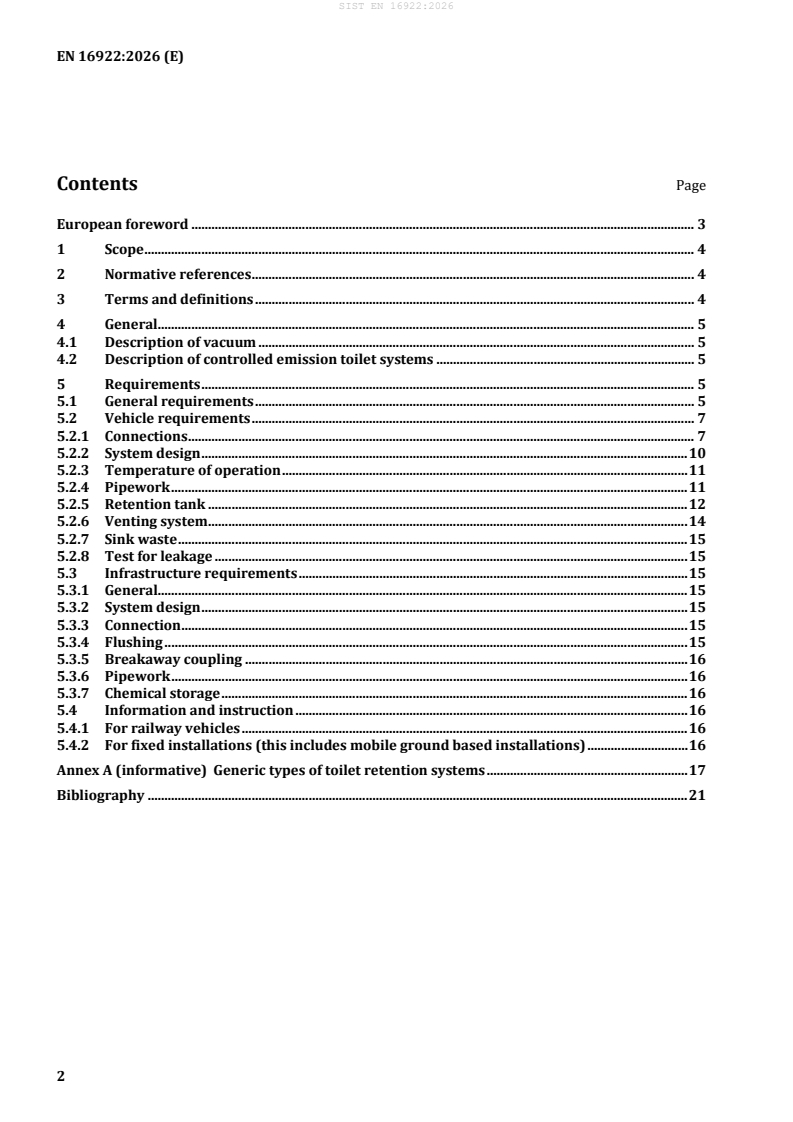
Contents Page
European foreword . 3
1 Scope . 4
2 Normative references . 4
3 Terms and definitions . 4
4 General. 5
4.1 Description of vacuum . 5
4.2 Description of controlled emission toilet systems . 5
5 Requirements . 5
5.1 General requirements . 5
5.2 Vehicle requirements . 7
5.2.1 Connections . 7
5.2.2 System design . 10
5.2.3 Temperature of operation . 11
5.2.4 Pipework . 11
5.2.5 Retention tank . 12
5.2.6 Venting system . 14
5.2.7 Sink waste . 15
5.2.8 Test for leakage . 15
5.3 Infrastructure requirements . 15
5.3.1 General. 15
5.3.2 System design . 15
5.3.3 Connection . 15
5.3.4 Flushing . 15
5.3.5 Breakaway coupling . 16
5.3.6 Pipework . 16
5.3.7 Chemical storage . 16
5.4 Information and instruction . 16
5.4.1 For railway vehicles . 16
5.4.2 For fixed installations (this includes mobile ground based installations) . 16
Annex A (informative) Generic types of toilet retention systems . 17
Bibliography . 21
European foreword
This document (EN 16922:2026) has been prepared by Technical Committee CEN/TC 256 “Railway
applications”, the secretariat of which is held by DIN.
This European Standard shall be given the status of a national standard, either by publication of an
identical text or by endorsement, at the latest by August 2026, and conflicting national standards shall be
withdrawn at the latest by August 2026.
Attention is drawn to the possibility that some of the elements of this document may be the subject of
patent rights. CEN shall not be held responsible for identifying any or all such patent rights.
This document supersedes EN 16922:2017+A1:2019.
This document includes the following significant changes with respect to EN 16922:2017+A1:2019:
— 5.2.8 is revised to give additional guidance to not overpressurize the system;
— update of standard references.
Any feedback and questions on this document should be directed to the users’ national standards body.
A complete listing of these bodies can be found on the CEN website.
According to the CEN-CENELEC Internal Regulations, the national standards organisations of the
following countries are bound to implement this European Standard: Austria, Belgium, Bulgaria, Croatia,
Cyprus, Czech Republic, Denmark, Estonia, Finland, France, Germany, Greece, Hungary, Iceland, Ireland,
Italy, Latvia, Lithuania, Luxembourg, Malta, Netherlands, Norway, Poland, Portugal, Republic of North
Macedonia, Romania, Serbia, Slovakia, Slovenia, Spain, Sweden, Switzerland, Türkiye and the United
Kingdom.
1 Scope
This document specifies the interface requirements for controlled emission toilet equipment on railway
vehicles and the infrastructure, including catering area sink waste retention tanks. Vehicle and
infrastructure specific requirements are also given.
The document includes fixed and portable infrastructure equipment used to empty retention tanks, but
excludes equipment fitted to railway vehicles where no fixed connections are used between vehicle and
infrastructure.
2 Normative references
The following documents are referred to in the text in such a way that some or all of their content
constitutes requirements of this document. For dated references, only the edition cited applies. For
undated references, the latest edition of the referenced document (including any amendments) applies.
EN 1717, Protection against pollution of water intended for human consumption in potable water
installations and general requirements for devices to prevent pollution by backflow
EN 12663-1, Railway applications — Structural requirements of railway vehicle bodies — Part 1:
Locomotives and passenger rolling stock (and alternative method for freight wagons)
EN 15877-2:2013, Railway applications — Markings of railway vehicles — Part 2: External markings on
coaches, motive power units, locomotives and on track machines
EN 16362:2013, Railway applications — Ground based services — Water restocking equipment
EN 45545-2, Railway applications — Fire protection on railway vehicles — Part 2: Requirements for fire
behaviour of materials and components
3 Terms and definitions
For the purposes of this document, the following terms and definitions apply.
ISO and IEC maintain terminology databases for use in standardization at the following addresses:
— ISO Online browsing platform: available at https://www.iso.org/obp/
— IEC Electropedia: available at https://www.electropedia.org/
3.1
railway infrastructure
all installations required for the running of railway vehicles including operating and support facilities
EXAMPLE Tracks, crossings, catenaries, signals, maintenance depots.
3.2
grey water
waste water from hand wash and galley sinks, usually contaminated with soap, germicides, residues of
food, drink and dish water
3.3
servicing point
location where maintenance, refuelling and cleaning is carried out
3.4
controlled emission toilet
toilet system where the toilet waste is retained on the vehicle and emptied at prescribed locations,
including onboard waste treatment systems which are permitted to discharge some wastes at various
locations
4 General
4.1 Description of vacuum
Vacuum can be expressed in different manners. Absolute vacuum is 0 bar and atmospheric pressure is
nominally 1 bar (although this varies). When a vacuum pump evacuates 0,2 bar from a tank the remaining
pressure within the tank is 0,8 bar (if the atmospheric pressure is 1 bar), but this can be expressed in a
variety of ways. Therefore, to avoid doubt, because the atmospheric pressure varies, throughout this
document, vacuum is expressed as a negative number of bars below atmosphere (i.e. in the above
example this is expressed within this standard as −0,2 bar).
Positive pressure is expressed as bars above atmosphere, i.e. in this document an absolute pressure of
3 bar is shown as +2 bar.
4.2 Description of controlled emission toilet systems
There are five generic types of controlled emission toilets fitted to railway vehicles considered in this
document, shown diagrammatically in Annex A.
5 Requirements
5.1 General requirements
Each vehicle and servicing point shall be clearly marked with the type of system that is fitted, or intended
to be used for. Adjacent to the connection on the vehicle and infrastructure the background, or if there is
no background, an area beside the connection with a minimum dimension 60 mm x 60 mm, shall be
coloured as shown in Table 1 and marked with the wording shown in Table 1 in the native language of
the servicing point or the home depot of the vehicle and also at least in English. The labels shall be in a
contrasting colour to the background colour.
Table 1 — Identification of toilet system
Background Wording of label Wording of label Wording of label
colour beside 3” beside 1” beside high
connection connection pressure water
The size of
connection
Type of system background
colour shall be
at least
60 mm × 60 mm:
Compact system Green Toilet discharge Flushing pipe Not applicable
On line vacuum Green Toilet discharge Flushing pipe Not applicable
Toilet discharge, Flushing pipe
Permanent
Red ensure ventilation Not applicable
vacuum
is open
Chemical toilet Flushing and
Chemical Blue Not applicable
discharge chemical addition
Onboard waste Onboard waste
Onboard waste Onboard waste
treatment toilet treatment water
treatment (e.g. Yellow treatment high
discharge and inlet and suction
bioreactor) pressure water
cleaning
Catering area sink Catering area sink Not applicable Not applicable
Grey
waste retention waste
The position on a vehicle of the background colour and labels described in Table 1 is shown
diagrammatically in Figure 1.
Key
1 background colour of type of system (as shown in Table 1)
2 label beside 3” connection
3 label beside 1” connection
Figure 1 — Identification of connections on vehicle
On the label shown in Figure 1, Key 2, the volume of the retention tank in litres shall be indicated.
5.2 Vehicle requirements
5.2.1 Connections
Except for vehicles fitted with onboard waste treatment system each vehicle with toilet waste or catering
area sink waste retention tank shall be fitted with a connection as shown in Figure 2 on each side of
vehicle. Vehicles fitted with onboard waste treatment system are permitted to have the 3” connection on
one side, but it is preferable to have on both sides.
For toilet waste retention tanks each such vehicle, excluding locomotives, shall also be fitted with a
flushing connection as shown in Figure 3. On vehicles fitted with a chemical toilet system (Annex A,
Figure A.4) the flushing connection shall be fitted on each side of the vehicle. For all other toilet systems
the flushing connection shall be as a minimum of one side of the vehicle.
As design guidance it is preferable to have the flushing connection on both sides. It is also preferable to
fit flushing connections for catering area sink waste tanks. Provision of the flushing connection reduces
maintenance costs and increases efficiency of cleaning operations of the tank.
Dimensions in millimetres
NOTE 1 General tolerances ±0,1 mm.
NOTE 2 Material: stainless steel.
Figure 2 — 3” connection (inner part)
Dimensions in millimetres
NOTE 1 General tolerances ±0,1.
NOTE 2 Material: stainless steel.
Figure 3 — 1” connection (inner part)
The connections on the vehicle shall be between 500 mm and 1 500 mm above rail level, measured to the
centre of the connection. They shall not be recessed deeper than 100 mm than the vehicle bodyline.
Where the connections are set back from the vehicle bodyline contained within a box structure, the floor
of the box shall be sloping outwards so that water cannot be retained in the enclosed box and always
drains to the outside of the vehicle. The connections shall have space around them as detailed in Figure 4
and Figure 5 to allow connection of the pipe – this does not have to be all the way around the connection
but shall be for the direction the pipe connection rotates (i.e. the space around the connection does not
have to be circular but is permitted to be rectangular or oval). When a manual valve is included in the
connection area, the space around the connection shall permit the opening and closing operations.
Dimensions in millimetres
a) Side view b) Plan view
Figure 4 — Space around 3” connection
Dimensions in millimetres
a) Side view b) Plan view
Figure 5 — Space around 1” connection
The 3” connection and 1” connection shall be separated from water filling connections, in accordance
with EN 16362, to avoid potential contamination. They shall be a minimum 500 mm apart, or separated
by a mechanical barrier. The mechanical barrier shall be impervious to stop spillage from the 3”
connection contaminating the water filling connection point. Where the 3” connection and water filling
connection are in the same area of the vehicle (whether separated by 500 mm or a mechanical barrier)
the 3” connection shall always be lower, as shown in Figure 6.
Where a mechanical barrier is fit
...