


prEN 1651
(Main)Paragliding equipment - Harnesses - Safety requirements and strength tests
Paragliding equipment - Harnesses - Safety requirements and strength tests
This document is applicable only to harnesses for paragliders. The intermediate attachment system between the harness and the paraglider / the emergency parachute does not form part of this document.
This document specifies safety requirements and test methods.
Ausrüstung für das Gleitschirmfliegen - Gurtzeuge - Sicherheitstechnische Anforderungen und Prüfung der Festigkeit
Dieses Dokument gilt nur für Gleitschirmgurtzeuge. Das Befestigungssystem zwischen Gurtzeug und Gleitschirm/Rettungsfallschirm ist nicht Bestandteil dieses Dokuments.
Dieses Dokument legt sicherheitstechnische Anforderungen und Prüfverfahren fest.
Équipement pour le parapente - Sellettes pour parapente - Éxigences de sécurité et essais de résistance
Le présent document ne s’applique qu’aux sellettes pour parapente. Le système d’attache intermédiaire entre la sellette et le parapente/parachute de secours n’est pas couvert par le présent document.
Le présent document spécifie des exigences de sécurité et des méthodes d’essai.
Oprema za jadralno padalstvo - Pasovi - Varnostne zahteve in preskusi trdnosti
General Information
- Status
- Not Published
- Publication Date
- 11-Nov-2026
- Technical Committee
- CEN/TC 136 - Sports, playground and other recreational equipment
- Drafting Committee
- CEN/TC 136/WG 6 - Paragliding equipment
- Current Stage
- 4599 - Dispatch of FV draft to CMC - Finalization for Vote
- Start Date
- 28-May-2026
- Due Date
- 14-May-2026
- Completion Date
- 28-May-2026

Relations
- Revises
EN 1651:2018+A1:2020 - Paragliding equipment - Harnesses - Safety requirements and strength tests - Effective Date
- 07-Aug-2024
Overview
prEN 1651 (draft revision 2025/2026) - Paragliding equipment: Harnesses - Safety requirements and strength tests - is a CEN technical standard that specifies safety requirements, definitions and test methods exclusively for paragliding harnesses. It applies only to harnesses; the intermediate attachment system between harness and wing or the emergency parachute is explicitly excluded. The document updates and will supersede EN 1651:2018+A1:2020 and adds modern requirements for integrated accessories, deployment systems and impact-pad evaluation.
Key topics and technical requirements
- Scope and terms: clear definitions for harness, impact pad (rigid, inflatable, airstream), deployment system, inner/outer container, integrated accessories and compatibility checks.
- Safety load requirements: symmetric and asymmetric strength tests at paraglider riser and emergency-parachute attachment points, tow and upright-position loads.
- Emergency parachute tests: static extraction, deployment strength and opening tests for inner containers (fully and partially opening).
- Anti slipping-out systems: tests for closure systems and non-structural elements that prevent pilot ejection.
- Vertical impact pad test: updated apparatus and procedures, reduced maximum peak g and requirement to calculate the Spine Injury Criterion (SIC) for impact-pad assessment.
- Test methods and apparatus: detailed procedures, required test files, and documentation for manufacturers and test labs.
- User information, marking and records: requirements for user manuals (including emergency parachute installation, repair/maintenance), manufacturing records and marking (including SIC on impact pads and identification of emergency-parachute inner containers).
Practical applications and users
This standard is intended for:
- Harness manufacturers and designers - to design, validate and document harness safety and compliance.
- Test laboratories and certification bodies - to carry out the specified strength, impact and deployment tests and produce test files.
- Importers, retailers and technical inspectors - to verify conformity and labeling, and to ensure correct user information is supplied.
- Pilots and flight schools - as a reference for understanding harness safety features (impact pads, deployment systems) and correct emergency-parachute installation.
Adoption of prEN 1651 improves product safety, harmonizes test procedures across Europe and supports clear communication about harness performance and emergency systems.
Related standards
- EN 1651:2018 + A1:2020 (to be superseded)
- EN 12491 - Paragliding equipment: Emergency parachutes - Safety requirements and test methods (normative reference)
Keywords: paragliding harnesses, safety requirements, strength tests, deployment system, impact pad, Spine Injury Criterion, CEN prEN 1651, emergency parachute.
Frequently Asked Questions
prEN 1651 is a draft published by the European Committee for Standardization (CEN). Its full title is "Paragliding equipment - Harnesses - Safety requirements and strength tests". This standard covers: This document is applicable only to harnesses for paragliders. The intermediate attachment system between the harness and the paraglider / the emergency parachute does not form part of this document. This document specifies safety requirements and test methods.
This document is applicable only to harnesses for paragliders. The intermediate attachment system between the harness and the paraglider / the emergency parachute does not form part of this document. This document specifies safety requirements and test methods.
prEN 1651 is classified under the following ICS (International Classification for Standards) categories: 97.220.40 - Outdoor and water sports equipment. The ICS classification helps identify the subject area and facilitates finding related standards.
prEN 1651 has the following relationships with other standards: It is inter standard links to EN 1651:2018+A1:2020. Understanding these relationships helps ensure you are using the most current and applicable version of the standard.
prEN 1651 is available in PDF format for immediate download after purchase. The document can be added to your cart and obtained through the secure checkout process. Digital delivery ensures instant access to the complete standard document.
Standards Content (Sample)
SLOVENSKI STANDARD
01-januar-2026
Oprema za jadralno padalstvo - Pasovi - Varnostne zahteve in preskusi trdnosti
Paragliding equipment - Harnesses - Safety requirements and strength tests
Ausrüstung für das Gleitschirmfliegen - Gurtzeuge - Sicherheitstechnische
Anforderungen und Prüfung der Festigkeit
Équipement pour le parapente - Sellettes pour parapente - Éxigences de sécurité et
essais de résistance
Ta slovenski standard je istoveten z: prEN 1651
ICS:
97.220.40 Oprema za športe na Outdoor and water sports
prostem in vodne športe equipment
2003-01.Slovenski inštitut za standardizacijo. Razmnoževanje celote ali delov tega standarda ni dovoljeno.
DRAFT
EUROPEAN STANDARD
NORME EUROPÉENNE
EUROPÄISCHE NORM
November 2025
ICS 97.220.40 Will supersede EN 1651:2018+A1:2020
English Version
Paragliding equipment - Harnesses - Safety requirements
and strength tests
Équipement pour le parapente - Sellettes pour Ausrüstung für das Gleitschirmfliegen - Gurtzeuge -
parapente - Éxigences de sécurité et essais de Sicherheitstechnische Anforderungen und Prüfung der
résistance Festigkeit
This draft European Standard is submitted to CEN members for enquiry. It has been drawn up by the Technical Committee
CEN/TC 136.
If this draft becomes a European Standard, CEN members are bound to comply with the CEN/CENELEC Internal Regulations
which stipulate the conditions for giving this European Standard the status of a national standard without any alteration.
This draft European Standard was established by CEN in three official versions (English, French, German). A version in any other
language made by translation under the responsibility of a CEN member into its own language and notified to the CEN-CENELEC
Management Centre has the same status as the official versions.
CEN members are the national standards bodies of Austria, Belgium, Bulgaria, Croatia, Cyprus, Czech Republic, Denmark, Estonia,
Finland, France, Germany, Greece, Hungary, Iceland, Ireland, Italy, Latvia, Lithuania, Luxembourg, Malta, Netherlands, Norway,
Poland, Portugal, Republic of North Macedonia, Romania, Serbia, Slovakia, Slovenia, Spain, Sweden, Switzerland, Türkiye and
United Kingdom.
Recipients of this draft are invited to submit, with their comments, notification of any relevant patent rights of which they are
aware and to provide supporting documentation.
Warning : This document is not a European Standard. It is distributed for review and comments. It is subject to change without
notice and shall not be referred to as a European Standard.
EUROPEAN COMMITTEE FOR STANDARDIZATION
COMITÉ EUROPÉEN DE NORMALISATION
EUROPÄISCHES KOMITEE FÜR NORMUNG
CEN-CENELEC Management Centre: Rue de la Science 23, B-1040 Brussels
© 2025 CEN All rights of exploitation in any form and by any means reserved Ref. No. prEN 1651:2025 E
worldwide for CEN national Members.
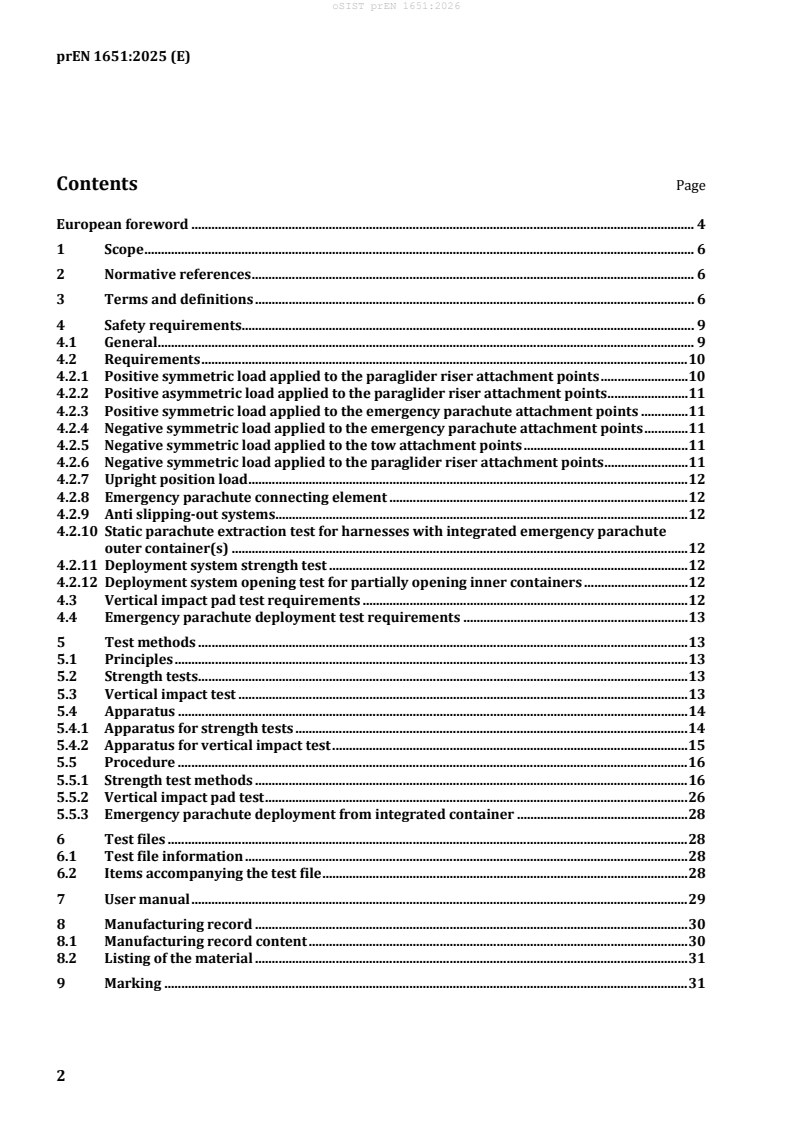
Contents Page
European foreword . 4
1 Scope . 6
2 Normative references . 6
3 Terms and definitions . 6
4 Safety requirements. 9
4.1 General . 9
4.2 Requirements . 10
4.2.1 Positive symmetric load applied to the paraglider riser attachment points . 10
4.2.2 Positive asymmetric load applied to the paraglider riser attachment points . 11
4.2.3 Positive symmetric load applied to the emergency parachute attachment points . 11
4.2.4 Negative symmetric load applied to the emergency parachute attachment points . 11
4.2.5 Negative symmetric load applied to the tow attachment points . 11
4.2.6 Negative symmetric load applied to the paraglider riser attachment points . 11
4.2.7 Upright position load . 12
4.2.8 Emergency parachute connecting element . 12
4.2.9 Anti slipping-out systems. 12
4.2.10 Static parachute extraction test for harnesses with integrated emergency parachute
outer container(s) . 12
4.2.11 Deployment system strength test . 12
4.2.12 Deployment system opening test for partially opening inner containers . 12
4.3 Vertical impact pad test requirements . 12
4.4 Emergency parachute deployment test requirements . 13
5 Test methods . 13
5.1 Principles . 13
5.2 Strength tests . 13
5.3 Vertical impact test . 13
5.4 Apparatus . 14
5.4.1 Apparatus for strength tests . 14
5.4.2 Apparatus for vertical impact test . 15
5.5 Procedure . 16
5.5.1 Strength test methods . 16
5.5.2 Vertical impact pad test . 26
5.5.3 Emergency parachute deployment from integrated container . 28
6 Test files . 28
6.1 Test file information . 28
6.2 Items accompanying the test file . 28
7 User manual . 29
8 Manufacturing record . 30
8.1 Manufacturing record content . 30
8.2 Listing of the material . 31
9 Marking . 31
Annex A (informative) Example of manufacturer's attestation for emergency parachute
deployment . 33
Annex B (normative) Examples of inner container types . 36
Annex C (informative) Example wording – User manual 7 h (iii) . 37
Annex D (informative) Spine Injury Criterion (SIC) calculation . 38
Bibliography . 40
European foreword
This document (prEN 1651:2025) has been prepared by Technical Committee CEN/TC 136 “Sports,
playground and other recreational facilities and equipment”, the secretariat of which is held by DIN.
This document is currently submitted to the CEN Enquiry.
This document will supersede EN 1651:2018+A1:2020.
This document includes the following significant technical changes with respect to
EN 1651:2018+A1:2020:
a) Terms and Definitions - amended to define the closure system, the additional closure system and
integrated accessories to enable additional tests to parts of modern harnesses.
b) Terms and Definitions - added an anatomical drawing to assist in the identification of the closure
system and the additional closure system.
c) Terms and Definitions - amended the definition of an impact pad to provide greater clarity on pad
types.
d) Terms and Definitions - added and amended definitions for the deployment system, the outer
container, the inner container, and dummy emergency parachute.
e) Terms and Definitions - added a definition for a compatibility check.
f) Safety requirements - Anti slipping out systems - amended to include an additional anti slipping out
test.
g) Safety requirements - added a Deployment system strength test.
h) Safety requirements - added a Deployment system opening test for partially opening inner
containers.
i) Test Methods - amended the vertical impact pad test apparatus requirements, including the dummy
angle and the vertical axis accelerometer.
j) Test Methods - amended anti falling-out system test to enable tests of non-structural elements that
form part of closure systems.
k) Test Methods - added a Deployment system strength test.
l) Test Methods - added a Deployment system opening test for partially opening inner containers.
m) Test Methods - amended the vertical impact pad test, including the requirements for the preparation
for the tests, and a reduction in max peak g.
n) Test Methods - added a requirement to calculate Spine Impact Criterion (SIC) for impact pads. This
has been introduced for future evaluation of the likelihood of spinal injury based on impact severity,
using a criterion analogous to the Head Injury Criterion (HIC).
o) User Manual - added requirements for information to be provided to assist with the correct
installation of an emergency parachute.
p) User Manual - added requirements for information to be provided to assist with repair and
maintenance.
q) Marking - added a requirement to include Spine Injury Criterion marking on integrated and
removable impact pads.
r) Marking - added a requirement to include marking on emergency parachute inner containers
supplied with a harness.
s) Annex A - amended to include minor modifications to adapt the table to the amended definitions.
t) Annex B - added to supply definitions for inner container types.
u) Annex C - added to supply example wording to assist with emergency parachute installation.
v) Annex D - added to supply Spine Injury Criterion calculation.
1 Scope
This document is applicable only to harnesses for paragliders. The intermediate attachment system
between the harness and the paraglider / the emergency parachute does not form part of this document.
This document specifies safety requirements and test methods.
2 Normative references
The following documents are referred to in the text in such a way that some or all of their content
constitutes requirements of this document. For dated references, only the edition cited applies. For
undated references, the latest edition of the referenced document (including any amendments) applies.
EN 12491, Paragliding equipment - Emergency parachutes - Safety requirements and test methods
3 Terms and definitions
For the purposes of this document, the following terms and definitions apply.
ISO and IEC maintain terminology databases for use in standardization at the following addresses:
— ISO Online browsing platform: available at https://www.iso.org/obp
— IEC Electropedia: available at https://www.electropedia.org/
3.1
paraglider
ultra-light foot launched aircraft comprised of a wing with no primary rigid structure and a harness (or
harnesses) necessary to support the pilot (and potentially one passenger)
3.2
harness
paraglider sub assembly for supporting the pilot in the seated or semi-recumbent or standing position
Note 1 to entry: The harness is attached to the wing via two rings or connectors, it can also be integral with the
wing via risers.
3.3
emergency parachute
emergency device intended to slow the descent of a paraglider pilot in the event of an incident in flight,
which is deployed by the pilot by an intentional manual action
3.4
emergency parachute connecting element
element not supplied as an integral part of either a harness or emergency parachute, provided to connect
an emergency parachute to a harness
3.5
clip-in weight
total weight in flight excluding the paraglider
3.6
special emergency parachute attachment points
symmetrical locations on the harness structure provided by the manufacturer specifically for the
attachment of an emergency parachute
Note 1 to entry: See Figure 2, locations 1 and 2.
3.7
integrated Y-bridle
load distributing component integrated into the harness structure used to connect the harness to a single
parachute bridle
3.8
structural element
load carrying element of the harness whilst it is tested according to 4.2.1 to 4.2.9
3.9
crotch strap
harness structural element passing between the legs intended to restrain the pilot
3.10
chest strap
Closure system which is a structural element
3.11
closure system
assembly which forms a link between the harness to paraglider riser attachment points (Figure 1,
locations 3 and 4) that bisects the sagittal plane, and is in front of the frontal plane
Key
S sagittal plane
F frontal plane
T transversal plane
3,4 harness attachment for paraglider riser(s)
Figure 1 — Anatomical planes
3.12
additional closure system
any non-structural harness closure element, below a transversal plane passing through the carabiners
Note 1 to entry: See Figures 1 and 2, locations 3 and 4.
3.13
integrated accessory
integrated non-structural device fitted to a harness in order to make it more useful, part of which can be
detached from the harness by the user
Note 1 to entry: Examples may be a harness “pod”, “cockpit bag” or emergency parachute front container
3.14
impact pad
component of a paraglider harness designed to attenuate the compression force transmitted to the spine
of the pilot in the event of a seated vertical fall
Note 1 to entry: Impact pads may consist of rigid, flexible and inflatable parts. Inflatable impact pads are further
categorized as:
1 - Airstream Inflatable airbag - requires an airstream to inflate all or part of the impact pad
2 - Air-tight airbag - (to be manually inflated before flight or during flight)
3 - Airbag - all other types, that do not require an airstream or manual pre-inflation.
3.15
deployment system
inner container and the extraction handle system, being either a handle fixed to the inner container, or a
free handle and handle attachment point(s) on the inner container
3.16
emergency parachute system
emergency parachute combined with its deployment system
3.17
outer container
external container, that remains attached to the harness after the emergency parachute has been
deployed
Note 1 to entry: this can be an integrated outer container (permanently attached to harness) or attached to the
harness by the user
3.18
inner container
container of the folded emergency parachute
Note 1 to entry: being either a “fully opening inner container”, or “partially opening inner container” as defined
in Annex B
3.19
dummy emergency parachute
emergency parachute for the purpose of testing, where the volume of the folded emergency parachute
(as specified by the emergency parachute manufacturer) is the maximum volume (plus 0% to 20%) of
the inner container maximum volume (as specified by the harness manufacturer)
3.20
compatibility check
a check performed to verify the correct function and the ease of withdrawing the inner container from
the outer container
3.21
durable medium
information given to the user in an unchangeable format that does not allow for unilateral editing or
altering by the information provider, and enables the recipient to store the information in a way that is
accessible for future reference for as long as the user might reasonably need it
4 Safety requirements
4.1 General
All free ends of the harness straps shall be finished with a folded hem making it impossible for the straps
to pass through the adjustable buckles.
The harness shall be made in accordance with accepted practice for textile assemblies.
All attachment points provided on the harness (see Figure 2) that may be used for attachment of the
paraglider or emergency parachute shall be clearly marked in a contrasting colour to the other webbing.
The attachment points for the emergency parachute shall not be in a position lower than the attachment
points of the paraglider and shall be positioned symmetrically on the harness.
Key
1 special harness attachment for emergency parachute (right)
2 special harness attachment for emergency parachute (left)
3 harness attachment for paraglider riser(s) (right)
4 harness attachment for paraglider riser(s) (left)
5 harness attachment for tow release (right)
6 harness attachment for tow release (left)
B1 dummy attachment to anchorage (right)
B2 dummy attachment to anchorage (left)
A dummy attachment point
F pulling force
Figure 2 — Attachment points for the tests
NOTE The numbering system for attachment points in this Figure 2 is retained in all the following figures of
this document.
4.2 Requirements
4.2.1 Positive symmetric load applied to the paraglider riser attachment points
When tested in accordance with 5.5.1.1, there shall be:
a) during the adjustable component slipping test, no slippage of any adjustable element exceeding
10 mm;
b) no rupture of any essential structural part;
c) no rupture of the stitching of any essential structural part;
d) no rupture, slipping or deformation likely to result in the dummy falling out of the harness.
4.2.2 Positive asymmetric load applied to the paraglider riser attachment points
When tested in accordance with 5.5.1.2, there shall be:
a) no rupture of any essential structural part;
b) no rupture of the stitching of any essential structural part;
c) no rupture, slipping or deformation that makes it possible for the dummy to fall out of the harness.
4.2.3 Positive symmetric load applied to the emergency parachute attachment points
For harnesses with special emergency parachute attachment points, and / or an integrated Y bridle, when
tested in accordance with 5.5.1.3, there shall be:
a) during the adjustable component slipping test, no slippage of any adjustable element exceeding
10 mm;
b) no rupture of any essential structural part;
c) no rupture of the stitching of any essential structural part;
d) no rupture, slipping or deformation likely to result in the dummy falling out of the harness.
4.2.4 Negative symmetric load applied to the emergency parachute attachment points
For harnesses with special emergency parachute attachment points, and / or an integrated Y-bridle,
which are formed by a separate attached construction which appears to be asymmetric, when tested in
accordance with 5.5.1.4, there shall be:
a) during the adjustable component slipping test, no slippage of any adjustable element exceeding
10 mm;
b) no rupture of any essential structural part;
c) no rupture of the stitching of any essential structural part;
d) no rupture, slipping or deformation likely to result in the dummy falling out of the harness.
4.2.5 Negative symmetric load applied to the tow attachment points
For harnesses with tow attachment points, when tested in accordance with 5.5.1.5, there shall be:
a) no rupture of any essential structural part;
b) no rupture of the stitching of any essential structural part;
c) no rupture, slipping or deformation that makes it possible for the dummy to fall out of the harness.
4.2.6 Negative symmetric load applied to the paraglider riser attachment points
When tested in accordance with 5.5.1.6, there shall be:
a) no rupture of any essential structural part;
b) no rupture of the stitching of any essential structural part;
c) no rupture, slipping or deformation likely to result in the dummy falling out of the harness.
4.2.7 Upright position load
When tested in accordance with 5.5.1.7, there shall be:
a) during the adjustable component slipping test, no slippage of any adjustable element exceeding
10 mm;
b) no rupture of any essential structural part;
c) no rupture of the stitching of any essential structural part;
d) no rupture, slipping or deformation likely to result in the dummy falling out of the harness.
4.2.8 Emergency parachute connecting element
When tested in accordance with 5.5.1.8, there shall be no rupture of any essential structural part.
4.2.9 Anti slipping-out systems
When tested in accordance with 5.5.1.9.1 and 5.5.1.9.2 there shall be:
a) no rupture of any essential structural part;
b) no rupture of the stitching of any essential structural part;
c) no rupture, slipping or deformation likely to result in the dummy falling out of the harness.
When tested in accordance with 5.5.1.9.2, the non-structural element taking the load shall be part of the
closure of at least one integrated accessory.
4.2.10 Static parachute extraction test for harnesses with integrated emergency parachute
outer container(s)
For harnesses with integrated emergency parachute outer container(s), the extraction of the emergency
parachute system shall be tested in accordance with 5.5.1.11.
4.2.11 Deployment system strength test
When tested in accordance with 5.5.1.12.1, there shall be no failure of any component of the deployment
system.
4.2.12 Deployment system opening test for partially opening inner containers
If the harness is supplied with a partially opening inner container(s) (see Annex B) a deployment test
shall be carried out with all inner container(s) supplied with the harness. A dummy emergency parachute
shall be installed.
When tested in accordance with 5.5.1.12.2, the inner container will release the full emergency parachute
(lines and parachute canopy material) without delay. The inner container shall separate completely from
the emergency parachute.
4.3 Vertical impact pad test requirements
Where the manufacturer claims the harness is equipped with an impact pad, the pad shall be tested in
accordance with the test procedure 5.5.2.
Stiff or rigid parts on the harness or impact pad shall only be permitted if no injuries to the back, neck or
head of the user are likely from these parts. The design and materials of the impact pad shall ensure as
far as possible that no bending or point loads to the back, neck or head of the user may occur on impact
or deformation.
The impact pad shall not depend on manual activation prior to impact.
4.4 Emergency parachute deployment test requirements
The requirements of this clause shall apply to integrated container(s) designed for an emergency
parachute(s) according to EN 12491.
If the harness comprises all or parts of an emergency parachute, these parts shall comply with EN 12491.
For harnesses with integrated outer containers, test deployments shall be made from all integrated outer
container locations.
The test is to be undertaken by the harness manufacturer according to 5.5.3. The manufacturer shall
provide an attestation of completion of the test.
5 Test methods
5.1 Principles
Unless otherwise specified, times are minimum cumulative duration and load requirements are minimum
values.
5.2 Strength tests
The strength of the harness and the safety of its occupant are verified using a dummy and the application
of various forces to the attachment points (see Figure 2).
The attachment points of the harness (1, 2, 3, 4, 5, 6) shall be connected to the test equipment by metallic
connectors of a minimum of 6 mm diameter. If the sample is equipped with connectors recommended by
the manufacturer, these shall be used to connect it to the test equipment.
The equipment supplied for testing shall be identical in all aspects with the marketed model.
If the manufacturer recommends a maximum clip-in weight of more than 100 kg, unless otherwise
specifically defined, all of the specified loads shall be increased by multiplying by the factor K. K is
calculated as:
m
c
K= (1)
m
ref
where
K is the factor for the specified load
m is the clip-in weight, in kg
c
m is the reference weight of 100 kg
ref
5.3 Vertical impact test
Where the manufacturer claims the harness is equipped with an impact pad, the damping of the impact
pad is verified using apparatus consisting of a vertical impact dummy and various measurement tools.
The equipment supplied for testing shall be identical in all aspects with the marketed model.
The test shall be performed with a dummy installed in an apparatus to ensure a vertical guided fall (see
Figure 4).
The impact pad test shall be conducted at an ambient temperature of (20° ± 5) °C. The impact pad itself
shall be at ambient temperature prior to testing.
5.4 Apparatus
5.4.1 Apparatus for strength tests
5.4.1.1 Seated dummy
A dummy in the seated position according to Figure 3 is to be used.
A tolerance of ± 5 % is allowed to the test dummy dimensions in Figure 3.
The ring indicated at the neck of the dummy in Figure 3 is an optional force application point.
Dimensions in millimetres
Figure 3 — Seated dummy
5.4.1.2 Electronic sensor for force measurement
A calibrated electronic sensor equipped with an electronic strain gauge for measuring the force (sampling
a minimum of 10 times per second) is required.
5.4.1.3 Measurement circuit
A measurement circuit with a graph clearly showing the force (N) against time (s) is required.
5.4.2 Apparatus for vertical impact test
5.4.2.1 Harness impact pad test dummy leaning position
The dummy shall be installed in a rearward leaning position at an angle alpha “α” between (22.5° ± 1°)
as illustrated in Figure 4.
Key
1 impact surface
2 vertical plane
3 dummy
4 lowest point of the dummy α dummy rearwards leaning angle
Figure 4 — Angle of attack of the impact pad test dummy
5.4.2.2 Harness impact pad test dummy description
The falling mass, excluding the harness, shall be a minimum of 50 kg.
The dummy shall be constructed according to Figure 5. A tolerance of 5 % is allowed for the test dummy
dimensions in Figure 5.
The dummy shall be made of a suitably robust and rigid material to withstand the tests without distortion.
Dimensions in millimetres
Figure 5 — Harness impact pad test dummy
5.4.2.3 Impact plate and dummy characteristics
The impact plate shall be horizontal and flat with anti-slip properties.
The damping of the system shall be checked by dropping the falling mass with no harness from 4 cm
(±2 mm) measured from the surface and shall produce a measured impact value of not less than 20 g.
5.4.2.4 Electronic device for vertical impact pad test
5.4.2.4.1 Vertical axis accelerometer
The accelerometer shall be mounted on the dummy, close to its centre of mass, to measure acceleration
in the direction of gravity within a tolerance of ± 10°.
5.4.2.4.2 A/D Converter
The acceleration during the fall should be recorded with a frequency not less than 1 000 Hz.
5.5 Procedure
5.5.1 Strength test methods
5.5.1.1 Positive symmetric load applied to the paraglider riser attachment points
The test is carried out with the dummy seated and strapped correctly in the harness and anchored by two
points (see points B1 and B2 in Figure 6).
If there are any relevant adjustable components, first carry out the adjustable component slipping test
according to 5.5.1.10 by applying a force of 4 500 N for 5 s to the two paraglider riser attachment points
(see poi
...