

EN 17389:2020
(Main)Stationary source emissions - Quality assurance and quality control procedures for automated dust arrestment plant monitors
General Information
- Abstract
This document specifies the quality assurance and quality control procedures related to automated dust arrestment plant monitors.
This document applies to two types of instruments commonly used for dust arrestment plant control purposes:
- filter dust monitors that are configured in mass concentration units (e.g. mg/m3) and are used for dust arrestment control purposes;
- filter leakage monitors that indicate a change in the emission levels or a change in the magnitude of the dust pulses created by the cleaning process of the dust arrestment plant.
This document applies to instruments certified according to the requirements of EN 15859.
This document provides information on the configuration, ongoing quality assurance (with automatic internal zero point and reference point checks) and annual surveillance tests of instruments. This ensures that the instrument is providing information to demonstrate that the dust arrestment plant is working correctly and controlling dust pollution to the required levels.
The configuration of the alarm levels of filter dust monitors is performed by parallel measurements with the standard reference method in EN 13284 1.
This document specifies the set-up of filter leakage monitors used to monitor a change in response caused by deterioration in the operation of the dust arrestment plant.
- Status
- Published
- Publication Date
- 05-May-2020
- Withdrawal Date
- 29-Nov-2020
- Technical Committee
- CEN/TC 264 - Air quality
- Drafting Committee
- CEN/TC 264/WG 5 - Total dust at low concentrations (emissions)
- Current Stage
- 9093 - Decision to confirm - Review Enquiry
- Start Date
- 05-Dec-2025
- Completion Date
- 30-Sep-2026



Overview
EN 17389:2020 - "Stationary source emissions - Quality assurance and quality control procedures for automated dust arrestment plant monitors" (CEN) defines QA/QC requirements for automated dust monitoring instruments used at industrial emission sources. The standard covers both filter dust monitors (calibrated in mass concentration units, e.g. mg/m3) and filter leakage monitors (indicative instruments for detecting changes in emissions or dust-pulse magnitude). EN 17389:2020 applies to instruments certified to EN 15859 and provides procedures for configuration, ongoing quality assurance (including automatic internal zero/reference checks) and annual surveillance tests to ensure reliable monitoring of dust arrestment plant performance.
Key Topics and Requirements
- Instrument types covered
- Filter dust monitors (quantitative control, mass concentration units)
- Filter leakage monitors (qualitative/indicative plant performance)
- Selection and installation
- Guidance on choosing a suitable instrument and correct installation at the measurement site
- Configuration
- Setting up instruments, calibration function establishment, and alarm level configuration
- Alarm configuration for filter dust monitors is performed by parallel measurements with the standard reference method (SRM) in EN 13284-1
- Set-up procedures for filter leakage monitors to detect operational deterioration
- Ongoing quality assurance
- Automatic internal zero point and internal reference point checks to ensure continuous instrument performance and data integrity
- Annual surveillance test
- Periodic verification to confirm continued suitability and correct operation of the monitors
- Supporting information
- Informative annexes on extending calibration range, bag filter operation, bag cleaning and interpretation of leakage signals
Practical Applications and Users
EN 17389:2020 is intended for professionals involved in monitoring and controlling particulate emissions at stationary sources:
- Industrial plant operators (e.g., foundries, manufacturing plants) using dust arrestment systems
- Environmental compliance teams and regulators seeking consistent QA/QC procedures for emission control monitoring
- Instrument manufacturers and integrators certifying and configuring automated dust monitors (EN 15859 certified devices)
- Environmental consultants and auditors conducting surveillance tests and parallel SRM measurements
Using EN 17389 helps demonstrate that dust arrestment plants are operating correctly, supports compliance with emission limits and aids early detection of filter deterioration or leaks.
Related Standards (selection)
- EN 15859 - Performance testing and certification requirements for dust arrestment plant monitors (applies to instruments covered by EN 17389)
- EN 13284-1 - Standard reference method (SRM) for manual gravimetric determination of low-range dust mass concentration (used for parallel calibration)
- EN 15259 / EN 14181 - Contextual standards on measurement site requirements and AMS QA/QC (relevant for higher-tier quantitative monitoring)
Keywords: EN 17389:2020, stationary source emissions, dust arrestment plant, filter dust monitor, filter leakage monitor, quality assurance, quality control, EN 15859, EN 13284-1.
Relations
- Effective Date
- 28-Jan-2026
- Effective Date
- 28-Jan-2026
- Effective Date
- 28-Jan-2026
Get Certified
Connect with accredited certification bodies for this standard

CIS Institut d.o.o.
Personal Protective Equipment (PPE) certification body. Notified Body NB-2890 for EU Regulation 2016/425 PPE.

Kiwa BDA Testing
Building and construction product certification.
Kmetijski inštitut Slovenije
Agricultural Institute of Slovenia. Soil testing, plant health, agricultural product analysis.
Sponsored listings
Frequently Asked Questions
EN 17389:2020 is a standard published by the European Committee for Standardization (CEN). Its full title is "Stationary source emissions - Quality assurance and quality control procedures for automated dust arrestment plant monitors". This standard covers: This document specifies the quality assurance and quality control procedures related to automated dust arrestment plant monitors. This document applies to two types of instruments commonly used for dust arrestment plant control purposes: - filter dust monitors that are configured in mass concentration units (e.g. mg/m3) and are used for dust arrestment control purposes; - filter leakage monitors that indicate a change in the emission levels or a change in the magnitude of the dust pulses created by the cleaning process of the dust arrestment plant. This document applies to instruments certified according to the requirements of EN 15859. This document provides information on the configuration, ongoing quality assurance (with automatic internal zero point and reference point checks) and annual surveillance tests of instruments. This ensures that the instrument is providing information to demonstrate that the dust arrestment plant is working correctly and controlling dust pollution to the required levels. The configuration of the alarm levels of filter dust monitors is performed by parallel measurements with the standard reference method in EN 13284 1. This document specifies the set-up of filter leakage monitors used to monitor a change in response caused by deterioration in the operation of the dust arrestment plant.
This document specifies the quality assurance and quality control procedures related to automated dust arrestment plant monitors. This document applies to two types of instruments commonly used for dust arrestment plant control purposes: - filter dust monitors that are configured in mass concentration units (e.g. mg/m3) and are used for dust arrestment control purposes; - filter leakage monitors that indicate a change in the emission levels or a change in the magnitude of the dust pulses created by the cleaning process of the dust arrestment plant. This document applies to instruments certified according to the requirements of EN 15859. This document provides information on the configuration, ongoing quality assurance (with automatic internal zero point and reference point checks) and annual surveillance tests of instruments. This ensures that the instrument is providing information to demonstrate that the dust arrestment plant is working correctly and controlling dust pollution to the required levels. The configuration of the alarm levels of filter dust monitors is performed by parallel measurements with the standard reference method in EN 13284 1. This document specifies the set-up of filter leakage monitors used to monitor a change in response caused by deterioration in the operation of the dust arrestment plant.
EN 17389:2020 is classified under the following ICS (International Classification for Standards) categories: 13.040.40 - Stationary source emissions. The ICS classification helps identify the subject area and facilitates finding related standards.
EN 17389:2020 has the following relationships with other standards: It is inter standard links to EN 15259:2007, EN 13284-1:2017, EN ISO 20418-1:2018. Understanding these relationships helps ensure you are using the most current and applicable version of the standard.
EN 17389:2020 is available in PDF format for immediate download after purchase. The document can be added to your cart and obtained through the secure checkout process. Digital delivery ensures instant access to the complete standard document.
Standards Content (Sample)
SLOVENSKI STANDARD
01-julij-2020
Emisije nepremičnih virov - Postopki zagotavljanja kakovosti in kontrole kakovosti
avtomatskih naprav za nadzor naprav za zadrževanje prahu
Stationary source emissions - Quality assurance and quality control procedures for
automated dust arrestment plant monitors
Emissionen aus stationären Quellen - Verfahren zur Qualitätssicherung und
Qualitätslenkung von automatischen Geräten zur Überwachung von Staubabscheidern
Émissions de sources fixes - Procédures d’assurance qualité et de contrôle qualité
applicables aux analyseurs automatiques pour la surveillance des systèmes de
dépoussiérage
Ta slovenski standard je istoveten z: EN 17389:2020
ICS:
13.040.40 Emisije nepremičnih virov Stationary source emissions
2003-01.Slovenski inštitut za standardizacijo. Razmnoževanje celote ali delov tega standarda ni dovoljeno.
EN 17389
EUROPEAN STANDARD
NORME EUROPÉENNE
May 2020
EUROPÄISCHE NORM
ICS 13.040.40
English Version
Stationary source emissions - Quality assurance and
quality control procedures for automated dust arrestment
plant monitors
Émissions de sources fixes - Procédures d'assurance Emissionen aus stationären Quellen - Verfahren zur
qualité et de contrôle qualité applicables aux Qualitätssicherung und Qualitätslenkung von
analyseurs automatiques pour la surveillance des automatischen Geräten zur Überwachung von
systèmes de dépoussiérage Staubabscheidern
This European Standard was approved by CEN on 6 April 2020.
CEN members are bound to comply with the CEN/CENELEC Internal Regulations which stipulate the conditions for giving this
European Standard the status of a national standard without any alteration. Up-to-date lists and bibliographical references
concerning such national standards may be obtained on application to the CEN-CENELEC Management Centre or to any CEN
member.
This European Standard exists in three official versions (English, French, German). A version in any other language made by
translation under the responsibility of a CEN member into its own language and notified to the CEN-CENELEC Management
Centre has the same status as the official versions.
CEN members are the national standards bodies of Austria, Belgium, Bulgaria, Croatia, Cyprus, Czech Republic, Denmark, Estonia,
Finland, France, Germany, Greece, Hungary, Iceland, Ireland, Italy, Latvia, Lithuania, Luxembourg, Malta, Netherlands, Norway,
Poland, Portugal, Republic of North Macedonia, Romania, Serbia, Slovakia, Slovenia, Spain, Sweden, Switzerland, Turkey and
United Kingdom.
EUROPEAN COMMITTEE FOR STANDARDIZATION
COMITÉ EUROPÉEN DE NORMALISATION
EUROPÄISCHES KOMITEE FÜR NORMUNG
CEN-CENELEC Management Centre: Rue de la Science 23, B-1040 Brussels
© 2020 CEN All rights of exploitation in any form and by any means reserved Ref. No. EN 17389:2020 E
worldwide for CEN national Members.
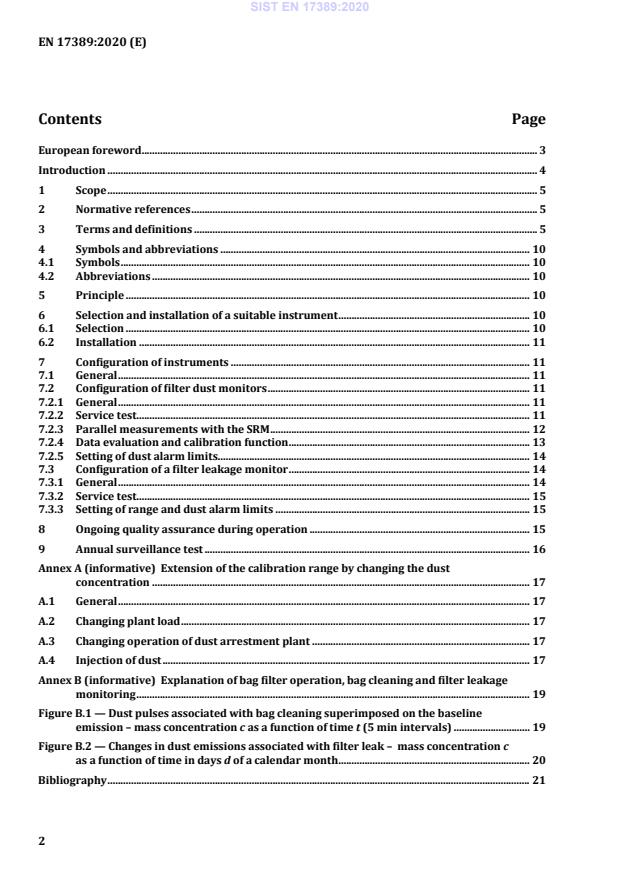
Contents Page
European foreword . 3
Introduction . 4
1 Scope . 5
2 Normative references . 5
3 Terms and definitions . 5
4 Symbols and abbreviations . 10
4.1 Symbols . 10
4.2 Abbreviations . 10
5 Principle . 10
6 Selection and installation of a suitable instrument . 10
6.1 Selection . 10
6.2 Installation . 11
7 Configuration of instruments . 11
7.1 General . 11
7.2 Configuration of filter dust monitors . 11
7.2.1 General . 11
7.2.2 Service test. 11
7.2.3 Parallel measurements with the SRM . 12
7.2.4 Data evaluation and calibration function . 13
7.2.5 Setting of dust alarm limits. 14
7.3 Configuration of a filter leakage monitor . 14
7.3.1 General . 14
7.3.2 Service test. 15
7.3.3 Setting of range and dust alarm limits . 15
8 Ongoing quality assurance during operation . 15
9 Annual surveillance test . 16
Annex A (informative) Extension of the calibration range by changing the dust
concentration . 17
A.1 General . 17
A.2 Changing plant load . 17
A.3 Changing operation of dust arrestment plant . 17
A.4 Injection of dust . 17
Annex B (informative) Explanation of bag filter operation, bag cleaning and filter leakage
monitoring . 19
Figure B.1 — Dust pulses associated with bag cleaning superimposed on the baseline
emission – mass concentration c as a function of time t (5 min intervals) . 19
Figure B.2 — Changes in dust emissions associated with filter leak – mass concentration c
as a function of time in days d of a calendar month . 20
Bibliography . 21
European foreword
This document (EN 17389:2020) has been prepared by Technical Committee CEN/TC 264 “Air quality”,
the secretariat of which is held by DIN.
This European Standard shall be given the status of a national standard, either by publication of an
identical text or by endorsement, at the latest by November 2020, and conflicting national standards shall
be withdrawn at the latest by November 2020.
Attention is drawn to the possibility that some of the elements of this document may be the subject of
patent rights. CEN shall not be held responsible for identifying any or all such patent rights.
According to the CEN-CENELEC Internal Regulations, the national standards organisations of the
following countries are bound to implement this European Standard: Austria, Belgium, Bulgaria, Croatia,
Cyprus, Czech Republic, Denmark, Estonia, Finland, France, Germany, Greece, Hungary, Iceland, Ireland,
Italy, Latvia, Lithuania, Luxembourg, Malta, Netherlands, Norway, Poland, Portugal, Republic of North
Macedonia, Romania, Serbia, Slovakia, Slovenia, Spain, Sweden, Switzerland, Turkey and the United
Kingdom.
Introduction
The type of monitoring of dust emissions at industrial plants depends on the monitoring objectives. In
general, three monitoring objectives can be distinguished:
— Monitoring of plants with emission limit values (ELV), which require quantitative measurements
with permanently installed automated measuring systems (AMS) providing measured values with a
maximum permissible measurement uncertainty specified by legislation, in order to determine
exceedances of the ELV and number of exceedances for specified time periods forms the first level of
monitoring. Large combustion plants and waste incineration plants are examples of plants under this
monitoring objective. The measurements are performed with AMS, which are performance tested
and certified according to EN 15267-1, EN 15267-2 and EN 15267-3. The quality assurance measures
for these AMS are laid down in EN 14181 and EN 13284-2.
— Monitoring of plants with ELV, which require qualitative measurements in order to demonstrate that
the dust emissions are below the specified ELV and the dust arrestment plant works properly form
the second level of monitoring. Foundries are typical examples of plants under this monitoring
objective. The measurements are performed with filter dust monitors, which can be calibrated in
mass concentration units (e.g. mg/m ) but have a larger measurement uncertainty than quantitative
measurements. Filter dust monitors are performance tested and certified according to EN 15859.
The quality assurance measures for these instruments are laid down in this document.
— Monitoring of dust arrestment plants with indicative measurements in order to indicate a possible
problem with the dust arrestment plant by monitoring a change in the emissions level or a change in
the magnitude of the dust pulses created by the cleaning process forms the third level of monitoring.
The measurements are performed with filter leakage monitors which are performance tested and
certified according to EN 15859. The quality assurance measures for these instruments are laid down
in this document.
This document provides supporting information on the quality assurance and quality control procedures
related to automated dust arrestment plant monitors, which cover both filter dust monitors and filter
leakage monitors.
For the purposes of this document, the term instrument is used to encompass both types of automated
dust arrestment plant monitors. The terms filter dust monitor and filter leakage monitor are only used
where it is necessary to distinguish between the two types.
This document includes provisions for the selection, installation, configuration, ongoing quality
assurance and annual surveillance test of automated dust arrestment plant monitors.
This document supports requirements for filter leakage monitors and filter dust monitors specified e.g.
in national legislation or in a number of industrial sector BREF Documents.
1 Scope
This document specifies the quality assurance and quality control procedures related to automated dust
arrestment plant monitors.
This document applies to two types of instruments commonly used for dust arrestment plant control
purposes:
— filter dust monitors that are configured in mass concentration units (e.g. mg/m ) and are used for
dust arrestment control purposes;
— filter leakage monitors that indicate a change in the emission levels or a change in the magnitude of
the dust pulses created by the cleaning process of the dust arrestment plant.
This document applies to instruments certified according to the requirements of EN 15859.
This document provides information on the configuration, ongoing quality assurance (with automatic
internal zero point and reference point checks) and annual surveillance tests of instruments. This ensures
that the instrument is providing information to demonstrate that the dust arrestment plant is working
correctly and controlling dust pollution to the required levels.
The configuration of the alarm levels of filter dust monitors is performed by parallel measurements with
the standard reference method in EN 13284-1.
This document specifies the set-up of filter leakage monitors used to monitor a change in response caused
by deterioration in the operation of the dust arrestment plant.
2 Normative references
The following documents are referred to in the text in such a way that some or all of their content
constitutes requirements of this document. For dated references, only the edition cited applies. For
undated references, the latest edition of the referenced document (including any amendments) applies.
EN 13284-1, Stationary source emissions - Determination of low range mass concentration of dust - Part 1:
Manual gravimetric method
EN 15259, Air quality - Measurement of stationary source emissions - Requirements for measurement
sections and sites and for the measurement objective, plan and report
3 Terms and definitions
For the purposes of this document, the following terms and definitions apply.
ISO and IEC maintain terminological databases for use in standardization at the following addresses:
— IEC Electropedia: available at http://www.electropedia.org/
— ISO Online browsing platform: available at https://www.iso.org/obp
3.1
dust
particles, of any shape, structure or density, dispersed in the gas phase at the sampling point conditions
which may be collected by filtration under specified conditions after representative sampling of the gas
to be analysed
Note 1 to entry: Adapted from EN 13284-1:2017, 3.1.
3.2
dust arrestment plant monitor
filter dust monitor or filter leakage monitor and additional devices for obtaining a result
Note 1 to entry: Apart from the actual measuring device (the analyser), an instrument can include further
components, like purge air blowers or external displays.
[SOURCE: EN 15859:2010, 3.2]
3.3
filter dust monitor
instrument, which can be calibrated in mass concentration units and used for dust arrestment control
purposes, but does not fulfil the uncertainty demands according to EN 14181, or does not have reference
materials for linearity test and QAL3 procedure according to EN 14181
Note 1 to entry: A mass concentration unit is e.g. mg/m .
[SOURCE: EN 15859:2010, 3.4]
3.4
filter leakage monitor
instrument, which indicates a possible problem with the dust arrestment plant
Note 1 to entry: These instruments can either monitor a rapid change in the emissions level or a change in the
magnitude of the dust pulses created by the cleaning process.
[SOURCE: EN 15859:2010, 3.5]
3.5
reference method
RM
measurement method taken as a reference by convention, which gives the accepted reference value of
the measurand
[SOURCE: EN 15259:2007, 3.8]
Note 1 to entry: A reference method is fully described.
Note 2 to entry: A reference method can be a manual or an automated method.
Note 3 to entry: Alternative methods can be used if equivalence to the reference method has been demonstrated
according to EN 14793.
3.6
standard reference method
SRM
reference method prescribed by European or National standard
Note 1 to entry: Standard reference methods are used e.g. to calibrate and validate instrument and for periodic
measurements to check compliance with limit values.
[SOURCE: EN 15259:2007, 3.9]
3.7
measurement
set of operations having the object of determining a value of a quantity
[SOURCE: EN 15259:2007, 3.1]
3.8
measurand
particular quantity subject to measurement
Note 1 to entry: The measurand is a quantifiable property of the waste gas under test, for example mass
concentration of a measured component, temperature, velocity, mass flow, oxygen content and water vapour
content.
[SOURCE: EN 15259:2007, 3.5]
3.9
measured component
constituent of the waste gas for which a defined measurand is to be determined by measurement
[SOURCE: EN 15259:2007, 3.6]
Note 1 to entry: Measured component is also called determinand.
3.10
calibration
determination of a calibration function with (time) limited validity applicable to an instrument at a
specific measurement site
Note 1 to entry: Adapted from EN 15267-3:2007, 3.9.
[SOURCE: EN 15859:2010, 3.13]
3.11
calibration function
relationship between the values of the SRM and the instrument with the assumption of a constant residual
standard deviation
Note 1 to entry: Adapted from EN 15267-3:2007, 3.10.
Note 2 to entry: The calibration function describes the statistical relationship between the starting variable
(measured signal) of the measuring system and the associated result of measurement (measured value)
simultaneously determined at the same point of measurement using a SRM.
[SOURCE: EN 15859:2010, 3.14]
3.12
automatic internal zero point
output of the instrument in response to an internally generated function, intended to represent absence
of the measured component
[SOURCE: EN 15859:2010, 3.15]
3.13
automatic internal reference point
output of the instrument in response to an internally generated function, intended to represent a defined
amount of the measured component
[SOURCE: EN 15859:2010, 3.16]
3.14
measured signal
output from an instrument in analogue or digital form which is converted into the measured value with
the aid of the calibration function
Note 1 to entry: Adapted from EN 15267-3:2007, 3.15.
[SOURCE: EN 15859:2010, 3.17]
3.15
output
reading, or digital or analogue electrical signal generated by an instrument in response to a measured
object
Note 1 to entry: Adapted from EN 15267-3:2007, 3.16.
[SOURCE: EN 15859:2010, 3.18]
3.16
performance characteristic
quantity assigned to an instrument in order to define its performance
Note 1 to entry: Adapted from EN 15267-3:2007, 3.19.
Note 2 to entry: A performance characteristic is described by values, tolerances and ranges.
[SOURCE: EN 15859:2010, 3.21]
3.17
averaging time
period of time over which an arithmetic or time-weighted average of concentrations is calculated
[SOURCE: EN 15267-3:2007, 3.22]
3.18
drift
monotonic change of the calibration function over a stated period of unattended operation, which results
in a change of the measured value
[SOURCE: EN 15267-3:2007, 3.26]
3.19
maintenance interval
maximum admissible interval of time for which the performance characteristics remain within a pre-
defined range without external servicing, e.g. refill, calibration, adjustment
Note 1 to entry: This is also known as the period of unattended operation.
[SOURCE: EN 15267-3:2007, 3.29]
3.20
response time
t
time interval between the instant of a sudden change in the value of the input quantity to an instrument
and the time as from which the value of the output quantity is reliably maintained beyond 90 % of the
change of the input quantity
Note 1 to entry: Adapted from EN 15267-3:2007, 3.31.
Note 2 to entry: The response time is also referred to as the 90 % time or t90 time.
[SOURCE: EN 15859:2010, 3.31]
3.21
uncertainty
parameter associated with the result of a measurement, which characterises the dispersion of the values
that could reasonably be attributed to the measurand
[SOURCE: ISO/IEC GUIDE 98-3]
3.22
emission limit value
ELV
limit values given in regulations such as EU Directives, ordinances, administrative regulations, permits,
licences, authorisations or consents
Note 1 to entry: ELV can be stated as concentration limits expressed as half-hourly, hourly and daily averaged
values, or mass flow limits expressed as hourly, daily, weekly, monthly or annually aggregated values.
[SOURCE: EN 15267-3:2007, 3.40]
4 Symbols and abbreviations
4.1 Symbols
a intercept of the calibration function
b slope of the calibration function
i counter
N number of parallel measurements
R coefficient of determination
th
x i filter dust monitor output; i = 1 to N
i
th
yi i SRM measured value; i = 1 to N
Z offset as the difference between the instrument zero reading and zero
4.2 Abbreviations
AMS automated measuring system
AST annual surveillance test
ELV emission limit value
SRM standard reference method
5 Principle
This document deals with quality assurance and quality control related to filter dust monitors and filter
leak monitors used on industrial plants for monitoring and controlling dust abatement systems.
The following four levels of quality assurance are required:
— selection and installation of a suitable instrument for the measurement task;
— configuration of the instrument;
— ongoing quality assurance of the instrument during its operation on an industrial plant by internal
fault detection;
— annual surveillance test of the instrument.
6 Selection and installation of a suitable instrument
6.1 Selection
This document shall be used with instruments that are certified according to EN 15859.
AMS that are certified according to EN 15267-1, EN 15267-2 and EN 15267-3 may also be used in
accordance with this document.
The application suitability of an instrument shall be consider
...