


FprEN 16150
(Main)Water quality - Guidance on pro-rata multi-habitat sampling of benthic macroinvertebrates from rivers and streams
Water quality - Guidance on pro-rata multi-habitat sampling of benthic macroinvertebrates from rivers and streams
This document gives guidance for pro-rata multi-habitat sampling of benthic macroinvertebrates in rivers and streams. The term "pro-rata" reflects the intention to sample all the main riverine habitats present at a monitoring site according to the proportion of the site that it covers. It is an objective way to divide sampling effort among the different habitats.
This document is applicable to all flowing waters, both artificial, modified and natural. It enables comparable samples to be collected from any type of river, regardless of the habitats present.
This document gives guidance on an overall approach rather than a specific method.
This document is applicable to:
- supporting environmental and conservation agencies, water boards, and water agencies to meet the monitoring requirements of the WFD (Article 8, Annex II, and Annex V) [1];
- generating data sets appropriate for monitoring and reporting of sites designated under the Habitats Directive and the Birds Directive to ensure that samples for comparing the overall composition of invertebrates from different stream types are comparable;
- ensuring samples for environmental quality assessments across different stream types are comparable even when sampled by different people;
- supporting river management and restoration initiatives;
- sampling sites in a consistent way that is not dependent on the presence of particular types of habitat; a user-friendly strategy for collecting biological data depending on the distribution of habitats;
- understanding the distribution of biological community types across different physical river types; and
- assessing quality based on deviation from reference, as adopted in the European Water Framework Directive [1].
Wasserbeschaffenheit - Anleitung für die pro-rata Multi-Habitat-Probenahme benthischer Makroinvertebraten in Fließgewässern
Dieses Dokument gibt eine Anleitung zur pro-rata Multi-Habitat-Probenahme von benthischen Makroinverte
braten in Fließgewässern. Der Begriff „pro-rata“ spiegelt die Zielsetzung wider, alle an einem
ort vorhandenen Haupthabitate in Flüssen entsprechend dem Anteil der Probenahmestelle, den sie abdecken, zu beproben. Es handelt sich um ein objektives Verfahren zur Aufteilung des Aufwands für die Probenahme auf die verschiedenen Habitate.
Dieses Dokument gilt für alle Fließgewässer und umfasst künstliche, veränderte und natürliche Fließgewässer. Es ermöglicht die Entnahme vergleichbarer Proben aus jeder Art von Flüssen, unabhängig von den vorhande
nen Habitaten.
Dieses Dokument gibt einen allgemeinen Ansatz statt ein spezifisches Verfahren.
Dieses Dokument ist anwendbar, um:
- Umwelt- und Artenschutzbehörden, bei der Einhaltung der Überwachungsanforderungen der Wasserrah
menrichtlinie (Artikel8, AnhangII und AnhangV) [1] zu unterstützen;
- Datensätze zu erstellen, die für die Überwachung und Berichterstattung von Probenahmestellen geeignet sind, die im Rahmen der Habitat-Richtlinie und der Vogelschutzrichtlinie ausgewiesen wurden, um sicher
zustellen, dass Proben für den Vergleich der Gesamtzusammensetzung von Wirbellosen aus verschiedenen Fließgewässern vergleichbar sind;
- sicherzustellen, dass Proben für die Bewertung der Umweltqualität verschiedener Fließgewässertypen miteinander vergleichbar sind, auch wenn die Proben von verschiedenen Personen entnommen wurden; und
- Initiativen zur Bewirtschaftung und Renaturierung von Flüssen zu unterstützen;
- eine einheitliche Art der Probenahme an Stellen sicherzustellen, die nicht vom Vorhandensein bestimmter Habitattypen abhängig sind;
- eine benutzerfreundliche Strategie zur Erfassung biologischer Daten abhängig von der Verteilung der Habi
tate;
- die Verteilung biologischer Lebensgemeinschaftstypen über verschiedene physische Flusstypen zu verste
hen;
- Qualität auf der Grundlage von Abweichungen von der Vergleichsbasis zu beurteilen, wie in der Europäi
schen Wasserrahmenrichtlinie [1] festgelegt.
Qualité de l’eau - Lignes directrices pour l’échantillonnage des macro-invertébrés benthiques en rivières et cours d’eau au prorata des surfaces de recouvrement des habitats présents
Le présent document fournit des recommandations relatives aux modes opératoires d’échantillonnage multi-habitats au prorata des macro-invertébrés benthiques dans les cours d’eau. Le terme « prorata » reflète l’intention d’échantillonner tous les principaux habitats fluviaux présents sur le site de surveillance conformément aux proportions du site couvert. Il s’agit d’une façon objective de répartir les efforts d’échantillonnage sur les différents habitats.
Les recommandations sont applicables à tous les cours d’eau, qu’ils soient artificiels, modifiés ou naturels. Cette conception permet de prélever des échantillons comparables dans tout type de rivière, quels que soient les habitats présents.
L’échantillonnage multi-habitats au prorata est une approche globale plutôt qu’une méthode spécifique.
Le présent document est destiné à :
- soutenir les agences de protection de l’environnement et de conservation afin de satisfaire aux exigences de surveillance de la DCE (Article 8, Annexe II et Annexe V) ;
- générer des ensembles de données appropriés pour la surveillance et la création de rapports concernant les sites désignés dans la Directive sur les habitats naturels et la Directive Oiseaux en veillant à ce que les échantillons destinés à comparer la composition globale de la population d’invertébrés de différents types de cours d’eau soient comparables ;
- s’assurer que les échantillons destinés aux évaluations de la qualité environnementale dans différents types de cours d’eau sont comparables, même lorsqu’ils sont prélevés par différentes personnes ;
- soutenir les initiatives de gestion et de restauration des rivières.
L’échantillonnage multi-habitats au prorata fournit :
- une méthode cohérente d’échantillonnage des sites qui ne dépend pas de la présence de types d’habitats en particulier ;
- des recommandations relatives à une stratégie conviviale de collecte de données biologiques en fonction de la répartition des types de substrat.
Cette méthode est également idéale pour :
- comprendre la répartition des types de communautés biologiques dans les différents types physiques de cours d’eau ;
- réaliser des évaluations de qualité fondées sur l’écart par rapport à une référence, comme mentionné dans le cadre de la Directive-cadre européenne sur l’eau (DCE).
Kakovost vode - Navodilo za vzorčenje bentoških nevretenčarjev v vodotokih v sorazmerju z zastopanostjo habitatov
General Information
- Status
- Not Published
- Publication Date
- 21-Apr-2026
- Technical Committee
- CEN/TC 230 - Water analysis
- Drafting Committee
- CEN/TC 230/WG 2 - Biological methods
- Current Stage
- 5060 - Closure of Vote - Formal Approval
- Start Date
- 12-Feb-2026
- Due Date
- 31-Jul-2025
- Completion Date
- 12-Feb-2026
Relations
- Effective Date
- 07-Jun-2023
Overview
FprEN 16150 - Water quality: Guidance on pro-rata multi-habitat sampling of benthic macroinvertebrates from rivers and streams (CEN draft) provides principles and practical guidance for collecting representative benthic macroinvertebrate samples from flowing waters. The pro‑rata approach allocates sampling effort across all main riverine habitats in proportion to their area at a monitoring site, enabling comparable biological samples regardless of the habitat mix. This document is an approach-level guidance (not a single prescriptive method) applicable to artificial, modified and natural rivers and streams.
Key topics and technical requirements
- Scope and purpose: Guidance for pro‑rata multi‑habitat sampling (MHS) to support ecological assessment and monitoring across diverse stream types.
- Principles of pro‑rata sampling: Objective division of sampling effort proportional to habitat area to reduce observer bias and improve comparability.
- Sampling units and devices: Definitions and use of standard devices (e.g., Surber sampler - 0.25 × 0.25 m sub-samples, hand-nets, grabs, dredges, airlift samplers) adapted to depth and accessibility.
- Site and habitat assessment: Estimation of habitat composition, definition of sampling site, and allocation of sampling units across habitats.
- Field procedures and sample treatment: Consistent collection, preservation and recording practices to ensure data comparability.
- Methods and examples: Annexes describe commonly used implementations (STAR‑AQEM, Austrian large-river method, RIVPACS-based approaches, French shallow-river method) and a list of national methods.
- Normative references: Includes EN ISO 10870 (sampling device selection) and EN 17136 (field and lab procedures for quantitative macroinvertebrate analysis).
Applications and users
FprEN 16150 is intended for:
- Environmental and conservation agencies, water boards and water agencies implementing monitoring under the Water Framework Directive (WFD).
- Organizations reporting under the Habitats Directive and Birds Directive where comparable invertebrate datasets are required.
- Laboratories, consultants and researchers conducting biomonitoring, ecological status classification, restoration assessment, or river management and restoration projects.
- Practitioners needing a user-friendly strategy to collect comparable biological data across streams with variable habitat composition.
Practical uses include classifying ecological status, generating comparable datasets for multi-site assessments, quality assessment against reference conditions (WFD), and supporting restoration effectiveness monitoring.
Related standards
- EN ISO 10870 - Guidelines for selection of sampling methods and devices for benthic macroinvertebrates.
- EN 17136 - Guidance on field and laboratory procedures for quantitative analysis and identification of macroinvertebrates.
- RIVPACS and other predictive models referenced as implementation options in annexes.
Keywords: pro‑rata multi‑habitat sampling, benthic macroinvertebrates, rivers and streams, Water Framework Directive, ecological monitoring, Surber sampler, biomonitoring.

Get Certified
Connect with accredited certification bodies for this standard

NSF International
Global independent organization facilitating standards development and certification.

CIS Institut d.o.o.
Personal Protective Equipment (PPE) certification body. Notified Body NB-2890 for EU Regulation 2016/425 PPE.

Kiwa BDA Testing
Building and construction product certification.
Sponsored listings
Frequently Asked Questions
FprEN 16150 is a draft published by the European Committee for Standardization (CEN). Its full title is "Water quality - Guidance on pro-rata multi-habitat sampling of benthic macroinvertebrates from rivers and streams". This standard covers: This document gives guidance for pro-rata multi-habitat sampling of benthic macroinvertebrates in rivers and streams. The term "pro-rata" reflects the intention to sample all the main riverine habitats present at a monitoring site according to the proportion of the site that it covers. It is an objective way to divide sampling effort among the different habitats. This document is applicable to all flowing waters, both artificial, modified and natural. It enables comparable samples to be collected from any type of river, regardless of the habitats present. This document gives guidance on an overall approach rather than a specific method. This document is applicable to: - supporting environmental and conservation agencies, water boards, and water agencies to meet the monitoring requirements of the WFD (Article 8, Annex II, and Annex V) [1]; - generating data sets appropriate for monitoring and reporting of sites designated under the Habitats Directive and the Birds Directive to ensure that samples for comparing the overall composition of invertebrates from different stream types are comparable; - ensuring samples for environmental quality assessments across different stream types are comparable even when sampled by different people; - supporting river management and restoration initiatives; - sampling sites in a consistent way that is not dependent on the presence of particular types of habitat; a user-friendly strategy for collecting biological data depending on the distribution of habitats; - understanding the distribution of biological community types across different physical river types; and - assessing quality based on deviation from reference, as adopted in the European Water Framework Directive [1].
This document gives guidance for pro-rata multi-habitat sampling of benthic macroinvertebrates in rivers and streams. The term "pro-rata" reflects the intention to sample all the main riverine habitats present at a monitoring site according to the proportion of the site that it covers. It is an objective way to divide sampling effort among the different habitats. This document is applicable to all flowing waters, both artificial, modified and natural. It enables comparable samples to be collected from any type of river, regardless of the habitats present. This document gives guidance on an overall approach rather than a specific method. This document is applicable to: - supporting environmental and conservation agencies, water boards, and water agencies to meet the monitoring requirements of the WFD (Article 8, Annex II, and Annex V) [1]; - generating data sets appropriate for monitoring and reporting of sites designated under the Habitats Directive and the Birds Directive to ensure that samples for comparing the overall composition of invertebrates from different stream types are comparable; - ensuring samples for environmental quality assessments across different stream types are comparable even when sampled by different people; - supporting river management and restoration initiatives; - sampling sites in a consistent way that is not dependent on the presence of particular types of habitat; a user-friendly strategy for collecting biological data depending on the distribution of habitats; - understanding the distribution of biological community types across different physical river types; and - assessing quality based on deviation from reference, as adopted in the European Water Framework Directive [1].
FprEN 16150 is classified under the following ICS (International Classification for Standards) categories: 13.060.70 - Examination of biological properties of water. The ICS classification helps identify the subject area and facilitates finding related standards.
FprEN 16150 has the following relationships with other standards: It is inter standard links to EN 16150:2012. Understanding these relationships helps ensure you are using the most current and applicable version of the standard.
FprEN 16150 is available in PDF format for immediate download after purchase. The document can be added to your cart and obtained through the secure checkout process. Digital delivery ensures instant access to the complete standard document.
Standards Content (Sample)
SLOVENSKI STANDARD
oSIST prEN 16150:2025
01-april-2025
Kakovost vode - Navodilo za vzorčenje bentoških nevretenčarjev v sorazmerju z
zastopanostjo habitatov v rekah in potokih
Water quality - Guidance on pro-rata multi-habitat sampling of benthic
macroinvertebrates from rivers and streams
Wasserbeschaffenheit - Anleitung für die pro-rata Multi-Habitat-Probenahme benthischer
Makroinvertebraten in Flüssen geringer Tiefe (watbar)
Qualité de l'eau Lignes directrices pour léchantillonnage des macroinvertébrés
benthiques en cours deau peu profonds au prorata des surfaces de recouvrement des
habitats présents
Ta slovenski standard je istoveten z: prEN 16150
ICS:
13.060.10 Voda iz naravnih virov Water of natural resources
13.060.70 Preiskava bioloških lastnosti Examination of biological
vode properties of water
oSIST prEN 16150:2025 en,fr,de
2003-01.Slovenski inštitut za standardizacijo. Razmnoževanje celote ali delov tega standarda ni dovoljeno.
oSIST prEN 16150:2025
oSIST prEN 16150:2025
DRAFT
EUROPEAN STANDARD
prEN 16150
NORME EUROPÉENNE
EUROPÄISCHE NORM
April 2025
ICS 13.060.70 Will supersede EN 16150:2012
English Version
Water quality - Guidance on pro-rata multi-habitat
sampling of benthic macroinvertebrates from rivers and
streams
Qualité de l'eau ¿ Lignes directrices pour Wasserbeschaffenheit - Anleitung für die pro-rata
l¿échantillonnage des macroinvertébrés benthiques en Multi-Habitat-Probenahme benthischer
cours d¿eau peu profonds au prorata des surfaces de Makroinvertebraten in Flüssen geringer Tiefe (watbar)
recouvrement des habitats présents
This draft European Standard is submitted to CEN members for enquiry. It has been drawn up by the Technical Committee
CEN/TC 230.
If this draft becomes a European Standard, CEN members are bound to comply with the CEN/CENELEC Internal Regulations
which stipulate the conditions for giving this European Standard the status of a national standard without any alteration.
This draft European Standard was established by CEN in three official versions (English, French, German). A version in any other
language made by translation under the responsibility of a CEN member into its own language and notified to the CEN-CENELEC
Management Centre has the same status as the official versions.
CEN members are the national standards bodies of Austria, Belgium, Bulgaria, Croatia, Cyprus, Czech Republic, Denmark, Estonia,
Finland, France, Germany, Greece, Hungary, Iceland, Ireland, Italy, Latvia, Lithuania, Luxembourg, Malta, Netherlands, Norway,
Poland, Portugal, Republic of North Macedonia, Romania, Serbia, Slovakia, Slovenia, Spain, Sweden, Switzerland, Türkiye and
United Kingdom.
Recipients of this draft are invited to submit, with their comments, notification of any relevant patent rights of which they are
aware and to provide supporting documentation.
Warning : This document is not a European Standard. It is distributed for review and comments. It is subject to change without
notice and shall not be referred to as a European Standard.
EUROPEAN COMMITTEE FOR STANDARDIZATION
COMITÉ EUROPÉEN DE NORMALISATION
EUROPÄISCHES KOMITEE FÜR NORMUNG
CEN-CENELEC Management Centre: Rue de la Science 23, B-1040 Brussels
© 2025 CEN All rights of exploitation in any form and by any means reserved Ref. No. prEN 16150:2025 E
worldwide for CEN national Members.
oSIST prEN 16150:2025
prEN 16150:2025 (E)
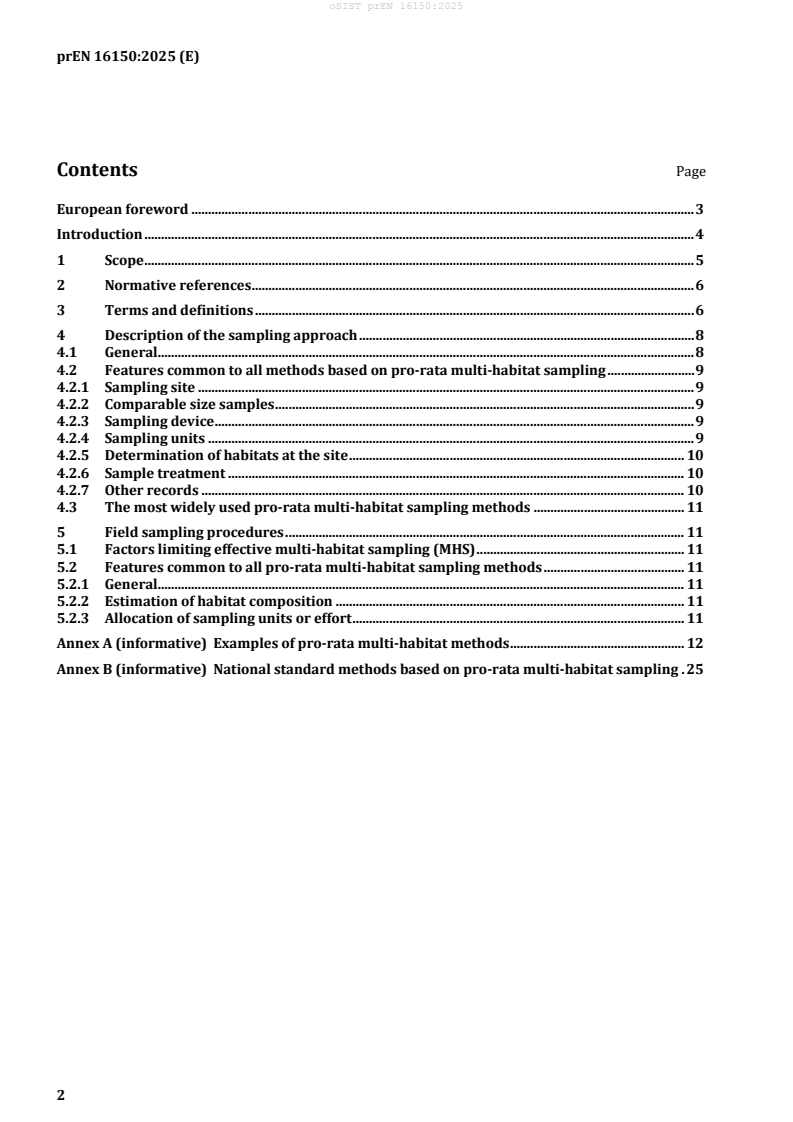
Contents Page
European foreword . 3
Introduction . 4
1 Scope . 5
2 Normative references . 6
3 Terms and definitions . 6
4 Description of the sampling approach . 8
4.1 General. 8
4.2 Features common to all methods based on pro-rata multi-habitat sampling . 9
4.2.1 Sampling site . 9
4.2.2 Comparable size samples . 9
4.2.3 Sampling device . 9
4.2.4 Sampling units . 9
4.2.5 Determination of habitats at the site . 10
4.2.6 Sample treatment . 10
4.2.7 Other records . 10
4.3 The most widely used pro-rata multi-habitat sampling methods . 11
5 Field sampling procedures . 11
5.1 Factors limiting effective multi-habitat sampling (MHS) . 11
5.2 Features common to all pro-rata multi-habitat sampling methods . 11
5.2.1 General. 11
5.2.2 Estimation of habitat composition . 11
5.2.3 Allocation of sampling units or effort . 11
Annex A (informative) Examples of pro-rata multi-habitat methods . 12
Annex B (informative) National standard methods based on pro-rata multi-habitat sampling . 25
oSIST prEN 16150:2025
prEN 16150:2025 (E)
European foreword
This document (prEN 16150:2025) has been prepared by Technical Committee CEN/TC 230 “Water
analysis”, the secretariat of which is held by DIN.
This document is currently submitted to the CEN Enquiry.
This document will supersede EN 16150:2012.
prEN 16150:2025 includes the following significant technical changes with respect to EN 16150:2012:
— provide more complete guidance about the standard’s application, aims and purpose;
— updated and enlarged list of normative references;
— revised list of terms and definitions reflecting the revised content of the main document and transfer
of description of STAR-AQEM method to an Annex;
— major revision, replacing the description of the STAR-AQEM method by a description of the pro-rata
multi-habitat approach;
— new part describing features common to all methods based on pro-rata multi-habitat sampling;
— new part describing the most widely used methods based on pro-rata multi habitat sampling;
— this part has been reduced to a description of common procedures with detailed description of the
STAR-AQEM method transferred to A.1;
— A.1: Description of STAR-AQEM method, transferred from Part 5 of the previous version;
— A.2: New part describing the Austrian method for large rivers;
— A.3: New part describing the RIVPACS method;
— A.4: New part describing the French method for shallow rivers; and
— Annex B: New part listing methods based on pro-rata multi-habitat sampling.
oSIST prEN 16150:2025
prEN 16150:2025 (E)
Introduction
This document sets out the fundamental principles of pro-rata multi-habitat sampling, its objectives and
the circumstances in which it should be applied. Whereas, EN 16150:2012 described one of the possible
techniques among the existing pro-rata multi-habitat sampling techniques. The aim of this revision is to
provide a better understanding of the rationale for this approach, describing more than one technique,
including that described in the previous version of this document as examples in the Annexes.
Pro-rata multi-habitat sampling can be applied to all surface waters, including small streams, large rivers,
springs, subterranean streams, temporary and intermittent streams. Standard sampling methods for
some of these types of habitats are still in development and not all these habitats are included in national
monitoring schemes.
It is suitable for national and regional monitoring networks for classifying ecological status under the
European Water Framework Directive (WFD). All water bodies in all EU member states are classified
under this Directive.
In contrast to small streams, large rivers cannot be inspected on foot, even at low flow. Deeper water with
relatively poor visibility sometimes makes the habitats invisible to the observer and prevents the
selective collection of samples. Where water depth varies through the year, sessile and less mobile
macroinvertebrates are more commonly found below the low-flow water level. For these reasons,
representative sampling from the banks is restricted to low-flow periods, but the water level of large
rivers is often too high for very long periods to get representative samples from the bank. In such cases,
it is advisable to survey with a sampling technique independent of the water level; for example, using a
grab, air-lift sampler, or dredge. Deployed from a boat or ship, samples should be taken across large rivers
to cover the main habitat gradients of flow and depth even if they are not visible. In all cases, the sampling
method should not be changed within one water body.
The pro-rata multi-habitat sampling technique does not replace other techniques. If the same habitat is
present at all monitoring sites, pro-rata multi-habitat sampling is not necessary because samples can
always be collected from this habitat and both reference values and samples associating different
environmental qualities will also be based on samples from that habitat. Results will be more directly
comparable between sites. Sampling from one habitat type reduces variation and, therefore, provides a
more consistent overall assessment. It also avoids variation caused by observer bias in the assessment of
habitat cover. The training burden is also reduced. The best habitat for practical and biological reasons
are shallow riffles with gravel substrates.
If the same type of habitat is not present at every site, it may be necessary to sample from a selection of
habitats. This approach is only practicable if at least one of the few habitats chosen to use are found in all
monitoring sites. The steps that can be taken to make data comparable across samples taken by this
approach are the same as for pro-rata MHS, such as expressing results as a proportion of their reference
value, which can be based on reference sites or models covering the same combinations of habitats.
Because not every habitat is sampled, this approach is not covered by this documents.
oSIST prEN 16150:2025
prEN 16150:2025 (E)
1 Scope
This document gives guidance on procedures for the pro-rata multi-habitat sampling of benthic
macroinvertebrates in rivers and streams. The term “pro-rata” reflects the intention to sample all the
main riverine habitats present at a monitoring site according to the proportion of the site that it covers.
It is an objective way to divide sampling effort among the different habitats.
This guidance is applicable to all flowing waters, both artificial, modified and natural. This design enables
comparable samples to be collected from any type of river, regardless of the habitats present.
The pro-rata multi-habitat sampling is an overall approach rather than a specific method.
This document is designed to:
— support environmental and conservation agencies to meet the monitoring requirements of the WFD
(Article 8, Annex II, and Annex V);
— generate data sets appropriate for monitoring and reporting of sites designated under the Habitats
Directive and the Birds Directive ensure that samples for comparing the overall composition of
invertebrates from different stream types are comparable;
— ensure samples for environmental quality assessments across different stream types are comparable
even when sampled by different people; and
— support river management and restoration initiatives.
The pro-rata multi-habitat sample (MHS) provides:
— a consistent way of sampling sites that is not dependent on the presence of particular types of habitat;
and
— guidance on a user-friendly strategy for collecting biological data depending on the distribution of
substrate type.
It is also ideal for:
— understanding the distribution of biological community types across different physical river types;
and
— quality assessments based on deviation from reference, as adopted in the European Water
Framework Directive.
oSIST prEN 16150:2025
prEN 16150:2025 (E)
2 Normative references
The following documents are referred to in the text in such a way that some or all of their content
constitutes requirements of this document. For dated references, only the edition cited applies. For
undated references, the latest edition of the referenced document (including any amendments) applies.
EN ISO 10870, Water quality — Guidelines for the selection of sampling methods and devices for benthic
macroinvertebrates in fresh waters (ISO 10870)
EN 17136, Water quality - Guidance on field and laboratory procedures for quantitative analysis and
identification of macroinvertebrates from inland surface waters
3 Terms and definitions
For the purposes of this document, the following terms and definitions apply.
ISO and IEC maintain terminology databases for use in standardization at the following addresses:
• ISO Online browsing platform: available at https://www.iso.org/obp/ui/
• IEC Electropedia: available at https://www.electropedia.org/
3.1
airlift
sampling device that uses compressed air to dislodge macroinvertebrates from the stream bed and raise
them into a collecting net
3.2
AQEM-STAR
development and testing of an integrated assessment system for the ecological quality of streams and
rivers throughout Europe using benthic macroinvertebrates and standardization of river classifications,
and the European Union’s 4th and 5th framework research projects in which the AQEM-STAR sampling
protocol was developed
3.3
dredge
sampling device that comprises a collecting net on a heavy frame that is dragged along the riverbed on
the end of a rope or cable to collect macroinvertebrates
3.4
grab
sampling device with strong jaws that bite into the riverbed and enclose the sample, which can then be
raised to the surface on a cable or rope
3.5
habitat
in the context of this document, it is a visibly distinct area of the stream of a specific grain size of the
stream bed, plant community, debris, current speed and/or depth, in which different assemblages of
macroinvertebrates are found
3.6
hand-net
sampling device comprising a collecting net on a rigid frame mounted on the end of a pole
oSIST prEN 16150:2025
prEN 16150:2025 (E)
3.7
heavily modified water body
HMWB
body of surface water which, as a result of physical alterations by human activity, is substantially changed
in character
Note 1 to entry: Water bodies designated as HMWB in accordance with WFD have environmental quality objectives
that accommodate the degradation in biological quality caused by the physical modification that is deemed
desirable (for navigation, flood defence or other use).
3.8
Hess sampler
sampling device comprising a metal or plastic cylinder that can be driven into the riverbed to separate it,
with a collecting net on one side and a screen on the opposite (front) side, which allows
macroinvertebrates to flow into the collecting net when the stream bed within the cylinder is disturbed
3.9
macroinvertebrate
for the purposes of this document, it is an invertebrate animal that is retained on a 500 μm mesh,
including insects, shrimps, snails and worms
3.10
microhabitat
for the purpose of this document, it is a habitat that cannot be distinguished visually
3.11
multi-habitat sample
MHS
a sample collected from more than one type of habitat; methods described in this document comprise
sample units from all habitats present at a site
3.12
pro-rata
for the purpose of this document, proportional to the area of stream bed at the sampling site
3.13
reference value
the value of a metric or biotic index that a rive type has
Note 1 to entry: Minimally impacted WFD reference quality [10].
3.14
River Invertebrate Classification and Prediction System
RIVPACS
mathematical model to predicting reference values
3.15
sampling site
location, usually but not always a defined length or area of river, from which sampling units are collected
oSIST prEN 16150:2025
prEN 16150:2025 (E)
3.16
sampling unit
for the purposes of this document, a sub-ample from a specific habitat; multi-habitat samples usually
comprise several sampling units; in STAR-AQEM samples, they are individual 0,25 × 0,25 m Surber sub-
samples
3.17
Surber sampler
collecting net on a rigid frame with another frame at right angles that delimits an area (0,25 × 0,25 m) of
the stream bed from which the sample is collected
3.18
type, river type
group of rivers characterized by geographical, natural chemical conditions that supports a particular type
of macroinvertebrate assemblage
3.19
water body
stretch, stream or river of the same type, with similar risks of environmental pressure and requiring the
same management actions to maintain or restore its quality
Note 1 to entry: This is the smallest geographical unit for management under WFD [11].
4 Description of the sampling approach
4.1 General
Samples shall be collected in a consistent way so that data from them is comparable. If sampling is not
consistent, it is not possible to know if differences are because of variation in sampling or because of
differences in the biological assemblages. Different biological results with different environmental
conditions can only be associated by comparing them with results from comparable samples where a
relationship has been established. Where environmental quality is measured by the deviation of a metric
from its reference value (the value that it would have in reference conditions), monitoring samples shall
be collected in exactly the same way as the reference samples against which they are to be compared.
Pro-rata multi-habitat sampling provides the greatest flexibility and allows any site to be used, provided
it is adequately covered by reference sites or models.
The regional or national river monitoring networks in most countries shall cover diverse river types that
have different combinations of habitats, and no single habitat type is present at every monitoring site
from which samples could be collected. Here, pro-rata multi-habitat sampling enables the effects of
differences in combinations of habitat to be taken into account in reference values as an integral part of
typology. This is a fundamental requisite of some multi-metric assessment approaches used to evaluate
the ecological status of running waters.
Pro-rata MHS is adopted almost universally for national and regional standard methods for river quality
management and ecological status assessment. The pro-rata MHS methodology is based on Rapid
Bioassessment Protocols [1], the RIVPACS procedures of the United Kingdom [2], the Austrian Guidelines
for the Assessment of the Saprobiological Water Quality of Rivers and Streams [3], the AQEM sampling
manual [4], the AQEM and STAR site protocol [5], the Austrian Standards M 6232 and M 6119-2 [6], [7],
the German Standard DIN 38410-1 [8] and the French Standard NF T90-333 [9].
oSIST prEN 16150:2025
prEN 16150:2025 (E)
The concept of sampling all major habitats in proportion to their cover is simple to understand, so it is
easy to give the same instruction to many different ecological surveyors with confidence that they will
collect samples correctly, although they may use different techniques in different habitats. The use of this
common concept increases comparability of samples collected by different observers.
This document also describes in a detailed manner how to sample different habitats that might be suitable
for sampling approaches other than multi-habitat sampling.
4.2 Features common to all methods based on pro-rata multi-habitat sampling
4.2.1 Sampling site
The area or length of river that constitutes a sampling site shall be standardized. This affects the number
of different habitats that will be sampled. At any particular site, it shall not be extended so that an
additional habitat can be sampled.
4.2.2 Comparable size samples
This can be standardized by the total area sampled or sampling effort. Where different devices are used
to collect samples from different types of sites (for example, Surber samples from shallow streams and
airlift samples from deep rivers), they should, as far as practicable, be used in a way that collects samples
of similar size (standardized by volume, area or effort). Small differences can be accommodated by the
type-specific reference values being based on samples collected by the same device. However, if they are
minimized, there are fewer problems of borderline sites being sampled by either method and this also
helps ensure that they can be subject to the same data analysis.
4.2.3 Sampling device
Ideally, the sampling devices should be simple and quick to use to reduce cost and should be capable of
sampling effectively from the majority of habitat and site types. All devices shall have collecting nets of
the same mesh size specified by EN ISO 10870.
4.2.4 Sampling units
These are similar to sub-samples, but they are physically pooled on-site to create a single sample rather
than being analysed separately. The sampling units are the minimum size sample that can be collected. It
may be a single quadrat. When sample size is determined by sampling effort, there is still a minimum time
that can be sampled that constitutes a sampling unit. For hand-nets, sampling units are usually a 10 to
15 s burst with a practicable minimum of about 5 s.
oSIST prEN 16150:2025
prEN 16150:2025 (E)
4.2.5 Determination of habitats at the site
Before starting to collect samples, the site shall be surveyed in order to identify the habitats present and
their cover. This is necessary to allocate sampling units to habitats in proportion to their cover. This initial
assessment may need to be adjusted after entering the water if habitat variations are visible that are not
seen from the banks. This evaluation should be re-done every time a site is sampled because bed material
will move, vegetation and debris grows or diminishes and their proportions change over time. Different
habitats for macroinvertebrates can be identified by differences in the size classes of particles forming
the stream bed (silt, sand, boulders, etc.), the composition of the stream bed (inorganic, organic), the plant
communities growing on it, flow, distance from the shore, woody and other debris and specialized
habitats such as tree roots and hard structures. Identifying different habitats and the relative proportion
of different substrate types is difficult in deep and turbid waters and is impossible where the riverbed is
not visible. In these situations, pro-rata multi-habitat sampling can only be approximated by collecting
samples along multiple transects across the river. This may be acceptable for methods with relatively
small sampling sites that do not cover larger downstream habitat variations but less so for methods
involving longer sites. For statistically representative results, sub-samples should be taken from locations
with the same habitat selected randomly as far as is practicable but not haphazardly; otherwise, observer
bias may be increased. In any case, sampling units should always be collected from downstream to
upstream to minimize disturbance caused by the sampling itself.
4.2.6 Sample treatment
Follow the procedures for sample treatment in the field and laboratory described in EN 17136 and any
procedures specific to the method based on pro-rata multi-habitat sampling that are being used.
4.2.7 Other records
It is useful to record the habitats sampled, the general physical characteristics of the sampling site and
the conditions at the time of sampling to help data analysis and interpretation. In some cases, this
information is necessary for determining the reference value of ecological quality indices. The AQEM-
STAR sampling protocol in Annex A is shown as an example.
Review this record, particularly the portion of microhabitats after the sampling has been completed.
Having sampled the various microhabitats, walking the reach helps to ensure a more accurate
assessment. Record the following:
— sampling equipment used;
— the conditions during sampling, e.g. evidence of recent high flows (note that sampling shall never be
conducted during spates to ensure operator safety and acceptable samples);
— treacherous rocks and other hazards;
— difficult access to the stream;
— anything else that could indicate an influence on the sample composition; and
— sampling date because seasonality can have a significant impact on the composition of the
invertebrate sample. Depending on the method used, sampling may be undertaken in specific
seasons to ensure compatibility with reference values for ecological quality assessment.
oSIST prEN 16150:2025
prEN 16150:2025 (E)
4.3 The most widely used pro-rata multi-habitat sampling methods
Two methods are used widely across Europe: the AQEM-STAR method and the RIVPACS method. In the
AQEM-STAR method, sampling units are allocated to major habitats according to their cover. In the
RIVPACS method, sampling effort (active sampling time) is allocated to habitats according to the area that
they cover. The effect is the same: all the habitats at the site are sampled in proportion to their cover,
hence pro-rata multi-habitat.
For RIVPACS, a hand-net or airlift should be used. For AQEM-STAR, either a hand-net, Surber or Hess
(cylinder) sampler. In all cases, the dimensions should be suitable for sampling an area approximately
25 × 25 cm. These devices are described in EN ISO 10870.
For ecological quality assessment in countries that are still considering which methods to adopt, the one
that is used in other parts of the river basin should be chosen to aid comparability and the management
of trans-boundary issues. It is important that the method that is adopted is compatible with the methods
for determining the reference values of the indices used for environmental assessment.
5 Field sampling procedures
5.1 Factors limiting effective multi-habitat sampling (MHS)
The effective use of pro-rata multi-habitat sampling may be impaired under the following conditions
which should be avoided and from which samples should not be taken (if possible):
— shortly after floods, consider allowing a recovery period of four to six weeks after a spate – for safety,
never collect samples during floods or spates;
— during or after prolonged extreme droughts; and
— during other natural or man-induced disturbances, e.g. if unnatural turbidity prevents a proper
estimation of the habitat composition or sampling of the stream bed.
5.2 Features common to all pro-rata multi-habitat sampling methods
5.2.1 General
The precise procedures may vary between different methods because of differences in sampling
equipment, the method of sample collection or the size of the site or sample. Pro-rata multi-habitat
sampling procedure involves several steps, which are described in the examples in Annex A.
5.2.2 Estimation of habitat composition
Before sampling begins, the percentage coverage of the different habitats within the sampling site shall
be estimated. Whenever possible, the sampling area should not be disturbed by physical contact. If the
estimates of the cover need to be corrected, e.g. due to low visibility of parts of the riverbed, this can be
done during the sampling.
5.2.3 Allocation of sampling units or effort
After estimating the cover of different habitats, the sampler shall decide where to collect the sample in
order to cover all the habitats in proportion to their cover. Again, this can be adjusted during the sampling
procedure to account for changes in the cover of different habitats that may become evident in the river.
oSIST prEN 16150:2025
prEN 16150:2025 (E)
Annex A
(informative)
Examples of pro-rata multi-habitat methods
A.1 Unit-based AQEM-STAR approach
A.1.1 Description
The length of the sampling site depends on the stream width and the variability of the habitats. As a
general rule, it should be 20 to 50 m in length in small (1 to 100 km ) streams and 50 to 100 m in length
in medium (100 to 1000 km ) streams. The sampling site shall cover the whole width of the stream and
be representative for a minimum survey area of 500 m stream length or 100 times the average stream
width, whichever is longer.
A sample consists of several sampling units (SU) taken from habitat types in relation to their spatial
percentage cover. The AQEM and STAR projects [5] identified 20 “sampling units” taken from all habitat
types at an investigation site, each with a share of at least 5 % spatial coverage, to be the optimum
approach for ecological status assessment of wadeable rivers. Where habitat diversity is very low or taxa
diversity within habitats is low and using 20 units would be an excessive repetitive sampling burden,
fewer than 20 “sampling units” may be required to gain an accurate assessment of the ecological status
with minimal analytical burden. Where fewer than 20 units are used, the minimum spatial coverage
should be adjusted accordingly: for example, with 10 sampling units, each sampling unit represents 10 %
of the total spatial cover, so habitats covering less than 10 % of the site are not represented. Throughout
the rest of this document, the example of 20 “sampling units” is used to describe the approach; users
should adjust the number of units accordingly in cases of low habitat or taxa diversity.
A “sampling unit” is a sample performed by positioning the net and disturbing the substrate i
...
Questions, Comments and Discussion
Ask us and Technical Secretary will try to provide an answer. You can facilitate discussion about the standard in here.
Loading comments...