


FprEN 16186-9
(Main)Railway applications - Driver's cabs - Part 9 : External visibility for metro vehicles
General Information
- Abstract
This document defines front visibility conditions including positions of drivers and its assessment.
This document applies to metro vehicles with or without permanent driver, excluding shuttles used for short distance transportation.
Metro vehicle definition is according to EN 17343.
Note For special vehicles, see EN 14033-4 and EN 15746-4.
- Status
- Not Published
- Publication Date
- 13-Oct-2026
- Technical Committee
- CEN/TC 256 - Railway applications
- Drafting Committee
- CEN/TC 256/WG 37 - Driver's cabs and windscreens
- Current Stage
- 5060 - Closure of Vote - Formal Approval
- Start Date
- 13-Aug-2026
- Due Date
- 27-Oct-2026
- Completion Date
- 13-Aug-2026

Overview
FprEN 16186-9: Railway applications - Driver's cabs - Part 9: External visibility for metro vehicles is a draft European standard developed by CEN within the series addressing the design and assessment of railway driver’s cabs. This part specifically outlines requirements for assessing and ensuring the forward, rear, and lateral external visibility from metro vehicle cabs, including consideration of driver anthropometric data, cab equipment, and operational scenarios.
This standard applies to all metro vehicles as defined in EN 17343, regardless of whether they have a permanent driver onboard. It excludes shuttles used for short-distance transportation. Enhanced external visibility from the driver's cab is critical to safety, operational effectiveness, and passenger handling, making its standardization essential across European metro systems.
Key Topics
Front Visibility Requirements: The standard specifies how forward visibility conditions must be evaluated for both seated and standing driving positions. It identifies the necessary field of vision, defines "primary" and "secondary" vision areas, and highlights avoidance of visual obstructions from stationary equipment in and around the cab.
Driver Anthropometrics: Requirements are based on defined principal body size measures to ensure visibility for a wide range of drivers. Use of driver “dummies” (models representing minimum and maximum anthropometric data) is stipulated for thorough assessment.
Windscreen and Ancillary Device Criteria: Specifications include the provision of windscreen cleaning devices, glare protection, de-icing and de-misting systems, and requirements for windscreen material properties-ensuring color perception of external signals is unaltered.
Rear and Lateral Visibility: Prescribes where and how rear-view and side windows or devices (like mirrors or cameras) must be provided to permit necessary viewing for both safety and operational needs, particularly in relation to passenger exchange and platform interface.
Assessment Methods: The approach to demonstrating compliance relies on geometric analysis using reference eye points, theoretical sightlines, and physical drawings based on real-world cab layouts.
Applications
FprEN 16186-9 is applicable to the design, manufacturing, refurbishment, and assessment of metro vehicles across Europe. Its implementation benefits:
- Train manufacturers by providing a clear framework for designing cabs that ensure consistent, safe, and ergonomic external visibility for drivers or operators.
- Railway operators who require demonstration of safety and operational efficiency in daily service and during emergencies, ensuring that cab design allows drivers to quickly recognize signals and anticipate track hazards.
- Cab retrofit and refurbishment projects, ensuring older metro rolling stock can be updated to meet modern standards for visibility and driver safety.
- Regulatory bodies that oversee the conformity of rolling stock to harmonized European requirements for railway safety and interoperability.
Key operational scenarios addressed include driver-operated and driverless metro vehicles, with special notes for handling driver instructor roles and the varying requirements for driverless configurations.
Related Standards
Several related standards and documents are referenced within FprEN 16186-9, including:
- EN 17343: Provides general definitions for metro vehicles.
- EN 15152:2019+A1:2023: Specifies requirements for train windscreens, critical for external visibility and the performance of associated equipment.
- EN 15663: Relates to reference masses essential for assessment conditions.
- Other parts of EN 16186 series: Cover aspects such as anthropometric data (Part 1), integration and design of displays and controls (Parts 2-4), and tram-specific external visibility (Parts 5-8).
For special vehicles, refer to EN 14033-4 and EN 15746-4.
Adhering to FprEN 16186-9 fortifies metro system safety, supports harmonized design, and ensures a consistent approach to driver’s cab visibility across the European rail industry.
Get Certified
Connect with accredited certification bodies for this standard

Bureau Veritas Railway Certification
Railway and transportation certification.

Deutsch Quality Systems (India) Pvt. Ltd. (DQS India)
Subsidiary of DQS Holding GmbH, founding member of IQNet. CDSCO Notified Body.

Excellence Ireland Quality Association (EIQA)
Irish quality certification organization.
Sponsored listings
Frequently Asked Questions
FprEN 16186-9 is a draft published by the European Committee for Standardization (CEN). Its full title is "Railway applications - Driver's cabs - Part 9 : External visibility for metro vehicles". This standard covers: This document defines front visibility conditions including positions of drivers and its assessment. This document applies to metro vehicles with or without permanent driver, excluding shuttles used for short distance transportation. Metro vehicle definition is according to EN 17343. Note For special vehicles, see EN 14033-4 and EN 15746-4.
This document defines front visibility conditions including positions of drivers and its assessment. This document applies to metro vehicles with or without permanent driver, excluding shuttles used for short distance transportation. Metro vehicle definition is according to EN 17343. Note For special vehicles, see EN 14033-4 and EN 15746-4.
FprEN 16186-9 is classified under the following ICS (International Classification for Standards) categories: 45.060.10 - Tractive stock; 45.140 - Metro, tram and light rail equipment. The ICS classification helps identify the subject area and facilitates finding related standards.
FprEN 16186-9 is associated with the following European legislation: Standardization Mandates: M/486. When a standard is cited in the Official Journal of the European Union, products manufactured in conformity with it benefit from a presumption of conformity with the essential requirements of the corresponding EU directive or regulation.
FprEN 16186-9 is available in PDF format for immediate download after purchase. The document can be added to your cart and obtained through the secure checkout process. Digital delivery ensures instant access to the complete standard document.
Standards Content (Sample)
SLOVENSKI STANDARD
oSIST prEN 16186-9:2025
01-junij-2025
Železniške naprave - Voznikova kabina - 9. del: Zunanja vidljivost vozil podzemne
železnice
Railway applications - Driver's cabs - Part 9 : External visibility for metro vehicles
Bahnanwendungen - Führerraum - Teil 9: Sichtbedingungen nach außen bei U-
Bahnfahrzeugen
Applications ferroviaires - Cabines de conduite - Partie 9: Visibilité extérieure depuis la
cabine de métro
Ta slovenski standard je istoveten z: prEN 16186-9
ICS:
45.060.10 Vlečna vozila Tractive stock
45.140 Oprema za podzemne vlake, Metro, tram and light rail
tramvaje in lahka tirna vozila equipment
oSIST prEN 16186-9:2025 en,fr,de
2003-01.Slovenski inštitut za standardizacijo. Razmnoževanje celote ali delov tega standarda ni dovoljeno.
oSIST prEN 16186-9:2025
oSIST prEN 16186-9:2025
DRAFT
EUROPEAN STANDARD
prEN 16186-9
NORME EUROPÉENNE
EUROPÄISCHE NORM
April 2025
ICS 45.060.10; 45.140
English Version
Railway applications - Driver's cabs - Part 9 : External
visibility for metro vehicles
EN 16186-9, Applications ferroviaires - Cabines de EN 16186-9, Bahnanwendungen - Führerraum - Teil 9 :
conduite - Partie 9 : Visibilité extérieure depuis la Sichtbedingungen nach außen bei U-Bahnfahrzeugen
cabine de métro
This draft European Standard is submitted to CEN members for enquiry. It has been drawn up by the Technical Committee
CEN/TC 256.
If this draft becomes a European Standard, CEN members are bound to comply with the CEN/CENELEC Internal Regulations
which stipulate the conditions for giving this European Standard the status of a national standard without any alteration.
This draft European Standard was established by CEN in three official versions (English, French, German). A version in any other
language made by translation under the responsibility of a CEN member into its own language and notified to the CEN-CENELEC
Management Centre has the same status as the official versions.
CEN members are the national standards bodies of Austria, Belgium, Bulgaria, Croatia, Cyprus, Czech Republic, Denmark, Estonia,
Finland, France, Germany, Greece, Hungary, Iceland, Ireland, Italy, Latvia, Lithuania, Luxembourg, Malta, Netherlands, Norway,
Poland, Portugal, Republic of North Macedonia, Romania, Serbia, Slovakia, Slovenia, Spain, Sweden, Switzerland, Türkiye and
United Kingdom.
Recipients of this draft are invited to submit, with their comments, notification of any relevant patent rights of which they are
aware and to provide supporting documentation.
Warning : This document is not a European Standard. It is distributed for review and comments. It is subject to change without
notice and shall not be referred to as a European Standard.
EUROPEAN COMMITTEE FOR STANDARDIZATION
COMITÉ EUROPÉEN DE NORMALISATION
EUROPÄISCHES KOMITEE FÜR NORMUNG
CEN-CENELEC Management Centre: Rue de la Science 23, B-1040 Brussels
© 2025 CEN All rights of exploitation in any form and by any means reserved Ref. No. prEN 16186-9:2025 E
worldwide for CEN national Members.
oSIST prEN 16186-9:2025
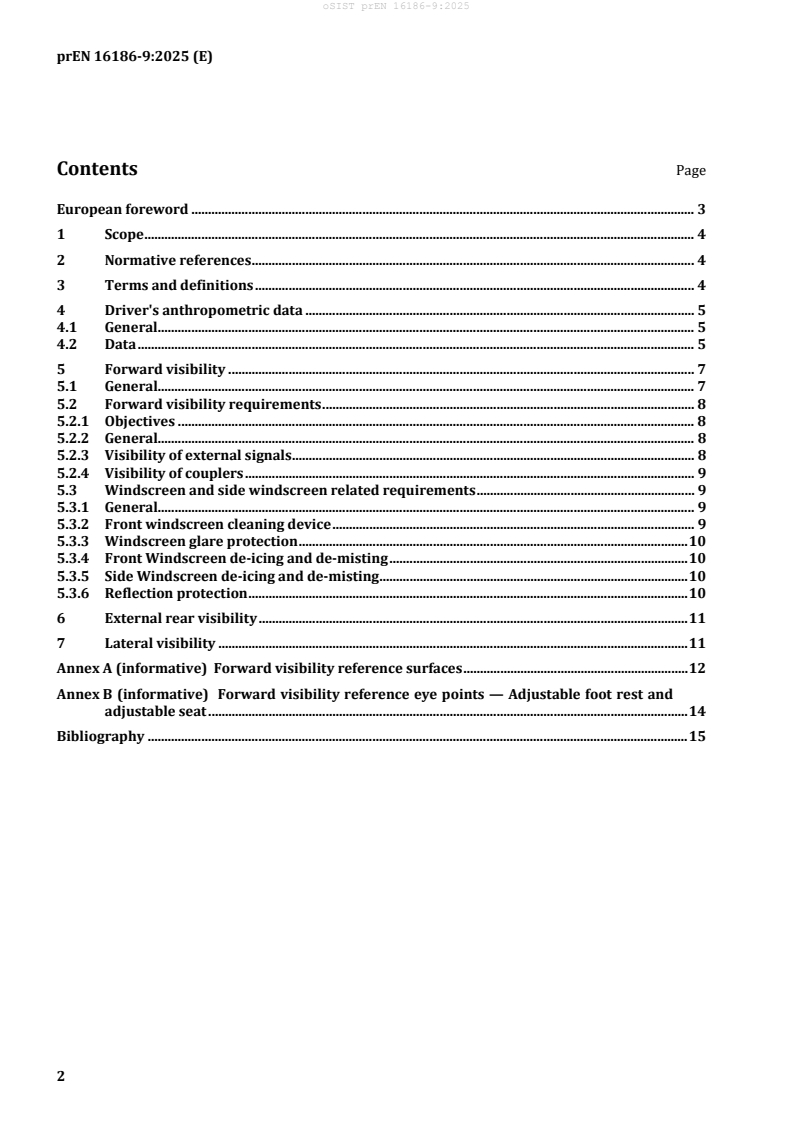
prEN 16186-9:2025 (E)
Contents Page
European foreword . 3
1 Scope . 4
2 Normative references . 4
3 Terms and definitions . 4
4 Driver's anthropometric data . 5
4.1 General. 5
4.2 Data . 5
5 Forward visibility . 7
5.1 General. 7
5.2 Forward visibility requirements . 8
5.2.1 Objectives . 8
5.2.2 General. 8
5.2.3 Visibility of external signals . 8
5.2.4 Visibility of couplers . 9
5.3 Windscreen and side windscreen related requirements . 9
5.3.1 General. 9
5.3.2 Front windscreen cleaning device . 9
5.3.3 Windscreen glare protection . 10
5.3.4 Front Windscreen de-icing and de-misting . 10
5.3.5 Side Windscreen de-icing and de-misting . 10
5.3.6 Reflection protection . 10
6 External rear visibility . 11
7 Lateral visibility . 11
Annex A (informative) Forward visibility reference surfaces . 12
Annex B (informative) Forward visibility reference eye points — Adjustable foot rest and
adjustable seat . 14
Bibliography . 15
oSIST prEN 16186-9:2025
prEN 16186-9:2025 (E)
European foreword
This document (prEN 16186-9:2025) has been prepared by Technical Committee CEN/TC 256 “Railway
applications”, the secretariat of which is held by DIN.
This document is currently submitted to the CEN Enquiry.
This document has been prepared under a standardization request addressed to CEN by the European
Commission. The Standing Committee of the EFTA States subsequently approves these requests for its
Member States.
EN 16186 Railway applications — Driver’s cab consists of the following parts:
— Part 1: Anthropometric data and visibility;
— Part 2: Integration of displays, controls and indicators;
— Part 3: Design of displays;
— Part 4: Layout and access;
— Part 5: External visibility for tram vehicles;
— Part 6: Integration of displays, controls and indicators for tram vehicles;
— Part 7: Design of displays for tram vehicles;
— Part 8: Tram vehicle layout and access;
— Part 9: External visibility for metro vehicles.
NOTE Part 1 to 4 above-mentioned standard are only applicable for heavy rail vehicles and part 5 to 8 are
only applicable to tram vehicles.
Under preparation, currently prEN 16186-7.
Under preparation, currently prEN 16186-9.
oSIST prEN 16186-9:2025
prEN 16186-9:2025 (E)
1 Scope
This document defines:
— General design rules for access to the metro cab,
— Front visibility conditions including positions of people,
— Assessment.
This document applies to metro vehicles with or without driver, excluding shuttles used for short
distance transportation.
Metro vehicle definition is according to EN 17343.
2 Normative references
The following documents are referred to in the text in such a way that some or all of their content
constitutes requirements of this document. For dated references, only the edition cited applies. For
undated references, the latest edition of the referenced document (including any amendments) applies.
EN 17343, Railway applications - General terms and definitions
EN 15152:2019+A1:2023, Railway applications — Windscreens for trains
EN 15663, Railway applications — Vehicle reference masses
3 Terms and definitions
For the purposes of this document, the terms and definitions given in EN 17343 and the following apply.
ISO and IEC maintain terminology databases for use in standardization at the following addresses:
• ISO Online browsing platform: available at https://www.iso.org/obp
• IEC Electropedia: available at https://www.electropedia.org/
3.1
primary vision area
area of the windscreen through which track and signals are visible from the driving position text of the
definition
[SOURCE: EN 15152:2019+A1:2023, definition 3.3]
3.2
secondary vision area term
area of the windscreen outside the primary vision area, through which the driver can also look from the
driving position text of the definition
[SOURCE: EN 15152:2019+A1:2023, definition 3.4]
3.3
windscreen
glazing in front of a driver through which the track ahead can be observed
oSIST prEN 16186-9:2025
prEN 16186-9:2025 (E)
[SOURCE: EN 15152:2019+A1:2023, 3.2, modified — “or passengers” is removed.]
3.4
side windscreen
additional glazing positioned at the side of a windscreen that is predominately positioned transversely
to the running direction
[SOURCE: EN 15152:2019+A1:2023, 3.2.2]
3.5
driver dummies
models referring to the min and max anthropometric data
Note 1 to entry: The anthropometric data are provided in Clause 4.
3.6
driverless metro
metro that, in normal operation, is operated without a driver on board
Note 1 to entry: A driverless metro can be operated by a driver with a simplified desk in degraded conditions.
3.7
shuttle
rail system that runs back and forth between two points
4 Driver's anthropometric data
4.1 General
This Clause defines the anthropometric data on which the requirements in this document are based.
The background on these anthropometric data are provided in CEN/TR 16823.
4.2 Data
Figure 1 and Figure 2 give the body size measures.
oSIST prEN 16186-9:2025
prEN 16186-9:2025 (E)
Dimensions in millimetres
Measure Min. Max.
a
a 1 580 1 940
a
b 1 480 1 815
d 710 860
e 545 665
a
g 405 510
h 120 180
i 440 525
a
j 107 126
k 353 457
l 377 473
m 403 498
n 257 312
o 223 266
p 170 221
t 104 131
x 232 261
a
Includes 30 mm allowance for
shoes.
Figure 1 — Principal body size measures
oSIST prEN 16186-9:2025
prEN 16186-9:2025 (E)
Dimensions in millimetres
Min. Max.
d see Figure 1
a
f 510 635
l see Figure 1
q 78 90
r 75 101
s 105 121
t see Figure 1
u 295 387
v 450 to 600 to
550 700
w 390 to 470 to
405 510
x see Figure 1
z 220 290
a
Includes 30 mm
allowance for shoes.
Key
a) sitting upright
b) sitting inclined
1 hip point
2 seat reference point
3 heel point (lowest rear point of the heel)
z/4 non-flexible part of the shoe pad
Figure 2 — Additional body size measures
The minimum distance between the eyes is 53 mm and the maximum distance between the eyes is
70 mm.
The minimum dimensions shall be used together with the minimum requirements listed in Figure 2.
The maximum dimensions shall be used together with the maximum requirements listed in Figure 2.
5 Forward visibility
5.1 General
For the seated driving position, the forward visibility requirements of 5.2.1 shall be ensured (see also
A.1 and Annex
...