

CEN/TS 16702-1:2014
(Main)Electronic fee collection - Secure monitoring for autonomous toll systems - Part 1: Compliance checking
General Information
- Abstract
This Technical Specification specifies transactions and data for Compliance Checking - Secure Monitoring. The scope of this technical specification consists of:
— The concept and involved processes for Secure Monitoring.
— The definition of new transactions and data.
— The use of the OBE compliance checking transaction as specified in CEN ISO/TS 12813:2009, for the purpose of Compliance Checking - Secure Monitoring.
— The use of back end transactions as specified in EN ISO 12855:2012, for the purpose of Compliance Checking – Secure Monitoring. This includes definitions for the use of optional elements and reserved attributes.
— A specification of technical and organisational security measures involved in Secure Monitoring, on top of measures provided for in the EFC Security Framework.
— The interrelations between different options in the OBE, TSP and TC domain and their high level impacts.
Outside the scope of this Technical Specification are:
— Information exchange between OBE and TR.
— Choices related to compliance checking policies e.g. which options are used, whether undetected/unexpected observations are applied, whether fixed, transportable and/or mobile compliance checking are deployed, locations and intensity of checking of itinerary freezing and checking of toll declaration.
— Details of procedures and criteria for assessing the validity or plausibility of Itinerary Records.
— Choices concerning the storage location of itinerary records, and data retention policy.
— Recommendations for a single specific implementation due to different applicable privacy laws. Instead, a set of options is provided.
- Status
- Withdrawn
- Publication Date
- 04-Nov-2014
- Withdrawal Date
- 29-Sep-2026
- Technical Committee
- CEN/TC 278 - Road transport and traffic telematics
- Drafting Committee
- CEN/TC 278/WG 1 - Electronic fee collection and access control (EFC)
- Current Stage
- 9960 - Withdrawal effective - Withdrawal
- Start Date
- 22-Jan-2020
- Completion Date
- 30-Sep-2026

Relations
- Effective Date
- 29-Jan-2020
- Effective Date
- 25-Aug-2026
- Effective Date
- 09-Feb-2026
- Effective Date
- 09-Feb-2026
- Effective Date
- 09-Feb-2026
- Effective Date
- 09-Feb-2026
- Effective Date
- 09-Feb-2026
- Effective Date
- 09-Feb-2026
- Effective Date
- 09-Feb-2026
- Effective Date
- 09-Feb-2026
- Effective Date
- 28-Jan-2026
- Effective Date
- 28-Jan-2026
- Effective Date
- 28-Jan-2026
- Effective Date
- 28-Jan-2026
- Effective Date
- 28-Jan-2026
Get Certified
Connect with accredited certification bodies for this standard

BSI Group
BSI (British Standards Institution) is the business standards company that helps organizations make excellence a habit.

NYCE
Mexican standards and certification body.
Sponsored listings
Frequently Asked Questions
CEN/TS 16702-1:2014 is a technical specification published by the European Committee for Standardization (CEN). Its full title is "Electronic fee collection - Secure monitoring for autonomous toll systems - Part 1: Compliance checking". This standard covers: This Technical Specification specifies transactions and data for Compliance Checking - Secure Monitoring. The scope of this technical specification consists of: — The concept and involved processes for Secure Monitoring. — The definition of new transactions and data. — The use of the OBE compliance checking transaction as specified in CEN ISO/TS 12813:2009, for the purpose of Compliance Checking - Secure Monitoring. — The use of back end transactions as specified in EN ISO 12855:2012, for the purpose of Compliance Checking – Secure Monitoring. This includes definitions for the use of optional elements and reserved attributes. — A specification of technical and organisational security measures involved in Secure Monitoring, on top of measures provided for in the EFC Security Framework. — The interrelations between different options in the OBE, TSP and TC domain and their high level impacts. Outside the scope of this Technical Specification are: — Information exchange between OBE and TR. — Choices related to compliance checking policies e.g. which options are used, whether undetected/unexpected observations are applied, whether fixed, transportable and/or mobile compliance checking are deployed, locations and intensity of checking of itinerary freezing and checking of toll declaration. — Details of procedures and criteria for assessing the validity or plausibility of Itinerary Records. — Choices concerning the storage location of itinerary records, and data retention policy. — Recommendations for a single specific implementation due to different applicable privacy laws. Instead, a set of options is provided.
This Technical Specification specifies transactions and data for Compliance Checking - Secure Monitoring. The scope of this technical specification consists of: — The concept and involved processes for Secure Monitoring. — The definition of new transactions and data. — The use of the OBE compliance checking transaction as specified in CEN ISO/TS 12813:2009, for the purpose of Compliance Checking - Secure Monitoring. — The use of back end transactions as specified in EN ISO 12855:2012, for the purpose of Compliance Checking – Secure Monitoring. This includes definitions for the use of optional elements and reserved attributes. — A specification of technical and organisational security measures involved in Secure Monitoring, on top of measures provided for in the EFC Security Framework. — The interrelations between different options in the OBE, TSP and TC domain and their high level impacts. Outside the scope of this Technical Specification are: — Information exchange between OBE and TR. — Choices related to compliance checking policies e.g. which options are used, whether undetected/unexpected observations are applied, whether fixed, transportable and/or mobile compliance checking are deployed, locations and intensity of checking of itinerary freezing and checking of toll declaration. — Details of procedures and criteria for assessing the validity or plausibility of Itinerary Records. — Choices concerning the storage location of itinerary records, and data retention policy. — Recommendations for a single specific implementation due to different applicable privacy laws. Instead, a set of options is provided.
CEN/TS 16702-1:2014 is classified under the following ICS (International Classification for Standards) categories: 35.240.60 - IT applications in transport. The ICS classification helps identify the subject area and facilitates finding related standards.
CEN/TS 16702-1:2014 has the following relationships with other standards: It is inter standard links to CEN/TS 16702-1:2020, ISO/IEC 18033-1:2005, ISO/IEC 8825-4:2008, ISO/IEC 8825-2:2008, ISO/IEC 11770-3:2008, ISO 14813-6:2009, ISO/IEC 8824-1:2008, ISO/IEC 18033-3:2010, ISO/IEC 9797-1:2011, ISO/IEC 8825-1:2008, CEN/TS 16439:2013, CEN ISO/TS 17575-1:2010, CEN ISO/TS 12813:2009, CEN ISO/TS 17575-3:2011, EN ISO 14906:2011. Understanding these relationships helps ensure you are using the most current and applicable version of the standard.
CEN/TS 16702-1:2014 is associated with the following European legislation: EU Directives/Regulations: 2004/52/EC; Standardization Mandates: M/338. When a standard is cited in the Official Journal of the European Union, products manufactured in conformity with it benefit from a presumption of conformity with the essential requirements of the corresponding EU directive or regulation.
CEN/TS 16702-1:2014 is available in PDF format for immediate download after purchase. The document can be added to your cart and obtained through the secure checkout process. Digital delivery ensures instant access to the complete standard document.
Standards Content (Sample)
SLOVENSKI STANDARD
01-februar-2015
Elektronsko pobiranje pristojbin - Varnostno spremljanje avtonomnih cestninskih
sistemov - 1. del: Preverjanje skladnosti
Electronic fee collection - Secure monitoring for autonomous toll systems - Part 1:
Compliance checking
Elektronische Gebührenerhebung - Sichere Überwachung von autonomen
Mautsystemen - Einhaltungsprüfung
Perception du télépéage - Surveillance sécurisée pour systèmes autonomes de péage -
Partie 1: Contrôle de conformité
Ta slovenski standard je istoveten z: CEN/TS 16702-1:2014
ICS:
35.240.60 Uporabniške rešitve IT v IT applications in transport
transportu in trgovini and trade
2003-01.Slovenski inštitut za standardizacijo. Razmnoževanje celote ali delov tega standarda ni dovoljeno.
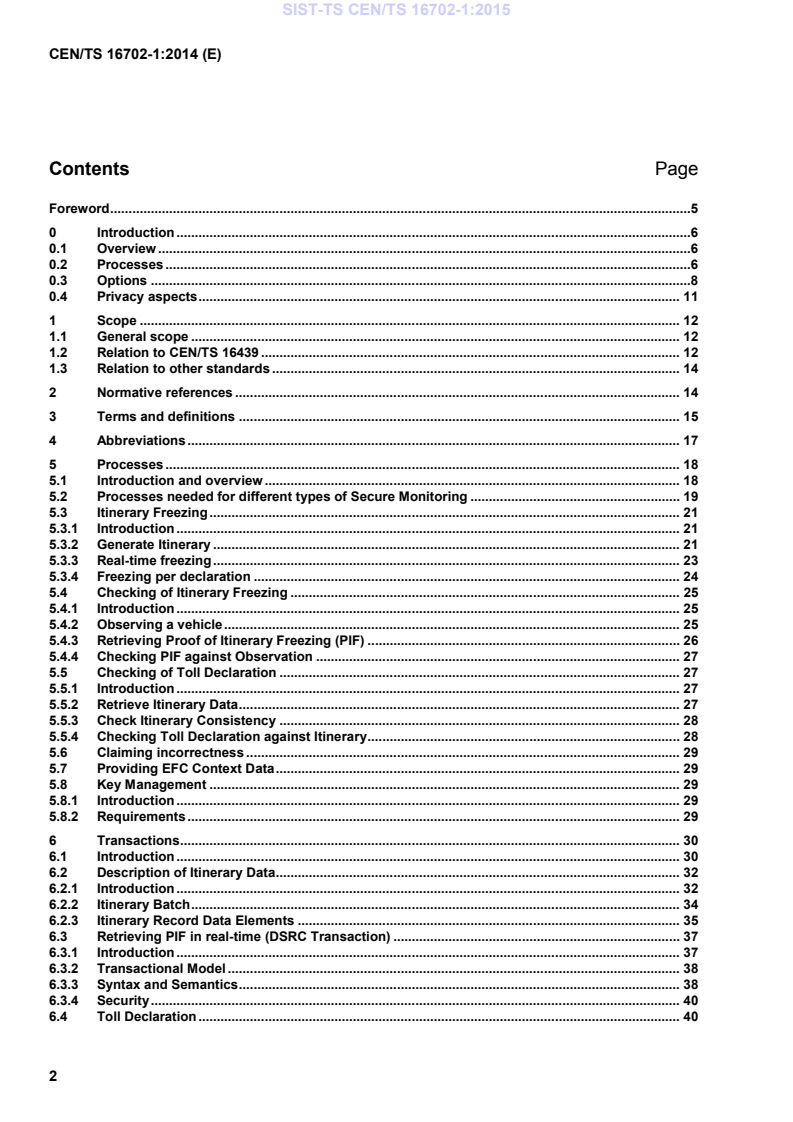
TECHNICAL SPECIFICATION
CEN/TS 16702-1
SPÉCIFICATION TECHNIQUE
TECHNISCHE SPEZIFIKATION
November 2014
ICS 35.240.60
English Version
Electronic fee collection - Secure monitoring for autonomous toll
systems - Part 1: Compliance checking
Perception du télépéage - Surveillance sécurisée pour Elektronische Gebührenerhebung - Sichere Überwachung
systèmes autonomes de péage - Partie 1: Contrôle de von autonomen Mautsystemen - Einhaltungsprüfung
conformité
This Technical Specification (CEN/TS) was approved by CEN on 14 June 2014 for provisional application.
The period of validity of this CEN/TS is limited initially to three years. After two years the members of CEN will be requested to submit their
comments, particularly on the question whether the CEN/TS can be converted into a European Standard.
CEN members are required to announce the existence of this CEN/TS in the same way as for an EN and to make the CEN/TS available
promptly at national level in an appropriate form. It is permissible to keep conflicting national standards in force (in parallel to the CEN/TS)
until the final decision about the possible conversion of the CEN/TS into an EN is reached.
CEN members are the national standards bodies of Austria, Belgium, Bulgaria, Croatia, Cyprus, Czech Republic, Denmark, Estonia,
Finland, Former Yugoslav Republic of Macedonia, France, Germany, Greece, Hungary, Iceland, Ireland, Italy, Latvia, Lithuania,
Luxembourg, Malta, Netherlands, Norway, Poland, Portugal, Romania, Slovakia, Slovenia, Spain, Sweden, Switzerland, Turkey and United
Kingdom.
EUROPEAN COMMITTEE FOR STANDARDIZATION
COMITÉ EUROPÉEN DE NORMALISATION
EUROPÄISCHES KOMITEE FÜR NORMUNG
CEN-CENELEC Management Centre: Avenue Marnix 17, B-1000 Brussels
© 2014 CEN All rights of exploitation in any form and by any means reserved Ref. No. CEN/TS 16702-1:2014 E
worldwide for CEN national Members.
Contents Page
Foreword .5
0 Introduction .6
0.1 Overview .6
0.2 Processes .6
0.3 Options .8
0.4 Privacy aspects . 11
1 Scope . 12
1.1 General scope . 12
1.2 Relation to CEN/TS 16439 . 12
1.3 Relation to other standards . 14
2 Normative references . 14
3 Terms and definitions . 15
4 Abbreviations . 17
5 Processes . 18
5.1 Introduction and overview . 18
5.2 Processes needed for different types of Secure Monitoring . 19
5.3 Itinerary Freezing . 21
5.3.1 Introduction . 21
5.3.2 Generate Itinerary . 21
5.3.3 Real-time freezing . 23
5.3.4 Freezing per declaration . 24
5.4 Checking of Itinerary Freezing . 25
5.4.1 Introduction . 25
5.4.2 Observing a vehicle . 25
5.4.3 Retrieving Proof of Itinerary Freezing (PIF) . 26
5.4.4 Checking PIF against Observation . 27
5.5 Checking of Toll Declaration . 27
5.5.1 Introduction . 27
5.5.2 Retrieve Itinerary Data . 27
5.5.3 Check Itinerary Consistency . 28
5.5.4 Checking Toll Declaration against Itinerary . 28
5.6 Claiming incorrectness . 29
5.7 Providing EFC Context Data . 29
5.8 Key Management . 29
5.8.1 Introduction . 29
5.8.2 Requirements . 29
6 Transactions . 30
6.1 Introduction . 30
6.2 Description of Itinerary Data . 32
6.2.1 Introduction . 32
6.2.2 Itinerary Batch . 34
6.2.3 Itinerary Record Data Elements . 35
6.3 Retrieving PIF in real-time (DSRC Transaction) . 37
6.3.1 Introduction . 37
6.3.2 Transactional Model . 38
6.3.3 Syntax and Semantics . 38
6.3.4 Security . 40
6.4 Toll Declaration . 40
6.4.1 Introduction . 40
6.4.2 Transactional Model . 40
6.4.3 Syntax and semantics . 41
6.4.4 Itinerary Sequence . 42
6.4.5 Security . 44
6.5 Back End Data Checking . 44
6.5.1 Introduction . 44
6.5.2 Transactional model . 45
6.5.3 Checks of the Itinerary . 46
6.5.4 Syntax and semantics . 47
6.5.5 Security . 50
6.6 Claiming incorrectness . 50
6.6.1 Introduction . 50
6.6.2 Transactional model . 51
6.6.3 Syntax and semantics . 52
6.6.4 Security . 52
6.7 Providing EFC Context Data . 53
6.7.1 Introduction . 53
6.7.2 Transactional Model . 53
6.7.3 Syntax and semantics . 53
6.7.4 Security . 55
7 Security . 55
7.1 Security functions and elements . 55
7.1.1 Hash functions . 55
7.1.2 MAC. 55
7.1.3 Digital signatures . 55
7.1.4 Public Keys, Certificates and CRL . 55
7.2 Key Management . 56
7.2.1 Key Exchange between Stakeholders . 56
7.2.2 Key generation and certification . 56
7.3 Trusted Recorder and SM_CC Verification SAM characteristics . 57
7.3.1 Introduction . 57
7.3.2 Trusted Recorder . 57
7.3.3 SM_CC Verification SAM . 58
Annex A (normative) Data type specification . 59
Annex B (normative) Protocol Implementation Conformance Statement . 67
B.1 Guidance for completing the PICS proforma . 67
B.1.1 Purposes and structure . 67
B.1.2 Abbreviations and conventions . 67
B.1.3 Instructions for completing the PICS proforma . 69
B.2 Identification of the implementation . 69
B.2.1 General . 69
B.2.2 Date of the statement . 69
B.2.3 Implementation Under Test (IUT) identification . 69
B.2.4 System Under Test (SUT) identification . 69
B.2.5 Product supplier . 70
B.2.6 Applicant (if different from product supplier). 70
B.2.7 PICS contact person . 70
B.3 Identification of the protocol . 71
B.4 Global statement of conformance . 71
B.5 Roles . 71
B.6 Types of Secure Monitoring . 71
B.7 Capabilities and conditions . 72
B.8 Processes . 73
Annex C (informative) Example transactions . 74
Annex D (informative) Addressed threats (in CEN/TS 16439) . 78
D.1 Introduction . 78
D.2 Threats where Secure Monitoring can provide Security Measures . 78
D.3 Related Requirements . 80
D.4 Related Security Measures . 81
Annex E (informative) Essentials of the SM_CC concept . 84
E.1 Introduction . 84
E.2 The SM_CC concept – FAQs . 84
E.3 SM_CC options . 86
E.3.1 SM_CC_1 . 86
E.3.2 SM_CC_2 . 90
E.3.3 SM_CC_3a . 93
E.3.4 SM_CC_3b . 95
E.4 Managing multiple toll domains . 96
E.4.1 Overlapping toll domains . 96
E.4.2 The ‘catch-all’ toll domain counter . 98
Annex F (informative) Use of this Technical Specification for the EETS . 99
F.1 General . 99
F.2 Overall relationship between European standardization and the EETS . 99
F.3 European standardization work supporting the EETS . 99
F.4 Correspondence between this technical specification and the EETS . 100
Bibliography . 101
Foreword
This document (CEN/TS 16702-1:2014) has been prepared by Technical Committee CEN/TC 278 “Intelligent
transport systems”, the secretariat of which is held by NEN.
Attention is drawn to the possibility that some of the elements of this document may be the subject of patent
rights. CEN [and/or CENELEC] shall not be held responsible for identifying any or all such patent rights.
This document has been prepared under a mandate given to CEN by the European Commission and the
European Free Trade Association.
According to the CEN-CENELEC Internal Regulations, the national standards organizations of the following
countries are bound to announce this Technical Specification: Austria, Belgium, Bulgaria, Croatia, Cyprus,
Czech Republic, Denmark, Estonia, Finland, Former Yugoslav Republic of Macedonia, France, Germany,
Greece, Hungary, Iceland, Ireland, Italy, Latvia, Lithuania, Luxembourg, Malta, Netherlands, Norway, Poland,
Portugal, Romania, Slovakia, Slovenia, Spain, Sweden, Switzerland, Turkey and the United Kingdom.
0 Introduction
0.1 Overview
In autonomous toll systems a Toll Service Provider (TSP) sends toll declarations to the Toll Charger (TC), i.e.
statements that a vehicle was circulating within a toll domain. Compliance Check Communication (CCC)
according to CEN ISO/TS 12813:2009 provides useful indications to a TC of whether the OBE is operating
correctly or not. It assumes the OBE to be secure and the TSP to be trusted. It mainly focusses on the
compliance of the Service User (SU) with the toll domain’s rules.
This Technical Specification does not assume the OBE to be secure nor the TSP to be trusted and adds
measures to deal with the associated risks. It specifies the requirements for Secure Monitoring Compliance
Checking (SM_CC), a concept that allows the TC to check the trustworthiness of toll declarations produced by
a TSP using an OBE operated by the SU, while respecting the privacy of the SU in accordance with the
applicable regulations. Trustworthiness equals the confidence in the reliable operation of the Toll Service
Provider’s EFC System and / or in case of errors gives technical indications about possible failures or
manipulations which may be attributed to the SU and/or the TSP or an external party. An operational EFC
System can use a combination of the CCC and SM_CC tools to keep misuse under control effectively.
This Technical Specification is the first part in a set of two that together specify Secure Monitoring for
Autonomous Toll Systems: This technical specification, “Secure Monitoring - Compliance Checking”,
specifies the transactions between RSE of the TC over DSRC as well as transactions between the Toll
Charger's and the Toll Service Provider's back end systems, for the purpose of Secure Monitoring. A second
part, “Secure Monitoring – Trusted Recorder”, specifies requirements on a tamper-proof entity called a
Trusted Recorder (TR) which can be part of the OBE. It also specifies the interface between OBE and TR.
Most – but not all – available options for secure monitoring require the use of a TR to provide for integrity,
authenticity and non-repudiation services.
The SM_CC method is suitable:
a) for use by Toll Chargers and Toll Service Providers that do not have to trust each other and only trust
parts of each other’s equipment;
b) for all types of toll regimes according to CEN ISO/TS 17575 (all parts);
c) for providing evidence that can be used in court;
d) for the application to local schemes as well as in interoperable sectors such as the European Electronic
Toll Service (EETS).
0.2 Processes
SM_CC provides a TC operating an autonomous toll system with the tools to check whether or not the usage
of a transport service by a vehicle in his toll domain is correctly recorded in what is called the itinerary.
In the OBE, the registration of a vehicle’s road usage is represented by a so-called itinerary which is
committed to in real-time or with a defined delay by a process called itinerary freezing. Itinerary freezing
ensures that the integrity of the itinerary is undeniably committed to. After an itinerary is frozen, deletion or
manipulation/replacement of itinerary data will invalidate the proof of integrity and can thus be detected. The
freezing process comes in two variants:
— real-time freezing: In this case the presence of a tamper proof trust anchor in the OBE is assumed. This
trust anchor is called the Trusted Recorder (TR) and takes care of digitally signing itinerary records
thereby committing to them in real-time.
— freezing per declaration: In this case, the itineraries are signed by the TSP back end and committed to
by sending the signature to the TC using the standard EN ISO 12855:2012 message Toll Declaration.
The road usage itself can be detected via (automatic or manual) observations. In order to be fully effective, the
concept requires either unexpected or undetected observations, depending on the type of secure monitoring
applied.
SM_CC provides the TSP with tools to check the consistency of the Charge Reports obtained from his Front-
end and/or the related Toll Declarations with the itinerary. SM_CC is based on a double principle and related
processes which are loosely coupled but need to be executed both: Checking of Itinerary Freezing (CIF)
and Checking of Toll Declaration (CTD).
Figure 1 — The sub-processes of Compliance Checking (UML use case diagram)
For CIF the aim is to check the registered itinerary data against an observation of road usage. The concept
ensures that such data cannot be corrected in case of an unexpected spot check observation or
deleted/changed in case of an absence of checks.
CIF can be done in real-time at the roadside using an SM_CC transaction via DSRC and / or with delay in the
back end using the CTD transaction. CIF gives the TC confidence in that all road usage is registered as an
itinerary in the freezing process. The frozen itineraries in turn are used as a reference for checking the
plausibility of the Toll Declarations.
It is mandatory that the TSP checks that the itinerary is plausible and that the Toll Declaration is consistent
with the Itinerary. The Toll Chargers confidence that this process is carried out continuously can be
established through the CTD Process, but it is also possible to achieve this through audits or other processes
not described in this standard.
CTD is a spot check operation in which the Toll Declaration is checked against the underlying detailed
itinerary data (which is not necessarily part of the Toll Declaration) in order to verify that the aggregated fields
that are reported (e.g. distance travelled in charging zone, aggregated fee etc.) have been computed
correctly. CTD also aims to verify the integrity, the completeness and plausibility of the itinerary data. Since
CTD requires the TC to analyse the detailed itineraries corresponding to the Toll Declaration of the SU it is
desirable from a privacy perspective to limit the number of CTD transactions.
CIF and CTD can be executed independently, however to achieve the complete coverage of Secure
Monitoring CIF needs to be complemented with CTD and vice-versa.
0.3 Options
For a derivation of the different types of Secure Monitoring from the available options, see Table 1. Annex E
provides further background information on the use of and the rationale for these options. Annex F how this
TS can be used for the EETS.
Type of Description Capabilities needed Conditions for Privacy impact
Secure effective
Monitoring compliance checks
SM_CC-1 1. Real-time Freezing using a Trusted An itinerary record (IR) is evaluated on the spot
Recorder without trusted time source by the TC and deleted together with the images
in case of correctness.
2. Unexpected observation
In case of delayed (back end) Checking of
3. Real-time Checking of itinerary
X X X
Itinerary Freezing: Observation data for those
freezing over DSRC
checks (images) are stored until itinerary records
Option: Occasional
can be checked.
delayed (back end) Checking of
Itinerary Freezing
SM_CC-2 1. Real-time Freezing using a Trusted Observation (images) data are stored until
Recorder with trusted time source itinerary records can be checked.
2. Unexpected observation X X X
3. Delayed (back end) Checking of
Itinerary Freezing
SM_CC-3a 1. Freezing per Declaration Observation (images) data are stored until
itinerary records can be checked.
2. Undetected observation
X
3. Delayed (back end) Checking of
Itinerary Freezing
SM_CC-3b 1. Freezing per Declaration with High Observation (images) data are stored until
Frequency itinerary records can be checked.
2. Unexpected observation X X
3. Delayed (back end) Checking of
Itinerary Freezing
Table 1 — Different types of Secure Monitoring
Trusted
Recorder
Trusted Time
Source
High
communicatio
n availability
CIF via DSRC
UNEXPECTE
D
observations
UNDETECTE
D
observations
A TC or TSP that wants to operate under one (or many) types of Secure Monitoring needs to implement the
required capabilities.
Trusted Recorder capability: To equip the OBE with a TR (SM_CC-1) or even a TR with Trusted Time
Source (SM_CC-2) is a TSP decision. Amongst other things, the TR needs to:
1. have a high level protection against unauthorised disclosure and/or modification of stored data;
2. be capable of secure cryptographic computations;
3. include a secure monotonous transaction counter;
4. be capable of enforcing a minimum time lock between records to be signed (frozen) or explicitly checking
the correctness of their timestamp (in case of presence of a trusted time source).
High communication availability: High communication availability (for SM_CC-3b) is in practice determined
by the telecommunication coverage of the toll domain. This is primarily something the TSP can influence by
contracting the appropriate service level with the mobile communications provider.
CIF via DSRC: The possibility to perform CIF in real-time (SM_CC-1) depends on the capability to have this
SM_CC transaction implemented over DSRC and for both TSP and TC to be equipped with DSRC
transponders and transceivers respectively.
Unexpected or undetected observations: An unexpected observation is not known to the driver or OBE
beforehand but might well be after. The reason could for example be because the user observed a road side
compliance checking equipment, or because a DSRC transaction took place which informs the OBE that it has
been observed. An undetected observation, by contrast, is known neither before nor after to the driver and
OBE.
SM_CC-1: The OBE is equipped with a TR which freezes all itineraries in real-time. By performing a CIF
transaction via DSRC, the RSE is able to check that the observed road usage of the vehicle is correctly
accounted for in the last frozen itinerary record. Because itinerary records are consecutively numbered and
can only be signed by the specific TR in the OBE, the TC can be confident that this itinerary record will be
included in the itinerary data underlying the declaration. (Missing or altered records can be detected through
CTD.) Consequently the observation data can be deleted immediately after the check, unless irregularities
were detected.
SM_CC-2: Here the OBE is equipped with a TR with trusted time source. This type is quite similar to SM_CC-
1 but does not require that CIF is performed in real-time over DSRC. The full effectiveness can be
accomplished with unexpected observations in combination with delayed CIF in the back end using the CTD
transaction. This is due to a trusted timestamp associated with a frozen record, as opposed to the previous
implementation scenario SM_CC-1 where only the order of records can be guaranteed through the toll domain
counter. With a trusted timestamp, attacks where (fake) itineraries are frozen afterwards are rendered
ineffective as they will be recorded with the actual time of creation.
SM_CC-3a: In this scenario no TR is needed, because the TSP performs freezing per declaration. An
observation of the vehicle is checked for consistency with the itinerary in the back end using the CTD
transaction. Observation data have to be stored until the toll declaration and requested underlying itinerary
data are received from the TSP. It is noted that this approach will be effective against manipulation of charge
and itinerary data by the SU (or TSP) only if observations are, at least occasionally, undetected by the SU (or
TSP). Otherwise, the SU (or TSP) could always take care that his manipulation goes undetected by including
correct data for the points of observation.
SM_CC-3b: In case there is no confidence that observations can be performed undetected, freezing per
declaration can still be effective if the reporting frequency for the declaration is high. It will be difficult to
manipulate itinerary data while including detected observation points under the condition that the resulting
itinerary data still constitute a realistic pattern. However, it depends on the scheme details what reporting
frequency would be sufficient. A high reporting frequency also imposes requirements and costs on mobile
communications and TSP back end.
0.4 Privacy aspects
SM_CC enables different implementations to comply with applicable privacy laws (which may depend on
vehicle categories involved and the road network covered). Different options for example regarding the
content of itinerary data (context dependent and/or independent itineraries) and different ways to access the
data for real-time or delayed checks can be selected in order to apply with legal requirements. With the
different options provided, this concept also supports collection limitation and data minimization as main
privacy principles from ISO/IEC 29100.
In some cases generation and provision of additional data for SM_CC might be forbidden or might require
modifications in legislation. It is in the responsibility of the TSP to ensure that toll domain specific privacy
requirements are implemented in the OBE. As a consequence, SM_CC requires an OBE to be toll domain
aware.
NOTE For example, in the German truck tolling system collection and storage of itinerary data regarding trips outside
the chargeable road network would not be allowed under the current Tolling Act (Bundesfernstraßenmautgesetz). This law
also restricts storage of time stamps with tolling events to prevent derivation of concrete speed information.
In some cases it might be necessary not to collect specific data within a specific toll domain, to select an
appropriate sampling rate or at least to delete the data directly on the OBE after its generation.
The TC may also be subject to toll domain specific requirements. For instance regulations for storage of
observation data can be different between countries. In some countries it might be forbidden to store
observation data without a suspicion of non-compliance or to store data that are related to vehicles that are
not liable to toll. In an extreme case this would allow unexpected observations using DSRC with real-time CIF,
but prohibit checks where roadside observations have to be stored until the corresponding toll declarations are
received by the TC.
The TC should also be aware that it might be forbidden for the TSP to provide any itinerary data that are
collected outside the TC’s toll domain or outside the TC’s country. This would limit TC’s possibilities for
delayed CIF. As one possible solution this concept provides the option that plausibility checks of the toll
declaration against itineraries are performed by the TSP. This would require a high level of trust between the
TC and the TSP.
1 Scope
1.1 General scope
This Technical Specification specifies transactions and data for Compliance Checking - Secure Monitoring.
The scope of this technical specification consists of:
— The concept and involved processes for Secure Monitoring.
— The definition of new transactions and data.
— The use of the OBE compliance checking transaction as specified in CEN ISO/TS 12813:2009, for the
purpose of Compliance Checking - Secure Monitoring.
— The use of back end transactions as specified in EN ISO 12855:2012, for the purpose of Compliance
Checking – Secure Monitoring. This includes definitions for the use of optional elements and reserved
attributes.
— A specification of technical and organisational security measures involved in Secure Monitoring, on top of
measures provided for in the EFC Security Framework.
— The interrelations between different options in the OBE, TSP and TC domain and their high level impacts.
Outside the scope of this Technical Specification are:
— Information exchange between OBE and TR.
— Choices related to compliance checking policies e.g. which options are used, whether
undetected/unexpected observations are applied, whether fixed, transportable and/or mobile compliance
checking are deployed, locations and intensity of checking of itinerary freezing and checking of toll
declaration.
— Details of procedures and criteria for assessing the validity or plausibility of Itinerary Records.
— Choices concerning the storage location of itinerary records, and data retention policy.
— Recommendations for a single specific implementation due to different applicable privacy laws. Instead, a
set of options is provided.
1.2 Relation to CEN/TS 16439
Secure Monitoring can be regarded as a set of specific measures addressing a number of serious threats
identified in the EFC Security Framework, namely:
Threats assigned to the User agent:
— Manipulating the system to not register road usage.
— Manipulating the system to register the wrong (lower) road usage.
— Manipulating the system to lose road usage data.
Threats assigned to Toll Service Provider agent:
— Modifying usage data reported from the OBE.
— Suppressing reporting of road use.
— Faulty interpretation of usage data.
— Wrongly configuring the front end.
NOTE The Technical Specification EFC Security Framework (CEN/TS 16439:2013) analyses the general
requirements of the stakeholders and provides a comprehensive threat analysis for an interoperable EFC scheme. A
number of identified threats may result in less revenue of the toll charger, incorrect charging and billing and not meeting
required service levels between Toll Service Provider and Toll Charger. The EFC Security Framework further specifies
requirements to counter the identified threats. Some of these requirements can be fulfilled by implementing basic security
measures that are specified in the same document, but more specific security measures are left to other standards and
specifications or to local choices.
Secure Monitoring makes use of basic cryptographic security measures and procedures provided for in the
EFC Security Framework as far as possible. The relation between the EFC Security Framework and the
Secure Monitoring technical specifications is illustrated in Figure 2.
Figure 2 — Relation between the EFC Security Framework, Secure Monitoring - Compliance Checking
and Secure Monitoring - Trusted Recorder
Based on the threat analysis that has been carried out in the EFC Security Framework, Figure 2 specifies
which attacks Secure Monitoring addresses.
1.3 Relation to other standards
This Technical Specification complies with the allocation of roles and responsibilities as specified in
ISO 17573:2010 Electronic fee collection – Systems architecture for vehicle related tolling.
This Technical Specification defines transactions in the interfaces between the TSP Front end and the Toll
Charger's road side equipment (RSE) as well as between the Toll Service Providers and the Toll Chargers
back end. As these interfaces are also covered by CEN ISO/TS 12813:2009 (Compliance Checking
Communication) and EN ISO 12855:2012 (Information Exchange between service provision and Toll
Charging), SM_CC reuses these standards by specifying which options to choose and by defining the content
of data fields. Extensions and additions are only specified in cases where it is not possible to specify the
SM_CC with the tools available in these standards.
The relation between this Technical Specification, the interfaces between TC and TSP and the
aforementioned standards is illustrated in Figure 3 below.
Figure 3 — Relation between Secure Monitoring – Compliance Checking, Compliance Checking
Communication (CEN ISO/TS 12813:2009) and Information Exchange between service provision and
Toll Chargers (EN ISO 12855:2012)
2 Normative references
The following documents, in whole or in part, are normatively referenced in this document and are
indispensable for its application. For dated references, only the edition cited applies. For undated references,
the latest edition of the referenced document (including any amendments) applies.
ISO/IEC 8824-1:2008, Information technology — Abstract Syntax Notation One (ASN.1): Specification of basic
notation
ISO/IEC 8825-1, Information technology — ASN.1 encoding rules: Specification of Basic Encoding Rules
(BER), Canonical Encoding Rules (CER) and Distinguished Encoding Rules (DER)
ISO/IEC 8825-2:2008, Information technology — ASN.1 encoding rules: Specification of Packed Encoding
Rules (PER)
ISO/IEC 8825-4:2008, Information technology — ASN.1 encoding rules: XML Encoding
...