

EN 13341:2005
(Main)Thermoplastics static tanks for above ground storage of domestic heating oils, kerosene and diesel fuels - Blow moulded polyethylene, rotationally moulded polyethylene and polyamide 6 by anionic polymerization tanks - Requirements and test methods
General Information
- Abstract
This document specifies requirements for materials, physical properties and performance of single blow moulded and rotationally moulded polyethylene tanks or polyamide 6 (by anionic polymerisation) tanks, with or without reinforcements, for above ground storage of domestic heating oil, kerosene and diesel fuels.
It is only applicable to static blow moulded and rotationally moulded polyethylene tanks and polyamide 6 (by anionic polymerisation) tanks that are subject to atmospheric pressure and have a capacity from 450 l up to 10 000 l.
This document does not consider the consequences of wind or snow loading which is considered to be an installation issue.
- Status
- Withdrawn
- Publication Date
- 15-Mar-2005
- Withdrawal Date
- 11-Jan-2011
- Technical Committee
- CEN/TC 266 - Thermoplastic static tanks
- Current Stage
- 9960 - Withdrawal effective - Withdrawal
- Start Date
- 12-Jan-2011
- Completion Date
- 12-Jan-2011
89/106/EEC - Construction productsOJ Ref: C, C 319 OJ Date: 14-Dec-2005

Relations
- Effective Date
- 19-Jan-2023
- Effective Date
- 22-Dec-2008
Get Certified
Connect with accredited certification bodies for this standard

Institut za varilstvo d.o.o. (Welding Institute)
Slovenia's leading welding institute since 1952. ISO 3834, EN 1090, pressure equipment certification, NDT personnel, welder qualification. Only IIW Au
Sponsored listings
Frequently Asked Questions
EN 13341:2005 is a standard published by the European Committee for Standardization (CEN). Its full title is "Thermoplastics static tanks for above ground storage of domestic heating oils, kerosene and diesel fuels - Blow moulded polyethylene, rotationally moulded polyethylene and polyamide 6 by anionic polymerization tanks - Requirements and test methods". This standard covers: This document specifies requirements for materials, physical properties and performance of single blow moulded and rotationally moulded polyethylene tanks or polyamide 6 (by anionic polymerisation) tanks, with or without reinforcements, for above ground storage of domestic heating oil, kerosene and diesel fuels. It is only applicable to static blow moulded and rotationally moulded polyethylene tanks and polyamide 6 (by anionic polymerisation) tanks that are subject to atmospheric pressure and have a capacity from 450 l up to 10 000 l. This document does not consider the consequences of wind or snow loading which is considered to be an installation issue.
This document specifies requirements for materials, physical properties and performance of single blow moulded and rotationally moulded polyethylene tanks or polyamide 6 (by anionic polymerisation) tanks, with or without reinforcements, for above ground storage of domestic heating oil, kerosene and diesel fuels. It is only applicable to static blow moulded and rotationally moulded polyethylene tanks and polyamide 6 (by anionic polymerisation) tanks that are subject to atmospheric pressure and have a capacity from 450 l up to 10 000 l. This document does not consider the consequences of wind or snow loading which is considered to be an installation issue.
EN 13341:2005 is classified under the following ICS (International Classification for Standards) categories: 23.020.10 - Stationary containers and tanks. The ICS classification helps identify the subject area and facilitates finding related standards.
EN 13341:2005 has the following relationships with other standards: It is inter standard links to EN 13341:2005+A1:2011, EN 13341:2005/FprA1. Understanding these relationships helps ensure you are using the most current and applicable version of the standard.
EN 13341:2005 is associated with the following European legislation: EU Directives/Regulations: 305/2011, 89/106/EEC; Standardization Mandates: M/131. When a standard is cited in the Official Journal of the European Union, products manufactured in conformity with it benefit from a presumption of conformity with the essential requirements of the corresponding EU directive or regulation.
EN 13341:2005 is available in PDF format for immediate download after purchase. The document can be added to your cart and obtained through the secure checkout process. Digital delivery ensures instant access to the complete standard document.
Standards Content (Sample)
2003-01.Slovenski inštitut za standardizacijo. Razmnoževanje celote ali delov tega standarda ni dovoljeno.Thermoplastics static tanks for above ground storage of domestic heating oils, kerosene and diesel fuels - Blow moulded polyethylene, rotationally moulded polyethylene and polyamide 6 by anionic polymerization tanks - Requirements and test methodsLMVNRVNRRéservoirs statiques en thermoplastiques destinés au stockage non enterré de fioul domestique, combustible liquide pour appareil mobile de chauffage/pétrole lampant et gazole - Réservoirs en polyéthylene moulés par soufflage, en polyéthylene moulés par rotation et en polyamide 6 par polymérisation anionique - Exigences et méthodes d'essaiOrtsfeste Tanks aus Thermoplasten für die oberirdische Lagerung von Heizölen, Kerosin und Dieselkraftstoffen - Tanks, die aus blasgeformtem Polyethylen, rotationsgeformtem Polyethylen und durch anionische Polymerisation von Polyamid 6 hergestellt wurden - Anforderungen und PrüfverfahrenTa slovenski standard je istoveten z:EN 13341:2005SIST EN 13341:2005en23.020.10ICS:SLOVENSKI
STANDARDSIST EN 13341:200501-junij-2005
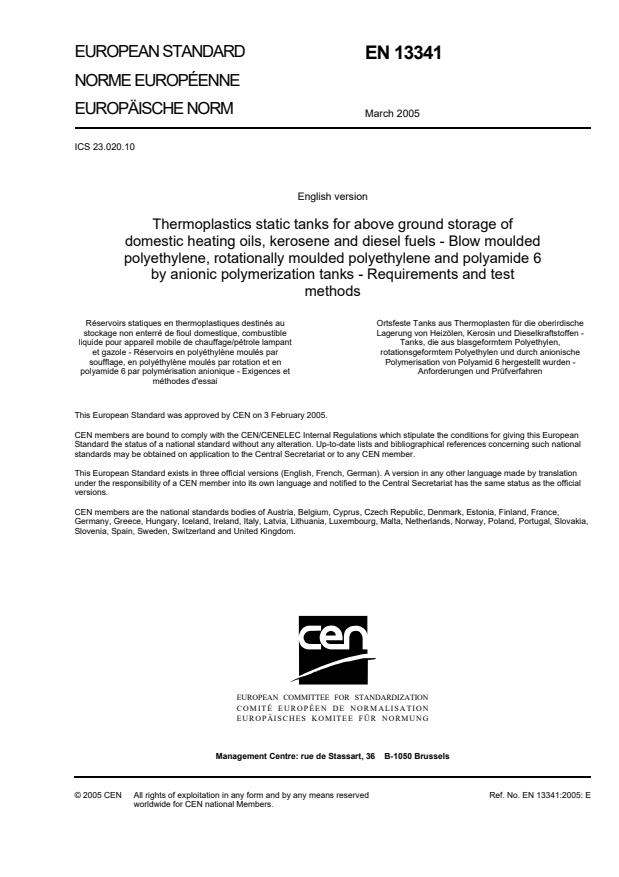
EUROPEAN STANDARDNORME EUROPÉENNEEUROPÄISCHE NORMEN 13341March 2005ICS 23.020.10English versionThermoplastics static tanks for above ground storage ofdomestic heating oils, kerosene and diesel fuels - Blow mouldedpolyethylene, rotationally moulded polyethylene and polyamide 6by anionic polymerization tanks - Requirements and testmethodsRéservoirs statiques en thermoplastiques destinés austockage non enterré de fioul domestique, combustibleliquide pour appareil mobile de chauffage/pétrole lampantet gazole - Réservoirs en polyéthylène moulés parsoufflage, en polyéthylène moulés par rotation et enpolyamide 6 par polymérisation anionique - Exigences etméthodes d'essaiOrtsfeste Tanks aus Thermoplasten für die oberirdischeLagerung von Heizölen, Kerosin und Dieselkraftstoffen -Tanks, die aus blasgeformtem Polyethylen,rotationsgeformtem Polyethylen und durch anionischePolymerisation von Polyamid 6 hergestellt wurden -Anforderungen und PrüfverfahrenThis European Standard was approved by CEN on 3 February 2005.CEN members are bound to comply with the CEN/CENELEC Internal Regulations which stipulate the conditions for giving this EuropeanStandard the status of a national standard without any alteration. Up-to-date lists and bibliographical references concerning such nationalstandards may be obtained on application to the Central Secretariat or to any CEN member.This European Standard exists in three official versions (English, French, German). A version in any other language made by translationunder the responsibility of a CEN member into its own language and notified to the Central Secretariat has the same status as the officialversions.CEN members are the national standards bodies of Austria, Belgium, Cyprus, Czech Republic, Denmark, Estonia, Finland, France,Germany, Greece, Hungary, Iceland, Ireland, Italy, Latvia, Lithuania, Luxembourg, Malta, Netherlands, Norway, Poland, Portugal, Slovakia,Slovenia, Spain, Sweden, Switzerland and United Kingdom.EUROPEAN COMMITTEE FOR STANDARDIZATIONCOMITÉ EUROPÉEN DE NORMALISATIONEUROPÄISCHES KOMITEE FÜR NORMUNGManagement Centre: rue de Stassart, 36
B-1050 Brussels© 2005 CENAll rights of exploitation in any form and by any means reservedworldwide for CEN national Members.Ref. No. EN 13341:2005: E
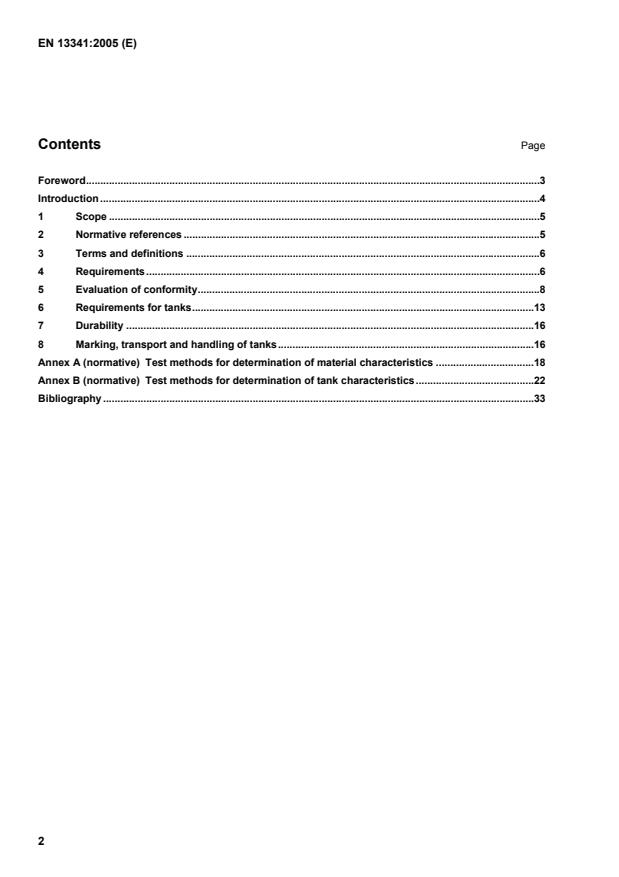
Test methods for determination of material characteristics.18 Annex B (normative)
Test methods for determination of tank characteristics.22 Bibliography.33
1 Scope This document specifies requirements for materials, physical properties and performance of single blow moulded and rotationally moulded polyethylene tanks or polyamide 6 (by anionic polymerisation) tanks, with or without reinforcements, for above ground storage of domestic heating oil, kerosene and diesel fuels. It is only applicable to static blow moulded and rotationally moulded polyethylene tanks and polyamide 6 (by anionic polymerisation) tanks that are subject to atmospheric pressure and have a capacity from 450 l up to 10 000 l. This document does not consider the consequences of wind or snow loading which is considered to be an installation issue. 2 Normative references The following referenced documents are indispensable for the application of this document. For dated references, only the edition cited applies. For undated references, the latest edition of the referenced document (including any amendments) applies. EN 13160-1, Leak detection systems — Part 1: General principles EN 13160-2, Leak detection systems — Part 2: Pressure and vacuum systems EN 13160-3, Leak detection systems — Part 3: Liquid systems for tanks EN 13160-4, Leak detection systems — Part 4: Liquid and/or vapour sensor systems for use in leakage containments or interstitial spaces EN 13160-5, Leak detection systems — Part 5: Tank gauge leak detection systems EN 13160-6, Leak detection systems — Part 6: Sensors in monitoring wells EN 13160-7, Leak detection systems — Part 7: General requirements and test methods for interstitial spaces, leak protecting linings and leak protecting jackets EN 13501-1, Fire classification of construction products and building elements — Part 1. Classification using test data from reaction to fire tests EN 13616, Overfill prevention devices for static tanks for liquid petroleum fuels EN ISO 175, Plastics — Methods of test for the determination of the effects of immersion in liquid chemicals (ISO 175:1999) EN ISO 527-3:1995, Plastics — Determination of tensile properties — Part 3: Test conditions for films and sheets (ISO 527-3:1995) EN ISO 960, Plastics — Polyamides (PA) — Determination of water content (ISO 960:1998) EN ISO 1133:1999, Plastics — Determination of the melt mass-flow rate (MFR) and the melt volume-flow rate (MVR) of thermoplastics (ISO 1133:1997) EN ISO 1183-1, Plastics - Methods for determining the density of non-cellular plastics - Part 1: Immersion method, liquid pyknometer method and titration method (ISO 1183-1:2004)
— Code of practice for the avoidance of hazards due to static electricity 3 Terms and definitions For the purposes of this document, the following terms and definitions apply. 3.1 tank container for the storage of domestic heating, kerosene and diesel fuels at atmospheric pressure which retains its designed shape without any reinforcements when empty 3.2 brimful capacity (of a tank) volume of water held by the tank filled through the filling orifice to the point of overflowing 3.3 maximum filling capacity (of a tank) value of 95 % of the brimful capacity 4 Requirements 4.1 Materials 4.1.1 General Raw materials and samples taken from tanks shall be tested and fulfil the requirements according to Table 1. The proportion of regrind from the same material shall not exceed 50 % for blow-moulded tanks. Regrind shall not be used for rotationally moulded tanks. Tanks for external installation shall be sufficiently opaque so as to protect the contents from degradation by ultra violet light. The manufacturer may use visual or prescriptive means to demonstrate compliance with this requirement. 4.1.2 Reaction to fire Where the product is subject to regulatory requirements, tanks made from polyethylene and polyamide 6 may be declared as Class F without further testing (CWFT) or the material shall be classified according to EN 13501-1, mounted and tested in conditions representative of the product’s intended use.
A.2.2 Tensile strength c
Tensile strength at yield shall not be less than 15 MPa. Elongation at yield shall not be more than 25 %. The elongation at break shall not be less than 200 %. A.2.3 Rotationally moulded polyethylene
Resistance to oil c Mass alteration shall be less than 10 %. Variation in tensile strength at yield shall not exceed 20 % of that measured in A.2.3. Change in elongation at break shall be less than 150 % of that measured in A.2.3. A.2.4 Tensile strength c Tensile strength shall not be less than 30 MPa at yield. Elongation shall be more than 20 % at break. A.3.1 Resistance to oil c Mass alteration shall be less than 0,4 %. Variation in tensile strength shall not exceed 5 % of that measured in A.3.1. Elongation at break shall be more than 20 %. A.3.2
Polyamide 6 (by anionic polymerization) Colour bleed c The bleed time of any sample shall not be less than 5,5 h. A.3.3 Blow moulded polyethylene
Rotationally moulded polyethylene Polyamide 6 (by anionic polymerisation) Resistance to weathering c
For external installations after exposure to total irradiance of 34 GJ/m2, the elongation at break shall be greater than 50 % of the initial value. For internal installations the elongation at break after exposure to total irradiance of 3,4 GJ/m2, shall be greater than 50 % of the initial elongation at break. The manufacturer shall ensure that changing the additive package does not decrease weather resistance. A.1.3, A.1.5
A.2.3, A.2.5
A.3.1, A.3.4 a Test to be carried out on raw material. b Test to be carried out on raw material and on sample taken from a tank. c Test to be carried out on tank.
4.2 Design 4.2.1 Filling systems In the case of direct fill, the aperture for filling shall be a minimum 38 mm in diameter and shall be covered with a cap or lid. 4.2.2 Supports The manufacturer shall provide instructions for appropriate tank support. 4.2.3 Venting systems All tanks shall be equipped with venting facilities. The minimum cross sectional area of the venting pipe shall not be less than the sum of the smallest cross sectional area of the filling system with a minimum diameter of 38 mm. 4.2.4 Suction/outlet system Tanks shall be equipped with an opening permitting the safe and reliable connection of withdrawal systems. All fittings shall be corrosive resistant. The tank outlet may be installed above or below the liquid level. 4.2.5 Drainage Where the outlet is installed below the liquid level, access shall be provided to allow the tank to be drained of sludge by means of a dip tube and pump. 4.2.6 Overflow alarm device All tanks shall have provision for an overfill prevention system according to EN 13616. 4.2.7 Contents gauge connection facility If the level of liquid can be seen through the walls of the tank a contents gauge is not required. In all other cases provision shall be made for a contents gauge to be fitted. 4.2.8 Leak detection system If a leak detection system is used, it shall fulfil the requirements according to EN 13160-1 to 7. 4.2.9 Inspection facilities Facilities for internal inspection (manholes, etc) of the tank/contents shall be designed so that they shall not affect the performance of the tank according to the requirements of this document. 5 Evaluation of conformity 5.1 General The compliance of thermoplastic tanks with the requirements of this document and with the stated values (including classes) shall be demonstrated by: initial type testing;
a) when the method of production is altered in such a way as to affect type test performance; b) when the manufacturer changes the base polymer grade used; c) when changes are made in the dimensions of wall thickness, height, diameter, length, width or configuration for any one tank capacity. 5.2.3 Sampling A minimum of three samples for ITT shall be randomly selected from the production batch. Test methods, given in Annexes A and B, which shall be used for ITT, are specified in Table 2.
Table 2 — Initial type testing of tanks Type of tank
Property Test Method Circumstances requiring ITT in 5.2.2 Blow moulded polyethylene tanks Density A.1.1
Melt flow rate A.1.2
Tensile strength A.1.3 b)
Resistance to oil A.1.4
Resistance to weathering A.1.5
Rotationally moulded Density A.2.1
polyethylene tanks Melt flow rate A.2.2
Tensile strength A.2.3 b)
Resistance to oil A.2.4
Resistance to weathering A.2.5
Polyamide 6 tanks Tensile strength A.3.1
by anionic polymerization Resistance to oil A.3.2 b)
Colour bleed A.3.3
Resistance to weathering A.3.4
Water content B.9
All tanks Capacity
B.1
Visual appearance B.2
Mass B.3 a), b), c)
Wall thickness B.4
Impact resistance B.5
Deformation or elongation a B.6
Pressure resistance B.7
Leak tightness B.8
a See Tables 4 and 5 for the choice of the test method.
Raw material
a Every new batch
Mass B.3 Tank Every tank Rotationally moulded polyethylene tanks Melt flow rate
A.2.2 Tank Once every working week on a programme that covers all machines
Raw material a
Every new batch
Mass B.3 Tank Every shot and one tank per shift Polyamide 6 tanks by anionic polymerization Colour bleed A.3.3 Tank At the beginning and the end of the working week
Mass B3 Tank Every tank All tanks Visual appearance B.2 Tank Every tank
Wall thickness B.4 Tank Every tank at its critical points as identified by the manufacturer and an overall test per shift
Leak tightness B.8 Tank Every tank a This requirement may be waived if the raw material manufacturer supplies a certificate of conformity with each delivery, i.e. a document which certifies that the material supplied is in compliance with the melt flow rate as specified in an agreed supply specification.
An FPC system conforming to the requirements of EN ISO 9001, and made specific to the requirements of this document, is considered to satisfy the above requirements. The results of inspections, tests or assessments requiring action shall be recorded, as shall any action taken. The action to be taken when control values or criteria are not met shall be recorded and retained for the period specified in the manufacturer’s FPC procedures.
Table 4 — Requirements for blow moulded polyethylene thermoplastic tanks Property Requirement Test method Capacity
The brimful capacity shall be measured. The maximum filling capacity, declared by the manufacturer, shall be checked. B.1 Visual appearance There shall be no bubbles, blisters or other defects in the tank wall which could cause a hole or fracture. B.2 Mass The minimum mass shall be the mass of the lightest tank as determined by the initial type test. B.3 Wall thickness For tanks intended for storage of kerosene, the minimum wall thickness shall be 4,5 mm, or if the wall thickness is less than 4,5 mm, the tank manufacturer shall demonstrate by a test method that the oil permeation is equal or less than the permeation through a rotationally moulded tank sample with a thickness of 4,5 mm and made of a polyethylene with a density of 934 kg/m3. For tanks tested in accordance with B.6.1, the minimum wall thickness shall not be less than 2,5 mm and, for factory production control the minimum wall thickness shall be the wall thickness as determined by the initial type test. For tanks tested in accordance with B.6.2, the minimum wall thickness shall be as follows, except for each area which surface does not exceed 300 mm2, where a margin of 10 % shall be allowed regarding the minimum wall thickness. These areas shall be located a minimum of 50 mm from the bottom of the tank. The manufacturer shall declare in a document, that the margin has no effects on the physical properties of the tank. B.4
For maximum filling capacity Minimum wall thickness
≥ 450 l,
< 1 000 l 3,0 mm
≥ 1 000 l,
< 1 500 l 3,2 mm
≥ 1 500 l,
< 2 000 l 3,5 mm
≥ 2 000 l,
< 2 500 l 3,7 mm
≥ 2 500 l,
< 3 000 l 3,9 mm
≥ 3 000 l, < 3 500 l 4,0 mm
The minimum wall thickness of tanks with a maximum brimful capacity ≥ 3 500 l shall be determined according to B 6.1.
Impact resistance The tank shall remain leak tight. B.5 Elongation The tank shall remain leak tight. Elongation at the surface shall no exceed 1,5 % after 1 000 h. B.6.1 Deformation The volumetric deformation is stabilized when the rate of volumetric expansion is not greater than 0,015 % volume, per day, for tanks with a maximum filling capacity of up to and including 3 800 l or 0,02 % volume, per day, for tanks with a maximum filling capacity of over 3 800 l. After stabilisation
the deformation shall conform to the following equations:
mmwwid100+≤
mmllid200+≤ where dl
is the length of the tank after deformation in mm; il
is the initial length of the tank in mm; dw
is the width of the tank after deformation in mm; iw
is the initial width of the tank in mm. B.6.2 Pressure resistance The tank shall be leak tight at five times hydrostatic pressure. In the case of reinforced tanks the reinforcement shall retain its reinforcing function up to a hydrostatic pressure corresponding to twice the tank height. B.7 Leak tightness The tank shall be leak tight. B.8
Property Requirement Test method Capacity
The brimful capacity shall be measured. The maximum filling capacity, declared by the manufacturer, shall be checked. B.1 Visual appearance There shall be no bubbles, blisters or o
...