

EN 15877-1:2024
(Main)Railway applications - Markings of railway vehicles - Part 1: Freight wagons
General Information
- Abstract
This document specifies the markings on heavy rail freight wagons, or parts of heavy rail freight wagons, relating to their technical, operational and maintenance characteristics. It specifies the characteristics of these markings, the requirements pertaining to their presentation, their shape and position on a rail vehicle and their meaning. Some markings are accompanied with (a) note(s), where appropriate.
Tank manufacturers’ design criteria, test and product specification plates have not been considered in this document as they are specified in EN 12561 1:2011.
Where fully specified in RID [14] dangerous goods markings have not been considered in this document (dimensions, colour, location and form). Where markings are not fully specified in RID they are included in this document.
- Status
- Published
- Publication Date
- 09-Jul-2024
- Technical Committee
- CEN/TC 256 - Railway applications
- Drafting Committee
- CEN/TC 256/WG 26 - Freight wagons
- Current Stage
- 6060 - Definitive text made available (DAV) - Publishing
- Start Date
- 10-Jul-2024
- Due Date
- 03-Nov-2023
- Completion Date
- 10-Jul-2024

Overview
EN 15877-1:2024 - Railway applications - Markings of railway vehicles - Part 1: Freight wagons - is the European standard that defines standardized markings for heavy rail freight wagons. It specifies the meaning, presentation, colour, shape and position of markings that convey technical, operational and maintenance characteristics. The standard applies across EU, EFTA and OTIF member states and aligns with Directive (EU) 2016/797 and COTIF UTP GEN‑A.
Keywords: EN 15877-1:2024, markings of railway vehicles, freight wagons, EVN, brake markings, payload markings.
Key topics and technical requirements
- Scope: Markings for heavy rail freight wagons or parts of wagons, excluding tank manufacturer plates (covered by EN 12561‑1) and those fully specified in RID (dangerous goods).
- Visibility & placement: Markings must be easily visible from ground level (generally not higher than 2 000 mm) and located so tarpaulins or equipment do not obscure them.
- Durability: Markings must remain legible for at least 6 years under −40 °C to +90 °C; resistant to weather, cleaning agents, high‑pressure washing and brushes.
- Presentation rules: Use Latin characters and Arabic numerals; non‑italic sans‑serif fonts (e.g., Univers 67, Helvetica, Arial). Minimum framing and contrast requirements (5 mm contrasting frame) and a 100 mm neutral border when other graphics/advertising are nearby.
- Materials & colours: Colour requirements follow ISO 3864‑4:2011; Annex A of the standard details colour guidance. Luminance contrast and legibility metrics are defined.
- Content of markings: Detailed provisions for:
- European Vehicle Number (EVN)
- Main markings (owner, keeper, technical data)
- Payload and tare mass
- Brake system markings and variable load indicators
- Restriction markings, electrical hazard warnings
- Traffic, combined‑traffic and tank wagon specific markings
- Wheelset markings and other operational symbols
- Operational notes: Rules on moveable panels, graffiti removal, placement on both sides unless stated otherwise, and tolerance on dimensions (±10 %).
Practical applications
EN 15877-1:2024 is used to:
- Ensure consistent, unambiguous information on freight wagons for safe operation and maintenance
- Support interoperability across international rail networks
- Guide painting, decal production and marking placement during manufacturing, overhaul and fleet modification
- Inform inspectors, infrastructure managers and emergency responders about technical and hazard information
Who should use this standard
- Wagon designers and manufacturers
- Fleet owners, keepers and operators
- Maintenance and workshop teams
- Infrastructure managers and rail safety inspectors
- Regulatory authorities and technical documentation authors
Related standards
- EN 12561‑8, EN 12663‑2, EN 13775‑1
- EN 15273‑2, EN 15528, EN 15625
- EN 17343, EN ISO 7010, ISO 3864‑4
This standard is essential for anyone responsible for marking, labeling or reading technical and safety information on heavy rail freight wagons.
Relations
- Effective Date
- 04-Aug-2021
- Effective Date
- 09-Feb-2026
- Effective Date
- 28-Jan-2026
- Effective Date
- 28-Jan-2026
- Effective Date
- 28-Jan-2026
- Effective Date
- 28-Jan-2026
- Effective Date
- 28-Jan-2026
- Effective Date
- 28-Jan-2026
- Effective Date
- 28-Jan-2026
- Effective Date
- 20-May-2026
- Effective Date
- 28-Jan-2026
- Effective Date
- 28-Jan-2026
- Referred By
EN 16404:2014 - Railway applications - Re-railing and recovery requirements for railway vehicles - Effective Date
- 28-Jan-2026
- Effective Date
- 28-Jan-2026
- Effective Date
- 28-Jan-2026
Get Certified
Connect with accredited certification bodies for this standard

IRIS Certification (UNIFE)
International Railway Industry Standard certification.

TÜV SÜD Rail GmbH
TÜV SÜD railway certification services.

Bureau Veritas Railway Certification
Railway and transportation certification.
Sponsored listings
Frequently Asked Questions
EN 15877-1:2024 is a standard published by the European Committee for Standardization (CEN). Its full title is "Railway applications - Markings of railway vehicles - Part 1: Freight wagons". This standard covers: This document specifies the markings on heavy rail freight wagons, or parts of heavy rail freight wagons, relating to their technical, operational and maintenance characteristics. It specifies the characteristics of these markings, the requirements pertaining to their presentation, their shape and position on a rail vehicle and their meaning. Some markings are accompanied with (a) note(s), where appropriate. Tank manufacturers’ design criteria, test and product specification plates have not been considered in this document as they are specified in EN 12561 1:2011. Where fully specified in RID [14] dangerous goods markings have not been considered in this document (dimensions, colour, location and form). Where markings are not fully specified in RID they are included in this document.
This document specifies the markings on heavy rail freight wagons, or parts of heavy rail freight wagons, relating to their technical, operational and maintenance characteristics. It specifies the characteristics of these markings, the requirements pertaining to their presentation, their shape and position on a rail vehicle and their meaning. Some markings are accompanied with (a) note(s), where appropriate. Tank manufacturers’ design criteria, test and product specification plates have not been considered in this document as they are specified in EN 12561 1:2011. Where fully specified in RID [14] dangerous goods markings have not been considered in this document (dimensions, colour, location and form). Where markings are not fully specified in RID they are included in this document.
EN 15877-1:2024 is classified under the following ICS (International Classification for Standards) categories: 45.060.20 - Trailing stock. The ICS classification helps identify the subject area and facilitates finding related standards.
EN 15877-1:2024 has the following relationships with other standards: It is inter standard links to EN 15877-1:2012+A1:2018, ISO 3864-4:2011, EN 17343:2023, EN 15625:2021, EN 12663-2:2010+A1:2023, EN ISO 7010:2020, EN 13775-1:2003, EN 12561-8:2011, EN 15273-2:2013+A1:2016, EN 14198:2026, EN 17069-1:2019, EN 16834:2019, EN 16404:2014, EN 15398:2020, EN 15955-2:2025. Understanding these relationships helps ensure you are using the most current and applicable version of the standard.
EN 15877-1:2024 is associated with the following European legislation: EU Directives/Regulations: 2016/797/EU, 2016/797/EU, 2016/797/EU, 2016/797/EU, 2016/797/EU, 2016/797/EU, 2016/797/EU, 2016/797/EU, 2016/797/EU, 2016/797/EU, 2016/797/EU, 2016/797/EU, 2016/797/EU; Standardization Mandates: M/483. When a standard is cited in the Official Journal of the European Union, products manufactured in conformity with it benefit from a presumption of conformity with the essential requirements of the corresponding EU directive or regulation.
EN 15877-1:2024 is available in PDF format for immediate download after purchase. The document can be added to your cart and obtained through the secure checkout process. Digital delivery ensures instant access to the complete standard document.
Standards Content (Sample)
SLOVENSKI STANDARD
01-september-2024
Železniške naprave - Oznake železniških vozil - 1. del: Tovorni vagoni
Railway applications - Markings of railway vehicles - Part 1: Freight wagons
Bahnanwendungen - Kennzeichnung von Schienenfahrzeugen - Teil 1: Güterwagen
Applications ferroviaires - Marquages pour véhicules ferroviaires - Partie 1: Wagons de
fret
Ta slovenski standard je istoveten z: EN 15877-1:2024
ICS:
01.075 Simboli za znake Character symbols
45.060.20 Železniški vagoni Trailing stock
2003-01.Slovenski inštitut za standardizacijo. Razmnoževanje celote ali delov tega standarda ni dovoljeno.
EN 15877-1
EUROPEAN STANDARD
NORME EUROPÉENNE
July 2024
EUROPÄISCHE NORM
ICS 45.060.20 Supersedes EN 15877-1:2012+A1:2018
English Version
Railway applications - Markings of railway vehicles -
Part 1: Freight wagons
Applications ferroviaires - Inscriptions pour véhicules Bahnanwendungen - Kennzeichnungen von
ferroviaires - Partie 1: Wagons Schienenfahrzeugen - Teil 1: Güterwagen
This European Standard was approved by CEN on 26 May 2024.
CEN members are bound to comply with the CEN/CENELEC Internal Regulations which stipulate the conditions for giving this
European Standard the status of a national standard without any alteration. Up-to-date lists and bibliographical references
concerning such national standards may be obtained on application to the CEN-CENELEC Management Centre or to any CEN
member.
This European Standard exists in three official versions (English, French, German). A version in any other language made by
translation under the responsibility of a CEN member into its own language and notified to the CEN-CENELEC Management
Centre has the same status as the official versions.
CEN members are the national standards bodies of Austria, Belgium, Bulgaria, Croatia, Cyprus, Czech Republic, Denmark, Estonia,
Finland, France, Germany, Greece, Hungary, Iceland, Ireland, Italy, Latvia, Lithuania, Luxembourg, Malta, Netherlands, Norway,
Poland, Portugal, Republic of North Macedonia, Romania, Serbia, Slovakia, Slovenia, Spain, Sweden, Switzerland, Türkiye and
United Kingdom.
EUROPEAN COMMITTEE FOR STANDARDIZATION
COMITÉ EUROPÉEN DE NORMALISATIO N
EUROPÄISCHES KOMITEE FÜR NORMUN G
CEN-CENELEC Management Centre: Rue de la Science 23, B-1040 Brussels
© 2024 CEN All rights of exploitation in any form and by any means reserved Ref. No. EN 15877-1:2024 E
worldwide for CEN national Members.
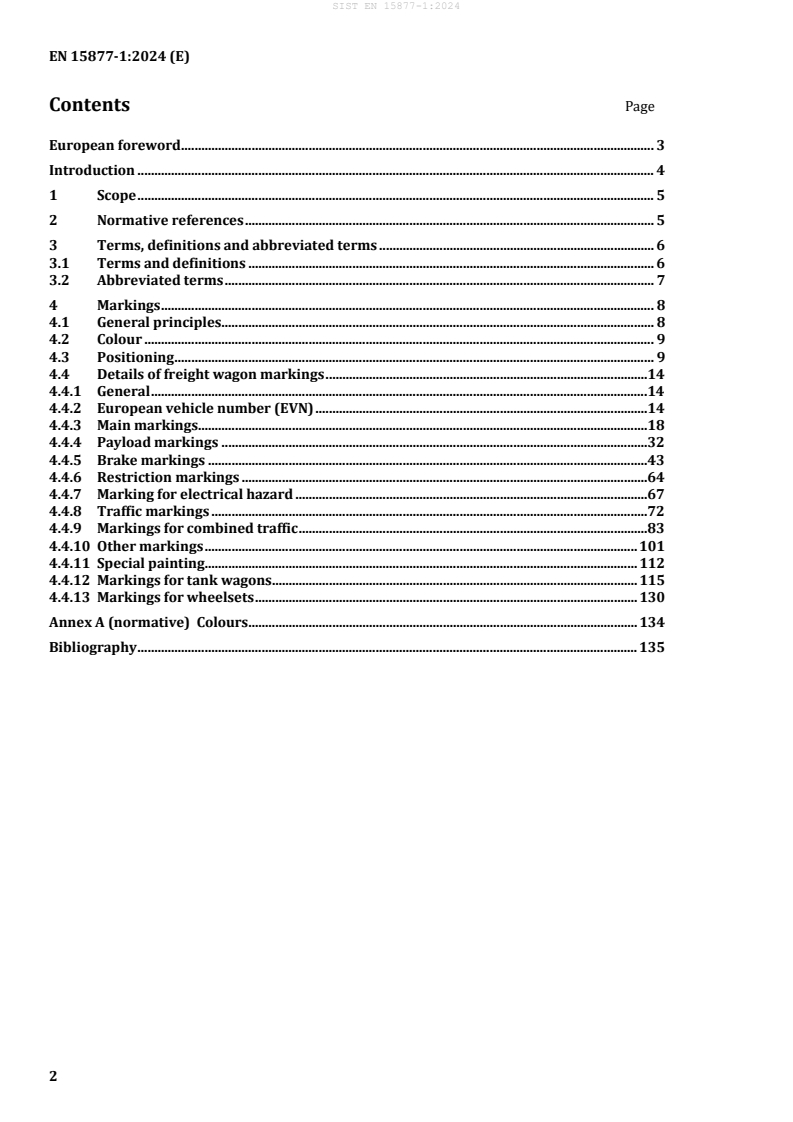
Contents Page
European foreword . 3
Introduction . 4
1 Scope . 5
2 Normative references . 5
3 Terms, definitions and abbreviated terms . 6
3.1 Terms and definitions . 6
3.2 Abbreviated terms . 7
4 Markings . 8
4.1 General principles . 8
4.2 Colour . 9
4.3 Positioning . 9
4.4 Details of freight wagon markings .14
4.4.1 General .14
4.4.2 European vehicle number (EVN) .14
4.4.3 Main markings.18
4.4.4 Payload markings .32
4.4.5 Brake markings .43
4.4.6 Restriction markings .64
4.4.7 Marking for electrical hazard .67
4.4.8 Traffic markings .72
4.4.9 Markings for combined traffic .83
4.4.10 Other markings . 101
4.4.11 Special painting . 112
4.4.12 Markings for tank wagons . 115
4.4.13 Markings for wheelsets . 130
Annex A (normative) Colours. 134
Bibliography . 135
European foreword
This document (EN 15877-1:2024) has been prepared by Technical Committee CEN/TC 256 “Railway
applications”, the secretariat of which is held by DIN.
This European Standard shall be given the status of a national standard, either by publication of an
identical text or by endorsement, at the latest by January 2025, and conflicting national standards shall
be withdrawn at the latest by January 2025.
Attention is drawn to the possibility that some of the elements of this document may be the subject of
patent rights. CEN shall not be held responsible for identifying any or all such patent rights.
This document supersedes EN 15877-1:2012+A1:2018.
EN 15877-1:2012+A1:2018:
— normative references have been updated;
— document has been newly structured;
— markings have been revised;
— new markings have been added (Figure 1 c), Figure 3, Figure 25, Figure 29, Figure 37 b),
Figure 38 a), Figures 45 to 48, Figure 51, Figure 60, Figure 63, Figures 92 to 97, Figure 100 b),
Figure 101 b), Figure 103, Figures 114 to 116, Figures 118 to 121, Figure 127 b), Figure 131 c));
— unused markings have been deleted (former Figures 1, 4, 11, 13 to 15, 36, 49 a), 50, 51, 60, 61, 63,
65, 87 a), 89, 105).
The series EN 15877, Railway applications — Markings of railway vehicles consists of two parts:
— Part 1: Freight wagons
— Part 2: External markings on coaches, motive power units, locomotives and on track machines
This document has been prepared under a standardization request addressed to CEN by the European
Commission. The Standing Committee of the EFTA States subsequently approves these requests for its
Member States.
Any feedback and questions on this document should be directed to the users’ national standards body.
A complete listing of these bodies can be found on the CEN website.
According to the CEN-CENELEC Internal Regulations, the national standards organisations of the
following countries are bound to implement this European Standard: Austria, Belgium, Bulgaria, Croatia,
Cyprus, Czech Republic, Denmark, Estonia, Finland, France, Germany, Greece, Hungary, Iceland, Ireland,
Italy, Latvia, Lithuania, Luxembourg, Malta, Netherlands, Norway, Poland, Portugal, Republic of North
Macedonia, Romania, Serbia, Slovakia, Slovenia, Spain, Sweden, Switzerland, Türkiye and the United
Kingdom.
Introduction
This document describes standardized markings for use on heavy rail freight wagons. These markings
are used to provide various items of information relating to the characteristics and intended use of rail
vehicles in a clear and concise manner. Among those markings are safety signs used to alert equipment
operators to hazards that can be encountered in the use or maintenance of the rail vehicles.
In addition to the markings in this document, there might be other markings and text applied to a heavy
rail freight wagon, e.g. instructions and warnings concerning the use of equipment. Such additional
markings are not in contravention of this document provided they do not interfere with or affect the
markings in the document.
The document is applicable to all heavy rail freight wagons operating within the European Union, the
European Free Trade Association member states and states which are member of OTIF
(Intergovernmental Organization for International Carriage by Rail) and it satisfies the legal
requirements within these institutions.
This document is consistent with:
— Directive (EU) 2016/797 on the interoperability of the rail system within the Community;
— COTIF UTP GEN-A: General provisions – Essential requirements.
It is intended to be used by all parties concerned with the marking of rail vehicles.
1 Scope
This document specifies the markings on heavy rail freight wagons, or parts of heavy rail freight wagons,
relating to their technical, operational and maintenance characteristics. It specifies the characteristics of
these markings, the requirements pertaining to their presentation, their shape and position on a rail
vehicle and their meaning. Some markings are accompanied with (a) note(s), where appropriate.
Tank manufacturers’ design criteria, test and product specification plates have not been considered in
this document as they are specified in EN 12561-1:2011.
Where fully specified in RID [14] dangerous goods markings have not been considered in this document
(dimensions, colour, location and form). Where markings are not fully specified in RID they are included
in this document.
2 Normative references
The following documents are referred to in the text in such a way that some or all of their content
constitutes requirements of this document. For dated references, only the edition cited applies. For
undated references, the latest edition of the referenced document (including any amendments) applies.
EN 12561-8:2011, Railway applications — Tank wagons — Part 8: Heating connections
EN 12663-2:2010+A1:2023, Railway applications - Structural requirements of railway vehicle bodies - Part
2: Freight wagons
EN 13775-1:2003, Railway applications - Measuring of new and modified freight wagons - Part 1:
Measuring principles
EN 15273-2:2013+A1:2016, Railway applications — Gauges — Part 2: Rolling stock gauge
EN 15528:2021, Railway applications - Line categories for managing the interface between load limits of
vehicles and infrastructure
EN 15625:2021, Railway applications - Braking - Automatic variable load sensing devices
EN 17343:2023, Railway applications - General terms and definitions
EN ISO 7010:2020, Graphical symbols — Safety colours and safety signs — Registered safety signs
(ISO 7010:2019, Corrected version 2020-06)
ISO 3864-4:2011, Graphical symbols — Safety colours and safety signs — Part 4: Colorimetric and
photometric properties of safety sign materials
The document is currently under revision. Stage at the time of publication: prEN 15273-2:2023.
3 Terms, definitions and abbreviated terms
3.1 Terms and definitions
For the purposes of this document, the terms and definitions given in EN 17343:2023 and the following
apply.
ISO and IEC maintain terminology databases for use in standardization at the following addresses:
— ISO Online browsing platform: available at https://www.iso.org/obp
— IEC Electropedia: available at https://www.electropedia.org/
3.1.1
buffer stroke
deflection of the buffer in the operating range of the elastic system
3.1.2
decal
picture or design printed on specially prepared plastic sheeting for the purpose of adherence to a freight
wagon
3.1.3
luminance contrast
C
quantity relating to the difference in luminance between two surfaces
Note 1 to entry: Widely accepted definitions include:
C = (L − L )/L with L > L (positive contrast),
1 2 1 1 2
C = (L1 − L2)/L1 with L1 < L2 (negative contrast),
C = (L − L )/(L + L ) with L > L ,
1 2 1 2 1 2
where C is the luminance contrast and L and L are the luminances of the two surfaces.
1 2
Note 2 to entry: Although luminance contrast is intended to correlate with brightness contrast, it is possible that it
does not do so directly because brightness contrast depends on other factors such as the angular separation, the
luminance gradient, and any size difference between the two surfaces
[SOURCE: IEC 60050-845:2020, 845-22-091]
3.1.4
marking
lettering or symbols applied to a freight wagon by means of decals, hand painting or by another agreed
method, with the purpose of providing information concerning the wagon
3.1.5
paint
liquid mixture, usually of a solid pigment in a liquid medium such as oil or water
3.1.6
stencil
template for the required lettering
3.1.7
tare mass
mass in the condition available for service, but without any payload
Note 1 to entry: This “mass” definition follows the definition of “working order” as given in
EN 15663:2017+A1:2018 , 3.1.12.
3.2 Abbreviated terms
For the purposes of this document, the following abbreviated terms apply:
ATP automatic train protection
COTIF Convention concerning International Carriage by Rail
EFTA European Free Trade Association
EU European Union
EVN European Vehicle Number
IM infrastructure manager
OTIF Intergovernmental Organization for International Carriage by Rail
RAL Colour standardization system of the German Institute for Quality Assurance and
Certification
RID Regulations concerning the International Carriage of Dangerous Goods
TSI Technical Specifications for Interoperability, the specifications by which each
subsystem or part subsystem is covered in order to meet the essential requirements
and ensure the interoperability of the trans-European rail system.
TEN Trans European Network
UIC International Union of Railways
UTP Uniform Technical Prescriptions
VKM vehicle keeper marking
TSI OPE Technical Specification for Interoperability Subsystem: Operation and Traffic
Management
TSI WAG Technical Specification for Interoperability Subsystem: Rolling Stock: Freight Wagons
The document is currently being amended. Stage at the time of publication:
EN 15663:2017+A1:2018/FprA2:2024.
4 Markings
4.1 General principles
4.1.1 The markings and the content of information are given in 4.4.
4.1.2 A marking shall be located on the wagon at a position easily visible by staff standing at ground
level and presented in a way clearly understandable to persons concerned. If the marking is intended to
be read by a person standing at ground level, it should not be located at a level higher than 2 000 mm
above the running surface. The visibility shall also be ensured if the marking needs to be read from a
position other than ground level or if it is placed on a non-vertical surface. Hazard markings, e.g. the
warning sign for live catenary, shall be located in such a position that they can be seen before the hazard
zone is actually reached.
The location of a marking shall be such that correctly positioned tarpaulins, which may be used to sheet
the wagon, do not obscure the marking.
4.1.3 Advertising, designs or other text or pictures not relating to the markings applied to a wagon shall
not affect the visibility and the clear and unambiguous understanding of the marking. Such items may
only be placed on the side walls or on the tank shell. In this case, a border of minimum 100 mm shall be
placed around each marking or composition of markings; these borders shall have a “neutral” colour or
be the colour which accentuates the marking.
For all required markings, the background around the marking shall be framed with a contrasting
background of at least 5 mm.
4.1.4 Graffiti which affects the visibility or understanding of the markings shall be removed.
4.1.5 Unless otherwise indicated in the figures, the markings shall be placed on both sides of the wagon.
4.1.6 A marking shall ensure durable, non-degraded marking for a period of at least 6 years under a
temperature range of −40 °C to +90 °C. If a marking is defective or illegible, it shall be restored. It shall be
weather-resistant and resistant to cleaning agents, high pressure water or air cleaning and cleaning
machines with brushes.
4.1.7 Alphanumeric characters used on markings shall use Latin characters and Arabic numerals. The
font to be used shall be non-italic, sans serif and of a type such as Univers 67, Helvetica or Arial.
4.1.8 The distances between value and unit shall be clearly separated by space (see
EN ISO 80000-1:2022, e.g. 7.1.4.)
4.1.9 The dimensions indicated in this document may have a tolerance of plus or minus 10 %. For better
readability, it is recommended to use industrial foils or stencils for hand produced markings.
4.1.10 When employing the use of moveable panels it shall be ensured that the required panel is suitably
secured so as not to be inadvertently changed or get lost.
4.1.11 If moveable panels are used, it shall be ensured that these are adequately secured so that they
cannot accidentally fold over or fall off.
4.2 Colour
4.2.1 Colours used shall be in accordance with ISO 3864-4:2011, see Annex A of this document.
4.2.2 Unless otherwise indicated in the figures of this document, the colours need not be made of retro
reflecting material.
4.2.3 The luminance contrast C shall be in accordance with ISO 3864-4:2011.
4.2.4 If there is no colour specification indicated with the specification of a marking, the colour of the
informative part (the symbol, letters/numbers, borders and lines) shall be black on a light background
or white on a dark background. The background for decals, stencils and painted markings may be
transparent and thereby represented by the colour of the material on which the marking is placed, e.g.
the wall of the wagon. In any case, when a part of the marking is indicated to be the wagon colour
background, the requirement to the luminance contrast shall be met.
4.3 Positioning
Where applicable, markings shall be positioned generally in accordance with Figure 1 and Figure 2. The
list of markings is contained in Table 1 and their position and meaning is described in 4.4. Not all
markings can be accommodated in the figures.
If no specific position for a marking is prescribed in 4.4, the following general rules shall be followed:
A marking indicating a lever, a button, a nozzle, an indicator, hidden equipment or a point for action (e.g.
a lifting point) shall be located next to that item (normally above, beneath or on the cover concealing the
item) and may not lead to any misunderstanding or confusion.
Dimensions in mm
a) Side view
b) Front view
c) Side view tank wagon for the carriage of gases
Key
1–60 See Table 1
a Details of the tank identification plate are specified in EN 12561-1:2011.
Figure 1 — Positioning of markings for rail tank wagons
Where movable panels are used, the name of the gas being carried (position no. 52) and the maximum
permissible payload for the gas shall be written on the same panel but shall not exceed the maximum
permissible loads as indicated on the tank identification plate or the maximum of the load
table position no. 19.
Dimensions in mm
a) Side view
b) Front view
Key
1–58 See Table 1.
Figure 2 — Positioning of markings for rail wagons
Table 1 shows the list of markings positioned in Figure 1 and Figure 2.
Table 1 — List of markings
Position no. Marking title Figure no.
1 European vehicle number (EVN) – dimensions 4 a)
2 European vehicle number (EVN) – alternative layouts 5
a
3 European vehicle number – at tank bottom –
4 Additional marking for compliancy with TSI WAG 7
5 Wagon tare mass 8
6 Wagon tare mass and braked weight of the parking brake 9, 10
7 Length over buffers 11
8 Gauge marking 12
9 Table of maintenance dates 14
10 Lifting and jacking point 15a,b
11 Lifting and jacking point – rerailing 15c
12 Minimum curve radius 16
13 Maximum ramp angle 17
14 Distance of bogie pivots 18
15 Buffer stroke 19
16 Loading length 20
17 Loading area 21
18 Wheelset position 25
a
19 Payload table 26
20 Special additional payload table 27
21 Maximum carrying capacity 30
22 General brake marking 34
Type of brake system and braked weight of wagons with automatic
23 35
load proportional brake
24 Distributor-isolating device handle 37
25 Type plate of weighing valve 49
26 Holding force of the parking brake 51
Maximum track gradient of parking brake for wagons with
27 52
composite brake blocks
28 Wagon fitted with composite brake blocks 53
29 Restriction to move with open doors or roof 59
a
30 Warning: overhead power line 63
Position no. Marking title Figure no.
31 EN ISO 7010:2020 – M005 “Connect an earth terminal to the 65
ground”
32 Wagon accepted on train-ferries 66
a
33 Wagon accepted for running through the Channel Tunnel 67
a
34 Wagon fitted with a vacuum brake 68
a
35 Wagon able to run between Spain/Portugal and France 70
a
36 Wagons built for running on 1 524 mm gauge rail networks 73
37 Wagon with automatic changeover wheelsets between 1 435 mm and 75
a
1 668 mm track gauges
38 Agreement of traffic acceptance 78
39 Spark arrestor plates 98
40 Removable wagon equipment 99
41 High strength coupling 100
42 Wagons which need special care when being shunted 102
43 Wagon equipped with anti-crash-components 105
44 Projected tow hooks projecting more than 250 mm 108
45 Volumetric capacity of tank wagon 109
a
46 Tank code 110
a
47 Provision code 111
a
48 Next tank inspection date 112
a
49 Proper shipping name of the substance accepted for carriage 113
a
50 Maximum working pressure 114
a
51 Name of the substance (gas) on moveable flaps 116
52 Registered keeper 117
a
53 Residue discharge and auto vent valve 119
a
54 Tank wagon for the carriage of gases 122
a
55 Protective lining of tanks or bulk containers 125
56 Wagon equipped with a derailment detector 127
57 Wheel set diameter 128
58 Wheel able to withstand high thermal stresses 129
59 Orange dangerous goods sign —
60 Bracket for dangerous goods label plate —
a
These inscriptions can in exceptional cases be located higher than 2 m above rail surface.
4.4 Details of freight wagon markings
4.4.1 General
The markings in this document are exemplarily displayed in Univers 67.
Where inscriptions are based on existing, measured or particular specified values, these values in the
figures are substituted by placeholders as shown in Figure 3:
— For digits the placeholders are shown as rectangles with rounded edges.
— For letters the placeholders are shown as rectangles (width is 0,7*H1 – this is according to the letters
D, H or K).
— For words, letter-combinations or sentences the placeholders are shown as rectangles.
They shall be replaced by the correct elements, e.g. designated or calculated values.
For different inscriptions, where there is not sufficient space, it is possible to use a narrow type of the
chosen font with a width of B1/B = 0,84.
Key
1 placeholder for digit (dimension B placed on digit “0” depending of the chosen font)
2 placeholder for narrow digit (dimension B1 is 0,84*B)
3 placeholder for letter with height H
4 placeholder for words or sentences with height H
Figure 3 — Type of placeholders in this document
4.4.2 European vehicle number (EVN)
The vehicle number lettering shall be at least 80 mm.
The EVN shall be positioned on the wagon as shown in Figure 4.
When the wagon body does not provide sufficient surface area for the preferred layout Figure 4 a) (flat
wagons in particular) the markings shall be applied as shown in Figure 5.
The EVN is in accordance with the EU regulation TSI OPE 2019/773/EU, Appendix H.
NOTE For countries which are not a member of the EU, vehicle numbers other than those shown can be
possible.
Dimensions in millimetres
a) Dimensions
b) Example
Key
1 interoperability code (1st and 2nd digit)
2 numerical country code in which the wagon is registered in accordance with TSI OPE 2019/773/EU,
Annex H (3rd and 4th digit)
3 principal technical characteristics (5th to 8th digit)
4 generic number of the wagon in its registration series (9th to 11th digit)
5 check digit (12th digit)
6 alphabetical marking of the interoperability compatibility (i.e. with the regulations of TEN)
7 alphabetical country code of member state where the wagon is registered (digit-code see TSI OPE)
8 VKM (see Commission Implementing Decision (EU) 2018/1614, Appendix 6, Part 4)
9 alphacode for wagon type (see UIC 438-2:2004)
10 marking of compatibility (GE or CW) with TSI WAG Annex C
NOTE 1 Position 6 shows the marking according to the EU regulations as set out in Directive (EU) 2016/797 and
corresponding COTIF regulations. At this position there can also be a reference to other rail networks.
NOTE 2 The width “x” or “*” is the standard width of “0” and depends on the chosen letter font.
Position:
The marking shall be positioned on the left of each side wall, or the left of each solebar in the case of low-
sided open wagons or on inscription panels in the case of wagons without side walls (e.g. tank wagons).
The marking shall not be located higher than 2 m above rail level.
When the full name and address information is inscribed on the rail vehicle, a vehicle keeper marking
(VKM) is not required for vehicles of keepers with such a limited vehicle fleet that this does not warrant
the use of a VKM, or specialized vehicles for infrastructure maintenance.
Figure 4 — European vehicle number (EVN)
Figure 5 shows alternative layouts for the EVN when the wagon body does not provide sufficient surface
area for the preferred layout of Figure 4.
Dimensions in millimetres
a) Alternative layout 1
b) Alternative layout 2
NOTE 1 For key and position see Figure 4.
NOTE 2 For examples see Figure 6.
Figure 5 — European vehicle number (EVN) – alternative layouts
Figure 6 shows examples for alternative layouts of EVN.
NOTE For key and position see Figure 4.
Figure 6 — Examples for alternative layouts of EVN
The different types of markings according to key 10 are shown in Figure 7.
Figure 7 a) shows the marking if a rail vehicle full fills the conditions. Figure 7b) shows the marking if a
rail vehicle full fills not all the conditions as set out in TSI WAG.
Dimensions in millimetres
a) Go everywhere (GE) marking b) Compatible with (CW) marking
NOTE For position see Figure 4 a) and Figure 5, key 10.
Figure 7 — Additional marking for compliancy with TSI WAG
4.4.3 Main markings
Figure 8 shows the indication of the wagon tare mass as weighed in a workshop.
When a wagon is equipped with a parking brake, the inscriptions for tare mass and parking braked weight
as shown in Figure 9 or Figure 10 shall be used.
Dimensions in millimetres
Key
a For tare mass ≥ 100 000 kg.
Position:
The marking shall be positioned on the left of each side of the wagon.
Figure 8 — Wagon tare mass
When a wagon is equipped with a manually platform-operated parking brake, Figure 9 shows the
indication of the wagon tare mass as weighed in a workshop in combination with the braked weight of
the parking brake.
Dimensions in millimetres
Key
a For tare mass ≥ 100 000 kg.
Position:
The marking shall be positioned on the left of each side of the wagon or near to the platform.
Figure 9 — Wagon tare mass and braked weight of the platform operated parking brake
When a wagon is equipped with a manually ground-operated parking brake, Figure 10 shows the
indication of the wagon tare mass as weighed in a workshop in combination with the braked weight of
the parking brake.
Dimensions in millimetres
Key
a For tare mass ≥ 100 000 kg.
Position:
The marking shall be positioned on the left of each side of the wagon.
Figure 10 — Wagon tare mass and braked weight of the ground-operated parking brake
When a wagon is fitted with more than one independently-acting parking brake, the corresponding
number of brakes shall be indicated in front of the braked weight (for example: 2 × 00,0 t).
Figure 11 shows the inscription for the overall length over uncompressed buffers of a wagon or a wagon
unit.
On wagons made up of separate units joined together by a permanent coupling (multiple and articulated
wagons) the total length of the wagon shall be indicated.
Dimensions in millimetres
Position:
The marking shall be positioned on the left of each side of the wagon.
Figure 11 — Length over buffers
Figure 12 a) indicates the kinematic reference contour of the wagon as requested in the TSI WAG and
OTIF regulations.
Figure 12 b) is used when the gauge is different from G1 or GA or GB or GC.
Dimensions in millimetres
a) General
b) Special
Key
1 classification of kinematic gauge in accordance with EN 15273-2:2013+A1:2016 (G1, GA, GB or GC as
requested in the WAG TSI and OTIF regulations)
2 kinematic reference contour for the superstructure of the wagon
3 kinematic reference contour for the lower area of the wagon (area ≤ 400 mm from top of rail)
4 element in accordance with EN ISO 7010:2020 (warning sign (W001))
Position:
The marking shall be positioned on the left of each side wall, or the left of each solebar, or on inscription
panels, near to the vehicle number (EVN).
Figure 12 — Gauge marking
Figure 13 is compulsory on bogie wagons that are suitable for crossing shunting humps but which have
a distance of more than 14 m between consecutive inner axles. The value indicated is the largest distance
between two consecutive axles.
Dimensions in millimetres
Position:
The marking shall be positioned on the left of each solebar or on parts covering the solebar or on special
panels fitted at the same height as the solebars.
Figure 13 — Distance of inner axles > 14 m at bogie wagon which is accepted for hump shunting
Figure 14 shows the revision table which indicates the date of the last revision and its validity period.
All revision tables in the following figures are examples. Only indicated measurements and positions are
required for modular layout of different tables.
When the wagon body does not provide sufficient surface area for the preferred layout the markings shall
be applied as shown in the alternative layout.
Dimensions in mm
a) Preferred layout
b) Alternative layout
Key
1 maintenance validity period in years, if no preventive maintenance is applied
2 identification mark of the workshop that carried out the maintenance work
3 date of last revision (day, month, year)
4 additional marking to be applied only on the instructions of the keeper (optional)
Position:
The marking shall be positioned on the right of each solebar or on parts covering the solebar or on special
panels fixed at the same height and on bogie frames, where applicable.
Figure 14 — Table of maintenance dates
Figure 15 shows the marking indicating where to place jacks, lifting devices, etc., in order to lift the whole
of the wagon body without running gear [Figure 15 a)], including the running gear where appropriate
[Figure 15 b)] or lifting the wagon body by headstock or close to the headstock including the running
gear, where appropriate [Figure 15 c)].
Dimensions in millimetres
a) Without running gear b) With or without running c) Rerailing
gear
Position:
The marking shall be positioned on the designated points on the solebars.
Figure 15 — Lifting and jacking point
The marking in Figure 16 shows the minimum curve radius. This marking shall be used for all rail vehicles
which are only able to negotiate curves over 35 m in radius.
Dimensions in millimetres
NOTE On wagons with special fittings, for example low-loader wagons, this indication refers to the radius that
the wagon can negotiate with the central position of the lateral sliding device and/or the maximum distance
between bogie centres.
Position:
The marking shall be positioned on the left of each solebar or on parts covering the solebar or on special
panels fitted at the same height as the solebars.
Figure 16 — Minimum curve radius
Figure 17 indicates the maximum ramp angle. This marking shall be used for all rail vehicles which are
only able to negotiate a ramp angle of less than 2°30′ when running onto/off ferries.
Dimensions in millimetres
Position:
The marking shall be positioned on the left of each solebar or on parts covering the solebar or on special
panels fitted at the same height as the solebars.
Figure 17 — Maximum ramp angle
Figure 18 indicates the distance between
— bogie pivots,
— end axles of wagons without bogies,
— outer axles of each bogie,
— the bogie centres per each unit of articulated wagons.
Dimensions in millimetres
Position:
The marking shall be positioned on the right of each solebar or on the bogie frame (it is sufficient for the
marking to feature on the left-hand side of the bogie, on each side of the wagon) or on parts covering the
solebar or on special panels fitted at the same height as the solebars.
On articulated wagons, the marking shall be positioned on each particular solebar between bogies or
axles.
Figure 18 — Distance of bogie pivots
Figure 19 indicates the buffer stroke. This marking shall be used for all rail vehicles which have a buffer
stroke > 105 mm.
Dimensions in millimetres
Position:
The marking shall be positioned on the headstocks between the buffers near the left buffer.
Figure 19 — Buffer stroke
Figure 20 indicates the loading length in metres for flat wagons and covered wagons with a flat floor,
minus the thickness of any intermediate partitions (useful length).
Dimensions in millimetres
Position:
The marking shall be positioned on the left of each side wall or solebar.
Figure 20 — Loading length
Figure 21 indicates the surface area of the floor of covered wagons and wagons with an opening roof and
flat floor.
Dimensions in millimetres
Position:
The marking shall be positioned on the left of each side wall or solebar.
Figure 21 — Loading area
Figure 22 indicates wagons not to be uncoupled in service. This marking is only used on wagons made up
of several units that are permanently coupled together.
Dimensions in millimetres
Position:
The marking shall be positioned on each inner headstock, next to the right-hand buffer.
Figure 22 — Permanently coupled wagon units
Figure 23 indicates wagons with a rigid underframe and single axles with leaf springs (tank wagons,
hopper wagons, etc.).
This marking indicates that if one spring is damaged, both springs shall be replaced. This does not apply
to suspension springs with progressive stiffness (e.g. parabolic springs).
Dimensions in millimetres
Position:
The marking shall be positioned on the right of each solebar, or on parts covering the solebar or on special
panels fitted at the same height as the solebars.
Figure 23 — Replacement of suspension leaf springs
Figure 24 indicates the capacity of hopper or box wagons.
Dimensions in millimetres
Position:
The marking shall be positioned on the left of each side of the wagon, wall or the tank itself or on special
panels.
From a volume of 100 m add an extra leading digit and increase the width of the marking frame so that
the required space of 26 mm in horizontal direction between digits and frame is fulfilled
Figure 24 — Capacity of hopper or box wagon
Figure 25 shows the marking for numbering of wheelsets. The wheelsets numbers shall begin with
wheelset No. 1, starting at wagon end 1 in accordance with EN 13775-1:2003 until last wheelset.
Dimensions in millimetres
a) Preferred layout
b) Alternative layout
Key
1 number of wheelset at right side of wagon
2 number of wheelset at left side of wagon
Position:
The marking shall be positioned on the solebar, on both sides of the wagon, as a numerical reference of
the position of the wheelset above each axle-box.
Figure 25— Wheelset position
4.4.4 Payload markings
4.4.4.1 General payload table markings
All payload table layouts in the following figures are examples. Only indicated measurements and
positions are required for modular layout of different tables.
The individual calculations of approved payloads shall be in accordance with EN 15528:2021.
Figure 26 shows two possibilities for the payload table layout. Figure 26 a) shows a basic layout of a
general freight wagon designed for a total approved mass of 90 t without length restrictions and
Figure 26 b) shows a specific layout of a freight wagon payload table.
For all other cases the width of the columns depends at least of the marking of track classification in the
first row.
Dimensions in millimetres
a) Basic layout
b) Specific layout
Key
1 letter for track classification in accordance with EN 15528:2021
2 maximum payload in t (tonnes)
3 running class (s-/ss-traffic)
4 approved running speed in km/h
5 marking for wagons authorized to run in trains up to 120 km/h with a brake that does not meet all the
requirements for ss-traffic
wagons built before entry into force of TSI WAG (2007–01–31)
wagons built since entry into force of TSI WAG and fitted with an automatic proportional brake
Position:
The marking shall be positioned on the left of each side of the wagon, wall or the tank itself or on special
panels.
Figure 26 — Payload table
4.4.4.2 Special additional payload table markings
Figure 27 shows two examples of special additional payload tables which has been agreed between
different contract parties (i.e. infrastructure manager (IM), railway undertaking or wagon keeper) and
may exceed the standardized values of approval.
Dimensions in millimetres
a) Example 1
b) Example 2
Key
1 letter for track classification in accordance with EN 15528:2021
2 maximum payload in t (tonnes)
3 running class (s-/ss-traffic)
4 approved running speed in km/h
5 abbreviation letters of IM or rail network that accept traffic of this wagon in brake regime S with different
maximum payload on track class C and D than indicated on main payload table
abbreviation letters of IM or rail network that accept traffic of this wagon up to the speed indicated in
column 2 with different maximum payload on track class C and D
7 abbreviation letters of several IMs or rail networks that accept traffic of this wagon up to the speed
indicated in column 2 with different maximum payload on track class C and/or D
Position:
The marking shall be positioned on the left of each side of the wagon, wall or the tank itself or on special
panels near to the main payload table (see Figure 26).
Figure 27 — Example of markings of special additional payload table
4.4.4.3 Concentrated payload markings
Figure 28 shows an example of marking for maximum concentrated payload spread over supporting
surfaces or which is resting on two separate points (i.e. distance a-a, b-b, etc.).
This marking is mainly used for flat wagons, high sided open wagons and wagon with flat floor and sliding
walls.
The values inside the frame give information about distance of support and approved payload which can
be transported according to the above mentioned distance.
All table layouts in the following figures are examples. Only indicated measurements and positions are
required
...