

EN 13861:2002
(Main)Safety of machinery - Guidance for the application of ergonomics standards in the design of machinery
General Information
- Abstract
This European standard provides a methodology to achieve a coherent application of various ergonomics standards for the design of machinery. This standard presents a step model calling upon specific standards. This standard can only be used in combination with other relevant ergonomics standards.
This European standard provides guidance where no relevant or suitable ergonomics clauses in C-type standards are available.
This European standard may also be used for incorporating ergonomics in the drafting of C-type standards.
- Status
- Withdrawn
- Publication Date
- 03-Dec-2002
- Withdrawal Date
- 18-Oct-2011
- Technical Committee
- CEN/TC 122 - Ergonomics
- Drafting Committee
- CEN/TC 122 - Ergonomics
- Current Stage
- 9960 - Withdrawal effective - Withdrawal
- Start Date
- 19-Oct-2011
- Completion Date
- 19-Oct-2011

Relations
- Effective Date
- 19-Dec-2009
Get Certified
Connect with accredited certification bodies for this standard

CIS Institut d.o.o.
Personal Protective Equipment (PPE) certification body. Notified Body NB-2890 for EU Regulation 2016/425 PPE.

Kiwa BDA Testing
Building and construction product certification.
Kmetijski inštitut Slovenije
Agricultural Institute of Slovenia. Soil testing, plant health, agricultural product analysis.
Sponsored listings
Frequently Asked Questions
EN 13861:2002 is a standard published by the European Committee for Standardization (CEN). Its full title is "Safety of machinery - Guidance for the application of ergonomics standards in the design of machinery". This standard covers: This European standard provides a methodology to achieve a coherent application of various ergonomics standards for the design of machinery. This standard presents a step model calling upon specific standards. This standard can only be used in combination with other relevant ergonomics standards. This European standard provides guidance where no relevant or suitable ergonomics clauses in C-type standards are available. This European standard may also be used for incorporating ergonomics in the drafting of C-type standards.
This European standard provides a methodology to achieve a coherent application of various ergonomics standards for the design of machinery. This standard presents a step model calling upon specific standards. This standard can only be used in combination with other relevant ergonomics standards. This European standard provides guidance where no relevant or suitable ergonomics clauses in C-type standards are available. This European standard may also be used for incorporating ergonomics in the drafting of C-type standards.
EN 13861:2002 is classified under the following ICS (International Classification for Standards) categories: 13.110 - Safety of machinery; 13.180 - Ergonomics. The ICS classification helps identify the subject area and facilitates finding related standards.
EN 13861:2002 has the following relationships with other standards: It is inter standard links to EN 13861:2011. Understanding these relationships helps ensure you are using the most current and applicable version of the standard.
EN 13861:2002 is available in PDF format for immediate download after purchase. The document can be added to your cart and obtained through the secure checkout process. Digital delivery ensures instant access to the complete standard document.
Standards Content (Sample)
2003-01.Slovenski inštitut za standardizacijo. Razmnoževanje celote ali delov tega standarda ni dovoljeno.Varnost strojev - Navodila za uporabo ergonomskih standardov pri oblikovanju strojevSicherheit von Maschinen - Leitfaden für die Anwendung von Ergonomie-Normen bei der Gestaltung von MaschinenSécurité des machines - Guide pour l' application des normes relatives a l'ergonomie dans la conception des machinesSafety of machinery - Guidance for the application of ergonomics standards in the design of machinery13.180ErgonomijaErgonomics13.110Varnost strojevSafety of machineryICS:Ta slovenski standard je istoveten z:EN 13861:2002SIST EN 13861:2003en01-julij-2003SIST EN 13861:2003SLOVENSKI
STANDARD
EUROPEAN STANDARDNORME EUROPÉENNEEUROPÄISCHE NORMEN 13861December 2002ICS 13.110; 13.180English versionSafety of machinery - Guidance for the application ofergonomics standards in the design of machinerySécurité des machines - Guide pour l' application desnormes relatives à l'ergonomie dans la conception desmachinesSicherheit von Maschinen - Leitfaden für die Anwendungvon Ergonomie-Normen bei der Gestaltung von MaschinenThis European Standard was approved by CEN on 23 October 2002.CEN members are bound to comply with the CEN/CENELEC Internal Regulations which stipulate the conditions for giving this EuropeanStandard the status of a national standard without any alteration. Up-to-date lists and bibliographical references concerning such nationalstandards may be obtained on application to the Management Centre or to any CEN member.This European Standard exists in three official versions (English, French, German). A version in any other language made by translationunder the responsibility of a CEN member into its own language and notified to the Management Centre has the same status as the officialversions.CEN members are the national standards bodies of Austria, Belgium, Czech Republic, Denmark, Finland, France, Germany, Greece,Iceland, Ireland, Italy, Luxembourg, Malta, Netherlands, Norway, Portugal, Spain, Sweden, Switzerland and United Kingdom.EUROPEAN COMMITTEE FOR STANDARDIZATIONCOMITÉ EUROPÉEN DE NORMALISATIONEUROPÄISCHES KOMITEE FÜR NORMUNGManagement Centre: rue de Stassart, 36
B-1050 Brussels© 2002 CENAll rights of exploitation in any form and by any means reservedworldwide for CEN national Members.Ref. No. EN 13861:2002 ESIST EN 13861:2003
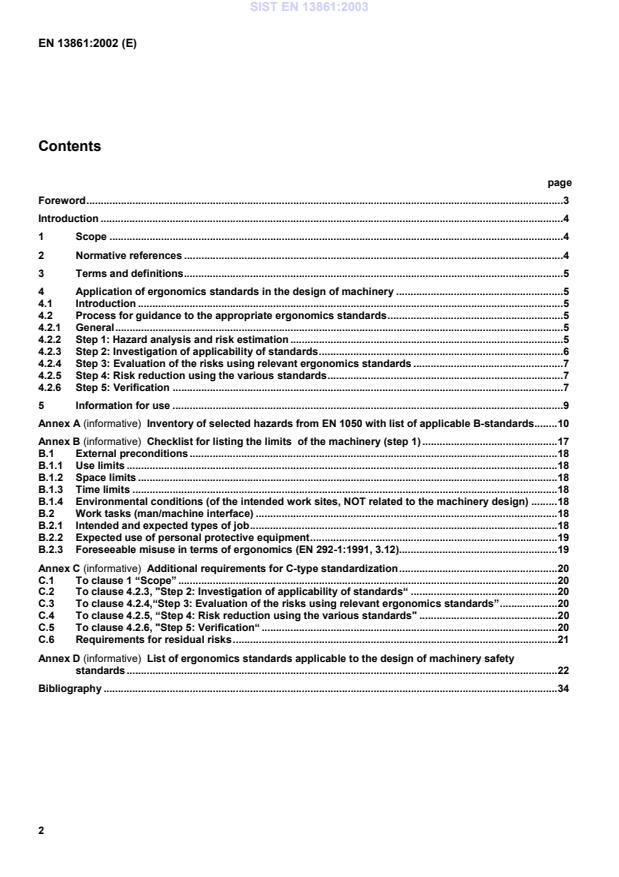
Inventory of selected hazards from EN 1050 with list of applicable B-standards.10Annex B (informative)
Checklist for listing the limits
of the machinery (step 1).17B.1External preconditions.18B.1.1Use limits.18B.1.2Space limits.18B.1.3Time limits.18B.1.4Environmental conditions (of the intended work sites, NOT related to the machinery design).18B.2Work tasks (man/machine interface).18B.2.1Intended and expected types of job.18B.2.2Expected use of personal protective equipment.19B.2.3Foreseeable misuse in terms of ergonomics (EN 292-1:1991, 3.12).19Annex C (informative)
Additional requirements for C-type standardization.20C.1To clause 1 “Scope”.20C.2To clause 4.2.3, "Step 2: Investigation of applicability of standards“.20C.3To clause 4.2.4,“Step 3: Evaluation of the risks using relevant ergonomics standards”.20C.4To clause 4.2.5, “Step 4: Risk reduction using the various standards".20C.5To clause 4.2.6, "Step 5: Verification“.20C.6Requirements for residual risks.21Annex D (informative)
List of ergonomics standards applicable to the design of machinery safetystandards.22Bibliography.34SIST EN 13861:2003
1)International Ergonomics AssociationSIST EN 13861:2003
(PPE) has to be taken into account when designing the machine, anadditional risk assessment shall be carried out in order to check that all essential health and safety requirements,including ergonomics, have been satisfied.4.2.6 Step 5: Verification¾ Check if all relevant and significant ergonomic related risks have been removed or reduced with the help ofapplicable standards.¾ Check if there are significant risks that are not covered by any standard or other technical specification. In thatcase, (re)design the man machine interface in accordance with EN 614-1 and EN 614-2.SIST EN 13861:2003
themachine with respect toergonomicsIdentify ergonomicrelated hazards /risksCan a specifictype C-standardbe applied?Isergonomic riskreduction measureacceptable?Implementreduction/measurefor each hazardStartYesYesRedesign
MMI*) ofmachine acc. EN 614-1oruse other references
Is thesolution
practical and reduces it risksufficiently?NoStep 1Refer to or apply ergonomicsB-standards(see Annex A)Step 2implementmeasureVerify ergonomic riskreduction measure(s)Step 3YesNoNoStep 4Step 5Apply other ergonomicsspecificationsCan risks bereduced with B-typestandards?Are otherergonomicsspecificationsavailable?NoNoYesYes*) Man Machine InterfaceFigure 1 — Flowchart of the step modelSIST EN 13861:2003
Definition Requirements/design process Measures Verification or testingmethods 3 Thermal hazards
3.1 Burns and scalds by a possible contact of persons, by flames orexplosions and also by the radiation of heat sources EN 563prEN ISO 13732-3
EN 563prEN ISO 13732-3 EN 13202 EN 563prEN ISO 13732-3 3.2 Health damaging affects by hot or cold work environment EN ISO 13731 EN 27243EN ISO 7730ENV ISO 11079
EN 12515EN 27726EN 28996 4 Hazards generated by noise
4.1 Hearing loss (deafness), other physiological disorders EN 1746 EN ISO 11688-1EN ISO 11688-2EN ISO 11690-1ISO 1999a
EN ISO 11688-1EN ISO 11688-2EN ISO 11690-2
EN ISO 11200EN ISO 11201EN ISO 11204EN ISO 3744EN ISO 4871SIST EN 13861:2003
Definition Requirements/design process Measures Verification or testingmethods 4.2 Interference with speech communication, acoustic signals, etc. EN 1746 EN 457a
EN 894-2
EN ISO 11690-1ISO 9921-1
EN ISO 11688-1EN ISO 11688-2EN ISO 11690-2 EN ISO 3744EN ISO 4871EN ISO 11200EN ISO 11201EN ISO 11204 5 Hazards generated by vibration
5.1 Use of hand-held machines resulting in a variety of neurological andvascular disorders CR 12349ENV 25349ISO 2041ISO 5805 EN 1033ENV 25349EN 28662-1 CR 1030-1 EN 1033ENV 25349ENV 28041prEN ISO 5349-2ISO 2631-1 5.2 Whole body vibration, particularly when combined with poor postures EN 1032CR 12349EN 12786ISO 2041ISO 2631-1ISO 5805ISO 8727 EN 1032prEN 14386 EN 1299 EN 1032ENV 28041EN 30326-1 6 Hazards generated by radiation
6.1 Low frequency, radio frequency radiation, microwaves EN 12198-1 ENV
50166-1ENV
50166-2 EN 12198-1 ENV
50166-1ENV
50166-2 8 Hazards generated by neglecting ergonomic principles in machinerydesign SIST EN 13861:2003
Definition Requirements/design process Measures Verification or testingmethods 8.18.28.3 Unhealthy postures or excessive effortInadequate consideration of hand-arm and foot-leg anatomyNeglected use of personal protective equipment EN 1005-1EN ISO 7250 EN 547-1EN 547-2EN 547-3EN ISO 14738EN 60204-1prEN 14386 EN 547-2Annex BprEN 1005-2EN 1005-3EN ISO 7250EN ISO 11064-2EN ISO 14738prEN ISO 11064-6b
prEN 1005-2EN 1005-3prEN 1005-4prEN ISO 15537
8.4 Inadequate local lighting EN 842EN 894-2EN 894-3EN 12665ISO 8995
EN 842EN 894-2EN 894-3EN 1837EN 60204-1EN 61310-1ISO 8995
EN 842ISO 8995 8.5 Mental overload and underload, stress EN ISO 10075-1 EN 614-2 EN 614-2
8.6 Human error, human behaviour EN 457EN 842EN 894-1EN 894-2EN 894-3EN 981
EN 457EN 842EN 894-1EN 894-2EN 894-3EN 981EN 60204-1EN 61310-1EN 61310-2 EN 61310-3
EN 457EN 842EN 894-3EN 981 21 Additional hazards and hazardous events due to mobility linkedto work position on the machine SIST EN 13861:2003
Definition Requirements/design process Measures Verification or testingmethods 21.1 Fall of persons during access to (or at/from) the work position EN ISO 7250 EN 547-1EN 547-2EN 547-3EN ISO 14738prEN 14386
prEN ISO 15537 21.5 Insufficient visibility from the work position EN 842EN 894-2EN 894-3 EN 61310-1EN 61310-2EN 842EN 894-2prEN 14386
EN 894-3 21.6 Inadequate lighting EN 12665ISO/ 8995 EN 1837 ISO 8995
ISO 8995 21.7 Inadequate seating EN 1005-1EN ISO 7250 prEN 1005-4EN ISO 14738EN 60204-1prEN 14386 EN ISO 14738 prEN 1005-4prEN ISO 15537SIST EN 13861:2003
Definition Requirements/design process Measures Verification or testingmethods 21.8 Noise at the work position EN 1746 EN 547-1EN 547-2EN 547-3prEN 1005-4EN ISO 11201EN ISO 11688-1EN ISO 11688-2EN ISO 11690-1EN ISO 14738prEN 14386ISO 1999a
EN ISO 11688-1 EN ISO 11688-2EN ISO 11690-2 EN ISO 11200EN ISO 11201EN ISO 11202EN ISO 11203EN ISO 11204 21.9 Vibration at the work position EN 12786ENV 25349ISO 2041ISO 5805 EN 547-1EN 547-2EN 547-3EN ISO 14738ENV 25349ENV 50166-1ENV 50166-2 CR 1030-1 EN 1033ENV 25349ENV 28041ENV 50166-1ENV 50166-2EN ISO 5349-2ISO 2631-1 22 Additional hazards and hazardous events due to the controlsystem SIST EN 13861:2003
Definition Requirements/design process Measures Verification or testingmethods 22.1 Inadequate location of controls/ control devices EN 894-2EN 894-3EN 1005-1EN ISO 7250 EN 894-2EN 894-3EN 1005-3prEN 1005-4EN ISO 14738EN 61310-2EN 60204-1prEN 14386 EN ISO 14738 EN 894-3EN 1005-3prEN 1005-4prEN ISO 15537
22.2 Inadequate design of the actuation mode and/or action mode ofcontrols EN 894-2EN 894-3EN 1005-1 EN 547-1EN 547-2EN 547-3EN 894-2EN 894-3EN 1005-3prEN 1005-4EN 61310-2EN 60204-1
EN 894-3EN 1005-3prEN 1005-4 29 Additional hazards and hazardous events due to lifting; hazardsgenerated by neglecting ergonomic principles SIST EN 13861:2003
Definition Requirements/design process Measures Verification or testingmethods 29.1 Insufficient visibility from the driving position EN 1005-1EN ISO 7250 EN 547-1EN 547-2EN 547-3EN 894-2prEN 1005-4EN ISO 14738EN 60204-1prEN 14386 EN ISO 14738 prEN 1005-4prEN ISO 15537astandard with only/mainly requirements for the immission at a workplace and therefore only indirectly on the emission of the machinebprEN ISO 11064-6 'Ergonomic design of control centres – Part 6: Environmental requirements for control centres'; under preparation; expected in 2003NOTEImportant subjects missing in EN 1050 are: ‘information displays’ and ‘repetitive movements’.The subject ‘information displays’ is included in table A.1 in number 21 (above).SIST EN 13861:2003
of the machinery (step 1) Prior conditions Life cycle phases
Construction Transport andcommissioning . assembly,
installation. adjustment Use
. setting, teaching/
programming or
process changeover . operation . cleaning . fault finding . maintenance De-commis-sioning,dismantling,disposal Externalpreconditions(characteristicsand restrictions)
User limits(user groups)
Space limits
Time limits. duration. frequency
Environmentalconditions. climate. noise, lighting. vibration
Work tasks(man/machineinterface)
Intended
andexpected use
Expected use ofpersonal protect-ive equipment
Foreseeablemisuse
¾
2)As defined in EN 292-1:1991, Clause 5.SIST EN 13861:2003
some significant risks have not been dealt with in relevant A- and B-type standards, neither in this C-typestandard, the exclusion of these significant risks shall be mentioned in the scope of the C-type standard, as statedin EN 414.C.5 To clause 4.2.6, "Step 5: Verification“Check if the use of standards removed the relevant risks or reduced these risks to an acceptable level. As far asthese standards do not help removing or reducing the risks sufficiently, additional specifications shall be drawn upin a C-type standard for the risks related to the specific machinery.The C-type standard shall provide information on how the stated ergonomic measures can be verified by means ofthe information in the relevant horizontal B-type standards where available.If there is no relevant B-standard, then a specific verification method shall be given in the C-type standard.SIST EN 13861:2003
...