

ASTM D127-19
(Test Method)Standard Test Method for Drop Melting Point of Petroleum Wax, Including Petrolatum
General Information
- Abstract
SIGNIFICANCE AND USE
5.1 Melting point is a wax property that is of interest to most wax consumers. It can be an indication of the performance properties of the wax. Drop melting point, Test Method D127, is often used to measure the melting characteristics of petrolatums and other high viscosity petroleum waxes.
SCOPE
1.1 This test method covers the determination of the drop melting point of petroleum wax. It is used primarily for petrolatums and other microcrystalline wax.
Note 1: Additional methods used for petroleum waxes are Test Method D87 and Test Method D938. Results obtained may differ, depending on the method used. For pharmaceutical petrolatum, Test Method D127 usually is used.
1.1.1 Test Method A—The dropping point of wax is determined with a mercury in glass thermometer, as stated below in6.3. (Warning—Mercury has been designated by many regulatory agencies as a hazardous substance that can cause serious medical issues. Mercury, or its vapor, has been demonstrated to be hazardous to health and corrosive to materials. Use Caution when handling mercury and mercury-containing products. See the applicable product Safety Data Sheet (SDS) for additional information. The potential exists that selling mercury or mercury-containing products, or both, is prohibited by local or national law. Users must determine legality of sales in their location.)
1.1.2 Test Method B—The dropping point of wax determined in a dropping point cup in an instrument which detects the drop and measures the temperature electronically, with a platinum thermometer instead of with mercury. Mercury has been recognized as a poison and a health hazard. Removing mercury from laboratories is a way of making the measuring process more inherently safe. The instrumental dropping point method has shown to produce results that are close to those determined by the original Test Method D127, Method A.
1.2 The values stated in SI units are to be regarded as the standard. The values given in parentheses are for information only.
1.3 This standard does not purport to address all of the safety concerns, if any, associated with its use. It is the responsibility of the user of this standard to establish appropriate safety, health, and environmental practices and determine the applicability of regulatory limitations prior to use.
1.4 This international standard was developed in accordance with internationally recognized principles on standardization established in the Decision on Principles for the Development of International Standards, Guides and Recommendations issued by the World Trade Organization Technical Barriers to Trade (TBT) Committee.
- Status
- Published
- Publication Date
- 31-Oct-2019
- Technical Committee
- D02 - Petroleum Products, Liquid Fuels, and Lubricants
Buy Documents
ASTM D127-19 - Standard Test Method for Drop Melting Point of Petroleum Wax, Including Petrolatum
REDLINE ASTM D127-19 - Standard Test Method for Drop Melting Point of Petroleum Wax, Including Petrolatum
Overview
ASTM D127-19: Standard Test Method for Drop Melting Point of Petroleum Wax, Including Petrolatum establishes procedures for determining the drop melting point of petroleum waxes, particularly petrolatums and microcrystalline waxes. This test is essential for assessing the melting characteristics of high-viscosity petroleum waxes. Used widely across industries that manufacture, process, or utilize petroleum-based waxes, this standard ensures consistency and comparability in measuring a critical property that impacts product performance, processing, and quality control.
Key Topics
- Test Methods:
- Method A utilizes a mercury-in-glass thermometer to identify the temperature at which molten wax drops from the bulb.
- Method B uses an electronic instrument with a platinum thermometer, improving safety by avoiding mercury and offering results closely comparable to Method A.
- Significance of Drop Melting Point:
- Provides valuable information about the performance characteristics of petroleum wax products.
- is frequently referenced by wax consumers and is vital in quality assurance processes.
- Safety Considerations:
- Mercury used in Method A is hazardous; appropriate safety measures and local legal requirements must be reviewed.
- Method B offers a mercury-free alternative, contributing to a safer laboratory environment.
- Scope of Application:
- While primarily used for petrolatums and microcrystalline waxes, this method is also suitable for other high-viscosity petroleum waxes.
- Especially preferred for pharmaceutical petrolatum.
Applications
The drop melting point determined by ASTM D127-19 is crucial for various practical applications:
- Product Specification and Quality Control:
- Ensures that wax products comply with defined melting characteristics critical for performance in end-use applications.
- Pharmaceutical and Cosmetic Industries:
- Supports the selection and verification of waxes in ointments, creams, and other formulations where controlled melting is necessary for stability and efficacy.
- Manufacturing of Candles, Coatings, and Polishes:
- Helps determine suitability of wax products for specific thermal environments to prevent premature softening or melting.
- Raw Material Assessment:
- Provides manufacturers and buyers with a reliable basis for assessing and comparing batches of petroleum wax.
- Regulatory Compliance:
- Fulfills industry and trade requirements in global markets, complying with WTO TBT Committee recommendations.
Related Standards
For comprehensive evaluation of petroleum wax properties, related ASTM standards include:
- ASTM D87: Test Method for Melting Point of Petroleum Wax (Cooling Curve)
- ASTM D938: Test Method for Congealing Point of Petroleum Waxes, Including Petrolatum
- ASTM D3104: Test Method for Softening Point of Pitches (Mettler Softening Point Method)
- ASTM D3954: Test Method for Dropping Point of Waxes
Other relevant references include:
- ASTM E1: Specification for ASTM Liquid-in-Glass Thermometers
- ASTM E177: Practice for Use of the Terms Precision and Bias in ASTM Test Methods
- ASTM E691: Practice for Conducting an Interlaboratory Study to Determine Precision
Practical Value
Adhering to ASTM D127-19 in determining the drop melting point of petroleum wax provides robust, reproducible results critical throughout the supply chain. Standardizing this measurement ensures consistency between suppliers and users. Utilizing either the traditional or safety-optimized electronic method allows organizations to choose the most suitable approach while maintaining compliance and protecting worker health. This standard underpins essential quality, regulatory, and performance benchmarks for a broad range of petroleum wax applications.
Keywords: ASTM D127-19, drop melting point, petroleum wax, petrolatum, microcrystalline wax, wax performance, quality control, melting characteristics, wax testing, standard test method.
Relations
- Effective Date
- 01-Dec-2018
- Effective Date
- 01-Oct-2014
- Effective Date
- 01-Jun-2014
- Effective Date
- 01-May-2014
- Refers
ASTM D87-09(2014) - Standard Test Method for Melting Point of Petroleum Wax (Cooling Curve) - Effective Date
- 01-May-2014
- Effective Date
- 01-May-2013
- Effective Date
- 01-May-2013
- Effective Date
- 01-May-2013
- Effective Date
- 01-Nov-2011
- Effective Date
- 01-Oct-2010
- Effective Date
- 01-May-2010
- Effective Date
- 01-May-2010
- Effective Date
- 01-Dec-2009
- Effective Date
- 01-Oct-2008
- Effective Date
- 01-Oct-2008
Buy Documents
ASTM D127-19 - Standard Test Method for Drop Melting Point of Petroleum Wax, Including Petrolatum
REDLINE ASTM D127-19 - Standard Test Method for Drop Melting Point of Petroleum Wax, Including Petrolatum
Get Certified
Connect with accredited certification bodies for this standard

Element Materials Technology
Materials testing and product certification.

ABS Group Brazil
ABS Group certification services in Brazil.

ABS Quality Evaluations Inc.
American Bureau of Shipping quality certification.
Sponsored listings
Frequently Asked Questions
ASTM D127-19 is a standard published by ASTM International. Its full title is "Standard Test Method for Drop Melting Point of Petroleum Wax, Including Petrolatum". This standard covers: SIGNIFICANCE AND USE 5.1 Melting point is a wax property that is of interest to most wax consumers. It can be an indication of the performance properties of the wax. Drop melting point, Test Method D127, is often used to measure the melting characteristics of petrolatums and other high viscosity petroleum waxes. SCOPE 1.1 This test method covers the determination of the drop melting point of petroleum wax. It is used primarily for petrolatums and other microcrystalline wax. Note 1: Additional methods used for petroleum waxes are Test Method D87 and Test Method D938. Results obtained may differ, depending on the method used. For pharmaceutical petrolatum, Test Method D127 usually is used. 1.1.1 Test Method A—The dropping point of wax is determined with a mercury in glass thermometer, as stated below in6.3. (Warning—Mercury has been designated by many regulatory agencies as a hazardous substance that can cause serious medical issues. Mercury, or its vapor, has been demonstrated to be hazardous to health and corrosive to materials. Use Caution when handling mercury and mercury-containing products. See the applicable product Safety Data Sheet (SDS) for additional information. The potential exists that selling mercury or mercury-containing products, or both, is prohibited by local or national law. Users must determine legality of sales in their location.) 1.1.2 Test Method B—The dropping point of wax determined in a dropping point cup in an instrument which detects the drop and measures the temperature electronically, with a platinum thermometer instead of with mercury. Mercury has been recognized as a poison and a health hazard. Removing mercury from laboratories is a way of making the measuring process more inherently safe. The instrumental dropping point method has shown to produce results that are close to those determined by the original Test Method D127, Method A. 1.2 The values stated in SI units are to be regarded as the standard. The values given in parentheses are for information only. 1.3 This standard does not purport to address all of the safety concerns, if any, associated with its use. It is the responsibility of the user of this standard to establish appropriate safety, health, and environmental practices and determine the applicability of regulatory limitations prior to use. 1.4 This international standard was developed in accordance with internationally recognized principles on standardization established in the Decision on Principles for the Development of International Standards, Guides and Recommendations issued by the World Trade Organization Technical Barriers to Trade (TBT) Committee.
SIGNIFICANCE AND USE 5.1 Melting point is a wax property that is of interest to most wax consumers. It can be an indication of the performance properties of the wax. Drop melting point, Test Method D127, is often used to measure the melting characteristics of petrolatums and other high viscosity petroleum waxes. SCOPE 1.1 This test method covers the determination of the drop melting point of petroleum wax. It is used primarily for petrolatums and other microcrystalline wax. Note 1: Additional methods used for petroleum waxes are Test Method D87 and Test Method D938. Results obtained may differ, depending on the method used. For pharmaceutical petrolatum, Test Method D127 usually is used. 1.1.1 Test Method A—The dropping point of wax is determined with a mercury in glass thermometer, as stated below in6.3. (Warning—Mercury has been designated by many regulatory agencies as a hazardous substance that can cause serious medical issues. Mercury, or its vapor, has been demonstrated to be hazardous to health and corrosive to materials. Use Caution when handling mercury and mercury-containing products. See the applicable product Safety Data Sheet (SDS) for additional information. The potential exists that selling mercury or mercury-containing products, or both, is prohibited by local or national law. Users must determine legality of sales in their location.) 1.1.2 Test Method B—The dropping point of wax determined in a dropping point cup in an instrument which detects the drop and measures the temperature electronically, with a platinum thermometer instead of with mercury. Mercury has been recognized as a poison and a health hazard. Removing mercury from laboratories is a way of making the measuring process more inherently safe. The instrumental dropping point method has shown to produce results that are close to those determined by the original Test Method D127, Method A. 1.2 The values stated in SI units are to be regarded as the standard. The values given in parentheses are for information only. 1.3 This standard does not purport to address all of the safety concerns, if any, associated with its use. It is the responsibility of the user of this standard to establish appropriate safety, health, and environmental practices and determine the applicability of regulatory limitations prior to use. 1.4 This international standard was developed in accordance with internationally recognized principles on standardization established in the Decision on Principles for the Development of International Standards, Guides and Recommendations issued by the World Trade Organization Technical Barriers to Trade (TBT) Committee.
ASTM D127-19 is classified under the following ICS (International Classification for Standards) categories: 75.140 - Waxes, bituminous materials and other petroleum products. The ICS classification helps identify the subject area and facilitates finding related standards.
ASTM D127-19 has the following relationships with other standards: It is inter standard links to ASTM D3104-14a(2018), ASTM D3104-14a, ASTM D3104-14, ASTM E177-14, ASTM D87-09(2014), ASTM E177-13, ASTM E691-13, ASTM E1-13, ASTM E691-11, ASTM E177-10, ASTM D3954-94(2010), ASTM D3104-99(2010), ASTM D87-09, ASTM E177-08, ASTM E691-08. Understanding these relationships helps ensure you are using the most current and applicable version of the standard.
ASTM D127-19 is available in PDF format for immediate download after purchase. The document can be added to your cart and obtained through the secure checkout process. Digital delivery ensures instant access to the complete standard document.
Standards Content (Sample)
This international standard was developed in accordance with internationally recognized principles on standardization established in the Decision on Principles for the
Development of International Standards, Guides and Recommendations issued by the World Trade Organization Technical Barriers to Trade (TBT) Committee.
Designation: D127 − 19
Designation: 133/79 (87)
Standard Test Method for
Drop Melting Point of Petroleum Wax, Including Petrolatum
This standard is issued under the fixed designation D127; the number immediately following the designation indicates the year of
original adoption or, in the case of revision, the year of last revision. A number in parentheses indicates the year of last reapproval. A
superscript epsilon (´) indicates an editorial change since the last revision or reapproval.
This standard has been approved for use by agencies of the U.S. Department of Defense.
1. Scope* method has shown to produce results that are close to those
determined by the original Test Method D127, Method A.
1.1 This test method covers the determination of the drop
melting point of petroleum wax. It is used primarily for 1.2 The values stated in SI units are to be regarded as the
petrolatums and other microcrystalline wax. standard. The values given in parentheses are for information
only.
NOTE 1—Additional methods used for petroleum waxes are Test
Method D87 and Test Method D938. Results obtained may differ, 1.3 This standard does not purport to address all of the
depending on the method used. For pharmaceutical petrolatum, Test
safety concerns, if any, associated with its use. It is the
Method D127 usually is used.
responsibility of the user of this standard to establish appro-
1.1.1 Test Method A—The dropping point of wax is deter-
priate safety, health, and environmental practices and deter-
mined with a mercury in glass thermometer, as stated below
mine the applicability of regulatory limitations prior to use.
in6.3. (Warning—Mercury has been designated by many
1.4 This international standard was developed in accor-
regulatory agencies as a hazardous substance that can cause
dance with internationally recognized principles on standard-
serious medical issues. Mercury, or its vapor, has been dem-
ization established in the Decision on Principles for the
onstrated to be hazardous to health and corrosive to materials.
Development of International Standards, Guides and Recom-
Use Caution when handling mercury and mercury-containing
mendations issued by the World Trade Organization Technical
products. See the applicable product Safety Data Sheet (SDS)
Barriers to Trade (TBT) Committee.
for additional information. The potential exists that selling
2. Referenced Documents
mercury or mercury-containing products, or both, is prohibited
by local or national law. Users must determine legality of sales
2.1 ASTM Standards:
in their location.)
D87 Test Method for Melting Point of Petroleum Wax
1.1.2 Test Method B—The dropping point of wax deter-
(Cooling Curve)
mined in a dropping point cup in an instrument which detects
D938 Test Method for Congealing Point of Petroleum
the drop and measures the temperature electronically, with a
Waxes, Including Petrolatum
platinum thermometer instead of with mercury. Mercury has
D3104 Test Method for Softening Point of Pitches (Mettler
been recognized as a poison and a health hazard. Removing
Softening Point Method)
mercury from laboratories is a way of making the measuring
D3954 Test Method for Dropping Point of Waxes
process more inherently safe. The instrumental dropping point
E1 Specification for ASTM Liquid-in-Glass Thermometers
E177 Practice for Use of the Terms Precision and Bias in
ASTM Test Methods
This test method is under the jurisdiction of ASTM Committee D02 on
E691 Practice for Conducting an Interlaboratory Study to
Petroleum Products, Liquid Fuels, and Lubricants and is the direct responsibility of
Determine the Precision of a Test Method
Subcommittee D02.10 on Properties of Petroleum Waxes and Alternative Wax-like
Materials.
Current edition approved Nov. 1, 2019. Published February 2020. Originally TEST METHOD A
approved in 1922. Last previous edition approved in 2015 as D127 – 08 (2015).
DOI: 10.1520/D0127-19.
3. Terminology
This test method was adopted as a joint ASTM-IP standard in 1964. In the IP, this
3.1 Definitions:
test method is under the jurisdiction of Standardization Committee.
In 1963, the title, scope, and definition were changed to define the determination
of “drop melting point.” Sections on procedure, report, and precision were revised,
and a new section on significance was added. For referenced ASTM standards, visit the ASTM website, www.astm.org, or
In 1964, minor editorial changes and additions to this method were made for its contact ASTM Customer Service at service@astm.org. For Annual Book of ASTM
publication as a joint ASTM-IP standard. Standards volume information, refer to the standard’s Document Summary page on
Only Method A of this test method is equivalent to IP 133/79 (87). the ASTM website.
*A Summary of Changes section appears at the end of this standard
Copyright © ASTM International, 100 Barr Harbor Drive, PO Box C700, West Conshohocken, PA 19428-2959. United States
D127 − 19
3.1.1 drop melting point of petroleum wax—the temperature having a temperature of 16 °C 6 1 °C (60 °F 6 2 °F). Prepare
at which material becomes sufficiently fluid to drop from the another specimen from the same sample using this procedure.
thermometer used in making the determination under definite
NOTE 2—A dipping temperature of 11 °C (20 °F) above the congealing
prescribed conditions.
point in accordance with Test Method D938 usually will be 6 °C to 11 °C
(10 °F to 20 °F) above the actual drop melting point.
4. Summary of Test Method
7.2 Securely fix the thermometers in the test tubes by means
of suitable stoppers, such as corks, so that the tip of each
4.1 Specimens are deposited on two thermometer bulbs by
dipping chilled thermometers into the sample. The thermom- thermometer is approximately 15 mm above the bottom of its
test tube. Insert the test tubes in the water bath which is at
eters bearing the specimens are placed in test tubes and heated
by means of a water bath until the specimens melt and the first 16 °C 6 1 °C (60 °F 6 2 °F) and adjust the height of the test
drop falls from each thermometer bulb. The average of the tubes so that the immersion marks on the thermometers are
temperatures at which these drops fall is the drop melting point level with the top surface of the water. Raise the temperature of
of the sample. the bath at a rate of approximately 2 °C (3 °F) ⁄min to 38 °C
(100 °F), then at a rate of approximately 1 °C (2 °F) ⁄min until
the first drop of material leaves each thermometer. Record in
5. Significance and Use
each case the temperature at which the first drop falls from the
5.1 Melting point is a wax property that is of interest to most
thermometer.
wax consumers. It can be an indication of the performance
properties of the wax. Drop melting point, Test Method D127,
8. Report
is often used to measure the melting characteristics of petro-
8.1 Report the average of the two determinations as the drop
latums and other high viscosity petroleum waxes.
melting point of the sample under test.
6. Apparatus
9. Precision and Bias
6.1 Test Tubes—Standard test tubes, 25 mm (1 in.) in out-
9.1 Precision—The precision of this test method as deter-
side diameter and 150 mm (6 in.) long. The test tubes shall
mined by statistical examination of interlaboratory results is as
utilize stoppers, such as corks, grooved at the sides to permit
follows:
air circulation and bored in the center to receive the thermom-
9.1.1 Repeatability—The difference between two test
eter.
results, obtained by the same operator with the same apparatus
6.2 Bath—A transparent container of not less than 1500 mL
under constant operating conditions on identical test material,
capacity, that will permit the immersion of the test tubes to a
would in the long run, in the normal and correct operation of
depth of at least 90 mm and still leave a depth of approximately
the test method, exceed the following values only in one case
15 mm of water below the bottoms of the test tubes.
in twenty:
0.8 °C (1.4 °F)
6.3 Thermometer, having a range as shown below and
conforming to the requirements as prescribed in Specification
9.1.2 Reproducibility—The difference between two single
E1 or in specifications for IP Standard Thermometers:
and independent results obtained by different operators work-
ing in different laboratories on identical test material would, in
Thermometer Number
Thermometer Range ASTM IP
the long run, in the normal and correct operation of the test
32 °C to 127 °C 61C 63C
method, exceed the following values only in one case in
90 °F to 260 °F 61F . . .
twenty:
6.4 Bath Thermometer, any suitable type, accurate to 0.5 °C
1.3 °C (2.4 °F)
(1 °F) throughout the required range.
NOTE 3—The following information on the precision of this test method
was developed by the Institute of Petroleum (now Energy Institute) in
7. Procedure
London and is being investigated:
7.1 Secure a sample of sufficient size that is representative
(1) Results of duplicate tests should not differ by more than the
following amounts:
of the material under inspection. Use a fresh portion of the
sample for each set of two determinations. Melt the sample Repeatability Reproducibility
1 °C (2 °F) 1.2 °C (2.2 °F)
slowly until the temperature reaches at least 11 °C (20 °F)
above the expected drop melting point. Place sufficient sample
(2) These precision values were obtained in 1954 by statistical
examination of interlaboratory test results.
in a flat bottom container to give a sample depth of 12 mm 6
1 mm. Adjust the temperature of the sample to at least 6 °C
9.2 Bias—The procedure in this test method has no bias
(10 °F) (Note 2) above its drop melting point using any general
because the value of drop melting point can be defined only in
laboratory thermometer for measurement. Chill one of the test
terms of a test method.
thermometer bulbs to approximately 4 °C (40 °F). Wipe dry,
TEST METHOD B
and, quickly but carefully, immerse the chilled bulb vertically
into the heated sample until it touches the bottom of the
10. Summary of Test Method
container (about 12 mm submerged) and withdraw it immedi-
ately. Hold the thermometer vertically away from the heat until 10.1 In this test method, the dropping point is defined as the
the surface dulls, and then place it for at least 5 min in water temperature at which the wax suspended in a cylindrical cup,
D127 − 19
with a 2.8 mm diameter hole in the bottom, flows downward 12. Apparatus
and releases a drop as the sample is heated at a constant rate in 3
12.1 A METTLER TOLEDO dropping point furnace shall
air. The cups may be nickel plated brass or aluminum. A glass
be used to determine pitch softening points by this test method.
receptacle contains the molten wax underneath the drop.
These commercially available instruments consist of a control
unit with a digital temperature indicator, with furnace built in
11. Significance and Use
11.1 This closely defined method may be used as an 3
The sole source of supply of the apparatus known to the committee at this time
alternate to Test Method D127 part A to measure the melting is METTLER TOLEDO LLC, 1900 Polaris Parkway, Columbus, OH 43240,
1-800-METTLER, www.mt.com. If you are aware of alternative suppliers, please
characteristics of natural waxes, paraffin waxes, microcrys-
provide this information to ASTM International Headquarters. Your comments will
talling waxes and petrolatums and other high viscosity petro- 1
receive careful consideration at a meeting of the responsible technical committee,
leum waxes. which you may attend.
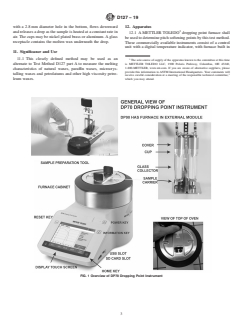
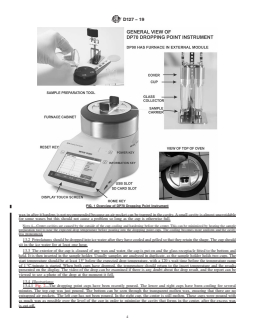
FIG. 1 Overview of DP70 Dropping Point Instrument
D127 − 19
or attached, sample cartridges, and accessories. The control with as much wax as possible over the level of the cup in order
unit automatically regulates the heating rate of the furnace. The to minimize the cavity that forms in the center, after the excess
dropping point is indicated on the readout, and the heating wax is cut
...
This document is not an ASTM standard and is intended only to provide the user of an ASTM standard an indication of what changes have been made to the previous version. Because
it may not be technically possible to adequately depict all changes accurately, ASTM recommends that users consult prior editions as appropriate. In all cases only the current version
of the standard as published by ASTM is to be considered the official document.
Designation: D127 − 08 (Reapproved 2015) D127 − 19 Technical Association of Pulp and Paper Industry
Tentative Method T 634ts-64
Designation: 133/79 (87)
Standard Test Method for
Drop Melting Point of Petroleum Wax, Including Petrolatum
This standard is issued under the fixed designation D127; the number immediately following the designation indicates the year of
original adoption or, in the case of revision, the year of last revision. A number in parentheses indicates the year of last reapproval. A
superscript epsilon (´) indicates an editorial change since the last revision or reapproval.
This standard has been approved for use by agencies of the U.S. Department of Defense.
1. Scope Scope*
1.1 This test method covers the determination of the drop melting point of petroleum wax. It is used primarily for petrolatums
and other microcrystalline wax.
NOTE 1—Additional methods used for petroleum waxes are Test Method D87 and Test Method D938. Results obtained may differ, depending on the
method used. For pharmaceutical petrolatum, Test Method D127 usually is used.
1.1.1 Test Method A—The dropping point of wax is determined with a mercury in glass thermometer, as stated below in6.3.
(Warning—Mercury has been designated by many regulatory agencies as a hazardous substance that can cause serious medical
issues. Mercury, or its vapor, has been demonstrated to be hazardous to health and corrosive to materials. Use Caution when
handling mercury and mercury-containing products. See the applicable product Safety Data Sheet (SDS) for additional
information. The potential exists that selling mercury or mercury-containing products, or both, is prohibited by local or national
law. Users must determine legality of sales in their location.)
1.1.2 Test Method B—The dropping point of wax determined in a dropping point cup in an instrument which detects the drop
and measures the temperature electronically, with a platinum thermometer instead of with mercury. Mercury has been recognized
as a poison and a health hazard. Removing mercury from laboratories is a way of making the measuring process more inherently
safe. The instrumental dropping point method has shown to produce results that are close to those determined by the original Test
Method D127, Method A.
1.2 The values stated in SI units are to be regarded as the standard. The values given in parentheses are for information only.
1.3 This standard does not purport to address all of the safety concerns, if any, associated with its use. It is the responsibility
of the user of this standard to establish appropriate safety safety, health, and healthenvironmental practices and determine the
applicability of regulatory limitations prior to use.
1.4 This international standard was developed in accordance with internationally recognized principles on standardization
established in the Decision on Principles for the Development of International Standards, Guides and Recommendations issued
by the World Trade Organization Technical Barriers to Trade (TBT) Committee.
2. Referenced Documents
2.1 ASTM Standards:
D87 Test Method for Melting Point of Petroleum Wax (Cooling Curve)
D938 Test Method for Congealing Point of Petroleum Waxes, Including Petrolatum
D3104 Test Method for Softening Point of Pitches (Mettler Softening Point Method)
This test method is under the jurisdiction of ASTM Committee D02 on Petroleum Products, Liquid Fuels, and Lubricants and is the direct responsibility of Subcommittee
D02.10.0A on Physical/Chemical Properties.
Current edition approved Jan. 1, 2015Nov. 1, 2019. Published February 2015February 2020. Originally approved in 1922. Last previous edition approved in 20082015
as D127 – 08.D127 – 08 (2015). DOI: 10.1520/D0127-19.
This test method is sponsored jointly by the Technical Association of Pulp and Paper Industry and ASTM International.
This test method was adopted as a joint ASTM-IP standard in 1964. In the IP, this test method is under the jurisdiction of Standardization Committee.
In 1963, the title, scope, and definition were changed to define the determination of “drop melting point.” Sections on procedure, report, and precision were revised, and
a new section on significance was added.
In 1964, minor editorial changes and additions to this method were made for its publication as a joint ASTM-IP standard. DOI: 10.1520/D0127-08R15.
Only Method A of this test method is equivalent to IP 133/79 (87).
For referenced ASTM standards, visit the ASTM website, www.astm.org, or contact ASTM Customer Service at service@astm.org. For Annual Book of ASTM Standards
volume information, refer to the standard’s Document Summary page on the ASTM website.
*A Summary of Changes section appears at the end of this standard
Copyright © ASTM International, 100 Barr Harbor Drive, PO Box C700, West Conshohocken, PA 19428-2959. United States
D127 − 19
D3954 Test Method for Dropping Point of Waxes
E1 Specification for ASTM Liquid-in-Glass Thermometers
E177 Practice for Use of the Terms Precision and Bias in ASTM Test Methods
E691 Practice for Conducting an Interlaboratory Study to Determine the Precision of a Test Method
TEST METHOD A
3. Terminology
3.1 Definitions:
3.1.1 drop melting point of petroleum wax—the temperature at which material becomes sufficiently fluid to drop from the
thermometer used in making the determination under definite prescribed conditions.
4. Summary of Test Method
4.1 Specimens are deposited on two thermometer bulbs by dipping chilled thermometers into the sample. The thermometers
bearing the specimens are placed in test tubes and heated by means of a water bath until the specimens melt and the first drop falls
from each thermometer bulb. The average of the temperatures at which these drops fall is the drop melting point of the sample.
5. Significance and Use
5.1 Melting point is a wax property that is of interest to most wax consumers. It can be an indication of the performance
properties of the wax. Drop melting point, Test Method D127, is often used to measure the melting characteristics of petrolatums
and other high viscosity petroleum waxes.
6. Apparatus
6.1 Test Tubes—Standard test tubes, 25-mm (1-in.)25 mm (1 in.) in outside diameter and 150-mm (6-in.)150 mm (6 in.) long.
The test tubes shall utilize stoppers, such as corks, grooved at the sides to permit air circulation and bored in the center to receive
the thermometer.
6.2 Bath—A transparent container of not less than 1500-mL1500 mL capacity, that will permit the immersion of the test tubes
to a depth of at least 90 mm 90 mm and still leave a depth of approximately 15 mm 15 mm of water below the bottoms of the
test tubes.
6.3 Thermometer, having a range as shown below and conforming to the requirements as prescribed in Specification E1 or in
specifications for IP Standard Thermometers:
Thermometer Number
Thermometer Range ASTM IP
32 to 127°C 61C 63C
32 °C to 127 °C 61C 63C
90 to 260°F 61F . . .
90 °F to 260 °F 61F . . .
6.4 Bath Thermometer, any suitable type, accurate to 0.5°C (1°F)0.5 °C (1 °F) throughout the required range.
7. Procedure
7.1 Secure a sample of sufficient size that is representative of the material under inspection. Use a fresh portion of the sample
for each set of two determinations. Melt the sample slowly until the temperature reaches at least 11°C (20°F)11 °C (20 °F) above
the expected drop melting point. Place sufficient sample in a flat bottom container to give a sample depth of 1212 mm 6 1 mm.
1 mm. Adjust the temperature of the sample to at least 6°C (10°F)6 °C (10 °F) (Note 2) above its drop melting point using any
general laboratory thermometer for measurement. Chill one of the test thermometer bulbs to approximately 4°C (40°F).4 °C
(40 °F). Wipe dry, and, quickly but carefully, immerse the chilled bulb vertically into the heated sample until it touches the bottom
of the container (about 12 mm submerged) and withdraw it immediately. Hold the thermometer vertically away from the heat until
the surface dulls, and then place it for at least 5 min 5 min in water having a temperature of 1616 °C 6 1°C (601 °C (60 °F 6
2°F).2 °F). Prepare another specimen from the same sample using this procedure.
NOTE 2—A dipping temperature of 11°C (20°F)11 °C (20 °F) above the congealing point in accordance with Test Method D938 usually will be 66 °C
to 11°C (1011 °C (10 °F to 20°F)20 °F) above the actual drop melting point.
7.2 Securely fix the thermometers in the test tubes by means of suitable stoppers, such as corks, so that the tip of each
thermometer is approximately 15 mm 15 mm above the bottom of its test tube. Insert the test tubes in the water bath which is at
1616 °C 6 1°C (601 °C (60 °F 6 2°F)2 °F) and adjust the height of the test tubes so that the immersion marks on the thermometers
are level with the top surface of the water. Raise the temperature of the bath at a rate of approximately 2°C (3°F)/min2 °C
(3 °F) ⁄min to 38°C (100°F),38 °C (100 °F), then at a rate of approximately 1°C (2°F)/min1 °C (2 °F) ⁄min until the first drop of
material leaves each thermometer. Record in each case the temperature at which the first drop falls from the thermometer.
D127 − 19
8. Report
8.1 Report the average of the two determinations as the drop melting point of the sample under test.
9. Precision and Bias
9.1 Precision—The precision of this test method as determined by statistical examination of interlaboratory results is as follows:
9.1.1 Repeatability—The difference between two test results, obtained by the same operator with the same apparatus under
constant operating conditions on identical test material, would in the long run, in the normal and correct operation of the test
method, exceed the following values only in one case in twenty:
0.8°C (1.4°F)
0.8 °C (1.4 °F)
9.1.2 Reproducibility—The difference between two single and independent results obtained by different operators working in
different laboratories on identical test material would, in the long run, in the normal and correct operation of the test method,
exceed the following values only in one case in twenty:
1.3°C (2.4°F)
1.3 °C (2.4 °F)
NOTE 3—The following information on the precision of this test method was developed by the Institute of Petroleum (now Energy Institute) in London
and is being investigated:
(1) Results of duplicate tests should not differ by more than the following amounts:
Repeatability Reproducibility
1°C (2°F) 1.2°C (2.2°F)
1 °C (2 °F) 1.2 °C (2.2 °F)
(2) These precision values were obtained in 1954 by statistical examination of interlaboratory test results.
9.2 Bias—The procedure in this test method has no bias because the value of drop melting point can be defined only in terms
of a test method.
TEST METHOD B
10. Summary of Test Method
10.1 In this test method, the dropping point is defined as the temperature at which the wax suspended in a cylindrical cup, with
a 2.8 mm diameter hole in the bottom, flows downward and releases a drop as the sample is heated at a constant rate in air. The
cups may be nickel plated brass or aluminum. A glass receptacle contains the molten wax underneath the drop.
11. Significance and Use
11.1 This closely defined method may be used as an alternate to Test Method D127 part A to measure the melting characteristics
of natural waxes, paraffin waxes, microcrystalling waxes and petrolatums and other high viscosity petroleum waxes.
12. Apparatus
12.1 A METTLER TOLEDO dropping point furnace shall be used to determine pitch softening points by this test method.
These commercially available instruments consist of a control unit with a digital temperature indicator, with furnace built in or
attached, sample cartridges, and accessories. The control unit automatically regulates the heating rate of the furnace. The dropping
point is indicated on the readout, and the heating program stopped, when the sample flow triggers a dropping point detection. A
general view of the contents of the METTLER TOLEDO dropping point instrument is shown in Fig. 1.
13. Procedure
13.1 Secure a sample of sufficient size that is representative of the material under inspection. Use a fresh portion of the sample
for each set of two
...