

ASTM C1842-16
(Test Method)Standard Test Method for The Analysis of Boron and Silicon in Uranium Hexfluoride via Fourier-Transform Infrared (FTIR) Spectroscopy
General Information
- Abstract
SIGNIFICANCE AND USE
5.1 This test method utilizes FTIR spectroscopy to determine the boron and silicon concentration in uranium hexafluoride.
5.2 These detection limits are low and very effective to check the compliance of UF6 with Specifications C787 and C996.
SCOPE
1.1 This test method is suitable for determining boron and silicon impurities as BF3 and SiF4 in uranium hexafluoride. This test method is an alternative to those described in Test Methods C761 and C1771.
1.2 The values stated in SI units are to be regarded as standard. No other units of measurement are included in this standard.
1.3 This standard does not purport to address all of the safety concerns, if any, associated with its use. It is the responsibility of the user of this standard to establish appropriate safety and health practices and determine the applicability of regulatory limitations prior to use.
- Status
- Published
- Publication Date
- 31-May-2016
- Technical Committee
- C26 - Nuclear Fuel Cycle
- Drafting Committee
- C26.05 - Methods of Test
Overview
ASTM C1842-16, the “Standard Test Method for The Analysis of Boron and Silicon in Uranium Hexafluoride via Fourier-Transform Infrared (FTIR) Spectroscopy,” establishes a reliable procedure for determining trace amounts of boron and silicon impurities in uranium hexafluoride (UF₆). This standard is particularly relevant for ensuring the purity of UF₆ used in the nuclear fuel cycle, supporting compliance with specifications such as ASTM C787 and ASTM C996. Applying FTIR spectroscopy, the method enables sensitive, accurate monitoring of impurities as boron trifluoride (BF₃) and silicon tetrafluoride (SiF₄), safeguarding material quality during isotope enrichment and international nuclear material transportation.
Key Topics
- Scope of Method: Suitable for analyzing boron and silicon impurities, present as BF₃ and SiF₄, in uranium hexafluoride. The method is an alternative to other ASTM test methods (C761 and C1771).
- Technique: Uses Fourier-Transform Infrared (FTIR) spectroscopy to analyze vapor-phase impurities, benefiting from high sensitivity and low detection limits.
- Sample Handling: Emphasizes the use of containers and manifolds constructed from materials inert to fluorine-bearing gases (e.g., nickel, Monel, copper).
- Calibration and Units: All measurements are conducted in SI units; calibration with standard gases (e.g., pure BF₃ and SiF₄) is required for valid results.
- Detection Limits: Capable of detecting boron and silicon at very low concentrations to confirm compliance with stringent nuclear-grade UF₆ specifications.
- Quality Assurance: Each laboratory must validate its precision and bias as part of its quality assurance process.
Applications
- Nuclear Fuel Cycle: Ensures the chemical purity of uranium hexafluoride during enrichment, transportation, and storage, minimizing the risk of contamination in nuclear reactors.
- Regulatory Compliance: Assures adherence to international and national regulations for UF₆ purity (ASTM C787, C996), crucial for fuel fabrication and non-proliferation commitments.
- Alternative Analysis: Offers a safe, non-destructive analytical alternative to mass spectrometric or inductively coupled plasma methods for boron and silicon detection.
- Transport Packaging: Supports requirements for UF₆ packaging and handling, in line with relevant ANSI and ISO documentation.
- Quality Control: Facilitates routine quality control in uranium conversion and enrichment facilities by allowing rapid determination and quantification of impurities.
Related Standards
Several other standards and practices complement ASTM C1842-16, enhancing its effectiveness and harmonizing it within the international regulatory framework:
- ASTM C787: Specification for Uranium Hexafluoride for Enrichment
- ASTM C996: Specification for Uranium Hexafluoride Enriched to less than 5% U-235
- ASTM C761: Test Methods for Chemical, Mass Spectrometric, Spectrochemical, Nuclear, and Radiochemical Analysis of Uranium Hexafluoride
- ASTM C1771: Test Method for Determination of Boron, Silicon, and Technetium in Hydrolyzed Uranium Hexafluoride by ICP-MS
- ANSI N14.1: Packaging for Transport of Uranium Hexafluoride
- ISO 7195: Nuclear Energy - Packaging of Uranium Hexafluoride (UF₆) for Transport
Conclusion
ASTM C1842-16 is an essential analytical standard for determining boron and silicon impurities in uranium hexafluoride, utilizing FTIR spectroscopy for precise, repeatable measurements. Its implementation is crucial for maintaining high standards in the nuclear fuel cycle, meeting regulatory requirements, and upholding nuclear safety and efficiency. This method’s low detection limits and compatibility with international practices make it a valuable tool for laboratories and facilities managing nuclear materials.
Keywords: ASTM C1842-16, boron, silicon, uranium hexafluoride, UF₆, FTIR spectroscopy, boron trifluoride, silicon tetrafluoride, nuclear fuel cycle, impurity analysis, standard test method, nuclear material quality, regulatory compliance.
Relations
- Effective Date
- 01-Jan-2024
- Effective Date
- 01-Jul-2020
- Effective Date
- 01-Mar-2020
- Effective Date
- 01-Mar-2020
- Effective Date
- 01-Nov-2019
- Effective Date
- 01-Feb-2018
- Effective Date
- 01-Jul-2015
- Effective Date
- 01-Jul-2015
- Effective Date
- 15-Jun-2014
- Effective Date
- 15-Jan-2014
- Effective Date
- 01-Jun-2013
- Effective Date
- 01-May-2013
- Effective Date
- 01-Jan-2013
- Effective Date
- 01-Jun-2011
- Effective Date
- 15-May-2011
Get Certified
Connect with accredited certification bodies for this standard

DNV
DNV is an independent assurance and risk management provider.

Lloyd's Register
Lloyd's Register is a global professional services organisation specialising in engineering and technology.
DNV Energy Systems
Energy and renewable energy certification.
Sponsored listings
Frequently Asked Questions
ASTM C1842-16 is a standard published by ASTM International. Its full title is "Standard Test Method for The Analysis of Boron and Silicon in Uranium Hexfluoride via Fourier-Transform Infrared (FTIR) Spectroscopy". This standard covers: SIGNIFICANCE AND USE 5.1 This test method utilizes FTIR spectroscopy to determine the boron and silicon concentration in uranium hexafluoride. 5.2 These detection limits are low and very effective to check the compliance of UF6 with Specifications C787 and C996. SCOPE 1.1 This test method is suitable for determining boron and silicon impurities as BF3 and SiF4 in uranium hexafluoride. This test method is an alternative to those described in Test Methods C761 and C1771. 1.2 The values stated in SI units are to be regarded as standard. No other units of measurement are included in this standard. 1.3 This standard does not purport to address all of the safety concerns, if any, associated with its use. It is the responsibility of the user of this standard to establish appropriate safety and health practices and determine the applicability of regulatory limitations prior to use.
SIGNIFICANCE AND USE 5.1 This test method utilizes FTIR spectroscopy to determine the boron and silicon concentration in uranium hexafluoride. 5.2 These detection limits are low and very effective to check the compliance of UF6 with Specifications C787 and C996. SCOPE 1.1 This test method is suitable for determining boron and silicon impurities as BF3 and SiF4 in uranium hexafluoride. This test method is an alternative to those described in Test Methods C761 and C1771. 1.2 The values stated in SI units are to be regarded as standard. No other units of measurement are included in this standard. 1.3 This standard does not purport to address all of the safety concerns, if any, associated with its use. It is the responsibility of the user of this standard to establish appropriate safety and health practices and determine the applicability of regulatory limitations prior to use.
ASTM C1842-16 is classified under the following ICS (International Classification for Standards) categories: 27.120.30 - Fissile materials and nuclear fuel technology. The ICS classification helps identify the subject area and facilitates finding related standards.
ASTM C1842-16 has the following relationships with other standards: It is inter standard links to ASTM C859-24, ASTM C1052-20, ASTM C787-20, ASTM C996-20, ASTM C1771-19, ASTM C761-18, ASTM C996-15, ASTM C787-15, ASTM C859-14a, ASTM C859-14, ASTM C859-13a, ASTM C859-13, ASTM C1771-13, ASTM C787-11, ASTM C761-11. Understanding these relationships helps ensure you are using the most current and applicable version of the standard.
ASTM C1842-16 is available in PDF format for immediate download after purchase. The document can be added to your cart and obtained through the secure checkout process. Digital delivery ensures instant access to the complete standard document.
Standards Content (Sample)
This international standard was developed in accordance with internationally recognized principles on standardization established in the Decision on Principles for the
Development of International Standards, Guides and Recommendations issued by the World Trade Organization Technical Barriers to Trade (TBT) Committee.
Designation:C1842 −16
Standard Test Method for
The Analysis of Boron and Silicon in Uranium Hexfluoride
via Fourier-Transform Infrared (FTIR) Spectroscopy
This standard is issued under the fixed designation C1842; the number immediately following the designation indicates the year of
original adoption or, in the case of revision, the year of last revision.Anumber in parentheses indicates the year of last reapproval.A
superscript epsilon (´) indicates an editorial change since the last revision or reapproval.
1. Scope 2.2 Other Documents:
ANSI N14.1 Nuclear Materials – Uranium Hexfluo-
1.1 This test method is suitable for determining boron and
ride–Packaging for Transport
silicon impurities as BF and SiF in uranium hexafluoride.
3 4
ISO 7195 Nuclear Energy – Packaging of Uranium
This test method is an alternative to those described in Test
Hexafluoride (UF ) for Transport
Methods C761 and C1771.
3. Terminology
1.2 The values stated in SI units are to be regarded as
standard. No other units of measurement are included in this
3.1 Except as otherwise defined herein, definitions of terms
standard.
are as given in Terminology C859.
1.3 This standard does not purport to address all of the
3.2 Definitions of Terms Specific to This Standard:
safety concerns, if any, associated with its use. It is the
3.2.1 detection limit, n—based on the minimum absorbance
responsibility of the user of this standard to establish appro-
obtainable at a given pressure to yield a meaningful result. In
priate safety and health practices and determine the applica-
accordance with Terminology C859, a low concentration level
bility of regulatory limitations prior to use.
could be achieved with these methods.
3.2.2 FTIR, n—Fourier-transform infrared spectroscopy.
2. Referenced Documents
3.2.3 K, n—infrared absorbance constant in pressure units
2.1 ASTM Standards:
[1/Pa], K = OD/Pressure.
C761Test Methods for Chemical, Mass Spectrometric,
3.2.4 “1S” container, n—a nickel or Monel container as
Spectrochemical,Nuclear,andRadiochemicalAnalysisof
described in ANSI N14.1.
Uranium Hexafluoride
C787Specification for Uranium Hexafluoride for Enrich-
4. Summary of Test Method
ment
4.1 ToperformtheFourier-TransformInfrared(FTIR)spec-
C859Terminology Relating to Nuclear Materials
troscopic analysis of boron and silicon impurities in uranium
C996Specification for Uranium Hexafluoride Enriched to
235 hexafluoride,asamplemustbecollectedina“1S”containeror
Less Than 5% U
equivalent with the methods described in Practices C1052 or
C1052Practice for Bulk Sampling of Liquid Uranium
C1703.
Hexafluoride
C1703 Practice for Sampling of Gaseous Uranium 4.2 The bottle is kept at room temperature. The manifold
Hexafluoride andthesamplecellaremaintainedat50°C.Intheseconditions,
C1771Test Method for Determination of Boron, Silicon, UF ismainlyinsolidphaseinthebottleandboronandsilicon
and Technetium in Hydrolyzed Uranium Hexafluoride by are present in the gaseous phase of manifold. In this medium,
Inductively Coupled Plasma—Mass Spectrometer After
the boron and silicon chemical forms are respectively BF and
Removal of Uranium by Solid Phase Extraction SiF .
4.3 The test method is based on the analysis in the gas
phase. The gas phase is analyzed at 50°C by FTIR spectrom-
ThistestmethodisunderthejurisdictionofASTMCommitteeC26onNuclear
etry to determine the B and Si concentration in uranium
Fuel Cycle and is the direct responsibility of Subcommittee C26.05 on Methods of
hexafluoride.
Test.
Current edition approved June 1, 2016. Published July 2016. DOI: 10.1520/
C1842-16. Available fromAmerican National Standards Institute (ANSI), 25 W. 43rd St.,
For referenced ASTM standards, visit the ASTM website, www.astm.org, or 4th Floor, New York, NY 10036, http://www.ansi.org.
contact ASTM Customer Service at service@astm.org. For Annual Book of ASTM Available from International Organization for Standardization (ISO), ISO
Standards volume information, refer to the standard’s Document Summary page on Central Secretariat, BIBC II, Chemin de Blandonnet 8, CP 401, 1214 Vernier,
the ASTM website. Geneva, Switzerland, http://www.iso.org.
Copyright © ASTM International, 100 Barr Harbor Drive, PO Box C700, West Conshohocken, PA 19428-2959. United States
C1842−16
4.4 The manifold and sample cell are filled at the vapor 7.2 A Manifold System, built with materials of construction
pressure of UF at room temperature (near 12 kPa). inert to fluorine-bearing gases. The manifold system shall be
conditioned and passivated with an appropriate fluorinating
4.5 After a screening, if the spectrum is the UF spectrum,
agent.
thistestmethodcanbeusedtocheckthecomplianceofUF as
specified in Specifications C787 and C996.
7.3 A Sample Cell,windowsaremadeofmaterial(s)inertto
fluorine-bearing gases, for example, zinc selenide (ZnSe). A
4.6 The boron and silicon determinations are done on the
cell path length of more than 150 mm was found to be
gaseous phase. The concentration and the limits of detection
sufficient for the required LOD. The cell is heated at 50°C.
are in units of µg/g U.
7.4 A Pressure Gauge, which can be read to 1 Pa is
4.7 There are no spectral interferences from uranium
necessary.
hexafluoride’s infrared absorbences.
7.5 Absorbence Data, or OD optical density, can be deter-
5. Significance and Use
mined to 0.001 units.
5.1 This test method utilizes FTIR spectroscopy to deter-
mine the boron and silicon concentration in uranium hexafluo-
8. Calibration and Standardization
ride.
8.1 Calibration:
5.2 These detection limits are low and very effective to
8.1.1 BF and SiF are calibrated between 15 and 150 Pa.
3 4
check the compliance of UF with Specifications C787 and
Thecelltemperatureismaintainedat50°C.Differentpressures
C996.
of pure BF or pure SiF are introduced between 15 and 150
3 4
Pa. The maximum of absorbance and the scans are recorded.
6. Hazards
The response of absorbance as a function of pressure is linear.
6.1 Uranium hexafluoride is a hazardous material. It is a
TheslopeofthislineisK.Theslopeisconstantfromnearzero
highly reactive and toxic substance in addition to its radioac-
absorbance to about 0.8 absorbance units.
tive properties. It must be handled as a gas in containers and
-1
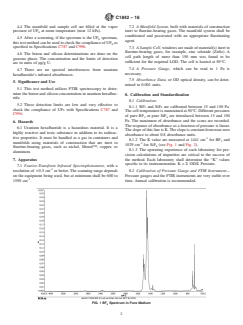
8.1.2 The K value are measured at 1441 cm for BF and
manifolds using materials of construction that are inert to
-1
1029 cm for SiF (see Fig. 1 and Fig. 2).
fluorine-bearing gases, such as nickel, Monel™, copper, or
8.1.3 The operating experience of each laboratory for pre-
aluminum.
cision calculations of impurities are critical to the success of
the method. Each laboratory shall determine the “K” values
7. Apparatus
specific to its instrumentation: K = Σ OD/Σ Pressure.
7.1 Fourier-Transform Infrared Spectrophotometer, with a
-1
resolution of 60.5 cm or better. The scanning range depends 8.2 Calibration of Pressure Gauge and FTIR Instrument—
on the equipment being used, but at minimum shall be 600 to Pressure gauges and the FTIR instruments are very stable over
-1
time. Annual calibration is recommended.
1550 cm .
FIG. 1BF Spectrum in Pure Medium
C1842−16
FIG. 2SiF Spectrum in Pure Medium
8.3 Calibration Checks—The calibration of the gauge 9.1.4 Evacuate manifold system until readout on gauge
should be checked before analyzing a UF standard. After the displays a value of less than 10 Pa.
check of the gauge calibration, 10 kPa of UF standard are
9.1.5 Verify the digital manometer for zero and full scale
-1
introduced and the maximum of absorbance at 625 cm is
readings.
recorded. These calibration checks should be performed each
9.1.6 Obtain an infrared background spectrum on the FTIR
day that the instrument is used. If the difference on the OD is
to check that the manifold is clean.
above 1%, the pressure gauge should be recalibrated. If the
9.1.7 Connect the sample 1S bottle on the manifold and
-1
wavelengthdifferenceisgreatherthan0.5cm ,thentheFTIR
control the tightness.
instrument should be recalibrated
9.1.8 Open the bottle valve on the manifold. Wait until the
pressure is stabilized and close the valve. Record the sample
9. Procedure
pressure (P).
9.1 Acquire a Sample Scan:
9.1.9 Obtaintheinfraredspectrum.Thespectrumwillbethe
9.1.1 Weigh the empty bottle (M1).
result of ten scans.
9.1.2 Withdraw a sample in a 1S bottle with the process
9.2 Interpret Spectrum:
defined in Practices C1052 or C1703.
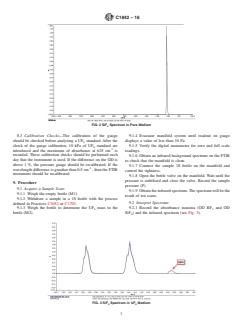
9.1.3 Weigh the bottle to determine the UF mass in the 9.2.1 Record the absorbance maxima (OD BF and OD
6 3
bottle (M2). SiF ) and the infrared spectrum (see Fig. 3).
FIG. 3SiF Spectrum in UF Medium
4 6
C1842−16
9.3 Representativity of the Sample: 10.2.1 CalculatethepartialpressureofBF (PBF )andSiF
3 3 4
9.3.1 The representativity of the sample is validated by the (PSiF ).
following process. Control the concentration of UF in the gas
PBF 5ODBF ⁄KBF ;PSiF 5ODSiF ⁄KSiF
3 3 3 4 4 4
phase. If the UF concentration is above 80%, the sample is
10.2.2 Calculate the mass of UF (MUF6) by the difference
validated and the boron and silicon concentration could be
of bottle mass empty (M1) and after the sampling (M2).
determined. If the UF concentration is under 80%, a resam-
pling is necessary.
MUF6 5M2 2M1
9.3.2 To determine the concentration of UF in the gas
10.2.3 Multiply the mass of UF by 0.6761 to calculate the
phase,performaUF calibrationintroducingapressureofpure
mass of uranium (MU).
UF (PUF ) and record the UF absorbance (ODUF)to
6 6 6 6
MU 5MUF 30.6761
calculate KUF (KUF = ODUF / PUF ). Record the UF
6 6 6 6 6
absorbance on the infrared spectrum of the sample and
10.2.4 Divide the mass of UF by the volumetric mass of
calculate the UF pressure with the K value. To calculate the
UF to obtain the volume of UF (VUF ).
6 6 6
concentration of UF in the gas phase, divide the UF pressure
6 6
VUF 5MUF 35.09
6 6
by the sample pressure (%UF = PUF / Psample).
6 6
10.2.5 Subtract the UF volume from the volume bottle
9.4 Evacuation of the Manifold System: 6
(VB) to calculate the free volume (VFB).
9.4.1 Open the cold trap.
9.4.2 Continue the total evacuation until the pressure gauge
VFB 5VB 2VUF6
reads below 10 Pa.
10.2.6 Add the free volume of the bottle, the manifold
NOTE 1—The manifold system must be passiva
...