

ASTM C187-23
(Test Method)Standard Test Method for Amount of Water Required for Normal Consistency of Hydraulic Cement Paste
General Information
- Abstract
SIGNIFICANCE AND USE
4.1 This test method is intended to be used to determine the amount of water required to prepare hydraulic cement pastes with normal consistency, as required for certain standard tests.
SCOPE
1.1 This test method covers the determination of the normal consistency of hydraulic cement.
1.2 Units—The values stated in SI units are to be regarded as standard. No other units of measurement are included in this standard.
1.3 This standard does not purport to address all of the safety concerns, if any, associated with its use. It is the responsibility of the user of this standard to establish appropriate safety, health, and environmental practices and determine the applicability of regulatory limitations prior to use. See 1.4 for a specific warning statement.
1.4 Warning—Fresh hydraulic cementitious mixtures are caustic and may cause chemical burns to skin and tissue upon prolonged exposure.2
1.5 This international standard was developed in accordance with internationally recognized principles on standardization established in the Decision on Principles for the Development of International Standards, Guides and Recommendations issued by the World Trade Organization Technical Barriers to Trade (TBT) Committee.
- Status
- Published
- Publication Date
- 14-Jun-2023
- Technical Committee
- C01 - Cement
- Drafting Committee
- C01.22 - Workability
Buy Documents


ASTM C187-23 - Standard Test Method for Amount of Water Required for Normal Consistency of Hydraulic Cement Paste

REDLINE ASTM C187-23 - Standard Test Method for Amount of Water Required for Normal Consistency of Hydraulic Cement Paste
Overview
ASTM C187-23: Standard Test Method for Amount of Water Required for Normal Consistency of Hydraulic Cement Paste provides a standardized procedure for determining the quantity of water necessary to achieve normal consistency in hydraulic cement paste. This test is essential for ensuring consistency in cement testing and forms a foundational step in many cement quality assurance and performance protocols. By standardizing how water content is evaluated, ASTM C187-23 helps ensure that subsequent physical tests on cement paste, such as setting time or strength tests, are based on material with comparable consistency, thus improving the reliability of test results across laboratories and projects.
Key Topics
- Normal Consistency Definition: Normal consistency is a critical property of hydraulic cement paste, impacting its workability and suitability for various applications. This standard references established terminology to define normal consistency.
- Testing Procedure: The method outlines detailed steps for mixing hydraulic cement paste and evaluating its consistency using the Vicat apparatus. These steps include mixing, molding, and testing within a controlled environment to guarantee repeatable outcomes.
- Apparatus and Materials:
- Vicat apparatus and ring, flat trowel, and graduated glass measuring equipment are specified for accurate assessment.
- Reference is made to supporting ASTM standards for apparatus compliance and testing conditions.
- Calculation and Reporting: Final water content is reported as a percentage of cement mass, rounding as specified for consistency.
- Precision and Bias: The method offers guidelines for replicability within a single laboratory and across multiple laboratories, supporting quality control.
Applications
ASTM C187-23 is widely used in:
- Cement Manufacturing and Quality Control: Manufacturers and testing laboratories rely on C187 to prepare cement pastes of known consistency prior to further testing, such as compressive strength or setting time, as required by cement specification standards.
- Research and Development: Researchers use this method to standardize the base conditions for studying admixtures, new cement formulations, or assessing performance characteristics of hydraulic cements.
- Construction Materials Testing: Testing agencies and quality control professionals employ ASTM C187-23 as part of their routine cement evaluation protocols, ensuring that mixtures are workable and predictable for further use in mortars, grouts, or concretes.
- Specification Compliance: The test method supports compliance verification with other cement-related standards and project specifications, especially where normal consistency is a baseline test criterion.
Related Standards
- ASTM C219 - Terminology Relating to Hydraulic and Other Inorganic Cements
- ASTM C305 - Practice for Mechanical Mixing of Hydraulic Cement Pastes and Mortars of Plastic Consistency
- ASTM C511 - Specification for Mixing Rooms, Moist Cabinets, Moist Rooms, and Water Storage Tanks Used in the Testing of Hydraulic Cements and Concretes
- ASTM C1005 - Specification for Reference Masses and Devices for Determining Mass and Volume for Use in Physical Testing of Hydraulic Cements
- ASTM D1193 - Specification for Reagent Water
Using ASTM C187-23 helps ensure reliable, repeatable, and scientifically valid results in hydraulic cement testing, making it foundational for quality assurance in the cement and construction industries. By establishing a uniform standard for normal consistency determination, this method underpins many downstream tests critical to cement performance assessment and product certification.
Keywords: ASTM C187-23, normal consistency, cement paste, hydraulic cement, Vicat apparatus, water requirement, cement testing, construction materials.
Relations
- Effective Date
- 01-Apr-2024
- Effective Date
- 01-Aug-2020
- Effective Date
- 15-Jul-2020
- Effective Date
- 01-Apr-2020
- Effective Date
- 15-Nov-2019
- Effective Date
- 01-Jun-2019
- Effective Date
- 01-May-2018
- Effective Date
- 15-Mar-2017
- Effective Date
- 01-Jul-2014
- Effective Date
- 01-May-2014
- Effective Date
- 01-Dec-2013
- Effective Date
- 01-Aug-2013
- Effective Date
- 15-Jun-2013
- Effective Date
- 01-Jun-2013
- Effective Date
- 01-May-2013
Buy Documents
ASTM C187-23 - Standard Test Method for Amount of Water Required for Normal Consistency of Hydraulic Cement Paste
REDLINE ASTM C187-23 - Standard Test Method for Amount of Water Required for Normal Consistency of Hydraulic Cement Paste
Get Certified
Connect with accredited certification bodies for this standard

DIBt (Deutsches Institut für Bautechnik)
German Institute for Building Technology.
DIN CERTCO
DIN Group product certification.

Aboma Certification B.V.
Specialized in construction, metal, and transport sectors.
Sponsored listings
Frequently Asked Questions
ASTM C187-23 is a standard published by ASTM International. Its full title is "Standard Test Method for Amount of Water Required for Normal Consistency of Hydraulic Cement Paste". This standard covers: SIGNIFICANCE AND USE 4.1 This test method is intended to be used to determine the amount of water required to prepare hydraulic cement pastes with normal consistency, as required for certain standard tests. SCOPE 1.1 This test method covers the determination of the normal consistency of hydraulic cement. 1.2 Units—The values stated in SI units are to be regarded as standard. No other units of measurement are included in this standard. 1.3 This standard does not purport to address all of the safety concerns, if any, associated with its use. It is the responsibility of the user of this standard to establish appropriate safety, health, and environmental practices and determine the applicability of regulatory limitations prior to use. See 1.4 for a specific warning statement. 1.4 Warning—Fresh hydraulic cementitious mixtures are caustic and may cause chemical burns to skin and tissue upon prolonged exposure.2 1.5 This international standard was developed in accordance with internationally recognized principles on standardization established in the Decision on Principles for the Development of International Standards, Guides and Recommendations issued by the World Trade Organization Technical Barriers to Trade (TBT) Committee.
SIGNIFICANCE AND USE 4.1 This test method is intended to be used to determine the amount of water required to prepare hydraulic cement pastes with normal consistency, as required for certain standard tests. SCOPE 1.1 This test method covers the determination of the normal consistency of hydraulic cement. 1.2 Units—The values stated in SI units are to be regarded as standard. No other units of measurement are included in this standard. 1.3 This standard does not purport to address all of the safety concerns, if any, associated with its use. It is the responsibility of the user of this standard to establish appropriate safety, health, and environmental practices and determine the applicability of regulatory limitations prior to use. See 1.4 for a specific warning statement. 1.4 Warning—Fresh hydraulic cementitious mixtures are caustic and may cause chemical burns to skin and tissue upon prolonged exposure.2 1.5 This international standard was developed in accordance with internationally recognized principles on standardization established in the Decision on Principles for the Development of International Standards, Guides and Recommendations issued by the World Trade Organization Technical Barriers to Trade (TBT) Committee.
ASTM C187-23 is classified under the following ICS (International Classification for Standards) categories: 91.100.10 - Cement. Gypsum. Lime. Mortar. The ICS classification helps identify the subject area and facilitates finding related standards.
ASTM C187-23 has the following relationships with other standards: It is inter standard links to ASTM C219-24, ASTM C219-20a, ASTM C305-20, ASTM C219-20, ASTM C219-19a, ASTM C219-19, ASTM C1005-18, ASTM C1005-17, ASTM C219-14, ASTM E177-14, ASTM C511-13, ASTM C219-13a, ASTM C219-13, ASTM C305-13, ASTM E177-13. Understanding these relationships helps ensure you are using the most current and applicable version of the standard.
ASTM C187-23 is available in PDF format for immediate download after purchase. The document can be added to your cart and obtained through the secure checkout process. Digital delivery ensures instant access to the complete standard document.
Standards Content (Sample)
This international standard was developed in accordance with internationally recognized principles on standardization established in the Decision on Principles for the
Development of International Standards, Guides and Recommendations issued by the World Trade Organization Technical Barriers to Trade (TBT) Committee.
Designation: C187 − 23 American Association State
Highway and Transportation Officials Standard
AASHTO No.: T 129
Standard Test Method for
Amount of Water Required for Normal Consistency of
Hydraulic Cement Paste
This standard is issued under the fixed designation C187; the number immediately following the designation indicates the year of
original adoption or, in the case of revision, the year of last revision. A number in parentheses indicates the year of last reapproval. A
superscript epsilon (´) indicates an editorial change since the last revision or reapproval.
1. Scope* Testing of Hydraulic Cements and Concretes
C1005 Specification for Reference Masses and Devices for
1.1 This test method covers the determination of the normal
Determining Mass and Volume for Use in Physical Testing
consistency of hydraulic cement.
of Hydraulic Cements
1.2 Units—The values stated in SI units are to be regarded
D1193 Specification for Reagent Water
as standard. No other units of measurement are included in this
E177 Practice for Use of the Terms Precision and Bias in
standard.
ASTM Test Methods
1.3 This standard does not purport to address all of the
safety concerns, if any, associated with its use. It is the
3. Terminology
responsibility of the user of this standard to establish appro-
3.1 Normal consistency is defined in Terminology standard
priate safety, health, and environmental practices and deter-
C219.
mine the applicability of regulatory limitations prior to use.
See 1.4 for a specific warning statement.
4. Significance and Use
1.4 Warning—Fresh hydraulic cementitious mixtures are
caustic and may cause chemical burns to skin and tissue upon
4.1 This test method is intended to be used to determine the
prolonged exposure.
amount of water required to prepare hydraulic cement pastes
with normal consistency, as required for certain standard tests.
1.5 This international standard was developed in accor-
dance with internationally recognized principles on standard-
5. Apparatus
ization established in the Decision on Principles for the
Development of International Standards, Guides and Recom-
5.1 Reference Masses and Devices for Determining Mass,
mendations issued by the World Trade Organization Technical
conforming to the requirements of Specification C1005. The
Barriers to Trade (TBT) Committee.
devices for determining mass shall be evaluated for precision
and bias at a total load of 1000 g.
2. Referenced Documents
5.2 Glass Graduates, 200 mL or 250 mL capacity, and
2.1 ASTM Standards:
conforming to the requirements of Specification C1005.
C219 Terminology Relating to Hydraulic and Other Inor-
ganic Cements
5.3 Vicat Apparatus—The Vicat apparatus shall consist of a
C305 Practice for Mechanical Mixing of Hydraulic Cement
frame A (Fig. 1) bearing a movable rod B, weighing 300 g, one
Pastes and Mortars of Plastic Consistency
end C, the plunger end, being 10 mm in diameter for a distance
C511 Specification for Mixing Rooms, Moist Cabinets,
of at least 50 mm, and the other end having a removable needle
Moist Rooms, and Water Storage Tanks Used in the
D, 1 mm in diameter and 50 mm in length. The rod B is
reversible, and can be held in any desired position by a set
1 screw E, and has an adjustable indicator F, which moves over
This test method is under the jurisdiction of ASTM Committee C01 on Cement
and is the direct responsibility of Subcommittee C01.22 on Workability.
a scale (graduated in millimetres) attached to the frame A. The
Current edition approved June 15, 2023. Published July 2023. Originally
paste is held in a rigid conical ring G, resting on a plane
approved in 1944. Last previous edition approved in 2016 as C187 – 16. DOI:
nonabsorptive square base plate H, about 100 mm on each side.
10.1520/C0187-23.
The rod B shall be made of stainless steel having a hardness of
See the section on Safety, Manual of Cement Testing, Annual Book of ASTM
Standards, Vol 04.01.
not less than 35 HRC, and shall be straight with the plunger
For referenced ASTM standards, visit the ASTM website, www.astm.org, or
end which is perpendicular to the rod axis. The ring shall be
contact ASTM Customer Service at service@astm.org. For Annual Book of ASTM
made of a noncorroding, nonabsorbent material, and shall have
Standards volume information, refer to the standard’s Document Summary page on
the ASTM website. an inside diameter of 70 mm at the base and 60 mm at the top,
*A Summary of Changes section appears at the end of this standard
Copyright © ASTM International, 100 Barr Harbor Drive, PO Box C700, West Conshohocken, PA 19428-2959. United States
C187 − 23
7.2 Molding Test Specimen—Quickly form the cement
paste, prepared as described in 7.1, into the approximate shape
of a ball with gloved hands. Then toss six times through a free
path of about 150 mm from one hand to another so as to
produce a nearly spherical mass that may be easily inserted into
the Vicat ring with a minimum amount of additional manipu-
lation. Press the ball, resting in the palm of one hand, into the
larger end of the conical ring G, Fig. 1, h
...
This document is not an ASTM standard and is intended only to provide the user of an ASTM standard an indication of what changes have been made to the previous version. Because
it may not be technically possible to adequately depict all changes accurately, ASTM recommends that users consult prior editions as appropriate. In all cases only the current version
of the standard as published by ASTM is to be considered the official document.
Designation: C187 − 16 C187 − 23 American Association State
Highway and Transportation Officials Standard
AASHTO No.: T 129
Standard Test Method for
Amount of Water Required for Normal Consistency of
Hydraulic Cement Paste
This standard is issued under the fixed designation C187; the number immediately following the designation indicates the year of
original adoption or, in the case of revision, the year of last revision. A number in parentheses indicates the year of last reapproval. A
superscript epsilon (´) indicates an editorial change since the last revision or reapproval.
1. Scope*
1.1 This test method covers the determination of the normal consistency of hydraulic cement.
1.2 Units—The values stated in SI units are to be regarded as standard. No other units of measurement are included in this
standard.
1.3 This standard does not purport to address all of the safety concerns, if any, associated with its use. It is the responsibility of
the user of this standard to establish appropriate safety and healthsafety, health, and environmental practices and determine the
applicability of regulatory limitations prior to use. See 1.4 for a specific warning statement.
1.4 Warning—Fresh hydraulic cementitious mixtures are caustic and may cause chemical burns to skin and tissue upon prolonged
exposure. The use of gloves, protective clothing, and eye protection is recommended. Wash contact area with copious amounts of
water after contact. Wash eyes for a minimum of 15 min. Avoid exposure of the body to clothing saturated with the liquid phase
of the unhardened material. Remove contaminated clothing immediately after exposure.
1.5 This international standard was developed in accordance with internationally recognized principles on standardization
established in the Decision on Principles for the Development of International Standards, Guides and Recommendations issued
by the World Trade Organization Technical Barriers to Trade (TBT) Committee.
2. Referenced Documents
2.1 ASTM Standards:
C219 Terminology Relating to Hydraulic and Other Inorganic Cements
C305 Practice for Mechanical Mixing of Hydraulic Cement Pastes and Mortars of Plastic Consistency
C511 Specification for Mixing Rooms, Moist Cabinets, Moist Rooms, and Water Storage Tanks Used in the Testing of Hydraulic
Cements and Concretes
C1005 Specification for Reference Masses and Devices for Determining Mass and Volume for Use in Physical Testing of
Hydraulic Cements
D1193 Specification for Reagent Water
E177 Practice for Use of the Terms Precision and Bias in ASTM Test Methods
This test method is under the jurisdiction of ASTM Committee C01 on Cement and is the direct responsibility of Subcommittee C01.22 on Workability.
Current edition approved Dec. 1, 2016June 15, 2023. Published December 2016July 2023. Originally approved in 1944. Last previous edition approved in 20112016 as
ε1
C187 – 11C187 – 16. . DOI: 10.1520/C0187-16.10.1520/C0187-23.
Section See the section on Safety, Manual of Cement Testing, Annual Book of ASTM Standards, Vol 04.01.
For referenced ASTM standards, visit the ASTM website, www.astm.org, or contact ASTM Customer Service at service@astm.org. For Annual Book of ASTM Standards
volume information, refer to the standard’s Document Summary page on the ASTM website.
*A Summary of Changes section appears at the end of this standard
Copyright © ASTM International, 100 Barr Harbor Drive, PO Box C700, West Conshohocken, PA 19428-2959. United States
C187 − 23
3. Terminology
3.1 Normal consistency is defined in Terminology standard C219.
4. Significance and Use
4.1 This test method is intended to be used to determine the amount of water required to prepare hydraulic cement pastes with
normal consistency, as required for certain standard tests.
5. Apparatus
5.1 Reference Masses and Devices for Determining Mass, conforming to the requirements of Specification C1005. The devices
for determining mass shall be evaluated for precision and bias at a total load of 1000 g.
5.2 Glass Graduates, 200 or 250-mL200 mL or 250 mL capacity, and conforming to the requirements of Specification C1005.
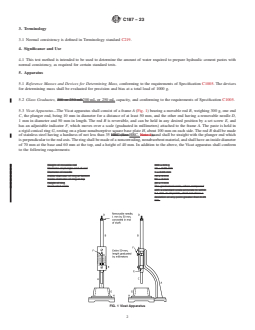
5.3 Vicat Apparatus—The Vicat apparatus shall consist of a frame A (Fig. 1) bearing a movable rod B, weighing 300 g, one end
C, the plunger end, being 10 mm in diameter for a distance of at least 50 mm, and the other end having a removable needle D,
1 mm in diameter and 50 mm in length. The rod B is reversible, and can be held in any desired position by a set screw E, and
has an adjustable indicator F, which moves over a scale (graduated in millimetres) attached to the frame A. The paste is held in
a rigid conical ring G, resting on a plane nonabsorptive square base plate H, about 100 mm on each side. The rod B shall be made
of stainless steel having a hardness of not less than 35 HRC (See HRC, Note 1), and shall be straight with the plunger end which
is perpendicular to the rod axis. The ring shall be made of a noncorroding, nonabsorbent material, and shall have an inside diameter
of 70 mm at the base and 60 mm at the top, and a height of 40 mm. In addition to the above, the Vicat apparatus shall conform
to the following requirements:
Weight of movable rod 300 ± 0.5 g
Diameter of plunger end of rod 10 ± 0.05 mm
Diameter of needle 1 ± 0.05 mm
Inside diameter of ring at bottom 70 ± 3 mm
Inside diameter of ring at top 60 ± 3 mm
Height of ring 40 ± 1 mm
Graduated scale The graduated scale, when compared
with a standard scale accurate to within
0.1 mm at all points, shall not show a
deviation at any point greater than 0.25
mm.
FIG. 1 Vicat Apparatus
------------
...