

ASTM B417-22
(Test Method)Standard Test Method for Apparent Density of Non-Free-Flowing Metal Powders Using the Carney Funnel
General Information
- Abstract
SIGNIFICANCE AND USE
5.1 This test method provides a guide for evaluation of an important physical characteristic of a powder known as the apparent density. The measured apparent density bears a relationship to the mass of powder that will fill a fixed volume die cavity. The degree of correlation between the results of this test and the performance of powders during use may vary with each particular application. Note, however, that the presence of moisture, oils, stearic acid, stearates, waxes, and the temperature of the powder mass may alter the physical characteristics of the powder.
SCOPE
1.1 This test method covers a procedure for determining the apparent density of non-free-flowing metal powders. It is designed for those metal powders that do not freely flow through the Hall flowmeter funnel.
1.2 Units—With the exception of the values for density and the mass used to determine density, for which the use of the gram per cubic centimeter (g/cm3) and gram (g) units is the long-standing industry practice, the values in inch-pound units are to be regarded as standard. The values given in parentheses are mathematical conversions to SI units that are provided for information only and are not considered standard.
1.3 This standard does not purport to address all of the safety concerns, if any, associated with its use. It is the responsibility of the user of this standard to establish appropriate safety, health, and environmental practices and determine the applicability of regulatory limitations prior to use.
1.4 This international standard was developed in accordance with internationally recognized principles on standardization established in the Decision on Principles for the Development of International Standards, Guides and Recommendations issued by the World Trade Organization Technical Barriers to Trade (TBT) Committee.
- Status
- Published
- Publication Date
- 31-Aug-2022
- Technical Committee
- B09 - Metal Powders and Metal Powder Products
- Drafting Committee
- B09.02 - Base Metal Powders
Buy Documents


ASTM B417-22 - Standard Test Method for Apparent Density of Non-Free-Flowing Metal Powders Using the Carney Funnel
REDLINE ASTM B417-22 - Standard Test Method for Apparent Density of Non-Free-Flowing Metal Powders Using the Carney Funnel
Overview
ASTM B417-22 is the internationally recognized standard test method for determining the apparent density of non-free-flowing metal powders using the Carney funnel. Developed by ASTM International, this method is specifically designed for metal powders that do not freely flow through conventional Hall flowmeter funnels, ensuring a reliable evaluation of a critical physical property - apparent density. Knowing the apparent density of metal powders is essential for compaction, blending, handling, and end-use applications in powder metallurgy and related industries.
Key Topics
- Apparent Density Measurement: The standard outlines a procedure to measure the mass of powder that fills a fixed-volume die cavity, providing the apparent density value. This is crucial for understanding powder behavior in manufacturing processes.
- Applicability: ASTM B417-22 is intended for non-free-flowing metal powders, expanding the ability to classify powder properties beyond those suitable for Hall flowmeter methods.
- Controlled Conditions: The test uses a Carney flowmeter funnel and a precisely measured density cup, ensuring consistency and repeatability in apparent density results.
- Influencing Factors: The method recognizes that moisture, oils, stearates, waxes, and powder temperature may influence results, highlighting the importance of sample condition control.
- Precision and Reporting: Provides guidelines for precision (repeatability and reproducibility) and requirements for reporting results, enhancing reliability and comparability across laboratories.
Applications
The apparent density test method described in ASTM B417-22 has broad relevance across multiple industries, especially those utilizing powder metallurgy:
- Powder Metallurgy: Accurate apparent density measurements are critical in optimizing powder blending, die filling, and compaction processes for fabricating parts.
- Quality Control: Routine testing ensures consistency of incoming powder lots, supporting both supplier quality agreements and internal manufacturing standards.
- Material Development and Specification: Researchers and engineers use apparent density data to select and design new powder compositions for additive manufacturing, sintering, and other advanced processes.
- Purchasing Standards: Powder suppliers and buyers reference ASTM B417-22 to communicate material requirements and verify material properties prior to transaction or processing.
- Process Optimization: Apparent density data informs adjustments in equipment and process parameters, improving efficiency and product quality in various powder-handling operations.
Related Standards
ASTM B417-22 relates closely to a number of other ASTM standards and terminology commonly used in powder metallurgy and material testing:
- ASTM B215: Practices for Sampling Metal Powders - Covers methods for obtaining representative samples for testing.
- ASTM B243: Terminology of Powder Metallurgy - Provides definitions and terms relevant to powders and their processing.
- ASTM B873: Test Method for Measuring Volume of Apparent Density Cups - Details the procedures for verifying the volumetric accuracy of cups used in density determination (including those used with Carney funnels).
- ASTM E456 and ASTM E691: Standards for quality and statistical methods, relevant for interlaboratory studies and ensuring test method precision.
Practical Value
The use of ASTM B417-22 delivers practical value by:
- Enabling reliable and reproducible assessment of non-free-flowing metal powders.
- Supporting quality assurance and material traceability in demanding industries.
- Facilitating communication and specification alignment between powder producers and end users.
- Assisting in process control decisions that affect product density, strength, and performance.
For scientists, engineers, and quality professionals, referencing this standard ensures industry best practices for measuring the apparent density of challenging powder materials, making it an indispensable resource in the powder metallurgy supply chain.
Relations
- Effective Date
- 01-Apr-2022
- Effective Date
- 01-Oct-2018
- Effective Date
- 01-Oct-2017
- Effective Date
- 01-Oct-2017
- Effective Date
- 01-Jul-2016
- Effective Date
- 15-Nov-2013
- Effective Date
- 15-Nov-2013
- Effective Date
- 15-Nov-2013
- Effective Date
- 15-Nov-2013
- Effective Date
- 01-Nov-2013
- Effective Date
- 15-Aug-2013
- Effective Date
- 01-May-2013
- Effective Date
- 01-Nov-2012
- Effective Date
- 15-Jul-2012
- Effective Date
- 01-May-2012
Buy Documents
ASTM B417-22 - Standard Test Method for Apparent Density of Non-Free-Flowing Metal Powders Using the Carney Funnel
REDLINE ASTM B417-22 - Standard Test Method for Apparent Density of Non-Free-Flowing Metal Powders Using the Carney Funnel
Get Certified
Connect with accredited certification bodies for this standard

Element Materials Technology
Materials testing and product certification.

Inštitut za kovinske materiale in tehnologije
Institute of Metals and Technology. Materials testing, metallurgical analysis, NDT.
Sponsored listings
Frequently Asked Questions
ASTM B417-22 is a standard published by ASTM International. Its full title is "Standard Test Method for Apparent Density of Non-Free-Flowing Metal Powders Using the Carney Funnel". This standard covers: SIGNIFICANCE AND USE 5.1 This test method provides a guide for evaluation of an important physical characteristic of a powder known as the apparent density. The measured apparent density bears a relationship to the mass of powder that will fill a fixed volume die cavity. The degree of correlation between the results of this test and the performance of powders during use may vary with each particular application. Note, however, that the presence of moisture, oils, stearic acid, stearates, waxes, and the temperature of the powder mass may alter the physical characteristics of the powder. SCOPE 1.1 This test method covers a procedure for determining the apparent density of non-free-flowing metal powders. It is designed for those metal powders that do not freely flow through the Hall flowmeter funnel. 1.2 Units—With the exception of the values for density and the mass used to determine density, for which the use of the gram per cubic centimeter (g/cm3) and gram (g) units is the long-standing industry practice, the values in inch-pound units are to be regarded as standard. The values given in parentheses are mathematical conversions to SI units that are provided for information only and are not considered standard. 1.3 This standard does not purport to address all of the safety concerns, if any, associated with its use. It is the responsibility of the user of this standard to establish appropriate safety, health, and environmental practices and determine the applicability of regulatory limitations prior to use. 1.4 This international standard was developed in accordance with internationally recognized principles on standardization established in the Decision on Principles for the Development of International Standards, Guides and Recommendations issued by the World Trade Organization Technical Barriers to Trade (TBT) Committee.
SIGNIFICANCE AND USE 5.1 This test method provides a guide for evaluation of an important physical characteristic of a powder known as the apparent density. The measured apparent density bears a relationship to the mass of powder that will fill a fixed volume die cavity. The degree of correlation between the results of this test and the performance of powders during use may vary with each particular application. Note, however, that the presence of moisture, oils, stearic acid, stearates, waxes, and the temperature of the powder mass may alter the physical characteristics of the powder. SCOPE 1.1 This test method covers a procedure for determining the apparent density of non-free-flowing metal powders. It is designed for those metal powders that do not freely flow through the Hall flowmeter funnel. 1.2 Units—With the exception of the values for density and the mass used to determine density, for which the use of the gram per cubic centimeter (g/cm3) and gram (g) units is the long-standing industry practice, the values in inch-pound units are to be regarded as standard. The values given in parentheses are mathematical conversions to SI units that are provided for information only and are not considered standard. 1.3 This standard does not purport to address all of the safety concerns, if any, associated with its use. It is the responsibility of the user of this standard to establish appropriate safety, health, and environmental practices and determine the applicability of regulatory limitations prior to use. 1.4 This international standard was developed in accordance with internationally recognized principles on standardization established in the Decision on Principles for the Development of International Standards, Guides and Recommendations issued by the World Trade Organization Technical Barriers to Trade (TBT) Committee.
ASTM B417-22 is classified under the following ICS (International Classification for Standards) categories: 77.160 - Powder metallurgy. The ICS classification helps identify the subject area and facilitates finding related standards.
ASTM B417-22 has the following relationships with other standards: It is inter standard links to ASTM E456-13a(2022)e1, ASTM B243-18, ASTM E456-13A(2017)e1, ASTM E456-13A(2017)e3, ASTM B243-16, ASTM E456-13ae1, ASTM E456-13ae2, ASTM E456-13ae3, ASTM E456-13a, ASTM B243-13, ASTM E456-13, ASTM E691-13, ASTM B873-12, ASTM B243-12, ASTM E456-12. Understanding these relationships helps ensure you are using the most current and applicable version of the standard.
ASTM B417-22 is available in PDF format for immediate download after purchase. The document can be added to your cart and obtained through the secure checkout process. Digital delivery ensures instant access to the complete standard document.
Standards Content (Sample)
This international standard was developed in accordance with internationally recognized principles on standardization established in the Decision on Principles for the
Development of International Standards, Guides and Recommendations issued by the World Trade Organization Technical Barriers to Trade (TBT) Committee.
Designation: B417 − 22
Standard Test Method for
Apparent Density of Non-Free-Flowing Metal Powders Using
the Carney Funnel
This standard is issued under the fixed designation B417; the number immediately following the designation indicates the year of
original adoption or, in the case of revision, the year of last revision. A number in parentheses indicates the year of last reapproval. A
superscript epsilon (´) indicates an editorial change since the last revision or reapproval.
1. Scope* Determine the Precision of a Test Method
1.1 This test method covers a procedure for determining the
3. Terminology
apparent density of non-free-flowing metal powders. It is
3.1 Definitions—Terms in Terminology B243 are applicable
designed for those metal powders that do not freely flow
to this test method.
through the Hall flowmeter funnel.
1.2 Units—With the exception of the values for density and
4. Summary of Test Method
the mass used to determine density, for which the use of the
4.1 Avolumeofpowderispermittedtoflowintoacontainer
gram per cubic centimeter (g/cm ) and gram (g) units is the
of definite volume under controlled conditions. The mass of
long-standing industry practice, the values in inch-pound units
powderperunitvolumeisdeterminedandreportedasapparent
are to be regarded as standard.The values given in parentheses
density, Carney (AD ).
C
are mathematical conversions to SI units that are provided for
information only and are not considered standard.
5. Significance and Use
1.3 This standard does not purport to address all of the
5.1 This test method provides a guide for evaluation of an
safety concerns, if any, associated with its use. It is the
important physical characteristic of a powder known as the
responsibility of the user of this standard to establish appro-
apparent density. The measured apparent density bears a
priate safety, health, and environmental practices and deter-
relationship to the mass of powder that will fill a fixed volume
mine the applicability of regulatory limitations prior to use.
die cavity.The degree of correlation between the results of this
1.4 This international standard was developed in accor-
test and the performance of powders during use may vary with
dance with internationally recognized principles on standard-
each particular application. Note, however, that the presence of
ization established in the Decision on Principles for the
moisture, oils, stearic acid, stearates, waxes, and the tempera-
Development of International Standards, Guides and Recom-
ture of the powder mass may alter the physical characteristics
mendations issued by the World Trade Organization Technical
of the powder.
Barriers to Trade (TBT) Committee.
6. Apparatus
2. Referenced Documents
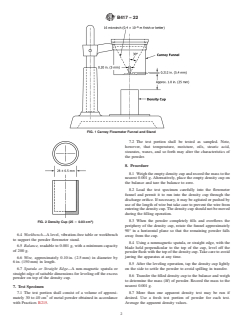
6.1 Powder Flowmeter —A Carney Flowmeter (Fig. 1).
2.1 ASTM Standards:
6.2 Density Cup —Acylindrical brass cup (Fig. 2) having a
B215 Practices for Sampling Metal Powders
capacity of 25 cm .The actual cup volume shall be determined
B243 Terminology of Powder Metallurgy
according toTest Method B873. If the measured volume of the
B873 Test Method for Measuring Volume ofApparent Den-
cup is outside the tolerance in Fig. 2 (25 6 0.03 cm ), the cup
sity Cup Used in Test Methods B212, B329, and B417
shall not be used.
E456 Terminology Relating to Quality and Statistics
E691 Practice for Conducting an Interlaboratory Study to 6.3 Stand—A stand (Fig. 1) to support the powder funnel
concentric with the density cup so that the bottom of the
powder funnel is approximately 1 in. (25 mm) above the top of
This test method is under the jurisdiction of ASTM Committee B09 on Metal
the density cup when the apparatus is assembled as shown in
Powders and Metal Powder Products and is the direct responsibility of Subcom-
Fig. 1.
mittee B09.02 on Base Metal Powders.
Current edition approved Sept. 1, 2022. Published September 2022. Originally
approved in 1964. Last previous edition approved in 2018 as B417 – 18. DOI:
10.1520/B0417-22. The sole source of supply of the flowmeter funnel, density cup, and stand
For referenced ASTM standards, visit the ASTM website, www.astm.org, or known to the committee at this time is ACu Powder International, LLC. If you are
contact ASTM Customer Service at service@astm.org. For Annual Book of ASTM aware of alternative suppliers, please provide this information to ASTM Interna-
Standards volume information, refer to the standard’s Document Summary page on tional Headquarters.Your comments will receive careful consideration at a meeting
the ASTM website. of the responsible technical committee, which you may attend.
*A Summary of Changes section appears at the end of this standard
Copyright © ASTM International, 100 Barr Harbor Drive, PO Box C700, West Conshohocken, PA 19428-2959. United States
B417 − 22
FIG. 1 Carney Flowmeter Funnel and Stand
7.2 The test portion shall be tested as sampled. Note,
however, that temperature, moisture, oils, stearic acid,
stearates, waxes, and so forth may alter the
...
This document is not an ASTM standard and is intended only to provide the user of an ASTM standard an indication of what changes have been made to the previous version. Because
it may not be technically possible to adequately depict all changes accurately, ASTM recommends that users consult prior editions as appropriate. In all cases only the current version
of the standard as published by ASTM is to be considered the official document.
Designation: B417 − 18 B417 − 22
Standard Test Method for
Apparent Density of Non-Free-Flowing Metal Powders Using
the Carney Funnel
This standard is issued under the fixed designation B417; the number immediately following the designation indicates the year of
original adoption or, in the case of revision, the year of last revision. A number in parentheses indicates the year of last reapproval. A
superscript epsilon (´) indicates an editorial change since the last revision or reapproval.
1. Scope*
1.1 This test method covers a procedure for determining the apparent density of non-free-flowing metal powders. It is designed
for those metal powders that do not freely flow through the Hall flowmeter funnel.
1.2 Units—With the exception of the values for density and the mass used to determine density, for which the use of the gram per
cubic centimeter (g/cm ) and gram (g) units is the long-standing industry practice, the values in inch-pound units are to be regarded
as standard. The values given in parentheses are mathematical conversions to SI units that are provided for information only,only
and are not considered standard.
1.3 This standard does not purport to address all of the safety concerns, if any, associated with its use. It is the responsibility
of the user of this standard to establish appropriate safety, health, and environmental practices and determine the applicability of
regulatory limitations prior to use.
1.4 This international standard was developed in accordance with internationally recognized principles on standardization
established in the Decision on Principles for the Development of International Standards, Guides and Recommendations issued
by the World Trade Organization Technical Barriers to Trade (TBT) Committee.
2. Referenced Documents
2.1 ASTM Standards:
B215 Practices for Sampling Metal Powders
B243 Terminology of Powder Metallurgy
B873 Test Method for Measuring Volume of Apparent Density Cup Used in Test Methods B212, B329, and B417
E456 Terminology Relating to Quality and Statistics
E691 Practice for Conducting an Interlaboratory Study to Determine the Precision of a Test Method
3. Terminology
3.1 Definitions—Terms in Terminology B243 are applicable to this test method.
4. Summary of Test Method
4.1 A volume of powder is permitted to flow into a container of definite volume under controlled conditions. The mass of powder
per unit volume is determined and reported as apparent density, Carney (AD ).
C
This test method is under the jurisdiction of ASTM Committee B09 on Metal Powders and Metal Powder Products and is the direct responsibility of Subcommittee B09.02
on Base Metal Powders.
Current edition approved Oct. 1, 2018Sept. 1, 2022. Published November 2018September 2022. Originally approved in 1964. Last previous edition approved in 20132018
as B417 – 13.B417 – 18. DOI: 10.1520/B0417-18.10.1520/B0417-22.
For referenced ASTM standards, visit the ASTM website, www.astm.org, or contact ASTM Customer Service at service@astm.org. For Annual Book of ASTM Standards
volume information, refer to the standard’s Document Summary page on the ASTM website.
*A Summary of Changes section appears at the end of this standard
Copyright © ASTM International, 100 Barr Harbor Drive, PO Box C700, West Conshohocken, PA 19428-2959. United States
B417 − 22
5. Significance and Use
5.1 This test method provides a guide for evaluation of an important physical characteristic of a powder known as the apparent
density. The measured apparent density bears a relationship to the mass of powder that will fill a fixed volume die cavity. The
degree of correlation between the results of this test and the performance of powders during use may vary with each particular
application. Note, however, that the presence of moisture, oils, stearic acid, stearates, waxes, and the temperature of the powder
mass may alter the physical characteristics of the powder.
6. Apparatus
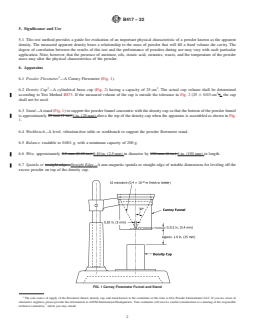
6.1 Powder Flowmeter —A Carney Flowmeter (Fig. 1).
3 3
6.2 Density Cup —A cylindrical brass cup (Fig. 2) having a capacity of 25 cm . The actual cup volume shall be determined
according to Test Method B873. If the measured volume of the cup is outside the tolerance in Fig. 2 (25 6 0.03 cm )), the cup
shall not be used.
6.3 Stand—A stand (Fig. 1) to support the powder funnel concentric with the density cup so that the bottom of the powder funnel
is approximately 25 mm (1 in.) 1 in. (25 mm) above the top of the density cup when the apparatus is assembled as shown in Fig.
1.
6.4 Workbench—A level, vibration-free table or workbench to support the powder flowmeter stand.
6.5 Balance, readable to 0.001 g, with a minimum capacity of 200 g.
6.6 Wire, approximately 2.5 mm (0.10 in.) 0.10 in. (2.5 mm) in diameter by 150 mm (6 in.) 6 in. (150 mm) in length.
6.7 Spatula or straight edge—Straight Edge—A non-magnetic spatula or straight edge of suitable dimensions for leveling off the
excess powder on top of the density cup.
FIG. 1 Carney Flowmeter Funnel and Stand
The sole source of supply of the flowmeter funnel, density cup, and stand known to the committee at this time is ACu Powder International, LLC. If you are aware of
alternative suppliers, please provide this information to ASTM International Headquarters. Your comments will receive careful consideration at a meeting of the responsible
technical committee, which you may attend.
B417 − 22
FIG. 2 Density Cup (25 6 0.03 cm )
7. Test Specimen
7.1 The test portion shall consist of a volume of appro
...