

ASTM F2680-17
(Specification)Standard Test Methods and Specifications for Bicycle Manually Operated Front Wheel Retention Systems
General Information
- Abstract
ABSTRACT
This specification covers the standard for front wheel retention systems for all bicycles equipped with manually operated retention systems such as a quick release. This specification is only for bicycles equipped with manually operated retention systems, and does not apply to tool-operated wheel fastening systems. Primary retention and secondary retention tests shall be performed to conform to the specified requirements.
SCOPE
1.1 These test methods and specifications cover the standard for front wheel retention systems for all bicycles equipped with manually operated retention systems such as a quick release.
1.2 This specification is only for bicycles equipped with manually operated retention systems, and does not apply to tool-operated wheel retention systems.
1.3 The intent of this specification is to define the performance of primary and secondary wheel retention systems, with the focus on preventing unintended wheel separation and prevention of unintended contact of the retention system with the disc brake rotor or wheel.
1.4 The values stated in SI units are to be regarded as standard. No other units of measurement are included in this standard.
1.5 This standard does not purport to address all of the safety concerns, if any, associated with its use. It is the responsibility of the user of this standard to establish appropriate safety, health, and environmental practices and determine the applicability of regulatory limitations prior to use.
1.6 This international standard was developed in accordance with internationally recognized principles on standardization established in the Decision on Principles for the Development of International Standards, Guides and Recommendations issued by the World Trade Organization Technical Barriers to Trade (TBT) Committee.
- Status
- Published
- Publication Date
- 31-Aug-2017
- Technical Committee
- F08 - Sports Equipment, Playing Surfaces, and Facilities
- Drafting Committee
- F08.10 - Bicycles
Buy Documents
ASTM F2680-17 - Standard Test Methods and Specifications for Bicycle Manually Operated Front Wheel Retention Systems
REDLINE ASTM F2680-17 - Standard Test Methods and Specifications for Bicycle Manually Operated Front Wheel Retention Systems
Overview
ASTM F2680-17: Standard Test Methods and Specifications for Bicycle Manually Operated Front Wheel Retention Systems establishes requirements for the safety and performance of manually operated front wheel retention systems, such as quick release mechanisms, used on bicycles. Published by ASTM International, this standard focuses exclusively on designs that do not require tools for operation, ensuring that both primary and secondary retention functions are robust enough to prevent unintended wheel separation and avoid interference with bicycle disc brake systems.
This specification is essential for manufacturers, testers, and regulatory bodies working in bicycle safety and quality assurance, helping to reduce the risk of accidents due to wheel detachment.
Key Topics
Scope and Applicability
- Covers only bicycles with manually operated retention systems (e.g., quick release).
- Does not apply to tool-operated wheel fastening systems.
- Applicable to adult bicycles and excludes those with 20-in. (51-cm) wheels or smaller, except adult models.
Performance Criteria
- Defines testing protocols for both primary and secondary retention mechanisms.
- Focuses on preventing unintended wheel separation during normal use and ensuring that the retention mechanism does not interfere with disc brake rotors or wheel operation.
Test Methods
- Fully describes standardized test setups and forces to be applied to wheel assemblies.
- Includes procedures to verify the locked and unlocked positions of retention systems for both normal and reversed wheel mounting.
- Specifies checks for clearance to ensure the quick release lever does not contact the brake rotor or wheel and does not stop or impede wheel rotation.
Terminology and Definitions
- Provides precise terms for components and mechanisms such as forks, dropouts, quick release assemblies, disc brakes, and both primary and secondary retention systems.
Applications
ASTM F2680-17 is widely referenced in the following contexts:
Bicycle Manufacturing & Design
- Guides component selection and integration of front wheel retention systems in new bicycle models.
- Assists designers to ensure mechanisms conform to recognized safety thresholds.
Product Testing & Certification
- Provides a benchmark for third-party testing laboratories and certification organizations to assess product compliance and safety performance.
- Used during quality assurance checks and regulatory approval processes.
Aftermarket Component Evaluation
- Serves as a basis for evaluating replacement or upgrade front wheel retention systems for compatibility and safety, especially in custom or high-performance bicycles.
International Trade and Industry Compliance
- Facilitates global harmonization by aligning with WTO principles, aiding manufacturers in meeting requirements in export markets.
Related Standards
For comprehensive bicycle safety and performance, refer to these associated ASTM standards:
- ASTM F2043: Standard Classification for Bicycle Usage
- ASTM F2711: Standard Test Methods for Bicycle Frames
- ASTM F2261: Standard Specification for Bicycle Grips
Also, consult ISO standards related to bicycle safety and mechanical performance for additional guidance on wheel and frame integration.
Keywords: ASTM F2680-17, bicycle front wheel retention, quick release, manually operated retention system, bicycle safety standards, primary retention, secondary retention, bicycle fork, disc brake rotor, wheel hub, testing methods.
Relations
- Effective Date
- 01-Sep-2017
- Referred By
ASTM F833-21 - Standard Consumer Safety Performance Specification for Carriages and Strollers - Effective Date
- 01-Sep-2017
Buy Documents
ASTM F2680-17 - Standard Test Methods and Specifications for Bicycle Manually Operated Front Wheel Retention Systems
REDLINE ASTM F2680-17 - Standard Test Methods and Specifications for Bicycle Manually Operated Front Wheel Retention Systems
Get Certified
Connect with accredited certification bodies for this standard

TÜV Rheinland
TÜV Rheinland is a leading international provider of technical services.

TÜV SÜD
TÜV SÜD is a trusted partner of choice for safety, security and sustainability solutions.

DEKRA Certification Inc.
DEKRA US certification services.
Sponsored listings
Frequently Asked Questions
ASTM F2680-17 is a technical specification published by ASTM International. Its full title is "Standard Test Methods and Specifications for Bicycle Manually Operated Front Wheel Retention Systems". This standard covers: ABSTRACT This specification covers the standard for front wheel retention systems for all bicycles equipped with manually operated retention systems such as a quick release. This specification is only for bicycles equipped with manually operated retention systems, and does not apply to tool-operated wheel fastening systems. Primary retention and secondary retention tests shall be performed to conform to the specified requirements. SCOPE 1.1 These test methods and specifications cover the standard for front wheel retention systems for all bicycles equipped with manually operated retention systems such as a quick release. 1.2 This specification is only for bicycles equipped with manually operated retention systems, and does not apply to tool-operated wheel retention systems. 1.3 The intent of this specification is to define the performance of primary and secondary wheel retention systems, with the focus on preventing unintended wheel separation and prevention of unintended contact of the retention system with the disc brake rotor or wheel. 1.4 The values stated in SI units are to be regarded as standard. No other units of measurement are included in this standard. 1.5 This standard does not purport to address all of the safety concerns, if any, associated with its use. It is the responsibility of the user of this standard to establish appropriate safety, health, and environmental practices and determine the applicability of regulatory limitations prior to use. 1.6 This international standard was developed in accordance with internationally recognized principles on standardization established in the Decision on Principles for the Development of International Standards, Guides and Recommendations issued by the World Trade Organization Technical Barriers to Trade (TBT) Committee.
ABSTRACT This specification covers the standard for front wheel retention systems for all bicycles equipped with manually operated retention systems such as a quick release. This specification is only for bicycles equipped with manually operated retention systems, and does not apply to tool-operated wheel fastening systems. Primary retention and secondary retention tests shall be performed to conform to the specified requirements. SCOPE 1.1 These test methods and specifications cover the standard for front wheel retention systems for all bicycles equipped with manually operated retention systems such as a quick release. 1.2 This specification is only for bicycles equipped with manually operated retention systems, and does not apply to tool-operated wheel retention systems. 1.3 The intent of this specification is to define the performance of primary and secondary wheel retention systems, with the focus on preventing unintended wheel separation and prevention of unintended contact of the retention system with the disc brake rotor or wheel. 1.4 The values stated in SI units are to be regarded as standard. No other units of measurement are included in this standard. 1.5 This standard does not purport to address all of the safety concerns, if any, associated with its use. It is the responsibility of the user of this standard to establish appropriate safety, health, and environmental practices and determine the applicability of regulatory limitations prior to use. 1.6 This international standard was developed in accordance with internationally recognized principles on standardization established in the Decision on Principles for the Development of International Standards, Guides and Recommendations issued by the World Trade Organization Technical Barriers to Trade (TBT) Committee.
ASTM F2680-17 is classified under the following ICS (International Classification for Standards) categories: 43.150 - Cycles. The ICS classification helps identify the subject area and facilitates finding related standards.
ASTM F2680-17 has the following relationships with other standards: It is inter standard links to ASTM F2680-09(2014), ASTM F833-21. Understanding these relationships helps ensure you are using the most current and applicable version of the standard.
ASTM F2680-17 is available in PDF format for immediate download after purchase. The document can be added to your cart and obtained through the secure checkout process. Digital delivery ensures instant access to the complete standard document.
Standards Content (Sample)
This international standard was developed in accordance with internationally recognized principles on standardization established in the Decision on Principles for the
Development of International Standards, Guides and Recommendations issued by the World Trade Organization Technical Barriers to Trade (TBT) Committee.
Designation:F2680 −17 An American National Standard
Standard Test Methods and Specifications for
Bicycle Manually Operated Front Wheel Retention Systems
This standard is issued under the fixed designation F2680; the number immediately following the designation indicates the year of
original adoption or, in the case of revision, the year of last revision. A number in parentheses indicates the year of last reapproval. A
superscript epsilon (´) indicates an editorial change since the last revision or reapproval.
1. Scope 2.1.3 direction of removal of the wheel from the fork,
n—direction, when both primary and secondary wheel reten-
1.1 These test methods and specifications cover the standard
tion systems are disengaged, that provides the least resistance
for front wheel retention systems for all bicycles equipped with
to wheel and fork separation or wheel removal.
manually operated retention systems such as a quick release.
2.1.4 disc brake, n—a brake that uses a caliper to squeeze a
1.2 This specification is only for bicycles equipped with
pair of pads against a disc brake rotor in order to create friction
manually operated retention systems, and does not apply to
that slows and stops the rotation of the wheel assembly.
tool-operated wheel retention systems.
2.1.5 disc brake rotor, n—the component of a disc brake
1.3 The intent of this specification is to define the perfor-
against which the brake pads are pressed in order to stop. The
mance of primary and secondary wheel retention systems, with
rotor is attached to the wheel hub.
the focus on preventing unintended wheel separation and
prevention of unintended contact of the retention system with 2.1.6 dropout (fork end), n—fork component used to
the disc brake rotor or wheel.
support, or mount, the front wheel at the axle.
1.4 The values stated in SI units are to be regarded as
2.1.7 manually operated, adj—without the use of tools.
standard. No other units of measurement are included in this
2.1.8 primary retention, n—system that keeps the bicycle
standard.
wheel connected to the bicycle fork for riding.
1.5 This standard does not purport to address all of the
2.1.9 primary retention system in the unlocked position,
safety concerns, if any, associated with its use. It is the
n—position where, (1) if a quick release cam is used, the cam
responsibility of the user of this standard to establish appro-
is opened as far as possible or (2) if a turning style system such
priate safety, health, and environmental practices and deter-
as a wing nut or another non-cam style system is used, the
mine the applicability of regulatory limitations prior to use.
manual lever is loosened 360°.
1.6 This international standard was developed in accor-
2.1.10 quick release assembly, n—lever-actuated cam
dance with internationally recognized principles on standard-
ization established in the Decision on Principles for the mechanism that connects and retains the bicycle front wheel to
the bicycle fork.
Development of International Standards, Guides and Recom-
mendations issued by the World Trade Organization Technical
2.1.10.1 Discussion—The assembly generally consists of a
Barriers to Trade (TBT) Committee. lever (actuating the cam mechanism), adjusting nut and springs
(two, optional).
2. Terminology
2.1.11 secondary retention, n—system that retains the bi-
2.1 Definitions of Terms Specific to This Standard:
cycle wheel in the dropouts when the primary retention system
2.1.1 adult bicycle, n—bicycle designed for, and marketed
is in the open (unlocked) position.
to, adult riders.
2.1.12 wheel hub, n—assembly consisting of an axle con-
2.1.2 bicycle fork (fork), n—structure between the head tube
nected by bearings to a hub shell, to which the spokes attach,
and front hub axle, including some or all of the following
and permitting the shell to revolve around the axle.
components;thesteerertube,crown,forkblades,tripleclamps,
shock absorbers, lower tubes, upper tubes and dropouts (fork
3. Performance Requirements
ends).
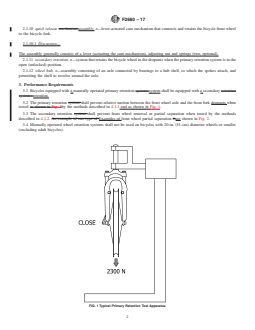
3.1 Bicycles equipped with a manually operated primary
retention system shall be equipped with a secondary retention.
These test methods and specifications are under the jurisdiction of ASTM
Committee F08 on Sports Equipment, Playing Surfaces, and Facilities and are the
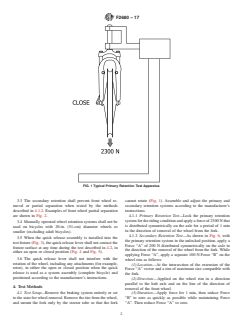
3.2 The primary retention shall prevent relative motion
direct responsibility of Subcommittee F08.10 on Bicycles.
between the front wheel axle and the front fork dropouts when
Current edition approved Sept. 1, 2017. Published October 2017. Originally
tested by the methods described in 4.1.1 and as shown in Fig.
approved in 2009. Last previous edition approved in 2014 as F2680 – 09 (2014).
DOI: 10.1520/F2680-17. 1.
Copyright © ASTM International, 100 Barr Harbor Drive, PO Box C700, West Conshohocken, PA 19428-2959. United States
F2680−17
FIG. 1Typical Primary Retention Test Apparatus
3.3 The secondary retention shall prevent front wheel re- cannot rotate (Fig. 1). Assemble and adjust the primary and
moval or partial separation when tested by the methods secondary retention systems according to the manufacturer’s
described in 4.1.2. Examples of front wheel partial separation instructions.
are shown in Fig. 2.
4.1.1 Primary Retention Test—Lock the primary retention
systemfortheridingconditionandapplyaforceof2300Nthat
3.4 Manually operated wheel retention systems shall not be
is distribute
...
This document is not an ASTM standard and is intended only to provide the user of an ASTM standard an indication of what changes have been made to the previous version. Because
it may not be technically possible to adequately depict all changes accurately, ASTM recommends that users consult prior editions as appropriate. In all cases only the current version
of the standard as published by ASTM is to be considered the official document.
Designation: F2680 − 09 (Reapproved 2014) F2680 − 17 An American National Standard
Standard Specification for Test Methods and Specifications for
Bicycle Manually Operated Front Wheel Retention Systems
for Bicycles
This standard is issued under the fixed designation F2680; the number immediately following the designation indicates the year of
original adoption or, in the case of revision, the year of last revision. A number in parentheses indicates the year of last reapproval. A
superscript epsilon (´) indicates an editorial change since the last revision or reapproval.
1. Scope
1.1 This specification covers These test methods and specifications cover the standard for front wheel retention systems for all
bicycles equipped with manually operated retention systems such as a quick release.
1.2 This specification is only for bicycles equipped with manually operated retention systems, and does not apply to
tool-operated wheel fasteningretention systems.
1.3 The intent of this specification is to define the performance of primary and secondary wheel retention systems, with the
focus on preventing unintended wheel separation.separation and prevention of unintended contact of the retention system with the
disc brake rotor or wheel.
1.4 The values stated in SI units are to be regarded as standard. No other units of measurement are included in this standard.
1.5 This standard does not purport to address all of the safety concerns, if any, associated with its use. It is the responsibility
of the user of this standard to establish appropriate safety safety, health, and healthenvironmental practices and determine the
applicability of regulatory limitations prior to use.
1.6 This international standard was developed in accordance with internationally recognized principles on standardization
established in the Decision on Principles for the Development of International Standards, Guides and Recommendations issued
by the World Trade Organization Technical Barriers to Trade (TBT) Committee.
2. Terminology
2.1 Definitions of Terms Specific to This Standard:
2.1.1 adult bicycle, n—bicycle designed for, and marketed to, adult riders.
2.1.2 bicycle fork (fork), n—mechanismstructure between the head tube and front hub axle, including some or all of the
following components; the steerer tube, crown, fork blades, triple clamps, shock absorbers, lower tubes, upper tubes and dropouts
(fork ends).
2.1.3 direction of removal of the wheel from the fork, n—direction, when both primary and secondary wheel retention systems
are disengaged, that provides the least resistance to wheel and fork separation or wheel removal.
2.1.4 disc brake, n—a brake that uses a caliper to squeeze a pair of pads against a disc brake rotor in order to create friction
that slows and stops the rotation of the wheel assembly.
2.1.5 disc brake rotor, n—the component of a disc brake against which the brake pads are pressed in order to stop. The rotor
is attached to the wheel hub.
2.1.6 dropout (fork end), n—fork component used to support, or mount, the front wheel at the axle.
2.1.7 manually operated, adj—without the use of tools.
2.1.8 primary retention, n—system that keeps the bicycle wheel connected to the bicycle fork for riding.
2.1.9 primary retention system in the unlocked position, n—position where, (1) if a quick release cam is used, the cam is opened
as far as possible or (2) if a turning style system such as a wing nut or another non-cam style system is used, the manual lever
is loosened 360°.
This specification is These test methods and specifications are under the jurisdiction of ASTM Committee F08 on Sports Equipment, Playing Surfaces, and Facilities
and isare the direct responsibility of Subcommittee F08.10 on Bicycles.
Current edition approved April 1, 2014Sept. 1, 2017. Published May 2014October 2017. Originally approved in 2009. Last previous edition approved in 20092014 as
F2680 – 09.F2680 – 09 (2014). DOI: 10.1520/F2680-09R14.10.1520/F2680-17.
Copyright © ASTM International, 100 Barr Harbor Drive, PO Box C700, West Conshohocken, PA 19428-2959. United States
F2680 − 17
2.1.10 quick release mechanism,assembly, n—lever-actuated cam mechanism that connects and retains the bicycle front wheel
to the bicycle fork.
2.1.10.1 Discussion—
The assembly generally consists of a lever (actuating the cam mechanism), adjusting nut and springs (two, optional).
2.1.11 secondary retention, n—system that retains the bicycle wheel in the dropouts when the primary retention system is in the
open (unlocked) position.
2.1.12 wheel hub, n—assembly consisting of an axle connected by bearings to a hub shell, to which the spokes attach, and
permitting the shell to revolve around the axle.
3. Performance Requirements
3.1 Bicycles equipped with a manually operated primary retention systemssystem shall be equipped with a secondary retention
systems.retention.
3.2 The primary retention system shall prevent relative motion between the front wheel axle and the front fork dropouts when
tested as shown in Fig. 1by the methods described in 4.1.1 and as shown in Fig. 1.
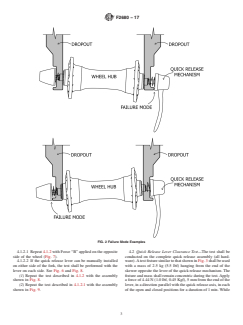
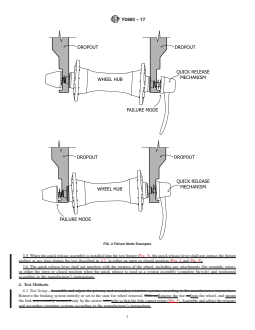
3.3 The secondary retention system shall prevent front wheel removal or partial separation when tested by the methods
described in 4.1.2. An example of one type of Examples of front wheel partial separation isare shown in Fig. 2.
3.4 Manually operated wheel retention systems shall not be used on bicycles with 20-in. (51-cm) diameter wheels or smaller
(excluding adult bicycles).
FIG. 1 Typical Primary Retention Test Apparatus
F2680 − 17
FIG. 2 Failure Mode Examples
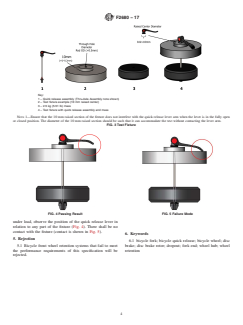
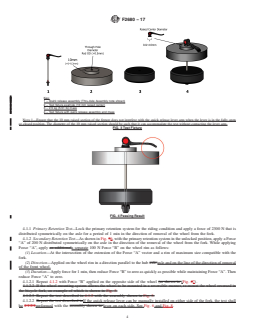
3.5 When the quick release assembly is installed into the test fixture (Fig. 3), the quick release lever shall not contact the fixture
surface at any time during the test de
...