

ASTM D8106-17
(Test Method)Standard Test Methods for Determining the Oil Sorption Capacity of Organophilic Clay
General Information
- Abstract
SIGNIFICANCE AND USE
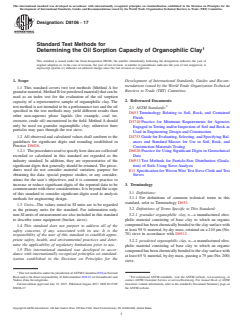
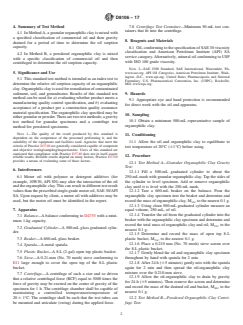
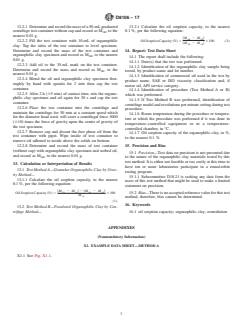
5.1 This standard test method is intended as an index test to determine the relative oil sorption capacity of an organophilic clay. Organophilic clay is used for remediation of contaminated sediment, soil, and groundwater. Results of this standard test method can be used for a) evaluating whether product meets a manufacturing quality control specification, and b) evaluating acceptance of a product per a construction quality assurance material specification. The organophilic clay specified may be either granular or powder. There are two test methods; a gravity test method for granular specimens and a centrifuge test method for powdered specimens.
Note 1: The quality of the result produced by this standard is dependent on the competence of the personnel performing it, and the suitability of the equipment and facilities used. Agencies that meet the criteria of Practice D3740 are generally considered capable of competent and objective testing/sampling/inspection/etc. Users of this standard are cautioned that compliance with Practice D3740 does not in itself assure reliable results. Reliable results depend on many factors; Practice D3740 provides a means of evaluating some of those factors.
SCOPE
1.1 This standard covers two test methods (Method A for granular material, Method B for powdered material) that can be used as an index test for the evaluation of the oil sorption capacity of a representative sample of organophilic clay. The test method is not intended to be a performance test and the oil specified in the test methods may yield different results than other non-aqueous phase liquids (for example, coal tar, creosote, crude oil) encountered in the field. Method A should only be used on granular organophilic clay; otherwise finer particles may pass through the test sieve.
1.2 All observed and calculated values shall conform to the guidelines for significant digits and rounding established in Practice D6026.
1.2.1 The procedures used to specify how data are collected/recorded or calculated in this standard are regarded as the industry standard. In addition, they are representative of the significant digits that generally should be retained. The procedures used do not consider material variation, purpose for obtaining the data, special purpose studies, or any considerations for the user’s objectives; and it is common practice to increase or reduce significant digits of the reported data to be commensurate with these considerations. It is beyond the scope of this standard to consider significant digits used in analysis methods for engineering design.
1.3 Units—The values stated in SI units are to be regarded as the primary units for the standard. For information only, non-SI units of measurement are also included in this standard to describe some equipment (bucket, sieve).
1.4 This standard does not purport to address all of the safety concerns, if any, associated with its use. It is the responsibility of the user of this standard to establish appropriate safety, health and environmental practices and determine the applicability of regulatory limitations prior to use.
1.5 This international standard was developed in accordance with internationally recognized principles on standardization established in the Decision on Principles for the Development of International Standards, Guides and Recommendations issued by the World Trade Organization Technical Barriers to Trade (TBT) Committee.
- Status
- Published
- Publication Date
- 14-Jul-2017
- Technical Committee
- D18 - Soil and Rock
- Drafting Committee
- D18.21 - Groundwater and Vadose Zone Investigations
Overview
ASTM D8106-17 is the globally recognized standard established by ASTM International for determining the oil sorption capacity of organophilic clay. Organophilic clay is widely used for remediation purposes in contaminated sediment, soil, and groundwater, especially where removal of hydrocarbons and oils is essential. The standard sets out clear test methods to assess the relative oil sorption index of both granular and powdered organophilic clay products.
The procedures defined in ASTM D8106-17 are intended as index tests rather than performance tests, providing a reliable baseline to evaluate the quality and suitability of these materials for environmental remediation and quality control processes.
Key Topics
Two Test Methods: The standard describes two distinct test methods that reflect the physical form of the organophilic clay:
- Method A (Gravity Test): For granular organophilic clay, using a gravity drainage approach.
- Method B (Centrifuge Test): For powdered organophilic clay, employing a centrifuge to assess sorption.
Application Context:
- Remediation: Organophilic clay serves to bind and remove oils and hydrocarbons from contaminated soils and groundwater.
- Quality Control: The test helps verify that production lots meet manufacturer and project requirements for oil sorption capacity.
- Material Acceptance: Results are used for construction quality assurance specifications.
Sample Handling: Detailed instructions ensure representative sampling, correct conditioning, and accurate sorption testing under standardized conditions.
Reporting and Documentation:
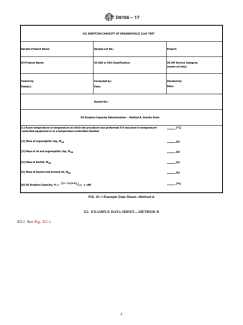
- Data collected using ASTM D8106-17 should be reported together with sample identification, test date, oil used, test temperature, and a complete record of procedures and calculations.
Significant Digits and Units: Results should conform to guidelines on significant digits (per ASTM D6026) and use SI units as primary, with non-SI units included where relevant.
Applications
ASTM D8106-17 finds critical application in various fields and scenarios:
- Environmental Remediation: Used by environmental consultants, contractors, and laboratories to select and qualify organophilic clay materials for treating contaminated sites.
- Manufacturing Quality Control: Producers of organophilic clay utilize this standard in routine quality assessment, ensuring each batch meets specified oil sorption index requirements.
- Construction Quality Assurance: Project managers and engineers apply these test results to accept or reject materials for use in field applications, enhancing remediation effectiveness and regulatory compliance.
- Research and Development: The standard provides a benchmark for laboratories developing or evaluating new formulations and treatments for oil contamination.
Related Standards
ASTM D8106-17 references several supporting ASTM standards to ensure consistency and reliability:
- ASTM D653 – Terminology Relating to Soil, Rock, and Contained Fluids
- ASTM D3740 – Practice for Minimum Requirements for Agencies Engaged in Testing and/or Inspection of Soil and Rock
- ASTM D4753 – Guide for Evaluating, Selecting, and Specifying Balances and Standard Masses
- ASTM D6026 – Practice for Using Significant Digits in Geotechnical Data
- ASTM D6913 – Test Methods for Particle-Size Distribution (Sieve Analysis)
- ASTM E11 – Specification for Woven Wire Test Sieve Cloth and Test Sieves
These linked standards contribute to the uniformity and reliability of the testing approach, supporting the broader goals of environmental safety, material quality, and regulatory adherence.
By following ASTM D8106-17, stakeholders ensure that organophilic clay products used in environmental projects are evaluated using an internationally recognized, standardized methodology, providing confidence in material selection and remediation outcomes.
Relations
- Effective Date
- 01-Feb-2024
- Effective Date
- 01-Nov-2023
- Effective Date
- 01-Oct-2019
- Effective Date
- 01-May-2015
- Effective Date
- 01-Aug-2014
- Effective Date
- 01-Oct-2013
- Effective Date
- 01-May-2012
- Effective Date
- 01-Mar-2012
- Effective Date
- 01-Sep-2011
- Effective Date
- 01-Sep-2011
- Effective Date
- 01-Mar-2010
- Effective Date
- 01-Jul-2009
- Effective Date
- 01-Jul-2009
- Effective Date
- 01-May-2009
- Effective Date
- 01-Jan-2009
Get Certified
Connect with accredited certification bodies for this standard

DIBt (Deutsches Institut für Bautechnik)
German Institute for Building Technology.
DIN CERTCO
DIN Group product certification.

Aboma Certification B.V.
Specialized in construction, metal, and transport sectors.
Sponsored listings
Frequently Asked Questions
ASTM D8106-17 is a standard published by ASTM International. Its full title is "Standard Test Methods for Determining the Oil Sorption Capacity of Organophilic Clay". This standard covers: SIGNIFICANCE AND USE 5.1 This standard test method is intended as an index test to determine the relative oil sorption capacity of an organophilic clay. Organophilic clay is used for remediation of contaminated sediment, soil, and groundwater. Results of this standard test method can be used for a) evaluating whether product meets a manufacturing quality control specification, and b) evaluating acceptance of a product per a construction quality assurance material specification. The organophilic clay specified may be either granular or powder. There are two test methods; a gravity test method for granular specimens and a centrifuge test method for powdered specimens. Note 1: The quality of the result produced by this standard is dependent on the competence of the personnel performing it, and the suitability of the equipment and facilities used. Agencies that meet the criteria of Practice D3740 are generally considered capable of competent and objective testing/sampling/inspection/etc. Users of this standard are cautioned that compliance with Practice D3740 does not in itself assure reliable results. Reliable results depend on many factors; Practice D3740 provides a means of evaluating some of those factors. SCOPE 1.1 This standard covers two test methods (Method A for granular material, Method B for powdered material) that can be used as an index test for the evaluation of the oil sorption capacity of a representative sample of organophilic clay. The test method is not intended to be a performance test and the oil specified in the test methods may yield different results than other non-aqueous phase liquids (for example, coal tar, creosote, crude oil) encountered in the field. Method A should only be used on granular organophilic clay; otherwise finer particles may pass through the test sieve. 1.2 All observed and calculated values shall conform to the guidelines for significant digits and rounding established in Practice D6026. 1.2.1 The procedures used to specify how data are collected/recorded or calculated in this standard are regarded as the industry standard. In addition, they are representative of the significant digits that generally should be retained. The procedures used do not consider material variation, purpose for obtaining the data, special purpose studies, or any considerations for the user’s objectives; and it is common practice to increase or reduce significant digits of the reported data to be commensurate with these considerations. It is beyond the scope of this standard to consider significant digits used in analysis methods for engineering design. 1.3 Units—The values stated in SI units are to be regarded as the primary units for the standard. For information only, non-SI units of measurement are also included in this standard to describe some equipment (bucket, sieve). 1.4 This standard does not purport to address all of the safety concerns, if any, associated with its use. It is the responsibility of the user of this standard to establish appropriate safety, health and environmental practices and determine the applicability of regulatory limitations prior to use. 1.5 This international standard was developed in accordance with internationally recognized principles on standardization established in the Decision on Principles for the Development of International Standards, Guides and Recommendations issued by the World Trade Organization Technical Barriers to Trade (TBT) Committee.
SIGNIFICANCE AND USE 5.1 This standard test method is intended as an index test to determine the relative oil sorption capacity of an organophilic clay. Organophilic clay is used for remediation of contaminated sediment, soil, and groundwater. Results of this standard test method can be used for a) evaluating whether product meets a manufacturing quality control specification, and b) evaluating acceptance of a product per a construction quality assurance material specification. The organophilic clay specified may be either granular or powder. There are two test methods; a gravity test method for granular specimens and a centrifuge test method for powdered specimens. Note 1: The quality of the result produced by this standard is dependent on the competence of the personnel performing it, and the suitability of the equipment and facilities used. Agencies that meet the criteria of Practice D3740 are generally considered capable of competent and objective testing/sampling/inspection/etc. Users of this standard are cautioned that compliance with Practice D3740 does not in itself assure reliable results. Reliable results depend on many factors; Practice D3740 provides a means of evaluating some of those factors. SCOPE 1.1 This standard covers two test methods (Method A for granular material, Method B for powdered material) that can be used as an index test for the evaluation of the oil sorption capacity of a representative sample of organophilic clay. The test method is not intended to be a performance test and the oil specified in the test methods may yield different results than other non-aqueous phase liquids (for example, coal tar, creosote, crude oil) encountered in the field. Method A should only be used on granular organophilic clay; otherwise finer particles may pass through the test sieve. 1.2 All observed and calculated values shall conform to the guidelines for significant digits and rounding established in Practice D6026. 1.2.1 The procedures used to specify how data are collected/recorded or calculated in this standard are regarded as the industry standard. In addition, they are representative of the significant digits that generally should be retained. The procedures used do not consider material variation, purpose for obtaining the data, special purpose studies, or any considerations for the user’s objectives; and it is common practice to increase or reduce significant digits of the reported data to be commensurate with these considerations. It is beyond the scope of this standard to consider significant digits used in analysis methods for engineering design. 1.3 Units—The values stated in SI units are to be regarded as the primary units for the standard. For information only, non-SI units of measurement are also included in this standard to describe some equipment (bucket, sieve). 1.4 This standard does not purport to address all of the safety concerns, if any, associated with its use. It is the responsibility of the user of this standard to establish appropriate safety, health and environmental practices and determine the applicability of regulatory limitations prior to use. 1.5 This international standard was developed in accordance with internationally recognized principles on standardization established in the Decision on Principles for the Development of International Standards, Guides and Recommendations issued by the World Trade Organization Technical Barriers to Trade (TBT) Committee.
ASTM D8106-17 is classified under the following ICS (International Classification for Standards) categories: 91.100.15 - Mineral materials and products. The ICS classification helps identify the subject area and facilitates finding related standards.
ASTM D8106-17 has the following relationships with other standards: It is inter standard links to ASTM D4753-24, ASTM D3740-23, ASTM D3740-19, ASTM D4753-15, ASTM D653-14, ASTM E11-13, ASTM D3740-12a, ASTM D3740-12, ASTM D3740-11, ASTM D653-11, ASTM D3740-10, ASTM D6913-04(2009)e1, ASTM D6913-04(2009), ASTM E11-09e1, ASTM D653-09. Understanding these relationships helps ensure you are using the most current and applicable version of the standard.
ASTM D8106-17 is available in PDF format for immediate download after purchase. The document can be added to your cart and obtained through the secure checkout process. Digital delivery ensures instant access to the complete standard document.
Standards Content (Sample)
This international standard was developed in accordance with internationally recognized principles on standardization established in the Decision on Principles for the
Development of International Standards, Guides and Recommendations issued by the World Trade Organization Technical Barriers to Trade (TBT) Committee.
Designation: D8106 − 17
Standard Test Methods for
Determining the Oil Sorption Capacity of Organophilic Clay
This standard is issued under the fixed designation D8106; the number immediately following the designation indicates the year of
original adoption or, in the case of revision, the year of last revision. A number in parentheses indicates the year of last reapproval. A
superscript epsilon (´) indicates an editorial change since the last revision or reapproval.
1. Scope Development of International Standards, Guides and Recom-
mendations issued by the World Trade Organization Technical
1.1 This standard covers two test methods (Method A for
Barriers to Trade (TBT) Committee.
granularmaterial,MethodBforpowderedmaterial)thatcanbe
used as an index test for the evaluation of the oil sorption
2. Referenced Documents
capacity of a representative sample of organophilic clay. The
test method is not intended to be a performance test and the oil
2.1 ASTM Standards:
specified in the test methods may yield different results than
D653 Terminology Relating to Soil, Rock, and Contained
other non-aqueous phase liquids (for example, coal tar,
Fluids
creosote, crude oil) encountered in the field. Method A should
D3740 Practice for Minimum Requirements for Agencies
only be used on granular organophilic clay; otherwise finer
Engaged in Testing and/or Inspection of Soil and Rock as
particles may pass through the test sieve.
Used in Engineering Design and Construction
1.2 All observed and calculated values shall conform to the D4753 Guide for Evaluating, Selecting, and Specifying Bal-
guidelines for significant digits and rounding established in ances and Standard Masses for Use in Soil, Rock, and
Practice D6026. Construction Materials Testing
1.2.1 Theproceduresusedtospecifyhowdataarecollected/ D6026 Practice for Using Significant Digits in Geotechnical
recorded or calculated in this standard are regarded as the
Data
industry standard. In addition, they are representative of the D6913 Test Methods for Particle-Size Distribution (Grada-
significant digits that generally should be retained. The proce-
tion) of Soils Using Sieve Analysis
dures used do not consider material variation, purpose for E11 Specification for Woven Wire Test Sieve Cloth and Test
obtaining the data, special purpose studies, or any consider-
Sieves
ations for the user’s objectives; and it is common practice to
increase or reduce significant digits of the reported data to be
3. Terminology
commensuratewiththeseconsiderations.Itisbeyondthescope
3.1 Definitions:
of this standard to consider significant digits used in analysis
3.1.1 For definitions of common technical terms in this
methods for engineering design.
standard, refer to Terminology D653.
1.3 Units—The values stated in SI units are to be regarded
3.2 Definitions of Terms Specific to This Standard:
as the primary units for the standard. For information only,
non-SI units of measurement are also included in this standard 3.2.1 granular organophilic clay, n—a manufactured oleo-
to describe some equipment (bucket, sieve).
philic material consisting of base clay to which an organic
compoundhasbeenchemicallybondedtotheclaysurfacewith
1.4 This standard does not purport to address all of the
at least 95 % material, by dry mass, retained on a 210 µm (No.
safety concerns, if any, associated with its use. It is the
70) sieve in accordance with D6913.
responsibility of the user of this standard to establish appro-
priate safety, health, and environmental practices and deter-
3.2.2 powdered organophilic clay, n—a manufactured oleo-
mine the applicability of regulatory limitations prior to use.
philic material consisting of base clay to which an organic
1.5 This international standard was developed in accor-
compoundhasbeenchemicallybondedtotheclaysurfacewith
dance with internationally recognized principles on standard-
at least 65 % material, by dry mass, passing a 75 µm (No. 200)
ization established in the Decision on Principles for the
sieve.
ThistestmethodisunderthejurisdictionofASTMCommitteeD18onSoiland
Rock and is the direct responsibility of Subcommittee D18.21 on Groundwater and For referenced ASTM standards, visit the ASTM website, www.astm.org, or
Vadose Zone Investigations. contact ASTM Customer Service at service@astm.org. For Annual Book of ASTM
Current edition approved July 15, 2017. Published August 2017. DOI:10.1520/ Standards volume information, refer to the standard’s Document Summary page on
D8106-17 the ASTM website.
Copyright © ASTM International, 100 Barr Harbor Drive, PO Box C700, West Conshohocken, PA 19428-2959. United States
D8106 − 17
4. Summary of Test Method 7.8 Centrifuge Test Container—Minimum 50-mL test con-
tainers that fit into the centrifuge.
4.1 In MethodA, a granular organophilic clay is mixed with
a specified classification of commercial oil and then gravity
8. Reagents and Materials
drained for a period of time to determine the oil sorption
capacity. 8.1 Oil, conforming to the specification of SAE 30 viscosity
classification and American Petroleum Institute (API) SA
4.2 In Method B, a powdered organophilic clay is mixed
service category.Alternatively, mineral oil conforming to USP
with a specific classification of commercial oil and then
with ISO 100 grade viscosity.
centrifuged to determine the oil sorption capacity.
NOTE 2—SAE J300 Standard, SAE International, Warrendale, PA,
5. Significance and Use www.sae.org. API Oil Categories, American Petroleum Institute, Wash-
ington ,D.C., www.api.org. United States Pharmacopoeia and National
5.1 This standard test method is intended as an index test to
Formulary, U.S. Pharmaceutical Convention, Inc. (USPC), Rockville,
determine the relative oil sorption capacity of an organophilic
MD, www.ups.org.
clay.Organophilicclayisusedforremediationofcontaminated
sediment, soil, and groundwater. Results of this standard test 9. Hazards
method can be used for a) evaluating whether product meets a
9.1 Appropriate eye and hand protection is recommended
manufacturing quality control specification, and b) evaluating
for direct work with the oil and apparatus.
acceptance of a product per a construction quality assurance
material specification. The organophilic clay specified may be
10. Sampling
eithergranularorpowder.Therearetwotestmethods;agravity
10.1 Obtain a minimum 500-mL representative sample of
test method for granular specimens and a centrifuge test
organophilic clay.
method for powdered specimens.
NOTE 1—The quality of the result produced by this standard is
11. Conditioning
dependent on the competence of the personnel performing it, and the
suitability of the equipment and facilities used. Agencies that meet the 11.1 Allow the oil and organophilic clay to equilibrate to
criteria of Practice D3740 are generally considered capable of competent
test temperature of 20°C (61°C) before using.
and objective testing/sampling/inspection/etc. Users of this standard are
cautioned that compliance with Practice D3740 does not in itself assure
12. Procedure
reliable results. Reliable results depend on many factors; Practice D3740
provides a means of evaluating some of those factors.
12.1 Test Method A—Granular Organophilic Clay Gravity
Test:
6. Interferences
12.1.1 Fill a 500-mL graduated cylinder to about the
6.1 Motor oil with polymer or detergent additives (for
250-mLmark with granul
...