

ASTM D2936-20
(Test Method)Standard Test Method for Direct Tensile Strength of Intact Rock Core Specimens
General Information
- Abstract
SIGNIFICANCE AND USE
5.1 Rock is much weaker in tension than in compression. Thus, in determining the failure condition for a rock structure, many investigators employ the tensile strength of the component rock as the failure strength for the structure. Direct tensile stressing of rock is the most basic test for determining the tensile strength of rock. However, direct tensile tests will typically break at the weakest link along the longitudinal axis of the specimen, whether it is the rock substance or any discontinuity that is weaker than the adjacent rock substance. Unless the purpose of the direct tension tests is to get the strength across discontinuities the test results are on the conservative side and are more representative of the tensile strength at the rock substance scale. See Note 2 for additional significance and use information.
Note 2: The quality of the result produced by these practices is dependent upon the competence of the personnel performing it and the suitability of the equipment and facilities used. Agencies that meet the criteria of Practice D3740 are generally considered capable of competent and objective testing and sampling. Users of these practices are cautioned that compliance with Practice D3740 does not in itself assure reliable results. Reliable results depend on many factors; Practice D3740 provides a means of evaluating some of those factors.
SCOPE
1.1 This test method covers the determination of the direct tensile strength of the rock substance or discontinuities normal to the longitudinal axis of intact, isotropic cylindrical rock specimens at room temperature.
1.2 Non-isotropic or even transversely isotropic specimens are not covered by this standard.
1.3 Cylindrical rock specimens can be drill core from the field or rock blocks transported to the laboratory and drill core specimen obtained there.
1.4 Specimen shapes other than cylindrical specimens, such as dog bone-shaped, are not covered by this standard.
1.5 Test specimens may be tested under constant load or deformation rate.
1.6 The values stated in SI units are to be regarded as standard. The values provided in parenthesis are for information only.
1.7 All observed and calculated values shall conform to the guidelines for significant digits and rounding established in Practice D6026 unless superseded by this standard.
1.8 This standard does not purport to address all of the safety concerns, if any, associated with its use. It is the responsibility of the user of this standard to establish appropriate safety, health, and environmental practices and determine the applicability of regulatory limitations prior to use.
1.9 This international standard was developed in accordance with internationally recognized principles on standardization established in the Decision on Principles for the Development of International Standards, Guides and Recommendations issued by the World Trade Organization Technical Barriers to Trade (TBT) Committee.
- Status
- Published
- Publication Date
- 31-Dec-2019
- Technical Committee
- D18 - Soil and Rock
- Drafting Committee
- D18.12 - Rock Mechanics
Overview
ASTM D2936-20 sets forth the standard test method for determining the direct tensile strength of intact rock core specimens. Issued by ASTM International, this standard is vital for accurately assessing the tensile properties of intact, isotropic cylindrical rock core specimens in geotechnical and civil engineering applications. The method is designed to help professionals measure the tensile strength of rock, which is typically much weaker than its compressive strength, thus playing a critical role in evaluating rock stability for structures like tunnels, dams, and foundations.
This test method emphasizes the importance of proper specimen selection, preparation, and testing to achieve reliable and representative tensile strength measurements under controlled laboratory conditions.
Key Topics
Direct Tensile Strength Testing:
- Measures the ability of intact rock core specimens to withstand pulling forces along their longitudinal axis.
- Focuses on isotropic (uniform) rock properties; specimens with anisotropy or transverse isotropy are not within this method's scope.
Specimen Preparation and Selection:
- Only cylindrical specimens are covered, typically sized to ensure valid and consistent results.
- Special attention is given to preserving field conditions like water content and ensuring specimen orientation reflects relevant geologic features.
Testing Parameters:
- Tests are performed at room temperature using constant load or deformation rate as specified in the project plan.
- Specimens are cemented to metal caps and subjected to controlled, purely tensile loading until failure.
Data Reporting and Quality Control:
- Test results must be meticulously documented, including all relevant specimen details, test setup, and boundary conditions.
- The precision and reliability of results depend on equipment quality, technician competence, and adherence to related ASTM practices (e.g., D3740).
Applications
Adopting ASTM D2936-20 is essential wherever accurate tensile strength determination influences engineering decisions, including:
Rock Mechanics and Geotechnical Engineering:
- Used to inform stability analyses for slopes, tunnels, underground excavations, and dam sites.
- Supports the safe and efficient design of civil infrastructure where rock mass behavior under tensile loads is critical.
Material Characterization:
- Provides a standard approach for comparing the tensile strength of different rock types or the effect of particular geologic features.
- Helps identify weak planes or discontinuities that may influence structural performance.
Site Investigation and Core Analysis:
- Assists in quality control during site exploration by enabling evaluation of rock core samples obtained from boreholes or blocks.
- Facilitates accurate reporting of site-specific geotechnical properties required for design specifications.
Related Standards
Several other ASTM standards are referenced or commonly used with ASTM D2936-20:
- ASTM D2113: Practice for Rock Core Drilling and Sampling for Site Exploration.
- ASTM D2216: Test Methods for Determination of Water (Moisture) Content of Soil and Rock by Mass.
- ASTM D3740: Minimum Requirements for Agencies Engaged in Testing and/or Inspection of Soil and Rock.
- ASTM D4543: Practices for Preparing Rock Core as Cylindrical Test Specimens.
- ASTM D6026: Practice for Using Significant Digits in Geotechnical Data.
- ASTM E4: Practices for Force Verification of Testing Machines.
- ASTM E122: Practice for Calculating Sample Size to Estimate With Specified Precision.
- ASTM D653: Terminology Relating to Soil, Rock, and Contained Fluids.
By following ASTM D2936-20, professionals can ensure the validity and comparability of tensile strength test results, enhancing the reliability of geotechnical investigations and the design of critical infrastructure. This standard thus plays a pivotal role in advancing the quality and consistency of rock mechanics testing worldwide.
Relations
- Effective Date
- 01-Jan-2020
- Effective Date
- 01-Nov-2023
- Effective Date
- 01-Oct-2019
- Effective Date
- 01-Apr-2019
- Effective Date
- 01-Mar-2019
- Effective Date
- 01-Aug-2014
- Effective Date
- 01-Jun-2014
- Effective Date
- 01-Jun-2014
- Effective Date
- 01-Oct-2013
- Effective Date
- 01-Oct-2012
- Effective Date
- 01-May-2012
- Effective Date
- 01-Mar-2012
- Effective Date
- 15-Feb-2012
- Effective Date
- 01-Jan-2012
- Effective Date
- 01-Sep-2011
Get Certified
Connect with accredited certification bodies for this standard

Zavod za gradbeništvo Slovenije (ZAG) - Inšpekcija
ZAG inspection body for construction products, structures, and materials.
Sponsored listings
Frequently Asked Questions
ASTM D2936-20 is a standard published by ASTM International. Its full title is "Standard Test Method for Direct Tensile Strength of Intact Rock Core Specimens". This standard covers: SIGNIFICANCE AND USE 5.1 Rock is much weaker in tension than in compression. Thus, in determining the failure condition for a rock structure, many investigators employ the tensile strength of the component rock as the failure strength for the structure. Direct tensile stressing of rock is the most basic test for determining the tensile strength of rock. However, direct tensile tests will typically break at the weakest link along the longitudinal axis of the specimen, whether it is the rock substance or any discontinuity that is weaker than the adjacent rock substance. Unless the purpose of the direct tension tests is to get the strength across discontinuities the test results are on the conservative side and are more representative of the tensile strength at the rock substance scale. See Note 2 for additional significance and use information. Note 2: The quality of the result produced by these practices is dependent upon the competence of the personnel performing it and the suitability of the equipment and facilities used. Agencies that meet the criteria of Practice D3740 are generally considered capable of competent and objective testing and sampling. Users of these practices are cautioned that compliance with Practice D3740 does not in itself assure reliable results. Reliable results depend on many factors; Practice D3740 provides a means of evaluating some of those factors. SCOPE 1.1 This test method covers the determination of the direct tensile strength of the rock substance or discontinuities normal to the longitudinal axis of intact, isotropic cylindrical rock specimens at room temperature. 1.2 Non-isotropic or even transversely isotropic specimens are not covered by this standard. 1.3 Cylindrical rock specimens can be drill core from the field or rock blocks transported to the laboratory and drill core specimen obtained there. 1.4 Specimen shapes other than cylindrical specimens, such as dog bone-shaped, are not covered by this standard. 1.5 Test specimens may be tested under constant load or deformation rate. 1.6 The values stated in SI units are to be regarded as standard. The values provided in parenthesis are for information only. 1.7 All observed and calculated values shall conform to the guidelines for significant digits and rounding established in Practice D6026 unless superseded by this standard. 1.8 This standard does not purport to address all of the safety concerns, if any, associated with its use. It is the responsibility of the user of this standard to establish appropriate safety, health, and environmental practices and determine the applicability of regulatory limitations prior to use. 1.9 This international standard was developed in accordance with internationally recognized principles on standardization established in the Decision on Principles for the Development of International Standards, Guides and Recommendations issued by the World Trade Organization Technical Barriers to Trade (TBT) Committee.
SIGNIFICANCE AND USE 5.1 Rock is much weaker in tension than in compression. Thus, in determining the failure condition for a rock structure, many investigators employ the tensile strength of the component rock as the failure strength for the structure. Direct tensile stressing of rock is the most basic test for determining the tensile strength of rock. However, direct tensile tests will typically break at the weakest link along the longitudinal axis of the specimen, whether it is the rock substance or any discontinuity that is weaker than the adjacent rock substance. Unless the purpose of the direct tension tests is to get the strength across discontinuities the test results are on the conservative side and are more representative of the tensile strength at the rock substance scale. See Note 2 for additional significance and use information. Note 2: The quality of the result produced by these practices is dependent upon the competence of the personnel performing it and the suitability of the equipment and facilities used. Agencies that meet the criteria of Practice D3740 are generally considered capable of competent and objective testing and sampling. Users of these practices are cautioned that compliance with Practice D3740 does not in itself assure reliable results. Reliable results depend on many factors; Practice D3740 provides a means of evaluating some of those factors. SCOPE 1.1 This test method covers the determination of the direct tensile strength of the rock substance or discontinuities normal to the longitudinal axis of intact, isotropic cylindrical rock specimens at room temperature. 1.2 Non-isotropic or even transversely isotropic specimens are not covered by this standard. 1.3 Cylindrical rock specimens can be drill core from the field or rock blocks transported to the laboratory and drill core specimen obtained there. 1.4 Specimen shapes other than cylindrical specimens, such as dog bone-shaped, are not covered by this standard. 1.5 Test specimens may be tested under constant load or deformation rate. 1.6 The values stated in SI units are to be regarded as standard. The values provided in parenthesis are for information only. 1.7 All observed and calculated values shall conform to the guidelines for significant digits and rounding established in Practice D6026 unless superseded by this standard. 1.8 This standard does not purport to address all of the safety concerns, if any, associated with its use. It is the responsibility of the user of this standard to establish appropriate safety, health, and environmental practices and determine the applicability of regulatory limitations prior to use. 1.9 This international standard was developed in accordance with internationally recognized principles on standardization established in the Decision on Principles for the Development of International Standards, Guides and Recommendations issued by the World Trade Organization Technical Barriers to Trade (TBT) Committee.
ASTM D2936-20 is classified under the following ICS (International Classification for Standards) categories: 93.020 - Earthworks. Excavations. Foundation construction. Underground works. The ICS classification helps identify the subject area and facilitates finding related standards.
ASTM D2936-20 has the following relationships with other standards: It is inter standard links to ASTM D2936-08, ASTM D3740-23, ASTM D3740-19, ASTM E2586-19e1, ASTM D2216-19, ASTM D653-14, ASTM E4-14, ASTM E2586-14, ASTM E2586-13, ASTM E2586-12b, ASTM D3740-12a, ASTM D3740-12, ASTM E2586-12a, ASTM E2586-12, ASTM D653-11. Understanding these relationships helps ensure you are using the most current and applicable version of the standard.
ASTM D2936-20 is available in PDF format for immediate download after purchase. The document can be added to your cart and obtained through the secure checkout process. Digital delivery ensures instant access to the complete standard document.
Standards Content (Sample)
This international standard was developed in accordance with internationally recognized principles on standardization established in the Decision on Principles for the
Development of International Standards, Guides and Recommendations issued by the World Trade Organization Technical Barriers to Trade (TBT) Committee.
Designation: D2936 − 20
Standard Test Method for
Direct Tensile Strength of Intact Rock Core Specimens
This standard is issued under the fixed designation D2936; the number immediately following the designation indicates the year of
original adoption or, in the case of revision, the year of last revision. A number in parentheses indicates the year of last reapproval. A
superscript epsilon (´) indicates an editorial change since the last revision or reapproval.
1. Scope* 2. Referenced Documents
1.1 This test method covers the determination of the direct
2.1 ASTM Standards:
tensile strength of the rock substance or discontinuities normal
D653 Terminology Relating to Soil, Rock, and Contained
to the longitudinal axis of intact, isotropic cylindrical rock
Fluids
specimens at room temperature.
D2113 Practice for Rock Core Drilling and Sampling of
Rock for Site Exploration
1.2 Non-isotropic or even transversely isotropic specimens
D2216 Test Methods for Laboratory Determination of Water
are not covered by this standard.
(Moisture) Content of Soil and Rock by Mass
1.3 Cylindrical rock specimens can be drill core from the
D2845 Test Method for Laboratory Determination of Pulse
field or rock blocks transported to the laboratory and drill core
Velocities and Ultrasonic Elastic Constants of Rock
specimen obtained there.
(Withdrawn 2017)
1.4 Specimen shapes other than cylindrical specimens, such
D3740 Practice for Minimum Requirements for Agencies
as dog bone-shaped, are not covered by this standard.
Engaged in Testing and/or Inspection of Soil and Rock as
Used in Engineering Design and Construction
1.5 Test specimens may be tested under constant load or
D4543 PracticesforPreparingRockCoreasCylindricalTest
deformation rate.
Specimens and Verifying Conformance to Dimensional
1.6 The values stated in SI units are to be regarded as
and Shape Tolerances
standard. The values provided in parenthesis are for informa-
D5079 Practices for Preserving and Transporting Rock Core
tion only.
Samples (Withdrawn 2017)
1.7 All observed and calculated values shall conform to the
D6026 Practice for Using Significant Digits in Geotechnical
guidelines for significant digits and rounding established in
Data
Practice D6026 unless superseded by this standard.
E4 Practices for Force Verification of Testing Machines
E122 Practice for Calculating Sample Size to Estimate,With
1.8 This standard does not purport to address all of the
Specified Precision, the Average for a Characteristic of a
safety concerns, if any, associated with its use. It is the
Lot or Process
responsibility of the user of this standard to establish appro-
E2586 Practice for Calculating and Using Basic Statistics
priate safety, health, and environmental practices and deter-
mine the applicability of regulatory limitations prior to use.
3. Terminology
1.9 This international standard was developed in accor-
dance with internationally recognized principles on standard-
3.1 Definitions:
ization established in the Decision on Principles for the
3.1.1 For definitions of common technical terms used in this
Development of International Standards, Guides and Recom-
standard, refer to Terminology D653.
mendations issued by the World Trade Organization Technical
Barriers to Trade (TBT) Committee. 3.2 Definitions of Terms Specific to This Standard:
1 2
ThistestmethodisunderthejurisdictionofASTMCommitteeD18onSoiland For referenced ASTM standards, visit the ASTM website, www.astm.org, or
Rock and is the direct responsibility of Subcommittee D18.12 on Rock Mechanics. contact ASTM Customer Service at service@astm.org. For Annual Book of ASTM
Current edition approved Jan. 1, 2020. Published March 2020. Originally Standards volume information, refer to the standard’s Document Summary page on
approved in 1971. Last previous edition approved in 2008 as D2936 – 08, which the ASTM website.
was withdrawn January 2017 and reinstated in January 2020. DOI: 10.1520/D2936- The last approved version of this historical standard is referenced on
20. www.astm.org.
*A Summary of Changes section appears at the end of this standard
Copyright © ASTM International, 100 Barr Harbor Drive, PO Box C700, West Conshohocken, PA 19428-2959. United States
D2936 − 20
3.2.1 transverse isotropy, n—impliesthat,atanypointinthe stress concentrations were reduced by directly cementing end
rock, there is an axis of symmetry of rotation and that the rock caps of the same diameter to the specimen ends which results
has isotropic properties in a plane normal to this axis. in a similar stress distribution as in a uniaxial compression test.
6.2 If the specimen is more anisotropic than isotropic, then
4. Summary of Test Method
this test procedure or data manipulations may need to be
4.1 Asample of rock cores or block samples, to be cored in
adjusted or handled differently. At the minimum, the data
the laboratory, are obtained in the field and as needed to be
should be flagged as anisotropic or isotropic for the user or
handled in accordance with Practice D5079 or as directed by
client, so it is used appropriately.
the client. The test intervals in the rock core sample are
selected, and the number of rock specimens selected, and then 7. Apparatus
those core segments are cut to the specified length and any
7.1 Loading Device, to apply and measure axial load and
relevant pretesting documentation recorded. Specimens can be
deformation, on the specimen, of sufficient capacity and at a
selected and prepared to test the tensile strength of the rock
rate conforming to the requirements of 9.3.The device shall be
substance or bonding of specific rock discontinuities.
verified at suitable time intervals in accordance with the
4.2 Both ends of the specimen are cemented to metal caps, procedures given in Practices E4 and shall comply with the
requirements prescribed therein.
which provide a means through which the specimen can be
held in the test apparatus, and a direct tensile load can be
7.2 Caps—Cylindrical metal caps that, when cemented to
applied to specimen. The specimen is loaded at a constant rate
the specimen ends, provide a means through which the direct
in tension, according to the project requirements, until it fails.
tensile load can be applied through some linkage to the loading
NOTE 1—To reduce costs and to get data that is not as biased toward the
device. The diameter of the metal caps shall not be less than
weakest link failure, some laboratory studies have taken the tensile test
that of the test specimen, nor shall it exceed the test specimen
specimen after it was broken and if the previous test had a clean break,
diameter by more than 4 %. Caps shall have a thickness of at
they re-bond the two halves of the specimen together and run the test
again.
least 30 mm (1 ⁄4 in.). Caps shall be provided with a suitable
linkage system for load transfer from the loading device to the
5. Significance and Use
test specimen.
5.1 Rock is much weaker in tension than in compression.
7.3 Linkage System—The connection between the cap and
Thus, in determining the failure condition for a rock structure,
the loading device. Any linkage is allowed but shall be so
many investigators employ the tensile strength of the compo-
designed that the load will be transmitted through the axis of
nent rock as the failure strength for the structure. Direct tensile
the test specimen without the application of bending or
stressing of rock is the most basic test for determining the
torsional stresses. The length of the linkages at each end shall
tensile strength of rock. However, direct tensile tests will
be at least two times the diameter of the metal end caps. One
typically break at the weakest link along the longitudinal axis
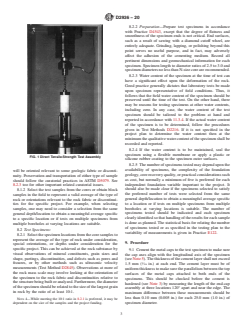
such system is shown in Fig. 1.
of the specimen, whether it is the rock substance or any
NOTE 3—Roller of link chain of suitable capacity has been found to
discontinuity that is weaker than the adjacent rock substance.
perform quite well in this application. Because roller chain flexes in one
Unless the purpose of the direct tension tests is to get the
plane only, the upper and lower segments should be positioned at right
strength across discontinuities the test results are on the
angles to each other to effectively reduce bending in the specimen.
conservative side and are more representative of the tensile Ball-and-socket, cable, or similar arrangements have been found to be
generally unsuitable as their tendency for bending and twisting makes the
strength at the rock substance scale. See Note 2 for additional
assembly unable to transmit a purely direct tensile stress to the test
significance and use information.
specimen. Metal rods just below the lower end cap in Fig. 1 are to prevent
the lower half of the specimen from falling and damaging the end cap or
NOTE 2—The quality of the result produced by these practices is
dependent upon the competence of the personnel performing it and the specimen for any post-failure observations or photographs.
suitability of the equipment and facilities used. Agencies that meet the
7.4 Cement—Any suitable material that will bond or adhere
criteria of Practice D3740 are generally considered capable of competent
to the two dissimilar materials together with enough strength
and objective testing and sampling. Users of these practices are cautioned
that the test specimen will not fail right at the contact between
that compliance with Practice D3740 does not in itself assure reliable
results. Reliable results depend on many factors; Practice D3740 provides
either end of the specimen and the cap during testing.
a means of evaluating some of those factors.
8. Sampling and Test Specimens
6. Interferences
8.1 Samples:
6.1 Gripping a cylindrical specimen (non-dog bone) speci-
8.1.1 Rock samples in the form of rock cores or rock blocks
men can cause stress concentrations at the ends near the grips.
that rock cores are obtained from may be used. Practice D2113
A valid direct tensile test should result in a failure at the
should be followed as needed or specified by the client.
midpoint of the specimen. With stress concentrations at the
Samplesmaybefromorientedcoreholesorblocksamplesthat
ends of the specimen, failure can initiate near the grips
were obtained such that test specimens can be prepared that
resulting in an invalid test. In work by Fairhurst (1961) , the
International Journal of Rock Mechanics and Mining Sciences Volume 34,
Fairhurst C (1961) Laboratory measurements of some physical properties of Issue 5, July 1997, Pages 837-849 Direct tensile behavior of a transversely isotropic
rock, Proceedings of the fourth symposium on rock mechanics. Pennsylvania, USA rock, Jyh Jong Liao, Ming-TzungYang, Huei-YannHsieh
D2936 − 20
8.2.2 Preparation—Prepare test specimens in accordance
with Practice D4543, except that the degree of flatness and
smoothness of the specimen ends is not critical. End surfaces,
such as a result of sawing with a diamond cutoff wheel, are
entirely adequate. Grinding, lapping, or polishing beyond this
point serves no useful purpose, and in fact, may adversely
affect the adhesion of the cementing medium. Record all
pertinent dimensions and geomechanical information for each
specimen. Specimen length to diameter ratios of 2.5 to 3.0 and
specimendiametersnolessthanN-sizecorearerecommended.
8.2.3 Water content of the specimen at the time of test can
have a significant effect upon the deformation of the rock.
Good practice generally dictates that laboratory tests be made
upon specimen representative of field conditions. Thus, it
follows that the field water content of the specimen should be
preserved until the time of the test. On the other hand, there
may be reasons for testing specimens at other water contents,
including zero. In any case, the water content of the test
specimen should be tailored to the problem at hand and
reported in accordance with 11.3.4. If the actual water content
of the specimen is to be determined, follow the procedures
given in Test Methods D2216. If it is not specified in the
project plan to determine the water content then at the
minimumthequalitativewatercontentofthespecimenshallbe
recorded and reported.
8.2.4 If the wat
...