

ASTM D7683-21
(Test Method)Standard Test Method for Cloud Point of Petroleum Products and Liquid Fuels (Small Test Jar Method)
General Information
- Abstract
SIGNIFICANCE AND USE
5.1 The cloud point of petroleum products and biodiesel fuels is an index of the lowest temperature of their utility for certain applications. Wax crystals of sufficient quantity can plug filters used in some fuel systems.
5.2 Petroleum blending operations require precise measurement of the cloud point.
5.3 This test method can determine the temperature of the test specimen at which wax crystals have formed sufficiently to be observed as a cloud with a resolution of 0.1 °C.
5.4 This test method provides results that, when corrected for bias and rounded to the next lower integer (see 12.2), have been found equivalent to Test Method D2500.
5.5 This test method determines the cloud point in a shorter time period than required by Test Method D2500.
SCOPE
1.1 This test method covers the determination of the cloud point of petroleum products, biodiesel, and biodiesel blends that are transparent in layers 40 mm in thickness, using an automatic instrument.
1.2 The measuring range of the apparatus is from –65 °C to +51 °C, however the precision statements were derived only from samples with cloud point temperatures from –50 °C to +6 °C.
1.3 The values stated in SI units are to be regarded as standard. No other units of measurement are included in this standard.
1.4 This standard does not purport to address all of the safety concerns, if any, associated with its use. It is the responsibility of the user of this standard to establish appropriate safety, health, and environmental practices and determine the applicability of regulatory limitations prior to use.
1.5 This international standard was developed in accordance with internationally recognized principles on standardization established in the Decision on Principles for the Development of International Standards, Guides and Recommendations issued by the World Trade Organization Technical Barriers to Trade (TBT) Committee.
- Status
- Published
- Publication Date
- 31-Dec-2020
- Technical Committee
- D02 - Petroleum Products, Liquid Fuels, and Lubricants
- Drafting Committee
- D02.07 - Flow Properties
Buy Documents
ASTM D7683-21 - Standard Test Method for Cloud Point of Petroleum Products and Liquid Fuels (Small Test Jar Method)
REDLINE ASTM D7683-21 - Standard Test Method for Cloud Point of Petroleum Products and Liquid Fuels (Small Test Jar Method)
Overview
ASTM D7683-21 defines the Standard Test Method for determining the cloud point of petroleum products and liquid fuels using the Small Test Jar Method. Developed by ASTM International, this standard provides a precise and automated approach, utilizing a microprocessor-controlled instrument for accurate measurement. The cloud point is a critical property indicating the temperature at which wax crystals begin to form in fuels such as petroleum diesel, biodiesel, and biodiesel blends. Ensuring proper cloud point measurement helps prevent filter plugging and other operational issues in fuel systems, especially under cold conditions.
Key Topics
- Cloud Point Determination: The cloud point is the temperature at which the first visible wax crystals appear in a fuel sample upon cooling. This property is crucial for evaluating low-temperature performance.
- Automated Testing: The small test jar method utilizes automated instruments equipped with temperature sensors and optical detection systems, allowing rapid and repeatable results with 0.1 °C resolution.
- Applicable Fuels: The standard applies to petroleum products, biodiesel (B100), and various blends (e.g., B5, B10, B20) that are transparent in layers 40 mm thick.
- Temperature Range: The apparatus can measure cloud points from –65 °C to +51 °C (with validated precision statements for –50 °C to +6 °C).
- Precision and Reproducibility: The method offers strong repeatability and reproducibility, with difference thresholds only rarely exceeded in controlled testing, supporting both internal and interlaboratory quality control.
Applications
- Fuel Quality Control: Refineries, fuel terminals, and distributors utilize ASTM D7683-21 to verify the cloud point of petroleum-based fuels and biodiesel prior to distribution, ensuring their suitability for intended climatic conditions.
- Blending Operations: The method enables precise monitoring during blending processes, optimizing cold flow characteristics and preventing issues such as filter clogging in end-user equipment.
- Regulatory Compliance: Meeting cloud point specifications supports compliance with fuel quality standards required by regulatory bodies and industry guidelines.
- Comparability with Other Methods: Results from D7683-21, after bias correction and rounding, are considered equivalent to those obtained via ASTM D2500, facilitating consistent reporting and data comparison.
Related Standards
- ASTM D2500: The core manual procedure for cloud point determination. D7683-21 offers an automated alternative with improved turnaround.
- ASTM D4057: Practice for Manual Sampling of Petroleum and Petroleum Products, supporting representative sampling for testing.
- ASTM D4177: Automatic Sampling of Petroleum and Petroleum Products, especially relevant for automated testing environments.
- ASTM D6708: Practice for Statistical Assessment and Improvement of Agreement Between Two Test Methods, relevant when correlating results between D7683 and other methods.
- ASTM D6751: Specification for Biodiesel Fuel Blend Stock (B100) for Middle Distillate Fuels.
- IP219: Energy Institute method for cloud point determination, cited as a reference for international equivalence and harmonization.
Practical Value
Implementing ASTM D7683-21 allows fuel producers, laboratories, and quality assurance professionals to:
- Streamline cloud point testing with faster, more repeatable results
- Enhance cold-weather operability and fuel system reliability
- Maintain product quality and reputation by preventing fuel-related failures
- Easily integrate with automated laboratory workflows
- Support global supply chain consistency through harmonized fuel testing standards
Adhering to ASTM D7683-21 ensures accurate, traceable, and internationally accepted cloud point measurements for petroleum products and biodiesel, contributing to safe and efficient fuel use across industries.
Relations
- Effective Date
- 01-Mar-2024
- Effective Date
- 01-May-2019
- Effective Date
- 01-Oct-2018
- Effective Date
- 01-Apr-2018
- Effective Date
- 01-Apr-2016
- Effective Date
- 01-Jan-2016
- Effective Date
- 01-Jan-2016
- Effective Date
- 01-Dec-2015
- Effective Date
- 01-Oct-2015
- Effective Date
- 01-Jul-2015
- Effective Date
- 01-Jun-2015
- Effective Date
- 01-Jan-2015
- Effective Date
- 01-Oct-2014
- Effective Date
- 01-May-2013
- Effective Date
- 01-Aug-2012
Buy Documents
ASTM D7683-21 - Standard Test Method for Cloud Point of Petroleum Products and Liquid Fuels (Small Test Jar Method)
REDLINE ASTM D7683-21 - Standard Test Method for Cloud Point of Petroleum Products and Liquid Fuels (Small Test Jar Method)
Get Certified
Connect with accredited certification bodies for this standard

Element Materials Technology
Materials testing and product certification.

ABS Group Brazil
ABS Group certification services in Brazil.

ABS Quality Evaluations Inc.
American Bureau of Shipping quality certification.
Sponsored listings
Frequently Asked Questions
ASTM D7683-21 is a standard published by ASTM International. Its full title is "Standard Test Method for Cloud Point of Petroleum Products and Liquid Fuels (Small Test Jar Method)". This standard covers: SIGNIFICANCE AND USE 5.1 The cloud point of petroleum products and biodiesel fuels is an index of the lowest temperature of their utility for certain applications. Wax crystals of sufficient quantity can plug filters used in some fuel systems. 5.2 Petroleum blending operations require precise measurement of the cloud point. 5.3 This test method can determine the temperature of the test specimen at which wax crystals have formed sufficiently to be observed as a cloud with a resolution of 0.1 °C. 5.4 This test method provides results that, when corrected for bias and rounded to the next lower integer (see 12.2), have been found equivalent to Test Method D2500. 5.5 This test method determines the cloud point in a shorter time period than required by Test Method D2500. SCOPE 1.1 This test method covers the determination of the cloud point of petroleum products, biodiesel, and biodiesel blends that are transparent in layers 40 mm in thickness, using an automatic instrument. 1.2 The measuring range of the apparatus is from –65 °C to +51 °C, however the precision statements were derived only from samples with cloud point temperatures from –50 °C to +6 °C. 1.3 The values stated in SI units are to be regarded as standard. No other units of measurement are included in this standard. 1.4 This standard does not purport to address all of the safety concerns, if any, associated with its use. It is the responsibility of the user of this standard to establish appropriate safety, health, and environmental practices and determine the applicability of regulatory limitations prior to use. 1.5 This international standard was developed in accordance with internationally recognized principles on standardization established in the Decision on Principles for the Development of International Standards, Guides and Recommendations issued by the World Trade Organization Technical Barriers to Trade (TBT) Committee.
SIGNIFICANCE AND USE 5.1 The cloud point of petroleum products and biodiesel fuels is an index of the lowest temperature of their utility for certain applications. Wax crystals of sufficient quantity can plug filters used in some fuel systems. 5.2 Petroleum blending operations require precise measurement of the cloud point. 5.3 This test method can determine the temperature of the test specimen at which wax crystals have formed sufficiently to be observed as a cloud with a resolution of 0.1 °C. 5.4 This test method provides results that, when corrected for bias and rounded to the next lower integer (see 12.2), have been found equivalent to Test Method D2500. 5.5 This test method determines the cloud point in a shorter time period than required by Test Method D2500. SCOPE 1.1 This test method covers the determination of the cloud point of petroleum products, biodiesel, and biodiesel blends that are transparent in layers 40 mm in thickness, using an automatic instrument. 1.2 The measuring range of the apparatus is from –65 °C to +51 °C, however the precision statements were derived only from samples with cloud point temperatures from –50 °C to +6 °C. 1.3 The values stated in SI units are to be regarded as standard. No other units of measurement are included in this standard. 1.4 This standard does not purport to address all of the safety concerns, if any, associated with its use. It is the responsibility of the user of this standard to establish appropriate safety, health, and environmental practices and determine the applicability of regulatory limitations prior to use. 1.5 This international standard was developed in accordance with internationally recognized principles on standardization established in the Decision on Principles for the Development of International Standards, Guides and Recommendations issued by the World Trade Organization Technical Barriers to Trade (TBT) Committee.
ASTM D7683-21 is classified under the following ICS (International Classification for Standards) categories: 75.080 - Petroleum products in general. The ICS classification helps identify the subject area and facilitates finding related standards.
ASTM D7683-21 has the following relationships with other standards: It is inter standard links to ASTM D6708-24, ASTM D6708-19, ASTM D6751-18, ASTM D6708-18, ASTM D6708-16a, ASTM D2500-16, ASTM D6708-16, ASTM D6751-15c, ASTM D6751-15b, ASTM D6708-15, ASTM D6751-15a, ASTM D6751-15, ASTM D6751-14, ASTM D6708-13e1, ASTM D6751-12. Understanding these relationships helps ensure you are using the most current and applicable version of the standard.
ASTM D7683-21 is available in PDF format for immediate download after purchase. The document can be added to your cart and obtained through the secure checkout process. Digital delivery ensures instant access to the complete standard document.
Standards Content (Sample)
This international standard was developed in accordance with internationally recognized principles on standardization established in the Decision on Principles for the
Development of International Standards, Guides and Recommendations issued by the World Trade Organization Technical Barriers to Trade (TBT) Committee.
Designation: D7683 − 21
Standard Test Method for
Cloud Point of Petroleum Products and Liquid Fuels (Small
Test Jar Method)
This standard is issued under the fixed designation D7683; the number immediately following the designation indicates the year of
original adoption or, in the case of revision, the year of last revision. A number in parentheses indicates the year of last reapproval. A
superscript epsilon (´) indicates an editorial change since the last revision or reapproval.
1. Scope* D6708 Practice for StatisticalAssessment and Improvement
of Expected Agreement Between Two Test Methods that
1.1 This test method covers the determination of the cloud
Purport to Measure the Same Property of a Material
point of petroleum products, biodiesel, and biodiesel blends
D6751 Specification for Biodiesel Fuel Blend Stock (B100)
that are transparent in layers 40 mm in thickness, using an
for Middle Distillate Fuels
automatic instrument.
2.2 Energy Institute Standards:
1.2 The measuring range of the apparatus is from –65 °C to
IP219 Test Method for Cloud Point of Petroleum Products
+51 °C, however the precision statements were derived only
from samples with cloud point temperatures from –50 °C to
3. Terminology
+6 °C.
3.1 Definitions:
1.3 The values stated in SI units are to be regarded as
3.1.1 biodiesel, n—fuel comprised of mono-alkyl esters of
standard. No other units of measurement are included in this
long chain fatty acids derived from vegetable oils or animal
standard.
fats, designated B100.
1.4 This standard does not purport to address all of the
3.1.1.1 Discussion—Biodiesel is typically produced by a
safety concerns, if any, associated with its use. It is the
reaction of a vegetable oil or animal fat with an alcohol such as
responsibility of the user of this standard to establish appro-
methanol or ethanol in the presence of a catalyst to yield
priate safety, health, and environmental practices and deter-
mono-alkylestersandglycerin,whichisremoved.Thefinished
mine the applicability of regulatory limitations prior to use.
biodiesel derives approximately 10 % of its mass from the
1.5 This international standard was developed in accor-
reacted alcohol. The alcohol used in the reaction may or may
dance with internationally recognized principles on standard-
not come from renewable resources.
ization established in the Decision on Principles for the
3.1.2 biodiesel blend (BXX), n—a homogeneous mixture of
Development of International Standards, Guides and Recom-
hydrocarbon oils and mono-alkyl esters of long chain fatty
mendations issued by the World Trade Organization Technical
acids.
Barriers to Trade (TBT) Committee.
3.1.2.1 Discussion—In the abbreviation, BXX, the XX rep-
resents the volume percentage of biodiesel fuel in the blend.
2. Referenced Documents
3.1.2.2 Discussion—The mono-alkyl esters of long chain
2.1 ASTM Standards:
fatty acids (that is, biodiesel) used in the mixture shall meet the
D2500 Test Method for Cloud Point of Petroleum Products
requirements of Specification D6751.
and Liquid Fuels
3.1.2.3 Discussion—Diesel fuel, fuel oil, and non-aviation
D4057 Practice for Manual Sampling of Petroleum and
gas turbine oil are examples of hydrocarbon oils.
Petroleum Products
3.1.3 biodiesel fuel, n—synonym for biodiesel.
D4177 Practice for Automatic Sampling of Petroleum and
3.1.4 cloud point, n—in petroleum products and biodiesel
Petroleum Products
fuels, the temperature of a liquid specimen when the smallest
observable cluster of wax crystals first occurs upon cooling
This test method is under the jurisdiction of ASTM Committee D02 on
under prescribed conditions.
Petroleum Products, Liquid Fuels, and Lubricants and is the direct responsibility of
3.1.4.1 Discussion—The cloud point occurs when the tem-
Subcommittee D02.07 on Flow Properties.
Current edition approved Jan. 1, 2021. Published January 2021. Originally perature of the specimen is low enough to cause wax crystals
approved in 2011. Last previous edition approved in 2020 as D7683 – 20. DOI:
to precipitate. In a homogeneous liquid, the cloud is always
10.1520/D7683-21.
For referenced ASTM standards, visit the ASTM website, www.astm.org, or
contact ASTM Customer Service at service@astm.org. For Annual Book of ASTM
Standards volume information, refer to the standard’s Document Summary page on Available from Energy Institute, 61 New Cavendish St., London, WIG 7AR,
the ASTM website. U.K., http://www.energyinst.org.uk.
*A Summary of Changes section appears at the end of this standard
Copyright © ASTM International, 100 Barr Harbor Drive, PO Box C700, West Conshohocken, PA 19428-2959. United States
D7683 − 21
noted first at the location in the specimen where the specimen controlled apparatus that is capable of heating and cooling a
temperature is the lowest.The cloud point is the temperature at test specimen at prescribed rates, optically observing the first
which the crystals first occur, regardless of their location in the appearance of hydrocarbon wax crystals, and recording the
specimen, and not after extensive crystallization has taken temperature of the test specimen. A detailed description of the
place. The wax crystals that precipitate at lower temperatures apparatus is provided in Annex A1.
are typically, but not excluded to, straight-chain hydrocarbons
6.2 Temperature-Measuring Device—The temperature-
and lipids.
measuring device in the specimen chamber shall be capable of
3.2 Definitions of Terms Specific to This Standard: measuringthetemperaturefrom–65 °Cto51 °Cataresolution
3.2.1 small test jar method, n—in cloud point test methods, of 0.1 °C.
automatic test procedure using a small sample size, prescribed
6.3 Test Jar—Clear, cylindrical borosilicate glass with a flat
cooling rate, specimen receptacle, and optical system for
bottomwithanapproximatecapacityof12mL.Approximately
detection of crystal formation.
4.5 mL of sample specimen is contained when filled to the
3.2.1.1 Discussion—The prescribed cooling rate is de-
scribed line. During the test, the test jar is fitted with a test jar
scribedin11.4,thespecimenreceptacleisdescribedin6.3,and
cap assembly on its top. See A1.1.2 for more details on the test
the optical system for detection of crystal formation is de-
jar.
scribed in A1.2.3.
6.4 Metallic Block Bath—Metallic block with a cylindrical
3.2.2 D2500/IP219 equivalent cloud point, n—temperature
hole to fit the test jar. The metallic block assembly shall have
of a specimen, in integers, calculated by applying a bias and
a provision for cooling/heating. A temperature sensor is em-
rounding the results of this test method to the next lower
bedded in the metallic block to monitor its temperature.
integer (see 12.2).
3.2.2.1 Discussion—This test method produces results with
7. Reagents and Materials
0.1 °C resolution. Should the user wish to provide results with
7.1 Cleaning Agents—Capable of cleaning and drying the
a similar format to Test Method D2500, then this calculation
test jar and test jar cap assembly, after each test. Chemical
can be performed. Some apparatus can perform this calculation
agentssuchasalcoholandpetroleum-basedsolventshavebeen
automatically.
found suitable to use. (Warning—Flammable.) (Warning—
4. Summary of Test Method
May be harmful by itself or when evaporated.)
4.1 After inserting the glass test jar containing the specimen
intotheautomaticapparatusandinitiatingthetestprogram,the 8. Sampling
specimen is heated, if necessary, to the designated temperature
8.1 Obtain a sample in accordance with Practice D4057 or
and then cooled by prescribed rates. (See 11.4.) The test
by Practice D4177.
specimen is continuously monitored for appearance of hydro-
8.2 Aminimum volume of 4.5 mLof sample is required for
carbon crystals with a light emitter and a light receiver through
each test.
coaxial-type optical fibers. (See A1.2.3.) When the crystalliza-
tion in the specimen is detected by the optical system, the
8.3 Samples of very viscous materials may be warmed until
temperature is recorded to 0.1 °C resolution. The specimen is
they are reasonably fluid before they are tested. However, no
then heated to facilitate the start of the next test.
sample should be heated more than is absolutely necessary to
facilitate pouring the sample into the instrument test jar.
5. Significance and Use
(Warning—Exercise care when selecting the preheating tem-
5.1 The cloud point of petroleum products and biodiesel
perature. Samples which are fluid at ambient room temperature
fuels is an index of the lowest temperature of their utility for
can also have a low flash point. Use higher preheating
certain applications. Wax crystals of sufficient quantity can
temperatures only on samples known to be solid near ambient
plug filters used in some fuel systems.
room temperature.)
5.2 Petroleum blending operations require precise measure-
8.4 The sample shall not be heated above 60 °C. When the
ment of the cloud point.
sample is heated above 60 °C allow the sample to cool below
60 °C before filtering or inserting into the apparatus.
5.3 This test method can determine the temperature of the
test specimen at which wax crystals have formed sufficiently to
8.5 When moisture is present, remove the moisture by a
be observed as a cloud with a resolution of 0.1 °C.
method such as filtration through dry, lint-free filter paper until
the oil is perfectly clear, but make such filtration at a tempera-
5.4 This test method provides results that, when corrected
ture at least 14 °C above the expected cloud point.
for bias and rounded to the next lower integer (see 12.2), have
been found equivalent to Test Method D2500.
NOTE 1—Moisture will be noticed in the sample as a separate phase or
as a haze throughout the entire sample. Generally, a slight haze will not
5.5 This test method determines the cloud point in a shorter
interfere with the detection of the wax cloud.
time perio
...
This document is not an ASTM standard and is intended only to provide the user of an ASTM standard an indication of what changes have been made to the previous version. Because
it may not be technically possible to adequately depict all changes accurately, ASTM recommends that users consult prior editions as appropriate. In all cases only the current version
of the standard as published by ASTM is to be considered the official document.
Designation: D7683 − 20 D7683 − 21
Standard Test Method for
Cloud Point of Petroleum Products and Liquid Fuels (Small
Test Jar Method)
This standard is issued under the fixed designation D7683; the number immediately following the designation indicates the year of
original adoption or, in the case of revision, the year of last revision. A number in parentheses indicates the year of last reapproval. A
superscript epsilon (´) indicates an editorial change since the last revision or reapproval.
1. Scope*
1.1 This test method covers the determination of the cloud point of petroleum products, biodiesel, and biodiesel blends that are
transparent in layers 40 mm in thickness, using an automatic instrument.
1.2 The measuring range of the apparatus is from –65 °C to +51 °C, however the precision statements were derived only from
samples with cloud point temperatures from –50 °C to +6 °C.
1.3 The values stated in SI units are to be regarded as standard. No other units of measurement are included in this standard.
1.4 This standard does not purport to address all of the safety concerns, if any, associated with its use. It is the responsibility
of the user of this standard to establish appropriate safety, health, and environmental practices and determine the applicability of
regulatory limitations prior to use.
1.5 This international standard was developed in accordance with internationally recognized principles on standardization
established in the Decision on Principles for the Development of International Standards, Guides and Recommendations issued
by the World Trade Organization Technical Barriers to Trade (TBT) Committee.
2. Referenced Documents
2.1 ASTM Standards:
D2500 Test Method for Cloud Point of Petroleum Products and Liquid Fuels
D4057 Practice for Manual Sampling of Petroleum and Petroleum Products
D4177 Practice for Automatic Sampling of Petroleum and Petroleum Products
D6708 Practice for Statistical Assessment and Improvement of Expected Agreement Between Two Test Methods that Purport
to Measure the Same Property of a Material
D6751 Specification for Biodiesel Fuel Blend Stock (B100) for Middle Distillate Fuels
2.2 Energy Institute Standards:
IP219 Test Method for Cloud Point of Petroleum Products
3. Terminology
3.1 Definitions:
This test method is under the jurisdiction of ASTM Committee D02 on Petroleum Products, Liquid Fuels, and Lubricants and is the direct responsibility of Subcommittee
D02.07 on Flow Properties.
Current edition approved June 1, 2020Jan. 1, 2021. Published June 2020January 2021. Originally approved in 2011. Last previous edition approved in 20172020 as
D7683 – 17.D7683 – 20. DOI: 10.1520/D7683-20.10.1520/D7683-21.
For referenced ASTM standards, visit the ASTM website, www.astm.org, or contact ASTM Customer Service at service@astm.org. For Annual Book of ASTM Standards
volume information, refer to the standard’s Document Summary page on the ASTM website.
Available from Energy Institute, 61 New Cavendish St., London, WIG 7AR, U.K., http://www.energyinst.org.uk.
*A Summary of Changes section appears at the end of this standard
Copyright © ASTM International, 100 Barr Harbor Drive, PO Box C700, West Conshohocken, PA 19428-2959. United States
D7683 − 21
3.1.1 biodiesel, n—fuel comprised of mono-alkyl esters of long chain fatty acids derived from vegetable oils or animal fats,
designated B100.
3.1.1.1 Discussion—
Biodiesel is typically produced by a reaction of a vegetable oil or animal fat with an alcohol such as methanol or ethanol in the
presence of a catalyst to yield mono-alkyl esters and glycerin, which is removed. The finished biodiesel derives approximately
10 % of its mass from the reacted alcohol. The alcohol used in the reaction may or may not come from renewable resources.
3.1.2 biodiesel blend, blend (BXX), n—blend of biodiesel fuel with diesel fuels and fuel oils.a homogeneous mixture of
hydrocarbon oils and mono-alkyl esters of long chain fatty acids.
3.1.2.1 Discussion—
In the abbreviation, BXX, the XX represents the volume percentage of biodiesel fuel in the blend.
3.1.2.2 Discussion—
The mono-alkyl esters of long chain fatty acids (that is, biodiesel) used in the mixture shall meet the requirements of Specification
D6751.
3.1.2.3 Discussion—
Diesel fuel, fuel oil, and non-aviation gas turbine oil are examples of hydrocarbon oils.
3.1.3 biodiesel fuel, n—synonym for biodiesel.
3.1.4 cloud point, n—in petroleum products and biodiesel fuels, the temperature of a liquid specimen when the smallest observable
cluster of wax crystals first occurs upon cooling under prescribed conditions.
3.1.4.1 Discussion—
The cloud point occurs when the temperature of the specimen is low enough to cause wax crystals to precipitate. In a homogeneous
liquid, the cloud is always noted first at the location in the specimen where the specimen temperature is the lowest. The cloud point
is the temperature at which the crystals first occur, regardless of their location in the specimen, and not after extensive
crystallization has taken place. The wax crystals that precipitate at lower temperatures are typically, but not excluded to,
straight-chain hydrocarbons and lipids.
3.2 Definitions of Terms Specific to This Standard:
3.2.1 small test jar method, n—in cloud point test methods, automatic test procedure using a small sample size, prescribed cooling
rate, specimen receptacle, and optical system for detection of crystal formation.
3.2.1.1 Discussion—
The prescribed cooling rate is described in 11.4, the specimen receptacle is described in 6.3, and the optical system for detection
of crystal formation is described in A1.2.3.
3.2.2 D2500/IP219 equivalent cloud point, n—temperature of a specimen, in integers, calculated by applying a bias and rounding
the results of this test method to the next lower integer (see 12.2).
3.2.2.1 Discussion—
This test method produces results with 0.1 °C resolution. Should the user wish to provide results with a similar format to Test
Method D2500, then this calculation can be performed. Some apparatus can perform this calculation automatically.
4. Summary of Test Method
4.1 After inserting the glass test jar containing the specimen into the automatic apparatus and initiating the test program, the
specimen is heated, if necessary, to the designated temperature and then cooled by prescribed rates. (See 11.4.) The test specimen
is continuously monitored for appearance of hydrocarbon crystals with a light emitter and a light receiver through coaxial-type
optical fibers. (See A1.2.3.) When the crystallization in the specimen is detected by the optical system, the temperature is recorded
to 0.1 °C resolution. The specimen is then heated to facilitate the start of the next test.
5. Significance and Use
5.1 The cloud point of petroleum products and biodiesel fuels is an index of the lowest temperature of their utility for certain
applications. Wax crystals of sufficient quantity can plug filters used in some fuel systems.
5.2 Petroleum blending operations require precise measurement of the cloud point.
D7683 − 21
5.3 This test method can determine the temperature of the test specimen at which wax crystals have formed sufficiently to be
observed as a cloud with a resolution of 0.1 °C.
5.4 This test method provides results that, when corrected for bias and rounded to the next lower integer (see 12.2), have been
found equivalent to Test Method D2500.
5.5 This test method determines the cloud point in a shorter time period than required by Test Method D2500.
6. Apparatus
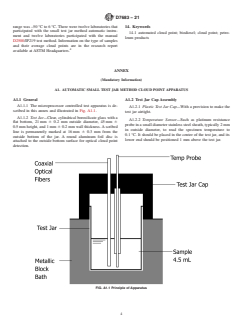
6.1 Automatic Apparatus—The automatic cloud point apparatus described in this test method is a microprocessor-controlled
apparatus that is capable of heating and cooling a test specimen at prescribed rates, optically observing the first appearance of
hydrocarbon wax crystals, and recording the temperature of the test specimen. A detailed description of the apparatus is provided
in Annex A1.
6.2 Temperature-Measuring Device—The temperature-measuring device in the specimen chamber shall be capable of measuring
the temperature from –65 °C to 51 °C at a resolution of 0.1 °C.
6.3 Test Jar—Clear, cylindrical borosilicate glass with a flat bottom with an approximate capacity of 12 mL. Approximately 4.5
mL of sample specimen is contained when filled to the scribed line. During the test, the test jar is fitted with a test jar cap assembly
on its top. See A1.1.2 for more details on the test jar.
6.4 Metallic Block Bath—Metallic block with a cylindrical hole to fit the test jar. The metallic block assembly shall have a
provision for cooling/heating. A temperature sensor is embedded in the metallic block to monitor its temperature.
7. Reagents and Materials
7.1 Cleaning Agents—Capable of cleaning and drying the test jar and test jar cap assembly, after each test. Chemical agents such
as alcohol and petroleum-based solvents have been found suitable to use. (Warning—Flammable.) (Warning— May be harmful
by itself or when evaporated.)
8. Sampling
8.1 Obtain a sample in accordance with Practice D4057 or by Practice D4177.
8.2 A minimum volume of 4.5 mL of sample is required for each test.
8.3 Samples of very viscous materials may be warmed until they are reasonably fluid before they are tested. However, no sample
should be heated more than is absolutely necessary to facilitate pouring the sample into the instrument test jar. (Warning—
Exercise care when selecting the preheating temperature. Samples which are fluid at ambient room temperature can also have a
low flash point. Use higher preheating temperatures only on samples known to be solid near ambient room temperature.)
8.4 The sample shall not be heated above 60 °C. When the sample is heated above 60 °C allow the sample to cool below 60 °C
before filtering or inserting into the apparatus.
8.5 When moisture is present, remove the moisture by a method such as filtration through dry, lint-free filter paper until the oil
is perfectly clear, but make such filtration at
...