

ASTM D8204-18(2022)
(Practice)Standard Practice for Burial and Retrieval of Samples in a Test Pad to Evaluate Installation Effects on Geosynthetic Clay Liners
General Information
- Abstract
SIGNIFICANCE AND USE
5.1 The ability to maintain design function (for example, barrier) or design properties (for example, peel strength, chemical resistance, etc.), or both, of a geosynthetic clay liner may be affected by damage to the physical structure of the GCL due to the rigors of field installation. The effect of damage may be assessed by analyzing specimens cut from sample(s) retrieved after installation in a representative test pad. Analysis may be performed with visual examination or laboratory testing of specimens from the control sample(s), and from the exhumed sample(s).
5.2 A uniform practice for installing and retrieving representative sample(s) from a test pad is needed to assess installation damage using project-specific or generally accepted, representative materials and procedures. Damage of a specific grade and type of GCL under specific installation procedures may be assessed with sample(s) exhumed from a full-scale test pad.
SCOPE
1.1 This practice covers standardized procedures for obtaining samples of geosynthetic clay liners (GCLs) from a test pad for use in assessment of the effects immediately after installation caused only by the installation techniques. The assessment may include physical testing. This practice is applicable to GCLs only.
1.2 This practice is limited to full-scale test pads, and does not address laboratory modeling of field conditions. This practice does not address which test method(s) to use for quantifying installation damage.
1.3 This standard does not purport to address all of the safety concerns, if any, associated with its use. It is the responsibility of the user of this standard to establish appropriate safety, health, and environmental practices and determine the applicability of regulatory limitations prior to use.
1.4 This international standard was developed in accordance with internationally recognized principles on standardization established in the Decision on Principles for the Development of International Standards, Guides and Recommendations issued by the World Trade Organization Technical Barriers to Trade (TBT) Committee.
- Status
- Published
- Publication Date
- 30-Sep-2022
- Technical Committee
- D35 - Geosynthetics
- Drafting Committee
- D35.04 - Geosynthetic Clay Liners
Overview
ASTM D8204-18(2022): Standard Practice for Burial and Retrieval of Samples in a Test Pad to Evaluate Installation Effects on Geosynthetic Clay Liners (GCLs) provides a uniform procedure for sampling geosynthetic clay liners from full-scale test pads. This process is critical for accurately assessing installation-related damage to GCLs under real-world site conditions. The standard establishes clear practice for installing, retrieving, and analyzing GCL samples to preserve their structural and barrier functions after exposure to typical field installation techniques.
This standard is published by ASTM International and developed according to the globally recognized WTO Technical Barriers to Trade (TBT) principles.
Key Topics
- Sampling from Full-Scale Test Pads: The standard specifies methods for collecting GCL samples immediately after installation, ensuring the assessment reflects only installation-induced effects and not subsequent aging or exposure.
- Installation and Exhumation Procedures: Guidance covers installation modeling with project-specific or representative methods, materials, and equipment. Sample retrieval should avoid additional damage and mirror the actual practices anticipated during construction.
- Control Samples: Control or baseline samples must originate from the same material batch as installed, allowing for accurate comparisons between exhumed and uninstalled specimens.
- Test Pad Configuration: Multiple test pad designs are addressed (above or below ground, with variable or uniform soil/stone cover), ensuring flexibility in simulating different site and loading conditions.
- Documentation and Reporting: The standard requires detailed documentation of weather, test pad construction, equipment, procedures, and testing outcomes for full traceability and quality assurance.
- Safety, Health, and Environmental Practices: It is the user’s responsibility to apply pertinent safety and regulatory requirements during implementation.
Applications
ASTM D8204-18(2022) delivers essential value for:
- Project Specification: Defining site-specific installation and sampling methods for GCLs in engineering and environmental projects such as landfills, ponds, and containment barriers.
- Quality Assurance and Control: Ensuring GCLs retain key design properties (e.g., peel strength, impermeability, chemical resistance) after field installation and that installation procedures do not compromise liner performance.
- Performance Validation: Supporting project owners, engineers, and contractors in evaluating installation techniques and equipment impacts before full deployment, mitigating the risk of costly post-installation failures.
- Research and Development: Helping manufacturers refine GCL products and construction methods by supplying empirical data on damage mechanisms and installation effects.
Through its standardized methods, ASTM D8204-18(2022) enhances project reliability, promotes best practices, and helps meet environmental protection requirements.
Related Standards
For comprehensive geosynthetic evaluation and installation quality, the following related ASTM and GRI standards are widely referenced alongside ASTM D8204-18(2022):
- ASTM D6102: Guide for Installation of Geosynthetic Clay Liners
- ASTM D6072/D6072M: Practice for Obtaining Samples of Geosynthetic Clay Liners
- ASTM D5888: Guide for Storage and Handling of Geosynthetic Clay Liners
- ASTM D5993: Test Method for Measuring Mass per Unit Area of Geosynthetic Clay Liners
- ASTM D6496/D6496M: Test Method for Determining Average Bonding Peel Strength of Needle-Punched GCLs
- ASTM D6768/D6768M: Test Method for Tensile Strength of Geosynthetic Clay Liners
- GRI GS11: Guide for Constructing Test Pads to Assess Protection Materials
These standards collectively support a robust, defensible process for evaluating geosynthetic clay liner installation, ensuring compliance, and optimizing long-term barrier performance.
Keywords: geosynthetic clay liner, GCL, installation damage, test pad, ASTM D8204, geosynthetics, field sampling, barrier performance, construction quality assurance, environmental containment.
Relations
- Effective Date
- 01-Feb-2024
- Effective Date
- 01-Nov-2023
- Effective Date
- 01-May-2020
- Effective Date
- 01-May-2019
- Effective Date
- 01-May-2019
- Effective Date
- 01-May-2019
- Effective Date
- 01-Mar-2019
- Effective Date
- 01-Jun-2018
- Effective Date
- 01-Jun-2018
- Effective Date
- 01-Jun-2018
- Effective Date
- 15-Apr-2018
- Effective Date
- 15-Dec-2017
- Effective Date
- 15-Dec-2017
- Effective Date
- 01-Aug-2017
- Effective Date
- 01-Sep-2016
Get Certified
Connect with accredited certification bodies for this standard

Control Union Certifications
Global certification for agriculture and sustainability.

Hohenstein Institut
Textile testing and certification.

Bureau Veritas Bangladesh
Bureau Veritas certification services in Bangladesh.
Sponsored listings
Frequently Asked Questions
ASTM D8204-18(2022) is a standard published by ASTM International. Its full title is "Standard Practice for Burial and Retrieval of Samples in a Test Pad to Evaluate Installation Effects on Geosynthetic Clay Liners". This standard covers: SIGNIFICANCE AND USE 5.1 The ability to maintain design function (for example, barrier) or design properties (for example, peel strength, chemical resistance, etc.), or both, of a geosynthetic clay liner may be affected by damage to the physical structure of the GCL due to the rigors of field installation. The effect of damage may be assessed by analyzing specimens cut from sample(s) retrieved after installation in a representative test pad. Analysis may be performed with visual examination or laboratory testing of specimens from the control sample(s), and from the exhumed sample(s). 5.2 A uniform practice for installing and retrieving representative sample(s) from a test pad is needed to assess installation damage using project-specific or generally accepted, representative materials and procedures. Damage of a specific grade and type of GCL under specific installation procedures may be assessed with sample(s) exhumed from a full-scale test pad. SCOPE 1.1 This practice covers standardized procedures for obtaining samples of geosynthetic clay liners (GCLs) from a test pad for use in assessment of the effects immediately after installation caused only by the installation techniques. The assessment may include physical testing. This practice is applicable to GCLs only. 1.2 This practice is limited to full-scale test pads, and does not address laboratory modeling of field conditions. This practice does not address which test method(s) to use for quantifying installation damage. 1.3 This standard does not purport to address all of the safety concerns, if any, associated with its use. It is the responsibility of the user of this standard to establish appropriate safety, health, and environmental practices and determine the applicability of regulatory limitations prior to use. 1.4 This international standard was developed in accordance with internationally recognized principles on standardization established in the Decision on Principles for the Development of International Standards, Guides and Recommendations issued by the World Trade Organization Technical Barriers to Trade (TBT) Committee.
SIGNIFICANCE AND USE 5.1 The ability to maintain design function (for example, barrier) or design properties (for example, peel strength, chemical resistance, etc.), or both, of a geosynthetic clay liner may be affected by damage to the physical structure of the GCL due to the rigors of field installation. The effect of damage may be assessed by analyzing specimens cut from sample(s) retrieved after installation in a representative test pad. Analysis may be performed with visual examination or laboratory testing of specimens from the control sample(s), and from the exhumed sample(s). 5.2 A uniform practice for installing and retrieving representative sample(s) from a test pad is needed to assess installation damage using project-specific or generally accepted, representative materials and procedures. Damage of a specific grade and type of GCL under specific installation procedures may be assessed with sample(s) exhumed from a full-scale test pad. SCOPE 1.1 This practice covers standardized procedures for obtaining samples of geosynthetic clay liners (GCLs) from a test pad for use in assessment of the effects immediately after installation caused only by the installation techniques. The assessment may include physical testing. This practice is applicable to GCLs only. 1.2 This practice is limited to full-scale test pads, and does not address laboratory modeling of field conditions. This practice does not address which test method(s) to use for quantifying installation damage. 1.3 This standard does not purport to address all of the safety concerns, if any, associated with its use. It is the responsibility of the user of this standard to establish appropriate safety, health, and environmental practices and determine the applicability of regulatory limitations prior to use. 1.4 This international standard was developed in accordance with internationally recognized principles on standardization established in the Decision on Principles for the Development of International Standards, Guides and Recommendations issued by the World Trade Organization Technical Barriers to Trade (TBT) Committee.
ASTM D8204-18(2022) is classified under the following ICS (International Classification for Standards) categories: 59.080.70 - Geotextiles. The ICS classification helps identify the subject area and facilitates finding related standards.
ASTM D8204-18(2022) has the following relationships with other standards: It is inter standard links to ASTM D4439-24, ASTM D5887/D5887M-23, ASTM D6768/D6768M-20, ASTM D6768/D6768M-19, ASTM D5888-19, ASTM D6496/D6496M-19, ASTM D2216-19, ASTM D6072/D6072M-18, ASTM D6496/D6496M-18, ASTM D6768/D6768M-18, ASTM D4439-18, ASTM D2487-17, ASTM D2487-17e1, ASTM D4439-17, ASTM D5887/D5887M-16. Understanding these relationships helps ensure you are using the most current and applicable version of the standard.
ASTM D8204-18(2022) is available in PDF format for immediate download after purchase. The document can be added to your cart and obtained through the secure checkout process. Digital delivery ensures instant access to the complete standard document.
Standards Content (Sample)
This international standard was developed in accordance with internationally recognized principles on standardization established in the Decision on Principles for the
Development of International Standards, Guides and Recommendations issued by the World Trade Organization Technical Barriers to Trade (TBT) Committee.
Designation: D8204 − 18 (Reapproved 2022)
Standard Practice for
Burial and Retrieval of Samples in a Test Pad to Evaluate
Installation Effects on Geosynthetic Clay Liners
This standard is issued under the fixed designation D8204; the number immediately following the designation indicates the year of
original adoption or, in the case of revision, the year of last revision. A number in parentheses indicates the year of last reapproval. A
superscript epsilon (´) indicates an editorial change since the last revision or reapproval.
1. Scope D2487 Practice for Classification of Soils for Engineering
Purposes (Unified Soil Classification System)
1.1 This practice covers standardized procedures for obtain-
D4429 Test Method for CBR (California Bearing Ratio) of
ing samples of geosynthetic clay liners (GCLs) from a test pad
Soils in Place (Withdrawn 2018)
for use in assessment of the effects immediately after installa-
D4439 Terminology for Geosynthetics
tion caused only by the installation techniques.The assessment
D5887/D5887M Test Method for Measurement of Index
may include physical testing. This practice is applicable to
Flux Through Saturated Geosynthetic Clay Liner Speci-
GCLs only.
mens Using a Flexible Wall Permeameter
1.2 This practice is limited to full-scale test pads, and does
D5888 Guide for Storage and Handling of Geosynthetic
not address laboratory modeling of field conditions. This
Clay Liners
practice does not address which test method(s) to use for
D5993 Test Method for Measuring Mass per Unit Area of
quantifying installation damage.
Geosynthetic Clay Liners
1.3 This standard does not purport to address all of the
D6072/D6072M Practice for Obtaining Samples of Geosyn-
safety concerns, if any, associated with its use. It is the thetic Clay Liners
responsibility of the user of this standard to establish appro-
D6102 Guide for Installation of Geosynthetic Clay Liners
priate safety, health, and environmental practices and deter- D6496/D6496M Test Method for Determining Average
mine the applicability of regulatory limitations prior to use.
Bonding Peel Strength Between Top and Bottom Layers
1.4 This international standard was developed in accor- of Needle-Punched Geosynthetic Clay Liners
dance with internationally recognized principles on standard-
D6768/D6768M Test Method for Tensile Strength of Geo-
ization established in the Decision on Principles for the synthetic Clay Liners
Development of International Standards, Guides and Recom-
D6913/D6913M Test Methods for Particle-Size Distribution
mendations issued by the World Trade Organization Technical
(Gradation) of Soils Using Sieve Analysis
Barriers to Trade (TBT) Committee.
2.2 GRI Standard:
GRI Guide GS11 Standard Guide for ConstructingTest Pads
2. Referenced Documents
to Assess Protection Materials Intended to Avoid
2.1 ASTM Standards: Geomembrane Puncture
D1557 Test Methods for Laboratory Compaction Character-
3. Terminology
istics of Soil Using Modified Effort (56,000 ft-lbf/ft
(2,700 kN-m/m ))
3.1 Definitions:
D1883 Test Method for California Bearing Ratio (CBR) of
3.1.1 geosynthetic clay liner (GCL), n—a manufactured
Laboratory-Compacted Soils
hydraulic barrier consisting of clay bonded to a layer or layers
D2216 Test Methods for Laboratory Determination of Water
of geosynthetics.
(Moisture) Content of Soil and Rock by Mass
3.1.2 multi-component GCL, n—GCLwith an attached film,
coating, or membrane decreasing the hydraulic conductivity or
protecting the clay core, or both.
This practice is under the jurisdiction of ASTM Committee D35 on Geosyn-
thetics and is the direct responsibility of Subcommittee D35.04 on Geosynthetic
3.1.3 sample, n—(1) a portion of material that is taken for
Clay Liners.
testing or for record purposes; (2) a group of specimens used,
Current edition approved Oct. 1, 2022. Published October 2022. Originally
approved in 2018. Last previous edition approved in 2018 as D8204 – 18. DOI:
10.1520/D8204-18R22.
2 3
For referenced ASTM standards, visit the ASTM website, www.astm.org, or The last approved version of this historical standard is referenced on
contact ASTM Customer Service at service@astm.org. For Annual Book of ASTM www.astm.org.
Standards volume information, refer to the standard’s Document Summary page on Available from Geosynthetic Institute, 475 Kedron Avenue, Folsom, PA
the ASTM website. 19033-1208, http://www.geosynthetic-institute.org.
Copyright © ASTM International, 100 Barr Harbor Drive, PO Box C700, West Conshohocken, PA 19428-2959. United States
D8204 − 18 (2022)
orofobservationsmade,whichprovideinformationthatcanbe 6.2 Test Pad Configurations:
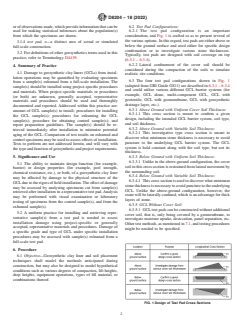
used for making statistical inferences about the population(s) 6.2.1 The test pad configuration is an important
from which the specimens are drawn. consideration, and Fig. 1 is crafted so as to present several of
the various options. In this regard, test pads are either above or
3.1.4 test pad, n—a distinct area of actual or simulated
below the ground surface and used either for specific design
full-scale construction.
confirmation or to investigate various stone thicknesses.
3.2 For definitions of other geosynthetics terms used in this
Typically, test pads are designed with soil coverage on top
practice, refer to Terminology D4439.
(6.3.1 – 6.3.4).
6.2.2 Lateral confinement of the cover soil should be
4. Summary of Practice
considered during the compaction of the soils to simulate
4.1 Damage to geosynthetic clay liners (GCLs) from instal-
realistic site conditions.
lation operations may be quantified by evaluating specimens
6.3 The four test pad configurations shown in Fig. 1
from a sample(s) exhumed from a full-scale installation. The
(adapted from GRI Guide GS11) are described in 6.3.1 – 6.3.4
sample(s) should be installed using project-specific procedures
and could utilize various different GCL barrier systems (for
and materials. When project-specific materials or procedures
example, GCL alone, multi-component GCL, GCL with
(or both) are unknown, generally accepted, representative
geotextile, GCL with geomembrane, GCL with geosynthetic
materials and procedures should be used and thoroughly
drainage layer, etc.).
documented and reported. Addressed within this practice are:
6.3.1 Above Ground with Uniform Cover Soil Thickness:
amount of GCL sample(s) to install; procedures for installing
6.3.1.1 This cross section is meant to confirm a given
the GCL sample(s); procedures for exhuming the GCL
design, including the intended GCL barrier system, soil type,
sample(s); procedure for obtaining control sample(s); and
and soil thickness.
report preparation guidelines. The sample(s) should be re-
6.3.2 Above Ground with Variable Soil Thickness:
trieved immediately after installation to minimize potential
6.3.2.1 This investigative type cross section is meant to
aging of the GCL. Comparison of test results on exhumed and
discover what minimum stone thickness is necessary to avoid
control specimens may be used to assess effects of installation.
puncture to the underlying GCL barrier system. The GCL
Tests to perform are not addressed herein, and will vary with
system is held constant along with the soil type, but not its
thetypeandfunctionofgeosyntheticandprojectrequirements.
thickness.
5. Significance and Use 6.3.3 Below Ground with Uniform Soil Thickness:
6.3.3.1 Unlike in the above-ground configuration, the cover
5.1 The ability to maintain design function (for example,
soilinthiscrosssectionisrestrainedfromlateralmovementby
barrier) or design properties (for example, peel strength,
the surrounding soil.
chemical resistance, etc.), or both, of a geosynthetic clay liner
6.3.4 Below Ground with Variable Soil Thickness:
may be affected by damage to the physical structure of the
6.3.4.1 Thiscrosssectionisusedtodiscoverwhatminimum
GCLduetotherigorsoffieldinstallation.Theeffectofdamage
stonethicknessisnecessarytoavoidpuncturetotheunderlying
may be assessed by analyzing specimens cut from sample(s)
GCL. Unlike the above-ground configuration, however, the
retrieved after installation in a representative test pad.Analysis
stonewillbelaterallyconfined,whichisanadvantageforthick
may be performed with visual examination or laboratory
layers of stone.
testing of specimens from the control sample(s), and from the
6.3.5 GCL Without Cover Soil:
exhumed sample(s).
6.3.5.1 GCLtest pads can be constructed without additional
5.2 A uniform practice for installing and retrieving repre-
cover soil, that is, only being covered by a geomembrane, to
sentative sample(s) from a test pad is needed to assess
investigate moisture uptake, desiccation, panel separation, etc.
installation damage using project-specific or generally
Othertestmethods,asmentionedin7.1,andtestingprocedures
accepted, representative materials and procedures. Damage of
might be needed to be specified.
a specific grade and type of GCL under specific installation
procedures may be assessed with sample(s) exhumed from a
full-scale test pad.
6. Procedure
6.1 Objective—Geosynthetic clay liner and soil placement
techniques shall model the methods anticipated during
construction, but may also be designed to model hypothetical
conditions such as various degrees of compaction, lift heights,
drop heights, equipment operations, types of fill material, or
combinations thereof.
FIG. 1 Design of Test Pad Cross Sections
D8204 − 18 (2022)
6.3.5.2 GCLtest pads can be constructed without cover soil 6.7.3 The material to be placed above the GCL under
todemonstratethatvehiclescandriveovertheGCL,ifneeded, investigation will typically be a soil fill, or another geosyn-
to install other geosynthetic materials (Guide D6102 mentions thetic material(s) with soil then placed upon it. When project-
that low ground pressure vehicles such as four-wheeled all- specific procedures or materials (or both) are not known,
terrain vehicles may be suitable) such as geomembranes, representative equipment, materials, and procedures should be
geosynthetic drainage systems, geotextiles, geogrids, or other used and thoroughly documented.
geosynthetic materials.
NOTE 3—In certain situations, such as multiple-layer installations,
6.4 The type of soil or rock (or both) of the foundation movement of individual layers in test pads may occur. Care should be
takentoensurethatstressandpotentialslippageconditionsinthetestpads
material upon which the GCL is placed is a critical item. If
simulate actual field conditions as closely as possible.
stones (or rock) are present, the GCL can likely be punctured
6.7.4 Fill placement above the GCL shall model expected
from below. It might be necessary to place an additional
field conditions. Construction equipment used in fill placement
protection geotextile beneath the GCL. If this is not the intent,
should be the same as that to be used in subsequent construc-
then a proper foundation material must be agreed upon by the
tion of the earth structure. Equipment shall be operated in
parties involved.
accordance with project-specific procedures. When project-
6.5 The type(s) of traffic loading/repetitions is another
specific equipment, procedures, materials, or combinations
critical item, and must be agreed upon by the various parties
thereof are not known, representative equipment, materials,
involved.
and procedures should be used and thoroughly documented.
6.6 Size of Test Pad:
6.7.5 SpreadfillintoliftsabovetheGCLmodelingexpected
6.6.1 The width of the test pad should be at least 100 %
field conditions. Construction equipment used in fill spreading
greater than the width of the agreed-upon placement and
should be in accordance with project-specific procedures.
compaction equipment or the trafficking equipment for the two
When project-specific equipment, procedures, materials, or
above-ground options and 50 % greater for the two below-
combinationsthereof arenot known, representativeequipment,
ground options. In this regard, the confinement by natural soil
materials, and procedures should be used and thoroughly
is an advantage. Other advantages are that equipment will not
documented.
havetorampuporrampdownfromanelevatedtestpadplaced
6.7.6 Fill lift compaction above the GCL shall model
on the original ground surface, as well as the associated safety
expected field conditions. Construction equipment used in soil
considerations.
compaction should be in accordance with pro
...