

ASTM F2992-23
(Test Method)Standard Test Method for Measuring Cut Resistance of Materials Used in Protective Clothing with Tomodynamometer Test Equipment
General Information
- Abstract
SIGNIFICANCE AND USE
5.1 This test method assesses the cut resistance of a material when exposed to a cutting edge under specified loads. Data obtained from this test method can be used to compare the cut resistance of different materials.
5.2 This test method only addresses that range of cutting hazards that are related to a cutting action by a smooth sharp edge across the surface of the material. It is not representative of any other cutting hazard to which the material may be subjected, such as serrated edges, saw blades, or motorized cutting tools. Nor is it representative of puncture, tear, or other modes of fabric failure.
SCOPE
1.1 This test method covers the measurement of the cut resistance of a material when mounted on a specimen holder and subjected to a cutting edge under a specified load using a tomodynamometer.2
1.1.1 This procedure is not valid for high-porosity materials which allow cutting edge contact with the mounting surface prior to cutting.
1.1.2 Test apparatus may have limitations in testing materials with a thickness greater than 20 mm.
1.2 The values stated in SI units are to be regarded as standard. The values given in parentheses after SI units are provided for information only and are not considered standard.
1.3 This standard does not purport to address all of the safety concerns, if any, associated with its use. It is the responsibility of the user of this standard to establish appropriate safety, health, and environmental practices and determine the applicability of regulatory limitations prior to use.
1.4 This international standard was developed in accordance with internationally recognized principles on standardization established in the Decision on Principles for the Development of International Standards, Guides and Recommendations issued by the World Trade Organization Technical Barriers to Trade (TBT) Committee.
- Status
- Published
- Publication Date
- 28-Feb-2023
- Technical Committee
- F23 - Personal Protective Clothing and Equipment
- Drafting Committee
- F23.20 - Physical
Buy Documents
ASTM F2992-23 - Standard Test Method for Measuring Cut Resistance of Materials Used in Protective Clothing with Tomodynamometer Test Equipment
REDLINE ASTM F2992-23 - Standard Test Method for Measuring Cut Resistance of Materials Used in Protective Clothing with Tomodynamometer Test Equipment
Overview
ASTM F2992-23: Standard Test Method for Measuring Cut Resistance of Materials Used in Protective Clothing with Tomodynamometer Test Equipment provides a widely recognized procedure for assessing and comparing the cut resistance of protective clothing materials. Developed and published by ASTM International, this test method specifically evaluates how resistant a material is to cutting hazards posed by a smooth, sharp edge, using specialized tomodynamometer (TDM-100) equipment.
Cut resistance is a critical performance criterion for personal protective equipment (PPE), especially in industries such as manufacturing, construction, automotive, and emergency response. By following ASTM F2992-23, manufacturers, testing laboratories, and safety professionals are able to reliably measure and classify the protective qualities of gloves, garments, and other safety apparel.
Key Topics
- Test Principle: The standard describes a method where a sharp-edged blade moves at a constant speed across a material specimen mounted on a holder. The apparatus applies a specified load, and the distance the blade travels before causing a cut-through is measured.
- Measured Parameters:
- Cut-through distance: The length the blade travels before penetrating the material.
- Calculated cutting load: The force required to achieve a standardized cut-through (reference distance) of 20 mm.
- Applicability: The method is suitable for materials typically used in protective clothing, as long as they are not high-porosity materials or materials thicker than 20 mm.
- Limitations: This test does not assess resistance against serrated blades, motorized cutting tools, punctures, or other failure modes. It is designed exclusively for smooth, sharp-edge hazards.
- Test Equipment: Requires a tomodynamometer (TDM-100) that can maintain precise loads and measure blade movement accurately.
- Repeatability and Reproducibility: The standard includes guidance and data for establishing precision across different laboratories.
Applications
- Protective Glove and Clothing Manufacturers: Enables objective comparison of the cut resistance of new or existing materials for product development and certification.
- Quality Assurance Testing: Ensures that production runs of protective materials continue to meet safety benchmarks for cut protection.
- Regulatory Compliance: Assists manufacturers and end users in complying with occupational health and safety standards requiring quantifiable cut resistance in PPE.
- Material R&D: Facilitates innovation in textiles and composite materials aimed at improving safety without compromising flexibility or comfort.
- Procurement & Specification: Provides data for safety managers and buyers to make informed decisions when selecting protective clothing based on standardized cut resistance ratings.
Related Standards
- ASTM F1790: Test Method for Measuring Cut Resistance of Materials Used in Protective Clothing with CPP Test Equipment - an alternative cut resistance test using different equipment.
- ISO 13997: Protective Clothing-Mechanical Properties-Determination of Resistance to Cutting by Sharp Objects - an international standard for cut resistance.
- ASTM D123: Standard Terminology Relating to Textiles – defines terms for textile materials.
- ASTM F1494: Terminology Relating to Protective Clothing – provides definitions specific to PPE.
- ASTM D1000 and D1776: Cover test methods and conditioning requirements for materials and adhesives.
Practical Value
ASTM F2992-23 is an essential resource for those involved in the design, selection, verification, and regulation of protective clothing and PPE materials, offering:
- Consistent, repeatable methodology for evaluating cut resistance.
- Objective data for product labeling and user protection.
- Improved workplace safety through standardized assessment of clothing performance.
- Worldwide recognition and acceptance for procurement and regulatory processes.
Keywords: cut resistance, protective clothing, tomodynamometer, ASTM F2992, TDM-100, PPE testing, calculated cutting load, cut-through distance, safety apparel standards.
Relations
- Effective Date
- 01-Feb-2020
- Effective Date
- 01-Jul-2017
- Effective Date
- 01-Mar-2017
- Effective Date
- 01-Jan-2016
- Effective Date
- 15-Sep-2015
- Effective Date
- 01-Sep-2015
- Effective Date
- 01-Apr-2015
- Effective Date
- 01-Feb-2015
- Effective Date
- 01-May-2014
- Effective Date
- 01-Jul-2013
- Effective Date
- 15-Jun-2013
- Effective Date
- 15-Jun-2013
- Effective Date
- 15-May-2013
- Effective Date
- 01-May-2013
- Effective Date
- 01-May-2013
Buy Documents
ASTM F2992-23 - Standard Test Method for Measuring Cut Resistance of Materials Used in Protective Clothing with Tomodynamometer Test Equipment
REDLINE ASTM F2992-23 - Standard Test Method for Measuring Cut Resistance of Materials Used in Protective Clothing with Tomodynamometer Test Equipment
Get Certified
Connect with accredited certification bodies for this standard

CIS Institut d.o.o.
Personal Protective Equipment (PPE) certification body. Notified Body NB-2890 for EU Regulation 2016/425 PPE.

Kiwa BDA Testing
Building and construction product certification.
Kmetijski inštitut Slovenije
Agricultural Institute of Slovenia. Soil testing, plant health, agricultural product analysis.
Sponsored listings
Frequently Asked Questions
ASTM F2992-23 is a standard published by ASTM International. Its full title is "Standard Test Method for Measuring Cut Resistance of Materials Used in Protective Clothing with Tomodynamometer Test Equipment". This standard covers: SIGNIFICANCE AND USE 5.1 This test method assesses the cut resistance of a material when exposed to a cutting edge under specified loads. Data obtained from this test method can be used to compare the cut resistance of different materials. 5.2 This test method only addresses that range of cutting hazards that are related to a cutting action by a smooth sharp edge across the surface of the material. It is not representative of any other cutting hazard to which the material may be subjected, such as serrated edges, saw blades, or motorized cutting tools. Nor is it representative of puncture, tear, or other modes of fabric failure. SCOPE 1.1 This test method covers the measurement of the cut resistance of a material when mounted on a specimen holder and subjected to a cutting edge under a specified load using a tomodynamometer.2 1.1.1 This procedure is not valid for high-porosity materials which allow cutting edge contact with the mounting surface prior to cutting. 1.1.2 Test apparatus may have limitations in testing materials with a thickness greater than 20 mm. 1.2 The values stated in SI units are to be regarded as standard. The values given in parentheses after SI units are provided for information only and are not considered standard. 1.3 This standard does not purport to address all of the safety concerns, if any, associated with its use. It is the responsibility of the user of this standard to establish appropriate safety, health, and environmental practices and determine the applicability of regulatory limitations prior to use. 1.4 This international standard was developed in accordance with internationally recognized principles on standardization established in the Decision on Principles for the Development of International Standards, Guides and Recommendations issued by the World Trade Organization Technical Barriers to Trade (TBT) Committee.
SIGNIFICANCE AND USE 5.1 This test method assesses the cut resistance of a material when exposed to a cutting edge under specified loads. Data obtained from this test method can be used to compare the cut resistance of different materials. 5.2 This test method only addresses that range of cutting hazards that are related to a cutting action by a smooth sharp edge across the surface of the material. It is not representative of any other cutting hazard to which the material may be subjected, such as serrated edges, saw blades, or motorized cutting tools. Nor is it representative of puncture, tear, or other modes of fabric failure. SCOPE 1.1 This test method covers the measurement of the cut resistance of a material when mounted on a specimen holder and subjected to a cutting edge under a specified load using a tomodynamometer.2 1.1.1 This procedure is not valid for high-porosity materials which allow cutting edge contact with the mounting surface prior to cutting. 1.1.2 Test apparatus may have limitations in testing materials with a thickness greater than 20 mm. 1.2 The values stated in SI units are to be regarded as standard. The values given in parentheses after SI units are provided for information only and are not considered standard. 1.3 This standard does not purport to address all of the safety concerns, if any, associated with its use. It is the responsibility of the user of this standard to establish appropriate safety, health, and environmental practices and determine the applicability of regulatory limitations prior to use. 1.4 This international standard was developed in accordance with internationally recognized principles on standardization established in the Decision on Principles for the Development of International Standards, Guides and Recommendations issued by the World Trade Organization Technical Barriers to Trade (TBT) Committee.
ASTM F2992-23 is classified under the following ICS (International Classification for Standards) categories: 13.340.10 - Protective clothing. The ICS classification helps identify the subject area and facilitates finding related standards.
ASTM F2992-23 has the following relationships with other standards: It is inter standard links to ASTM D1776/D1776M-20, ASTM D1000-17, ASTM D123-17, ASTM D1776/D1776M-16, ASTM D123-15b, ASTM D123-15a, ASTM D123-15, ASTM D1776/D1776M-15, ASTM E177-14, ASTM F1494-13, ASTM D123-13ae1, ASTM D123-13a, ASTM D123-13, ASTM E691-13, ASTM E177-13. Understanding these relationships helps ensure you are using the most current and applicable version of the standard.
ASTM F2992-23 is available in PDF format for immediate download after purchase. The document can be added to your cart and obtained through the secure checkout process. Digital delivery ensures instant access to the complete standard document.
Standards Content (Sample)
This international standard was developed in accordance with internationally recognized principles on standardization established in the Decision on Principles for the
Development of International Standards, Guides and Recommendations issued by the World Trade Organization Technical Barriers to Trade (TBT) Committee.
Designation: F2992 − 23
Standard Test Method for
Measuring Cut Resistance of Materials Used in Protective
Clothing with Tomodynamometer Test Equipment
This standard is issued under the fixed designation F2992; the number immediately following the designation indicates the year of
original adoption or, in the case of revision, the year of last revision. A number in parentheses indicates the year of last reapproval. A
superscript epsilon (´) indicates an editorial change since the last revision or reapproval.
1. Scope Coated Tapes Used for Electrical and Electronic Applica-
tions
1.1 This test method covers the measurement of the cut
D1776/D1776M Practice for Conditioning and Testing Tex-
resistance of a material when mounted on a specimen holder
tiles
and subjected to a cutting edge under a specified load using a
2 E177 Practice for Use of the Terms Precision and Bias in
tomodynamometer.
ASTM Test Methods
1.1.1 This procedure is not valid for high-porosity materials
E691 Practice for Conducting an Interlaboratory Study to
which allow cutting edge contact with the mounting surface
Determine the Precision of a Test Method
prior to cutting.
F1494 Terminology Relating to Protective Clothing
1.1.2 Test apparatus may have limitations in testing materi-
2.2 ISO Standards:
als with a thickness greater than 20 mm.
ISO 13997 Protective Clothing—Mechanical Properties—
1.2 The values stated in SI units are to be regarded as
Determination of Resistance to Cutting by Sharp Objects
standard. The values given in parentheses after SI units are
3. Terminology
provided for information only and are not considered standard.
1.3 This standard does not purport to address all of the 3.1 Definitions:
3.1.1 calculated cutting load, n—in cut resistance testing,
safety concerns, if any, associated with its use. It is the
responsibility of the user of this standard to establish appro- the load required to cause a cutting edge to produce a
cut-through when it traverses the reference distance across the
priate safety, health, and environmental practices and deter-
mine the applicability of regulatory limitations prior to use. material being tested.
3.1.1.1 Discussion—The calculated cutting load is deter-
1.4 This international standard was developed in accor-
dance with internationally recognized principles on standard- mined by performing a series of tests at three or more loads as
ization established in the Decision on Principles for the described in Section 11. A material with a higher calculated
Development of International Standards, Guides and Recom- cutting load is considered to be more cut resistant.
mendations issued by the World Trade Organization Technical
3.1.2 cut resistance, n—in blade cut testing, the property
Barriers to Trade (TBT) Committee.
that hinders cut-through when a material or a combination of
materials is exposed to a sharp-edged device.
2. Referenced Documents
3.1.3 cut-through, n—in blade cut resistance tests, the pen-
2.1 ASTM Standards:
etration of the cutting edge entirely through material as
D123 Terminology Relating to Textiles
indicated by electrical contact of the cutting edge and the
D1000 Test Methods for Pressure-Sensitive Adhesive-
conductive strip or substrate.
3.1.4 cut-through distance, n—in cut resistance testing, the
This test method is under the jurisdiction of ASTM Committee F23 on Personal distance of required travel by the cutting edge to cut through
Protective Clothing and Equipment and is the direct responsibility of Subcommittee
the specimen.
F23.20 on Physical.
3.1.5 cutting edge, n—in cut resistance tests, a sharp-edged
Current edition approved March 1, 2023. Published April 2023. Originally
approved in 2015. Last previous edition approved in 2015 as F2992/F2992M – 15.
device used to initiate cut-through of a planar structure.
DOI: 10.1520/F2992-23.
2 3.1.6 no cut, n—in cut resistance testing, a trial for which
Derived from the Greek tomo, to cut or slice, dynamo, force or energy, and
meter, to measure. From Masse, S., Lara, J., Sirard, C., and Daigle, R., “Basic the load used is insufficient to cause a cut-through in the
Principles Used in the Development of a New Cut-Test Machine for
maximum allowable blade travel of the apparatus.
Standardization,” ASTM Special Technical Publication No. 1273, 1997, pp. 66–83.
For referenced ASTM standards, visit the ASTM website, www.astm.org, or
contact ASTM Customer Service at service@astm.org. For Annual Book of ASTM Available from International Organization for Standardization (ISO), ISO
Standards volume information, refer to the standard’s Document Summary page on Central Secretariat, Chemin de Blandonnet 8, CP 401, 1214 Vernier, Geneva,
the ASTM website. Switzerland, http://www.iso.org.
Copyright © ASTM International, 100 Barr Harbor Drive, PO Box C700, West Conshohocken, PA 19428-2959. United States
F2992 − 23
3.1.6.1 Discussion—For this test method, the maximum 6. Apparatus
allowable blade travel is 50 mm (1.97 in.).
6.1 Test Principle—The principle of the cut test is to
3.1.7 protective clothing, n—an item of clothing that is
measure the distance traveled by a cutting edge as it is
specifically designed and constructed for the intended purpose
maintained under a load during the test. The cut test apparatus
of isolating all or part of the body from a potential hazard; or,
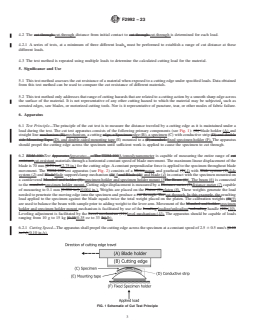
consists of the following primary components (see Fig. 1):
isolating the external environment from contamination by the
blade holder (A) and straight line mechanism, a cutting edge
wearer of the clothing.
(B), a specimen (C) with conductive strip (D), and double-
3.1.7.1 Discussion—In this test method, the potential hazard
sided mounting tape (E) mounted to a fixed specimen holder
is cutting.
(F). The apparatus should propel the cutting edge across the
3.1.8 reference distance, n—in cut resistance testing, a
specimen until sufficient work is applied to cause the specimen
standardized distance for a blade to travel across a material to
to cut through.
produce a cut-through.
6.2 Test Apparatus—A tomodynamometer is capable of
3.1.8.1 Discussion—For this test method, the reference
measuring the entire range of cut-resistant materials through a
distance is 20 mm (0.8 in.).
horizontal constant speed of blade movement. The maximum
3.2 Additional Terminology—Terms relevant to textiles are
linear displacement of the blade is 70 mm (2.75 in.) for the
defined in Terminology D123. Terms relevant to protective
cutting edge. A constant perpendicular force is applied to the
clothing are defined in Terminology F1494.
specimen throughout blade movement. The test apparatus (see
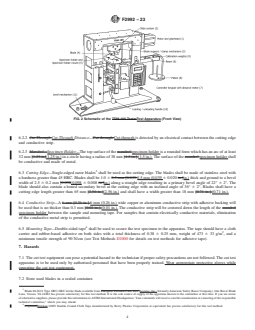
Fig. 2) consists of a motor and gearhead (1) with slide system
4. Summary of Test Method
(2) and blade support/clamp mechanism (3) and blade (4) in
4.1 A cutting edge under a specified load is moved one time
contact with the specimen mounted on a cantilevered specimen
across a specimen mounted on a specimen holder.
holder and specimen holder mount (5). The beam (6) is
4.2 The cut-through distance from initial contact to cut-
connected to the specimen holder mount. Cutting edge dis-
through is determined for each load.
placement is measured by a distance meter (7) capable of
4.2.1 A series of tests, at a minimum of three different loads,
measuring to 0.1 mm (0.004 in.). Weights are placed on the
must be performed to establish a range of cut distance at these
platen (8). These weights generate the load needed to penetrate
different loads.
the moving edge into the specimen and produce a cut-through.
In this example, the resulting load applied to the specimen
4.3 The test method is repeated using multiple loads to
determine the calculated cutting load for the material. against the blade equals twice the total weight placed on the
platen. The calibration weights (9) are used to balance the
5. Significance and Use
beam with sample prior to adding weight to the lever arm.
Movement of the specimen holder and specimen holder mount
5.1 This test method assesses the cut resistance of a material
mechanism is facilitated by use of the loading/unloading
when exposed to a cutting edge under specified loads. Data
handle (10). Leveling adjustment is facilitated by the level
obtained from this test method can be used to compare the cut
mechanism (11). The apparatus should be capable of loads
resistance of different materials.
ranging from 10 g to 15 kg (0.35 oz to 33 lb).
5.2 This test method only addresses that range of cutting
6.2.1 Cutting Speed—The apparatus shall propel the cutting
hazards that are related to a cutting action by a smooth sharp
edge across the specimen at a constant speed of 2.5 6 0.5 mm/s
edge across the surface of the material. It is not representative
(0.10 in./s).
of any other cutting hazard to which the material may be
subjected, such as serrated edges, saw blades, or motorized 6.2.2 Cut-Through Distance—Cut-through is detected by an
cutting tools. Nor is it representative of puncture, tear, or other electrical contact between the cutting edge and conductive
modes of fabric failure. strip.
FIG. 1 Schematic of Cut Test Principle
F2992 − 23
FIG. 2 Schematic of the Test Apparatus (Front View)
6.2.3 Specimen Holder—The top surface of the specimen 7. Hazards
holder is a rounded form which has an arc of at least 32 mm
7.1 The cut test equipment can pose a potential hazard to the
(1.25 in.) in a circle having a radius of 38 mm (1.5 in.). The
technician if proper safety precautions are not followed. The
surface of the specimen holder shall be conductive and made of
cut test apparatus is to be used only by authorized personnel
metal.
that have been properly trained. Wear appropriate protective
6.3 Cutting Edge—Single-edged razor blades shall be used
gloves while operating the cut test equipment.
as the cutting edge. The blades shall be made of stainless steel
7.2 Store used blades in a sealed container.
with a hardness greater than 45 HRC. Blades shall be 1.0 6
0.5 mm (0.039 6 0.020 in.) thick and ground to a bevel width 7.3 Remove blades from the apparatus at the end of each
of 2.5 6 0.2 mm (0.098 6 0.008 in.) along a straight edge
test or when the apparatus is not in use.
resulting in a primary bevel angle of 22° 6 2°. The blade
7.4 Keep hands out of cutting area when a blade is installed
should also contain a honed secondary bevel at the cutting edge
in the apparatus and when the apparatus is operating.
with an inclined angle of 36° 6 2°. Blades shall have a cutting
edge length greater than 65 mm (2.56 in.) and shall have a 7.5 Turn off machine before making instrument adjustments
width greater than 18 mm (0.71 in.). to avoid the chance of a low-voltage shock.
6.4 Conductive Strip—A 6 mm (0.26 in.) wide copper or
8. Sampling and Test Specimens
aluminum conductive strip with adhesive backing will be used
that is no thicker than 0.3 mm (0.01 in.). The conductive strip
8.1 Lot Sample—As a lot sample for acceptance testing, take
will be centered down the length of the specimen holder
at random the number of shipping units directed in an
between the sample and mounting tape. For samples that
applicable material specification.
contain electrically conductive materials, elimination of the
8.2 Laboratory Sample—As a laboratory sample for accep-
conductive metal strip is permitted.
tance testing, take at random from each shipping unit in the lot
6.5 Mounting Tape—Double-sided tape shall be used to
sample the number of packages or pieces directed in an
secure the test specimen to the apparatus. The tape should have
applicable material specification or other agreement between
a cloth carrier and rubber-based adhesive on both sides with a
the purchaser and the supplier.
total thickness of 0.38 6 0.25 mm, weight of 473 6 33 g/m ,
8.3 Protective Clothing Sample—A sample of the actual
and a minimum tensile strength of 90 N/cm (see Test Methods
protective clothing article.
D1000 for details on test methods for adhesive tape).
8.4 Test Specimens:
Blade 88-0121 Type GRU-GRU textile blade available from Accutec, Inc. 8.4.1 Take test specimens at random from each sample.
(formerly American Safety Razor Company), One Razor Blade Lane, Verona, VA
8.4.1.1 When performing up to 15 cut tests per specimen, as
24482 has proven satisfactory for this test method. It is the sole source of supply of
when determining the reference load of the material, the
the apparatus known to the committee at this time. If you are aware of alternative
suppliers, please provide this information to ASTM International Headquarters. specimen shall have a minimum dimension of 25.4 by 100 mm
Your comments will receive careful consideration at a meeting of the responsible
(1.0 by 4.0 in.).
technical committee, which you may attend.
8.4.1.2 For textile materials, cut the specimen on the bias as
Polyken 108Fr Double-Coated Cloth Tape manufactured by Berry Plastics
Corporation or equivalent has proven satisfactory for this test method. to create an angle of 0.785 rad (45°) between the machine and
F2992 − 23
cross-machine directions of the material (see Terminology 10. Conditioning
D123 for the definition of machine directions of textile
10.1 Condition test specimens as indicated in Practice
materials).
D1776/D1776M.
8.4.1.3 For gloves and sleeves, cut the specimen from the
primary protective area of the glove, usually the palm area or
11. Procedure
other area claiming to be cut resistant. Cut the specimen on the
11.1 Specimen Mounting:
bias as to create an angle of 0.785 rad (45°) between the
11.1.1 Cover the specimen holder surface with double-sided
machine and cross-machine directions of the material.
tape and place a 6 mm (0.25 in.) conductive strip with the
NOTE 1—For small samples of insufficient width to cut the sample on
adhesive side up centered down the length of the specimen
the bias, such as protective clothing, cut the test specimen parallel to the
holder on the double-sided tape. Clip the end of this strip to the
machine direction up to the maximum allowable width and then rotate it
specimen holder, or attach it securely to the electrical circuit
0.785 rad (45°) when mounting it on the apparatus.
that detects cut-through. Without stretching or distorting the
9. Calibration and Standardization
material, place the test specimen over the tape with the surface
9.1 Beam Balancing Procedure – #1: to be cut facing up. Apply firm pressure on the specimen to
9.1.1 Remove any sample or tape from the sample holder. secure it to the specimen holder. For samples that contain
9.1.2 Install sample holder on the base. electrically conductive materials, the conductive strip can be
9.1.3 Carefully control the vertical movement of the sample eliminated.
holder when unlocking the cam lock device with the loading/
NOTE 2—The tape and strip can also be applied directly to the sample
unloading handle.
before the test specimen is cut and then mounted directly to the specimen
9.1.4 Place the mechanism horizontally.
holder. This procedure is helpful for materials that curl or distort when
being cut from the sample.
9.1.5 If mechanism stays in equilibrium, the apparatus is
correctly balanced. If mechanism loses equilibrium, follow
11.1.2 Insert the specimen holder in the specimen holder
procedure #2 (9.2) for beam balancing.
mount with the sample facing the blade and position the
specimen holder in place.
9.2 Beam Balancing Procedure – #2:
11.1.3 Balance the beam with sample prior to adding
9.2.1 Lock movement of the beam in the higher position
weights to the platen. This can be done either by adjusting the
with cam lock device.
calibration weights or by adding half of the sample mounting
9.2.2 Remove blade holder with the quick release ball lock
weight to the platen.
device.
9.2.3 Place the mechanism horizontally.
11.2 Test Procedure for Measuring the Cut-Through Dis-
9.2.4 Counterbalance with the two fine adjustment nuts until
tance:
the mechanism stays in equilibrium.
11.2.1 Insert a new blade from a validated blade supply in
9.3 Validation of Cutting Edge Supply: the blade clamp and tighten the blade clamping system.
9.3.1 Calibration Material—Calibration material is a neo-
NOTE 3—Refer to 9.3 for instructions on how to validate the blade
prene sheet, having a hardness of 50 6 5 Shore A and a
supply.
thickness of 1.57 6 0.05 mm (0.062 6 0.002 in.).
11.2.2 Verify that the cutting arm is at the ready position,
9.3.1.1 Store the calibration material under controlled labo-
making certain that only the blade edge and
...
This document is not an ASTM standard and is intended only to provide the user of an ASTM standard an indication of what changes have been made to the previous version. Because
it may not be technically possible to adequately depict all changes accurately, ASTM recommends that users consult prior editions as appropriate. In all cases only the current version
of the standard as published by ASTM is to be considered the official document.
Designation: F2992/F2992M − 15 F2992 − 23
Standard Test Method for
Measuring Cut Resistance of Materials Used in Protective
Clothing with Tomodynamometer (TDM-100) Test
Equipment
This standard is issued under the fixed designation F2992/F2992M;F2992; the number immediately following the designation indicates
the year of original adoption or, in the case of revision, the year of last revision. A number in parentheses indicates the year of last
reapproval. A superscript epsilon (´) indicates an editorial change since the last revision or reapproval.
1. Scope
1.1 This test method covers the measurement of the cut resistance of a material when mounted on a mandrel specimen holder and
subjected to a cutting edge under a specified load using the Tomodynamometer a tomodynamometer.(TDM-100).
1.1.1 This procedure is not valid for high-porosity materials which allow cutting edge contact with the mounting surface prior to
cutting.
1.1.2 Test apparatus may have limitations in testing materials with a thickness greater than 20 mm.
1.2 The values stated in either SI units or inch-pound units are to be regarded separately as standard. The values stated in each
system may not be exact equivalents; therefore, each system shall be used independently of the other. Combining values from the
two systems may result in non-conformance with the given in parentheses after SI units are provided for information only and are
not considered standard.
1.3 This standard does not purport to address all of the safety concerns, if any, associated with its use. It is the responsibility
of the user of this standard to establish appropriate safety and healthsafety, health, and environmental practices and determine
the applicability of regulatory limitations prior to use.
1.4 This international standard was developed in accordance with internationally recognized principles on standardization
established in the Decision on Principles for the Development of International Standards, Guides and Recommendations issued
by the World Trade Organization Technical Barriers to Trade (TBT) Committee.
2. Referenced Documents
2.1 ASTM Standards:
D123 Terminology Relating to Textiles
D1000 Test Methods for Pressure-Sensitive Adhesive-Coated Tapes Used for Electrical and Electronic Applications
D1776D1776/D1776M Practice for Conditioning and Testing Textiles
E177 Practice for Use of the Terms Precision and Bias in ASTM Test Methods
E691 Practice for Conducting an Interlaboratory Study to Determine the Precision of a Test Method
This test method is under the jurisdiction of ASTM Committee F23 on Personal Protective Clothing and Equipment and is the direct responsibility of Subcommittee
F23.20 on Physical.
Current edition approved July 1, 2015March 1, 2023. Published August 2015April 2023. Originally approved in 2015. Last previous edition approved in 2015 as
F2992/F2992M – 15. DOI: 10.1520/F2992_F2992M-15.10.1520/F2992-23.
Derived from the Greek tomo, to cut or slice, dynamo, force or energy, and meter, to measure. From Masse, S., Lara, J., Sirard, C., and Daigle, R., “Basic Principles
Used in the Development of a New Cut-Test Machine for Standardization,” ASTM Special Technical Publication No. 1273, 1997, pp. 66–83.
For referenced ASTM standards, visit the ASTM website, www.astm.org, or contact ASTM Customer Service at service@astm.org. For Annual Book of ASTM Standards
volume information, refer to the standard’s Document Summary page on the ASTM website.
Copyright © ASTM International, 100 Barr Harbor Drive, PO Box C700, West Conshohocken, PA 19428-2959. United States
F2992 − 23
F1494 Terminology Relating to Protective Clothing
F1790 Test Method for Measuring Cut Resistance of Materials Used in Protective Clothing with CPP Test Equipment
2.2 ISO Standards:
ISO 13997 Protective Clothing—Mechanical Properties—Determination of Resistance to Cutting by Sharp Objects
3. Terminology
3.1 Definitions:
3.1.1 calculated cutting load, n—in cut resistance testing, the load required to cause a cutting edge to produce a cut-through when
it traverses the reference distance across the material being tested.
3.1.1.1 Discussion—
The calculated cutting load is determined by performing a series of tests at three or more loads as described in Section 11. A
material with a higher calculated cutting load is considered to be more cut resistant.
3.1.2 cut resistance, n—in blade cut testing, the property that hinders cut through cut-through when a material or a combination
of materials is exposed to a sharp-edged device.
3.1.3 cut through, cut-through, n—in blade cut resistance tests, the penetration of the cutting edge entirely through material as
indicated by electrical contact of the cutting edge and the conductive strip or substrate.
3.1.4 cut through cut-through distance, n—in cut resistance testing, the distance of required travel by the cutting edge to cut
through the specimen.
3.1.5 cutting edge, n—in cut resistance tests, a sharp-edged device used to initiate cut through cut-through of a planar structure.
3.1.6 no cut, n—in cut resistance testing, a trial for which the load used is insufficient to cause a cut through cut-through in the
maximum allowable blade travel of the apparatus.
3.1.6.1 Discussion—
For this test method, the maximum allowable blade travel is 65 mm [2.6 in.].50 mm (1.97 in.).
3.1.7 protective clothing, n—an item of clothing that is specifically designed and constructed for the intended purpose of isolating
all or part of the body from a potential hazard; or, isolating the external environment from contamination by the wearer of the
clothing.
3.1.7.1 Discussion—
In this test method, the potential hazard is cutting.
3.1.7 calculated cutting load, n—in cut resistance testing, the load required to cause a cutting edge to produce a cut through when
it traverses the reference distance across the material being tested.
3.1.7.1 Discussion—
The calculated cutting load is determined by performing a series of tests at three or more loads as described in Section 11. A
material with a higher calculated cutting load is considered to be more cut resistant.
3.1.8 reference distance, n—in cut resistance testing, a standardized distance for a blade to travel across a material to produce a
cut through.cut-through.
3.1.8.1 Discussion—
For this test method, the reference distance is 20 mm [0.8 in.].(0.8 in.).
3.2 Additional Terminology—Terms relevant to textiles are defined in Terminology D123. Terms relevant to protective clothing
are defined in Terminology F1494.
4. Summary of Test Method
4.1 A cutting edge under a specified load is moved one time across a specimen mounted on a mandrel.specimen holder.
Available from International Organization for Standardization (ISO), ISO Central Secretariat, Chemin de Blandonnet 8, CP 401, 1214 Vernier, Geneva, Switzerland,
http://www.iso.org.
F2992 − 23
4.2 The cut through cut-through distance from initial contact to cut through cut-through is determined for each load.
4.2.1 A series of tests, at a minimum of three different loads, must be performed to establish a range of cut distance at these
different loads.
4.3 The test method is repeated using multiple loads to determine the calculated cutting load for the material.
5. Significance and Use
5.1 This test method assesses the cut resistance of a material when exposed to a cutting edge under specified loads. Data obtained
from this test method can be used to compare the cut resistance of different materials.
5.2 This test method only addresses that range of cutting hazards that are related to a cutting action by a smooth sharp edge across
the surface of the material. It is not representative of any other cutting hazard to which the material may be subjected, such as
serrated edges, saw blades, or motorized cutting tools. Nor is it representative of puncture, tear, or other modes of fabric failure.
6. Apparatus
6.1 Test Principle—The principle of the cut test is to measure the distance traveled by a cutting edge as it is maintained under a
load during the test. The cut test apparatus consists of the following primary components (see Fig. 1): (A) blade holder (A) and
straight line mechanism (B) mechanism, a cutting edge, a Specimenedge (B), a specimen (C) with conductive strip (D) and double
side Mounting Tape (D), and double-sided mounting tape (E) mounted to a (F) mandrel. fixed specimen holder (F). The apparatus
should propel the cutting edge across the specimen until sufficient work is applied to cause the specimen to cut through.
6.2 TDM-100 Test ApparatusApparatus——The TDM-100A tomodynamometer is capable of measuring the entire range of cut
resistant cut-resistant materials through a horizontal constant speed of blade movement. The maximum linear displacement of the
blade is 70 mm [2.75 in.](2.75 in.) for the cutting edge. A constant perpendicular force is applied to the specimen throughout blade
movement. The TDM-100 test apparatus (see Fig. 2) consists of a Motormotor and gearhead (1)(1) with Slide system (2)slide
system (2) and Bladeblade support/clamp mechanism (3)(3 and Blade (4)) and blade (4) in contact with the specimen mounted on
a cantilevered Mandrel and holder (5). specimen holder and specimen holder mount (5The Beam (6)). The beam (6) is connected
to the mandrel. specimen holder mount. Cutting edge displacement is measured by a Distance meter (7)distance meter (7) capable
of measuring to 0.1 mm [0.004 in.].(0.004 in.). Weights are placed on the Platen (8).platen (8). These weights generate the load
needed to penetrate the moving edge into the specimen and produce a cut through. The cut-through. In this example, the resulting
load applied to the specimen against the blade equals twice the total weight placed on the platen. The calibration weights (9)(9)
are used to balance the beam with sample prior to adding weight to the lever arm. Movement of the Mandrel and holder specimen
holder and specimen holder mount mechanism is facilitated by use of the Loading loading/unloading⁄ unloading handle (10).(10).
Leveling adjustment is facilitated by the Level mechanism (11).level mechanism (11). The apparatus should be capable of loads
ranging from 10 g to 15 kg [0.35(0.35 oz to 33 lb].lb).
6.2.1 Cutting Speed—The apparatus shall propel the cutting edge across the specimen at a constant speed of 2.5 6 0.5 mm/s [0.10
in./s].(0.10 in./s).
FIG. 1 Schematic of Cut Test Principle
F2992 − 23
FIG. 2 Schematic of the TDM-100 TesterTest Apparatus (Front View)
6.2.2 Cut Through Cut-Through Distance—Cut through Cut-through is detected by an electrical contact between the cutting edge
and conductive strip.
6.2.3 Mandrel—Specimen Holder—The top surface of the mandrel specimen holder is a rounded form which has an arc of at least
32 mm [1.25 in](1.25 in.) in a circle having a radius of 38 mm [1.5 in.].(1.5 in.). The surface of the mandrel specimen holder shall
be conductive and made of metal.
6.3 Cutting Edge—Single-edged razor blades shall be used as the cutting edge. The blades shall be made of stainless steel with
a hardness greater than 45 HRC. Blades shall be 1.0 6 0.5 mm [0.039 0.5 mm (0.039 6 0.020 in.]in.) thick and ground to a bevel
width of 2.5 6 0.2 mm [0.098(0.098 6 0.008 in.]in.) along a straight edge resulting in a primary bevel angle of 22° 6 2°. The
blade should also contain a honed secondary bevel at the cutting edge with an inclined angle of 36° 6 2°. Blades shall have a
cutting edge length greater than 65 mm [2.56 in.](2.56 in.) and shall have a width greater than 18 mm [0.71 in.].(0.71 in.).
6.4 Conductive Strip—A 6-mm [0.26-in.] 6 mm (0.26 in.) wide copper or aluminum conductive strip with adhesive backing will
be used that is no thicker than 0.3 mm [0.01 in.].(0.01 in.). The conductive strip will be centered down the length of the mandrel
specimen holder between the sample and mounting tape. For samples that contain electrically conductive materials, elimination
of the conductive metal strip is permitted.
6.5 Mounting Tape—Double-sided tape shall be used to secure the test specimen to the apparatus. The tape should have a cloth
carrier and rubber-based adhesive on both sides with a total thickness of 0.38 6 0.25 mm, weight of 473 6 33 g/m , and a
minimum tensile strength of 90 N/cm (see Test Methods D1000 for details on test methods for adhesive tape).
7. Hazards
7.1 The cut test equipment can pose a potential hazard to the technician if proper safety precautions are not followed. The cut test
apparatus is to be used only by authorized personnel that have been properly trained. Wear appropriate protective gloves while
operating the cut test equipment.
7.2 Store used blades in a sealed container.
Blade 88-0121 Type GRU-GRU textile blade available from Energizer Personal Care, LLC Accutec, Inc. (formerly American Safety Razor Company), One Razor Blade
Lane, Verona, VA 24482 has proven satisfactory for this test method. It is the sole source of supply of the apparatus known to the committee at this time. If you are aware
of alternative suppliers, please provide this information to ASTM International Headquarters. Your comments will receive careful consideration at a meeting of the responsible
technical committee, which you may attend.
Polyken®Polyken 108Fr Double-Coated Cloth Tape manufactured by Berry Plastics Corporation or equivalent has proven satisfactory for this test method.
F2992 − 23
7.3 Remove blades from the apparatus at the end of each test or when the apparatus is not in use.
7.4 Keep hands out of cutting area when a blade is installed in the apparatus and when the apparatus is operating.
7.5 Turn off machine before making instrument adjustments to avoid the chance of a low-voltage shock.
8. Sampling and Test Specimens
8.1 Lot Sample—As a lot sample for acceptance testing, take at random the number of shipping units directed in an applicable
material specification.
8.2 Laboratory Sample—As a laboratory sample for acceptance testing, take at random from each shipping unit in the lot
sample,sample the number of packages or pieces directed in an applicable material specification or other agreement between the
purchaser and the supplier.
8.3 Protective Clothing Sample—A sample of actual Protective Clothing Article.the actual protective clothing article.
8.4 Test Specimens:
8.4.1 Take test specimens at random from each sample.
8.4.1.1 When performing up to fifteen15 cut tests per specimen, as when determining the reference load of the material, the
specimen shall have a minimum dimension of 25.4 by 100 mm [1.0(1.0 by 4.0 in.].in.).
8.4.1.2 For textile materials, cut the specimen on the bias as to create an angle of 0.785 rad (45°) between the machine and
cross-machine directions of the material (see Terminology D123 for the definition of machine directions of textile materials).
8.4.1.3 For textile materials, gloves and sleeves, cut the specimen from the primary protective area of the glove, usually the palm
area or other area claiming to be cut resistant. Cut the specimen on the bias as to create an angle of 0.785 rad (45°) between the
machine and cross-machine directions of the material (see Terminology material.D123 for the definition of machine directions of
textile materials).
NOTE 1—For small samples of insufficient width to cut the sample on the bias, such as protective clothing, cut the test specimen parallel to the machine
direction up to the maximum allowable width and then rotate it 0.785 rad (45°) when mounting it on the apparatus.
NOTE 1—For small samples of insufficient width to cut the sample on the bias, such as protective clothing, cut the test specimen parallel to the machine
direction up to the maximum allowable width and then rotate it 0.785 rad (45°) when mounting it on the apparatus.
9. Calibration and Standardization
9.1 Beam Balancing Procedure – #1:
9.1.1 Remove any sample or tape from the sample holder.
9.1.2 Install sample holder on the base.
9.1.3 Carefully control the vertical movement of the sample holder when unlocking the cam lock device with the loading/
unloading handle.
9.1.4 Place the mechanism horizontally.
9.1.5 If mechanism stays in equilibrium, the apparatus is correctly balanced. If mechanism loses equilibrium, follow procedure
#2 (9.2) for beam balancing.
9.2 Beam Balancing Procedure – #2:
F2992 − 23
9.2.1 Lock movement of the beam in the higher position with cam lock device.
9.2.2 Remove blade holder with the quick release ball lock device.
9.2.3 Place the mechanism horizontally.
9.2.4 Counterbalance with the two fine adjustment nuts until the mechanism stays in equilibrium.
9.3 Validation of Cutting Edge Supply:
9.3.1 Calibration Material—Calibration material is a neoprene sheet, having a hardness of 50 6 5 Shore A and a thickness of
1.57 6 0.05 mm [0.062(0.062 6 0.002 in.].in.).
9.3.1.1 Store the calibration material under controlled laboratory conditions described in Practice D1776D1776/D1776M in an
opaque container to prevent deterioration by heat or ultraviolet light.
9.3.2 Blade Validation Procedure:
9.3.2.1 Take a specimen of the calibration material and follow the mounting procedure as described in 11.1.
9.3.2.2 Calculate the average cut through cut-through distance using a minimum of 1one blade cut out of 20 for each blade supply
by performing a cut test with each blade following the test procedure described in 11.2 using a cutting load of 500 gf.
9.3.2.3 To be a valid blade supply, the average cut through cut-through distance for the blade supply must be between 15.0 and
25.0 mm [0.6 25.0 mm (0.6 and 1.0 in.],in.), and the cut through cut-through distances for all the tested blades in the supply should
not differ by more than 10 mm [0.4 in.].10 mm (0.4 in.).
10. Conditioning
10.1 Condition test specimens as indicated in Practice D1776D1776/D1776M.
11. Procedure
11.1 Specimen Mounting:
11.1.1 Cover the mandrel specimen holder surface with double-sided tape and place a 6-mm [0.25-in.] 6 mm (0.25 in.) conductive
strip with the adhesive side up centered down the length of the mandrel specimen holder on the double sided double-sided tape.
Clip the end of this strip to the mandrel, specimen holder, or attach it securely to the electrical circuit that detects cut through.
cut-through. Without stretching or distorting the material, place the test specimen over the tape with the surface to be cut facing
up. Apply firm pressure on the specimen to secure it to the mandrel. specimen holder. For samples that contain electrically
conductive materials, the conductive strip can be eliminated.
NOTE 2—The tape and strip can also be applied directly to the sample before the test specimen is cut and then mounted directly to the mandrel. specimen
holder. This procedure is helpful for materials that curl or distort when being cut from the sample.
11.1.2 Insert the mandrel specimen holder in the mandrelspecimen holder mount with the sample facing the blade and position
mandrel the specimen holder in place.
11.1.3 Balance the beam with sample prior to adding weights to the platen. This can be done either by adjusting the calibration
weights or by adding half of the sample mounting weight to the platen.
11.2 Test Procedure for Measuring the Cut Through Cut-Through Distance:
Fairprene Code: WFP-N2RS (Comparable Product reference #NS5550-062-010 black (comparable to NS-5550 Neoprene Sheet Stock Material) manufactured by
Longwood Industries, Inc., Greensboro, NC (website www.fairprene.com) Gindor, Inc., 66101 US 33, Goshen, IN 46526-9483 (website: www.gindor.com) has proven
satisfactory for this method. If you are aware of alternative suppliers, please provides this information to ASTM International Headquarters. Your comments will receive
careful consideration at a meeting of the responsible technical committee, which you may attend.
F2992 − 23
11.2.1 Insert a new blade from a validated blade supply in the blade clamp and tighten the blade clamping system.
NOTE 3—Refer to 9.3 for inst
...