

ASTM D4921-20
(Test Method)Standard Test Method for Foaming Tendencies of Engine Coolants at Room Temperature
General Information
- Abstract
SIGNIFICANCE AND USE
4.1 The test method will generally identify coolants that have a tendency to foam excessively at room temperature.
Note 1: In use, the foaming tendency of a coolant solution may be increased by service aging or contamination.
SCOPE
1.1 This test method applies to a simple shake test for evaluating the tendency of an aqueous solution of engine coolant to foam at room temperature.
1.2 The values stated in SI units are to be regarded as standard. No other units of measurement are included in this standard.
1.3 This standard does not purport to address all of the safety concerns, if any, associated with its use. It is the responsibility of the user of this standard to establish appropriate safety, health, and environmental practices and determine the applicability of regulatory limitations prior to use.
1.4 This international standard was developed in accordance with internationally recognized principles on standardization established in the Decision on Principles for the Development of International Standards, Guides and Recommendations issued by the World Trade Organization Technical Barriers to Trade (TBT) Committee.
- Status
- Published
- Publication Date
- 31-Mar-2020
- Technical Committee
- D15 - Engine Coolants and Related Fluids
- Drafting Committee
- D15.06 - Glassware Performance Tests
Buy Documents
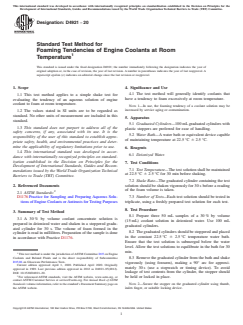


ASTM D4921-20 - Standard Test Method for Foaming Tendencies of Engine Coolants at Room Temperature
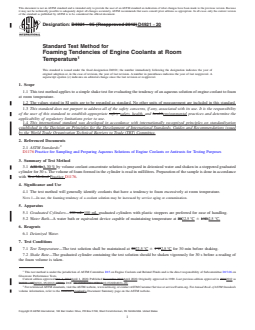


REDLINE ASTM D4921-20 - Standard Test Method for Foaming Tendencies of Engine Coolants at Room Temperature
Overview
ASTM D4921-20, titled Standard Test Method for Foaming Tendencies of Engine Coolants at Room Temperature, is an internationally recognized method published by ASTM International. This standard defines a procedure for evaluating the foaming tendency of aqueous engine coolant solutions through a simple shake test at room temperature. Excessive foam formation in engine coolants can negatively impact engine performance, making this method vital for quality assessment and product development in the automotive and coolant manufacturing industries.
Key Topics
- Test Method: Utilizes a 30% by volume solution of coolant concentrate in deionized water. The mixture is shaken in a stoppered graduated cylinder with evaluation of foam volume produced.
- Room Temperature Evaluation: The test is conducted at approximately 20-22.5°C to closely simulate standard storage and application conditions.
- Measurement and Reporting: Foam volume is measured in milliliters and results are reported as both individual test values and averages from triplicate tests.
- Precision and Repeatability: The method specifies the expected consistency of results within and between laboratories, facilitating reliable foam tendency data.
- Significance: Identifies coolants that may pose operational issues due to excessive foaming, especially as such tendencies may increase with aging or contamination in service.
- Safety and Compliance: Emphasizes user responsibility for safety, health, and environmental practices when applying the test method.
Applications
ASTM D4921-20 is essential for:
- Engine Coolant Manufacturers: Assuring product formulations meet industry standards for low foaming, which is critical for optimal cooling system function.
- Automotive OEMs and Service Centers: Screening and quality control of coolants used in production or maintenance to reduce risk of coolant system malfunctions caused by excess foam.
- Laboratories: Conducting comparative studies on new or existing coolant formulations to ensure consistent and reliable performance.
- Regulatory Compliance: Assisting organizations in meeting international trade and technical barriers regulations, as the method is developed in accordance with WTO TBT Committee guidelines.
- Ongoing Product Development: Identifying potential improvements in coolant chemistry to minimize foam-related risks over the product’s lifespan.
Related Standards
For comprehensive coolant testing and quality assurance, consider these related ASTM standards:
- ASTM D1176: Practice for Sampling and Preparing Aqueous Solutions of Engine Coolants or Antirusts for Testing Purposes. D1176 is referenced in D4921 for sample preparation protocols.
- ASTM D1881: Standard Test Method for Foaming Tendencies of Engine Coolants in Glassware at 88°C, which evaluates coolant foam at elevated temperatures.
- ASTM D3306: Standard Specification for Glycol Base Engine Coolant for Automobile and Light-Duty Service.
- ASTM D6210: Standard Specification for Fully-Formulated Glycol Base Engine Coolant for Heavy-Duty Engines.
These standards, together with ASTM D4921-20, establish a comprehensive framework for engine coolant evaluation, helping manufacturers and end users maintain efficient, reliable, and safe cooling systems.
By following the guidelines outlined in ASTM D4921-20, organizations can ensure consistent engine coolant performance, reduce operational risk, and maintain compliance with international quality standards.
Relations
- Effective Date
- 01-Apr-2020
- Effective Date
- 01-Oct-2019
- Effective Date
- 01-Apr-2014
- Effective Date
- 01-Apr-2008
- Effective Date
- 10-Apr-1998
- Effective Date
- 10-Apr-1998
Buy Documents
ASTM D4921-20 - Standard Test Method for Foaming Tendencies of Engine Coolants at Room Temperature
REDLINE ASTM D4921-20 - Standard Test Method for Foaming Tendencies of Engine Coolants at Room Temperature
Get Certified
Connect with accredited certification bodies for this standard

ECOCERT
Organic and sustainability certification.

Eurofins Food Testing Global
Global leader in food, environment, and pharmaceutical product testing.

Intertek Bangladesh
Intertek certification and testing services in Bangladesh.
Sponsored listings
Frequently Asked Questions
ASTM D4921-20 is a standard published by ASTM International. Its full title is "Standard Test Method for Foaming Tendencies of Engine Coolants at Room Temperature". This standard covers: SIGNIFICANCE AND USE 4.1 The test method will generally identify coolants that have a tendency to foam excessively at room temperature. Note 1: In use, the foaming tendency of a coolant solution may be increased by service aging or contamination. SCOPE 1.1 This test method applies to a simple shake test for evaluating the tendency of an aqueous solution of engine coolant to foam at room temperature. 1.2 The values stated in SI units are to be regarded as standard. No other units of measurement are included in this standard. 1.3 This standard does not purport to address all of the safety concerns, if any, associated with its use. It is the responsibility of the user of this standard to establish appropriate safety, health, and environmental practices and determine the applicability of regulatory limitations prior to use. 1.4 This international standard was developed in accordance with internationally recognized principles on standardization established in the Decision on Principles for the Development of International Standards, Guides and Recommendations issued by the World Trade Organization Technical Barriers to Trade (TBT) Committee.
SIGNIFICANCE AND USE 4.1 The test method will generally identify coolants that have a tendency to foam excessively at room temperature. Note 1: In use, the foaming tendency of a coolant solution may be increased by service aging or contamination. SCOPE 1.1 This test method applies to a simple shake test for evaluating the tendency of an aqueous solution of engine coolant to foam at room temperature. 1.2 The values stated in SI units are to be regarded as standard. No other units of measurement are included in this standard. 1.3 This standard does not purport to address all of the safety concerns, if any, associated with its use. It is the responsibility of the user of this standard to establish appropriate safety, health, and environmental practices and determine the applicability of regulatory limitations prior to use. 1.4 This international standard was developed in accordance with internationally recognized principles on standardization established in the Decision on Principles for the Development of International Standards, Guides and Recommendations issued by the World Trade Organization Technical Barriers to Trade (TBT) Committee.
ASTM D4921-20 is classified under the following ICS (International Classification for Standards) categories: 71.100.40 - Surface active agents. The ICS classification helps identify the subject area and facilitates finding related standards.
ASTM D4921-20 has the following relationships with other standards: It is inter standard links to ASTM D4921-95(2012), ASTM D1176-14(2019), ASTM D1176-14, ASTM D1176-98(2008), ASTM D1176-98(2002), ASTM D1176-98. Understanding these relationships helps ensure you are using the most current and applicable version of the standard.
ASTM D4921-20 is available in PDF format for immediate download after purchase. The document can be added to your cart and obtained through the secure checkout process. Digital delivery ensures instant access to the complete standard document.
Standards Content (Sample)
This international standard was developed in accordance with internationally recognized principles on standardization established in the Decision on Principles for the
Development of International Standards, Guides and Recommendations issued by the World Trade Organization Technical Barriers to Trade (TBT) Committee.
Designation: D4921 − 20
Standard Test Method for
Foaming Tendencies of Engine Coolants at Room
Temperature
This standard is issued under the fixed designation D4921; the number immediately following the designation indicates the year of
original adoption or, in the case of revision, the year of last revision. A number in parentheses indicates the year of last reapproval. A
superscript epsilon (´) indicates an editorial change since the last revision or reapproval.
1. Scope 4. Significance and Use
4.1 The test method will generally identify coolants that
1.1 This test method applies to a simple shake test for
have a tendency to foam excessively at room temperature.
evaluating the tendency of an aqueous solution of engine
coolant to foam at room temperature.
NOTE 1—In use, the foaming tendency of a coolant solution may be
increased by service aging or contamination.
1.2 The values stated in SI units are to be regarded as
standard. No other units of measurement are included in this
5. Apparatus
standard.
5.1 GraduatedCylinders—100 mLgraduated cylinders with
1.3 This standard does not purport to address all of the
plastic stoppers are preferred for ease of handling.
safety concerns, if any, associated with its use. It is the
5.2 Water Bath—A water bath or equivalent device capable
responsibility of the user of this standard to establish appro-
of maintaining temperature at 22.5 °C 6 2.5 °C.
priate safety, health, and environmental practices and deter-
mine the applicability of regulatory limitations prior to use.
6. Reagents
1.4 This international standard was developed in accor-
6.1 Deionized Water.
dance with internationally recognized principles on standard-
ization established in the Decision on Principles for the
7. Test Conditions
Development of International Standards, Guides and Recom-
7.1 Test Temperature—The test solution shall be maintained
mendations issued by the World Trade Organization Technical
at 22.5 °C 6 2.5 °C for 30 min before shaking.
Barriers to Trade (TBT) Committee.
7.2 Shake Rate—The graduated cylinder containing the test
2. Referenced Documents solution should be shaken vigorously for 30 s before a reading
of the foam volume is taken.
2.1 ASTM Standards:
7.3 Number of Tests—Each test solution should be tested in
D1176 Practice for Sampling and Preparing Aqueous Solu-
triplicate, using a freshly prepared test solution for each test.
tions of Engine Coolants orAntirusts for Testing Purposes
8. Test Procedure
3. Summary of Test Method
8.1 Prepare three 50 mL samples of a 30 % by volume
3.1 A 30 % by volume coolant concentrate solution is
(15 mL) coolant solution in deionized water. Use 100 mL
prepared in deionized water and shaken in a stoppered gradu-
graduated cylinders.
ated cylinder for 30 s. The volume of foam formed in the
8.2 The graduated cylinders should be stoppered and placed
cylinder is read in millilitres. Preparation of the sample is done
in the constant 22.5 °C 6 2.5 °C temperature water bath.
in accordance with Practice D1176.
Ensure that the test solution is submerged below the water
level. Allow the test solutions to equilibrate in the bath for 30
min.
This test method is under the j
...
This document is not an ASTM standard and is intended only to provide the user of an ASTM standard an indication of what changes have been made to the previous version. Because
it may not be technically possible to adequately depict all changes accurately, ASTM recommends that users consult prior editions as appropriate. In all cases only the current version
of the standard as published by ASTM is to be considered the official document.
Designation: D4921 − 95 (Reapproved 2012) D4921 − 20
Standard Test Method for
Foaming Tendencies of Engine Coolants at Room
Temperature
This standard is issued under the fixed designation D4921; the number immediately following the designation indicates the year of
original adoption or, in the case of revision, the year of last revision. A number in parentheses indicates the year of last reapproval. A
superscript epsilon (´) indicates an editorial change since the last revision or reapproval.
1. Scope
1.1 This test method applies to a simple shake test for evaluating the tendency of an aqueous solution of engine coolant to foam
at room temperature.
1.2 The values stated in SI units are to be regarded as standard. No other units of measurement are included in this standard.
1.3 This standard does not purport to address all of the safety concerns, if any, associated with its use. It is the responsibility
of the user of this standard to establish appropriate safety safety, health, and healthenvironmental practices and determine the
applicability of regulatory limitations prior to use.
1.4 This international standard was developed in accordance with internationally recognized principles on standardization
established in the Decision on Principles for the Development of International Standards, Guides and Recommendations issued
by the World Trade Organization Technical Barriers to Trade (TBT) Committee.
2. Referenced Documents
2.1 ASTM Standards:
D1176 Practice for Sampling and Preparing Aqueous Solutions of Engine Coolants or Antirusts for Testing Purposes
3. Summary of Test Method
3.1 A30 % A 30 % by volume coolant concentrate solution is prepared in deionized water and shaken in a stoppered graduated
cylinder for 30 s. The volume of foam formed in the cylinder is read in millilitres. Preparation of the sample is done in accordance
with Test Method Practice D1176.
4. Significance and Use
4.1 The test method will generally identify coolants that have a tendency to foam excessively at room temperature.
NOTE 1—In use, the foaming tendency of a coolant solution may be increased by service aging or contamination.
5. Apparatus
5.1 Graduated Cylinders—100-mL 100 mL graduated cylinders with plastic stoppers are preferred for ease of handling.
5.2 Water Bath—A water bath or equivalent device capable of maintaining temperature at 2022.5 °C 6 1°C.2.5 °C.
6. Reagents
6.1 Deionized Water.
7. Test Conditions
7.1 Test Temperature—The test solution shall be maintained at 2022.5 °C 6 1°C2.5 °C for 30 min before shaking.
7.2 Shake Rate—The graduated cylinder containing the test solution should be shaken vigorously for 30 s before a reading of
the foam volume is taken.
This test method is under the jurisdiction of ASTM Committee D15 on Engine Coolants and Related Fluids and is the direct responsibility of Subcommittee D15.06 on
Glassware Performance Tests.
Current edition approved Oct. 1, 2012April 1, 2020. Published November 2012April 2020. Originally approved in 1989. Last previous edition approved in 20062012 as
D4921 – 95D4921–95(2012).(2006). DOI: 10.1520/D4921-95R12.10.1520/D4921–20.
For referenced ASTM standards, visit the ASTM website, www.astm.org, or contact ASTM Customer Service at service@as
...