

ASTM D5875/D5875M-18
(Guide)Standard Guide for Use of Cable-Tool Drilling and Sampling Methods for Geoenvironmental Exploration and Installation of Subsurface Water Quality Monitoring Devices
General Information
- Abstract
SIGNIFICANCE AND USE
4.1 Cable-tool rigs (also referred to as churn rigs, water-well drilling rigs, spudders, or percussion rigs) are used in the oil fields and in the water-well industry. The Chinese developed the percussion method some 4,000 years ago.
4.2 Cable-tool drilling and sampling methods may be used in support of geoenvironmental exploration and for installation of subsurface water quality monitoring devices in both unconsolidated and consolidated materials. Cable-tool drilling and sampling may be selected over other methods based on its advantages, some of which are its high mobility, low water use, low operating cost, and low maintenance. Cable-tool drilling is the most widely available casing-advancement method that is restricted to the drilling of unconsolidated sediment and softer rocks.
4.2.1 The application of cable-tool drilling and sampling to geoenvironmental exploration may involve sampling unconsolidated materials. Depth of drill holes may exceed 900 m [3000 ft] and may be limited by the length of cable attached to the bull reel. However, most drill holes for geoenvironmental exploration rarely are needed to go that deep. Rates for cable-tool drilling and sampling can vary from a general average of as much as 7.5 to 9 m/h [25 to 30 ft/h] including setting 200 mm [8 in.] diameter casing to considerably less than that depending on the type(s) of material drilled, and the type and condition of the equipment and rig used.
Note 2: As a general rule, cable-tool rigs are used to sample the surficial sediments (that is, overburden), and to set surface casing in order that rotary-core rigs subsequently may be set up on the drill hole to core drill hard rock if coring is needed.
Note 3: The quality of the result produced by this standard is dependent on the competence of the personnel performing it, and the suitability of the equipment and facilities used. Agencies that meet the criteria of Practice D3740 are generally considered capable of competent and objective...
SCOPE
1.1 This guide covers cable-tool drilling and sampling procedures used for geoenvironmental exploration and installation of subsurface water quality monitoring devices.
1.2 Several sampling methods exist for obtaining samples from drill holes for geoenvironmental purposes and subsequent laboratory testing. Selection of a particular drilling procedure should be made on the basis of sample types needed and geohydrologic conditions observed at the study site.
1.3 Drilling procedures for geoenvironmental exploration often will involve safety planning, administration and documentation. This guide does not purport to specifically address exploration and site safety.
Note 1: This guide does not include considerations for geotechnical site characterizations.
1.4 The values stated in either SI units or inch-pound units are to be regarded separately as standard. The values stated in each system may not be exact equivalents; therefore, each system shall be used independently of the other. Combining values from the two systems may result in non-conformance with the standard.
1.5 This standard does not purport to address all of the safety concerns, if any, associated with its use. It is the responsibility of the user of this standard to establish appropriate safety, health, and environmental practices and determine the applicability of regulatory limitations prior to use.
1.6 This guide offers an organized collection of information or a series of options and does not recommend a specific course of action. This document cannot replace education or experience and should be used in conjunction with professional judgment. Not all aspects of this guide may be applicable in all circumstances. This ASTM standard is not intended to represent or replace the standard of care by which the adequacy of a given professional service must be judged, nor should this document be applied without consideration of a project's many uniqu...
- Status
- Published
- Publication Date
- 31-May-2018
- Technical Committee
- D18 - Soil and Rock
- Drafting Committee
- D18.21 - Groundwater and Vadose Zone Investigations
Buy Documents
ASTM D5875/D5875M-18 - Standard Guide for Use of Cable-Tool Drilling and Sampling Methods for Geoenvironmental Exploration and Installation of Subsurface Water Quality Monitoring Devices
REDLINE ASTM D5875/D5875M-18 - Standard Guide for Use of Cable-Tool Drilling and Sampling Methods for Geoenvironmental Exploration and Installation of Subsurface Water Quality Monitoring Devices
Overview
ASTM D5875/D5875M-18, titled "Standard Guide for Use of Cable-Tool Drilling and Sampling Methods for Geoenvironmental Exploration and Installation of Subsurface Water Quality Monitoring Devices," provides comprehensive guidance on using cable-tool (percussion) drilling rigs for geoenvironmental exploration. This standard, developed by ASTM International’s Committee D18 on Soil and Rock, addresses best practices for drilling, sampling, and installing subsurface water quality monitoring devices in both unconsolidated and consolidated materials. Cable-tool drilling is one of the oldest and most widely available casing-advancement methods and is recognized for its reliability, cost-effectiveness, and adaptability in varied geological settings.
Key Topics
- Cable-Tool Drilling Methodology: Provides procedures for the operation of cable-tool rigs (also known as churn, spudder, or percussion rigs) for boring and sampling.
- Sampling and Installation Guidance: Outlines steps for collecting subsurface materials and installing water quality monitoring devices, including considerations for casing, grout, and filter pack usage.
- Applicability in Various Strata: Suitable for both unconsolidated sediments and softer rock formations, with capabilities to reach substantial depths as needed by the exploration objectives.
- Operational Advantages: Highlights high mobility, low water use, low operating cost, and ease of maintenance as key benefits of cable-tool drilling.
- Documentation and Data Recording: Emphasizes the importance of thorough documentation of drilling procedures, site conditions, sampling events, and installation details.
- Unit Consistency: Instructs users to apply either SI units or inch-pound units exclusively to maintain consistency and compliance with the standard.
- Safety and Competence: Advises on the importance of safety, health, and environmental considerations without prescribing specific measures, urging use of professional judgement and compliance with applicable regulations.
Applications
ASTM D5875/D5875M-18 is essential for professionals involved in:
- Geoenvironmental Exploration: Collecting samples for laboratory testing and characterizing subsurface environmental conditions, especially where groundwater monitoring is required.
- Installation of Water Quality Monitoring Devices: Guiding the placement and completion of devices that detect chemical, biological, or radiological properties of groundwater or pore water.
- Environmental Site Assessments: Supporting investigations related to contaminated land, landfill sites, and waste management projects.
- Hydrogeological Studies: Facilitating well installation and borehole completion for projects assessing aquifer characteristics, groundwater resources, and vadose zone investigations.
- Regulatory Compliance and Reporting: Assisting in the preparation of detailed drilling records, sampling logs, and installation reports necessary for regulatory approval or project documentation.
Related Standards
The use of ASTM D5875/D5875M-18 often intersects with several other ASTM guides and test methods, including:
- ASTM D653: Terminology Relating to Soil, Rock, and Contained Fluids
- ASTM D1452: Practice for Soil Exploration and Sampling by Auger Borings
- ASTM D1586: Test Method for Standard Penetration Test and Split-Barrel Sampling of Soils
- ASTM D1587: Practice for Thin-Walled Tube Sampling of Fine-Grained Soils for Geotechnical Purposes
- ASTM D3550: Practice for Thick Wall, Ring-Lined, Split Barrel, Drive Sampling of Soils
- ASTM D3740: Practice for Requirements for Agencies Engaged in Testing and/or Inspection of Soil and Rock
- ASTM D5088: Practice for Decontamination of Field Equipment Used at Waste Sites
- ASTM D4428/D4428M: Test Methods for Crosshole Seismic Testing
For successful geoenvironmental projects, this standard ensures clear procedures for cable-tool operation, sample integrity, accurate installation of monitoring devices, and documentation, meeting both practical needs and regulatory expectations in the environmental and hydrogeological fields.
Relations
- Effective Date
- 01-Jun-2018
- Effective Date
- 01-Nov-2023
- Effective Date
- 01-May-2020
- Effective Date
- 01-Oct-2019
- Effective Date
- 01-Aug-2015
- Effective Date
- 15-Jan-2015
- Effective Date
- 01-Aug-2014
- Effective Date
- 01-May-2012
- Effective Date
- 01-Mar-2012
- Effective Date
- 01-Sep-2011
- Effective Date
- 01-Sep-2011
- Effective Date
- 01-Mar-2010
- Effective Date
- 01-Jan-2009
- Effective Date
- 01-Dec-2008
- Effective Date
- 01-Nov-2008
Buy Documents
ASTM D5875/D5875M-18 - Standard Guide for Use of Cable-Tool Drilling and Sampling Methods for Geoenvironmental Exploration and Installation of Subsurface Water Quality Monitoring Devices
REDLINE ASTM D5875/D5875M-18 - Standard Guide for Use of Cable-Tool Drilling and Sampling Methods for Geoenvironmental Exploration and Installation of Subsurface Water Quality Monitoring Devices
Get Certified
Connect with accredited certification bodies for this standard

CIS Institut d.o.o.
Personal Protective Equipment (PPE) certification body. Notified Body NB-2890 for EU Regulation 2016/425 PPE.

Kiwa BDA Testing
Building and construction product certification.
Kmetijski inštitut Slovenije
Agricultural Institute of Slovenia. Soil testing, plant health, agricultural product analysis.
Sponsored listings
Frequently Asked Questions
ASTM D5875/D5875M-18 is a guide published by ASTM International. Its full title is "Standard Guide for Use of Cable-Tool Drilling and Sampling Methods for Geoenvironmental Exploration and Installation of Subsurface Water Quality Monitoring Devices". This standard covers: SIGNIFICANCE AND USE 4.1 Cable-tool rigs (also referred to as churn rigs, water-well drilling rigs, spudders, or percussion rigs) are used in the oil fields and in the water-well industry. The Chinese developed the percussion method some 4,000 years ago. 4.2 Cable-tool drilling and sampling methods may be used in support of geoenvironmental exploration and for installation of subsurface water quality monitoring devices in both unconsolidated and consolidated materials. Cable-tool drilling and sampling may be selected over other methods based on its advantages, some of which are its high mobility, low water use, low operating cost, and low maintenance. Cable-tool drilling is the most widely available casing-advancement method that is restricted to the drilling of unconsolidated sediment and softer rocks. 4.2.1 The application of cable-tool drilling and sampling to geoenvironmental exploration may involve sampling unconsolidated materials. Depth of drill holes may exceed 900 m [3000 ft] and may be limited by the length of cable attached to the bull reel. However, most drill holes for geoenvironmental exploration rarely are needed to go that deep. Rates for cable-tool drilling and sampling can vary from a general average of as much as 7.5 to 9 m/h [25 to 30 ft/h] including setting 200 mm [8 in.] diameter casing to considerably less than that depending on the type(s) of material drilled, and the type and condition of the equipment and rig used. Note 2: As a general rule, cable-tool rigs are used to sample the surficial sediments (that is, overburden), and to set surface casing in order that rotary-core rigs subsequently may be set up on the drill hole to core drill hard rock if coring is needed. Note 3: The quality of the result produced by this standard is dependent on the competence of the personnel performing it, and the suitability of the equipment and facilities used. Agencies that meet the criteria of Practice D3740 are generally considered capable of competent and objective... SCOPE 1.1 This guide covers cable-tool drilling and sampling procedures used for geoenvironmental exploration and installation of subsurface water quality monitoring devices. 1.2 Several sampling methods exist for obtaining samples from drill holes for geoenvironmental purposes and subsequent laboratory testing. Selection of a particular drilling procedure should be made on the basis of sample types needed and geohydrologic conditions observed at the study site. 1.3 Drilling procedures for geoenvironmental exploration often will involve safety planning, administration and documentation. This guide does not purport to specifically address exploration and site safety. Note 1: This guide does not include considerations for geotechnical site characterizations. 1.4 The values stated in either SI units or inch-pound units are to be regarded separately as standard. The values stated in each system may not be exact equivalents; therefore, each system shall be used independently of the other. Combining values from the two systems may result in non-conformance with the standard. 1.5 This standard does not purport to address all of the safety concerns, if any, associated with its use. It is the responsibility of the user of this standard to establish appropriate safety, health, and environmental practices and determine the applicability of regulatory limitations prior to use. 1.6 This guide offers an organized collection of information or a series of options and does not recommend a specific course of action. This document cannot replace education or experience and should be used in conjunction with professional judgment. Not all aspects of this guide may be applicable in all circumstances. This ASTM standard is not intended to represent or replace the standard of care by which the adequacy of a given professional service must be judged, nor should this document be applied without consideration of a project's many uniqu...
SIGNIFICANCE AND USE 4.1 Cable-tool rigs (also referred to as churn rigs, water-well drilling rigs, spudders, or percussion rigs) are used in the oil fields and in the water-well industry. The Chinese developed the percussion method some 4,000 years ago. 4.2 Cable-tool drilling and sampling methods may be used in support of geoenvironmental exploration and for installation of subsurface water quality monitoring devices in both unconsolidated and consolidated materials. Cable-tool drilling and sampling may be selected over other methods based on its advantages, some of which are its high mobility, low water use, low operating cost, and low maintenance. Cable-tool drilling is the most widely available casing-advancement method that is restricted to the drilling of unconsolidated sediment and softer rocks. 4.2.1 The application of cable-tool drilling and sampling to geoenvironmental exploration may involve sampling unconsolidated materials. Depth of drill holes may exceed 900 m [3000 ft] and may be limited by the length of cable attached to the bull reel. However, most drill holes for geoenvironmental exploration rarely are needed to go that deep. Rates for cable-tool drilling and sampling can vary from a general average of as much as 7.5 to 9 m/h [25 to 30 ft/h] including setting 200 mm [8 in.] diameter casing to considerably less than that depending on the type(s) of material drilled, and the type and condition of the equipment and rig used. Note 2: As a general rule, cable-tool rigs are used to sample the surficial sediments (that is, overburden), and to set surface casing in order that rotary-core rigs subsequently may be set up on the drill hole to core drill hard rock if coring is needed. Note 3: The quality of the result produced by this standard is dependent on the competence of the personnel performing it, and the suitability of the equipment and facilities used. Agencies that meet the criteria of Practice D3740 are generally considered capable of competent and objective... SCOPE 1.1 This guide covers cable-tool drilling and sampling procedures used for geoenvironmental exploration and installation of subsurface water quality monitoring devices. 1.2 Several sampling methods exist for obtaining samples from drill holes for geoenvironmental purposes and subsequent laboratory testing. Selection of a particular drilling procedure should be made on the basis of sample types needed and geohydrologic conditions observed at the study site. 1.3 Drilling procedures for geoenvironmental exploration often will involve safety planning, administration and documentation. This guide does not purport to specifically address exploration and site safety. Note 1: This guide does not include considerations for geotechnical site characterizations. 1.4 The values stated in either SI units or inch-pound units are to be regarded separately as standard. The values stated in each system may not be exact equivalents; therefore, each system shall be used independently of the other. Combining values from the two systems may result in non-conformance with the standard. 1.5 This standard does not purport to address all of the safety concerns, if any, associated with its use. It is the responsibility of the user of this standard to establish appropriate safety, health, and environmental practices and determine the applicability of regulatory limitations prior to use. 1.6 This guide offers an organized collection of information or a series of options and does not recommend a specific course of action. This document cannot replace education or experience and should be used in conjunction with professional judgment. Not all aspects of this guide may be applicable in all circumstances. This ASTM standard is not intended to represent or replace the standard of care by which the adequacy of a given professional service must be judged, nor should this document be applied without consideration of a project's many uniqu...
ASTM D5875/D5875M-18 is classified under the following ICS (International Classification for Standards) categories: 13.060.10 - Water of natural resources. The ICS classification helps identify the subject area and facilitates finding related standards.
ASTM D5875/D5875M-18 has the following relationships with other standards: It is inter standard links to ASTM D5875/D5875M-13, ASTM D3740-23, ASTM D5088-20, ASTM D3740-19, ASTM D5088-15a, ASTM D5088-15, ASTM D653-14, ASTM D3740-12a, ASTM D3740-12, ASTM D653-11, ASTM D3740-11, ASTM D3740-10, ASTM D653-09, ASTM D653-08a, ASTM D653-08. Understanding these relationships helps ensure you are using the most current and applicable version of the standard.
ASTM D5875/D5875M-18 is available in PDF format for immediate download after purchase. The document can be added to your cart and obtained through the secure checkout process. Digital delivery ensures instant access to the complete standard document.
Standards Content (Sample)
This international standard was developed in accordance with internationally recognized principles on standardization established in the Decision on Principles for the
Development of International Standards, Guides and Recommendations issued by the World Trade Organization Technical Barriers to Trade (TBT) Committee.
Designation: D5875/D5875M − 18
Standard Guide for
Use of Cable-Tool Drilling and Sampling Methods for
Geoenvironmental Exploration and Installation of
Subsurface Water Quality Monitoring Devices
This standard is issued under the fixed designation D5875/D5875M; the number immediately following the designation indicates the
year of original adoption or, in the case of revision, the year of last revision. A number in parentheses indicates the year of last
reapproval. A superscript epsilon (´) indicates an editorial change since the last revision or reapproval.
1. Scope* a given professional service must be judged, nor should this
document be applied without consideration of a project’s many
1.1 This guide covers cable-tool drilling and sampling
unique aspects. The word “Standard” in the title of this
procedures used for geoenvironmental exploration and instal-
document means only that the document has been approved
lation of subsurface water quality monitoring devices.
through the ASTM consensus process.
1.2 Several sampling methods exist for obtaining samples
1.7 This international standard was developed in accor-
from drill holes for geoenvironmental purposes and subsequent
dance with internationally recognized principles on standard-
laboratory testing. Selection of a particular drilling procedure
ization established in the Decision on Principles for the
should be made on the basis of sample types needed and
Development of International Standards, Guides and Recom-
geohydrologic conditions observed at the study site.
mendations issued by the World Trade Organization Technical
1.3 Drilling procedures for geoenvironmental exploration
Barriers to Trade (TBT) Committee.
often will involve safety planning, administration and docu-
mentation. This guide does not purport to specifically address
2. Referenced Documents
exploration and site safety. 2
2.1 ASTM Standards:
NOTE 1—This guide does not include considerations for geotechnical D653 Terminology Relating to Soil, Rock, and Contained
site characterizations.
Fluids
D3740 Practice for Minimum Requirements for Agencies
1.4 The values stated in either SI units or inch-pound units
Engaged in Testing and/or Inspection of Soil and Rock as
are to be regarded separately as standard. The values stated in
Used in Engineering Design and Construction
each system may not be exact equivalents; therefore, each
system shall be used independently of the other. Combining D4428/D4428M Test Methods for Crosshole Seismic Test-
ing
values from the two systems may result in non-conformance
with the standard. D5088 Practice for Decontamination of Field Equipment
Used at Waste Sites
1.5 This standard does not purport to address all of the
safety concerns, if any, associated with its use. It is the
3. Terminology
responsibility of the user of this standard to establish appro-
3.1 Definitions:
priate safety, health, and environmental practices and deter-
3.1.1 For definitions of general technical terms used within
mine the applicability of regulatory limitations prior to use.
this standard, refer to Terminology D653.
1.6 This guide offers an organized collection of information
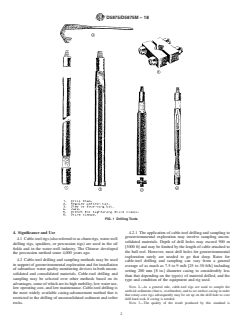
3.1.2 jars—a tool composed of two connected links or reins
or a series of options and does not recommend a specific
with vertical play between them (see Fig. 1 and Ref (1)).
course of action. This document cannot replace education or
Drilling jars have a stroke of 230 to 460 mm [9 to 18 in.]
experience and should be used in conjunction with professional
whereas, fishing jars have a stroke of 460 to 900 mm [18 to 36
judgment. Not all aspects of this guide may be applicable in all
in.]. Jars permit a sudden upward load or shock to loosen a
circumstances. This ASTM standard is not intended to repre-
string of tools stuck in the borehole.
sent or replace the standard of care by which the adequacy of
1 2
This guide is under the jurisdiction ofASTM Committee D18 on Soil and Rock For referenced ASTM standards, visit the ASTM website, www.astm.org, or
and is the direct responsibility of Subcommittee D18.21 on Groundwater and contact ASTM Customer Service at service@astm.org. For Annual Book of ASTM
Vadose Zone Investigations. Standards volume information, refer to the standard’s Document Summary page on
CurrenteditionapprovedJune1,2018.PublishedJuly2018.Originallyapproved the ASTM website.
in 1995. Last previous edition approved in 2013 as D5875 – 13. DOI: 10.1520/ The boldface numbers given in parentheses refer to a list of references at the
D5875_D5875M-18. end of the text.
*A Summary of Changes section appears at the end of this standard
Copyright © ASTM International, 100 Barr Harbor Drive, PO Box C700, West Conshohocken, PA 19428-2959. United States
D5875/D5875M − 18
FIG. 1 Drilling Tools
4. Significance and Use 4.2.1 The application of cable-tool drilling and sampling to
geoenvironmental exploration may involve sampling uncon-
4.1 Cable-toolrigs(alsoreferredtoaschurnrigs,water-well
solidated materials. Depth of drill holes may exceed 900 m
drilling rigs, spudders, or percussion rigs) are used in the oil
[3000 ft] and may be limited by the length of cable attached to
fields and in the water-well industry. The Chinese developed
the bull reel. However, most drill holes for geoenvironmental
the percussion method some 4,000 years ago.
exploration rarely are needed to go that deep. Rates for
4.2 Cable-tool drilling and sampling methods may be used
cable-tool drilling and sampling can vary from a general
in support of geoenvironmental exploration and for installation
average of as much as 7.5 to 9 m/h [25 to 30 ft/h] including
of subsurface water quality monitoring devices in both uncon-
setting 200 mm [8 in.] diameter casing to considerably less
solidated and consolidated materials. Cable-tool drilling and
than that depending on the type(s) of material drilled, and the
sampling may be selected over other methods based on its
type and condition of the equipment and rig used.
advantages,someofwhichareitshighmobility,lowwateruse,
NOTE 2—As a general rule, cable-tool rigs are used to sample the
low operating cost, and low maintenance. Cable-tool drilling is
surficial sediments (that is, overburden), and to set surface casing in order
the most widely available casing-advancement method that is
that rotary-core rigs subsequently may be set up on the drill hole to core
restricted to the drilling of unconsolidated sediment and softer
drill hard rock if coring is needed.
rocks. NOTE 3—The quality of the result produced by this standard is
D5875/D5875M − 18
dependent on the competence of the personnel performing it, and the
together in the United States with right-hand threaded tool
suitability of the equipment and facilities used. Agencies that meet the
joints of standard API (American Petroleum Institute) design
criteria of Practice D3740 are generally considered capable of competent
and dimension (6).
and objective testing/sampling/evaluation/and the like. Users of this
standard are cautioned that compliance with Practice D3740 does not in
5.4 The wire rope cable that carries and rotates the drilling
itself assure reliable results. Reliable results depend on many factors;
tool is called the drill line. It is typically a 16-mm [0.625-in.]
Practice D3740 provides a means of evaluating some of those factors.
to 25-mm [1-in.] left-hand lay cable that twists the tool joint on
4.2.2 The cable-tool rig may be used to facilitate the
each upward stroke to prevent it from unscrewing. The drill
installation of a subsurface water quality monitoring device(s)
line is reeved over a crown sheave at the top of the mast, down
including in situ testing devices.The monitoring device(s) may
to the spudding sheave on the walking beam, to the heel
be installed through the casing as the casing is removed from
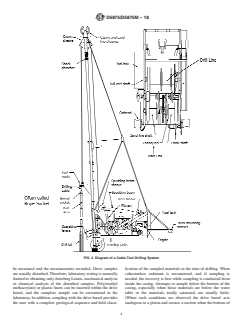
sheave, and then to the working-line side of the bull-reel (see
the borehole. The sand line can be used to raise, lower, or set
Fig. 2). The stroke of the cable-tool rig should be controlled
in situ testing device(s). If necessary, the casing may also be
and sufficient tension maintained on the wire cable to keep the
left in the borehole as part of the device.
jars open or extended when in operation (often referred to as
tight-line drilling). Bull reels generally are set-up with a
NOTE 4—The user may install a monitoring device within the same
separator on the drum to provide a working-line and a
borehole wherein sampling, in situ, or pore-fluid testing, or coring was
performed. storage-line side (6).
NOTE 6—The mast must be constructed safely to carry the needed loads
5. Apparatus
for drilling, sampling, and completion of boreholes of the diameter and
depth for which the rig manufacturer specifies the equipment.To allow for
5.1 Cable-tool rigs (see Fig. 2) have a string of drill tools
contingencies it is recommended that the rated capacity of the mast should
with a drive clamp (see Fig. 1 and Ref (2)) on the drill string
be twice the anticipated weight load or normal pulling load.
connected by wire rope that periodically can be hoisted and
5.5 The characteristic up and down or spudding action of a
allowed to “fall” for percussion drilling in unconsolidated and
cable-tool rig is imparted to the drill line and drilling tools by
consolidated sediment and for driving/retrieving casing. The
the walking beam. The walking beam pivots at one end while
full string of drilling equipment consists of drill bit (see Fig. 1
its out end, which carries the sheave for the drill line, is moved
and Ref (3)—Regular bit used for all-around general drilling
up and down by a single or double pitman connected to a
and, Ref (4)—Star bit used for chopping and breaking hard
crankshaft. The vertical stroke of the walking beam, and thus
materials and rock), drilling jars (optional), and a drill stem
the drill tools, can be varied by adjusting the position of the
(see Fig. 1 and Ref (5)), with a swivel socket (see Fig. 2)
pitman on the bull gear and the connection to the walking
connected by a wire rope fastened to a drum called a bull reel
beam. The number of strokes per minute can be varied by
that raises and lowers the drilling tools and permits percussion
changing the speed of the driveshaft. The bull gears are driven
drilling either by crushing the material or by drive sampling.
by a pinion mounted on a clutch. This clutch, the friction drive
The spudding beam, commonly referred to as the walking
for sand line (on smaller cable tool rigs only), and the drive
beam, that is driven by the pitman and crank, imparts a
pinion for the drill-line reel are mounted on the same shaft
reciprocating motion to the drilling line.
assembly.
NOTE 5—Cable-tool rigs have the capacity to lift and drop heavy drive
5.6 Another drum, called a casing reel, frequently is added
clamps for installing large-diameter casing in unconsolidated sediment.
to the basic machine assembly. The casing reel is capable of
5.2 Drilling rigs for water wells have been converted (for
exerting a powerful pull on a third cable, the casing- or
the purpose of geoenvironmental-engineering explorations) by
main-line. This cable is used for handling heavy casing, tools,
replacing the jars and stem, and replacing the chopping bit (see
and pumps, or other heavy hoisting. It may be used to pull a
Fig. 1 and Ref (4)) with a drive barrel that is used for sampling
string of casing when the cable is reeved with blocks to make
purposes. If the bit becomes stuck in the borehole it can
two-, three-, or four-part lines (6).
normally be freed by upward blows of the drilling jars (jars can
also be used in the same mode to extract casing). The primary 5.7 Another commonly used hoisting device on a cable-tool
function of the drilling jars is to transmit the energy from the rig is called a cathead. Use of this drum requires that a heavy
line of manila rope be carried on a separate sheave at the top
bull wheel to the drill stem and the sample barrel. The stroke
of the drilling jars is 230 mm to 460 mm [9 to 18 in.] and of the derrick.This line may be used for handling light loads at
distinguishes them from fishing jars that have a stroke 460 to shallow depths (usually 3 m [10 ft] or less) and alternately
920 mm [18 to 36 in.]. Jars are often not used when hard-rock lifting and dropping tools such as a drive block or bumper,
drilling (2, 6). spears, heads for driving casing, and individual lengths of
casing so they may be stood on end and joined to the last piece
5.3 The swivel socket connects the drill string to the cable
in the ground (2). The cathead and line is often used to shake
and, in addition, the weight of the socket supplies part of the
the sample from large-diameter drive barrels. Should standard-
weight of the drill tools. The socket also imparts part of the
penetration tests be needed for specific geoenvironmental
upward energy to the jars when their use becomes necessary.
studies, standard rotary drill rods and drop hammer can be
The socket transmits the rotation of the cable to the tool string
manipulated using the cathead and line.
and bit (drive barrel) so that the drive is completed on the
downstroke, thereby assuring that a round, straight hole will 5.8 Dependingonthelengthofthedrivebarrels,thedriveof
result. The elements of the tool string are typically coupled the sampling is usually 0.6 m [2 ft]. Prior to drilling, tools must
D5875/D5875M − 18
FIG. 2 Diagram of a Cable Tool Drilling System
be measured and the measurements recorded. Drive samples fication of the sampled materials at the time of drilling. When
are usually disturbed. Therefore, laboratory testing is normally cohesionless sediment is encountered, and if sampling is
limitedtoobtainingonlyAtterbergLimits,mechanicalanalysis needed, the recovery is best while sampling is conducted from
or chemical analysis of the disturbed samples. Poly(methyl inside the casing. Attempts to sample below the bottom of the
methacrylate) or plastic liners can be inserted within the drive casing, especially when these materials are below the water
barrel, and the complete sample can be reexamined in the table or the materials totally saturated, are usually futile.
laboratory. In addition, sampling with the drive barrel provides (When such conditions are observed the drive barrel acts
the user with a complete geological sequence and field classi- analogous to a piston and creates a suction when the bottom of
D5875/D5875M − 18
F
...
This document is not an ASTM standard and is intended only to provide the user of an ASTM standard an indication of what changes have been made to the previous version. Because
it may not be technically possible to adequately depict all changes accurately, ASTM recommends that users consult prior editions as appropriate. In all cases only the current version
of the standard as published by ASTM is to be considered the official document.
Designation: D5875/D5875M − 13 D5875/D5875M − 18
Standard Guide for
Use of Cable-Tool Drilling and Sampling Methods for
Geoenvironmental Exploration and Installation of
Subsurface Water-Quality Water Quality Monitoring Devices
This standard is issued under the fixed designation D5875/D5875M; the number immediately following the designation indicates the
year of original adoption or, in the case of revision, the year of last revision. A number in parentheses indicates the year of last
reapproval. A superscript epsilon (´) indicates an editorial change since the last revision or reapproval.
1. Scope*
1.1 This guide covers cable-tool drilling and sampling procedures used for geoenvironmental exploration and installation of
subsurface water-quality water quality monitoring devices.
1.2 Several sampling methods exist for obtaining samples from drill holes for geoenvironmental purposes and subsequent
laboratory testing. Selection of a particular drilling procedure should be made on the basis of sample types needed and
geohydrologic conditions observed at the study site.
1.3 Drilling procedures for geoenvironmental exploration often will involve safety planning, administration and documentation.
This guide does not purport to specifically address exploration and site safety.
NOTE 1—This guide does not include considerations for geotechnical site characterizations.
1.4 The values stated in either SI units or inch-pound units are to be regarded separately as standard. The values stated in each
system may not be exact equivalents; therefore, each system shall be used independently of the other. Combining values from the
two systems may result in non-conformance with the standard.
1.5 This standard does not purport to address all of the safety concerns, if any, associated with its use. It is the responsibility
of the user of this standard to establish appropriate safety safety, health, and healthenvironmental practices and determine the
applicability of regulatory limitations prior to use.
1.6 This guide offers an organized collection of information or a series of options and does not recommend a specific course
of action. This document cannot replace education or experience and should be used in conjunction with professional judgment.
Not all aspects of this guide may be applicable in all circumstances. This ASTM standard is not intended to represent or replace
the standard of care by which the adequacy of a given professional service must be judged, nor should this document be applied
without consideration of a project’s many unique aspects. The word “Standard” in the title of this document means only that the
document has been approved through the ASTM consensus process.
1.7 This international standard was developed in accordance with internationally recognized principles on standardization
established in the Decision on Principles for the Development of International Standards, Guides and Recommendations issued
by the World Trade Organization Technical Barriers to Trade (TBT) Committee.
2. Referenced Documents
2.1 ASTM Standards:
D653 Terminology Relating to Soil, Rock, and Contained Fluids
D1452 Practice for Soil Exploration and Sampling by Auger Borings
D1586 Test Method for Standard Penetration Test (SPT) and Split-Barrel Sampling of Soils
D1587 Practice for Thin-Walled Tube Sampling of Fine-Grained Soils for Geotechnical Purposes
D3550 Practice for Thick Wall, Ring-Lined, Split Barrel, Drive Sampling of Soils
D3740 Practice for Minimum Requirements for Agencies Engaged in Testing and/or Inspection of Soil and Rock as Used in
Engineering Design and Construction
This guide is under the jurisdiction of ASTM Committee D18 on Soil and Rock and is the direct responsibility of Subcommittee D18.21 on Groundwater and Vadose
Zone Investigations.
Current edition approved Aug. 1, 2013June 1, 2018. Published September 2013July 2018. Originally approved in 1995. Last previous edition approved in 20062013 as
D5875 – 95 (2006).D5875 – 13. DOI: 10.1520/D5875/D5875M-13.10.1520/D5875_D5875M-18.
For referenced ASTM standards, visit the ASTM website, www.astm.org, or contact ASTM Customer Service at service@astm.org. For Annual Book of ASTM Standards
volume information, refer to the standard’s Document Summary page on the ASTM website.
*A Summary of Changes section appears at the end of this standard
Copyright © ASTM International, 100 Barr Harbor Drive, PO Box C700, West Conshohocken, PA 19428-2959. United States
D5875/D5875M − 18
D4428/D4428M Test Methods for Crosshole Seismic Testing
D5088 Practice for Decontamination of Field Equipment Used at Waste Sites
3. Terminology
3.1 Definitions:
3.2 For definitions of general technical terms used within this guide, refer to Terminology D653.
3.1 Definitions of Terms Specific to This Standard:Definitions:
3.3.1 bailer—a long, narrow bucket, made from a piece of large-diameter pipe with a dart valve in the bottom, used to remove
cuttings from the borehole.
3.1.1 For definitions of general technical terms used within this standard, refer to Terminology D653.
3.3.2 bentonite—the common name for drilling-fluid additives and well-construction products consisting mostly of naturally
occurring montmorillonite. Some bentonite products have chemical additives which may affect water-quality analyses.
3.3.3 bentonite granules and chips—irregularly-shaped particles of bentonite (free from additives) that have been dried and
separated into a specific size range.
3.3.4 bentonite pellets—roughly spherical- or disc-shaped units of compressed bentonite powder (some pellet manufacturers
coat the bentonite with chemicals that may affect the water-quality analysis).
3.3.5 collar—the section of a drill tool between the wrench square and the pin or box joint.
3.3.6 dart valve—a type of valve used on a bailer, that opens when the bailer drops through the cuttings at the bottom of the
borehole.
3.3.7 drill bit—the steel tool on the lower end of the string of tools which does the actual drilling; shaped to perform the
operations of penetration, reaming, crushing, and mixing.
3.3.8 drill hole—a cylindrical hole advanced into the subsurface by mechanical means. Also known as a borehole or boring.
3.3.9 drill stem—a steel tool composed of a round bar of steel with a pin joint at its upper end and a box joint at its lower end
that is placed below the jars in a string of drilling tools to furnish the necessary weight to the tool string.
3.3.10 drill string—the complete cable-tool drilling assembly including bit, drill rods and connector assemblies (subs). The total
length of this assembly is used to determine drilling depth by referencing the position of the top of the string to a datum near the
ground surface.
3.3.11 drive shoe—a forged- or machined-steel collar either a threaded- or drop-type attached to the upper joint of casing to
protect the casing threads during driving operations.
3.3.12 filter pack—also known as a gravel pack or primary filter pack in the practice of monitoring-well installations. The gravel
pack is usually granular material, having specified grain-size characteristics, that is placed between a monitoring device and the
borehole wall. The basic purpose of the filter pack or gravel envelope is to act as a non-clogging filter when the aquifer is not suited
to natural development or a formation stabilizer when the aquifer is suitable for natural development.
3.3.12.1 Discussion—
Under most circumstances a clean, quartz sand or gravel should be used. In some cases a pre-packed screen may be used.
3.3.13 grout packer—a reusable inflatable or expandable annular plug that is attached to a tremie pipe, usually positioned
immediately above the discharge end of the pipe.
3.3.14 intermittent sampling devices—usually barrel-type samplers that are driven below the bottom of a borehole with drill rods
or with a wireline system to lower, drive, and retrieve the sampler following completion of an increment of drilling. The user is
referred to the following standards relating to suggested sampling methods and procedures: Practice D1452, Test Method D1586,
Practice D3550, and Practice D1587.
3.3.15 in-situ testing devices—sensors or probes, used to obtain mechanical- or chemical-test data, that are typically pushed,
rotated or driven below the bottom of a borehole following completion of an increment of drilling. However, some in-situ testing
devices (such as electronic pressure transducers, gas-lift samplers, tensiometers, and so forth) may require lowering and setting of
the device(s) in pre-existing boreholes by means of a suspension line or a string of lowering rods or pipes. Centralizers may be
required to correctly position the device(s) in the borehole.
3.1.2 jars—a tool composed of two connected links or reins with vertical play between them (see Fig. 1 and Ref (1)). Drilling
jars have a stroke of 230 to 460 mm [9 to 18 in.] whereas, fishing jars have a stroke of 460 to 900 mm [18 to 36 in.]. Jars permit
a sudden upward load or shock to loosen a string of tools stuck in the borehole.
The boldface numbers given in parentheses refer to a list of references at the end of the text.
D5875/D5875M − 18
FIG. 1 Drilling Tools
3.3.17 sand pump—bailer made of tubing with a hinge-flap valve and a plunger that works inside the barrel. It is used in sand
and gravel where the dart-valve bailer will not pick up the materials adequately.
3.3.18 spear—a fishing tool used when the drilling line or sand line breaks leaving the drilling tools or bailer in the hole with
the line on top of the lost tools.
3.3.19 swivel socket—a socket that permits the tool string to spin or turn during the drilling action (sometimes referred to as
a rope socket).
3.3.20 subsurface water-quality monitoring device—an instrument placed below ground surface to obtain a sample for analysis
of the chemical, biological or radiological characteristics of subsurface pore water or to make in-situ measurements.
3.3.21 wrench square—a square section on any drilling tool by which the joints are set up or broken.
4. Significance and Use
4.1 Cable-tool rigs (also referred to as churn rigs, water-well drilling rigs, spudders, or percussion rigs) are used in the oil fields
and in the water-well industry. The Chinese developed the percussion method some 40004,000 years ago.
D5875/D5875M − 18
4.2 Cable-tool drilling and sampling methods may be used in support of geoenvironmental exploration and for installation of
subsurface water-quality water quality monitoring devices in both unconsolidated and consolidated materials. Cable-tool drilling
and sampling may be selected over other methods based on its advantages, some of which are its high mobility, low water use,
low operating cost, and low maintenance. Cable-tool drilling is the most widely available casing-advancement method that is
restricted to the drilling of unconsolidated materialssediment and softer rocks.
4.2.1 The application of cable-tool drilling and sampling to geoenvironmental exploration may involve sampling unconsolidated
materials. Depth of drill holes may exceed 900 m [3000 ft] and may be limited by the length of cable attached to the bull reel.
However, most drill holes for geoenvironmental exploration rarely are requiredneeded to go that deep. Rates for cable-tool drilling
and sampling can vary from a general average of as much as 7.5 to 9 m/h [25 to 30 ft/h] including setting 200 mm [8 in.] diameter
casing to considerably less than that depending on the type(s) of material drilled, and the type and condition of the equipment and
rig used.
NOTE 2—As a general rule, cable-tool rigs are used to sample the surficial materials, sediments (that is, overburden), and to set surface casing in order
that rotary-core rigs subsequently may be set up on the drill hole to core drill hard rock if coring is required. needed.
NOTE 3—The quality of the result produced by this standard is dependent on the competence of the personnel performing it, and the suitability of the
equipment and facilities used. Agencies that meet the criteria of Practice D3740 are generally considered capable of competent and objective
testing/sampling/inspection/etc. testing/sampling/evaluation/and the like. Users of this standard are cautioned that compliance with Practice D3740 does
not in itself assure reliable results. Reliable results depend on many factors; Practice D3740 provides a means of evaluating some of those factors.
4.2.2 The cable-tool rig may be used to facilitate the installation of a subsurface water-quality water quality monitoring
device(s) including in-situ in situ testing devices. The monitoring device(s) may be installed through the casing as the casing is
removed from the borehole. The sand line can be used to raise, lower, or set in-situ testing device(s), or all of these. in situ testing
device(s). If necessary, the casing may also be left in the borehole as part of the device.
NOTE 4—The user may install a monitoring device within the same borehole wherein sampling, in-situ, in situ, or pore-fluid testing, or coring was
performed.
5. Apparatus
5.1 Cable-tool rigs (see Fig. 2) have a string of drill tools with a drive clamp (see Fig. 1 and Ref (2)) on the drill string connected
by wire rope that periodically can be hoisted and allowed to “fall” for percussion drilling in unconsolidated and consolidated
materialssediment and for driving/retrieving casing. The full string of drilling equipment consists of drill bit (see Fig. 1 and Ref
(3)—Regular bit used for all-around general drilling and, Ref (4)—Star bit used for chopping and breaking hard materials and
rock), drilling jars (optional), and a drill stem (see Fig. 1 and Ref (5)), with a swivel socket (see Fig. 2) connected by a wire rope
fastened to a drum called a bull reel that raises and lowers the drilling tools and permits percussion drilling either by crushing the
material or by drive sampling. The spudding beam, commonly referred to as the walking beam, that is driven by the pitman and
crank, imparts a reciprocating motion to the drilling line.
NOTE 5—All cable-tool Cable-tool rigs have the capacity to lift and drop heavy drive clamps for installing large-diameter casing in unconsolidated
materials.sediment.
5.2 Drilling rigs for water wells have been converted (for the purpose of geoenvironmental-engineering explorations) by
replacing the jars and stem, and replacing the chopping bit (see Fig. 1 and Ref (4)) with a drive barrel that is used for sampling
purposes. If the bit becomes stuck in the borehole it can normally be freed by upward blows of the drilling jars (jars can also be
used in the same mode to extract casing). The primary function of the drilling jars is to transmit the energy from the bull wheel
to the drill stem and the sample barrel. The stroke of the drilling jars is 230 mm to 460 mm [9 to 18 in.] and distinguishes them
from fishing jars that have a stroke 460 to 920 mm [18 to 36 in.]. Jars are often not used when hard-rock drilling (2, 6).
5.3 The swivel socket connects the drill string to the cable and, in addition, the weight of the socket supplies part of the weight
of the drill tools. The socket also imparts part of the upward energy to the jars when their use becomes necessary. The socket
transmits the rotation of the cable to the tool string and bit (drive barrel) so that the drive is completed on the downstroke, thereby
assuring that a round, straight hole will result. The elements of the tool string are typically coupled together in the United States
with right-hand threaded tool joints of standard API (American Petroleum Institute) design and dimension (6).
5.4 The wire rope cable that carries and rotates the drilling tool is called the drill line. It is typically a 16-mm [0.625-in.] to
25-mm [1-in.] left-hand lay cable that twists the tool joint on each upward stroke to prevent it from unscrewing. The drill line is
reeved over a crown sheave at the top of the mast, down to the spudding sheave on the walking beam, to the heel sheave, and then
to the working-line side of the bull-reel (see Fig. 2). The stroke of the cable-tool rig should be controlled and sufficient tension
maintained on the wire cable to keep the jars open or extended when in operation (often referred to as tight-line drilling). Bull reels
generally are set-up with a separator on the drum to provide a working-line and a storage-line side (6).
NOTE 6—The mast must be constructed safely to carry the requiredneeded loads for drilling, sampling, and completion of boreholes of the diameter
and depth for which the rig manufacturer specifies the equipment. To allow for contingencies it is recommended that the rated capacity of the mast should
be at least twice the anticipated weight load or normal pulling load.
5.5 The characteristic up and down or spudding action of a cable-tool rig is imparted to the drill line and drilling tools by the
walking beam. The walking beam pivots at one end while its out end, which carries the sheave for the drill line, is moved up and
D5875/D5875M − 18
FIG. 2 Diagram of a Cable Tool Drilling System
down by a single or double pitman connected to a crankshaft. The vertical stroke of the walking beam, and thus the drill tools,
can be varied by adjusting the position of the pitman on the bull gear and the connection to the walking beam. The number of
strokes per minute can be varied by changing the speed of the driveshaft. The bull gears are driven by a pinion mounted on a clutch.
This clutch, the friction drive for sand line (on smaller cable tool rigs only), and the drive pinion for the drill-line reel are all
mounted on the same shaft assembly.
------
...