

ASTM D7737/D7737M-15(2023)
(Test Method)Standard Test Method for Individual Geogrid Junction Strength
General Information
- Abstract
SIGNIFICANCE AND USE
5.1 This index test method is to be used to determine the strength of an individual junction in a geogrid product. The test is performed in isolation, while in service the junction is typically confined. Thus the results from this test method are not anticipated to be related to design performance.
5.2 The value of junction strength can be used for manufacturing quality control, development of new products, or a general understanding of the in-isolation behavior of a particular geogrid’s junction (for example, in relation to handling during shipment and placement of the geogrid).
5.3 This test method is applicable to geogrid products with essentially symmetrical orthogonal or non-orthogonal ribs, yarns, or straps, that is, geogrids which are composed of ribs, yarns, or straps that are entangled through weaving or knitting, welded, bonded, or formed through drawing.
SCOPE
1.1 This test method is an index test which provides a procedure for determining the strength of an individual geogrid junction, also called a node. The test is configured such that a single rib is pulled from its junction with a rib(s) transverse to the test direction to obtain the maximum force, or strength of the junction. The procedure allows for the use of two different clamps with the appropriate clamp selected to minimize the influence of the clamping mechanism on the specific type of geogrid to be tested.
1.2 The values stated in either SI units or inch-pound units are to be regarded separately as standard. The values stated in each system are not necessarily exact equivalents; therefore, to ensure conformance with the standard, each system shall be used independently of the other, and values from the two systems shall not be combined.
1.3 This standard does not purport to address all of the safety concerns, if any, associated with its use. It is the responsibility of the user of this standard to establish appropriate safety, health, and environmental practices and determine the applicability of regulatory limitations prior to use.
1.4 This international standard was developed in accordance with internationally recognized principles on standardization established in the Decision on Principles for the Development of International Standards, Guides and Recommendations issued by the World Trade Organization Technical Barriers to Trade (TBT) Committee.
- Status
- Published
- Publication Date
- 31-May-2023
- Technical Committee
- D35 - Geosynthetics
- Drafting Committee
- D35.01 - Mechanical Properties
Overview
ASTM D7737/D7737M-15(2023), titled Standard Test Method for Individual Geogrid Junction Strength, specifies procedures for assessing the strength of a single junction (node) within geogrid materials. Developed by ASTM International, this test method is vital for understanding the tensile properties of geogrid junctions in isolation. Junctions are critical points where geogrid ribs, yarns, or straps intersect, providing structure and dimensional stability to the geogrid product.
This standard provides an index test method rather than a direct measure of the in-service performance of geogrid products, as the results represent unconfined, in-isolation junction behavior rather than practical application under load in geotechnical engineering projects.
Key Topics
- Junction Strength Testing: The test targets a single rib at a junction, extracting it by applying tensile force until failure to measure the maximum force (breaking strength) the junction can withstand.
- Test Methodology: Two clamping methods (Method A and Method B) are used to minimize clamping effects and adapt to different geogrid constructions. The process ensures reliable, repeatable measurement of individual junction strength without impacting or pre-damaging the junction.
- Applicability: The method is suitable for geogrids made from symmetrical orthogonal or non-orthogonal ribs, yarns, or straps. These can be manufactured by weaving, knitting, welding, bonding, or drawing.
- Data and Reporting: Results provide average junction strength and strength per width for quality control. The test is conducted in controlled atmospheric conditions for consistency.
Applications
- Manufacturing Quality Control: The test provides a benchmark for assessing variability and consistency of junction strength in geogrid production, ensuring product reliability and adherence to manufacturing specifications.
- Product Development: Results can inform the development of new geogrid materials or designs, allowing manufacturers to compare different junction constructions and optimize material properties.
- Material Handling: Understanding the in-isolation behavior of geogrid junctions enables improved handling protocols during shipping and installation, reducing the risk of damage.
- Research and Specification: The test offers valuable data for academic research, product certifications, and specification documents, supporting the selection of geogrid products for specific roles in civil engineering, road construction, and soil reinforcement.
While the ASTM D7737/D7737M-15(2023) test does not correlate directly with in-service geogrid performance in soil reinforcement applications, it provides essential data for quality assurance and comparative material assessment.
Related Standards
ASTM D7737/D7737M-15(2023) is part of a suite of ASTM geosynthetics test methods, including:
- ASTM D4354: Practice for Sampling of Geosynthetics and Rolled Erosion Control Products (RECPs) for Testing.
- ASTM D4439: Terminology for Geosynthetics.
- ASTM D5262: Test Method for Determining the Unconfined Tension Creep and Creep Rupture Behavior of Planar Geosynthetics Used for Reinforcement Purposes.
These related standards provide comprehensive frameworks for sampling, defining, and testing geosynthetics, supporting consistent assessment practices across the industry.
Keywords: ASTM D7737, geogrid junction strength, geosynthetics, geogrid testing, tensile strength, quality control, reinforcement, index test method, civil engineering standards, geogrid node, geogrid rib, mechanical properties.
Relations
- Effective Date
- 01-Feb-2024
- Effective Date
- 01-May-2020
- Effective Date
- 15-Apr-2018
- Effective Date
- 01-Aug-2017
- Effective Date
- 01-Sep-2015
- Effective Date
- 01-Jul-2015
- Effective Date
- 01-Mar-2014
- Effective Date
- 01-Jul-2012
- Effective Date
- 01-Jul-2012
- Effective Date
- 01-Oct-2011
- Effective Date
- 15-Jan-2009
- Effective Date
- 01-Jun-2007
- Effective Date
- 01-Aug-2006
- Effective Date
- 01-Nov-2004
- Effective Date
- 01-Jul-2004
Get Certified
Connect with accredited certification bodies for this standard

Control Union Certifications
Global certification for agriculture and sustainability.

Hohenstein Institut
Textile testing and certification.

Bureau Veritas Bangladesh
Bureau Veritas certification services in Bangladesh.
Sponsored listings
Frequently Asked Questions
ASTM D7737/D7737M-15(2023) is a standard published by ASTM International. Its full title is "Standard Test Method for Individual Geogrid Junction Strength". This standard covers: SIGNIFICANCE AND USE 5.1 This index test method is to be used to determine the strength of an individual junction in a geogrid product. The test is performed in isolation, while in service the junction is typically confined. Thus the results from this test method are not anticipated to be related to design performance. 5.2 The value of junction strength can be used for manufacturing quality control, development of new products, or a general understanding of the in-isolation behavior of a particular geogrid’s junction (for example, in relation to handling during shipment and placement of the geogrid). 5.3 This test method is applicable to geogrid products with essentially symmetrical orthogonal or non-orthogonal ribs, yarns, or straps, that is, geogrids which are composed of ribs, yarns, or straps that are entangled through weaving or knitting, welded, bonded, or formed through drawing. SCOPE 1.1 This test method is an index test which provides a procedure for determining the strength of an individual geogrid junction, also called a node. The test is configured such that a single rib is pulled from its junction with a rib(s) transverse to the test direction to obtain the maximum force, or strength of the junction. The procedure allows for the use of two different clamps with the appropriate clamp selected to minimize the influence of the clamping mechanism on the specific type of geogrid to be tested. 1.2 The values stated in either SI units or inch-pound units are to be regarded separately as standard. The values stated in each system are not necessarily exact equivalents; therefore, to ensure conformance with the standard, each system shall be used independently of the other, and values from the two systems shall not be combined. 1.3 This standard does not purport to address all of the safety concerns, if any, associated with its use. It is the responsibility of the user of this standard to establish appropriate safety, health, and environmental practices and determine the applicability of regulatory limitations prior to use. 1.4 This international standard was developed in accordance with internationally recognized principles on standardization established in the Decision on Principles for the Development of International Standards, Guides and Recommendations issued by the World Trade Organization Technical Barriers to Trade (TBT) Committee.
SIGNIFICANCE AND USE 5.1 This index test method is to be used to determine the strength of an individual junction in a geogrid product. The test is performed in isolation, while in service the junction is typically confined. Thus the results from this test method are not anticipated to be related to design performance. 5.2 The value of junction strength can be used for manufacturing quality control, development of new products, or a general understanding of the in-isolation behavior of a particular geogrid’s junction (for example, in relation to handling during shipment and placement of the geogrid). 5.3 This test method is applicable to geogrid products with essentially symmetrical orthogonal or non-orthogonal ribs, yarns, or straps, that is, geogrids which are composed of ribs, yarns, or straps that are entangled through weaving or knitting, welded, bonded, or formed through drawing. SCOPE 1.1 This test method is an index test which provides a procedure for determining the strength of an individual geogrid junction, also called a node. The test is configured such that a single rib is pulled from its junction with a rib(s) transverse to the test direction to obtain the maximum force, or strength of the junction. The procedure allows for the use of two different clamps with the appropriate clamp selected to minimize the influence of the clamping mechanism on the specific type of geogrid to be tested. 1.2 The values stated in either SI units or inch-pound units are to be regarded separately as standard. The values stated in each system are not necessarily exact equivalents; therefore, to ensure conformance with the standard, each system shall be used independently of the other, and values from the two systems shall not be combined. 1.3 This standard does not purport to address all of the safety concerns, if any, associated with its use. It is the responsibility of the user of this standard to establish appropriate safety, health, and environmental practices and determine the applicability of regulatory limitations prior to use. 1.4 This international standard was developed in accordance with internationally recognized principles on standardization established in the Decision on Principles for the Development of International Standards, Guides and Recommendations issued by the World Trade Organization Technical Barriers to Trade (TBT) Committee.
ASTM D7737/D7737M-15(2023) is classified under the following ICS (International Classification for Standards) categories: 59.080.70 - Geotextiles. The ICS classification helps identify the subject area and facilitates finding related standards.
ASTM D7737/D7737M-15(2023) has the following relationships with other standards: It is inter standard links to ASTM D4439-24, ASTM D4354-12(2020), ASTM D4439-18, ASTM D4439-17, ASTM D4439-15a, ASTM D4439-15, ASTM D4439-14, ASTM D4354-12, ASTM D5262-07(2012), ASTM D4439-11, ASTM D4354-99(2009), ASTM D5262-07, ASTM D5262-06, ASTM D4354-99(2004), ASTM D5262-04. Understanding these relationships helps ensure you are using the most current and applicable version of the standard.
ASTM D7737/D7737M-15(2023) is available in PDF format for immediate download after purchase. The document can be added to your cart and obtained through the secure checkout process. Digital delivery ensures instant access to the complete standard document.
Standards Content (Sample)
This international standard was developed in accordance with internationally recognized principles on standardization established in the Decision on Principles for the
Development of International Standards, Guides and Recommendations issued by the World Trade Organization Technical Barriers to Trade (TBT) Committee.
Designation: D7737/D7737M − 15 (Reapproved 2023)
Standard Test Method for
Individual Geogrid Junction Strength
This standard is issued under the fixed designation D7737/D7737M; the number immediately following the designation indicates the
year of original adoption or, in the case of revision, the year of last revision. A number in parentheses indicates the year of last
reapproval. A superscript epsilon (´) indicates an editorial change since the last revision or reapproval.
1. Scope D5262 Test Method for Determining the Unconfined Ten-
sion Creep and Creep Rupture Behavior of Planar Geo-
1.1 This test method is an index test which provides a
synthetics Used for Reinforcement Purposes
procedure for determining the strength of an individual geogrid
junction, also called a node. The test is configured such that a
3. Terminology
single rib is pulled from its junction with a rib(s) transverse to
3.1 Definitions: Definitions of other terms applying to this
the test direction to obtain the maximum force, or strength of
test method appear in Terminology D4439.
the junction. The procedure allows for the use of two different
3.1.1 atmosphere for testing geosynthetics, n—air main-
clamps with the appropriate clamp selected to minimize the
tained at a relative humidity of 50 to 70 % and a temperature
influence of the clamping mechanism on the specific type of
of 21 6 2 °C [70 6 4 °F].
geogrid to be tested.
3.1.2 breaking force, (F), n—the force at failure.
1.2 The values stated in either SI units or inch-pound units
are to be regarded separately as standard. The values stated in
3.1.3 geogrid, n—a geosynthetic formed by a regular net-
each system are not necessarily exact equivalents; therefore, to
work of integrally connected elements with apertures greater
ensure conformance with the standard, each system shall be
than 6.35 mm [0.25 in.] to allow interlocking with surrounding
used independently of the other, and values from the two soil, rock, earth, and other surrounding materials to primarily
systems shall not be combined.
function as reinforcement. D5262
1.3 This standard does not purport to address all of the 3.1.4 index test, n—a test procedure which may contain
safety concerns, if any, associated with its use. It is the
known bias, but which may be used to establish an order for a
responsibility of the user of this standard to establish appro- set of specimens with respect to the property of interest.
priate safety, health, and environmental practices and deter-
3.1.5 integral, adj—in geosynthetics, forming a necessary
mine the applicability of regulatory limitations prior to use.
part of the whole; a constituent.
1.4 This international standard was developed in accor-
3.1.6 junction, n—the point where geogrid ribs are intercon-
dance with internationally recognized principles on standard-
nected to provide structure and dimensional stability.
ization established in the Decision on Principles for the
3.1.7 rib, n—for geogrids, the continuous elements of a
Development of International Standards, Guides and Recom-
geogrid which are either in the machine or cross-machine
mendations issued by the World Trade Organization Technical
direction as manufactured.
Barriers to Trade (TBT) Committee.
3.1.8 rupture, n—for geogrids, the breaking or tearing apart
2. Referenced Documents
of ribs.
2.1 ASTM Standards:
4. Summary of Test Method
D4354 Practice for Sampling of Geosynthetics and Rolled
Erosion Control Products (RECPs) for Testing
4.1 This standard proposes a test method for performing
D4439 Terminology for Geosynthetics
tension tests on geogrid junctions. The procedure provides two
clamping techniques for the junction to be tested including:
Method A in which the clamps firmly grip the ribs transverse to
This test method is under the jurisdiction of ASTM Committee D35 on
the test direction on each side of the junction, and Method B in
Geosynthetics and is the direct responsibility of Subcommittee D35.01 on Mechani-
which the ribs transverse to the test direction are constrained in
cal Properties.
a slot, constraining rotation of the junction, while the rib in the
Current edition approved June 1, 2023. Published June 2023. Originally
test direction passes through the slot without the junction
approved in 2011. Last previous edition approved in 2015 as D7737/D7737M – 15.
DOI: 10.1520/D7737_D7737M-15R23.
clamp applying confinement to the junction. The junction
For referenced ASTM standards, visit the ASTM website, www.astm.org, or
clamping technique is selected for the specific type of geogrid
contact ASTM Customer Service at service@astm.org. For Annual Book of ASTM
in order to minimize rotation and corresponding peal of the
Standards volume information, refer to the standard’s Document Summary page on
the ASTM website. junction during the test. The rib in the test direction going
Copyright © ASTM International, 100 Barr Harbor Drive, PO Box C700, West Conshohocken, PA 19428-2959. United States
D7737/D7737M − 15 (2023)
through the junction is then clamped at a distance from the yarns, or straps that are entangled through weaving or knitting,
junction and the system tensioned until junction (or rib) failure welded, bonded, or formed through drawing.
occurs. This forces a tension or shear force to occur within the
6. Apparatus
junction in the direction of the applied load. The junction has
no normal pressure on it, that is, it is horizontally unconfined.
6.1 The test apparatus for this method consists of three
parts: the tensile testing machine, the junction clamp, and the
5. Significance and Use
rib clamp.
5.1 This index test method is to be used to determine the
6.2 Tensile Testing Machine—The testing machine should
strength of an individual junction in a geogrid product. The test
operate under a constant rate of extension. It should have the
is performed in isolation, while in service the junction is
capabilities of measuring the tensile force, typically with a load
typically confined. Thus the results from this test method are
cell having an adequate load capacity to cover the full range of
not anticipated to be related to design performance.
products to be tested. The test recorder must be able to
5.2 The value of junction strength can be used for manu- adequately record the complete force-elongation curve during
facturing quality control, development of new products, or a the test.
general understanding of the in-isolation behavior of a particu-
6.3 Method A: Junction Clamp (Rotation is
lar geogrid’s junction (for example, in relation to handling
Unconstrained)—The clamp assembly which holds the geogrid
during shipment and placement of the geogrid).
junction shall be of the same design or equivalent to that shown
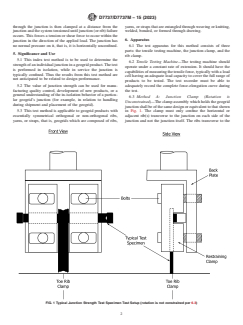
5.3 This test method is applicable to geogrid products with in Fig. 1. The clamp must only confine the horizontal or
essentially symmetrical orthogonal or non-orthogonal ribs, adjacent rib(s) transverse to the junction on each side of the
yarns, or straps, that is, geogrids which are composed of ribs, junction and not the junction itself. The ribs transverse to the
FIG. 1 Typical Junction Strength Test Specimen Test Setup (rotation is not constrained per 6.3)
D7737/D7737M − 15 (2023)
test direction should be placed horizontally level such that in the shape of a “T” with at least one junction remaining on
torsion is not applied to the junction. The clamp cannot hinder each side of the junction being tested. The direction of the test
or influence the junction. The two movable parts of the
shall be defined as a nominal angle (skew to the machine
restraining clamp should be adjustable to allow the bearing
direction), according to Fig. 4, where machine direction (MD)
surfaces to fit snugly without touching the junction of the
is defined as 0° and cross-machine direction (CMD) as 90°. See
geogrid product being tested. The clamp assembly should
Fig. 5 for illustrations of some geogrid test specimens. For
provide the appropriate clamping power to prevent slipping or
woven and knitted geogrids where nodes may unravel when
crushing (damage) of the horizontal rib. The entire clamp
cut, adjacent ribs can be cut away from the node as shown in
assembly is to be placed in the upper portion of the testing
Fig. 5(d) to minimize the effect of cutting on the structure of
machine.
the product. Fig. 5(e) shows the testing arrangement for
symmetrical, non-orthogonal ribs. The specimens should be cut
NOTE 1—These clamps are particularly well suited for homogeneous
extruded and woven geogrids with either essentially symmetrical orthogo-
to allow for the maximum amount of transverse rib on each
nal or non-orthogonal ribs and longitudinal ribs concentric with transverse
side of the junction to be tested. The center rib shall be long
ribs.
enough (typically a minimum of three bars or nodes) so as to
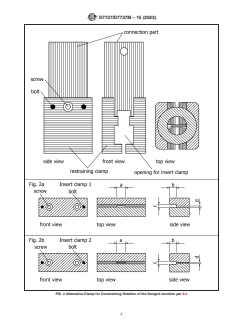
6.4 Method B: Junction Clamp (Rotation is Constrained)—
allow for enough clamping action within the rib clamp. The
The clamps according to Fig. 2 must only confine the horizon-
test specimens should be brought to standard test conditions of
tal or adjacent rib(s) transverse to the test direction on each side
temperatures 21 6 2 °C [70 6 4 °F] and tested under the same
of the junction and not the junction itself. The clamps should
conditions. Relative humidity is not an issue for this test
continuously su
...