

ASTM D8318-20
(Specification)Standard Specification for Low-Density Poly (Vinylidene Fluoride) Based Material Intended for Use in Wire and Cable Jacketing
General Information
- Abstract
SCOPE
1.1 This specification covers a low-density material based on poly (vinylidene fluoride) (PVDF), intended for use as jacketing material for wire and cable.
1.1.1 The material has a closed cell foam structure.
1.2 The jacketing material covered in this specification is intended for use in wires and cables in power-limited applications, such as optical fiber cables, communications cables, coaxial cables, or power limited fire alarm cables. The material is not intended for use in power cables.
1.3 The values stated in SI units are to be regarded as standard. The values given in parentheses are mathematical conversions to inch-pound units that are provided for information only and are not considered standard.
1.4 This standard does not purport to address all of the safety concerns, if any, associated with its use. It is the responsibility of the user of this standard to establish appropriate safety, health, and environmental practices and determine the applicability of regulatory limitations prior to use.
1.5 This international standard was developed in accordance with internationally recognized principles on standardization established in the Decision on Principles for the Development of International Standards, Guides and Recommendations issued by the World Trade Organization Technical Barriers to Trade (TBT) Committee.
- Status
- Published
- Publication Date
- 31-Jul-2020
- Technical Committee
- D09 - Electrical and Electronic Insulating Materials
- Drafting Committee
- D09.07 - Electrical Insulating Materials


Overview
ASTM D8318-20 is the standard specification developed by ASTM International for low-density poly (vinylidene fluoride) (PVDF) based materials designed for use in wire and cable jacketing. This standard outlines the requirements and test methods for closed cell foam PVDF materials intended specifically for power-limited applications such as optical fiber cables, communication cables, coaxial cables, and power-limited fire alarm cables. It is not intended for use in power cables.
This specification ensures that jacketing materials meet stringent physical, mechanical, electrical, and fire performance properties, providing reliable insulation and protection in demanding electrical applications.
Key Topics
- Low-Density PVDF Materials: The specification covers PVDF homopolymers and copolymers, with a focus on their suitability as closed cell foam structures for cable jackets.
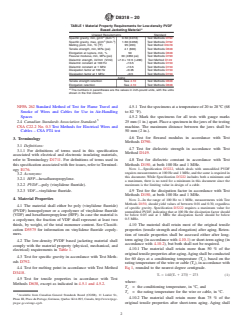
- Material Properties: Requirements are set for specific gravity, melting point, tensile strength, elongation at rupture, flexural modulus, dielectric strength, dielectric constant, and dissipation factor.
- Aging Performance: The material must retain a defined portion of its original tensile properties after both short-term and long-term aging, ensuring durability throughout the lifecycle of wire and cable products.
- Fire Safety Requirements: Includes material fire test requirements, such as flammability ratings, specific optical density of smoke, and radiant panel index, to ensure compliance with fire codes and safety regulations for cable materials.
- Test Methods: Includes referenced ASTM, UL, NFPA, and CSA test methods to evaluate compliance with mechanical, electrical, and flammability properties.
Applications
ASTM D8318-20 is applicable to the following wire and cable types in power-limited environments:
- Optical Fiber Cables: Provides insulation and environmental protection important for high-speed communication infrastructure.
- Communications and Coaxial Cables: Ensures electrical insulation and fire resistance, critical for data and signal transmission in buildings and industrial applications.
- Power-Limited Fire Alarm Cables: Enhances safety with low flammability and smoke generation properties, meeting regulatory fire performance requirements.
- Not for Power Cables: The material is not specified for high-power electrical cables due to its intended performance criteria.
Practical Benefits
- Enhanced Safety: Meets multiple fire resistance and smoke generation standards to comply with building and electrical safety codes.
- Reliable Performance: Maintains key mechanical and electrical properties even after prolonged aging and environmental exposure.
- Versatility: Can be used in various cable designs and for different power-limited applications.
- International Acceptance: Developed in accordance with internationally recognized standardization principles, supporting global trade and regulatory compliance.
Related Standards
ASTM D8318-20 references several important standards for testing and performance evaluation, including:
- ASTM D149 - Dielectric Breakdown Voltage and Dielectric Strength
- ASTM D150 - AC Loss Characteristics and Permittivity of Solid Electrical Insulation
- ASTM D638 - Tensile Properties of Plastics
- ASTM D790 - Flexural Properties of Plastics and Electrical Insulating Materials
- ASTM D792 - Density and Specific Gravity of Plastics
- ASTM D2633 - Thermoplastic Insulations and Jackets for Wire and Cable
- ASTM D3801 / UL 94 - Flammability of Plastic Materials
- UL 1581, UL 1666, UL 1685 - Fire and flammability tests for electrical wires and cables
- NFPA 70 (National Electrical Code), NFPA 262 - Electrical and fire safety standards
- CSA C22.2 - Canadian fire test standards for electrical wires and cables
Summary
ASTM D8318-20 provides a comprehensive specification for low-density PVDF-based jacketing materials, ensuring safety, performance, and durability in power-limited wire and cable applications. By adhering to this standard, manufacturers and users can achieve compliance with international safety regulations, reduce fire hazards, and ensure reliable operation of electrical systems in diverse environments.
Keywords: ASTM D8318-20, low-density PVDF, wire and cable jacketing, poly (vinylidene fluoride), electrical insulation, fire safety standards, cable materials, closed cell foam, communications cable insulation, cable flammability requirements.
Relations
- Effective Date
- 01-Mar-2024
- Effective Date
- 01-Jan-2024
- Effective Date
- 01-Jan-2020
- Effective Date
- 01-Dec-2019
- Effective Date
- 15-Jan-2019
- Effective Date
- 15-Dec-2018
- Effective Date
- 01-Dec-2018
- Effective Date
- 01-May-2018
- Effective Date
- 01-Mar-2018
- Effective Date
- 01-Jul-2017
- Effective Date
- 01-Jul-2017
- Effective Date
- 01-Feb-2017
- Effective Date
- 15-Dec-2015
- Effective Date
- 01-Dec-2015
- Effective Date
- 01-Dec-2015
Get Certified
Connect with accredited certification bodies for this standard

IMQ S.p.A. (Certification)
Italian electrical product certification.

SLG Prüf- und Zertifizierungs GmbH
German testing and certification body.

UL Solutions
Global safety science company with testing, inspection and certification.
Sponsored listings
Frequently Asked Questions
ASTM D8318-20 is a technical specification published by ASTM International. Its full title is "Standard Specification for Low-Density Poly (Vinylidene Fluoride) Based Material Intended for Use in Wire and Cable Jacketing". This standard covers: SCOPE 1.1 This specification covers a low-density material based on poly (vinylidene fluoride) (PVDF), intended for use as jacketing material for wire and cable. 1.1.1 The material has a closed cell foam structure. 1.2 The jacketing material covered in this specification is intended for use in wires and cables in power-limited applications, such as optical fiber cables, communications cables, coaxial cables, or power limited fire alarm cables. The material is not intended for use in power cables. 1.3 The values stated in SI units are to be regarded as standard. The values given in parentheses are mathematical conversions to inch-pound units that are provided for information only and are not considered standard. 1.4 This standard does not purport to address all of the safety concerns, if any, associated with its use. It is the responsibility of the user of this standard to establish appropriate safety, health, and environmental practices and determine the applicability of regulatory limitations prior to use. 1.5 This international standard was developed in accordance with internationally recognized principles on standardization established in the Decision on Principles for the Development of International Standards, Guides and Recommendations issued by the World Trade Organization Technical Barriers to Trade (TBT) Committee.
SCOPE 1.1 This specification covers a low-density material based on poly (vinylidene fluoride) (PVDF), intended for use as jacketing material for wire and cable. 1.1.1 The material has a closed cell foam structure. 1.2 The jacketing material covered in this specification is intended for use in wires and cables in power-limited applications, such as optical fiber cables, communications cables, coaxial cables, or power limited fire alarm cables. The material is not intended for use in power cables. 1.3 The values stated in SI units are to be regarded as standard. The values given in parentheses are mathematical conversions to inch-pound units that are provided for information only and are not considered standard. 1.4 This standard does not purport to address all of the safety concerns, if any, associated with its use. It is the responsibility of the user of this standard to establish appropriate safety, health, and environmental practices and determine the applicability of regulatory limitations prior to use. 1.5 This international standard was developed in accordance with internationally recognized principles on standardization established in the Decision on Principles for the Development of International Standards, Guides and Recommendations issued by the World Trade Organization Technical Barriers to Trade (TBT) Committee.
ASTM D8318-20 is classified under the following ICS (International Classification for Standards) categories: 29.035.20 - Plastics and rubber insulating materials. The ICS classification helps identify the subject area and facilitates finding related standards.
ASTM D8318-20 has the following relationships with other standards: It is inter standard links to ASTM D1711-24, ASTM E176-24, ASTM D149-20, ASTM D3801-19a, ASTM D3801-19, ASTM E176-18a, ASTM E662-18, ASTM D3222-18, ASTM E176-18, ASTM E662-17a, ASTM D790-17, ASTM E662-17, ASTM E162-15b, ASTM D790-15, ASTM D790-15e1. Understanding these relationships helps ensure you are using the most current and applicable version of the standard.
ASTM D8318-20 is available in PDF format for immediate download after purchase. The document can be added to your cart and obtained through the secure checkout process. Digital delivery ensures instant access to the complete standard document.
Standards Content (Sample)
This international standard was developed in accordance with internationally recognized principles on standardization established in the Decision on Principles for the
Development of International Standards, Guides and Recommendations issued by the World Trade Organization Technical Barriers to Trade (TBT) Committee.
Designation:D8318 −20
Standard Specification for
Low-Density Poly (Vinylidene Fluoride) Based Material
Intended for Use in Wire and Cable Jacketing
This standard is issued under the fixed designation D8318; the number immediately following the designation indicates the year of
original adoption or, in the case of revision, the year of last revision. A number in parentheses indicates the year of last reapproval. A
superscript epsilon (´) indicates an editorial change since the last revision or reapproval.
1. Scope tivity (Dielectric Constant) of Solid Electrical Insulation
D638 Test Method for Tensile Properties of Plastics
1.1 This specification covers a low-density material based
D790 Test Methods for Flexural Properties of Unreinforced
on poly (vinylidene fluoride) (PVDF), intended for use as
and Reinforced Plastics and Electrical Insulating Materi-
jacketing material for wire and cable.
als
1.1.1 The material has a closed cell foam structure.
D792 Test Methods for Density and Specific Gravity (Rela-
1.2 The jacketing material covered in this specification is
tive Density) of Plastics by Displacement
intended for use in wires and cables in power-limited
D1711 Terminology Relating to Electrical Insulation
applications, such as optical fiber cables, communications
D2633 Test Methods for Thermoplastic Insulations and
cables, coaxial cables, or power limited fire alarm cables. The
Jackets for Wire and Cable
material is not intended for use in power cables.
D3222 Specification for Unmodified Poly(Vinylidene Fluo-
ride) (PVDF) Molding Extrusion and Coating Materials
1.3 The values stated in SI units are to be regarded as
standard. The values given in parentheses are mathematical D3418 Test Method for Transition Temperatures and En-
thalpies of Fusion and Crystallization of Polymers by
conversions to inch-pound units that are provided for informa-
tion only and are not considered standard. Differential Scanning Calorimetry
D3801 TestMethodforMeasuringtheComparativeBurning
1.4 This standard does not purport to address all of the
Characteristics of Solid Plastics in a Vertical Position
safety concerns, if any, associated with its use. It is the
D5575 Classification System for Copolymers of Vinylidene
responsibility of the user of this standard to establish appro-
Fluoride (VDF) with Other Fluorinated Monomers
priate safety, health, and environmental practices and deter-
E162 Test Method for Surface Flammability of Materials
mine the applicability of regulatory limitations prior to use.
Using a Radiant Heat Energy Source
1.5 This international standard was developed in accor-
E176 Terminology of Fire Standards
dance with internationally recognized principles on standard-
E662 Test Method for Specific Optical Density of Smoke
ization established in the Decision on Principles for the
Generated by Solid Materials
Development of International Standards, Guides and Recom-
2.2 UL Standards:
mendations issued by the World Trade Organization Technical
Barriers to Trade (TBT) Committee. UL 94 Standard for Tests for Flammability of Plastic Mate-
rials for Parts in Devices and Appliances
2. Referenced Documents UL 1581 Reference Standard for Electrical Wires, Cables
2 and Flexible Cords
2.1 ASTM Standards:
UL 1666 Standard Test for Flame Propagation Height of
D149 Test Method for Dielectric Breakdown Voltage and
Electrical and Optical-Fiber Cable Installed Vertically in
DielectricStrengthofSolidElectricalInsulatingMaterials
Shafts
at Commercial Power Frequencies
UL 1685 Standard for Safety for Vertical-Tray Fire-
D150 Test Methods forAC Loss Characteristics and Permit-
Propagation and Smoke-Release Test for Electrical and
Optical-Fiber Cables
1 2.3 NFPA Standards:
This specification is under the jurisdiction of ASTM Committee D09 on
Electrical and Electronic Insulating Materials and is the direct responsibility of
NFPA 70 National Electrical Code
Subcommittee D09.07 on Electrical Insulating Materials.
Current edition approved Aug. 1, 2020. Published September 2020. DOI:
10.1520/D8318-20.
2 3
For referenced ASTM standards, visit the ASTM website, www.astm.org, or Available from Underwriters Laboratories (UL), 2600 N.W. Lake Rd., Camas,
contact ASTM Customer Service at service@astm.org. For Annual Book of ASTM WA 98607-8542, http://www.ul.com.
Standards volume information, refer to the standard’s Document Summary page on Available from National Fire Protection Association (NFPA), 1 Batterymarch
the ASTM website. Park, Quincy, MA 02169-7471, http://www.nfpa.org.
Copyright © ASTM International, 100 Barr Harbor Drive, PO Box C700, West Conshohocken, PA 19428-2959. United States
D8318−20
TABLE 1 Material Property Requirements for Low-density PVDF
A
Based Jacketing Material
Unaged Requirements Standard
3 3
Specific gravity, min, g/cm (lb/in. ) 0.50 (0.018) Test Methods D792
3 3
Specific gravity, max, g/cm (lb/in. ) 1.60 (0.058) Test Methods D792
Melting point, min, ºC (ºF) 95 (203) Test Method D3418
Tensile strength, min, MPa (psi) 4.1 (600) Test Methods D638
Elongation at rupture, min, % 50 Test Methods D638
Flexural modulus, min, MPa (psi) 30 (4350 psi) Test Methods D790
Dielectric strength, kV/mm (V/mil) >7.9 × 10 6 (>200) Test Method D149
Dielectric constant at 100 Hz <13.5 Test Methods D150
Dielectric constant at 1 MHz <13.5 Test Methods D150
Dissipation factor at 100 Hz <0.05 Test Methods D150
Dissipation factor at 1 MHz <0.5 Test Methods D150
Aging
Tensile strength retention See 4.10 Test Methods D638
Elongation retention See 4.10 Test Methods D638
A
The numbers in parentheses are the values in inch-pound units, with the units
shown in the first column.
NFPA 262 Standard Method of Test for Flame Travel and 4.5.1 Test the specimens at a temperature of 20 to 28 ºC (68
Smoke of Wires and Cables for Use in Air-Handling to 82 °F).
Spaces 4.5.2 Mark the specimens for all tests with gauge marks
2.4 Canadian Standards Association Standard: 25 mm (1 in.) apart. Place a specimen in the jaws of the testing
CSA C22.2 No. 0.3 Test Methods for Electrical Wires and machine. The maximum distance between the jaws shall be
Cables – CSA FT4 test 50 mm (2 in.).
4.6 Test for flexural modulus in accordance with Test
3. Terminology
Methods D790.
3.1 Definitions:
4.7 Test for dielectric strength in accordance with Test
3.1.1 For definitions of terms used in this specification
Method D149.
associated with electrical and electronic insulating materials,
4.8 Test for dielectric constant in accordance with Test
refer to Terminology D1711. For definitions of terms used in
Methods D150, at both 100 Hz and 1 MHz.
this specification associated with fire issues, refer to Terminol-
NOTE 1—Spec
...